BSBDIV601 Develop and Implement Diversity Policy: A Detailed Report

Verified

Added on  2023/03/21

|8
|2062
|69
Report
AI Summary
This report provides a comprehensive analysis of developing and implementing a diversity policy within an organization. It outlines the benefits of diversity, including increased productivity, improved creativity, and higher profits, linking these to core business objectives. The report examines diversity policies from various organizations, emphasizing fairness, inclusivity, and legal compliance. It details the impact of implementing such policies, such as reducing cultural differences, increasing employee involvement, and fostering a supportive work environment. Key business operations linked to diversity, including business planning, management, process improvement, and succession planning, are discussed. The report also explores different types of diversity within a business environment, contemporary diversity theory, and relevant legislation like the Equality Act 2010, providing a thorough overview for effective diversity management.
Document Page
Develop and implement diversity policy 0
Develop and implement diversity policy
System04116
6/1/2019
tabler-icon-diamond-filled.svg

Paraphrase This Document

Need a fresh take? Get an instant paraphrase of this document with our AI Paraphraser
Document Page
Develop and implement diversity policy 1
Question 1
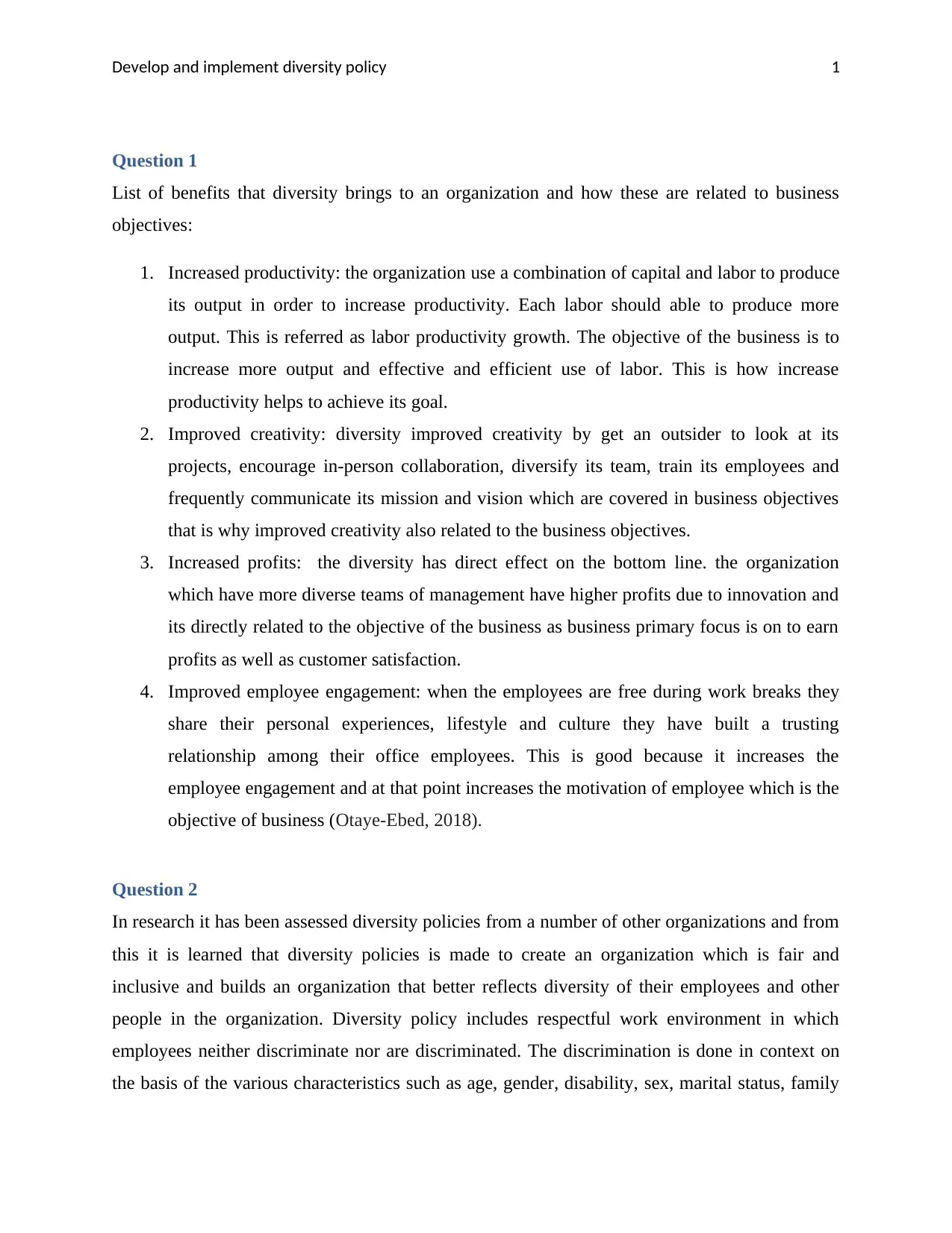
List of benefits that diversity brings to an organization and how these are related to business
objectives:
1. Increased productivity: the organization use a combination of capital and labor to produce
its output in order to increase productivity. Each labor should able to produce more
output. This is referred as labor productivity growth. The objective of the business is to
increase more output and effective and efficient use of labor. This is how increase
productivity helps to achieve its goal.
2. Improved creativity: diversity improved creativity by get an outsider to look at its
projects, encourage in-person collaboration, diversify its team, train its employees and
frequently communicate its mission and vision which are covered in business objectives
that is why improved creativity also related to the business objectives.
3. Increased profits: the diversity has direct effect on the bottom line. the organization
which have more diverse teams of management have higher profits due to innovation and
its directly related to the objective of the business as business primary focus is on to earn
profits as well as customer satisfaction.
4. Improved employee engagement: when the employees are free during work breaks they
share their personal experiences, lifestyle and culture they have built a trusting
relationship among their office employees. This is good because it increases the
employee engagement and at that point increases the motivation of employee which is the
objective of business (Otaye-Ebed, 2018).
Question 2
In research it has been assessed diversity policies from a number of other organizations and from
this it is learned that diversity policies is made to create an organization which is fair and
inclusive and builds an organization that better reflects diversity of their employees and other
people in the organization. Diversity policy includes respectful work environment in which
employees neither discriminate nor are discriminated. The discrimination is done in context on
the basis of the various characteristics such as age, gender, disability, sex, marital status, family
Document Page
Develop and implement diversity policy 2
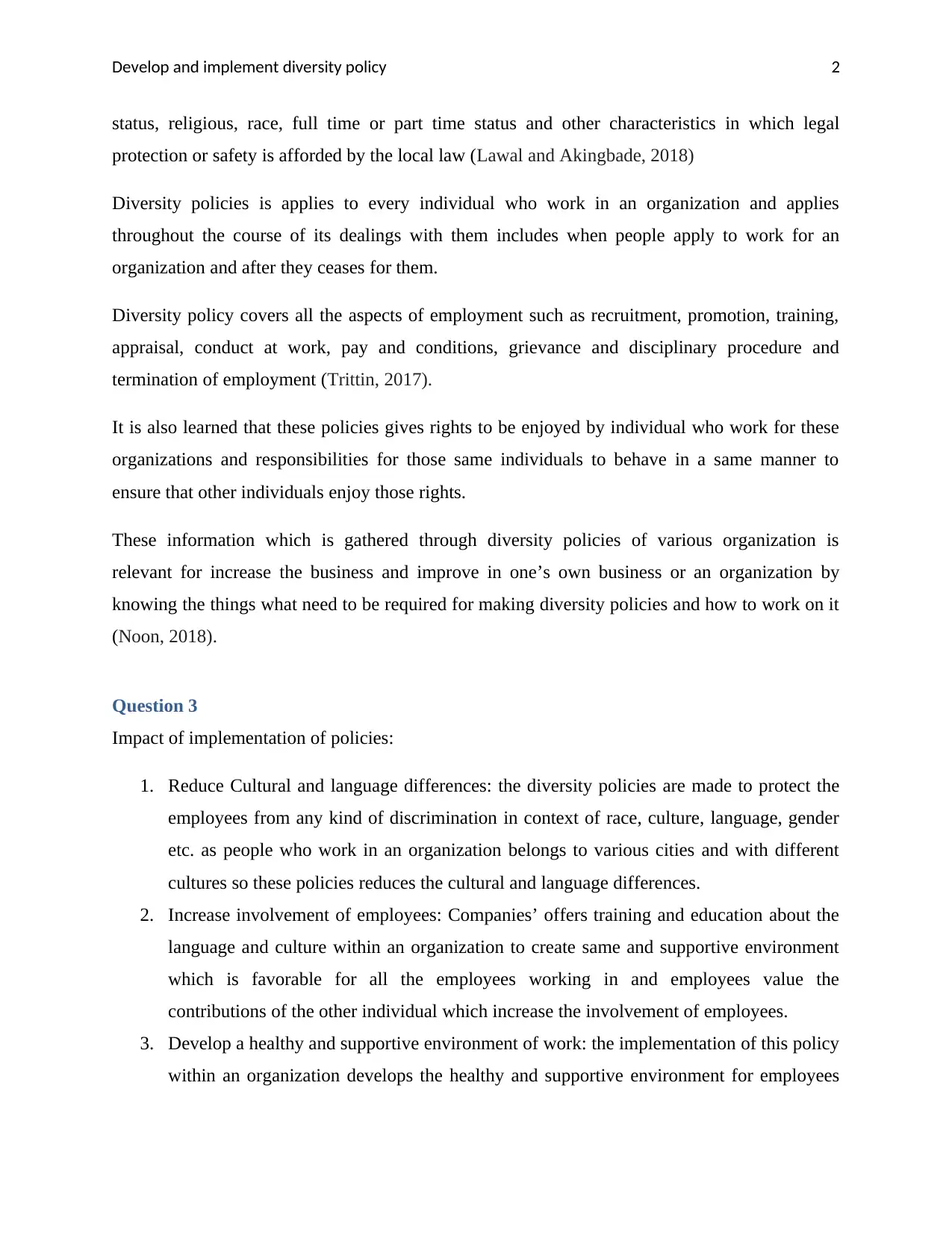
status, religious, race, full time or part time status and other characteristics in which legal
protection or safety is afforded by the local law (Lawal and Akingbade, 2018)
Diversity policies is applies to every individual who work in an organization and applies
throughout the course of its dealings with them includes when people apply to work for an
organization and after they ceases for them.
Diversity policy covers all the aspects of employment such as recruitment, promotion, training,
appraisal, conduct at work, pay and conditions, grievance and disciplinary procedure and
termination of employment (Trittin, 2017).
It is also learned that these policies gives rights to be enjoyed by individual who work for these
organizations and responsibilities for those same individuals to behave in a same manner to
ensure that other individuals enjoy those rights.
These information which is gathered through diversity policies of various organization is
relevant for increase the business and improve in one’s own business or an organization by
knowing the things what need to be required for making diversity policies and how to work on it
(Noon, 2018).
Question 3
Impact of implementation of policies:
1. Reduce Cultural and language differences: the diversity policies are made to protect the
employees from any kind of discrimination in context of race, culture, language, gender
etc. as people who work in an organization belongs to various cities and with different
cultures so these policies reduces the cultural and language differences.
2. Increase involvement of employees: Companies’ offers training and education about the
language and culture within an organization to create same and supportive environment
which is favorable for all the employees working in and employees value the
contributions of the other individual which increase the involvement of employees.
3. Develop a healthy and supportive environment of work: the implementation of this policy
within an organization develops the healthy and supportive environment for employees
Document Page
Develop and implement diversity policy 3
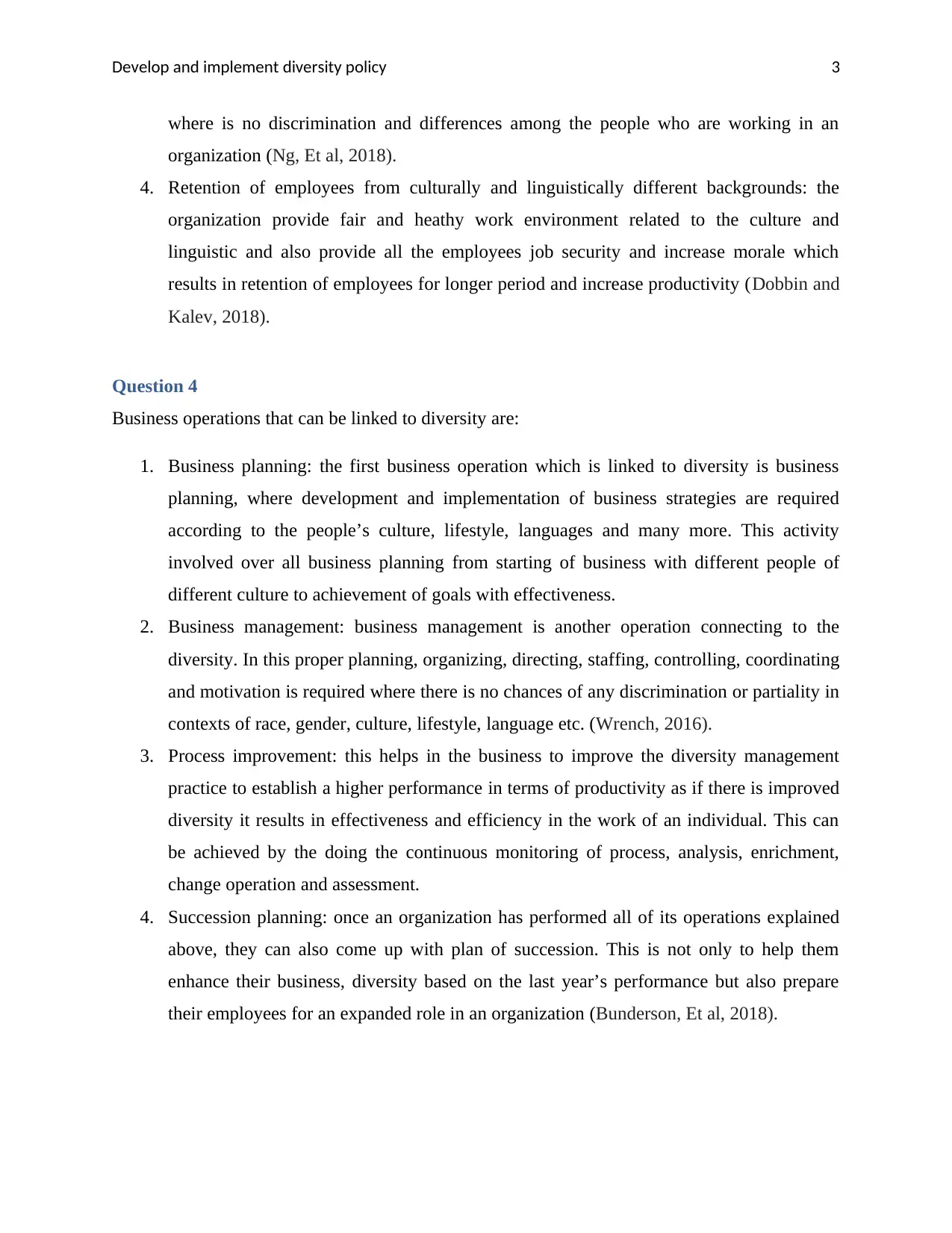
where is no discrimination and differences among the people who are working in an
organization (Ng, Et al, 2018).
4. Retention of employees from culturally and linguistically different backgrounds: the
organization provide fair and heathy work environment related to the culture and
linguistic and also provide all the employees job security and increase morale which
results in retention of employees for longer period and increase productivity (Dobbin and
Kalev, 2018).
Question 4
Business operations that can be linked to diversity are:
1. Business planning: the first business operation which is linked to diversity is business
planning, where development and implementation of business strategies are required
according to the people’s culture, lifestyle, languages and many more. This activity
involved over all business planning from starting of business with different people of
different culture to achievement of goals with effectiveness.
2. Business management: business management is another operation connecting to the
diversity. In this proper planning, organizing, directing, staffing, controlling, coordinating
and motivation is required where there is no chances of any discrimination or partiality in
contexts of race, gender, culture, lifestyle, language etc. (Wrench, 2016).
3. Process improvement: this helps in the business to improve the diversity management
practice to establish a higher performance in terms of productivity as if there is improved
diversity it results in effectiveness and efficiency in the work of an individual. This can
be achieved by the doing the continuous monitoring of process, analysis, enrichment,
change operation and assessment.
4. Succession planning: once an organization has performed all of its operations explained
above, they can also come up with plan of succession. This is not only to help them
enhance their business, diversity based on the last year’s performance but also prepare
their employees for an expanded role in an organization (Bunderson, Et al, 2018).
tabler-icon-diamond-filled.svg

Paraphrase This Document

Need a fresh take? Get an instant paraphrase of this document with our AI Paraphraser
Document Page
Develop and implement diversity policy 4
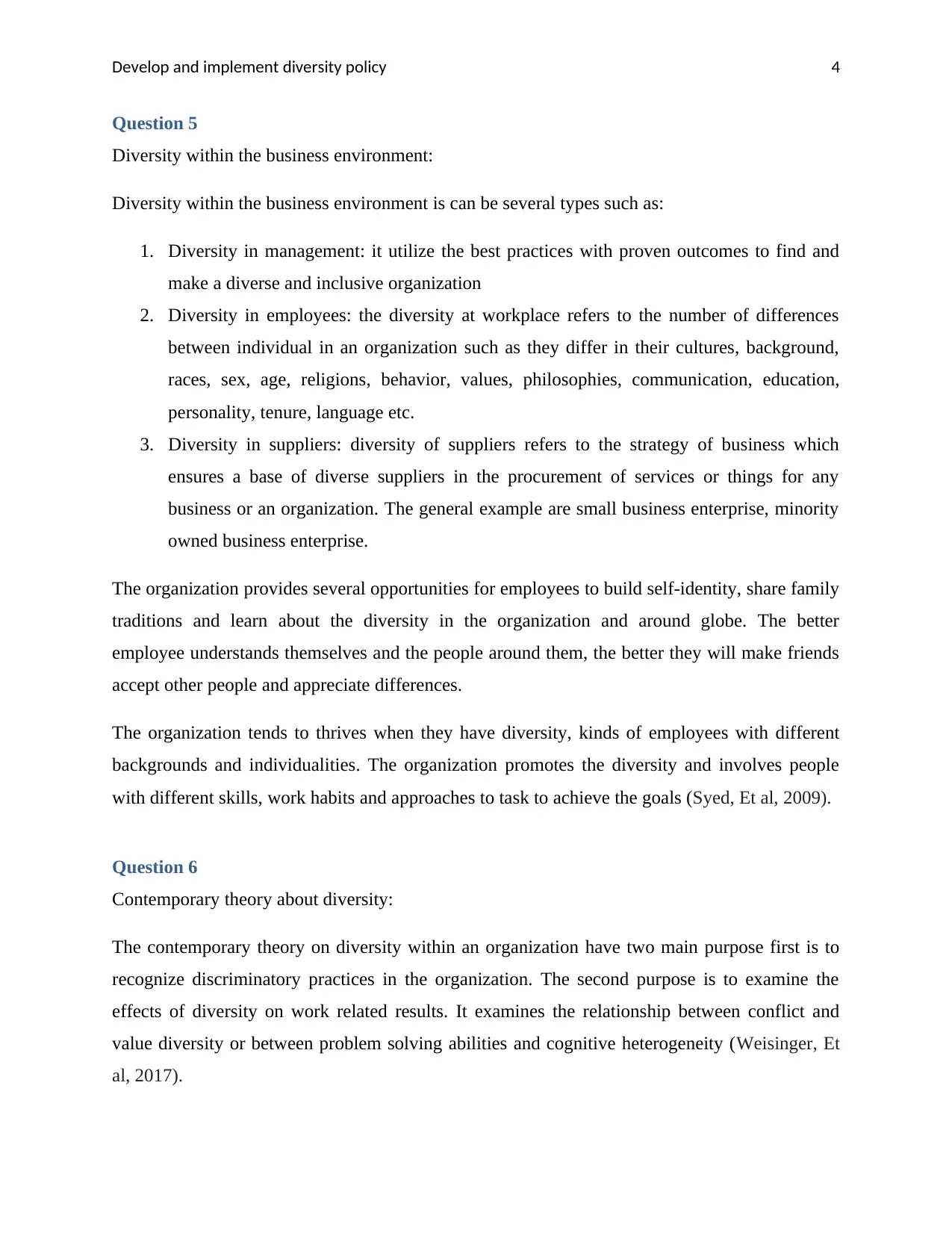
Question 5
Diversity within the business environment:
Diversity within the business environment is can be several types such as:
1. Diversity in management: it utilize the best practices with proven outcomes to find and
make a diverse and inclusive organization
2. Diversity in employees: the diversity at workplace refers to the number of differences
between individual in an organization such as they differ in their cultures, background,
races, sex, age, religions, behavior, values, philosophies, communication, education,
personality, tenure, language etc.
3. Diversity in suppliers: diversity of suppliers refers to the strategy of business which
ensures a base of diverse suppliers in the procurement of services or things for any
business or an organization. The general example are small business enterprise, minority
owned business enterprise.
The organization provides several opportunities for employees to build self-identity, share family
traditions and learn about the diversity in the organization and around globe. The better
employee understands themselves and the people around them, the better they will make friends
accept other people and appreciate differences.
The organization tends to thrives when they have diversity, kinds of employees with different
backgrounds and individualities. The organization promotes the diversity and involves people
with different skills, work habits and approaches to task to achieve the goals (Syed, Et al, 2009).
Question 6
Contemporary theory about diversity:
The contemporary theory on diversity within an organization have two main purpose first is to
recognize discriminatory practices in the organization. The second purpose is to examine the
effects of diversity on work related results. It examines the relationship between conflict and
value diversity or between problem solving abilities and cognitive heterogeneity (Weisinger, Et
al, 2017).
Document Page
Develop and implement diversity policy 5
Its potential contribution to business advantage:
1. The utilization of diversity theory within an organization increases the level of awareness
of diversity from positive actions.
2. The talents of diverse workforce are utilized to gain the competitive advantage in
managing the diversity (Park, Et al, 2019).
Question 7
The legislation which an organization applies for the development of diversity policy is Equality
Act 2010. It is the legislation which surrounding the subjects of equality and diversity to
safeguards the rights of people and advance equality of opportunity for all employees.
The code of practice sets diversity at the heart of the BBC’s commissioning courses and
reporting framework across TV, radio and online digital content. The diversity commissioning
code of practice is applied to an organization which is the part of the BBC’s commitment to
enhance the diversity on and off air to represent and reflect the organization.
The ACRL national standards for develop the diversity policy is committed to diversity of people
and ideas. It reflects the sectors they serve and provide their quality services to their increasingly
different constituencies (Riccucci, 2018).
Document Page
Develop and implement diversity policy 6
References
Bunderson, J.S. and Van der Vegt, G.S. (2018) Diversity and inequality in management teams: A
review and integration of research on vertical and horizontal member differences. Annual Review
of Organizational Psychology and Organizational Behavior, 5, pp.47-73.
Dobbin, F. and Kalev, A. (2018) Why Doesn't Diversity Training Work? The Challenge for
Industry and Academia. Anthropology Now, 10(2), pp.48-55.
Lawal, A.A. and Akingbade, W.A. (2018) Diversity Management and Organizational
Performance of Small and Medium Enterprises: Lagos State, Nigeria. Journal of Knowledge
Globalization, 10(1).
Ng, E.S. and Sears, G.J. (2018) Walking the Talk on Diversity: CEO Beliefs, Moral Values, and
the Implementation of Workplace Diversity Practices. Journal of Business Ethics, pp.1-14.
Noon, M. (2018) Pointless diversity training: unconscious bias, new racism and agency. Work,
employment and society, 32(1), pp.198-209.
Otaye-Ebede, L. (2018) Employees’ perception of diversity management practices: scale
development and validation. European Journal of Work and Organizational Psychology, 27(4),
pp.462-476.
Park, S. and Liang, J. (2019) Merit, Diversity, and Performance: Does Diversity Management
Moderate the Effect of Merit Principles on Governmental Performance?. Public Personnel
Management, p.0091026019848459.
Riccucci, N. (2018) Managing Diversity In Public Sector Workforces: Essentials Of Public
Policy And Administration Series. UK: Routledge.
Syed, J. and Özbilgin, M. (2009) A relational framework for international transfer of diversity
management practices. The International Journal of Human Resource Management, 20(12),
pp.2435-2453.
tabler-icon-diamond-filled.svg

Paraphrase This Document

Need a fresh take? Get an instant paraphrase of this document with our AI Paraphraser
Document Page
Develop and implement diversity policy 7
Trittin, H. and Schoeneborn, D. (2017) Diversity as polyphony: Reconceptualizing diversity
management from a communication-centered perspective. Journal of Business Ethics, 144(2),
pp.305-322.
Weisinger, J., Sowa, J.E. and Word, J. (2017) Diversity and diversity management in nonprofit
organizations. The nonprofit human resource management handbook: From theory to practice,
pp.323-338.
Wrench, J. (2016) Diversity management and discrimination: Immigrants and ethnic minorities
in the EU. UK: Routledge.
chevron_up_icon
1 out of 8
circle_padding
hide_on_mobile
zoom_out_icon
[object Object]