BSBFIM601 Manage Finances: Budgeting, Forecasting, Reporting, Analysis
VerifiedAdded on 2023/06/18
|55
|16091
|459
Homework Assignment
AI Summary
This assignment for BSBFIM601 Manage Finances consists of two main parts: research questions and a case study. The research questions require students to explore and explain various aspects of financial management, including obligations under the Corporations Act 2001 and relevant Australian and international legislation. The case study involves budgeting, financial forecasting, reporting, and resource allocation for a simulated business, divided into two stages. Stage one focuses on preparing budgets, analyzing financial data, and identifying discrepancies. Stage two requires students to analyze these discrepancies, produce a report accounting for variations, and participate in a role-play scenario discussing the company's financial situation and making recommendations. The assignment expects students to use appropriate financial management software and reference their sources correctly.

ASSESSMENT GUIDE
Student
BSBFIM601 Manage finances
Student
BSBFIM601 Manage finances

Paraphrase This Document
Need a fresh take? Get an instant paraphrase of this document with our AI Paraphraser
BSBFIM601 Manage finances
ASSESSMENT
BSBFIM601 Manage finances
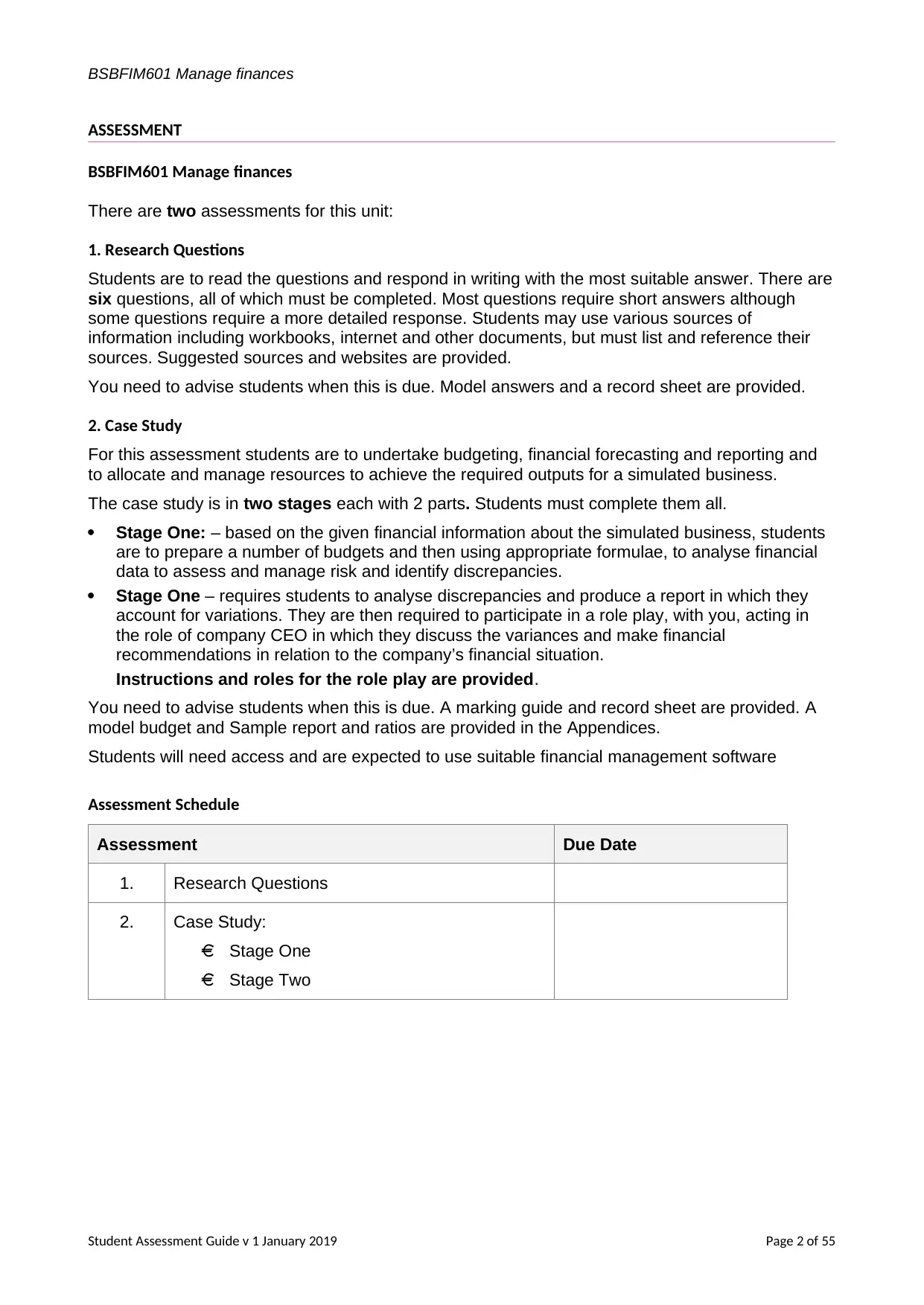
There are two assessments for this unit:
1. Research Questions
Students are to read the questions and respond in writing with the most suitable answer. There are
six questions, all of which must be completed. Most questions require short answers although
some questions require a more detailed response. Students may use various sources of
information including workbooks, internet and other documents, but must list and reference their
sources. Suggested sources and websites are provided.
You need to advise students when this is due. Model answers and a record sheet are provided.
2. Case Study
For this assessment students are to undertake budgeting, financial forecasting and reporting and
to allocate and manage resources to achieve the required outputs for a simulated business.
The case study is in two stages each with 2 parts. Students must complete them all.
Stage One: – based on the given financial information about the simulated business, students
are to prepare a number of budgets and then using appropriate formulae, to analyse financial
data to assess and manage risk and identify discrepancies.
Stage One – requires students to analyse discrepancies and produce a report in which they
account for variations. They are then required to participate in a role play, with you, acting in
the role of company CEO in which they discuss the variances and make financial
recommendations in relation to the company’s financial situation.
Instructions and roles for the role play are provided.
You need to advise students when this is due. A marking guide and record sheet are provided. A
model budget and Sample report and ratios are provided in the Appendices.
Students will need access and are expected to use suitable financial management software
Assessment Schedule
Assessment Due Date
1. Research Questions
2. Case Study:
Stage One
Stage Two
Student Assessment Guide v 1 January 2019 Page 2 of 55
ASSESSMENT
BSBFIM601 Manage finances
There are two assessments for this unit:
1. Research Questions
Students are to read the questions and respond in writing with the most suitable answer. There are
six questions, all of which must be completed. Most questions require short answers although
some questions require a more detailed response. Students may use various sources of
information including workbooks, internet and other documents, but must list and reference their
sources. Suggested sources and websites are provided.
You need to advise students when this is due. Model answers and a record sheet are provided.
2. Case Study
For this assessment students are to undertake budgeting, financial forecasting and reporting and
to allocate and manage resources to achieve the required outputs for a simulated business.
The case study is in two stages each with 2 parts. Students must complete them all.
Stage One: – based on the given financial information about the simulated business, students
are to prepare a number of budgets and then using appropriate formulae, to analyse financial
data to assess and manage risk and identify discrepancies.
Stage One – requires students to analyse discrepancies and produce a report in which they
account for variations. They are then required to participate in a role play, with you, acting in
the role of company CEO in which they discuss the variances and make financial
recommendations in relation to the company’s financial situation.
Instructions and roles for the role play are provided.
You need to advise students when this is due. A marking guide and record sheet are provided. A
model budget and Sample report and ratios are provided in the Appendices.
Students will need access and are expected to use suitable financial management software
Assessment Schedule
Assessment Due Date
1. Research Questions
2. Case Study:
Stage One
Stage Two
Student Assessment Guide v 1 January 2019 Page 2 of 55
BSBFIM601 Manage finances
INFORMATION FOR STUDENTS
General Assessment Information
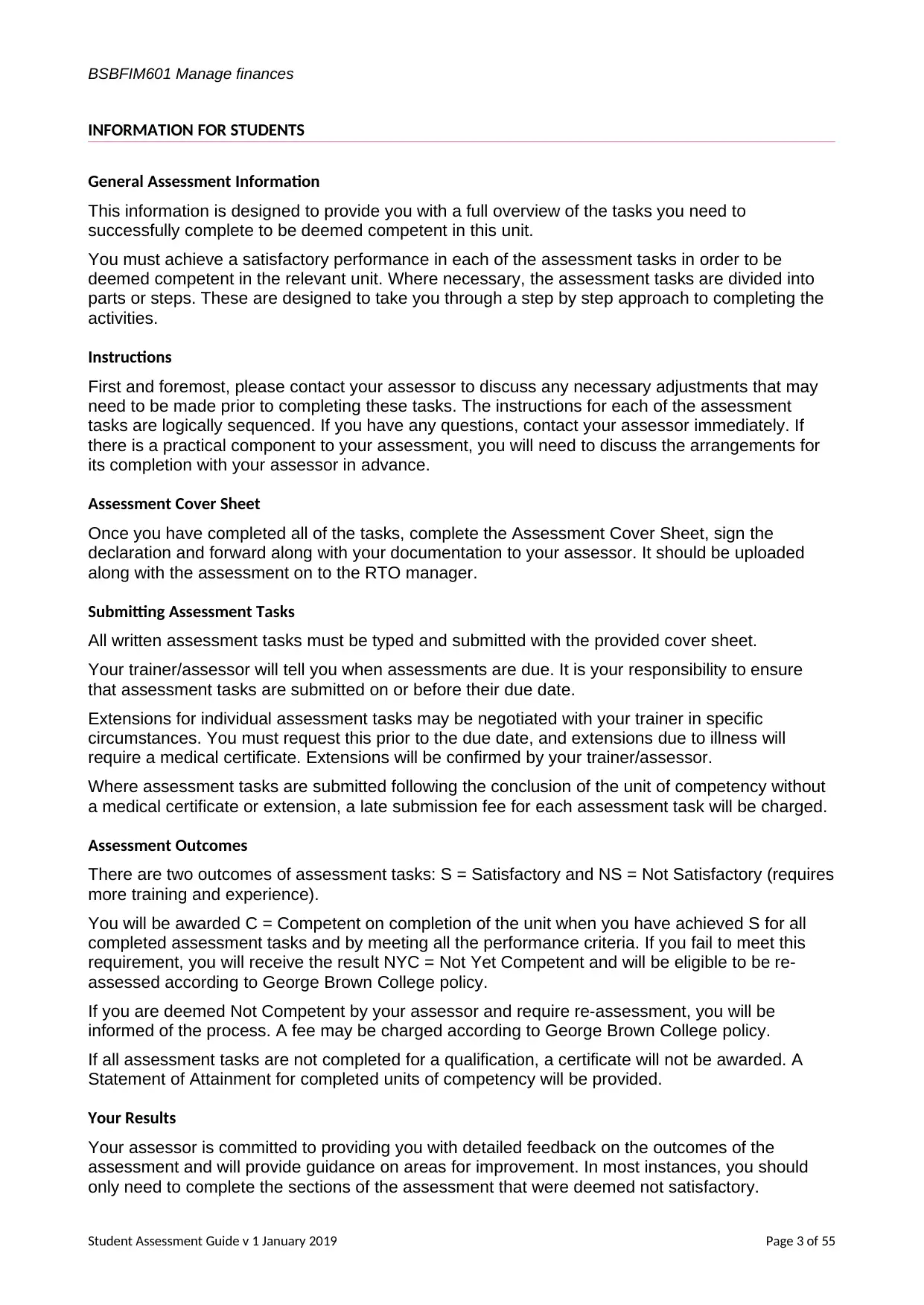
This information is designed to provide you with a full overview of the tasks you need to
successfully complete to be deemed competent in this unit.
You must achieve a satisfactory performance in each of the assessment tasks in order to be
deemed competent in the relevant unit. Where necessary, the assessment tasks are divided into
parts or steps. These are designed to take you through a step by step approach to completing the
activities.
Instructions
First and foremost, please contact your assessor to discuss any necessary adjustments that may
need to be made prior to completing these tasks. The instructions for each of the assessment
tasks are logically sequenced. If you have any questions, contact your assessor immediately. If
there is a practical component to your assessment, you will need to discuss the arrangements for
its completion with your assessor in advance.
Assessment Cover Sheet
Once you have completed all of the tasks, complete the Assessment Cover Sheet, sign the
declaration and forward along with your documentation to your assessor. It should be uploaded
along with the assessment on to the RTO manager.
Submitting Assessment Tasks
All written assessment tasks must be typed and submitted with the provided cover sheet.
Your trainer/assessor will tell you when assessments are due. It is your responsibility to ensure
that assessment tasks are submitted on or before their due date.
Extensions for individual assessment tasks may be negotiated with your trainer in specific
circumstances. You must request this prior to the due date, and extensions due to illness will
require a medical certificate. Extensions will be confirmed by your trainer/assessor.
Where assessment tasks are submitted following the conclusion of the unit of competency without
a medical certificate or extension, a late submission fee for each assessment task will be charged.
Assessment Outcomes
There are two outcomes of assessment tasks: S = Satisfactory and NS = Not Satisfactory (requires
more training and experience).
You will be awarded C = Competent on completion of the unit when you have achieved S for all
completed assessment tasks and by meeting all the performance criteria. If you fail to meet this
requirement, you will receive the result NYC = Not Yet Competent and will be eligible to be re-
assessed according to George Brown College policy.
If you are deemed Not Competent by your assessor and require re-assessment, you will be
informed of the process. A fee may be charged according to George Brown College policy.
If all assessment tasks are not completed for a qualification, a certificate will not be awarded. A
Statement of Attainment for completed units of competency will be provided.
Your Results
Your assessor is committed to providing you with detailed feedback on the outcomes of the
assessment and will provide guidance on areas for improvement. In most instances, you should
only need to complete the sections of the assessment that were deemed not satisfactory.
Student Assessment Guide v 1 January 2019 Page 3 of 55
INFORMATION FOR STUDENTS
General Assessment Information
This information is designed to provide you with a full overview of the tasks you need to
successfully complete to be deemed competent in this unit.
You must achieve a satisfactory performance in each of the assessment tasks in order to be
deemed competent in the relevant unit. Where necessary, the assessment tasks are divided into
parts or steps. These are designed to take you through a step by step approach to completing the
activities.
Instructions
First and foremost, please contact your assessor to discuss any necessary adjustments that may
need to be made prior to completing these tasks. The instructions for each of the assessment
tasks are logically sequenced. If you have any questions, contact your assessor immediately. If
there is a practical component to your assessment, you will need to discuss the arrangements for
its completion with your assessor in advance.
Assessment Cover Sheet
Once you have completed all of the tasks, complete the Assessment Cover Sheet, sign the
declaration and forward along with your documentation to your assessor. It should be uploaded
along with the assessment on to the RTO manager.
Submitting Assessment Tasks
All written assessment tasks must be typed and submitted with the provided cover sheet.
Your trainer/assessor will tell you when assessments are due. It is your responsibility to ensure
that assessment tasks are submitted on or before their due date.
Extensions for individual assessment tasks may be negotiated with your trainer in specific
circumstances. You must request this prior to the due date, and extensions due to illness will
require a medical certificate. Extensions will be confirmed by your trainer/assessor.
Where assessment tasks are submitted following the conclusion of the unit of competency without
a medical certificate or extension, a late submission fee for each assessment task will be charged.
Assessment Outcomes
There are two outcomes of assessment tasks: S = Satisfactory and NS = Not Satisfactory (requires
more training and experience).
You will be awarded C = Competent on completion of the unit when you have achieved S for all
completed assessment tasks and by meeting all the performance criteria. If you fail to meet this
requirement, you will receive the result NYC = Not Yet Competent and will be eligible to be re-
assessed according to George Brown College policy.
If you are deemed Not Competent by your assessor and require re-assessment, you will be
informed of the process. A fee may be charged according to George Brown College policy.
If all assessment tasks are not completed for a qualification, a certificate will not be awarded. A
Statement of Attainment for completed units of competency will be provided.
Your Results
Your assessor is committed to providing you with detailed feedback on the outcomes of the
assessment and will provide guidance on areas for improvement. In most instances, you should
only need to complete the sections of the assessment that were deemed not satisfactory.
Student Assessment Guide v 1 January 2019 Page 3 of 55
⊘ This is a preview!⊘
Do you want full access?
Subscribe today to unlock all pages.

Trusted by 1+ million students worldwide
BSBFIM601 Manage finances
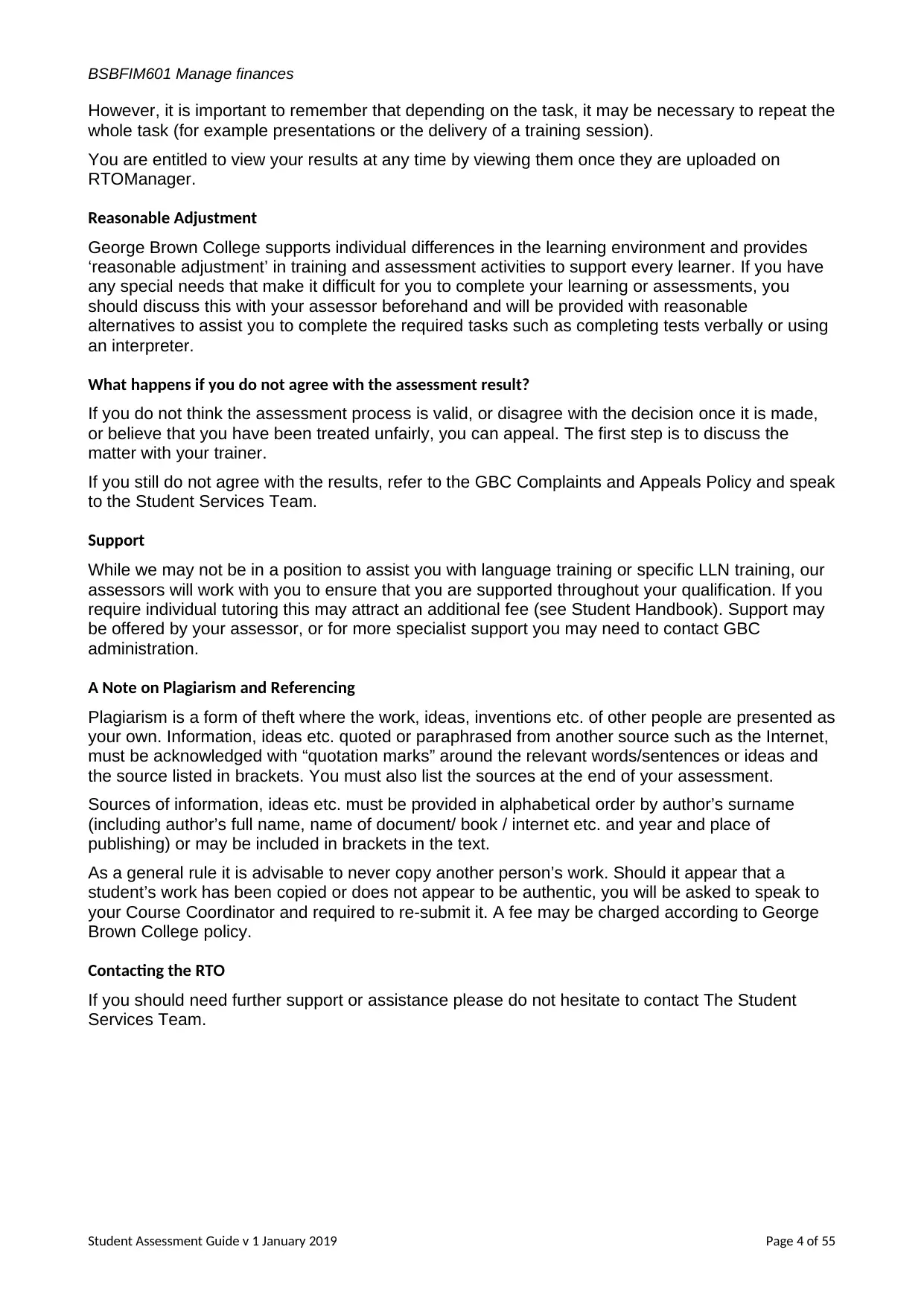
However, it is important to remember that depending on the task, it may be necessary to repeat the
whole task (for example presentations or the delivery of a training session).
You are entitled to view your results at any time by viewing them once they are uploaded on
RTOManager.
Reasonable Adjustment
George Brown College supports individual differences in the learning environment and provides
‘reasonable adjustment’ in training and assessment activities to support every learner. If you have
any special needs that make it difficult for you to complete your learning or assessments, you
should discuss this with your assessor beforehand and will be provided with reasonable
alternatives to assist you to complete the required tasks such as completing tests verbally or using
an interpreter.
What happens if you do not agree with the assessment result?
If you do not think the assessment process is valid, or disagree with the decision once it is made,
or believe that you have been treated unfairly, you can appeal. The first step is to discuss the
matter with your trainer.
If you still do not agree with the results, refer to the GBC Complaints and Appeals Policy and speak
to the Student Services Team.
Support
While we may not be in a position to assist you with language training or specific LLN training, our
assessors will work with you to ensure that you are supported throughout your qualification. If you
require individual tutoring this may attract an additional fee (see Student Handbook). Support may
be offered by your assessor, or for more specialist support you may need to contact GBC
administration.
A Note on Plagiarism and Referencing
Plagiarism is a form of theft where the work, ideas, inventions etc. of other people are presented as
your own. Information, ideas etc. quoted or paraphrased from another source such as the Internet,
must be acknowledged with “quotation marks” around the relevant words/sentences or ideas and
the source listed in brackets. You must also list the sources at the end of your assessment.
Sources of information, ideas etc. must be provided in alphabetical order by author’s surname
(including author’s full name, name of document/ book / internet etc. and year and place of
publishing) or may be included in brackets in the text.
As a general rule it is advisable to never copy another person’s work. Should it appear that a
student’s work has been copied or does not appear to be authentic, you will be asked to speak to
your Course Coordinator and required to re-submit it. A fee may be charged according to George
Brown College policy.
Contacting the RTO
If you should need further support or assistance please do not hesitate to contact The Student
Services Team.
Student Assessment Guide v 1 January 2019 Page 4 of 55
However, it is important to remember that depending on the task, it may be necessary to repeat the
whole task (for example presentations or the delivery of a training session).
You are entitled to view your results at any time by viewing them once they are uploaded on
RTOManager.
Reasonable Adjustment
George Brown College supports individual differences in the learning environment and provides
‘reasonable adjustment’ in training and assessment activities to support every learner. If you have
any special needs that make it difficult for you to complete your learning or assessments, you
should discuss this with your assessor beforehand and will be provided with reasonable
alternatives to assist you to complete the required tasks such as completing tests verbally or using
an interpreter.
What happens if you do not agree with the assessment result?
If you do not think the assessment process is valid, or disagree with the decision once it is made,
or believe that you have been treated unfairly, you can appeal. The first step is to discuss the
matter with your trainer.
If you still do not agree with the results, refer to the GBC Complaints and Appeals Policy and speak
to the Student Services Team.
Support
While we may not be in a position to assist you with language training or specific LLN training, our
assessors will work with you to ensure that you are supported throughout your qualification. If you
require individual tutoring this may attract an additional fee (see Student Handbook). Support may
be offered by your assessor, or for more specialist support you may need to contact GBC
administration.
A Note on Plagiarism and Referencing
Plagiarism is a form of theft where the work, ideas, inventions etc. of other people are presented as
your own. Information, ideas etc. quoted or paraphrased from another source such as the Internet,
must be acknowledged with “quotation marks” around the relevant words/sentences or ideas and
the source listed in brackets. You must also list the sources at the end of your assessment.
Sources of information, ideas etc. must be provided in alphabetical order by author’s surname
(including author’s full name, name of document/ book / internet etc. and year and place of
publishing) or may be included in brackets in the text.
As a general rule it is advisable to never copy another person’s work. Should it appear that a
student’s work has been copied or does not appear to be authentic, you will be asked to speak to
your Course Coordinator and required to re-submit it. A fee may be charged according to George
Brown College policy.
Contacting the RTO
If you should need further support or assistance please do not hesitate to contact The Student
Services Team.
Student Assessment Guide v 1 January 2019 Page 4 of 55
Paraphrase This Document
Need a fresh take? Get an instant paraphrase of this document with our AI Paraphraser
BSBFIM601 Manage finances
ASSESSMENT
BSBFIM601 Manage finances
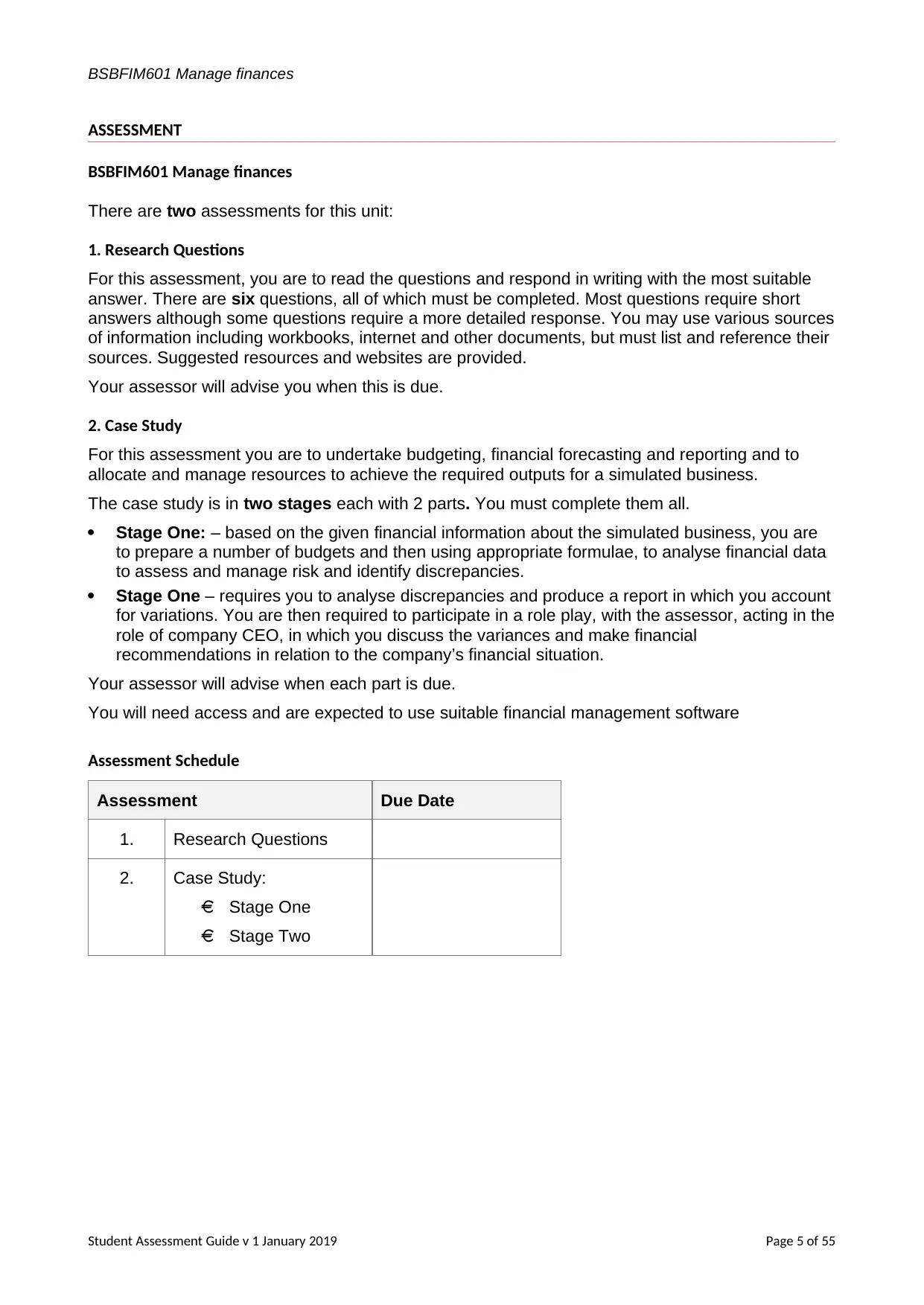
There are two assessments for this unit:
1. Research Questions
For this assessment, you are to read the questions and respond in writing with the most suitable
answer. There are six questions, all of which must be completed. Most questions require short
answers although some questions require a more detailed response. You may use various sources
of information including workbooks, internet and other documents, but must list and reference their
sources. Suggested resources and websites are provided.
Your assessor will advise you when this is due.
2. Case Study
For this assessment you are to undertake budgeting, financial forecasting and reporting and to
allocate and manage resources to achieve the required outputs for a simulated business.
The case study is in two stages each with 2 parts. You must complete them all.
Stage One: – based on the given financial information about the simulated business, you are
to prepare a number of budgets and then using appropriate formulae, to analyse financial data
to assess and manage risk and identify discrepancies.
Stage One – requires you to analyse discrepancies and produce a report in which you account
for variations. You are then required to participate in a role play, with the assessor, acting in the
role of company CEO, in which you discuss the variances and make financial
recommendations in relation to the company’s financial situation.
Your assessor will advise when each part is due.
You will need access and are expected to use suitable financial management software
Assessment Schedule
Assessment Due Date
1. Research Questions
2. Case Study:
Stage One
Stage Two
Student Assessment Guide v 1 January 2019 Page 5 of 55
ASSESSMENT
BSBFIM601 Manage finances
There are two assessments for this unit:
1. Research Questions
For this assessment, you are to read the questions and respond in writing with the most suitable
answer. There are six questions, all of which must be completed. Most questions require short
answers although some questions require a more detailed response. You may use various sources
of information including workbooks, internet and other documents, but must list and reference their
sources. Suggested resources and websites are provided.
Your assessor will advise you when this is due.
2. Case Study
For this assessment you are to undertake budgeting, financial forecasting and reporting and to
allocate and manage resources to achieve the required outputs for a simulated business.
The case study is in two stages each with 2 parts. You must complete them all.
Stage One: – based on the given financial information about the simulated business, you are
to prepare a number of budgets and then using appropriate formulae, to analyse financial data
to assess and manage risk and identify discrepancies.
Stage One – requires you to analyse discrepancies and produce a report in which you account
for variations. You are then required to participate in a role play, with the assessor, acting in the
role of company CEO, in which you discuss the variances and make financial
recommendations in relation to the company’s financial situation.
Your assessor will advise when each part is due.
You will need access and are expected to use suitable financial management software
Assessment Schedule
Assessment Due Date
1. Research Questions
2. Case Study:
Stage One
Stage Two
Student Assessment Guide v 1 January 2019 Page 5 of 55
BSBFIM601 Manage finances
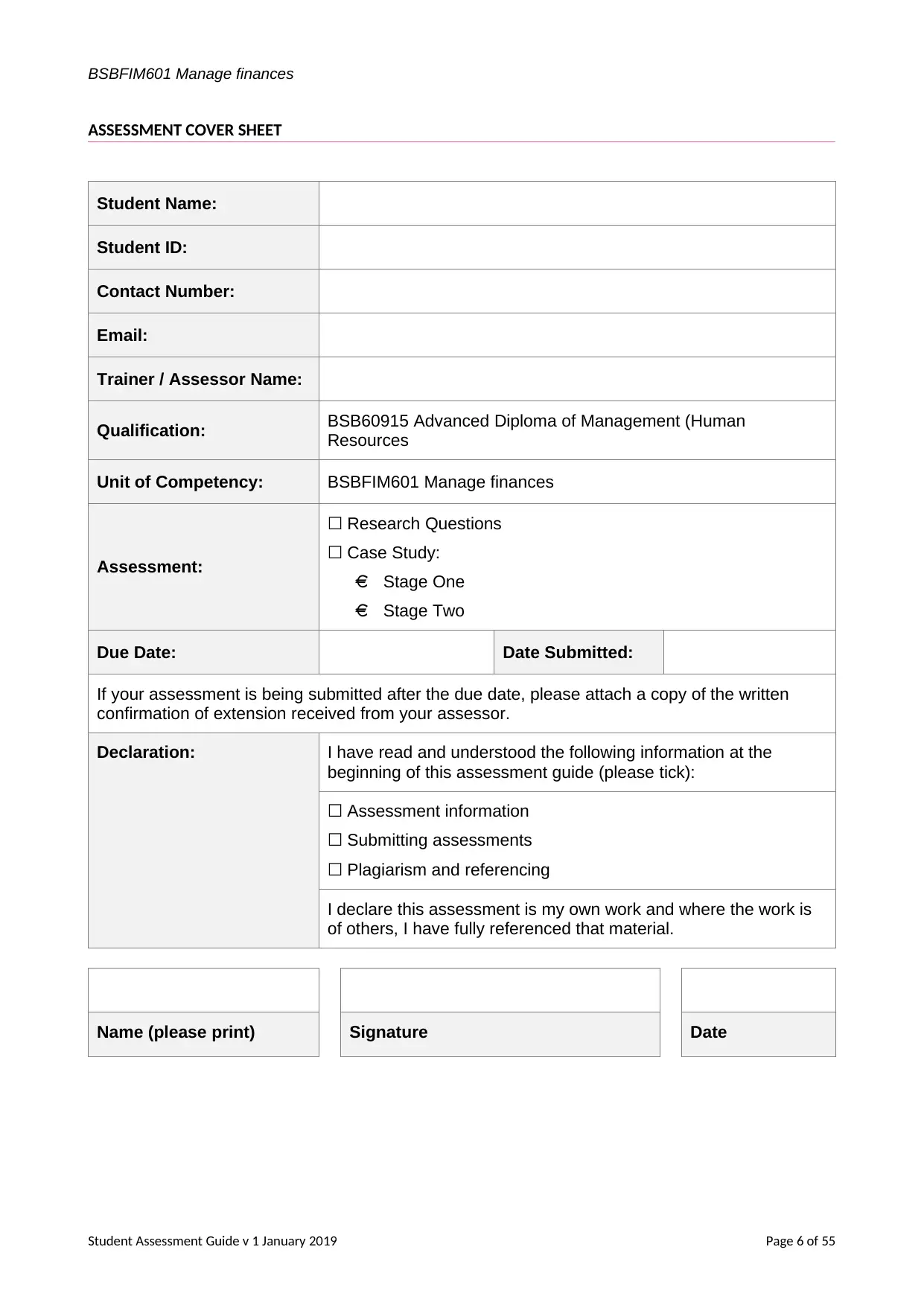
ASSESSMENT COVER SHEET
Student Name:
Student ID:
Contact Number:
Email:
Trainer / Assessor Name:
Qualification: BSB60915 Advanced Diploma of Management (Human
Resources
Unit of Competency: BSBFIM601 Manage finances
Assessment:
☐ Research Questions
☐ Case Study:
Stage One
Stage Two
Due Date: Date Submitted:
If your assessment is being submitted after the due date, please attach a copy of the written
confirmation of extension received from your assessor.
Declaration: I have read and understood the following information at the
beginning of this assessment guide (please tick):
☐ Assessment information
☐ Submitting assessments
☐ Plagiarism and referencing
I declare this assessment is my own work and where the work is
of others, I have fully referenced that material.
Name (please print) Signature Date
Student Assessment Guide v 1 January 2019 Page 6 of 55
ASSESSMENT COVER SHEET
Student Name:
Student ID:
Contact Number:
Email:
Trainer / Assessor Name:
Qualification: BSB60915 Advanced Diploma of Management (Human
Resources
Unit of Competency: BSBFIM601 Manage finances
Assessment:
☐ Research Questions
☐ Case Study:
Stage One
Stage Two
Due Date: Date Submitted:
If your assessment is being submitted after the due date, please attach a copy of the written
confirmation of extension received from your assessor.
Declaration: I have read and understood the following information at the
beginning of this assessment guide (please tick):
☐ Assessment information
☐ Submitting assessments
☐ Plagiarism and referencing
I declare this assessment is my own work and where the work is
of others, I have fully referenced that material.
Name (please print) Signature Date
Student Assessment Guide v 1 January 2019 Page 6 of 55
⊘ This is a preview!⊘
Do you want full access?
Subscribe today to unlock all pages.
Trusted by 1+ million students worldwide
BSBFIM601 Manage finances
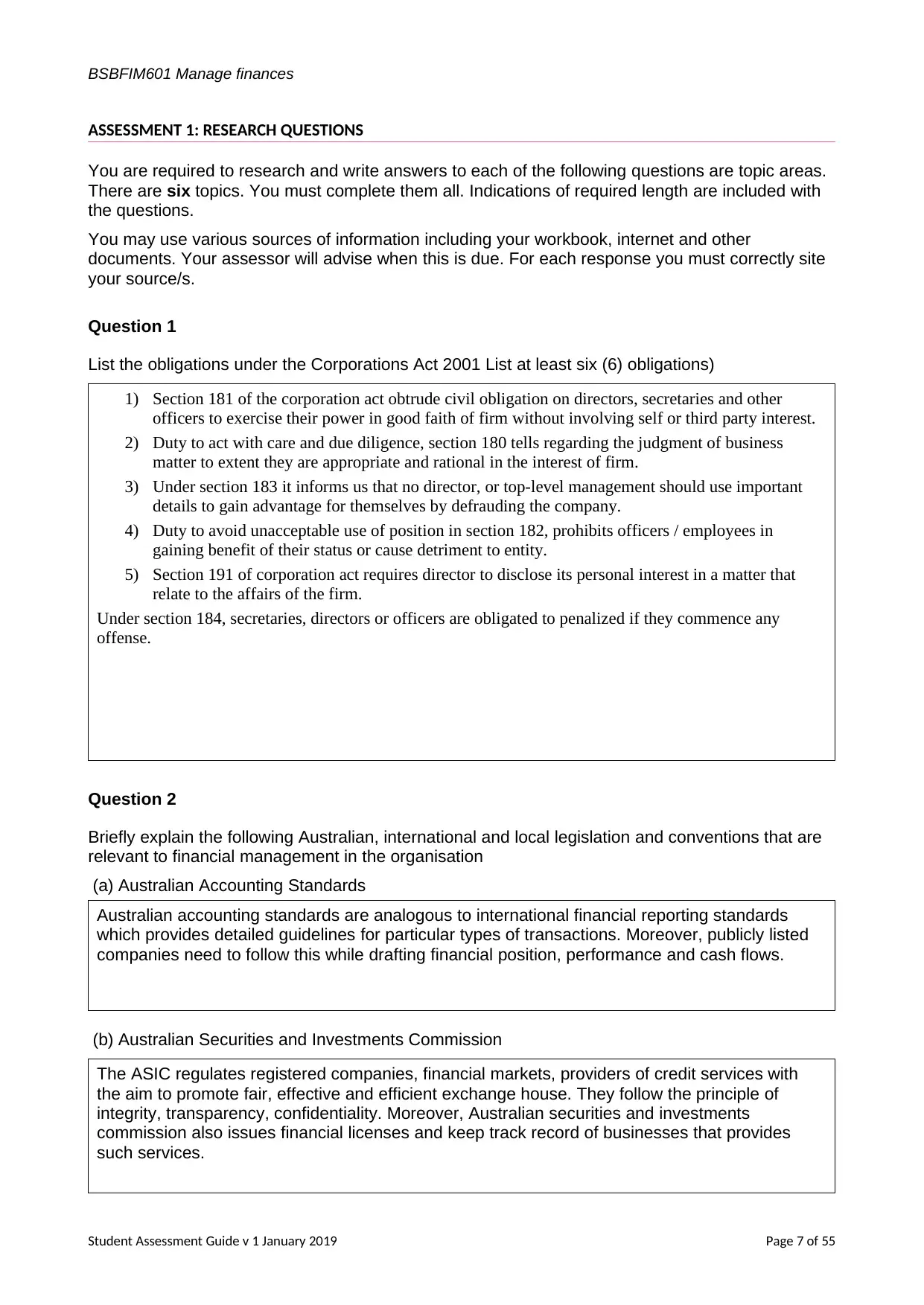
ASSESSMENT 1: RESEARCH QUESTIONS
You are required to research and write answers to each of the following questions are topic areas.
There are six topics. You must complete them all. Indications of required length are included with
the questions.
You may use various sources of information including your workbook, internet and other
documents. Your assessor will advise when this is due. For each response you must correctly site
your source/s.
Question 1
List the obligations under the Corporations Act 2001 List at least six (6) obligations)
1) Section 181 of the corporation act obtrude civil obligation on directors, secretaries and other
officers to exercise their power in good faith of firm without involving self or third party interest.
2) Duty to act with care and due diligence, section 180 tells regarding the judgment of business
matter to extent they are appropriate and rational in the interest of firm.
3) Under section 183 it informs us that no director, or top-level management should use important
details to gain advantage for themselves by defrauding the company.
4) Duty to avoid unacceptable use of position in section 182, prohibits officers / employees in
gaining benefit of their status or cause detriment to entity.
5) Section 191 of corporation act requires director to disclose its personal interest in a matter that
relate to the affairs of the firm.
Under section 184, secretaries, directors or officers are obligated to penalized if they commence any
offense.
Question 2
Briefly explain the following Australian, international and local legislation and conventions that are
relevant to financial management in the organisation
(a) Australian Accounting Standards
Australian accounting standards are analogous to international financial reporting standards
which provides detailed guidelines for particular types of transactions. Moreover, publicly listed
companies need to follow this while drafting financial position, performance and cash flows.
(b) Australian Securities and Investments Commission
The ASIC regulates registered companies, financial markets, providers of credit services with
the aim to promote fair, effective and efficient exchange house. They follow the principle of
integrity, transparency, confidentiality. Moreover, Australian securities and investments
commission also issues financial licenses and keep track record of businesses that provides
such services.
Student Assessment Guide v 1 January 2019 Page 7 of 55
ASSESSMENT 1: RESEARCH QUESTIONS
You are required to research and write answers to each of the following questions are topic areas.
There are six topics. You must complete them all. Indications of required length are included with
the questions.
You may use various sources of information including your workbook, internet and other
documents. Your assessor will advise when this is due. For each response you must correctly site
your source/s.
Question 1
List the obligations under the Corporations Act 2001 List at least six (6) obligations)
1) Section 181 of the corporation act obtrude civil obligation on directors, secretaries and other
officers to exercise their power in good faith of firm without involving self or third party interest.
2) Duty to act with care and due diligence, section 180 tells regarding the judgment of business
matter to extent they are appropriate and rational in the interest of firm.
3) Under section 183 it informs us that no director, or top-level management should use important
details to gain advantage for themselves by defrauding the company.
4) Duty to avoid unacceptable use of position in section 182, prohibits officers / employees in
gaining benefit of their status or cause detriment to entity.
5) Section 191 of corporation act requires director to disclose its personal interest in a matter that
relate to the affairs of the firm.
Under section 184, secretaries, directors or officers are obligated to penalized if they commence any
offense.
Question 2
Briefly explain the following Australian, international and local legislation and conventions that are
relevant to financial management in the organisation
(a) Australian Accounting Standards
Australian accounting standards are analogous to international financial reporting standards
which provides detailed guidelines for particular types of transactions. Moreover, publicly listed
companies need to follow this while drafting financial position, performance and cash flows.
(b) Australian Securities and Investments Commission
The ASIC regulates registered companies, financial markets, providers of credit services with
the aim to promote fair, effective and efficient exchange house. They follow the principle of
integrity, transparency, confidentiality. Moreover, Australian securities and investments
commission also issues financial licenses and keep track record of businesses that provides
such services.
Student Assessment Guide v 1 January 2019 Page 7 of 55
Paraphrase This Document
Need a fresh take? Get an instant paraphrase of this document with our AI Paraphraser
BSBFIM601 Manage finances
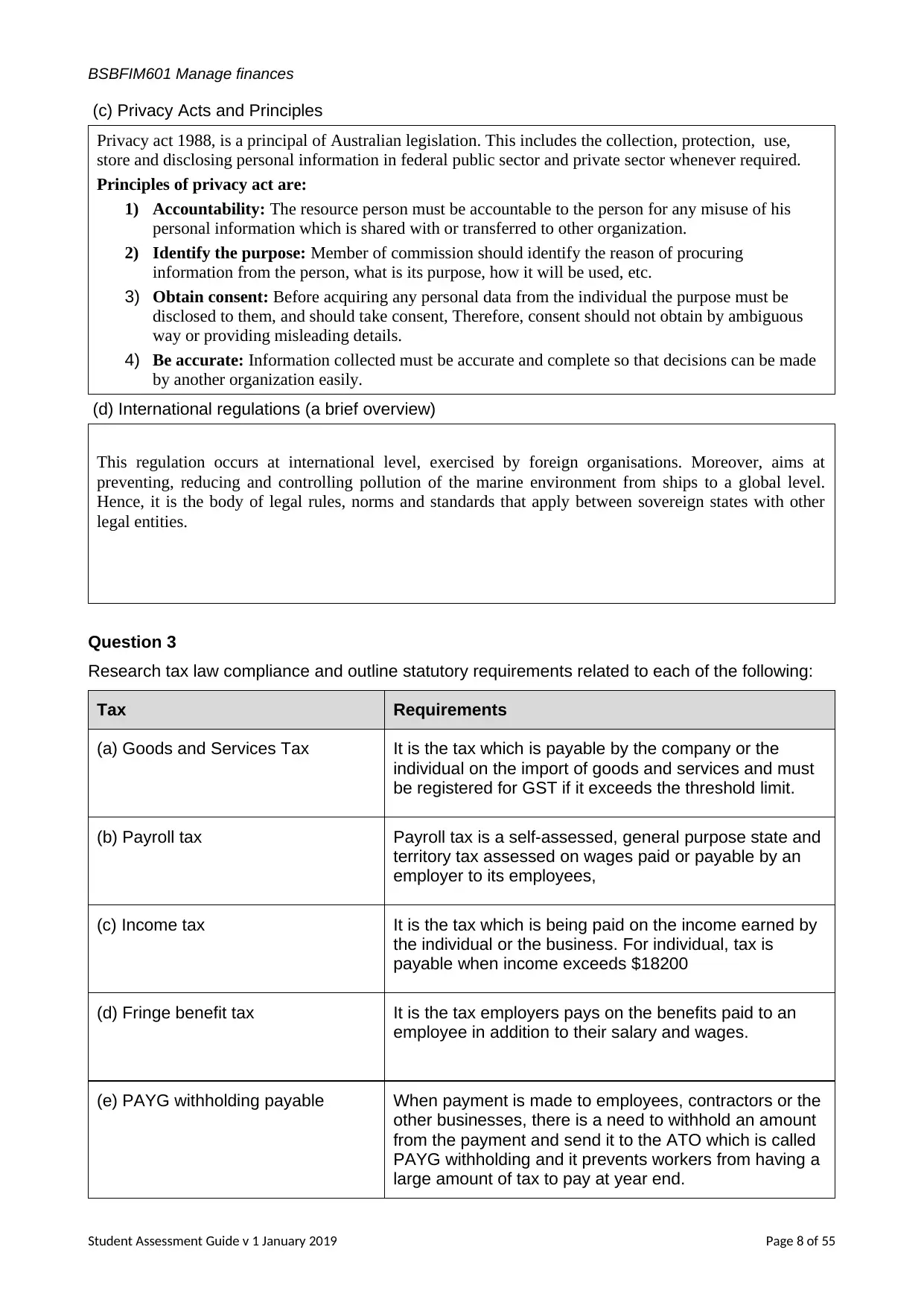
(c) Privacy Acts and Principles
Privacy act 1988, is a principal of Australian legislation. This includes the collection, protection, use,
store and disclosing personal information in federal public sector and private sector whenever required.
Principles of privacy act are:
1) Accountability: The resource person must be accountable to the person for any misuse of his
personal information which is shared with or transferred to other organization.
2) Identify the purpose: Member of commission should identify the reason of procuring
information from the person, what is its purpose, how it will be used, etc.
3) Obtain consent: Before acquiring any personal data from the individual the purpose must be
disclosed to them, and should take consent, Therefore, consent should not obtain by ambiguous
way or providing misleading details.
4) Be accurate: Information collected must be accurate and complete so that decisions can be made
by another organization easily.
(d) International regulations (a brief overview)
This regulation occurs at international level, exercised by foreign organisations. Moreover, aims at
preventing, reducing and controlling pollution of the marine environment from ships to a global level.
Hence, it is the body of legal rules, norms and standards that apply between sovereign states with other
legal entities.
Question 3
Research tax law compliance and outline statutory requirements related to each of the following:
Tax Requirements
(a) Goods and Services Tax It is the tax which is payable by the company or the
individual on the import of goods and services and must
be registered for GST if it exceeds the threshold limit.
(b) Payroll tax Payroll tax is a self-assessed, general purpose state and
territory tax assessed on wages paid or payable by an
employer to its employees,
(c) Income tax It is the tax which is being paid on the income earned by
the individual or the business. For individual, tax is
payable when income exceeds $18200
(d) Fringe benefit tax It is the tax employers pays on the benefits paid to an
employee in addition to their salary and wages.
(e) PAYG withholding payable When payment is made to employees, contractors or the
other businesses, there is a need to withhold an amount
from the payment and send it to the ATO which is called
PAYG withholding and it prevents workers from having a
large amount of tax to pay at year end.
Student Assessment Guide v 1 January 2019 Page 8 of 55
(c) Privacy Acts and Principles
Privacy act 1988, is a principal of Australian legislation. This includes the collection, protection, use,
store and disclosing personal information in federal public sector and private sector whenever required.
Principles of privacy act are:
1) Accountability: The resource person must be accountable to the person for any misuse of his
personal information which is shared with or transferred to other organization.
2) Identify the purpose: Member of commission should identify the reason of procuring
information from the person, what is its purpose, how it will be used, etc.
3) Obtain consent: Before acquiring any personal data from the individual the purpose must be
disclosed to them, and should take consent, Therefore, consent should not obtain by ambiguous
way or providing misleading details.
4) Be accurate: Information collected must be accurate and complete so that decisions can be made
by another organization easily.
(d) International regulations (a brief overview)
This regulation occurs at international level, exercised by foreign organisations. Moreover, aims at
preventing, reducing and controlling pollution of the marine environment from ships to a global level.
Hence, it is the body of legal rules, norms and standards that apply between sovereign states with other
legal entities.
Question 3
Research tax law compliance and outline statutory requirements related to each of the following:
Tax Requirements
(a) Goods and Services Tax It is the tax which is payable by the company or the
individual on the import of goods and services and must
be registered for GST if it exceeds the threshold limit.
(b) Payroll tax Payroll tax is a self-assessed, general purpose state and
territory tax assessed on wages paid or payable by an
employer to its employees,
(c) Income tax It is the tax which is being paid on the income earned by
the individual or the business. For individual, tax is
payable when income exceeds $18200
(d) Fringe benefit tax It is the tax employers pays on the benefits paid to an
employee in addition to their salary and wages.
(e) PAYG withholding payable When payment is made to employees, contractors or the
other businesses, there is a need to withhold an amount
from the payment and send it to the ATO which is called
PAYG withholding and it prevents workers from having a
large amount of tax to pay at year end.
Student Assessment Guide v 1 January 2019 Page 8 of 55
BSBFIM601 Manage finances
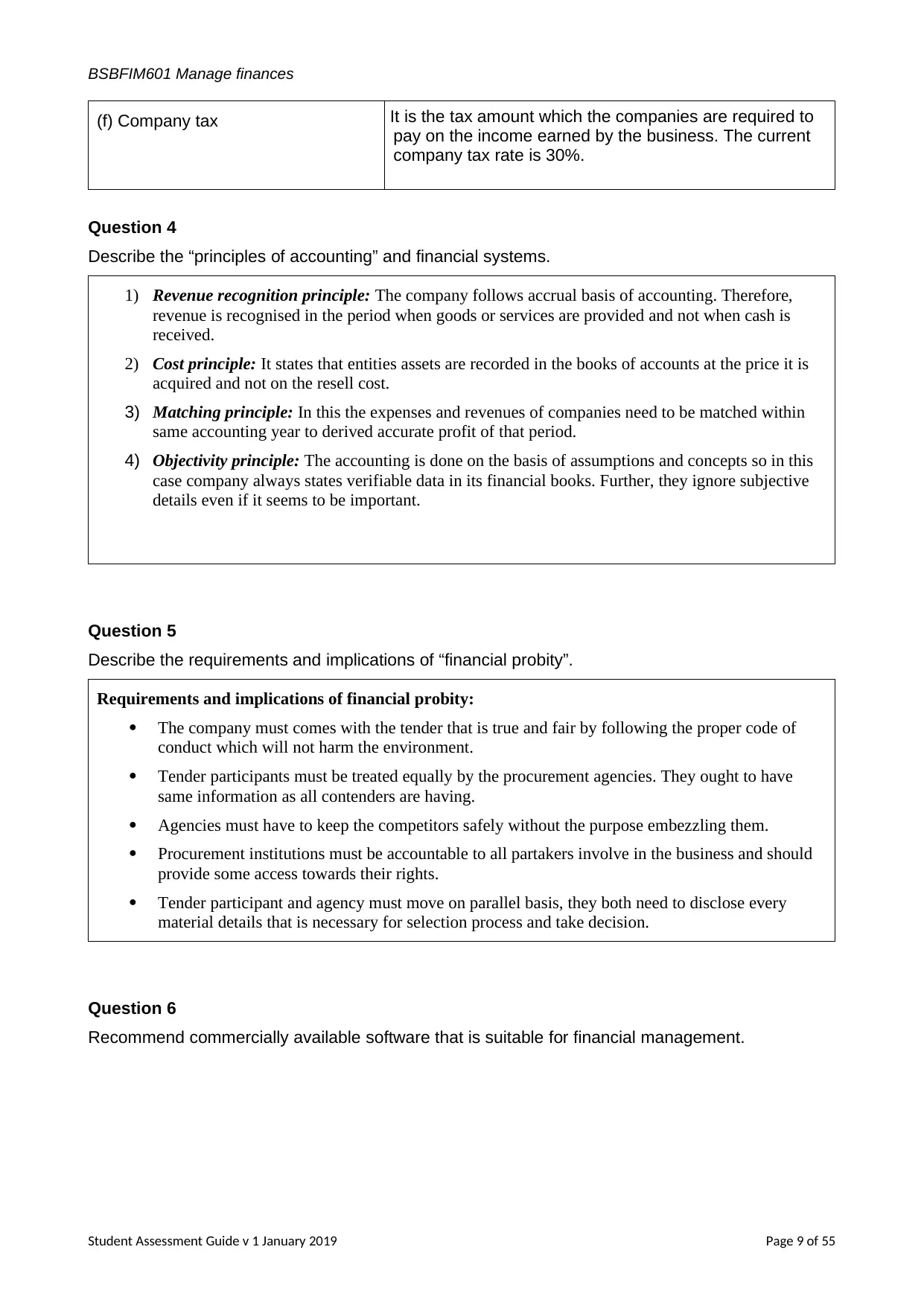
(f) Company tax It is the tax amount which the companies are required to
pay on the income earned by the business. The current
company tax rate is 30%.
Question 4
Describe the “principles of accounting” and financial systems.
1) Revenue recognition principle: The company follows accrual basis of accounting. Therefore,
revenue is recognised in the period when goods or services are provided and not when cash is
received.
2) Cost principle: It states that entities assets are recorded in the books of accounts at the price it is
acquired and not on the resell cost.
3) Matching principle: In this the expenses and revenues of companies need to be matched within
same accounting year to derived accurate profit of that period.
4) Objectivity principle: The accounting is done on the basis of assumptions and concepts so in this
case company always states verifiable data in its financial books. Further, they ignore subjective
details even if it seems to be important.
Question 5
Describe the requirements and implications of “financial probity”.
Requirements and implications of financial probity:
The company must comes with the tender that is true and fair by following the proper code of
conduct which will not harm the environment.
Tender participants must be treated equally by the procurement agencies. They ought to have
same information as all contenders are having.
Agencies must have to keep the competitors safely without the purpose embezzling them.
Procurement institutions must be accountable to all partakers involve in the business and should
provide some access towards their rights.
Tender participant and agency must move on parallel basis, they both need to disclose every
material details that is necessary for selection process and take decision.
Question 6
Recommend commercially available software that is suitable for financial management.
Student Assessment Guide v 1 January 2019 Page 9 of 55
(f) Company tax It is the tax amount which the companies are required to
pay on the income earned by the business. The current
company tax rate is 30%.
Question 4
Describe the “principles of accounting” and financial systems.
1) Revenue recognition principle: The company follows accrual basis of accounting. Therefore,
revenue is recognised in the period when goods or services are provided and not when cash is
received.
2) Cost principle: It states that entities assets are recorded in the books of accounts at the price it is
acquired and not on the resell cost.
3) Matching principle: In this the expenses and revenues of companies need to be matched within
same accounting year to derived accurate profit of that period.
4) Objectivity principle: The accounting is done on the basis of assumptions and concepts so in this
case company always states verifiable data in its financial books. Further, they ignore subjective
details even if it seems to be important.
Question 5
Describe the requirements and implications of “financial probity”.
Requirements and implications of financial probity:
The company must comes with the tender that is true and fair by following the proper code of
conduct which will not harm the environment.
Tender participants must be treated equally by the procurement agencies. They ought to have
same information as all contenders are having.
Agencies must have to keep the competitors safely without the purpose embezzling them.
Procurement institutions must be accountable to all partakers involve in the business and should
provide some access towards their rights.
Tender participant and agency must move on parallel basis, they both need to disclose every
material details that is necessary for selection process and take decision.
Question 6
Recommend commercially available software that is suitable for financial management.
Student Assessment Guide v 1 January 2019 Page 9 of 55
⊘ This is a preview!⊘
Do you want full access?
Subscribe today to unlock all pages.
Trusted by 1+ million students worldwide

BSBFIM601 Manage finances
The best available software for financial management are mentioned below:
Quick books: This software aids the small and medium enterprises accountants with the bank
reconciliation, invoices, payroll, tracking record and advanced reporting. Moreover, it's a
powerful feature for the entities who deal in high volume of manufacturing or retail sector.
Zoho finance plus: Zoho software helps the employees working in back office operations like
accounts department, finance department, inventory handling department, etc. Therefore, this
application acts as a backbone for systematic arrangement of all crucial business related data.
Oracle financials cloud: It is an enterprise resource planning system accessed on the cloud.
Moreover, this is good for the organisation who looks towards controllability with scalability, they
are the comprehensive and integrated ecosystem of finance tools.
Student Assessment Guide v 1 January 2019 Page 10 of 55
The best available software for financial management are mentioned below:
Quick books: This software aids the small and medium enterprises accountants with the bank
reconciliation, invoices, payroll, tracking record and advanced reporting. Moreover, it's a
powerful feature for the entities who deal in high volume of manufacturing or retail sector.
Zoho finance plus: Zoho software helps the employees working in back office operations like
accounts department, finance department, inventory handling department, etc. Therefore, this
application acts as a backbone for systematic arrangement of all crucial business related data.
Oracle financials cloud: It is an enterprise resource planning system accessed on the cloud.
Moreover, this is good for the organisation who looks towards controllability with scalability, they
are the comprehensive and integrated ecosystem of finance tools.
Student Assessment Guide v 1 January 2019 Page 10 of 55
Paraphrase This Document
Need a fresh take? Get an instant paraphrase of this document with our AI Paraphraser
BSBFIM601 Manage finances
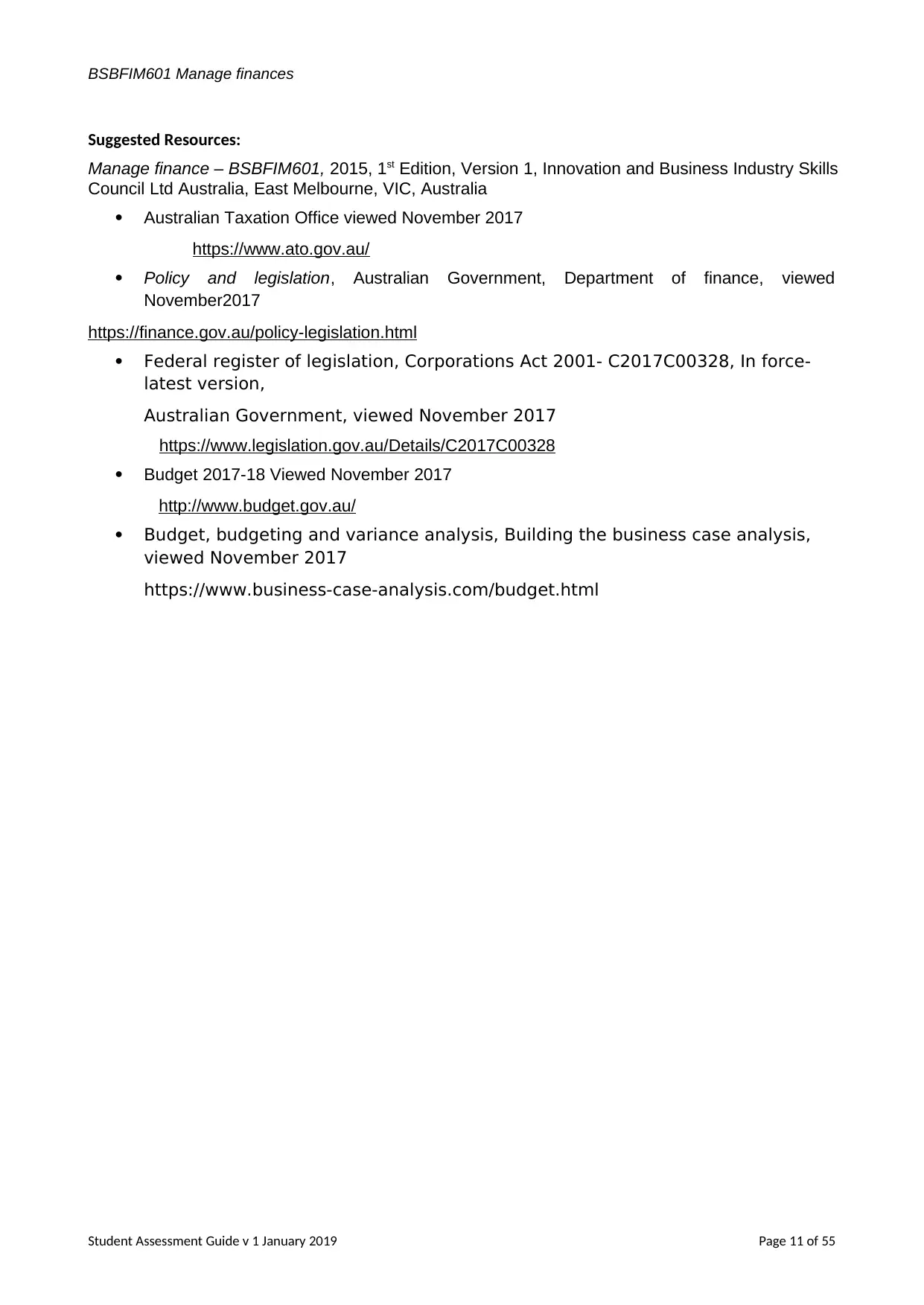
Suggested Resources:
Manage finance – BSBFIM601, 2015, 1st Edition, Version 1, Innovation and Business Industry Skills
Council Ltd Australia, East Melbourne, VIC, Australia
Australian Taxation Office viewed November 2017
https://www.ato.gov.au/
Policy and legislation, Australian Government, Department of finance, viewed
November2017
https://finance.gov.au/policy-legislation.html
Federal register of legislation, Corporations Act 2001- C2017C00328, In force-
latest version,
Australian Government, viewed November 2017
https://www.legislation.gov.au/Details/C2017C00328
Budget 2017-18 Viewed November 2017
http://www.budget.gov.au/
Budget, budgeting and variance analysis, Building the business case analysis,
viewed November 2017
https://www.business-case-analysis.com/budget.html
Student Assessment Guide v 1 January 2019 Page 11 of 55
Suggested Resources:
Manage finance – BSBFIM601, 2015, 1st Edition, Version 1, Innovation and Business Industry Skills
Council Ltd Australia, East Melbourne, VIC, Australia
Australian Taxation Office viewed November 2017
https://www.ato.gov.au/
Policy and legislation, Australian Government, Department of finance, viewed
November2017
https://finance.gov.au/policy-legislation.html
Federal register of legislation, Corporations Act 2001- C2017C00328, In force-
latest version,
Australian Government, viewed November 2017
https://www.legislation.gov.au/Details/C2017C00328
Budget 2017-18 Viewed November 2017
http://www.budget.gov.au/
Budget, budgeting and variance analysis, Building the business case analysis,
viewed November 2017
https://www.business-case-analysis.com/budget.html
Student Assessment Guide v 1 January 2019 Page 11 of 55
BSBFIM601 Manage finances
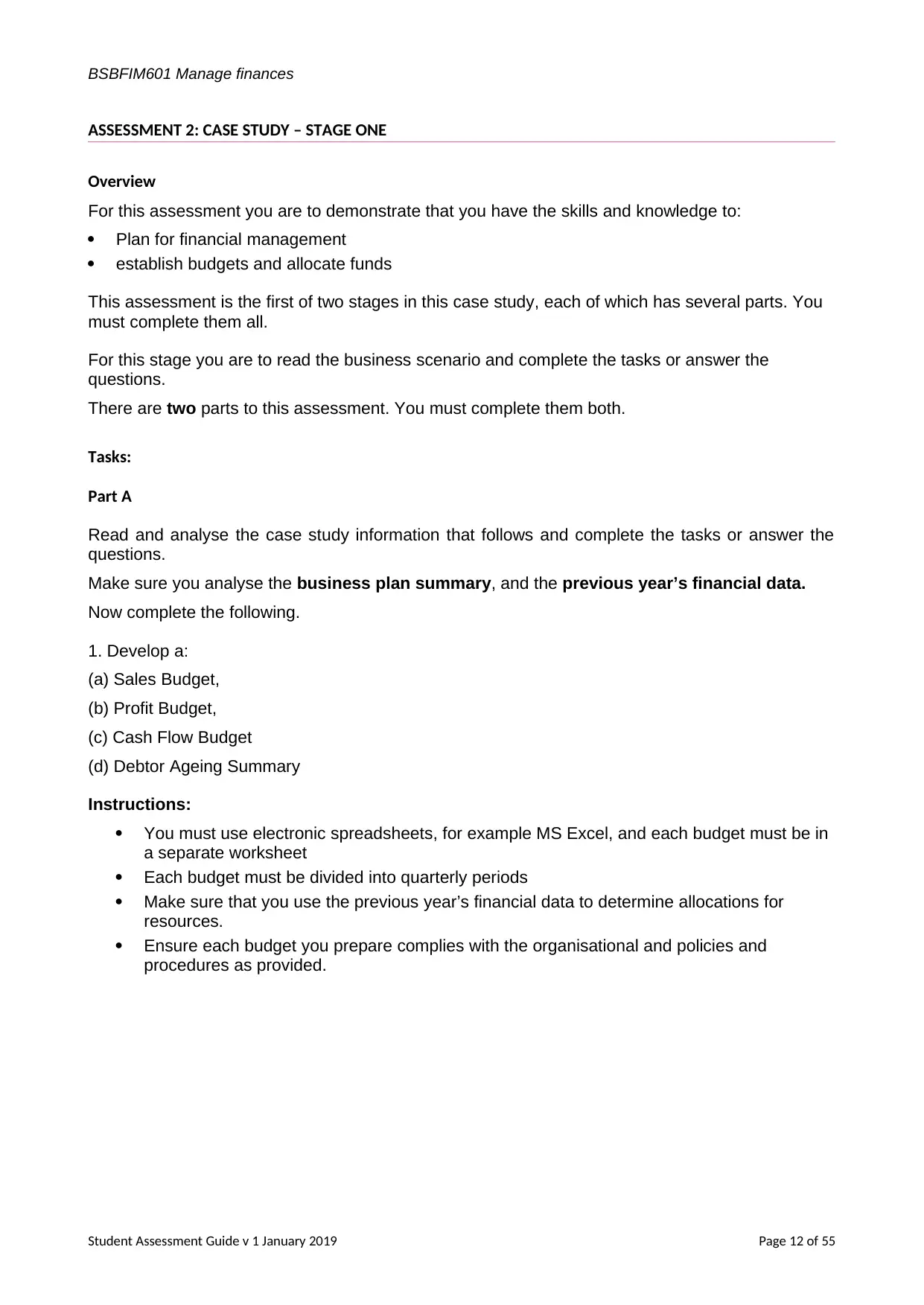
ASSESSMENT 2: CASE STUDY – STAGE ONE
Overview
For this assessment you are to demonstrate that you have the skills and knowledge to:
Plan for financial management
establish budgets and allocate funds
This assessment is the first of two stages in this case study, each of which has several parts. You
must complete them all.
For this stage you are to read the business scenario and complete the tasks or answer the
questions.
There are two parts to this assessment. You must complete them both.
Tasks:
Part A
Read and analyse the case study information that follows and complete the tasks or answer the
questions.
Make sure you analyse the business plan summary, and the previous year’s financial data.
Now complete the following.
1. Develop a:
(a) Sales Budget,
(b) Profit Budget,
(c) Cash Flow Budget
(d) Debtor Ageing Summary
Instructions:
You must use electronic spreadsheets, for example MS Excel, and each budget must be in
a separate worksheet
Each budget must be divided into quarterly periods
Make sure that you use the previous year’s financial data to determine allocations for
resources.
Ensure each budget you prepare complies with the organisational and policies and
procedures as provided.
Student Assessment Guide v 1 January 2019 Page 12 of 55
ASSESSMENT 2: CASE STUDY – STAGE ONE
Overview
For this assessment you are to demonstrate that you have the skills and knowledge to:
Plan for financial management
establish budgets and allocate funds
This assessment is the first of two stages in this case study, each of which has several parts. You
must complete them all.
For this stage you are to read the business scenario and complete the tasks or answer the
questions.
There are two parts to this assessment. You must complete them both.
Tasks:
Part A
Read and analyse the case study information that follows and complete the tasks or answer the
questions.
Make sure you analyse the business plan summary, and the previous year’s financial data.
Now complete the following.
1. Develop a:
(a) Sales Budget,
(b) Profit Budget,
(c) Cash Flow Budget
(d) Debtor Ageing Summary
Instructions:
You must use electronic spreadsheets, for example MS Excel, and each budget must be in
a separate worksheet
Each budget must be divided into quarterly periods
Make sure that you use the previous year’s financial data to determine allocations for
resources.
Ensure each budget you prepare complies with the organisational and policies and
procedures as provided.
Student Assessment Guide v 1 January 2019 Page 12 of 55
⊘ This is a preview!⊘
Do you want full access?
Subscribe today to unlock all pages.
Trusted by 1+ million students worldwide

1 out of 55


Related Documents


Your All-in-One AI-Powered Toolkit for Academic Success.
+13062052269
info@desklib.com
Available 24*7 on WhatsApp / Email
![[object Object]](/_next/static/media/star-bottom.7253800d.svg)
Unlock your academic potential
Copyright © 2020–2026 A2Z Services. All Rights Reserved. Developed and managed by ZUCOL.