Report: Analysis of Managing Knowledge and Information (BSBINM601)

Verified

Added on  2022/10/12

|10
|2027
|14
Report
AI Summary
This report addresses key aspects of knowledge and information management within a business context. It begins by emphasizing the importance of data collection in identifying business problems and managing risks, followed by a description of the leader's role in knowledge management, including building a confidential organizational culture and strengthening communication. The report then explores circumstances leading to the loss of corporate knowledge and outlines five consequences of failing to maintain it, such as revenue loss and slow decision-making. It also covers statistical analysis methods like sample size determination and sensitivity analysis, along with their benefits. The report further provides a case study focused on improving customer relations, including data collection methods and communication strategies. The report also delves into risk management, effective decision-making, and delegation, and concludes with a communication plan, including objectives, audience, dissemination methods, and supporting documentation. The assignment references various academic sources to support its findings, providing a comprehensive overview of the topic.
Document Page
Running head: MANAGE KNOWLEDGE AND INFORMATION
MANAGE KNOWLEDGE AND INFORMATION
Name of Student
Name of University
Author’s Note
tabler-icon-diamond-filled.svg

Paraphrase This Document

Need a fresh take? Get an instant paraphrase of this document with our AI Paraphraser
Document Page
1MANAGE KNOWLEDGE AND INFORMATION
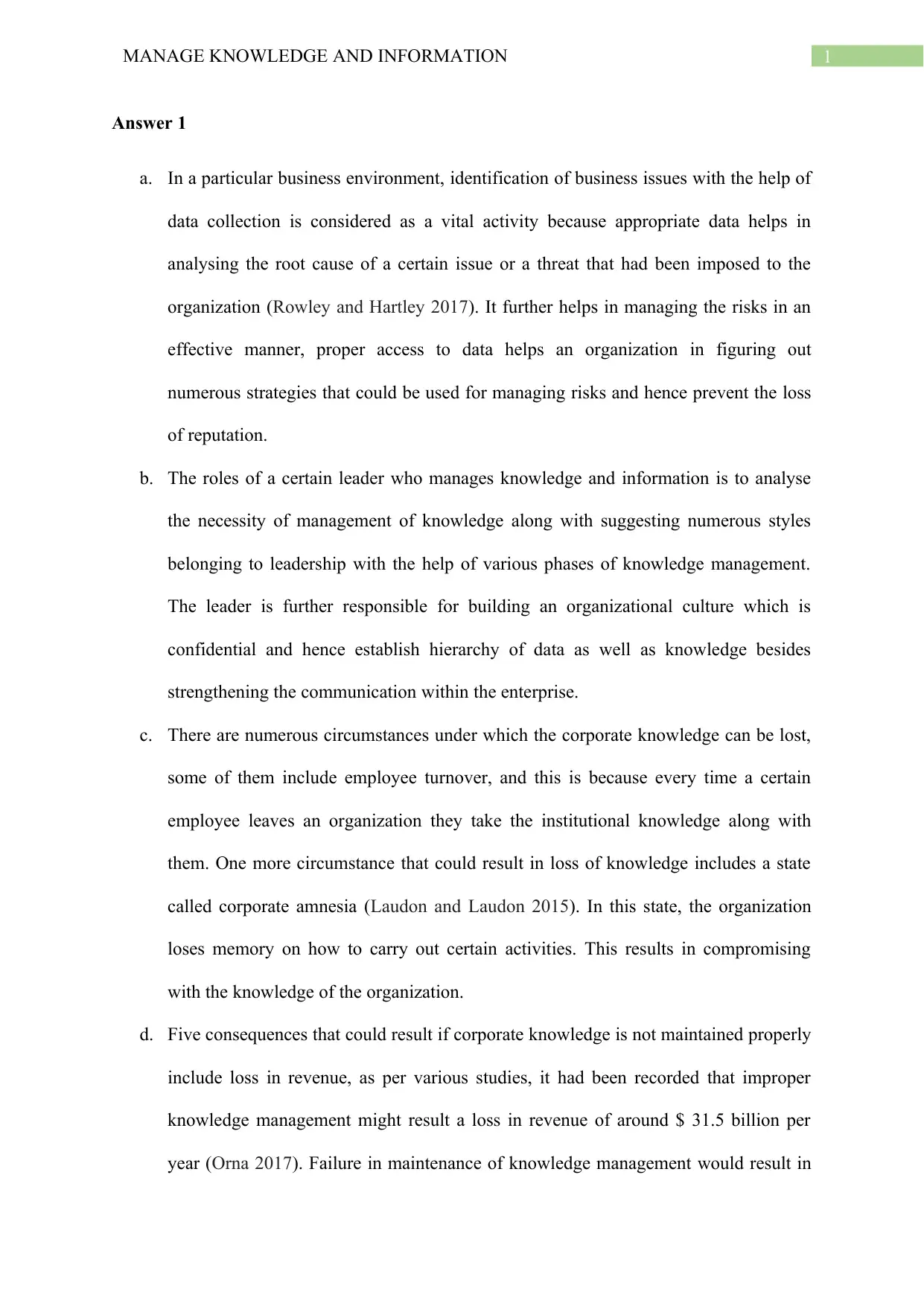
Answer 1
a. In a particular business environment, identification of business issues with the help of
data collection is considered as a vital activity because appropriate data helps in
analysing the root cause of a certain issue or a threat that had been imposed to the
organization (Rowley and Hartley 2017). It further helps in managing the risks in an
effective manner, proper access to data helps an organization in figuring out
numerous strategies that could be used for managing risks and hence prevent the loss
of reputation.
b. The roles of a certain leader who manages knowledge and information is to analyse
the necessity of management of knowledge along with suggesting numerous styles
belonging to leadership with the help of various phases of knowledge management.
The leader is further responsible for building an organizational culture which is
confidential and hence establish hierarchy of data as well as knowledge besides
strengthening the communication within the enterprise.
c. There are numerous circumstances under which the corporate knowledge can be lost,
some of them include employee turnover, and this is because every time a certain
employee leaves an organization they take the institutional knowledge along with
them. One more circumstance that could result in loss of knowledge includes a state
called corporate amnesia (Laudon and Laudon 2015). In this state, the organization
loses memory on how to carry out certain activities. This results in compromising
with the knowledge of the organization.
d. Five consequences that could result if corporate knowledge is not maintained properly
include loss in revenue, as per various studies, it had been recorded that improper
knowledge management might result a loss in revenue of around $ 31.5 billion per
year (Orna 2017). Failure in maintenance of knowledge management would result in
Document Page
2MANAGE KNOWLEDGE AND INFORMATION
further failure of the document management systems. It would also result in lack of
innovation, slow decision making and unable to access data at correct time.
e. One test that could be used for reliability of data soured include CRAP test. One test
that can be used for validity of the information includes Construct validity.
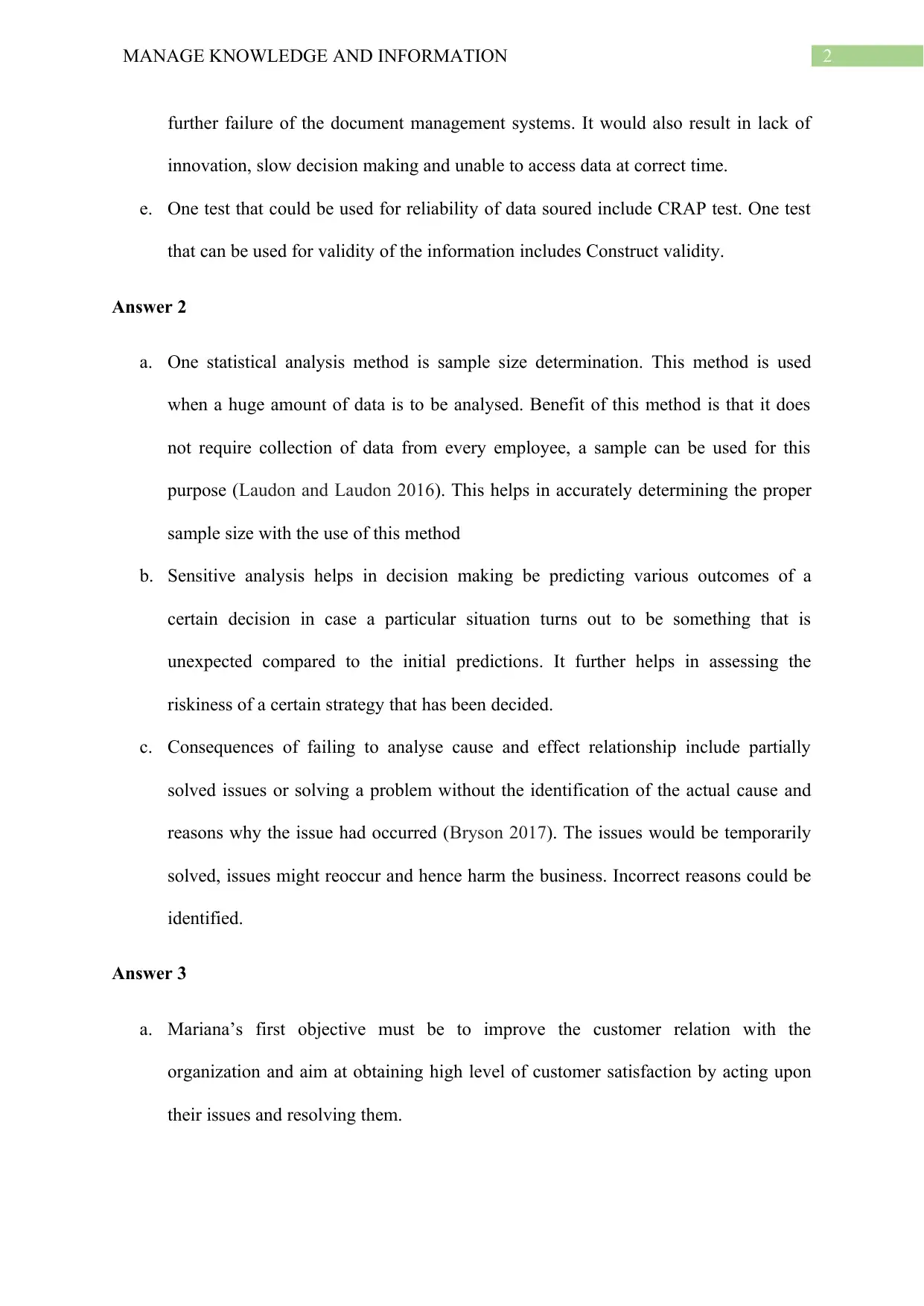
Answer 2
a. One statistical analysis method is sample size determination. This method is used
when a huge amount of data is to be analysed. Benefit of this method is that it does
not require collection of data from every employee, a sample can be used for this
purpose (Laudon and Laudon 2016). This helps in accurately determining the proper
sample size with the use of this method
b. Sensitive analysis helps in decision making be predicting various outcomes of a
certain decision in case a particular situation turns out to be something that is
unexpected compared to the initial predictions. It further helps in assessing the
riskiness of a certain strategy that has been decided.
c. Consequences of failing to analyse cause and effect relationship include partially
solved issues or solving a problem without the identification of the actual cause and
reasons why the issue had occurred (Bryson 2017). The issues would be temporarily
solved, issues might reoccur and hence harm the business. Incorrect reasons could be
identified.
Answer 3
a. Mariana’s first objective must be to improve the customer relation with the
organization and aim at obtaining high level of customer satisfaction by acting upon
their issues and resolving them.
Document Page
3MANAGE KNOWLEDGE AND INFORMATION
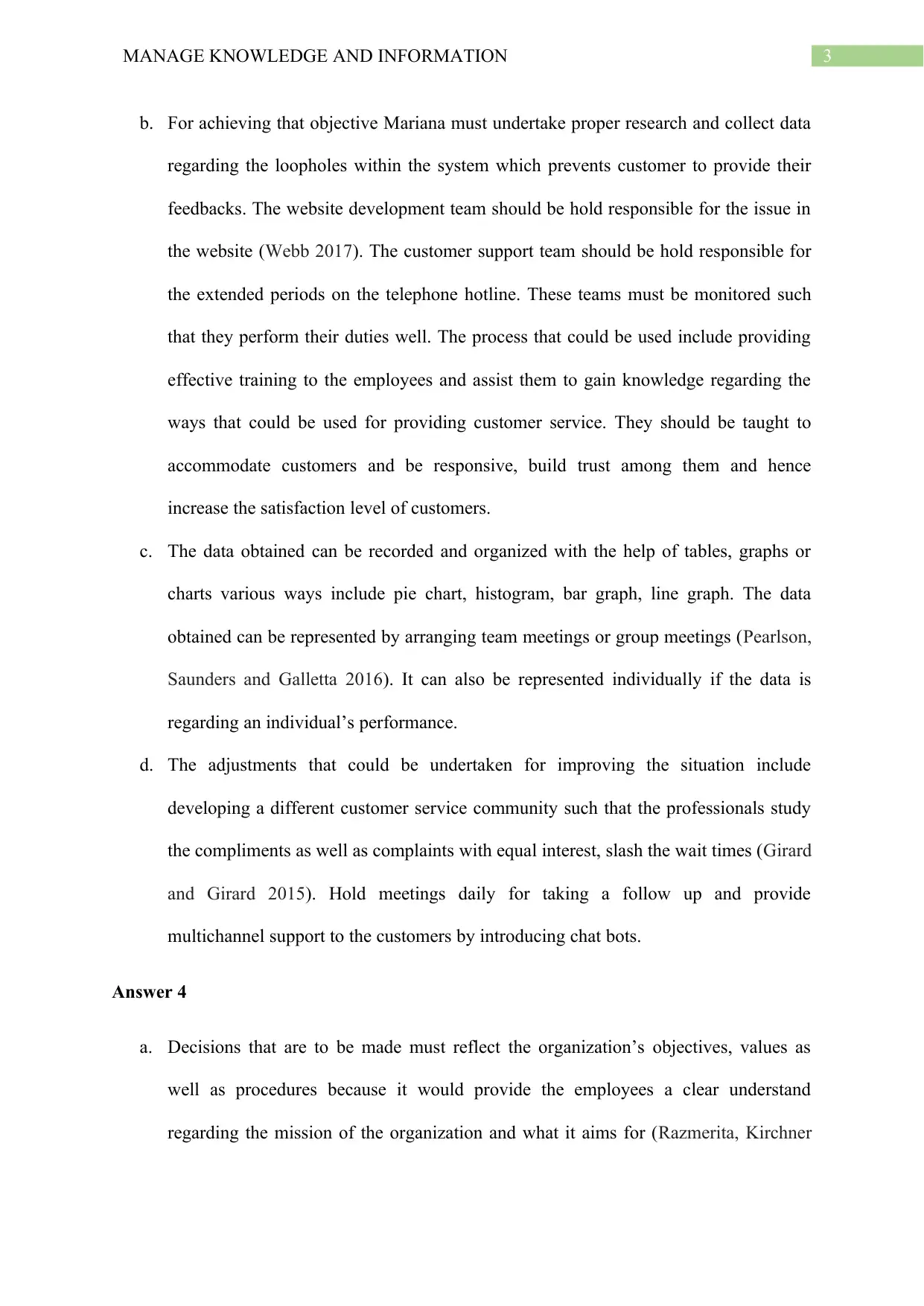
b. For achieving that objective Mariana must undertake proper research and collect data
regarding the loopholes within the system which prevents customer to provide their
feedbacks. The website development team should be hold responsible for the issue in
the website (Webb 2017). The customer support team should be hold responsible for
the extended periods on the telephone hotline. These teams must be monitored such
that they perform their duties well. The process that could be used include providing
effective training to the employees and assist them to gain knowledge regarding the
ways that could be used for providing customer service. They should be taught to
accommodate customers and be responsive, build trust among them and hence
increase the satisfaction level of customers.
c. The data obtained can be recorded and organized with the help of tables, graphs or
charts various ways include pie chart, histogram, bar graph, line graph. The data
obtained can be represented by arranging team meetings or group meetings (Pearlson,
Saunders and Galletta 2016). It can also be represented individually if the data is
regarding an individual’s performance.
d. The adjustments that could be undertaken for improving the situation include
developing a different customer service community such that the professionals study
the compliments as well as complaints with equal interest, slash the wait times (Girard
and Girard 2015). Hold meetings daily for taking a follow up and provide
multichannel support to the customers by introducing chat bots.
Answer 4
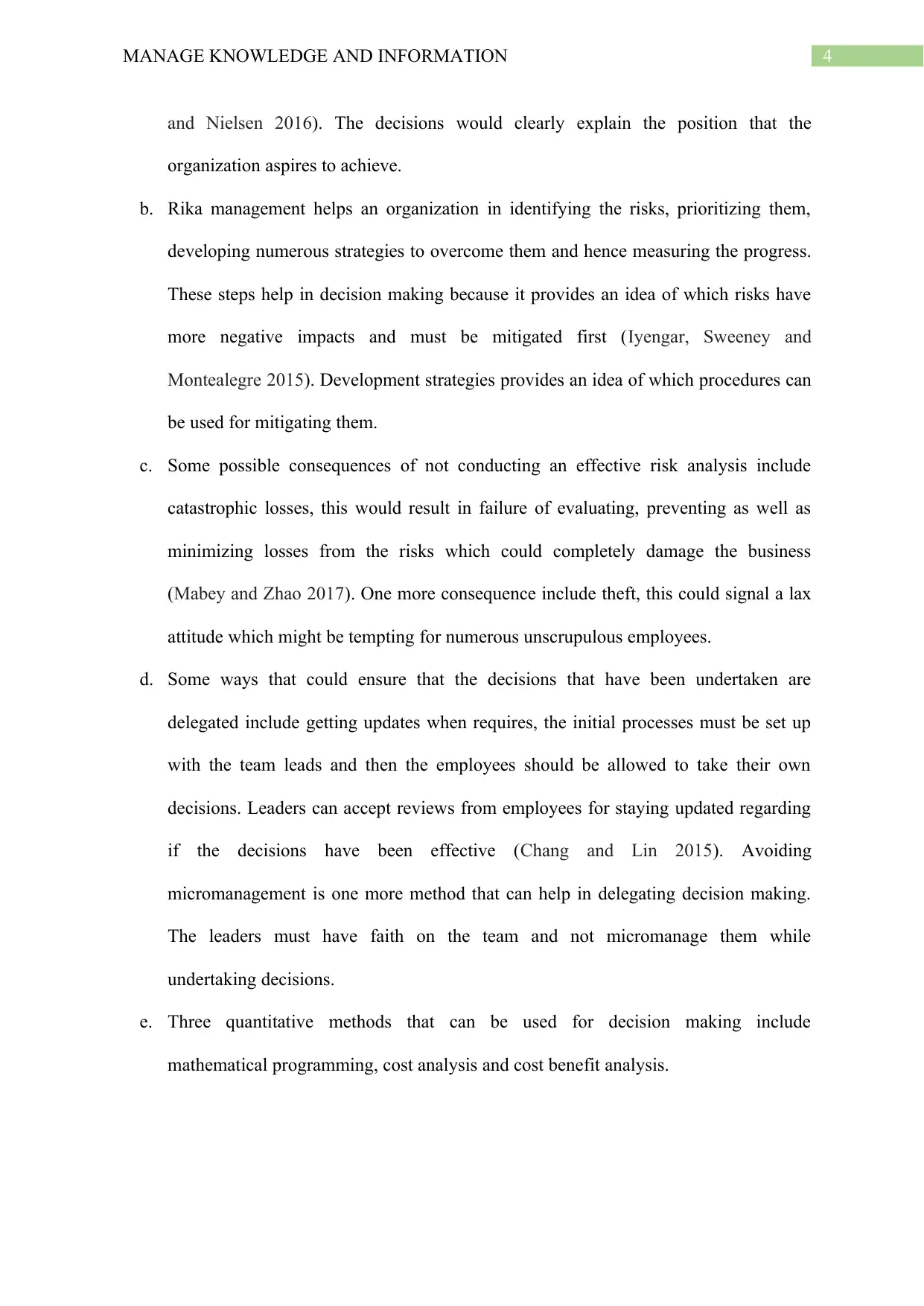
a. Decisions that are to be made must reflect the organization’s objectives, values as
well as procedures because it would provide the employees a clear understand
regarding the mission of the organization and what it aims for (Razmerita, Kirchner
tabler-icon-diamond-filled.svg

Paraphrase This Document

Need a fresh take? Get an instant paraphrase of this document with our AI Paraphraser
Document Page
4MANAGE KNOWLEDGE AND INFORMATION
and Nielsen 2016). The decisions would clearly explain the position that the
organization aspires to achieve.
b. Rika management helps an organization in identifying the risks, prioritizing them,
developing numerous strategies to overcome them and hence measuring the progress.
These steps help in decision making because it provides an idea of which risks have
more negative impacts and must be mitigated first (Iyengar, Sweeney and
Montealegre 2015). Development strategies provides an idea of which procedures can
be used for mitigating them.
c. Some possible consequences of not conducting an effective risk analysis include
catastrophic losses, this would result in failure of evaluating, preventing as well as
minimizing losses from the risks which could completely damage the business
(Mabey and Zhao 2017). One more consequence include theft, this could signal a lax
attitude which might be tempting for numerous unscrupulous employees.
d. Some ways that could ensure that the decisions that have been undertaken are
delegated include getting updates when requires, the initial processes must be set up
with the team leads and then the employees should be allowed to take their own
decisions. Leaders can accept reviews from employees for staying updated regarding
if the decisions have been effective (Chang and Lin 2015). Avoiding
micromanagement is one more method that can help in delegating decision making.
The leaders must have faith on the team and not micromanage them while
undertaking decisions.
e. Three quantitative methods that can be used for decision making include
mathematical programming, cost analysis and cost benefit analysis.
Document Page
5MANAGE KNOWLEDGE AND INFORMATION
f. Three strategies that can be implemented for ensuring that organizational processes as
well as regulatory requirements are met while decision making include considering
the consequences, evaluation of the decisions and monitoring the actions.
Answer 5
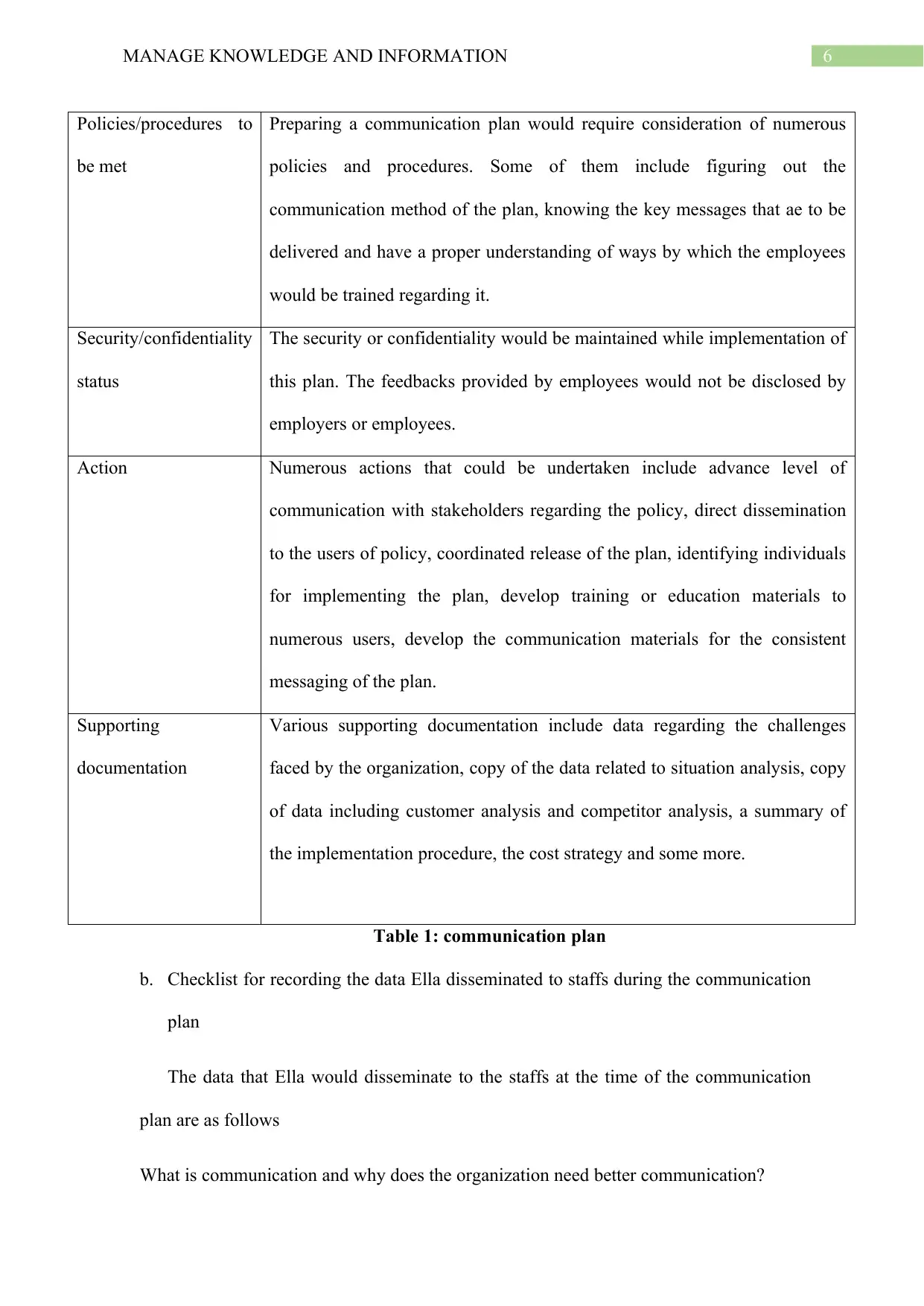
a. Ella’s communication plan
Item Comments
Objective The communication plan would aim in improving the work performance.
Information checked
for accuracy,
sufficiency, currency
and relevance
Information that would be checked for accuracy, relevance and currency
include the performance of the employee and their contribution towards the
organization.
Audience The audience include Board as well as the CEO, managers, executive
management team and staffs.
Location The plan would be presented in the office premises.
Dissemination methods Publishing of the program or the policy briefs
Publishing the project findings in numerous national journals along with
state-wide publications.
Creating various toolkits relevant to training materials as well as curricula for
different communities.
Conveying of data to the heads to share it with other staffs
Meeting relevant departments for raising awareness.
Time line The entire plan would be presented to the employees within three days.
Document Page
6MANAGE KNOWLEDGE AND INFORMATION
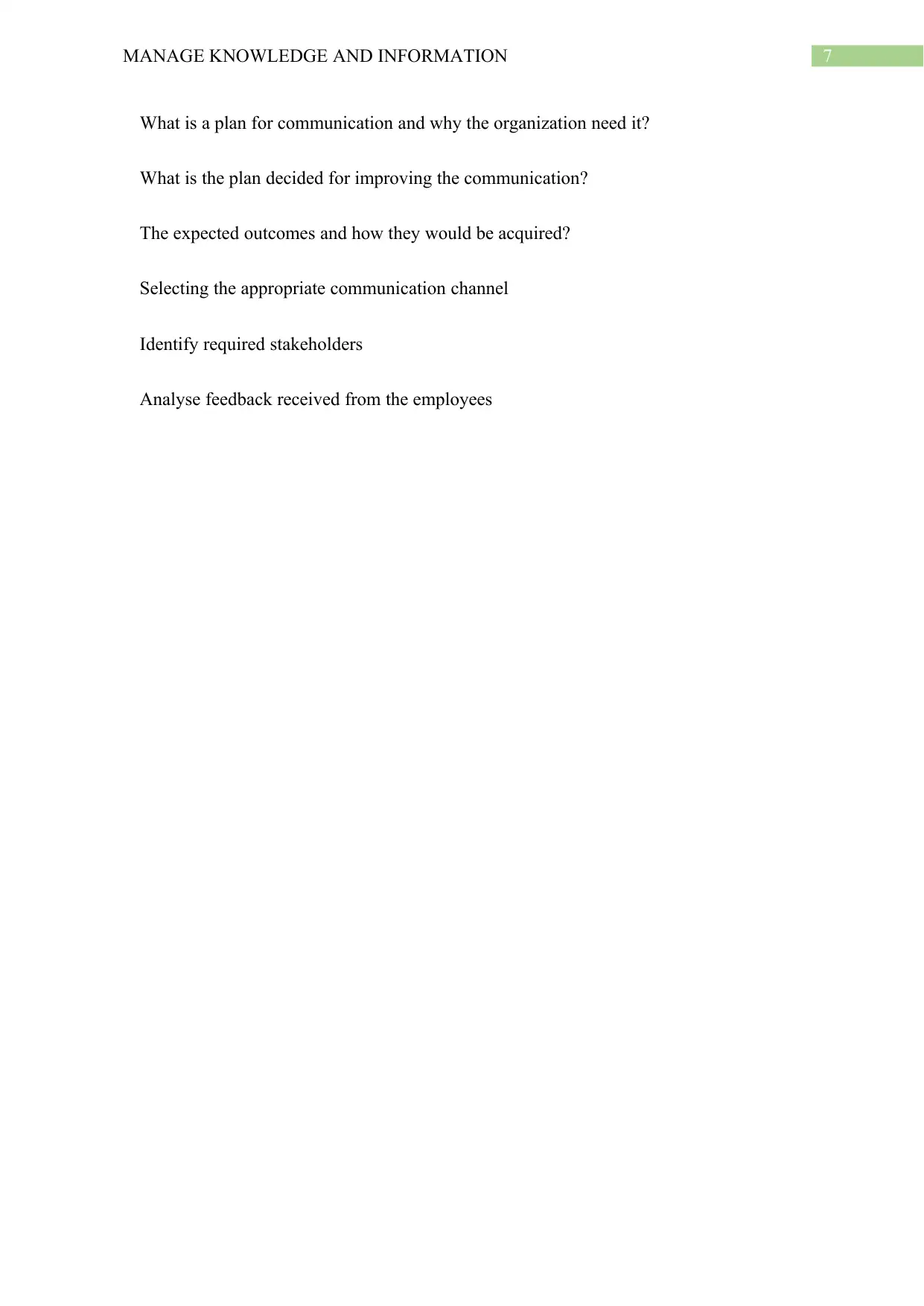
Policies/procedures to
be met
Preparing a communication plan would require consideration of numerous
policies and procedures. Some of them include figuring out the
communication method of the plan, knowing the key messages that ae to be
delivered and have a proper understanding of ways by which the employees
would be trained regarding it.
Security/confidentiality
status
The security or confidentiality would be maintained while implementation of
this plan. The feedbacks provided by employees would not be disclosed by
employers or employees.
Action Numerous actions that could be undertaken include advance level of
communication with stakeholders regarding the policy, direct dissemination
to the users of policy, coordinated release of the plan, identifying individuals
for implementing the plan, develop training or education materials to
numerous users, develop the communication materials for the consistent
messaging of the plan.
Supporting
documentation
Various supporting documentation include data regarding the challenges
faced by the organization, copy of the data related to situation analysis, copy
of data including customer analysis and competitor analysis, a summary of
the implementation procedure, the cost strategy and some more.
Table 1: communication plan
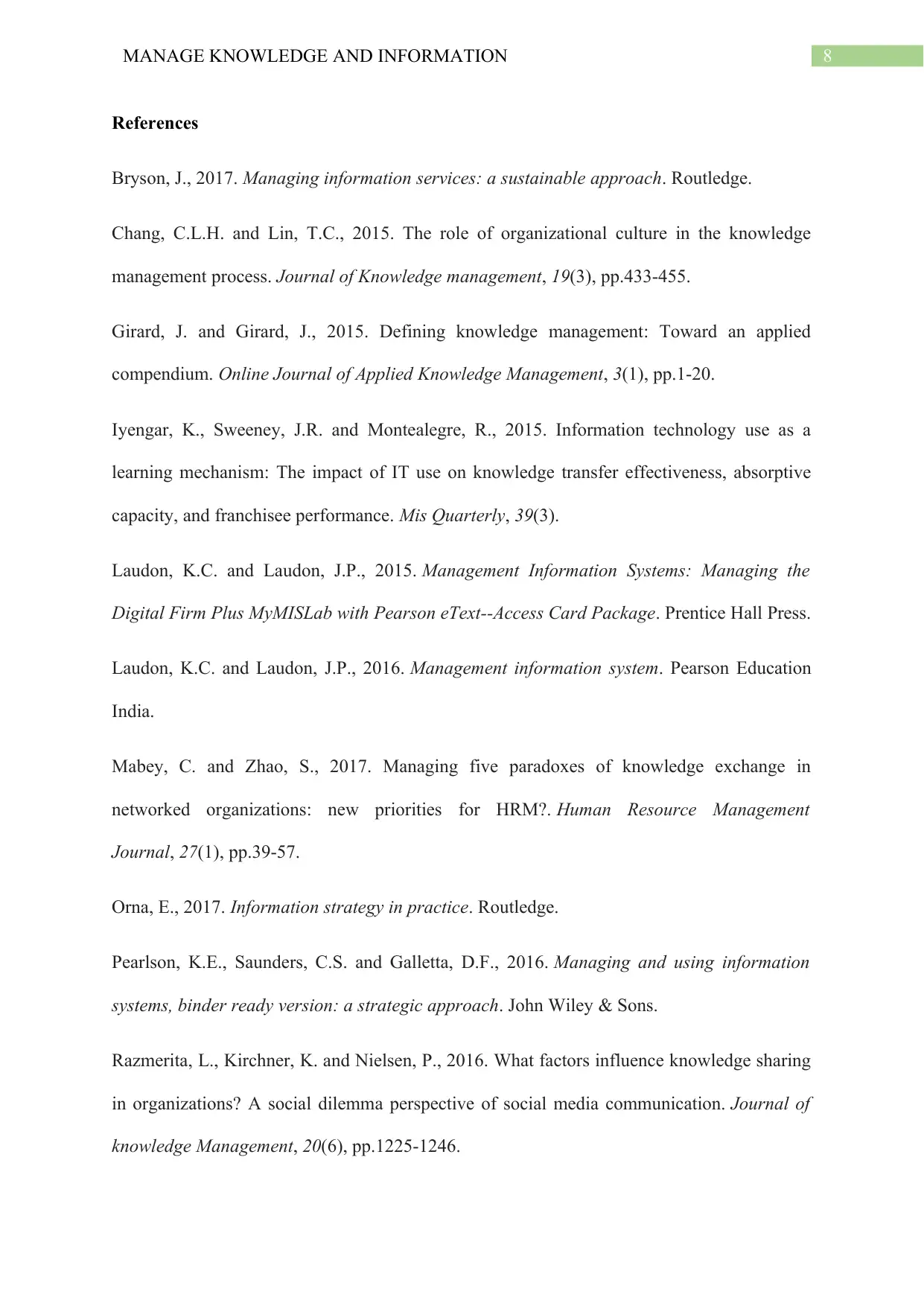
b. Checklist for recording the data Ella disseminated to staffs during the communication
plan
The data that Ella would disseminate to the staffs at the time of the communication
plan are as follows
What is communication and why does the organization need better communication?
tabler-icon-diamond-filled.svg

Paraphrase This Document

Need a fresh take? Get an instant paraphrase of this document with our AI Paraphraser
Document Page
7MANAGE KNOWLEDGE AND INFORMATION
What is a plan for communication and why the organization need it?
What is the plan decided for improving the communication?
The expected outcomes and how they would be acquired?
Selecting the appropriate communication channel
Identify required stakeholders
Analyse feedback received from the employees
Document Page
8MANAGE KNOWLEDGE AND INFORMATION
References
Bryson, J., 2017. Managing information services: a sustainable approach. Routledge.
Chang, C.L.H. and Lin, T.C., 2015. The role of organizational culture in the knowledge
management process. Journal of Knowledge management, 19(3), pp.433-455.
Girard, J. and Girard, J., 2015. Defining knowledge management: Toward an applied
compendium. Online Journal of Applied Knowledge Management, 3(1), pp.1-20.
Iyengar, K., Sweeney, J.R. and Montealegre, R., 2015. Information technology use as a
learning mechanism: The impact of IT use on knowledge transfer effectiveness, absorptive
capacity, and franchisee performance. Mis Quarterly, 39(3).
Laudon, K.C. and Laudon, J.P., 2015. Management Information Systems: Managing the
Digital Firm Plus MyMISLab with Pearson eText--Access Card Package. Prentice Hall Press.
Laudon, K.C. and Laudon, J.P., 2016. Management information system. Pearson Education
India.
Mabey, C. and Zhao, S., 2017. Managing five paradoxes of knowledge exchange in
networked organizations: new priorities for HRM?. Human Resource Management
Journal, 27(1), pp.39-57.
Orna, E., 2017. Information strategy in practice. Routledge.
Pearlson, K.E., Saunders, C.S. and Galletta, D.F., 2016. Managing and using information
systems, binder ready version: a strategic approach. John Wiley & Sons.
Razmerita, L., Kirchner, K. and Nielsen, P., 2016. What factors influence knowledge sharing
in organizations? A social dilemma perspective of social media communication. Journal of
knowledge Management, 20(6), pp.1225-1246.
Document Page
9MANAGE KNOWLEDGE AND INFORMATION
Rowley, J. and Hartley, R., 2017. Organizing knowledge: an introduction to managing
access to information. Routledge.
Webb, S.P., 2017. Knowledge management: Linchpin of change. Routledge.
chevron_up_icon
1 out of 10
circle_padding
hide_on_mobile
zoom_out_icon
[object Object]