BSBLED501 - Analyzing Tesco's Workplace Learning Environment
VerifiedAdded on 2023/05/30
|10
|2382
|162
Case Study
AI Summary
This assignment provides a comprehensive analysis of Tesco's approach to training and development within its workplace learning environment, referencing a case study focusing on how these initiatives support business growth. It begins by differentiating between training and development, highlighting how changing customer expectations necessitate robust staff training at Tesco. The solution details Tesco's training methods, including both on-the-job and off-the-job approaches, and explains how training needs are identified through business targets and competency assessments. Furthermore, it analyzes Tesco's employee development methods, weighing the strengths and weaknesses of their personal development program. The assignment also evaluates the benefits of structured training programs for Tesco, assessing the return on investment. The document then shifts to Tesla Company and provides organizational learning goals and SMART objectives for Tesla Company along with strategies for realizing objectives and policies for implementing the strategies. Finally, it addresses the skills and knowledge required for a training officer role, conducting a SWOT analysis, identifying skills gaps, and outlining short-term and long-term professional development goals.

1
BSBLED501
Develop a Workplace Learning Environment
Name
Course
Student id
BSBLED501
Develop a Workplace Learning Environment
Name
Course
Student id

Paraphrase This Document
Need a fresh take? Get an instant paraphrase of this document with our AI Paraphraser
2
ASSESSMENT 1
1. Explain the difference between training and development. How have changes in
customer expectations affected Tesco and its need to train staff?
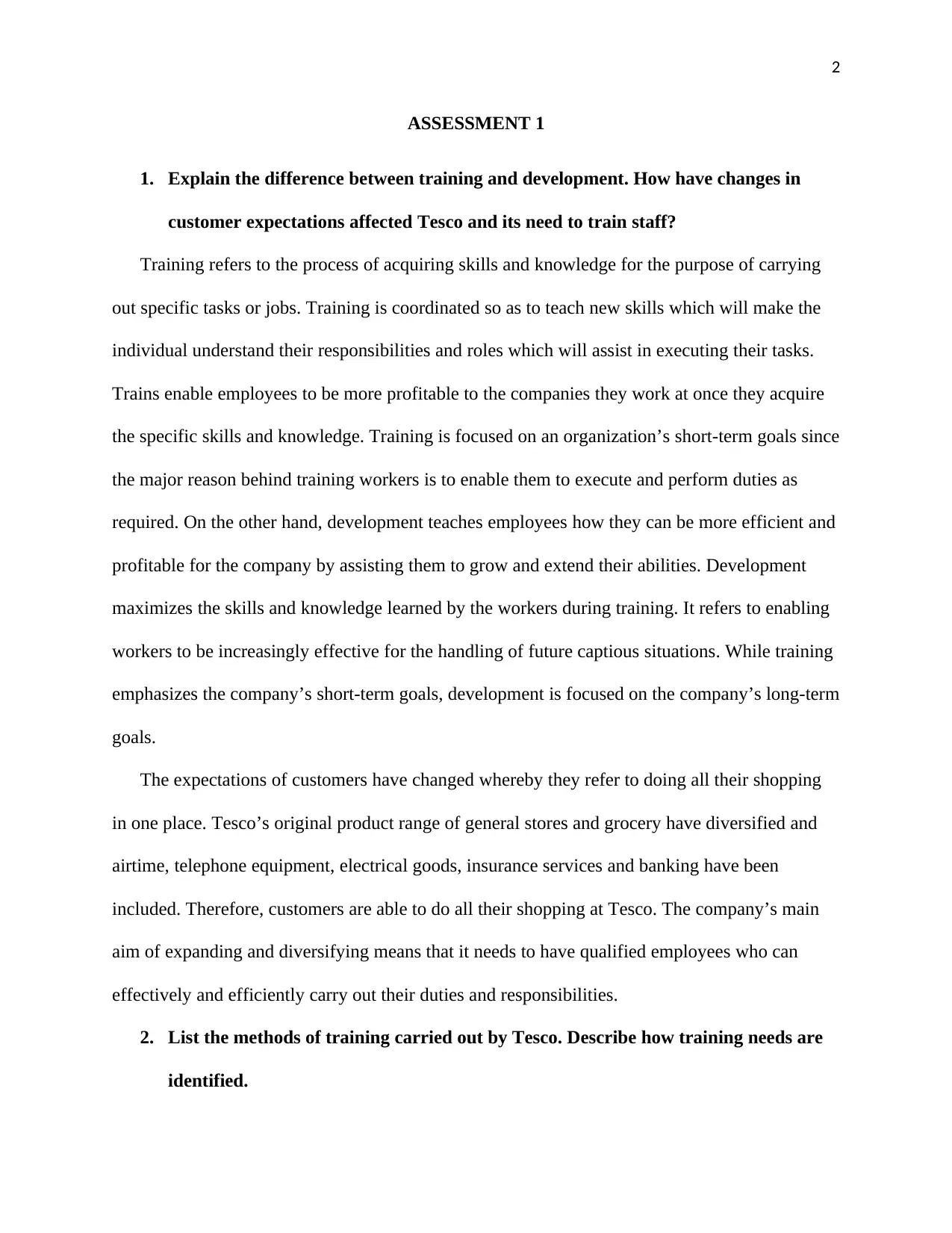
Training refers to the process of acquiring skills and knowledge for the purpose of carrying
out specific tasks or jobs. Training is coordinated so as to teach new skills which will make the
individual understand their responsibilities and roles which will assist in executing their tasks.
Trains enable employees to be more profitable to the companies they work at once they acquire
the specific skills and knowledge. Training is focused on an organization’s short-term goals since
the major reason behind training workers is to enable them to execute and perform duties as
required. On the other hand, development teaches employees how they can be more efficient and
profitable for the company by assisting them to grow and extend their abilities. Development
maximizes the skills and knowledge learned by the workers during training. It refers to enabling
workers to be increasingly effective for the handling of future captious situations. While training
emphasizes the company’s short-term goals, development is focused on the company’s long-term
goals.
The expectations of customers have changed whereby they refer to doing all their shopping
in one place. Tesco’s original product range of general stores and grocery have diversified and
airtime, telephone equipment, electrical goods, insurance services and banking have been
included. Therefore, customers are able to do all their shopping at Tesco. The company’s main
aim of expanding and diversifying means that it needs to have qualified employees who can
effectively and efficiently carry out their duties and responsibilities.
2. List the methods of training carried out by Tesco. Describe how training needs are
identified.
ASSESSMENT 1
1. Explain the difference between training and development. How have changes in
customer expectations affected Tesco and its need to train staff?
Training refers to the process of acquiring skills and knowledge for the purpose of carrying
out specific tasks or jobs. Training is coordinated so as to teach new skills which will make the
individual understand their responsibilities and roles which will assist in executing their tasks.
Trains enable employees to be more profitable to the companies they work at once they acquire
the specific skills and knowledge. Training is focused on an organization’s short-term goals since
the major reason behind training workers is to enable them to execute and perform duties as
required. On the other hand, development teaches employees how they can be more efficient and
profitable for the company by assisting them to grow and extend their abilities. Development
maximizes the skills and knowledge learned by the workers during training. It refers to enabling
workers to be increasingly effective for the handling of future captious situations. While training
emphasizes the company’s short-term goals, development is focused on the company’s long-term
goals.
The expectations of customers have changed whereby they refer to doing all their shopping
in one place. Tesco’s original product range of general stores and grocery have diversified and
airtime, telephone equipment, electrical goods, insurance services and banking have been
included. Therefore, customers are able to do all their shopping at Tesco. The company’s main
aim of expanding and diversifying means that it needs to have qualified employees who can
effectively and efficiently carry out their duties and responsibilities.
2. List the methods of training carried out by Tesco. Describe how training needs are
identified.
3
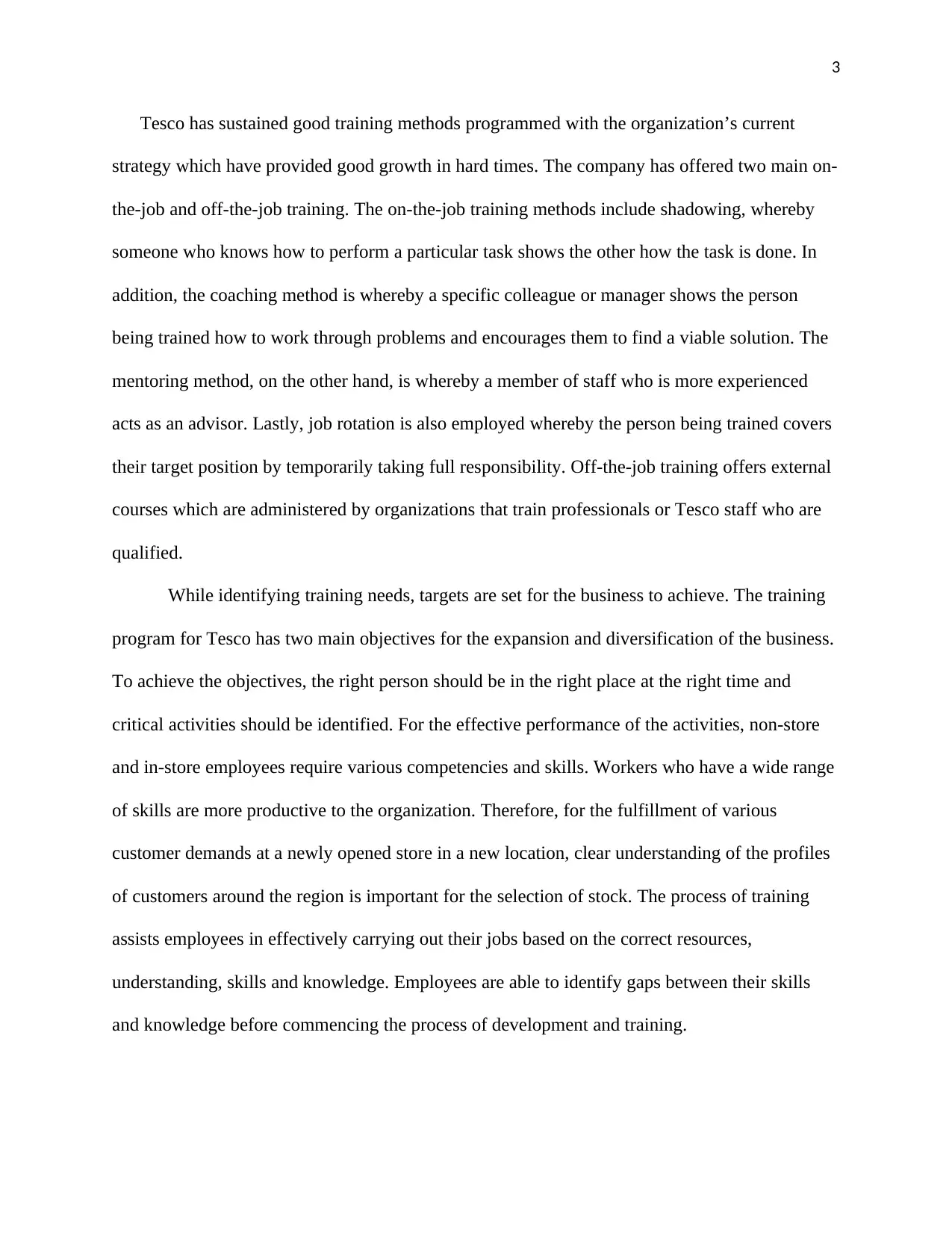
Tesco has sustained good training methods programmed with the organization’s current
strategy which have provided good growth in hard times. The company has offered two main on-
the-job and off-the-job training. The on-the-job training methods include shadowing, whereby
someone who knows how to perform a particular task shows the other how the task is done. In
addition, the coaching method is whereby a specific colleague or manager shows the person
being trained how to work through problems and encourages them to find a viable solution. The
mentoring method, on the other hand, is whereby a member of staff who is more experienced
acts as an advisor. Lastly, job rotation is also employed whereby the person being trained covers
their target position by temporarily taking full responsibility. Off-the-job training offers external
courses which are administered by organizations that train professionals or Tesco staff who are
qualified.
While identifying training needs, targets are set for the business to achieve. The training
program for Tesco has two main objectives for the expansion and diversification of the business.
To achieve the objectives, the right person should be in the right place at the right time and
critical activities should be identified. For the effective performance of the activities, non-store
and in-store employees require various competencies and skills. Workers who have a wide range
of skills are more productive to the organization. Therefore, for the fulfillment of various
customer demands at a newly opened store in a new location, clear understanding of the profiles
of customers around the region is important for the selection of stock. The process of training
assists employees in effectively carrying out their jobs based on the correct resources,
understanding, skills and knowledge. Employees are able to identify gaps between their skills
and knowledge before commencing the process of development and training.
Tesco has sustained good training methods programmed with the organization’s current
strategy which have provided good growth in hard times. The company has offered two main on-
the-job and off-the-job training. The on-the-job training methods include shadowing, whereby
someone who knows how to perform a particular task shows the other how the task is done. In
addition, the coaching method is whereby a specific colleague or manager shows the person
being trained how to work through problems and encourages them to find a viable solution. The
mentoring method, on the other hand, is whereby a member of staff who is more experienced
acts as an advisor. Lastly, job rotation is also employed whereby the person being trained covers
their target position by temporarily taking full responsibility. Off-the-job training offers external
courses which are administered by organizations that train professionals or Tesco staff who are
qualified.
While identifying training needs, targets are set for the business to achieve. The training
program for Tesco has two main objectives for the expansion and diversification of the business.
To achieve the objectives, the right person should be in the right place at the right time and
critical activities should be identified. For the effective performance of the activities, non-store
and in-store employees require various competencies and skills. Workers who have a wide range
of skills are more productive to the organization. Therefore, for the fulfillment of various
customer demands at a newly opened store in a new location, clear understanding of the profiles
of customers around the region is important for the selection of stock. The process of training
assists employees in effectively carrying out their jobs based on the correct resources,
understanding, skills and knowledge. Employees are able to identify gaps between their skills
and knowledge before commencing the process of development and training.
⊘ This is a preview!⊘
Do you want full access?
Subscribe today to unlock all pages.

Trusted by 1+ million students worldwide
4
3. Analyze Tesco’s method of developing its employees. Consider the strengths and
weaknesses of such a program
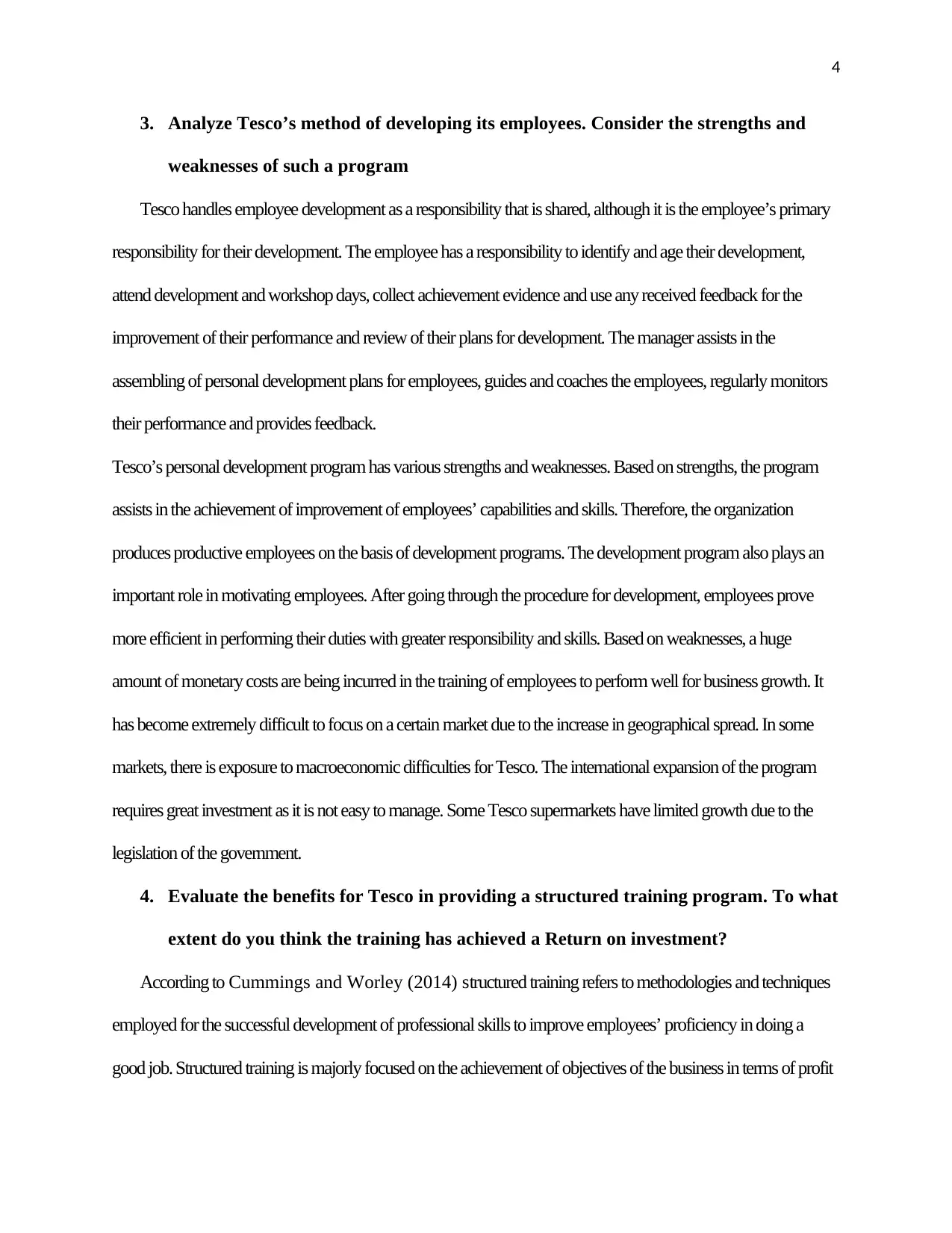
Tesco handles employee development as a responsibility that is shared, although it is the employee’s primary
responsibility for their development. The employee has a responsibility to identify and age their development,
attend development and workshop days, collect achievement evidence and use any received feedback for the
improvement of their performance and review of their plans for development. The manager assists in the
assembling of personal development plans for employees, guides and coaches the employees, regularly monitors
their performance and provides feedback.
Tesco’s personal development program has various strengths and weaknesses. Based on strengths, the program
assists in the achievement of improvement of employees’ capabilities and skills. Therefore, the organization
produces productive employees on the basis of development programs. The development program also plays an
important role in motivating employees. After going through the procedure for development, employees prove
more efficient in performing their duties with greater responsibility and skills. Based on weaknesses, a huge
amount of monetary costs are being incurred in the training of employees to perform well for business growth. It
has become extremely difficult to focus on a certain market due to the increase in geographical spread. In some
markets, there is exposure to macroeconomic difficulties for Tesco. The international expansion of the program
requires great investment as it is not easy to manage. Some Tesco supermarkets have limited growth due to the
legislation of the government.
4. Evaluate the benefits for Tesco in providing a structured training program. To what
extent do you think the training has achieved a Return on investment?
According to Cummings and Worley (2014) structured training refers to methodologies and techniques
employed for the successful development of professional skills to improve employees’ proficiency in doing a
good job. Structured training is majorly focused on the achievement of objectives of the business in terms of profit
3. Analyze Tesco’s method of developing its employees. Consider the strengths and
weaknesses of such a program
Tesco handles employee development as a responsibility that is shared, although it is the employee’s primary
responsibility for their development. The employee has a responsibility to identify and age their development,
attend development and workshop days, collect achievement evidence and use any received feedback for the
improvement of their performance and review of their plans for development. The manager assists in the
assembling of personal development plans for employees, guides and coaches the employees, regularly monitors
their performance and provides feedback.
Tesco’s personal development program has various strengths and weaknesses. Based on strengths, the program
assists in the achievement of improvement of employees’ capabilities and skills. Therefore, the organization
produces productive employees on the basis of development programs. The development program also plays an
important role in motivating employees. After going through the procedure for development, employees prove
more efficient in performing their duties with greater responsibility and skills. Based on weaknesses, a huge
amount of monetary costs are being incurred in the training of employees to perform well for business growth. It
has become extremely difficult to focus on a certain market due to the increase in geographical spread. In some
markets, there is exposure to macroeconomic difficulties for Tesco. The international expansion of the program
requires great investment as it is not easy to manage. Some Tesco supermarkets have limited growth due to the
legislation of the government.
4. Evaluate the benefits for Tesco in providing a structured training program. To what
extent do you think the training has achieved a Return on investment?
According to Cummings and Worley (2014) structured training refers to methodologies and techniques
employed for the successful development of professional skills to improve employees’ proficiency in doing a
good job. Structured training is majorly focused on the achievement of objectives of the business in terms of profit
Paraphrase This Document
Need a fresh take? Get an instant paraphrase of this document with our AI Paraphraser
5
and growth. The frequent performance feedback is used for the maintenance of the explicit task focus. Therefore,
employees must put into a realistic scenario with all the required conditions to sustain an organized task
performance sequence for the achievement of the structured training benefits. Structured training has various
benefits as it is a method which is effective in improving and expanding the business through the provision of
quality services to customers and staff training for the performance of business activities in a professional manner.
The training program has therefore improved the efficiency of staff by enabling them to deal with various
situations through the application of abilities and skills acquired from training. Employees who are trained prove to
be great assets to the organization as their capabilities and knowledge increase over time.
Assessment task 2
Introduction
The assessment will be based on Tesla Company that has recognized the need for
creating a learning culture and facilitates development opportunities to its employees.
Organizational learning goals
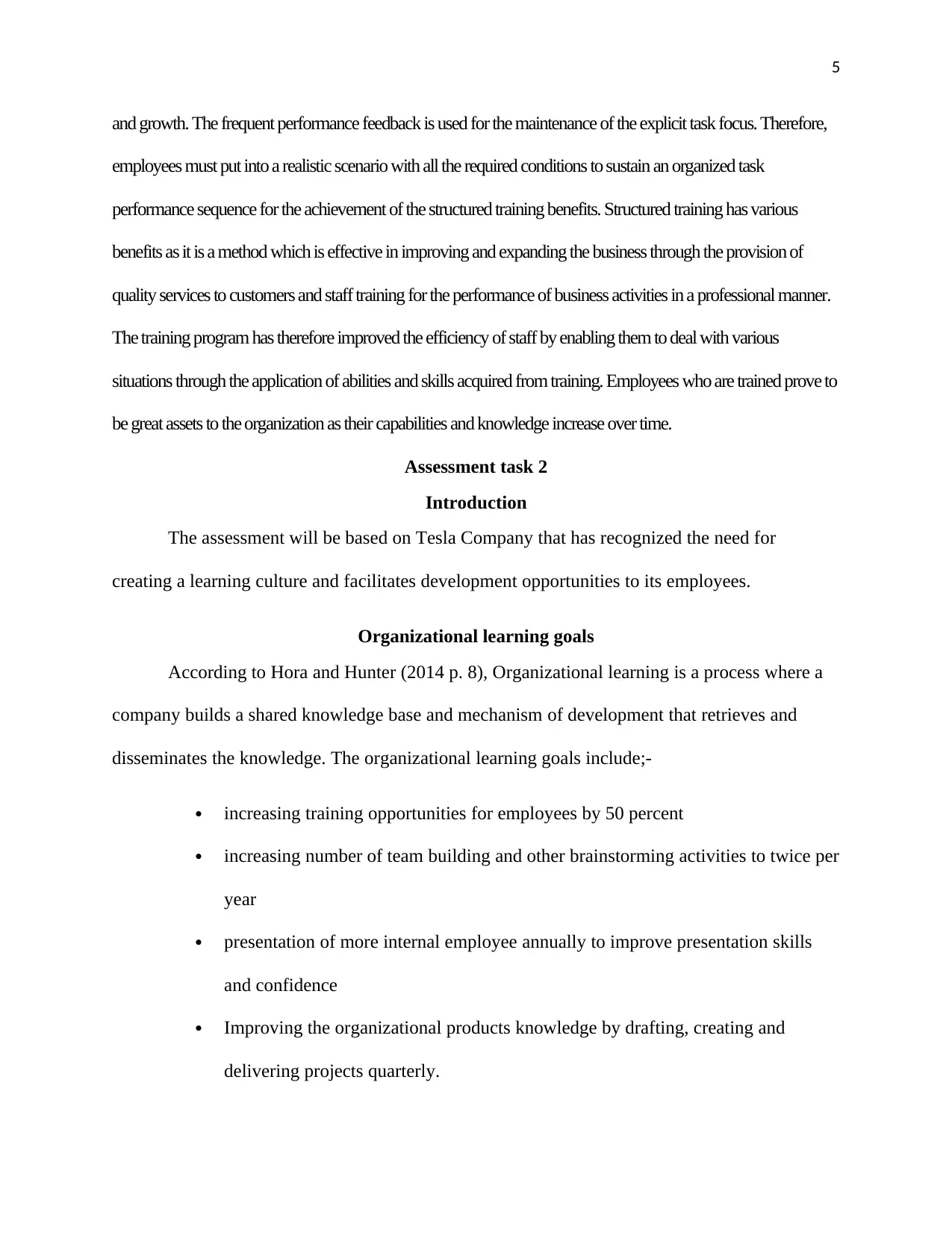
According to Hora and Hunter (2014 p. 8), Organizational learning is a process where a
company builds a shared knowledge base and mechanism of development that retrieves and
disseminates the knowledge. The organizational learning goals include;-
increasing training opportunities for employees by 50 percent
increasing number of team building and other brainstorming activities to twice per
year
presentation of more internal employee annually to improve presentation skills
and confidence
Improving the organizational products knowledge by drafting, creating and
delivering projects quarterly.
and growth. The frequent performance feedback is used for the maintenance of the explicit task focus. Therefore,
employees must put into a realistic scenario with all the required conditions to sustain an organized task
performance sequence for the achievement of the structured training benefits. Structured training has various
benefits as it is a method which is effective in improving and expanding the business through the provision of
quality services to customers and staff training for the performance of business activities in a professional manner.
The training program has therefore improved the efficiency of staff by enabling them to deal with various
situations through the application of abilities and skills acquired from training. Employees who are trained prove to
be great assets to the organization as their capabilities and knowledge increase over time.
Assessment task 2
Introduction
The assessment will be based on Tesla Company that has recognized the need for
creating a learning culture and facilitates development opportunities to its employees.
Organizational learning goals
According to Hora and Hunter (2014 p. 8), Organizational learning is a process where a
company builds a shared knowledge base and mechanism of development that retrieves and
disseminates the knowledge. The organizational learning goals include;-
increasing training opportunities for employees by 50 percent
increasing number of team building and other brainstorming activities to twice per
year
presentation of more internal employee annually to improve presentation skills
and confidence
Improving the organizational products knowledge by drafting, creating and
delivering projects quarterly.
6
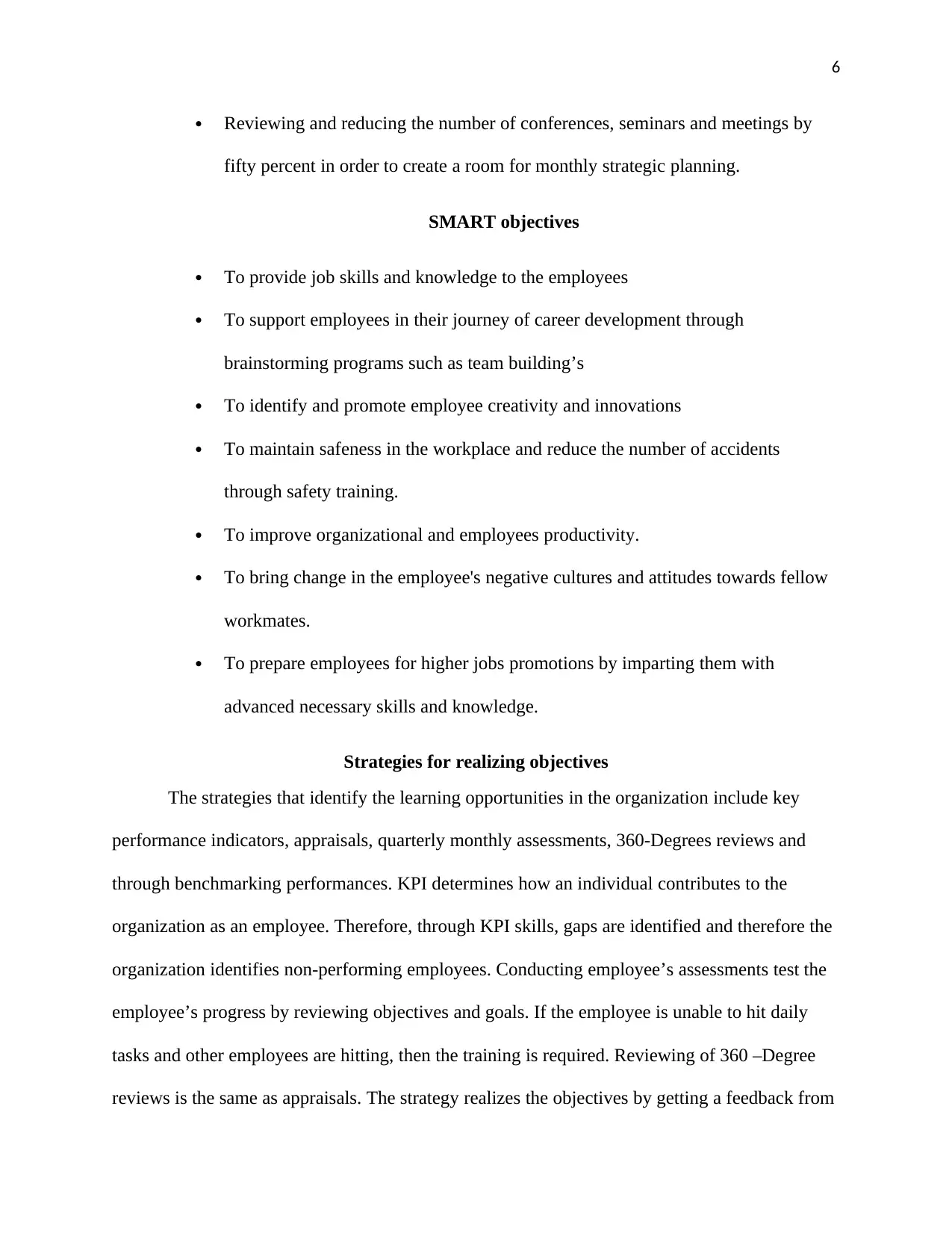
Reviewing and reducing the number of conferences, seminars and meetings by
fifty percent in order to create a room for monthly strategic planning.
SMART objectives
To provide job skills and knowledge to the employees
To support employees in their journey of career development through
brainstorming programs such as team building’s
To identify and promote employee creativity and innovations
To maintain safeness in the workplace and reduce the number of accidents
through safety training.
To improve organizational and employees productivity.
To bring change in the employee's negative cultures and attitudes towards fellow
workmates.
To prepare employees for higher jobs promotions by imparting them with
advanced necessary skills and knowledge.
Strategies for realizing objectives
The strategies that identify the learning opportunities in the organization include key
performance indicators, appraisals, quarterly monthly assessments, 360-Degrees reviews and
through benchmarking performances. KPI determines how an individual contributes to the
organization as an employee. Therefore, through KPI skills, gaps are identified and therefore the
organization identifies non-performing employees. Conducting employee’s assessments test the
employee’s progress by reviewing objectives and goals. If the employee is unable to hit daily
tasks and other employees are hitting, then the training is required. Reviewing of 360 –Degree
reviews is the same as appraisals. The strategy realizes the objectives by getting a feedback from
Reviewing and reducing the number of conferences, seminars and meetings by
fifty percent in order to create a room for monthly strategic planning.
SMART objectives
To provide job skills and knowledge to the employees
To support employees in their journey of career development through
brainstorming programs such as team building’s
To identify and promote employee creativity and innovations
To maintain safeness in the workplace and reduce the number of accidents
through safety training.
To improve organizational and employees productivity.
To bring change in the employee's negative cultures and attitudes towards fellow
workmates.
To prepare employees for higher jobs promotions by imparting them with
advanced necessary skills and knowledge.
Strategies for realizing objectives
The strategies that identify the learning opportunities in the organization include key
performance indicators, appraisals, quarterly monthly assessments, 360-Degrees reviews and
through benchmarking performances. KPI determines how an individual contributes to the
organization as an employee. Therefore, through KPI skills, gaps are identified and therefore the
organization identifies non-performing employees. Conducting employee’s assessments test the
employee’s progress by reviewing objectives and goals. If the employee is unable to hit daily
tasks and other employees are hitting, then the training is required. Reviewing of 360 –Degree
reviews is the same as appraisals. The strategy realizes the objectives by getting a feedback from
⊘ This is a preview!⊘
Do you want full access?
Subscribe today to unlock all pages.
Trusted by 1+ million students worldwide
7
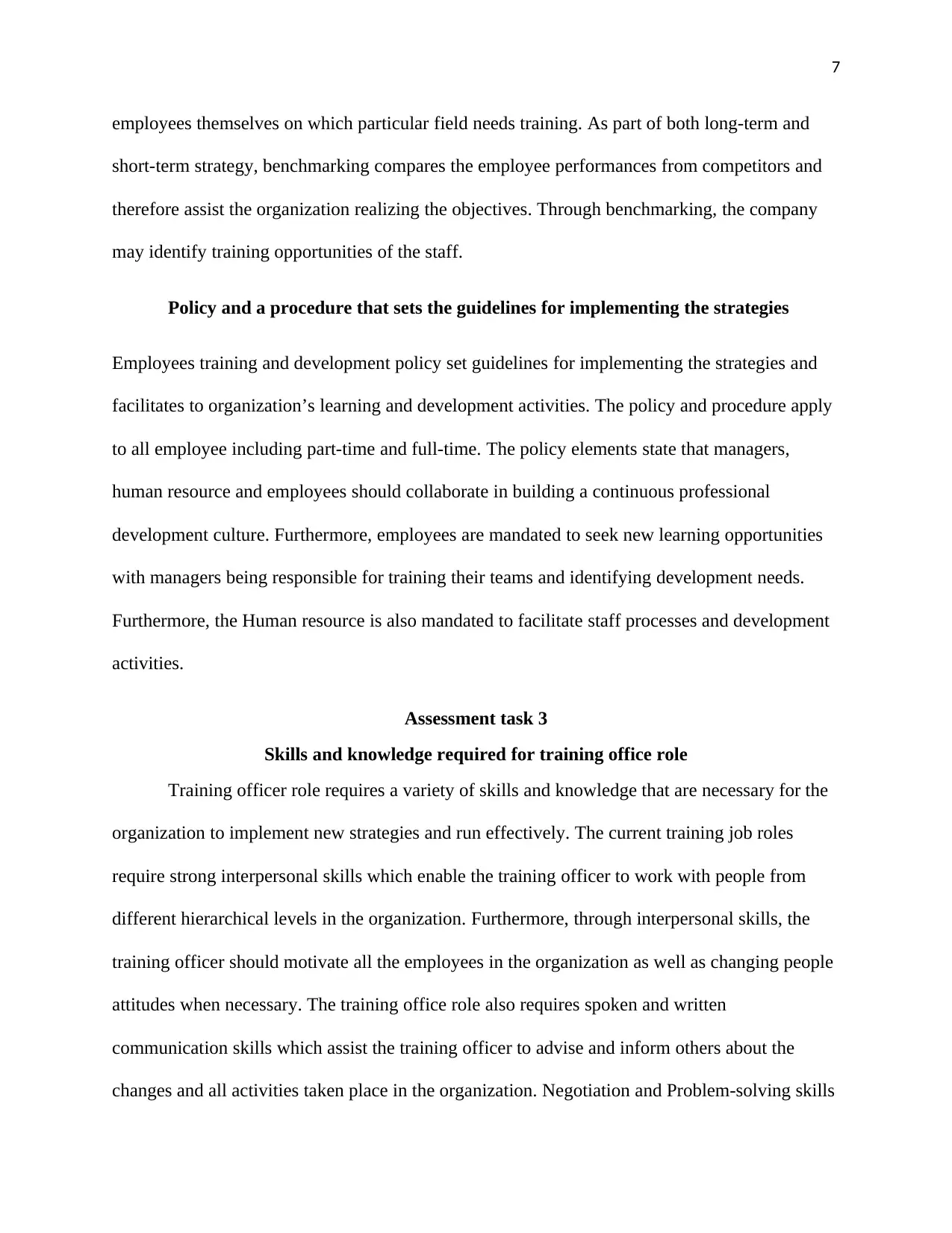
employees themselves on which particular field needs training. As part of both long-term and
short-term strategy, benchmarking compares the employee performances from competitors and
therefore assist the organization realizing the objectives. Through benchmarking, the company
may identify training opportunities of the staff.
Policy and a procedure that sets the guidelines for implementing the strategies
Employees training and development policy set guidelines for implementing the strategies and
facilitates to organization’s learning and development activities. The policy and procedure apply
to all employee including part-time and full-time. The policy elements state that managers,
human resource and employees should collaborate in building a continuous professional
development culture. Furthermore, employees are mandated to seek new learning opportunities
with managers being responsible for training their teams and identifying development needs.
Furthermore, the Human resource is also mandated to facilitate staff processes and development
activities.
Assessment task 3
Skills and knowledge required for training office role
Training officer role requires a variety of skills and knowledge that are necessary for the
organization to implement new strategies and run effectively. The current training job roles
require strong interpersonal skills which enable the training officer to work with people from
different hierarchical levels in the organization. Furthermore, through interpersonal skills, the
training officer should motivate all the employees in the organization as well as changing people
attitudes when necessary. The training office role also requires spoken and written
communication skills which assist the training officer to advise and inform others about the
changes and all activities taken place in the organization. Negotiation and Problem-solving skills
employees themselves on which particular field needs training. As part of both long-term and
short-term strategy, benchmarking compares the employee performances from competitors and
therefore assist the organization realizing the objectives. Through benchmarking, the company
may identify training opportunities of the staff.
Policy and a procedure that sets the guidelines for implementing the strategies
Employees training and development policy set guidelines for implementing the strategies and
facilitates to organization’s learning and development activities. The policy and procedure apply
to all employee including part-time and full-time. The policy elements state that managers,
human resource and employees should collaborate in building a continuous professional
development culture. Furthermore, employees are mandated to seek new learning opportunities
with managers being responsible for training their teams and identifying development needs.
Furthermore, the Human resource is also mandated to facilitate staff processes and development
activities.
Assessment task 3
Skills and knowledge required for training office role
Training officer role requires a variety of skills and knowledge that are necessary for the
organization to implement new strategies and run effectively. The current training job roles
require strong interpersonal skills which enable the training officer to work with people from
different hierarchical levels in the organization. Furthermore, through interpersonal skills, the
training officer should motivate all the employees in the organization as well as changing people
attitudes when necessary. The training office role also requires spoken and written
communication skills which assist the training officer to advise and inform others about the
changes and all activities taken place in the organization. Negotiation and Problem-solving skills
Paraphrase This Document
Need a fresh take? Get an instant paraphrase of this document with our AI Paraphraser
8
is another key skill for the job role. Ability to offer and initiate new ideas is also essential skills
for the role. The job role also requires planning and organizational knowledge and skills that
assist training officer and other employees to meet objectives, goals, targets, deadlines and
manage time. Furthermore, the role also requires good time-keeping skills that enable the
training officer to manage training schedules effectively.
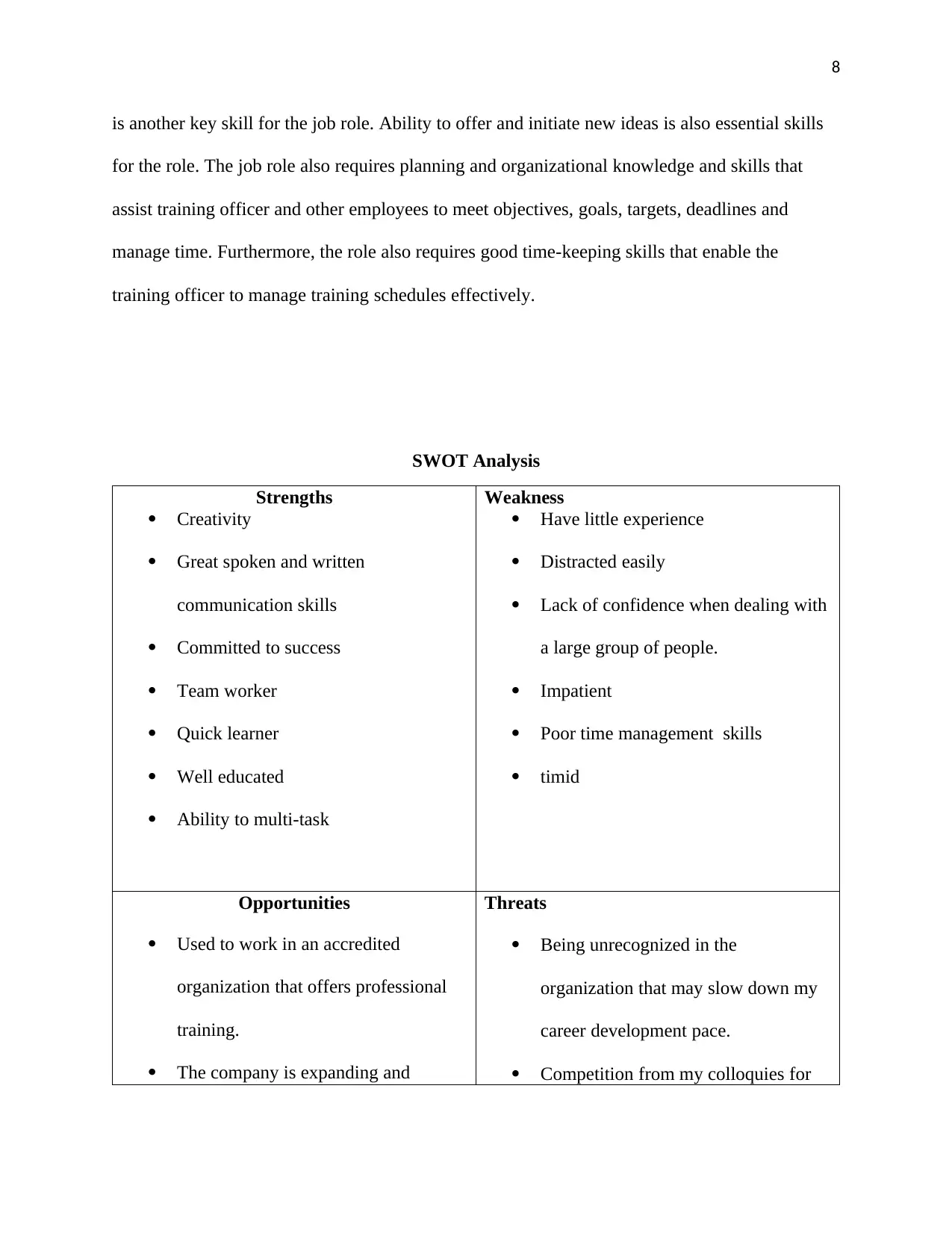
SWOT Analysis
Strengths
Creativity
Great spoken and written
communication skills
Committed to success
Team worker
Quick learner
Well educated
Ability to multi-task
Weakness
Have little experience
Distracted easily
Lack of confidence when dealing with
a large group of people.
Impatient
Poor time management skills
timid
Opportunities
Used to work in an accredited
organization that offers professional
training.
The company is expanding and
Threats
Being unrecognized in the
organization that may slow down my
career development pace.
Competition from my colloquies for
is another key skill for the job role. Ability to offer and initiate new ideas is also essential skills
for the role. The job role also requires planning and organizational knowledge and skills that
assist training officer and other employees to meet objectives, goals, targets, deadlines and
manage time. Furthermore, the role also requires good time-keeping skills that enable the
training officer to manage training schedules effectively.
SWOT Analysis
Strengths
Creativity
Great spoken and written
communication skills
Committed to success
Team worker
Quick learner
Well educated
Ability to multi-task
Weakness
Have little experience
Distracted easily
Lack of confidence when dealing with
a large group of people.
Impatient
Poor time management skills
timid
Opportunities
Used to work in an accredited
organization that offers professional
training.
The company is expanding and
Threats
Being unrecognized in the
organization that may slow down my
career development pace.
Competition from my colloquies for
9
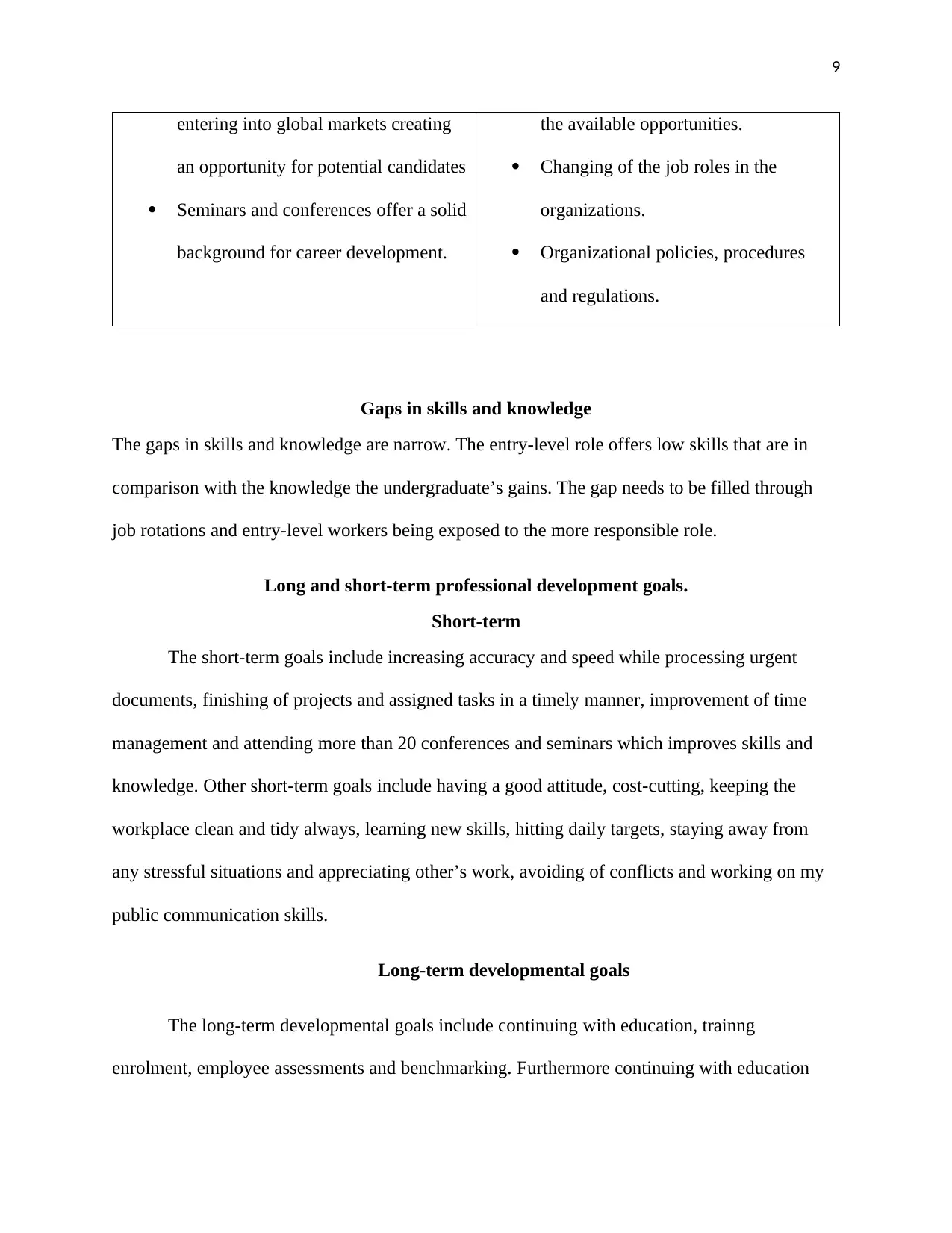
entering into global markets creating
an opportunity for potential candidates
Seminars and conferences offer a solid
background for career development.
the available opportunities.
Changing of the job roles in the
organizations.
Organizational policies, procedures
and regulations.
Gaps in skills and knowledge
The gaps in skills and knowledge are narrow. The entry-level role offers low skills that are in
comparison with the knowledge the undergraduate’s gains. The gap needs to be filled through
job rotations and entry-level workers being exposed to the more responsible role.
Long and short-term professional development goals.
Short-term
The short-term goals include increasing accuracy and speed while processing urgent
documents, finishing of projects and assigned tasks in a timely manner, improvement of time
management and attending more than 20 conferences and seminars which improves skills and
knowledge. Other short-term goals include having a good attitude, cost-cutting, keeping the
workplace clean and tidy always, learning new skills, hitting daily targets, staying away from
any stressful situations and appreciating other’s work, avoiding of conflicts and working on my
public communication skills.
Long-term developmental goals
The long-term developmental goals include continuing with education, trainng
enrolment, employee assessments and benchmarking. Furthermore continuing with education
entering into global markets creating
an opportunity for potential candidates
Seminars and conferences offer a solid
background for career development.
the available opportunities.
Changing of the job roles in the
organizations.
Organizational policies, procedures
and regulations.
Gaps in skills and knowledge
The gaps in skills and knowledge are narrow. The entry-level role offers low skills that are in
comparison with the knowledge the undergraduate’s gains. The gap needs to be filled through
job rotations and entry-level workers being exposed to the more responsible role.
Long and short-term professional development goals.
Short-term
The short-term goals include increasing accuracy and speed while processing urgent
documents, finishing of projects and assigned tasks in a timely manner, improvement of time
management and attending more than 20 conferences and seminars which improves skills and
knowledge. Other short-term goals include having a good attitude, cost-cutting, keeping the
workplace clean and tidy always, learning new skills, hitting daily targets, staying away from
any stressful situations and appreciating other’s work, avoiding of conflicts and working on my
public communication skills.
Long-term developmental goals
The long-term developmental goals include continuing with education, trainng
enrolment, employee assessments and benchmarking. Furthermore continuing with education
⊘ This is a preview!⊘
Do you want full access?
Subscribe today to unlock all pages.
Trusted by 1+ million students worldwide
10
also involves enrolling in formal masters, degree and Ph.D. programs and workshops.
Enrollment in training programs is also another long-term goal that involves attending
international, regional and local meetings and conferences. Furthermore, the developmental goal
also involves serving as a board member, officer or committee member. Improvement in job
performance is also a long-term goal that is accomplished by keeping up with technology,
processes, systems, learning of new skills in the training field and improving the current skills.
Other long-term goals include increasing duties and responsibilities and developing leadership
capabilities.
References
Cummings, T. G., & Worley, C. G. (2014). Organization development and change. Cengage
learning.
Hora, M.T., Hunter, A. (2014). Exploring the dynamics of organizational learning: identifying
the decision chains science and math faculty use to plan and teach undergraduate courses.
International Journal of STEM education, 2014(1), p.8
also involves enrolling in formal masters, degree and Ph.D. programs and workshops.
Enrollment in training programs is also another long-term goal that involves attending
international, regional and local meetings and conferences. Furthermore, the developmental goal
also involves serving as a board member, officer or committee member. Improvement in job
performance is also a long-term goal that is accomplished by keeping up with technology,
processes, systems, learning of new skills in the training field and improving the current skills.
Other long-term goals include increasing duties and responsibilities and developing leadership
capabilities.
References
Cummings, T. G., & Worley, C. G. (2014). Organization development and change. Cengage
learning.
Hora, M.T., Hunter, A. (2014). Exploring the dynamics of organizational learning: identifying
the decision chains science and math faculty use to plan and teach undergraduate courses.
International Journal of STEM education, 2014(1), p.8

1 out of 10


Related Documents


Your All-in-One AI-Powered Toolkit for Academic Success.
+13062052269
info@desklib.com
Available 24*7 on WhatsApp / Email
![[object Object]](/_next/static/media/star-bottom.7253800d.svg)
Unlock your academic potential
Copyright © 2020–2026 A2Z Services. All Rights Reserved. Developed and managed by ZUCOL.