BSBMGT517 Manage Operational Plans: Solved Written Questions APSI
VerifiedAdded on 2023/06/10
|41
|7758
|69
Homework Assignment
AI Summary
This document presents solutions to written questions for the BSBMGT517 Manage Operational Plans unit from the Australian Professional Skills Institute (APSI). It covers key aspects of operational plan development and implementation, including the steps to develop an operational plan, analyzing resource requirements (funding, organizational structure, physical resources), involving stakeholders in the planning process, and measuring organizational performance. The solutions provide detailed explanations and examples related to target setting, resource allocation, stakeholder engagement, and performance measurement, offering valuable insights for students studying business services and management.
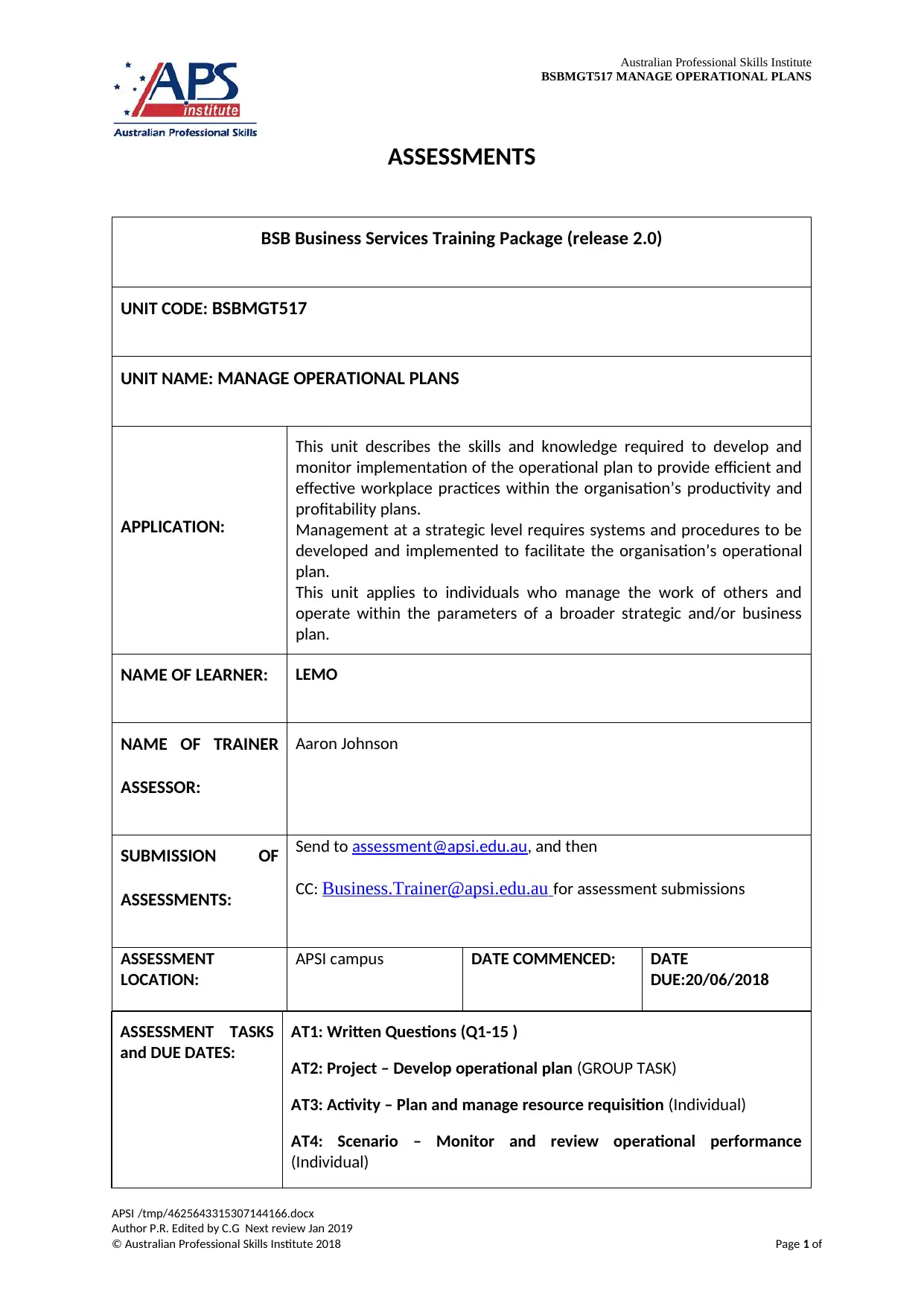
Australian Professional Skills Institute
BSBMGT517 MANAGE OPERATIONAL PLANS
ASSESSMENTS
BSB Business Services Training Package (release 2.0)
UNIT CODE: BSBMGT517
UNIT NAME: MANAGE OPERATIONAL PLANS
APPLICATION:
This unit describes the skills and knowledge required to develop and
monitor implementation of the operational plan to provide efficient and
effective workplace practices within the organisation’s productivity and
profitability plans.
Management at a strategic level requires systems and procedures to be
developed and implemented to facilitate the organisation’s operational
plan.
This unit applies to individuals who manage the work of others and
operate within the parameters of a broader strategic and/or business
plan.
NAME OF LEARNER: LEMO
NAME OF TRAINER
ASSESSOR:
Aaron Johnson
SUBMISSION OF
ASSESSMENTS:
Send to assessment@apsi.edu.au, and then
CC: Business.Trainer@apsi.edu.au for assessment submissions
ASSESSMENT
LOCATION:
APSI campus DATE COMMENCED: DATE
DUE:20/06/2018
ASSESSMENT TASKS
and DUE DATES:
AT1: Written Questions (Q1-15 )
AT2: Project – Develop operational plan (GROUP TASK)
AT3: Activity – Plan and manage resource requisition (Individual)
AT4: Scenario – Monitor and review operational performance
(Individual)
APSI /tmp/4625643315307144166.docx
Author P.R. Edited by C.G Next review Jan 2019
© Australian Professional Skills Institute 2018 Page 1 of
BSBMGT517 MANAGE OPERATIONAL PLANS
ASSESSMENTS
BSB Business Services Training Package (release 2.0)
UNIT CODE: BSBMGT517
UNIT NAME: MANAGE OPERATIONAL PLANS
APPLICATION:
This unit describes the skills and knowledge required to develop and
monitor implementation of the operational plan to provide efficient and
effective workplace practices within the organisation’s productivity and
profitability plans.
Management at a strategic level requires systems and procedures to be
developed and implemented to facilitate the organisation’s operational
plan.
This unit applies to individuals who manage the work of others and
operate within the parameters of a broader strategic and/or business
plan.
NAME OF LEARNER: LEMO
NAME OF TRAINER
ASSESSOR:
Aaron Johnson
SUBMISSION OF
ASSESSMENTS:
Send to assessment@apsi.edu.au, and then
CC: Business.Trainer@apsi.edu.au for assessment submissions
ASSESSMENT
LOCATION:
APSI campus DATE COMMENCED: DATE
DUE:20/06/2018
ASSESSMENT TASKS
and DUE DATES:
AT1: Written Questions (Q1-15 )
AT2: Project – Develop operational plan (GROUP TASK)
AT3: Activity – Plan and manage resource requisition (Individual)
AT4: Scenario – Monitor and review operational performance
(Individual)
APSI /tmp/4625643315307144166.docx
Author P.R. Edited by C.G Next review Jan 2019
© Australian Professional Skills Institute 2018 Page 1 of

Paraphrase This Document
Need a fresh take? Get an instant paraphrase of this document with our AI Paraphraser
Australian Professional Skills Institute
BSBMGT517 MANAGE OPERATIONAL PLANS
Verbal questions may be asked to ensure your work is your own and
represents your knowledge. If there is a concern regarding your
knowledge you may be asked to resit written questions under test
conditions.
All assessments are to be submitted the by due date and satisfactorily
completed in order for competency in this unit to be demonstrated. If
you believe you already have the skills and knowledge in this unit
please speak to your Trainer Assessor.
UNIT AND
ASSESSMENT
DETAILS:
If you would like a copy of the mapping document that outlines this
Unit of Competency and the Performance Criteria, Critical Aspects and
Essential Knowledge and Skills required to be demonstrated please
refer to the Learner Drive.
For further information that relates to assessments please refer back to
your Learner Handbook on the Learner Drive.
ASSESSMENTS
GUIDELINES:
It is your responsibility to keep a second copy of your assessments.
Australian Professional Skills Institute does not take responsibility for
lost or stolen assessments. Australian Professional Skills Institute
reserves the right to request a copy of your original assessment at any
time after you have submitted your assessment. Students MUST keep a
copy of their submitted assessment by using the assessment record
sheet on the back of their timetable, or the confirmation email as a
proof of submission.
LATE SUBMISSION OF
ASSESSMENTS:
$25 PER
ASSESSMENT PER
WEEK
Your delivery plan / timetable prescribes when each assessment is due
for each Unit of Competence. If you submit your assessments later
than the due date you will be required to pay the stated late
assessment fee at Student Services. You will receive a receipt which you
must attach to the assessment before it will be marked. Assessments
submitted eight weeks or longer after the due date will not marked and
you will be required to re-sit the relevant unit(s).
UNIT RE-
ASSESSMENT FEE:
$150 PER UNIT
If your first submission was marked Not Yet Satisfactory, you will be
given the opportunity to resubmit your assessment without any fees.
After two submissions and you are still deemed not yet satisfactory you
are required to pay a re-assessment fee. Students whose participation
in class is 80% or higher will not be required to pay a re-assessment fee
and where students have shown a genuine effort to perform
satisfactorily. If you are absent on the date of assessment, you are
APSI /tmp/4625643315307144166.docx
Author P.R. Edited by C.G Next review Jan 2019
© Australian Professional Skills Institute 2018 Page 2 of
BSBMGT517 MANAGE OPERATIONAL PLANS
Verbal questions may be asked to ensure your work is your own and
represents your knowledge. If there is a concern regarding your
knowledge you may be asked to resit written questions under test
conditions.
All assessments are to be submitted the by due date and satisfactorily
completed in order for competency in this unit to be demonstrated. If
you believe you already have the skills and knowledge in this unit
please speak to your Trainer Assessor.
UNIT AND
ASSESSMENT
DETAILS:
If you would like a copy of the mapping document that outlines this
Unit of Competency and the Performance Criteria, Critical Aspects and
Essential Knowledge and Skills required to be demonstrated please
refer to the Learner Drive.
For further information that relates to assessments please refer back to
your Learner Handbook on the Learner Drive.
ASSESSMENTS
GUIDELINES:
It is your responsibility to keep a second copy of your assessments.
Australian Professional Skills Institute does not take responsibility for
lost or stolen assessments. Australian Professional Skills Institute
reserves the right to request a copy of your original assessment at any
time after you have submitted your assessment. Students MUST keep a
copy of their submitted assessment by using the assessment record
sheet on the back of their timetable, or the confirmation email as a
proof of submission.
LATE SUBMISSION OF
ASSESSMENTS:
$25 PER
ASSESSMENT PER
WEEK
Your delivery plan / timetable prescribes when each assessment is due
for each Unit of Competence. If you submit your assessments later
than the due date you will be required to pay the stated late
assessment fee at Student Services. You will receive a receipt which you
must attach to the assessment before it will be marked. Assessments
submitted eight weeks or longer after the due date will not marked and
you will be required to re-sit the relevant unit(s).
UNIT RE-
ASSESSMENT FEE:
$150 PER UNIT
If your first submission was marked Not Yet Satisfactory, you will be
given the opportunity to resubmit your assessment without any fees.
After two submissions and you are still deemed not yet satisfactory you
are required to pay a re-assessment fee. Students whose participation
in class is 80% or higher will not be required to pay a re-assessment fee
and where students have shown a genuine effort to perform
satisfactorily. If you are absent on the date of assessment, you are
APSI /tmp/4625643315307144166.docx
Author P.R. Edited by C.G Next review Jan 2019
© Australian Professional Skills Institute 2018 Page 2 of
Australian Professional Skills Institute
BSBMGT517 MANAGE OPERATIONAL PLANS
required to pay the unit re-assessment fee unless you present a valid
medical certificate for the day of the assessment. Fees are payable at
Student Services and you are required to produce an official receipt
before your trainer will conduct the re-assessment.
UNIT RESIT FEE:
$300 PER UNIT
Competency requires demonstration of current performance; therefore
assessments MUST be submitted within five (5) weeks of the Unit being
completed. If you have not submitted your assessments or re-
assessment you will be deemed Not Yet Competent for that unit and
will be required to re-enrol in the unit. You are also required to re-enrol
in this unit if you are absent on the delivery dates of this unit. A
separate timetable will be given to you upon payment of the required
fees at Student Services.
CODE OF CONDUCT: Academic Dishonesty / Collusion and Plagiarism
You must ensure that the evidence you submit for assessment is your
own work, and/or that you acknowledge the work of others
appropriately (see referencing guide). In an educational environment
cheating means to act dishonestly in an attempt to mislead the
Trainer/Assessor to accept the work of others as your own work.
SIGNATURE OF
LEARNER:
LEMO
DATE:
25/06/2018
APSI /tmp/4625643315307144166.docx
Author P.R. Edited by C.G Next review Jan 2019
© Australian Professional Skills Institute 2018 Page 3 of
BSBMGT517 MANAGE OPERATIONAL PLANS
required to pay the unit re-assessment fee unless you present a valid
medical certificate for the day of the assessment. Fees are payable at
Student Services and you are required to produce an official receipt
before your trainer will conduct the re-assessment.
UNIT RESIT FEE:
$300 PER UNIT
Competency requires demonstration of current performance; therefore
assessments MUST be submitted within five (5) weeks of the Unit being
completed. If you have not submitted your assessments or re-
assessment you will be deemed Not Yet Competent for that unit and
will be required to re-enrol in the unit. You are also required to re-enrol
in this unit if you are absent on the delivery dates of this unit. A
separate timetable will be given to you upon payment of the required
fees at Student Services.
CODE OF CONDUCT: Academic Dishonesty / Collusion and Plagiarism
You must ensure that the evidence you submit for assessment is your
own work, and/or that you acknowledge the work of others
appropriately (see referencing guide). In an educational environment
cheating means to act dishonestly in an attempt to mislead the
Trainer/Assessor to accept the work of others as your own work.
SIGNATURE OF
LEARNER:
LEMO
DATE:
25/06/2018
APSI /tmp/4625643315307144166.docx
Author P.R. Edited by C.G Next review Jan 2019
© Australian Professional Skills Institute 2018 Page 3 of
⊘ This is a preview!⊘
Do you want full access?
Subscribe today to unlock all pages.

Trusted by 1+ million students worldwide
Australian Professional Skills Institute
BSBMGT517 MANAGE OPERATIONAL PLANS
AT 1 Assessment 1: Written Questions (Individual Task)
Assessment
instructions:
You are required to answer the questions outlined
below. All questions must be answered satisfactorily,
as partial responses will be deemed unsatisfactory. The
answers will be used in conjunction with other forms of
evidence in the final assessment decision. If you do
not wish to answer the questions in written format, an
interview may be used as an alternative approach if
negotiated with your Trainer Assessor.
Not Yet Satisfactory
Satisfactory
Learner resources
required:
To complete this assessment task you will require:
The questions response section
Learner Guide and/or internet access
Q:1 What must you do prior to developing an operational plan? Explain
each action:
NYS
S
APSI /tmp/4625643315307144166.docx
Author P.R. Edited by C.G Next review Jan 2019
© Australian Professional Skills Institute 2018 Page 4 of
BSBMGT517 MANAGE OPERATIONAL PLANS
AT 1 Assessment 1: Written Questions (Individual Task)
Assessment
instructions:
You are required to answer the questions outlined
below. All questions must be answered satisfactorily,
as partial responses will be deemed unsatisfactory. The
answers will be used in conjunction with other forms of
evidence in the final assessment decision. If you do
not wish to answer the questions in written format, an
interview may be used as an alternative approach if
negotiated with your Trainer Assessor.
Not Yet Satisfactory
Satisfactory
Learner resources
required:
To complete this assessment task you will require:
The questions response section
Learner Guide and/or internet access
Q:1 What must you do prior to developing an operational plan? Explain
each action:
NYS
S
APSI /tmp/4625643315307144166.docx
Author P.R. Edited by C.G Next review Jan 2019
© Australian Professional Skills Institute 2018 Page 4 of
Paraphrase This Document
Need a fresh take? Get an instant paraphrase of this document with our AI Paraphraser
Australian Professional Skills Institute
BSBMGT517 MANAGE OPERATIONAL PLANS
A: The operations managers should follow the below-mentioned steps
while forming operational plans:
Step 1: The operations managers should consider the target assigned to
the departments they are heading. The target can consist of sales target,
generation of outstanding amount from debtors and improving the
employee competencies to a higher level1.
Step 2: They must communicate the target to their subordinates. The
operations managers must communicate the targets to their subordinate
employees and encourage them to participate in making plans to achieve
the targets assigned2.
Step 3: The operations managers should breakdown the target into
smaller parts like the portion of the target which the team under them
should achieve with a particular week. This break down would enable
the managers to monitor and control the achievement of the targets. This
would also enable them take steps to ensure targets if the same are not
achieved within the target time.
Step 4: The operation managers should assign the portions of the total
target to appropriate team members. The senior members of the team
should be assigned more targets while the new members should be
assigned less target. The target assigned to individual employee should
be realistic and achievable.
Step 5: The operation manager should maintain record of the targets1 Haksever, Cengiz, and Barry Render. "Service and Operations Management." World Scientific
Books (2018).
2 Hitt, Michael A., Kai Xu, and Christina Matz Carnes. "Resource based theory in operations
management research." Journal of Operations Management 41 (2016): 77-94.
APSI /tmp/4625643315307144166.docx
Author P.R. Edited by C.G Next review Jan 2019
© Australian Professional Skills Institute 2018 Page 5 of
BSBMGT517 MANAGE OPERATIONAL PLANS
A: The operations managers should follow the below-mentioned steps
while forming operational plans:
Step 1: The operations managers should consider the target assigned to
the departments they are heading. The target can consist of sales target,
generation of outstanding amount from debtors and improving the
employee competencies to a higher level1.
Step 2: They must communicate the target to their subordinates. The
operations managers must communicate the targets to their subordinate
employees and encourage them to participate in making plans to achieve
the targets assigned2.
Step 3: The operations managers should breakdown the target into
smaller parts like the portion of the target which the team under them
should achieve with a particular week. This break down would enable
the managers to monitor and control the achievement of the targets. This
would also enable them take steps to ensure targets if the same are not
achieved within the target time.
Step 4: The operation managers should assign the portions of the total
target to appropriate team members. The senior members of the team
should be assigned more targets while the new members should be
assigned less target. The target assigned to individual employee should
be realistic and achievable.
Step 5: The operation manager should maintain record of the targets1 Haksever, Cengiz, and Barry Render. "Service and Operations Management." World Scientific
Books (2018).
2 Hitt, Michael A., Kai Xu, and Christina Matz Carnes. "Resource based theory in operations
management research." Journal of Operations Management 41 (2016): 77-94.
APSI /tmp/4625643315307144166.docx
Author P.R. Edited by C.G Next review Jan 2019
© Australian Professional Skills Institute 2018 Page 5 of
Australian Professional Skills Institute
BSBMGT517 MANAGE OPERATIONAL PLANS
Q:2 What would you need to consider when analysing resource requirements
for your operational plan? (Consider more than the budget)
the
S
3 Smith, Laura, Roger Maull, and Irene CL Ng. "Servitization and operations management: a service
dominant-logic approach." International Journal of Operations & Production Management 34.2 (2014):
242-269.
APSI /tmp/4625643315307144166.docx
Author P.R. Edited by C.G Next review Jan 2019
© Australian Professional Skills Institute 2018 Page 6 of
BSBMGT517 MANAGE OPERATIONAL PLANS
Q:2 What would you need to consider when analysing resource requirements
for your operational plan? (Consider more than the budget)
the
S
3 Smith, Laura, Roger Maull, and Irene CL Ng. "Servitization and operations management: a service
dominant-logic approach." International Journal of Operations & Production Management 34.2 (2014):
242-269.
APSI /tmp/4625643315307144166.docx
Author P.R. Edited by C.G Next review Jan 2019
© Australian Professional Skills Institute 2018 Page 6 of
⊘ This is a preview!⊘
Do you want full access?
Subscribe today to unlock all pages.
Trusted by 1+ million students worldwide
Australian Professional Skills Institute
BSBMGT517 MANAGE OPERATIONAL PLANS
A: Funding:
The operation managers should take into account the amount of
financial investment operations may attract and also recognize the
sources from where the company can source the estimated funds.
Organizational structure:
The managers should take into account the structure of the organizations
and their implications on the decision making. They should consider
factors like the size of the organizations, their areas of business and
present operational capabilities.
Organizational attributes:
Operational managers should consider the personnel aspects of the
organization. The personnel aspects should encompass the key
personnel of the organizations under question, the current team of staff
which the organizations have, their specialization and allocation of jobs
to them. They operational managers while exploring the personnel
factors should take into account the relationships between employees
and areas of control of each employee4.
Physical resources:
The operational managers should consider the physical resources which
the companies under question hold at a given point of time. The
resources include raw materials, finished goods, technology and
research and development facilities.
4 Bromiley, Philip, and Devaki Rau. "Operations management and the resource based view: Another
view." Journal of Operations Management 41 (2016): 95-106.
APSI /tmp/4625643315307144166.docx
Author P.R. Edited by C.G Next review Jan 2019
© Australian Professional Skills Institute 2018 Page 7 of
BSBMGT517 MANAGE OPERATIONAL PLANS
A: Funding:
The operation managers should take into account the amount of
financial investment operations may attract and also recognize the
sources from where the company can source the estimated funds.
Organizational structure:
The managers should take into account the structure of the organizations
and their implications on the decision making. They should consider
factors like the size of the organizations, their areas of business and
present operational capabilities.
Organizational attributes:
Operational managers should consider the personnel aspects of the
organization. The personnel aspects should encompass the key
personnel of the organizations under question, the current team of staff
which the organizations have, their specialization and allocation of jobs
to them. They operational managers while exploring the personnel
factors should take into account the relationships between employees
and areas of control of each employee4.
Physical resources:
The operational managers should consider the physical resources which
the companies under question hold at a given point of time. The
resources include raw materials, finished goods, technology and
research and development facilities.
4 Bromiley, Philip, and Devaki Rau. "Operations management and the resource based view: Another
view." Journal of Operations Management 41 (2016): 95-106.
APSI /tmp/4625643315307144166.docx
Author P.R. Edited by C.G Next review Jan 2019
© Australian Professional Skills Institute 2018 Page 7 of
Paraphrase This Document
Need a fresh take? Get an instant paraphrase of this document with our AI Paraphraser
Australian Professional Skills Institute
BSBMGT517 MANAGE OPERATIONAL PLANS
Q:3 In what areas of planning should you involve others in the planning
process? (Consider WHO you would involve and in WHAT parts of
your plan)
The
S
APSI /tmp/4625643315307144166.docx
Author P.R. Edited by C.G Next review Jan 2019
© Australian Professional Skills Institute 2018 Page 8 of
BSBMGT517 MANAGE OPERATIONAL PLANS
Q:3 In what areas of planning should you involve others in the planning
process? (Consider WHO you would involve and in WHAT parts of
your plan)
The
S
APSI /tmp/4625643315307144166.docx
Author P.R. Edited by C.G Next review Jan 2019
© Australian Professional Skills Institute 2018 Page 8 of
Australian Professional Skills Institute
BSBMGT517 MANAGE OPERATIONAL PLANS
A Operational plans give directions to the different areas which have to be
covered in order to achieve the goal and also points out the involvement
pattern of different individuals in the project. The operations managers
should consider involving different stakeholders at different point of
time. For example, the operational managers should involve the
customers in the initial product development part or phase. They
should consider the feedback from customers to form the product
strategy.
The operations manager should involve the project team in forming the
project plan like the raw materials which would be required to
manufacture the product, the stock of raw materials already in inventory
and the raw materials which have to be acquired and formation of
project budgets. Thus, at this phase the project managers should involve
their teams of subordinates.
The third stage should involve gaining approval form the management
and the other related departments like the finance department. This
analysis shows that at this stage the stakeholders involved would consist
of the apex management and the middle level management.
The fourth stage in managing the operations would be acquisition of
the raw materials. Thus, it can be pointed out that the operations at this
stage have to contribution from the suppliers. It can also be pointed the
operations managers at this also require involving the logistic chains
which would supply the raw materials.
The fifth stage would involve production of finished goods which
APSI /tmp/4625643315307144166.docx
Author P.R. Edited by C.G Next review Jan 2019
© Australian Professional Skills Institute 2018 Page 9 of
BSBMGT517 MANAGE OPERATIONAL PLANS
A Operational plans give directions to the different areas which have to be
covered in order to achieve the goal and also points out the involvement
pattern of different individuals in the project. The operations managers
should consider involving different stakeholders at different point of
time. For example, the operational managers should involve the
customers in the initial product development part or phase. They
should consider the feedback from customers to form the product
strategy.
The operations manager should involve the project team in forming the
project plan like the raw materials which would be required to
manufacture the product, the stock of raw materials already in inventory
and the raw materials which have to be acquired and formation of
project budgets. Thus, at this phase the project managers should involve
their teams of subordinates.
The third stage should involve gaining approval form the management
and the other related departments like the finance department. This
analysis shows that at this stage the stakeholders involved would consist
of the apex management and the middle level management.
The fourth stage in managing the operations would be acquisition of
the raw materials. Thus, it can be pointed out that the operations at this
stage have to contribution from the suppliers. It can also be pointed the
operations managers at this also require involving the logistic chains
which would supply the raw materials.
The fifth stage would involve production of finished goods which
APSI /tmp/4625643315307144166.docx
Author P.R. Edited by C.G Next review Jan 2019
© Australian Professional Skills Institute 2018 Page 9 of
⊘ This is a preview!⊘
Do you want full access?
Subscribe today to unlock all pages.
Trusted by 1+ million students worldwide
Australian Professional Skills Institute
BSBMGT517 MANAGE OPERATIONAL PLANS
Q:4 What should you include in your plan to help measure organisational
performance? (Be specific as to HOW you measure performance)
The
S
5 Walker, Helen, et al. "Theoretical perspectives in operations management: an analysis of the
literature." International Journal of Operations & Production Management 35.8 (2015): 1182-1206.
APSI /tmp/4625643315307144166.docx
Author P.R. Edited by C.G Next review Jan 2019
© Australian Professional Skills Institute 2018 Page 10 of
BSBMGT517 MANAGE OPERATIONAL PLANS
Q:4 What should you include in your plan to help measure organisational
performance? (Be specific as to HOW you measure performance)
The
S
5 Walker, Helen, et al. "Theoretical perspectives in operations management: an analysis of the
literature." International Journal of Operations & Production Management 35.8 (2015): 1182-1206.
APSI /tmp/4625643315307144166.docx
Author P.R. Edited by C.G Next review Jan 2019
© Australian Professional Skills Institute 2018 Page 10 of
Paraphrase This Document
Need a fresh take? Get an instant paraphrase of this document with our AI Paraphraser
Australian Professional Skills Institute
BSBMGT517 MANAGE OPERATIONAL PLANS
A: The operations managers should include the following aspects to
measure the performance of the organisations they are employed with:
1. Organisational vision:
The operational managers should take into account the bench marks
which the organisation looks forward to achieve in the short and long
run. The short run aim can be earning higher profits while the long term
goals can consist of achieving higher market position. The companies in
the long run also aim to achieve higher degree of customer satisfaction
with each passing year.
2. Organisational mission:
The operational managers should take into account the mission which
the organisation seek to achieve, like customer satisfaction and profits.
3. Business objective:
The business objective can consist of bringing about changes which
would optimise the operations of the organisation. For example,
increasing the target profit to be achieved in the coming year6.
Key Performance Indicators:
The business organisation must set the key performance indicators
which the employees have to achieve in the course of actions. The KPIs
should mention but not remain limited to profit generation alone. It
should also include objectives like minimising of errors, minimising
wastage of resources and increasing repeat business besides new6 Brandon-Jones, Alistair, et al. "Towards a contingent understanding of the characteristics and
managerial challenges of management consultancy operations." Journal of Operations Management,
Vols (2016): 42-43.
APSI /tmp/4625643315307144166.docx
Author P.R. Edited by C.G Next review Jan 2019
© Australian Professional Skills Institute 2018 Page 11 of
BSBMGT517 MANAGE OPERATIONAL PLANS
A: The operations managers should include the following aspects to
measure the performance of the organisations they are employed with:
1. Organisational vision:
The operational managers should take into account the bench marks
which the organisation looks forward to achieve in the short and long
run. The short run aim can be earning higher profits while the long term
goals can consist of achieving higher market position. The companies in
the long run also aim to achieve higher degree of customer satisfaction
with each passing year.
2. Organisational mission:
The operational managers should take into account the mission which
the organisation seek to achieve, like customer satisfaction and profits.
3. Business objective:
The business objective can consist of bringing about changes which
would optimise the operations of the organisation. For example,
increasing the target profit to be achieved in the coming year6.
Key Performance Indicators:
The business organisation must set the key performance indicators
which the employees have to achieve in the course of actions. The KPIs
should mention but not remain limited to profit generation alone. It
should also include objectives like minimising of errors, minimising
wastage of resources and increasing repeat business besides new6 Brandon-Jones, Alistair, et al. "Towards a contingent understanding of the characteristics and
managerial challenges of management consultancy operations." Journal of Operations Management,
Vols (2016): 42-43.
APSI /tmp/4625643315307144166.docx
Author P.R. Edited by C.G Next review Jan 2019
© Australian Professional Skills Institute 2018 Page 11 of

Australian Professional Skills Institute
BSBMGT517 MANAGE OPERATIONAL PLANS
Q:5 How can you minimise the impact of unforeseen circumstances?
(WHAT strategy would you use, HOW will it minimize impact)
NYS
S
APSI /tmp/4625643315307144166.docx
Author P.R. Edited by C.G Next review Jan 2019
© Australian Professional Skills Institute 2018 Page 12 of
BSBMGT517 MANAGE OPERATIONAL PLANS
Q:5 How can you minimise the impact of unforeseen circumstances?
(WHAT strategy would you use, HOW will it minimize impact)
NYS
S
APSI /tmp/4625643315307144166.docx
Author P.R. Edited by C.G Next review Jan 2019
© Australian Professional Skills Institute 2018 Page 12 of
⊘ This is a preview!⊘
Do you want full access?
Subscribe today to unlock all pages.
Trusted by 1+ million students worldwide

1 out of 41


Related Documents


Your All-in-One AI-Powered Toolkit for Academic Success.
+13062052269
info@desklib.com
Available 24*7 on WhatsApp / Email
![[object Object]](/_next/static/media/star-bottom.7253800d.svg)
Unlock your academic potential
Copyright © 2020–2026 A2Z Services. All Rights Reserved. Developed and managed by ZUCOL.