BSBMGT608: Manage Innovation and Continuous Improvement Project Report
VerifiedAdded on 2022/10/11
|29
|5614
|11
Project
AI Summary
This comprehensive project report for BSBMGT608 focuses on managing innovation and continuous improvement within Woodhouse Recruitment. The project addresses various aspects including cost-benefit analysis, creativity theories, diffusion of innovation, learning organizations, and quality management. It explores concepts such as shared vision, team learning, and the implications of Kotter's 8-step change model. The report also covers ISO 9000 standards, risk management, and sustainability practices. Furthermore, it analyzes Woodhouse Recruitment's supply chain, operations, and delivery systems, proposing strategies for continuous improvement through social media and sustainability programs. The project includes detailed assessments, email communications, and action plans to enhance the agency's performance, competitiveness, and sustainable business practices. It also includes an implementation review and supporting documents like a presentation.
Running head: MANAGE INNOVATION AND CONTINUOUS IMPROVEMENT
BSBMGT608 Manage Innovation and Continuous Improvement
Name of the Student:
Name of the University:
BSBMGT608 Manage Innovation and Continuous Improvement
Name of the Student:
Name of the University:

Paraphrase This Document
Need a fresh take? Get an instant paraphrase of this document with our AI Paraphraser
1MANAGE INNOVATION AND CONTINUOUS IMPROVEMENT
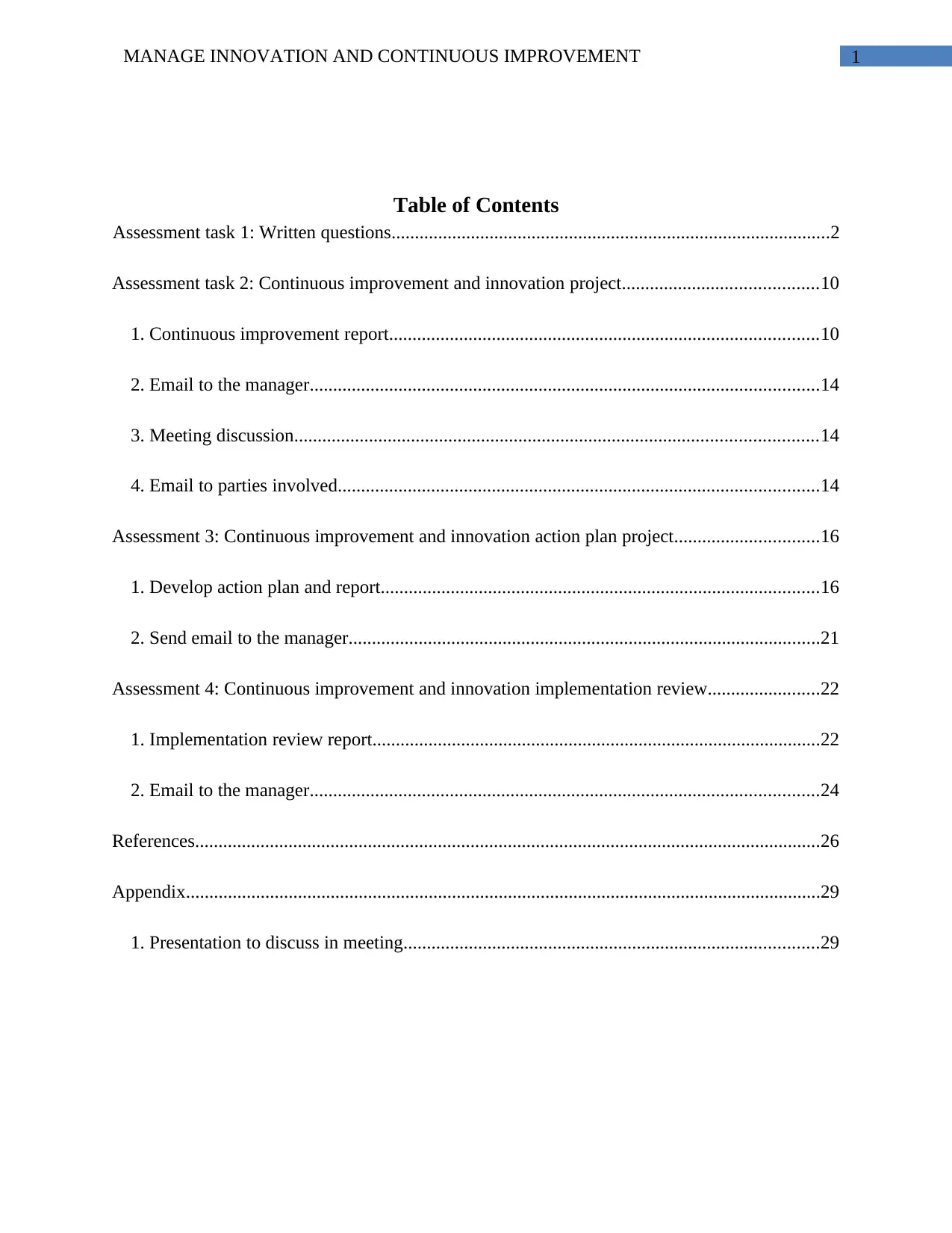
Table of Contents
Assessment task 1: Written questions..............................................................................................2
Assessment task 2: Continuous improvement and innovation project..........................................10
1. Continuous improvement report............................................................................................10
2. Email to the manager.............................................................................................................14
3. Meeting discussion................................................................................................................14
4. Email to parties involved.......................................................................................................14
Assessment 3: Continuous improvement and innovation action plan project...............................16
1. Develop action plan and report..............................................................................................16
2. Send email to the manager.....................................................................................................21
Assessment 4: Continuous improvement and innovation implementation review........................22
1. Implementation review report................................................................................................22
2. Email to the manager.............................................................................................................24
References......................................................................................................................................26
Appendix........................................................................................................................................29
1. Presentation to discuss in meeting.........................................................................................29
Table of Contents
Assessment task 1: Written questions..............................................................................................2
Assessment task 2: Continuous improvement and innovation project..........................................10
1. Continuous improvement report............................................................................................10
2. Email to the manager.............................................................................................................14
3. Meeting discussion................................................................................................................14
4. Email to parties involved.......................................................................................................14
Assessment 3: Continuous improvement and innovation action plan project...............................16
1. Develop action plan and report..............................................................................................16
2. Send email to the manager.....................................................................................................21
Assessment 4: Continuous improvement and innovation implementation review........................22
1. Implementation review report................................................................................................22
2. Email to the manager.............................................................................................................24
References......................................................................................................................................26
Appendix........................................................................................................................................29
1. Presentation to discuss in meeting.........................................................................................29
2MANAGE INNOVATION AND CONTINUOUS IMPROVEMENT
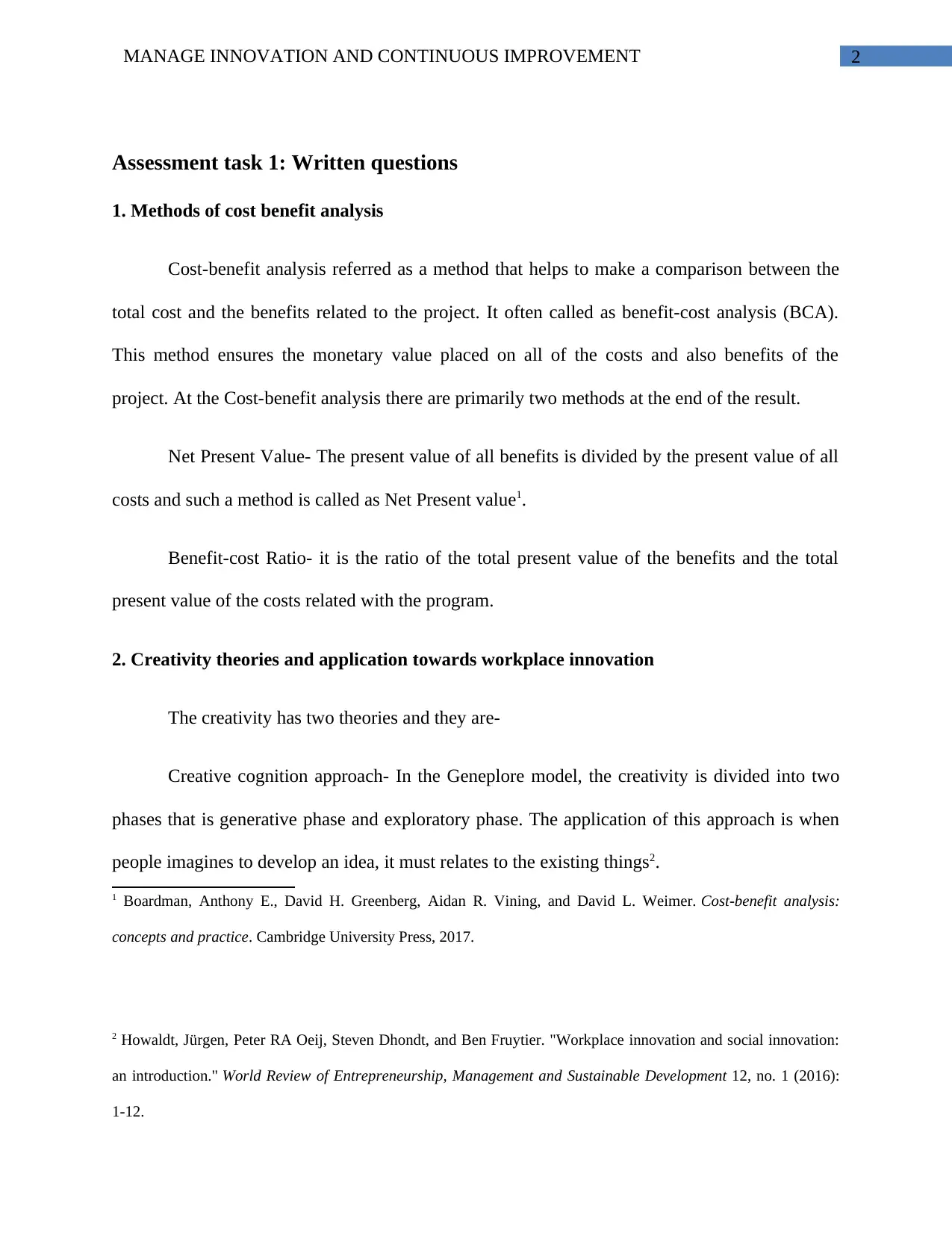
Assessment task 1: Written questions
1. Methods of cost benefit analysis
Cost-benefit analysis referred as a method that helps to make a comparison between the
total cost and the benefits related to the project. It often called as benefit-cost analysis (BCA).
This method ensures the monetary value placed on all of the costs and also benefits of the
project. At the Cost-benefit analysis there are primarily two methods at the end of the result.
Net Present Value- The present value of all benefits is divided by the present value of all
costs and such a method is called as Net Present value1.
Benefit-cost Ratio- it is the ratio of the total present value of the benefits and the total
present value of the costs related with the program.
2. Creativity theories and application towards workplace innovation
The creativity has two theories and they are-
Creative cognition approach- In the Geneplore model, the creativity is divided into two
phases that is generative phase and exploratory phase. The application of this approach is when
people imagines to develop an idea, it must relates to the existing things2.
1 Boardman, Anthony E., David H. Greenberg, Aidan R. Vining, and David L. Weimer. Cost-benefit analysis:
concepts and practice. Cambridge University Press, 2017.
2 Howaldt, Jürgen, Peter RA Oeij, Steven Dhondt, and Ben Fruytier. "Workplace innovation and social innovation:
an introduction." World Review of Entrepreneurship, Management and Sustainable Development 12, no. 1 (2016):
1-12.
Assessment task 1: Written questions
1. Methods of cost benefit analysis
Cost-benefit analysis referred as a method that helps to make a comparison between the
total cost and the benefits related to the project. It often called as benefit-cost analysis (BCA).
This method ensures the monetary value placed on all of the costs and also benefits of the
project. At the Cost-benefit analysis there are primarily two methods at the end of the result.
Net Present Value- The present value of all benefits is divided by the present value of all
costs and such a method is called as Net Present value1.
Benefit-cost Ratio- it is the ratio of the total present value of the benefits and the total
present value of the costs related with the program.
2. Creativity theories and application towards workplace innovation
The creativity has two theories and they are-
Creative cognition approach- In the Geneplore model, the creativity is divided into two
phases that is generative phase and exploratory phase. The application of this approach is when
people imagines to develop an idea, it must relates to the existing things2.
1 Boardman, Anthony E., David H. Greenberg, Aidan R. Vining, and David L. Weimer. Cost-benefit analysis:
concepts and practice. Cambridge University Press, 2017.
2 Howaldt, Jürgen, Peter RA Oeij, Steven Dhondt, and Ben Fruytier. "Workplace innovation and social innovation:
an introduction." World Review of Entrepreneurship, Management and Sustainable Development 12, no. 1 (2016):
1-12.
⊘ This is a preview!⊘
Do you want full access?
Subscribe today to unlock all pages.

Trusted by 1+ million students worldwide
3MANAGE INNOVATION AND CONTINUOUS IMPROVEMENT
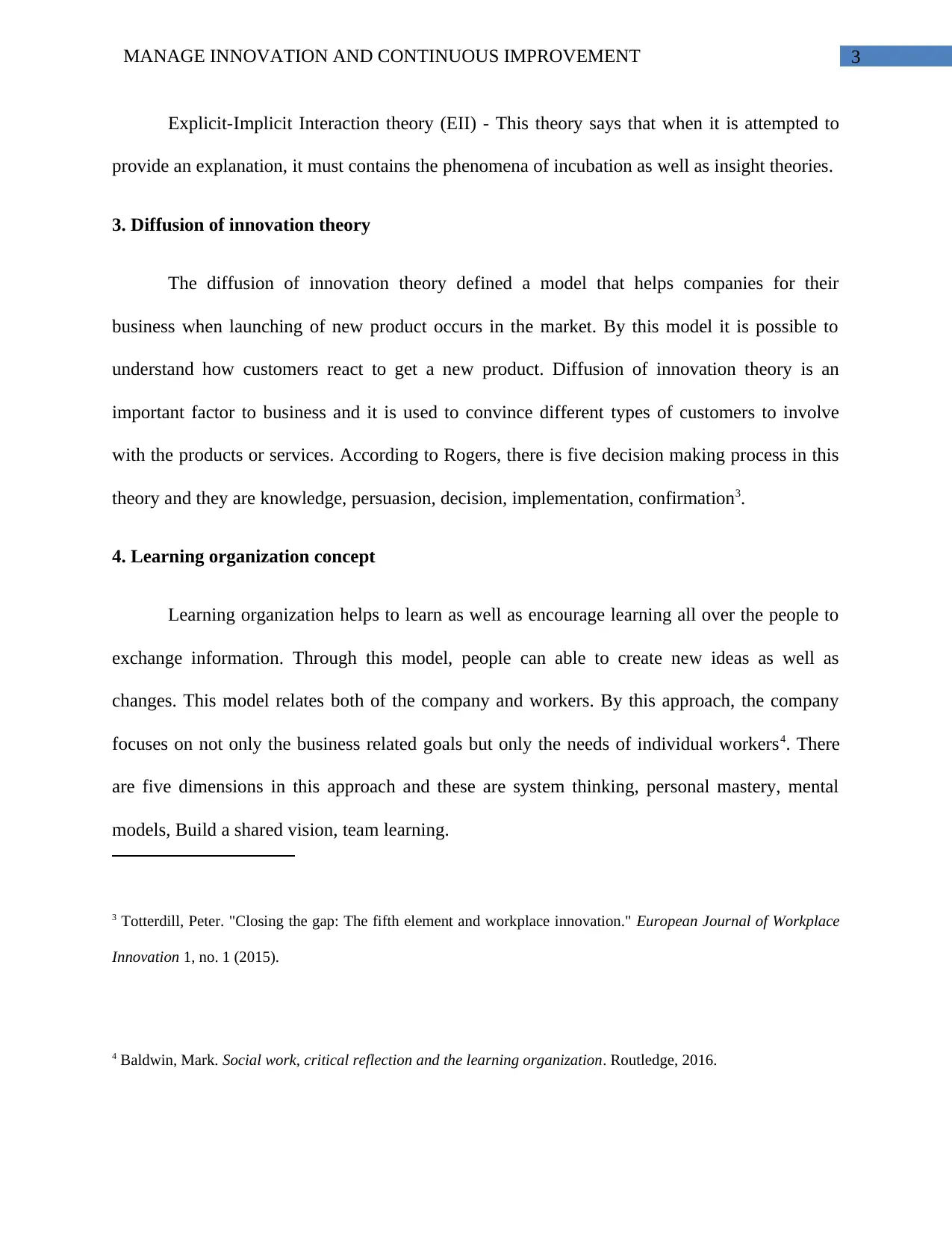
Explicit-Implicit Interaction theory (EII) - This theory says that when it is attempted to
provide an explanation, it must contains the phenomena of incubation as well as insight theories.
3. Diffusion of innovation theory
The diffusion of innovation theory defined a model that helps companies for their
business when launching of new product occurs in the market. By this model it is possible to
understand how customers react to get a new product. Diffusion of innovation theory is an
important factor to business and it is used to convince different types of customers to involve
with the products or services. According to Rogers, there is five decision making process in this
theory and they are knowledge, persuasion, decision, implementation, confirmation3.
4. Learning organization concept
Learning organization helps to learn as well as encourage learning all over the people to
exchange information. Through this model, people can able to create new ideas as well as
changes. This model relates both of the company and workers. By this approach, the company
focuses on not only the business related goals but only the needs of individual workers4. There
are five dimensions in this approach and these are system thinking, personal mastery, mental
models, Build a shared vision, team learning.
3 Totterdill, Peter. "Closing the gap: The fifth element and workplace innovation." European Journal of Workplace
Innovation 1, no. 1 (2015).
4 Baldwin, Mark. Social work, critical reflection and the learning organization. Routledge, 2016.
Explicit-Implicit Interaction theory (EII) - This theory says that when it is attempted to
provide an explanation, it must contains the phenomena of incubation as well as insight theories.
3. Diffusion of innovation theory
The diffusion of innovation theory defined a model that helps companies for their
business when launching of new product occurs in the market. By this model it is possible to
understand how customers react to get a new product. Diffusion of innovation theory is an
important factor to business and it is used to convince different types of customers to involve
with the products or services. According to Rogers, there is five decision making process in this
theory and they are knowledge, persuasion, decision, implementation, confirmation3.
4. Learning organization concept
Learning organization helps to learn as well as encourage learning all over the people to
exchange information. Through this model, people can able to create new ideas as well as
changes. This model relates both of the company and workers. By this approach, the company
focuses on not only the business related goals but only the needs of individual workers4. There
are five dimensions in this approach and these are system thinking, personal mastery, mental
models, Build a shared vision, team learning.
3 Totterdill, Peter. "Closing the gap: The fifth element and workplace innovation." European Journal of Workplace
Innovation 1, no. 1 (2015).
4 Baldwin, Mark. Social work, critical reflection and the learning organization. Routledge, 2016.
Paraphrase This Document
Need a fresh take? Get an instant paraphrase of this document with our AI Paraphraser
4MANAGE INNOVATION AND CONTINUOUS IMPROVEMENT
5. Shared vision concept
In the learning organization, it should be noted to create a vision via the interaction with
employees in the organization. The shared vision behaves as powerful motivator. Shared vision
makes to compromise the visions of both the organization and individual. People not sharing
vision do not interact with the organization5. It helps to change the relationship with organization
and for that it converts the performance into learning mechanism.
6. Team learning concept
Team learning referred as collaborative effort that helps to achieve a common objective
among the group. The purpose of team learning is to manage the objective by using dialogue as
well as discussion6. It is the process in which team discover their new formula to achieve
success.
7. Theories on quality management and continuous improvement
There are five theories in quality management and these are:
Deming’s Theory- This theory consists of fourteen points related to management and it is
the ratio of total work efforts over total costs.
5 Klinge, Carolyn M. "A conceptual framework for mentoring in a learning organization." Adult learning 26, no. 4
(2015): 160-166.
6 Sessa, Valerie I., and Manuel London. Continuous learning in organizations: Individual, group, and
organizational perspectives. Psychology Press, 2015.
5. Shared vision concept
In the learning organization, it should be noted to create a vision via the interaction with
employees in the organization. The shared vision behaves as powerful motivator. Shared vision
makes to compromise the visions of both the organization and individual. People not sharing
vision do not interact with the organization5. It helps to change the relationship with organization
and for that it converts the performance into learning mechanism.
6. Team learning concept
Team learning referred as collaborative effort that helps to achieve a common objective
among the group. The purpose of team learning is to manage the objective by using dialogue as
well as discussion6. It is the process in which team discover their new formula to achieve
success.
7. Theories on quality management and continuous improvement
There are five theories in quality management and these are:
Deming’s Theory- This theory consists of fourteen points related to management and it is
the ratio of total work efforts over total costs.
5 Klinge, Carolyn M. "A conceptual framework for mentoring in a learning organization." Adult learning 26, no. 4
(2015): 160-166.
6 Sessa, Valerie I., and Manuel London. Continuous learning in organizations: Individual, group, and
organizational perspectives. Psychology Press, 2015.
5MANAGE INNOVATION AND CONTINUOUS IMPROVEMENT
Crosby’s Theory- It is almost similar to Deming’s theory and it consists of four absolutes
of the quality management7.
Joseph Juran’s Theory- in this theory, the quality trilogy is composed of quality planning,
quality improvement, quality control.
The EFQM framework- the framework consists of nine features of quality management8.
Ishikawa’s Theory- this theory helps to the company to handle quality related projects.
8. Implications of Kotter’s 8-step change model
The Kotter’s 8 step model helps to improve the change in ability of the organization and
increase the success. By using this approach, failure can be avoided and it helps to happen
changes. For that, company does not require to adjust any changes. The eight factors are to create
urgency, guiding coalition, a vision of change, communication the vision, remove obstacles, to
create short term wins, consolidate improvements, anchor the changes9.
9. ISO 9000 standards for quality management
7 Ross, Joel E. Total quality management: Text, cases, and readings. Routledge, 2017.
8 Tang, Keow Ngang. "Change management." In Leadership and Change Management, pp. 47-55. Springer,
Singapore, 2019.
9 Hoyle, David. ISO 9000 Quality Systems Handbook-updated for the ISO 9001: 2015 standard: Increasing the
Quality of an Organization’s Outputs. Routledge, 2017.
Crosby’s Theory- It is almost similar to Deming’s theory and it consists of four absolutes
of the quality management7.
Joseph Juran’s Theory- in this theory, the quality trilogy is composed of quality planning,
quality improvement, quality control.
The EFQM framework- the framework consists of nine features of quality management8.
Ishikawa’s Theory- this theory helps to the company to handle quality related projects.
8. Implications of Kotter’s 8-step change model
The Kotter’s 8 step model helps to improve the change in ability of the organization and
increase the success. By using this approach, failure can be avoided and it helps to happen
changes. For that, company does not require to adjust any changes. The eight factors are to create
urgency, guiding coalition, a vision of change, communication the vision, remove obstacles, to
create short term wins, consolidate improvements, anchor the changes9.
9. ISO 9000 standards for quality management
7 Ross, Joel E. Total quality management: Text, cases, and readings. Routledge, 2017.
8 Tang, Keow Ngang. "Change management." In Leadership and Change Management, pp. 47-55. Springer,
Singapore, 2019.
9 Hoyle, David. ISO 9000 Quality Systems Handbook-updated for the ISO 9001: 2015 standard: Increasing the
Quality of an Organization’s Outputs. Routledge, 2017.
⊘ This is a preview!⊘
Do you want full access?
Subscribe today to unlock all pages.
Trusted by 1+ million students worldwide
6MANAGE INNOVATION AND CONTINUOUS IMPROVEMENT
The ISO 9000 standards systems for the quality management is considered as to help the
organizations that ensures the needs of consumer and stakeholders when meeting statutory or
regulatory requirements have arelation with a product10.
10. Identification of risks for risk management AS/NZS ISO 31000:2009
The development of set of standards all over the world that helps organizations to
implement risk management in a systematic way as well as effective way. These standards need
to establish a view on frameworks, processes as well as practices11.
11. Concept of risk management and factors make the risk management system
The risk management is defined as detecting the project risks involved with identification
of threats as well as vulnerabilities affect assets of the business organization. There is analysis of
the project risk deal with calculating data based on identified risks.
The factors for effective risk management are as follows:
i. Commitment as well as support from the higher management level12
10 Kristina, S., and B. M. Wijaya. "Risk management for food and beverage industry using Australia/New Zealand
4360 Standard." In IOP Conference Series: Materials Science and Engineering, vol. 277, no. 1, p. 012025. IOP
Publishing, 2017.
11 Aven, Terje. "Risk assessment and risk management: Review of recent advances on their foundation." European
Journal of Operational Research 253, no. 1 (2016): 1-13.
12 Pan, Zhao, Yaobin Lu, Bin Wang, and Patrick YK Chau. "Who do you think you are? Common and differential
effects of social self-identity on social media usage." Journal of Management Information Systems 34, no. 1 (2017):
The ISO 9000 standards systems for the quality management is considered as to help the
organizations that ensures the needs of consumer and stakeholders when meeting statutory or
regulatory requirements have arelation with a product10.
10. Identification of risks for risk management AS/NZS ISO 31000:2009
The development of set of standards all over the world that helps organizations to
implement risk management in a systematic way as well as effective way. These standards need
to establish a view on frameworks, processes as well as practices11.
11. Concept of risk management and factors make the risk management system
The risk management is defined as detecting the project risks involved with identification
of threats as well as vulnerabilities affect assets of the business organization. There is analysis of
the project risk deal with calculating data based on identified risks.
The factors for effective risk management are as follows:
i. Commitment as well as support from the higher management level12
10 Kristina, S., and B. M. Wijaya. "Risk management for food and beverage industry using Australia/New Zealand
4360 Standard." In IOP Conference Series: Materials Science and Engineering, vol. 277, no. 1, p. 012025. IOP
Publishing, 2017.
11 Aven, Terje. "Risk assessment and risk management: Review of recent advances on their foundation." European
Journal of Operational Research 253, no. 1 (2016): 1-13.
12 Pan, Zhao, Yaobin Lu, Bin Wang, and Patrick YK Chau. "Who do you think you are? Common and differential
effects of social self-identity on social media usage." Journal of Management Information Systems 34, no. 1 (2017):
Paraphrase This Document
Need a fresh take? Get an instant paraphrase of this document with our AI Paraphraser
7MANAGE INNOVATION AND CONTINUOUS IMPROVEMENT
ii. Communication with the organizational employees13
iii. Training to the employees those have lack of technical skills
12. Seven steps in the risk management process in AS/NZS ISO 31000:2009
Step 1: Outline the objectives: In this step, the project goals are to be collected by the
team member. It is included with identification of project requirements and created with
understanding of project achievement.
Step 2: Risk management plan: It maintains definition of risk management with goals of
the risk processes.
Step 3: Identification: In this step, there is identification of project risks with methods
like fishbone, brain mapping as well as questioning14.
Step 4: Evaluation: There is evaluation of the risks by means of quantitative and
qualitative risk analysis method. The qualitative evaluation is provided with results and enabled
to position of risk problems15. Quantitative is included depiction of the risks.
71-101.
13 Aven, Terje. "Risk assessment and risk management: Review of recent advances on their foundation." European
Journal of Operational Research 253, no. 1 (2016): 1-13.
14 Perrin, Andrew. "Social media usage." Pew research center(2015): 52-68.
ii. Communication with the organizational employees13
iii. Training to the employees those have lack of technical skills
12. Seven steps in the risk management process in AS/NZS ISO 31000:2009
Step 1: Outline the objectives: In this step, the project goals are to be collected by the
team member. It is included with identification of project requirements and created with
understanding of project achievement.
Step 2: Risk management plan: It maintains definition of risk management with goals of
the risk processes.
Step 3: Identification: In this step, there is identification of project risks with methods
like fishbone, brain mapping as well as questioning14.
Step 4: Evaluation: There is evaluation of the risks by means of quantitative and
qualitative risk analysis method. The qualitative evaluation is provided with results and enabled
to position of risk problems15. Quantitative is included depiction of the risks.
71-101.
13 Aven, Terje. "Risk assessment and risk management: Review of recent advances on their foundation." European
Journal of Operational Research 253, no. 1 (2016): 1-13.
14 Perrin, Andrew. "Social media usage." Pew research center(2015): 52-68.
8MANAGE INNOVATION AND CONTINUOUS IMPROVEMENT
Step 5: Planning: The risks are identified with developing of mitigation strategies16.
Step 6: Management: The risk mitigation plan is audited through entire development
lifecycle.
Step 7: Feedback: The customers are provided with feedback which helps to assess
situations concerning on the project risks plus enable to provide efficient project results.
13. Three different sustainability practices in workplaces of Australia
I. Encouraging the organizational employees to use of the public transportation
II. Changing towards eco-friendly lightning of the workplace17
III. Switching to the customer’s waste as well as paper based products
15 Giannakis, Mihalis, and Thanos Papadopoulos. "Supply chain sustainability: A risk management
approach." International Journal of Production Economics 171 (2016): 455-470.
16 Fardouly, Jasmine, and Lenny R. Vartanian. "Social media and body image concerns: Current research and future
directions." Current opinion in psychology 9 (2016): 1-5.
17 Markey, Raymond, Joseph McIvor, and Chris F. Wright. "Employee participation and carbon emissions reduction
in Australian workplaces." The International Journal of Human Resource Management 27, no. 2 (2016): 173-191.
Step 5: Planning: The risks are identified with developing of mitigation strategies16.
Step 6: Management: The risk mitigation plan is audited through entire development
lifecycle.
Step 7: Feedback: The customers are provided with feedback which helps to assess
situations concerning on the project risks plus enable to provide efficient project results.
13. Three different sustainability practices in workplaces of Australia
I. Encouraging the organizational employees to use of the public transportation
II. Changing towards eco-friendly lightning of the workplace17
III. Switching to the customer’s waste as well as paper based products
15 Giannakis, Mihalis, and Thanos Papadopoulos. "Supply chain sustainability: A risk management
approach." International Journal of Production Economics 171 (2016): 455-470.
16 Fardouly, Jasmine, and Lenny R. Vartanian. "Social media and body image concerns: Current research and future
directions." Current opinion in psychology 9 (2016): 1-5.
17 Markey, Raymond, Joseph McIvor, and Chris F. Wright. "Employee participation and carbon emissions reduction
in Australian workplaces." The International Journal of Human Resource Management 27, no. 2 (2016): 173-191.
⊘ This is a preview!⊘
Do you want full access?
Subscribe today to unlock all pages.
Trusted by 1+ million students worldwide
9MANAGE INNOVATION AND CONTINUOUS IMPROVEMENT
Assessment task 2: Continuous improvement and innovation project
1. Continuous improvement report
Introduction
Woodhouse Recruitment is operated in Central Melbourne and it is a recruitment agency
offered with the recruitment services to meet with requirements of client. The company was
being established in the year 2010. It is a recruitment agency provides services on recruitment,
selection, candidates sourcing plus screening. After reviewing current business process of
Woodhouse recruitment, it is found that there are no such formal performance indicator for
measuring the service standards, no social media strategies to promote the recruitment services,
minimum qualification of staffs and lack of sustainability towards green office environment. The
report is based on improving over two areas such as sustainability program and social media
strategies. After going through entire business processes of Woodhouse recruitment and its
issues, the management team decided to implement continuous improvement and innovative
processes for its two selected areas of improvement.
Continuous improvement and innovative processes
For sustainability program
The existing system of the recruitment agency should implement sustainability program
so that they can provide green office environment to their employees. Sustainability aspects
should help to incorporate of green environment. It will increase productivity, reduce operational
cost and reduce waste in the business.
Assessment task 2: Continuous improvement and innovation project
1. Continuous improvement report
Introduction
Woodhouse Recruitment is operated in Central Melbourne and it is a recruitment agency
offered with the recruitment services to meet with requirements of client. The company was
being established in the year 2010. It is a recruitment agency provides services on recruitment,
selection, candidates sourcing plus screening. After reviewing current business process of
Woodhouse recruitment, it is found that there are no such formal performance indicator for
measuring the service standards, no social media strategies to promote the recruitment services,
minimum qualification of staffs and lack of sustainability towards green office environment. The
report is based on improving over two areas such as sustainability program and social media
strategies. After going through entire business processes of Woodhouse recruitment and its
issues, the management team decided to implement continuous improvement and innovative
processes for its two selected areas of improvement.
Continuous improvement and innovative processes
For sustainability program
The existing system of the recruitment agency should implement sustainability program
so that they can provide green office environment to their employees. Sustainability aspects
should help to incorporate of green environment. It will increase productivity, reduce operational
cost and reduce waste in the business.
Paraphrase This Document
Need a fresh take? Get an instant paraphrase of this document with our AI Paraphraser
10MANAGE INNOVATION AND CONTINUOUS IMPROVEMENT
For social media strategies
Woodhouse Recruitment should adopt social media strategies in their business so that
they can approach candidates, contracting with the university’s students to seek job, performing
online interview, selecting of candidates, online screening plus email interview by online test.
Those improvements should help the agency to grow and develop its customer’s value.
Range of strategies to monitor and evaluate current performance
For sustainability program
i. Training to the employees to maintain sustainability in the business to achieve green
business environment
ii. Recruitment of consultant to possess professional knowledge as well as efficient
communication skills18
For social media strategies
I. Taking usage of the Instagram as the social media strategy to seek the candidates
II. Using Facebook page to provide the recruitment and selection details for
facilitating the candidates
Analyze the aspects of the Woodhouse Recruitment
18 Beyhan Yasar, Neslihan, Bulent Sezen, and Ibrahim S. Karakadilar. "Mediating effect of continuous improvement
on the relationship between innovation and financial performance." Total Quality Management & Business
Excellence 30, no. 7-8 (2019): 893-907.
For social media strategies
Woodhouse Recruitment should adopt social media strategies in their business so that
they can approach candidates, contracting with the university’s students to seek job, performing
online interview, selecting of candidates, online screening plus email interview by online test.
Those improvements should help the agency to grow and develop its customer’s value.
Range of strategies to monitor and evaluate current performance
For sustainability program
i. Training to the employees to maintain sustainability in the business to achieve green
business environment
ii. Recruitment of consultant to possess professional knowledge as well as efficient
communication skills18
For social media strategies
I. Taking usage of the Instagram as the social media strategy to seek the candidates
II. Using Facebook page to provide the recruitment and selection details for
facilitating the candidates
Analyze the aspects of the Woodhouse Recruitment
18 Beyhan Yasar, Neslihan, Bulent Sezen, and Ibrahim S. Karakadilar. "Mediating effect of continuous improvement
on the relationship between innovation and financial performance." Total Quality Management & Business
Excellence 30, no. 7-8 (2019): 893-907.
11MANAGE INNOVATION AND CONTINUOUS IMPROVEMENT
Supply chain: The receptionist handles the supply chain activities such as call from
candidates and enquiry of the recruitment. The administrator manager performs administration
along with functional activities of recruitment agency. Five of the consultants are involved to
select, screen and source the candidates while 30 clients are availing to the agency’s services on
daily basis. Therefore, the supply chain is being effective.
Operations: The operational activities of agency are recruitment, souring of the
candidates along with screening.
Product and delivery system: The delivery system is focused on type of candidates for
purpose of screening plus recruitment. The candidates are finalized after 3-4 interview rounds
while 30 are employed with candidates of the selected companies.
There is required to make improvement over social media strategies so that through
promotion of the recruitment agency, it can attract the candidates and raise the customer base. In
order to gain more profit, the agency is required to start with online presence.
Outline of assessment tools and techniques
Candidate survey: Through this tool the satisfaction level of the candidates are analyzed.
Feedback captured by the candidate is provided with valuable insights on how the customers are
experiencing with the recruitment agency.
Brainstorming: This tool and technique improves over critical thinking and also problem
solving skills to the individual as well as team19.
19 Singh, Jagdeep, and Harwinder Singh. "Continuous improvement philosophy–literature review
and directions." Benchmarking: An International Journal 22, no. 1 (2015): 75-119.
Supply chain: The receptionist handles the supply chain activities such as call from
candidates and enquiry of the recruitment. The administrator manager performs administration
along with functional activities of recruitment agency. Five of the consultants are involved to
select, screen and source the candidates while 30 clients are availing to the agency’s services on
daily basis. Therefore, the supply chain is being effective.
Operations: The operational activities of agency are recruitment, souring of the
candidates along with screening.
Product and delivery system: The delivery system is focused on type of candidates for
purpose of screening plus recruitment. The candidates are finalized after 3-4 interview rounds
while 30 are employed with candidates of the selected companies.
There is required to make improvement over social media strategies so that through
promotion of the recruitment agency, it can attract the candidates and raise the customer base. In
order to gain more profit, the agency is required to start with online presence.
Outline of assessment tools and techniques
Candidate survey: Through this tool the satisfaction level of the candidates are analyzed.
Feedback captured by the candidate is provided with valuable insights on how the customers are
experiencing with the recruitment agency.
Brainstorming: This tool and technique improves over critical thinking and also problem
solving skills to the individual as well as team19.
19 Singh, Jagdeep, and Harwinder Singh. "Continuous improvement philosophy–literature review
and directions." Benchmarking: An International Journal 22, no. 1 (2015): 75-119.
⊘ This is a preview!⊘
Do you want full access?
Subscribe today to unlock all pages.
Trusted by 1+ million students worldwide

1 out of 29


Related Documents


Your All-in-One AI-Powered Toolkit for Academic Success.
+13062052269
info@desklib.com
Available 24*7 on WhatsApp / Email
![[object Object]](/_next/static/media/star-bottom.7253800d.svg)
Unlock your academic potential
Copyright © 2020–2026 A2Z Services. All Rights Reserved. Developed and managed by ZUCOL.