BSBMKG608: Assessment Task 1 - Marketing Objectives Questions
VerifiedAdded on 2023/01/06
|23
|6930
|55
Homework Assignment
AI Summary
This document presents a student's completed assessment task for the BSBMKG608 unit, focusing on developing organizational marketing objectives. The assignment comprises answers to ten written questions, covering essential marketing concepts such as the purpose of marketing objectives, the SMART framework, the Ansoff matrix, and the differences between marketing strategies and objectives. It explores Porter's model of competitive advantage, marketing strategies like market penetration and diversification, and the balanced scorecard approach for assessing organizational performance. The document also includes the calculation of Return on Investment (ROI) and statistical methods for evaluating marketing opportunities, providing a comprehensive overview of key marketing principles and their practical application.
BSBMKG608 Develop organisational marketing objectives–Student Assessment Tasks Ver.1.1
BSB61015
Advanced Diploma of Leadership and Management
BSBMKG608
Develop organisational marketing objectives
Student Name:
Student ID:
BSB61015
Advanced Diploma of Leadership and Management
BSBMKG608
Develop organisational marketing objectives
Student Name:
Student ID:

Paraphrase This Document
Need a fresh take? Get an instant paraphrase of this document with our AI Paraphraser
BSBMKG608 Develop organisational marketing objectives–Student Assessment Tasks Ver.1.1
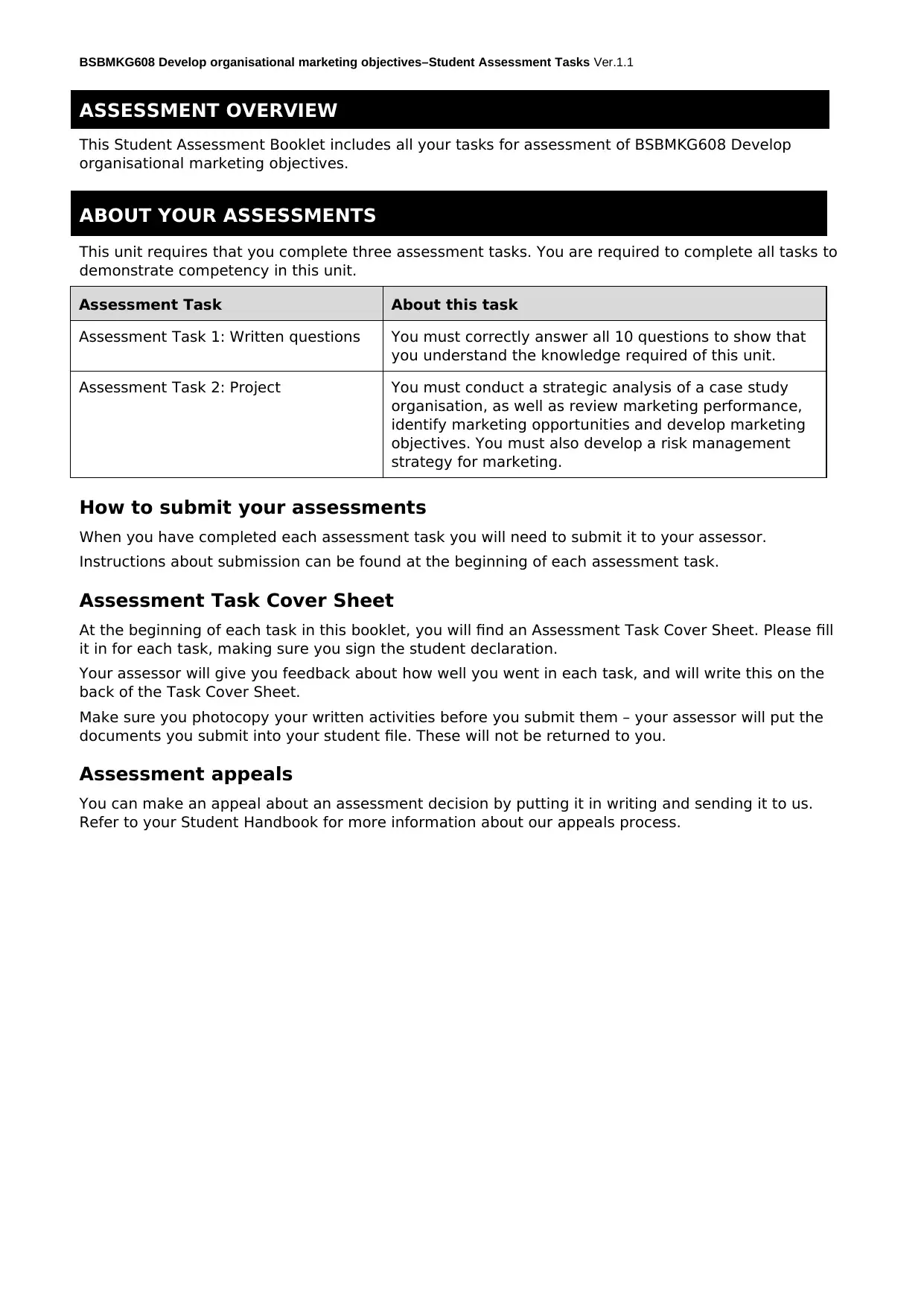
ASSESSMENT OVERVIEW
This Student Assessment Booklet includes all your tasks for assessment of BSBMKG608 Develop
organisational marketing objectives.
ABOUT YOUR ASSESSMENTS
This unit requires that you complete three assessment tasks. You are required to complete all tasks to
demonstrate competency in this unit.
Assessment Task About this task
Assessment Task 1: Written questions You must correctly answer all 10 questions to show that
you understand the knowledge required of this unit.
Assessment Task 2: Project You must conduct a strategic analysis of a case study
organisation, as well as review marketing performance,
identify marketing opportunities and develop marketing
objectives. You must also develop a risk management
strategy for marketing.
How to submit your assessments
When you have completed each assessment task you will need to submit it to your assessor.
Instructions about submission can be found at the beginning of each assessment task.
Assessment Task Cover Sheet
At the beginning of each task in this booklet, you will find an Assessment Task Cover Sheet. Please fill
it in for each task, making sure you sign the student declaration.
Your assessor will give you feedback about how well you went in each task, and will write this on the
back of the Task Cover Sheet.
Make sure you photocopy your written activities before you submit them – your assessor will put the
documents you submit into your student file. These will not be returned to you.
Assessment appeals
You can make an appeal about an assessment decision by putting it in writing and sending it to us.
Refer to your Student Handbook for more information about our appeals process.
ASSESSMENT OVERVIEW
This Student Assessment Booklet includes all your tasks for assessment of BSBMKG608 Develop
organisational marketing objectives.
ABOUT YOUR ASSESSMENTS
This unit requires that you complete three assessment tasks. You are required to complete all tasks to
demonstrate competency in this unit.
Assessment Task About this task
Assessment Task 1: Written questions You must correctly answer all 10 questions to show that
you understand the knowledge required of this unit.
Assessment Task 2: Project You must conduct a strategic analysis of a case study
organisation, as well as review marketing performance,
identify marketing opportunities and develop marketing
objectives. You must also develop a risk management
strategy for marketing.
How to submit your assessments
When you have completed each assessment task you will need to submit it to your assessor.
Instructions about submission can be found at the beginning of each assessment task.
Assessment Task Cover Sheet
At the beginning of each task in this booklet, you will find an Assessment Task Cover Sheet. Please fill
it in for each task, making sure you sign the student declaration.
Your assessor will give you feedback about how well you went in each task, and will write this on the
back of the Task Cover Sheet.
Make sure you photocopy your written activities before you submit them – your assessor will put the
documents you submit into your student file. These will not be returned to you.
Assessment appeals
You can make an appeal about an assessment decision by putting it in writing and sending it to us.
Refer to your Student Handbook for more information about our appeals process.
BSBMKG608 Develop organisational marketing objectives–Student Assessment Tasks Ver.1.1
Record of Assessment Outcome
This page is to be completed by the assessor to record the overall judgement on the students’ submission. All assessment
tasks must be completed satisfactorily for an overall satisfactory result to be awarded.
Student name
Student number
Assessor name
Unit Code BSBMKG608
Unit Title Develop organisational marketing objectives
The following assessment tasks
were completed:
Attempt 1
Submission date:
Attempt 2
Re-submission date:
Assessment Task 001 Satisfactory Not
Satisfactory
Satisfactory Not
Satisfactory
Assessment Task 002 Satisfactory Not
Satisfactory
Satisfactory Not
Satisfactory
Final assessment result Competent Not Yet
Competent
Competent Not Yet
Competent
*Does this student need ‘Attempt 3’? □Yes □No
If ‘yes’, please use and attach another ‘Record of Assessment Outcome’ sheet.
Feedback to student
Student Declaration: I declare this assessment is my
own work and have provided references where
appropriate
Signature:
Submission Date:
Assessor Declaration: I declare that I have conducted
a fair and valid assessment and the student has been
provided with feedback
Signature:
Assessment Date:
Record of Assessment Outcome
This page is to be completed by the assessor to record the overall judgement on the students’ submission. All assessment
tasks must be completed satisfactorily for an overall satisfactory result to be awarded.
Student name
Student number
Assessor name
Unit Code BSBMKG608
Unit Title Develop organisational marketing objectives
The following assessment tasks
were completed:
Attempt 1
Submission date:
Attempt 2
Re-submission date:
Assessment Task 001 Satisfactory Not
Satisfactory
Satisfactory Not
Satisfactory
Assessment Task 002 Satisfactory Not
Satisfactory
Satisfactory Not
Satisfactory
Final assessment result Competent Not Yet
Competent
Competent Not Yet
Competent
*Does this student need ‘Attempt 3’? □Yes □No
If ‘yes’, please use and attach another ‘Record of Assessment Outcome’ sheet.
Feedback to student
Student Declaration: I declare this assessment is my
own work and have provided references where
appropriate
Signature:
Submission Date:
Assessor Declaration: I declare that I have conducted
a fair and valid assessment and the student has been
provided with feedback
Signature:
Assessment Date:
⊘ This is a preview!⊘
Do you want full access?
Subscribe today to unlock all pages.

Trusted by 1+ million students worldwide
BSBMKG608 Develop organisational marketing objectives–Student Assessment Tasks Ver.1.1
ASSESSOR FEEDBACK
Assessors: Please return this cover sheet to the student with assessment results and feedback.
A copy must be supplied to the office and kept in the student’s file with the evidence.
______________________________________________________________________________________________________
______________________________________________________________________________________________________
______________________________________________________________________________________________________
______________________________________________________________________________________________________
______________________________________________________________________________________________________
______________________________________________________________________________________________________
______________________________________________________________________________________________________
______________________________________________________________________________________________________
______________________________________________________________________________________________________
______________________________________________________________________________________________________
______________________________________________________________________________________________________
______________________________________________________________________________________________________
______________________________________________________________________________________________________
______________________________________________________________________________________________________
______________________________________________________________________________________________________
______________________________________________________________________________________________________
Assessor signature: __________________________________________________________________________________
Assessor name: ______________________________________________________________________________________
Date: ________________________________________________________________________________________________
ASSESSOR FEEDBACK
Assessors: Please return this cover sheet to the student with assessment results and feedback.
A copy must be supplied to the office and kept in the student’s file with the evidence.
______________________________________________________________________________________________________
______________________________________________________________________________________________________
______________________________________________________________________________________________________
______________________________________________________________________________________________________
______________________________________________________________________________________________________
______________________________________________________________________________________________________
______________________________________________________________________________________________________
______________________________________________________________________________________________________
______________________________________________________________________________________________________
______________________________________________________________________________________________________
______________________________________________________________________________________________________
______________________________________________________________________________________________________
______________________________________________________________________________________________________
______________________________________________________________________________________________________
______________________________________________________________________________________________________
______________________________________________________________________________________________________
Assessor signature: __________________________________________________________________________________
Assessor name: ______________________________________________________________________________________
Date: ________________________________________________________________________________________________
Paraphrase This Document
Need a fresh take? Get an instant paraphrase of this document with our AI Paraphraser
BSBMKG608 Develop organisational marketing objectives–Student Assessment Tasks Ver.1.1
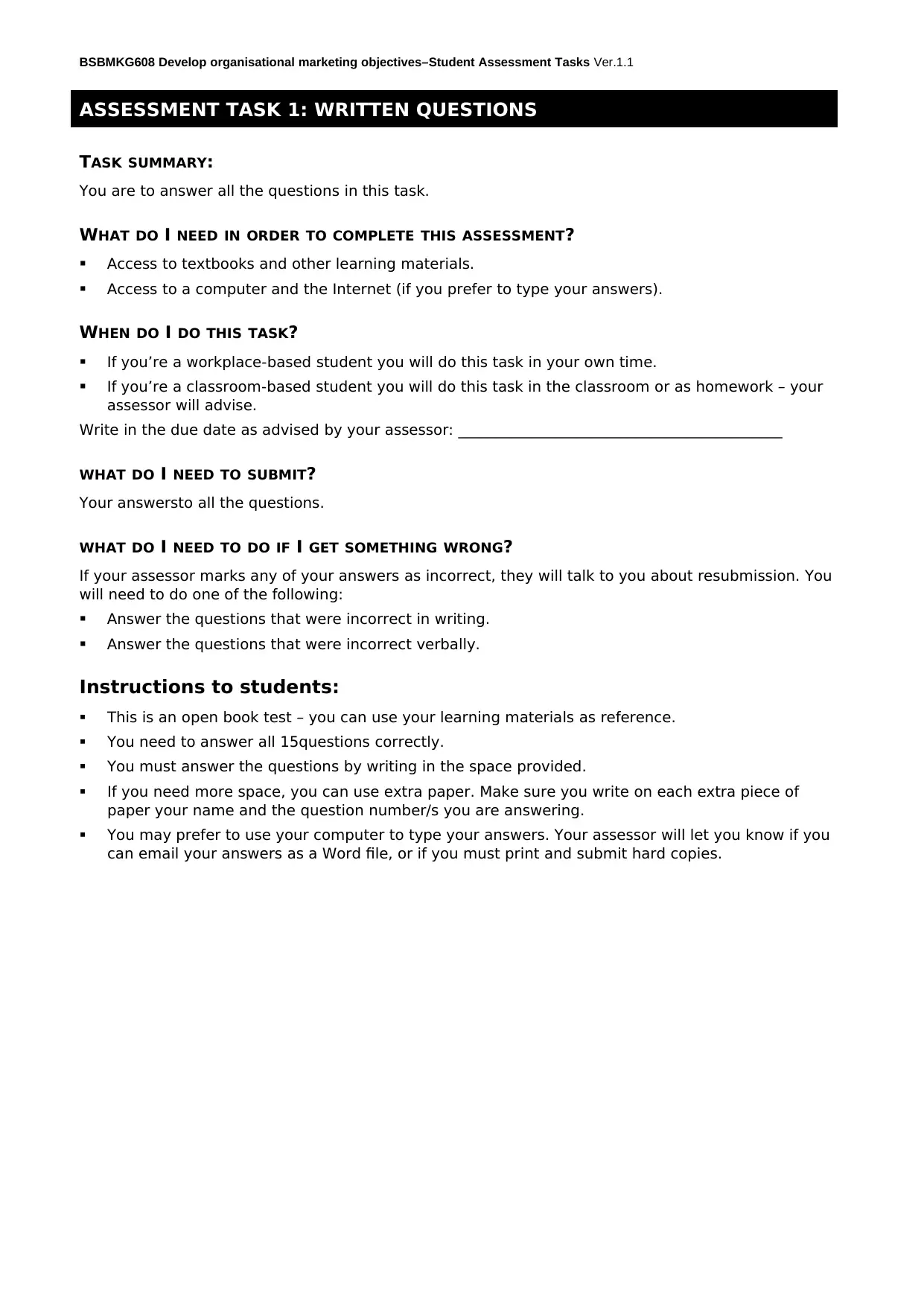
ASSESSMENT TASK 1: WRITTEN QUESTIONS
TASK SUMMARY:
You are to answer all the questions in this task.
WHAT DO I NEED IN ORDER TO COMPLETE THIS ASSESSMENT?
Access to textbooks and other learning materials.
Access to a computer and the Internet (if you prefer to type your answers).
WHEN DO I DO THIS TASK?
If you’re a workplace-based student you will do this task in your own time.
If you’re a classroom-based student you will do this task in the classroom or as homework – your
assessor will advise.
Write in the due date as advised by your assessor: ____________________________________________
WHAT DO I NEED TO SUBMIT?
Your answersto all the questions.
WHAT DO I NEED TO DO IF I GET SOMETHING WRONG?
If your assessor marks any of your answers as incorrect, they will talk to you about resubmission. You
will need to do one of the following:
Answer the questions that were incorrect in writing.
Answer the questions that were incorrect verbally.
Instructions to students:
This is an open book test – you can use your learning materials as reference.
You need to answer all 15questions correctly.
You must answer the questions by writing in the space provided.
If you need more space, you can use extra paper. Make sure you write on each extra piece of
paper your name and the question number/s you are answering.
You may prefer to use your computer to type your answers. Your assessor will let you know if you
can email your answers as a Word file, or if you must print and submit hard copies.
ASSESSMENT TASK 1: WRITTEN QUESTIONS
TASK SUMMARY:
You are to answer all the questions in this task.
WHAT DO I NEED IN ORDER TO COMPLETE THIS ASSESSMENT?
Access to textbooks and other learning materials.
Access to a computer and the Internet (if you prefer to type your answers).
WHEN DO I DO THIS TASK?
If you’re a workplace-based student you will do this task in your own time.
If you’re a classroom-based student you will do this task in the classroom or as homework – your
assessor will advise.
Write in the due date as advised by your assessor: ____________________________________________
WHAT DO I NEED TO SUBMIT?
Your answersto all the questions.
WHAT DO I NEED TO DO IF I GET SOMETHING WRONG?
If your assessor marks any of your answers as incorrect, they will talk to you about resubmission. You
will need to do one of the following:
Answer the questions that were incorrect in writing.
Answer the questions that were incorrect verbally.
Instructions to students:
This is an open book test – you can use your learning materials as reference.
You need to answer all 15questions correctly.
You must answer the questions by writing in the space provided.
If you need more space, you can use extra paper. Make sure you write on each extra piece of
paper your name and the question number/s you are answering.
You may prefer to use your computer to type your answers. Your assessor will let you know if you
can email your answers as a Word file, or if you must print and submit hard copies.
BSBMKG608 Develop organisational marketing objectives–Student Assessment Tasks Ver.1.1
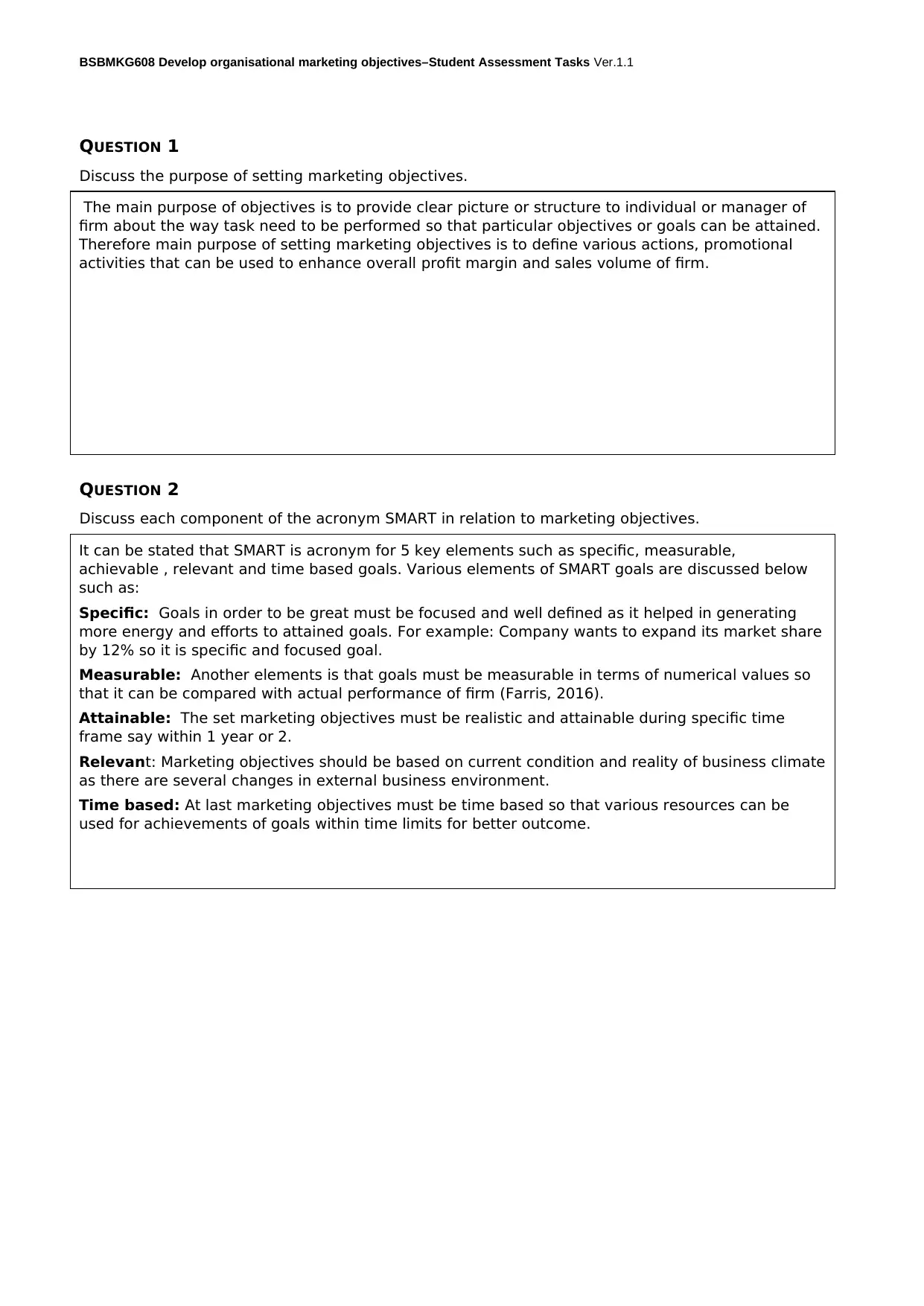
QUESTION 1
Discuss the purpose of setting marketing objectives.
The main purpose of objectives is to provide clear picture or structure to individual or manager of
firm about the way task need to be performed so that particular objectives or goals can be attained.
Therefore main purpose of setting marketing objectives is to define various actions, promotional
activities that can be used to enhance overall profit margin and sales volume of firm.
QUESTION 2
Discuss each component of the acronym SMART in relation to marketing objectives.
It can be stated that SMART is acronym for 5 key elements such as specific, measurable,
achievable , relevant and time based goals. Various elements of SMART goals are discussed below
such as:
Specific: Goals in order to be great must be focused and well defined as it helped in generating
more energy and efforts to attained goals. For example: Company wants to expand its market share
by 12% so it is specific and focused goal.
Measurable: Another elements is that goals must be measurable in terms of numerical values so
that it can be compared with actual performance of firm (Farris, 2016).
Attainable: The set marketing objectives must be realistic and attainable during specific time
frame say within 1 year or 2.
Relevant: Marketing objectives should be based on current condition and reality of business climate
as there are several changes in external business environment.
Time based: At last marketing objectives must be time based so that various resources can be
used for achievements of goals within time limits for better outcome.
QUESTION 1
Discuss the purpose of setting marketing objectives.
The main purpose of objectives is to provide clear picture or structure to individual or manager of
firm about the way task need to be performed so that particular objectives or goals can be attained.
Therefore main purpose of setting marketing objectives is to define various actions, promotional
activities that can be used to enhance overall profit margin and sales volume of firm.
QUESTION 2
Discuss each component of the acronym SMART in relation to marketing objectives.
It can be stated that SMART is acronym for 5 key elements such as specific, measurable,
achievable , relevant and time based goals. Various elements of SMART goals are discussed below
such as:
Specific: Goals in order to be great must be focused and well defined as it helped in generating
more energy and efforts to attained goals. For example: Company wants to expand its market share
by 12% so it is specific and focused goal.
Measurable: Another elements is that goals must be measurable in terms of numerical values so
that it can be compared with actual performance of firm (Farris, 2016).
Attainable: The set marketing objectives must be realistic and attainable during specific time
frame say within 1 year or 2.
Relevant: Marketing objectives should be based on current condition and reality of business climate
as there are several changes in external business environment.
Time based: At last marketing objectives must be time based so that various resources can be
used for achievements of goals within time limits for better outcome.
⊘ This is a preview!⊘
Do you want full access?
Subscribe today to unlock all pages.
Trusted by 1+ million students worldwide
BSBMKG608 Develop organisational marketing objectives–Student Assessment Tasks Ver.1.1
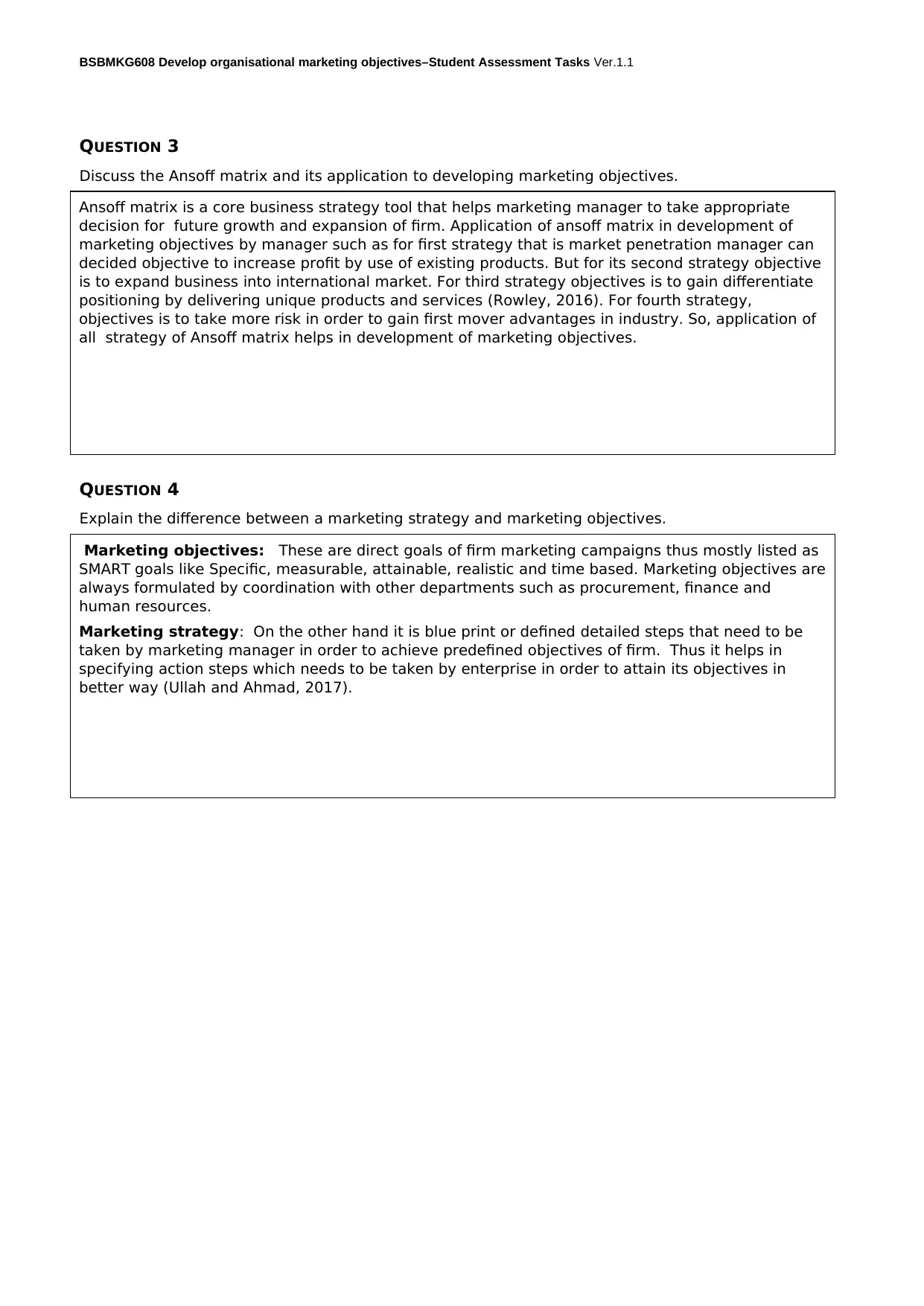
QUESTION 3
Discuss the Ansoff matrix and its application to developing marketing objectives.
Ansoff matrix is a core business strategy tool that helps marketing manager to take appropriate
decision for future growth and expansion of firm. Application of ansoff matrix in development of
marketing objectives by manager such as for first strategy that is market penetration manager can
decided objective to increase profit by use of existing products. But for its second strategy objective
is to expand business into international market. For third strategy objectives is to gain differentiate
positioning by delivering unique products and services (Rowley, 2016). For fourth strategy,
objectives is to take more risk in order to gain first mover advantages in industry. So, application of
all strategy of Ansoff matrix helps in development of marketing objectives.
QUESTION 4
Explain the difference between a marketing strategy and marketing objectives.
Marketing objectives: These are direct goals of firm marketing campaigns thus mostly listed as
SMART goals like Specific, measurable, attainable, realistic and time based. Marketing objectives are
always formulated by coordination with other departments such as procurement, finance and
human resources.
Marketing strategy: On the other hand it is blue print or defined detailed steps that need to be
taken by marketing manager in order to achieve predefined objectives of firm. Thus it helps in
specifying action steps which needs to be taken by enterprise in order to attain its objectives in
better way (Ullah and Ahmad, 2017).
QUESTION 3
Discuss the Ansoff matrix and its application to developing marketing objectives.
Ansoff matrix is a core business strategy tool that helps marketing manager to take appropriate
decision for future growth and expansion of firm. Application of ansoff matrix in development of
marketing objectives by manager such as for first strategy that is market penetration manager can
decided objective to increase profit by use of existing products. But for its second strategy objective
is to expand business into international market. For third strategy objectives is to gain differentiate
positioning by delivering unique products and services (Rowley, 2016). For fourth strategy,
objectives is to take more risk in order to gain first mover advantages in industry. So, application of
all strategy of Ansoff matrix helps in development of marketing objectives.
QUESTION 4
Explain the difference between a marketing strategy and marketing objectives.
Marketing objectives: These are direct goals of firm marketing campaigns thus mostly listed as
SMART goals like Specific, measurable, attainable, realistic and time based. Marketing objectives are
always formulated by coordination with other departments such as procurement, finance and
human resources.
Marketing strategy: On the other hand it is blue print or defined detailed steps that need to be
taken by marketing manager in order to achieve predefined objectives of firm. Thus it helps in
specifying action steps which needs to be taken by enterprise in order to attain its objectives in
better way (Ullah and Ahmad, 2017).
Paraphrase This Document
Need a fresh take? Get an instant paraphrase of this document with our AI Paraphraser
BSBMKG608 Develop organisational marketing objectives–Student Assessment Tasks Ver.1.1
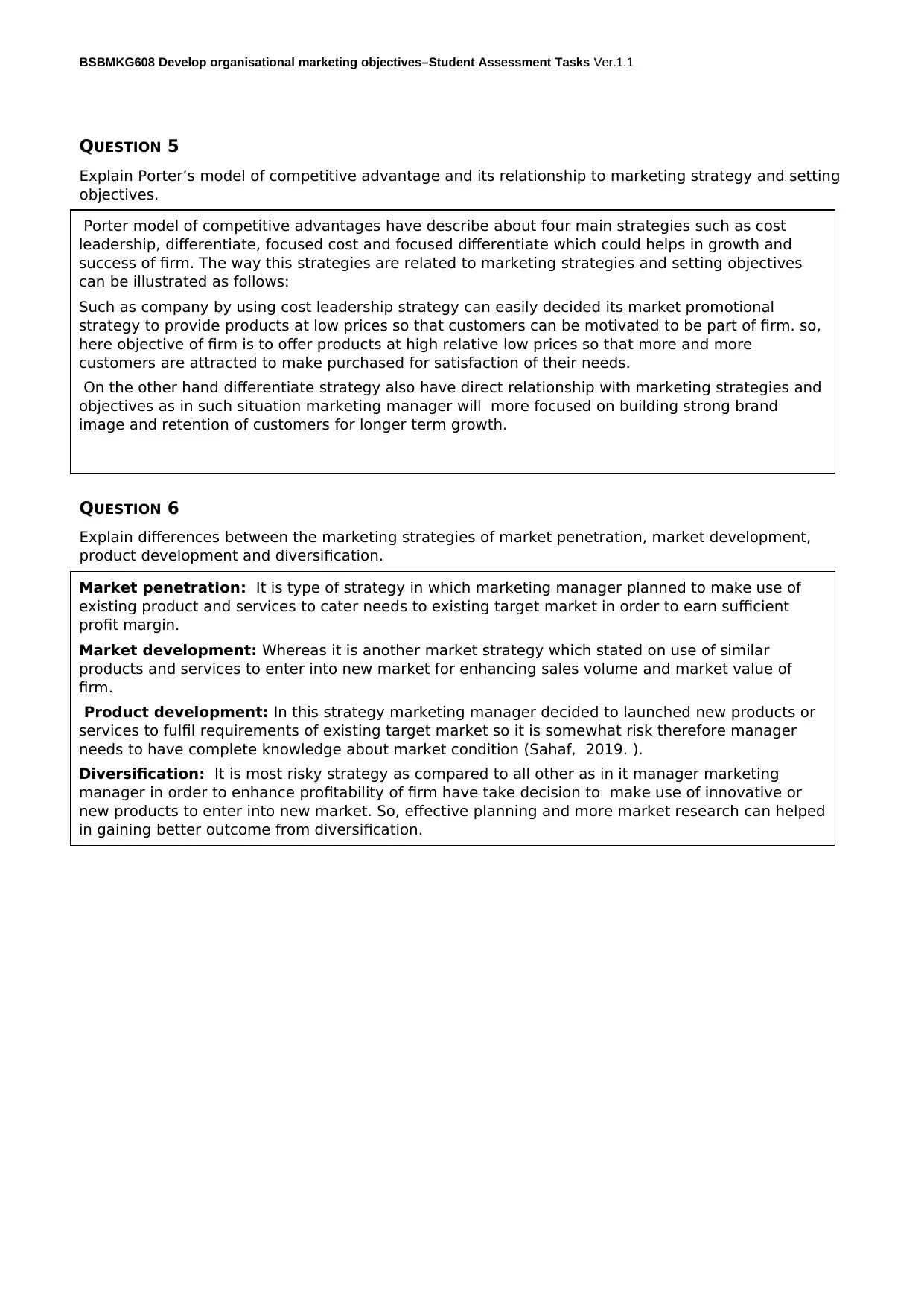
QUESTION 5
Explain Porter’s model of competitive advantage and its relationship to marketing strategy and setting
objectives.
Porter model of competitive advantages have describe about four main strategies such as cost
leadership, differentiate, focused cost and focused differentiate which could helps in growth and
success of firm. The way this strategies are related to marketing strategies and setting objectives
can be illustrated as follows:
Such as company by using cost leadership strategy can easily decided its market promotional
strategy to provide products at low prices so that customers can be motivated to be part of firm. so,
here objective of firm is to offer products at high relative low prices so that more and more
customers are attracted to make purchased for satisfaction of their needs.
On the other hand differentiate strategy also have direct relationship with marketing strategies and
objectives as in such situation marketing manager will more focused on building strong brand
image and retention of customers for longer term growth.
QUESTION 6
Explain differences between the marketing strategies of market penetration, market development,
product development and diversification.
Market penetration: It is type of strategy in which marketing manager planned to make use of
existing product and services to cater needs to existing target market in order to earn sufficient
profit margin.
Market development: Whereas it is another market strategy which stated on use of similar
products and services to enter into new market for enhancing sales volume and market value of
firm.
Product development: In this strategy marketing manager decided to launched new products or
services to fulfil requirements of existing target market so it is somewhat risk therefore manager
needs to have complete knowledge about market condition (Sahaf, 2019. ).
Diversification: It is most risky strategy as compared to all other as in it manager marketing
manager in order to enhance profitability of firm have take decision to make use of innovative or
new products to enter into new market. So, effective planning and more market research can helped
in gaining better outcome from diversification.
QUESTION 5
Explain Porter’s model of competitive advantage and its relationship to marketing strategy and setting
objectives.
Porter model of competitive advantages have describe about four main strategies such as cost
leadership, differentiate, focused cost and focused differentiate which could helps in growth and
success of firm. The way this strategies are related to marketing strategies and setting objectives
can be illustrated as follows:
Such as company by using cost leadership strategy can easily decided its market promotional
strategy to provide products at low prices so that customers can be motivated to be part of firm. so,
here objective of firm is to offer products at high relative low prices so that more and more
customers are attracted to make purchased for satisfaction of their needs.
On the other hand differentiate strategy also have direct relationship with marketing strategies and
objectives as in such situation marketing manager will more focused on building strong brand
image and retention of customers for longer term growth.
QUESTION 6
Explain differences between the marketing strategies of market penetration, market development,
product development and diversification.
Market penetration: It is type of strategy in which marketing manager planned to make use of
existing product and services to cater needs to existing target market in order to earn sufficient
profit margin.
Market development: Whereas it is another market strategy which stated on use of similar
products and services to enter into new market for enhancing sales volume and market value of
firm.
Product development: In this strategy marketing manager decided to launched new products or
services to fulfil requirements of existing target market so it is somewhat risk therefore manager
needs to have complete knowledge about market condition (Sahaf, 2019. ).
Diversification: It is most risky strategy as compared to all other as in it manager marketing
manager in order to enhance profitability of firm have take decision to make use of innovative or
new products to enter into new market. So, effective planning and more market research can helped
in gaining better outcome from diversification.
BSBMKG608 Develop organisational marketing objectives–Student Assessment Tasks Ver.1.1
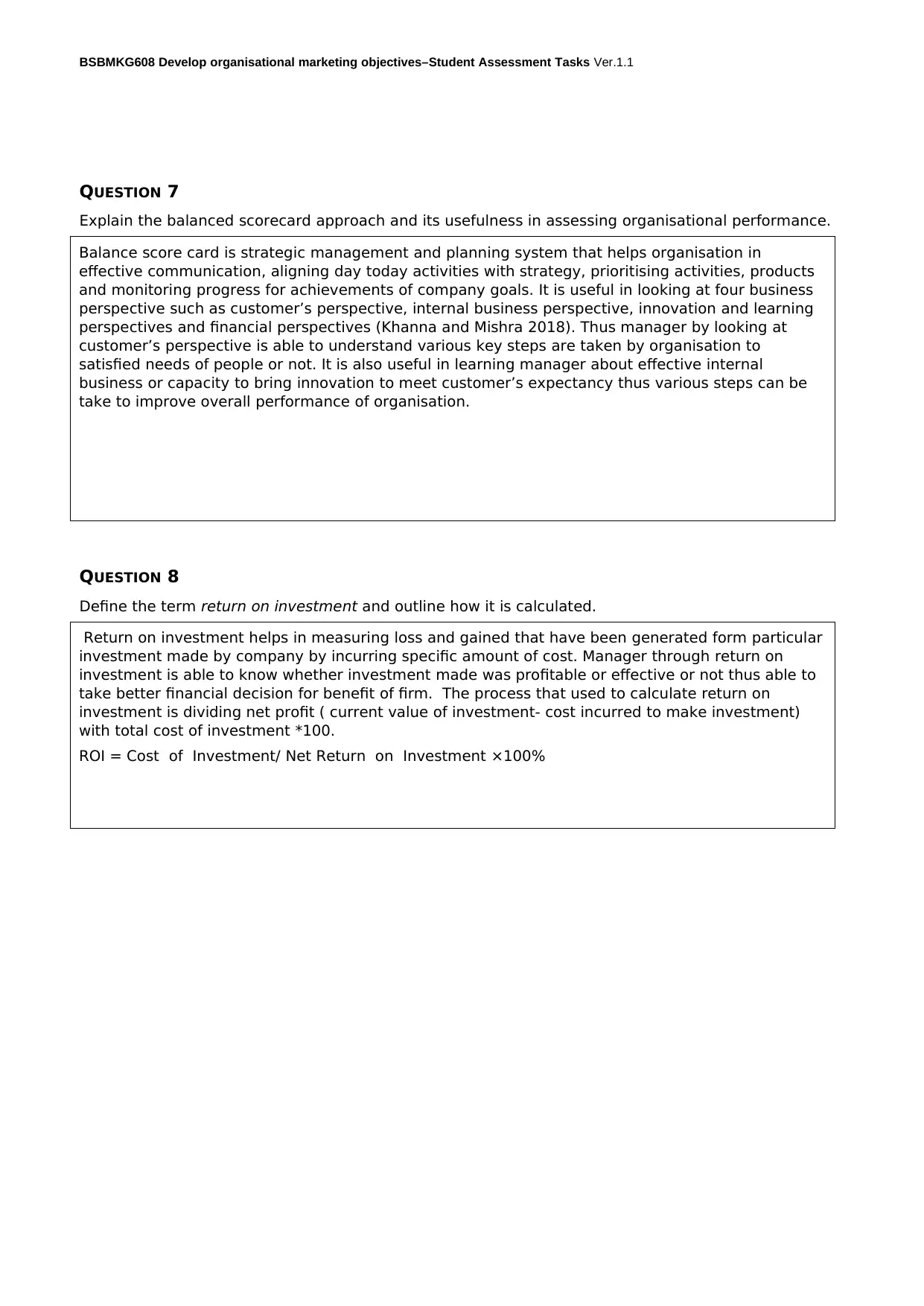
QUESTION 7
Explain the balanced scorecard approach and its usefulness in assessing organisational performance.
Balance score card is strategic management and planning system that helps organisation in
effective communication, aligning day today activities with strategy, prioritising activities, products
and monitoring progress for achievements of company goals. It is useful in looking at four business
perspective such as customer’s perspective, internal business perspective, innovation and learning
perspectives and financial perspectives (Khanna and Mishra 2018). Thus manager by looking at
customer’s perspective is able to understand various key steps are taken by organisation to
satisfied needs of people or not. It is also useful in learning manager about effective internal
business or capacity to bring innovation to meet customer’s expectancy thus various steps can be
take to improve overall performance of organisation.
QUESTION 8
Define the term return on investment and outline how it is calculated.
Return on investment helps in measuring loss and gained that have been generated form particular
investment made by company by incurring specific amount of cost. Manager through return on
investment is able to know whether investment made was profitable or effective or not thus able to
take better financial decision for benefit of firm. The process that used to calculate return on
investment is dividing net profit ( current value of investment- cost incurred to make investment)
with total cost of investment *100.
ROI = Cost of Investment/ Net Return on Investment ×100%
QUESTION 7
Explain the balanced scorecard approach and its usefulness in assessing organisational performance.
Balance score card is strategic management and planning system that helps organisation in
effective communication, aligning day today activities with strategy, prioritising activities, products
and monitoring progress for achievements of company goals. It is useful in looking at four business
perspective such as customer’s perspective, internal business perspective, innovation and learning
perspectives and financial perspectives (Khanna and Mishra 2018). Thus manager by looking at
customer’s perspective is able to understand various key steps are taken by organisation to
satisfied needs of people or not. It is also useful in learning manager about effective internal
business or capacity to bring innovation to meet customer’s expectancy thus various steps can be
take to improve overall performance of organisation.
QUESTION 8
Define the term return on investment and outline how it is calculated.
Return on investment helps in measuring loss and gained that have been generated form particular
investment made by company by incurring specific amount of cost. Manager through return on
investment is able to know whether investment made was profitable or effective or not thus able to
take better financial decision for benefit of firm. The process that used to calculate return on
investment is dividing net profit ( current value of investment- cost incurred to make investment)
with total cost of investment *100.
ROI = Cost of Investment/ Net Return on Investment ×100%
⊘ This is a preview!⊘
Do you want full access?
Subscribe today to unlock all pages.
Trusted by 1+ million students worldwide
BSBMKG608 Develop organisational marketing objectives–Student Assessment Tasks Ver.1.1
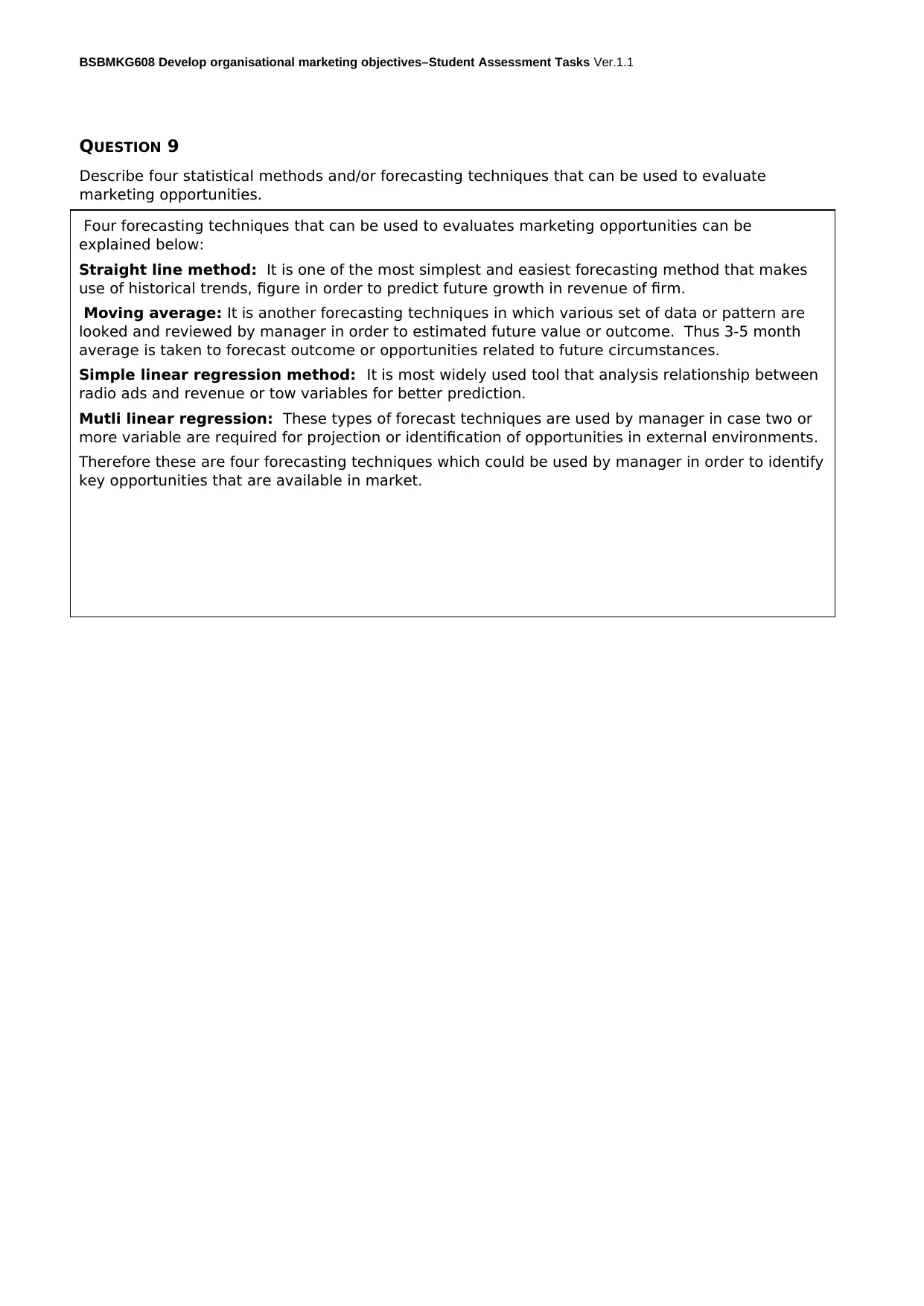
QUESTION 9
Describe four statistical methods and/or forecasting techniques that can be used to evaluate
marketing opportunities.
Four forecasting techniques that can be used to evaluates marketing opportunities can be
explained below:
Straight line method: It is one of the most simplest and easiest forecasting method that makes
use of historical trends, figure in order to predict future growth in revenue of firm.
Moving average: It is another forecasting techniques in which various set of data or pattern are
looked and reviewed by manager in order to estimated future value or outcome. Thus 3-5 month
average is taken to forecast outcome or opportunities related to future circumstances.
Simple linear regression method: It is most widely used tool that analysis relationship between
radio ads and revenue or tow variables for better prediction.
Mutli linear regression: These types of forecast techniques are used by manager in case two or
more variable are required for projection or identification of opportunities in external environments.
Therefore these are four forecasting techniques which could be used by manager in order to identify
key opportunities that are available in market.
QUESTION 9
Describe four statistical methods and/or forecasting techniques that can be used to evaluate
marketing opportunities.
Four forecasting techniques that can be used to evaluates marketing opportunities can be
explained below:
Straight line method: It is one of the most simplest and easiest forecasting method that makes
use of historical trends, figure in order to predict future growth in revenue of firm.
Moving average: It is another forecasting techniques in which various set of data or pattern are
looked and reviewed by manager in order to estimated future value or outcome. Thus 3-5 month
average is taken to forecast outcome or opportunities related to future circumstances.
Simple linear regression method: It is most widely used tool that analysis relationship between
radio ads and revenue or tow variables for better prediction.
Mutli linear regression: These types of forecast techniques are used by manager in case two or
more variable are required for projection or identification of opportunities in external environments.
Therefore these are four forecasting techniques which could be used by manager in order to identify
key opportunities that are available in market.
Paraphrase This Document
Need a fresh take? Get an instant paraphrase of this document with our AI Paraphraser
BSBMKG608 Develop organisational marketing objectives–Student Assessment Tasks Ver.1.1
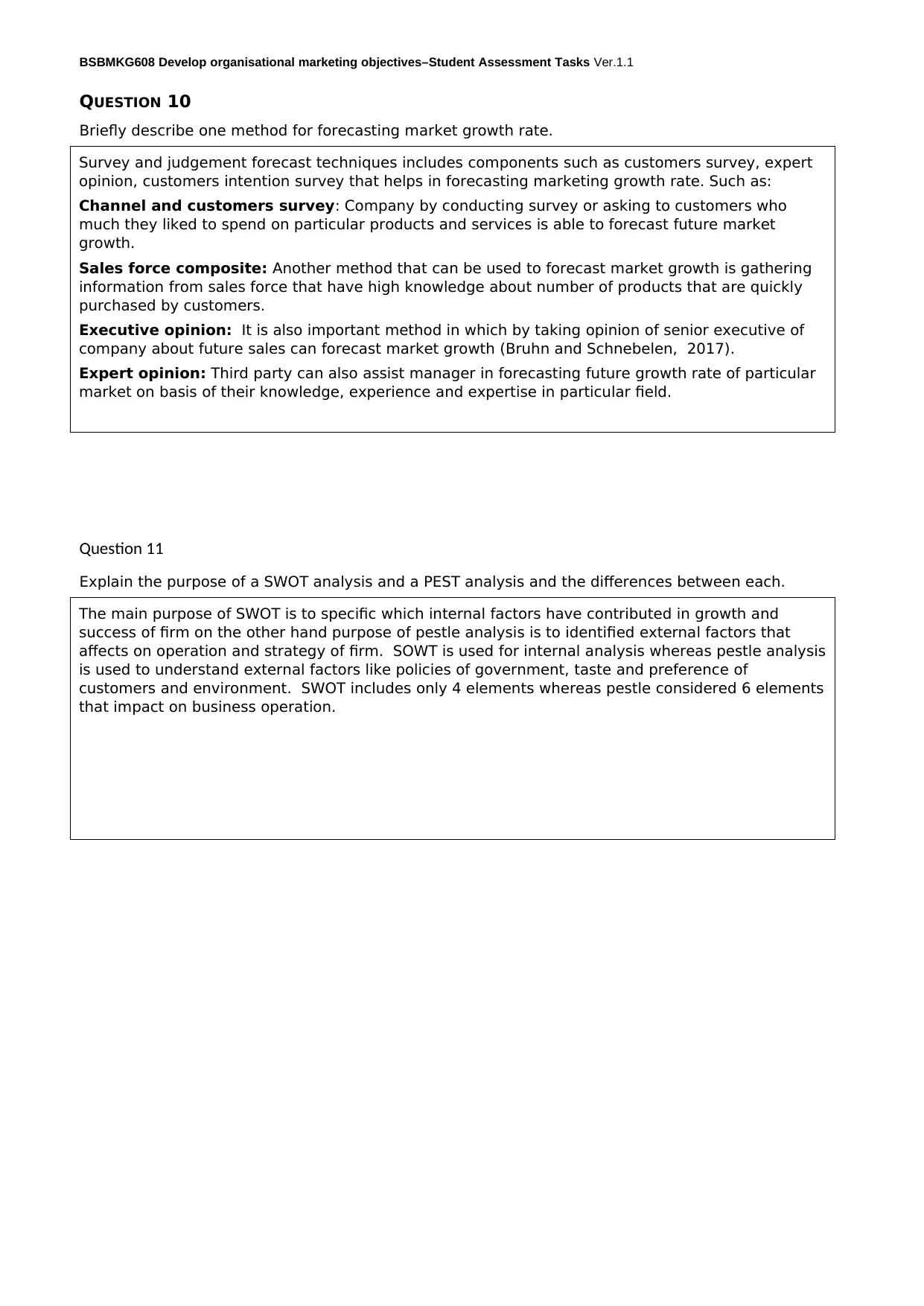
QUESTION 10
Briefly describe one method for forecasting market growth rate.
Survey and judgement forecast techniques includes components such as customers survey, expert
opinion, customers intention survey that helps in forecasting marketing growth rate. Such as:
Channel and customers survey: Company by conducting survey or asking to customers who
much they liked to spend on particular products and services is able to forecast future market
growth.
Sales force composite: Another method that can be used to forecast market growth is gathering
information from sales force that have high knowledge about number of products that are quickly
purchased by customers.
Executive opinion: It is also important method in which by taking opinion of senior executive of
company about future sales can forecast market growth (Bruhn and Schnebelen, 2017).
Expert opinion: Third party can also assist manager in forecasting future growth rate of particular
market on basis of their knowledge, experience and expertise in particular field.
Question 11
Explain the purpose of a SWOT analysis and a PEST analysis and the differences between each.
The main purpose of SWOT is to specific which internal factors have contributed in growth and
success of firm on the other hand purpose of pestle analysis is to identified external factors that
affects on operation and strategy of firm. SOWT is used for internal analysis whereas pestle analysis
is used to understand external factors like policies of government, taste and preference of
customers and environment. SWOT includes only 4 elements whereas pestle considered 6 elements
that impact on business operation.
QUESTION 10
Briefly describe one method for forecasting market growth rate.
Survey and judgement forecast techniques includes components such as customers survey, expert
opinion, customers intention survey that helps in forecasting marketing growth rate. Such as:
Channel and customers survey: Company by conducting survey or asking to customers who
much they liked to spend on particular products and services is able to forecast future market
growth.
Sales force composite: Another method that can be used to forecast market growth is gathering
information from sales force that have high knowledge about number of products that are quickly
purchased by customers.
Executive opinion: It is also important method in which by taking opinion of senior executive of
company about future sales can forecast market growth (Bruhn and Schnebelen, 2017).
Expert opinion: Third party can also assist manager in forecasting future growth rate of particular
market on basis of their knowledge, experience and expertise in particular field.
Question 11
Explain the purpose of a SWOT analysis and a PEST analysis and the differences between each.
The main purpose of SWOT is to specific which internal factors have contributed in growth and
success of firm on the other hand purpose of pestle analysis is to identified external factors that
affects on operation and strategy of firm. SOWT is used for internal analysis whereas pestle analysis
is used to understand external factors like policies of government, taste and preference of
customers and environment. SWOT includes only 4 elements whereas pestle considered 6 elements
that impact on business operation.
BSBMKG608 Develop organisational marketing objectives–Student Assessment Tasks Ver.1.1
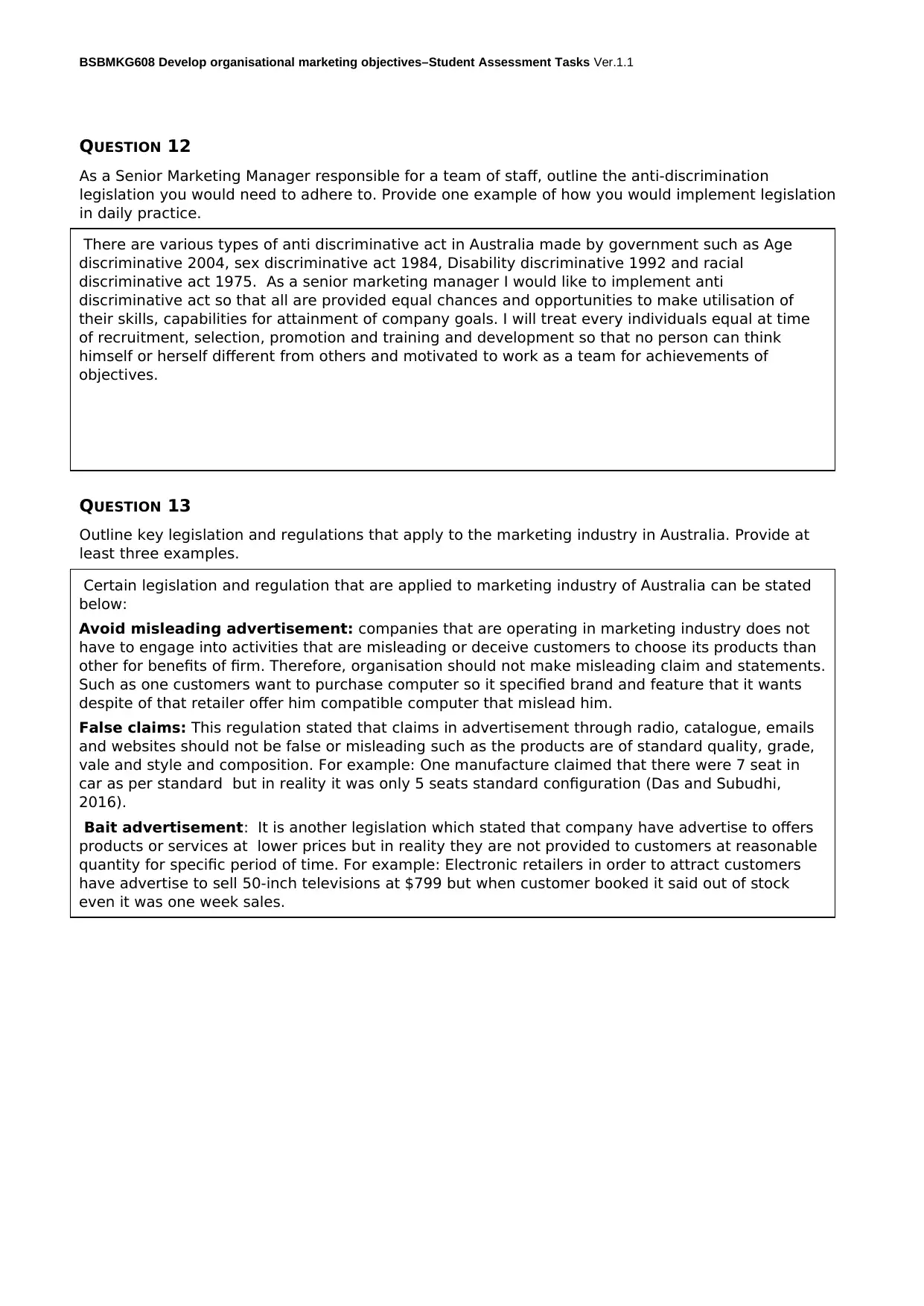
QUESTION 12
As a Senior Marketing Manager responsible for a team of staff, outline the anti-discrimination
legislation you would need to adhere to. Provide one example of how you would implement legislation
in daily practice.
There are various types of anti discriminative act in Australia made by government such as Age
discriminative 2004, sex discriminative act 1984, Disability discriminative 1992 and racial
discriminative act 1975. As a senior marketing manager I would like to implement anti
discriminative act so that all are provided equal chances and opportunities to make utilisation of
their skills, capabilities for attainment of company goals. I will treat every individuals equal at time
of recruitment, selection, promotion and training and development so that no person can think
himself or herself different from others and motivated to work as a team for achievements of
objectives.
QUESTION 13
Outline key legislation and regulations that apply to the marketing industry in Australia. Provide at
least three examples.
Certain legislation and regulation that are applied to marketing industry of Australia can be stated
below:
Avoid misleading advertisement: companies that are operating in marketing industry does not
have to engage into activities that are misleading or deceive customers to choose its products than
other for benefits of firm. Therefore, organisation should not make misleading claim and statements.
Such as one customers want to purchase computer so it specified brand and feature that it wants
despite of that retailer offer him compatible computer that mislead him.
False claims: This regulation stated that claims in advertisement through radio, catalogue, emails
and websites should not be false or misleading such as the products are of standard quality, grade,
vale and style and composition. For example: One manufacture claimed that there were 7 seat in
car as per standard but in reality it was only 5 seats standard configuration (Das and Subudhi,
2016).
Bait advertisement: It is another legislation which stated that company have advertise to offers
products or services at lower prices but in reality they are not provided to customers at reasonable
quantity for specific period of time. For example: Electronic retailers in order to attract customers
have advertise to sell 50-inch televisions at $799 but when customer booked it said out of stock
even it was one week sales.
QUESTION 12
As a Senior Marketing Manager responsible for a team of staff, outline the anti-discrimination
legislation you would need to adhere to. Provide one example of how you would implement legislation
in daily practice.
There are various types of anti discriminative act in Australia made by government such as Age
discriminative 2004, sex discriminative act 1984, Disability discriminative 1992 and racial
discriminative act 1975. As a senior marketing manager I would like to implement anti
discriminative act so that all are provided equal chances and opportunities to make utilisation of
their skills, capabilities for attainment of company goals. I will treat every individuals equal at time
of recruitment, selection, promotion and training and development so that no person can think
himself or herself different from others and motivated to work as a team for achievements of
objectives.
QUESTION 13
Outline key legislation and regulations that apply to the marketing industry in Australia. Provide at
least three examples.
Certain legislation and regulation that are applied to marketing industry of Australia can be stated
below:
Avoid misleading advertisement: companies that are operating in marketing industry does not
have to engage into activities that are misleading or deceive customers to choose its products than
other for benefits of firm. Therefore, organisation should not make misleading claim and statements.
Such as one customers want to purchase computer so it specified brand and feature that it wants
despite of that retailer offer him compatible computer that mislead him.
False claims: This regulation stated that claims in advertisement through radio, catalogue, emails
and websites should not be false or misleading such as the products are of standard quality, grade,
vale and style and composition. For example: One manufacture claimed that there were 7 seat in
car as per standard but in reality it was only 5 seats standard configuration (Das and Subudhi,
2016).
Bait advertisement: It is another legislation which stated that company have advertise to offers
products or services at lower prices but in reality they are not provided to customers at reasonable
quantity for specific period of time. For example: Electronic retailers in order to attract customers
have advertise to sell 50-inch televisions at $799 but when customer booked it said out of stock
even it was one week sales.
⊘ This is a preview!⊘
Do you want full access?
Subscribe today to unlock all pages.
Trusted by 1+ million students worldwide

1 out of 23


Related Documents


Your All-in-One AI-Powered Toolkit for Academic Success.
+13062052269
info@desklib.com
Available 24*7 on WhatsApp / Email
![[object Object]](/_next/static/media/star-bottom.7253800d.svg)
Unlock your academic potential
Copyright © 2020–2026 A2Z Services. All Rights Reserved. Developed and managed by ZUCOL.