Australian College BSBPMG514: Manage Project Cost - Task 1 Solution
VerifiedAdded on 2023/01/09
|37
|6456
|71
Homework Assignment
AI Summary
This document presents a comprehensive solution to Task 1 of the BSBPMG514 Manage Project Cost assignment, focusing on the analysis of project costing methods and tools. The assignment requires students to demonstrate their understanding of various components involved in project development and implementation. The solution includes detailed answers to questions about costing methods, such as expert judgment and parametric estimating, along with tools like bottom-up and three-point estimation. Furthermore, it explores different strategies for managing project costs, including budgeting and cost tracking, and identifies the most effective strategies for addressing budgetary problems. The document also emphasizes the importance of referencing sources and adhering to academic integrity standards. This solution provides valuable insights into the key concepts of project cost management and offers a practical guide for students tackling similar assessments.
Student
Assessment Guide:
BSBPMG514 Manage project cost
Assessment Guide:
BSBPMG514 Manage project cost

Paraphrase This Document
Need a fresh take? Get an instant paraphrase of this document with our AI Paraphraser
photocopying, recording or otherwise without the prior written permission of Australian College of Business Intelligence.
Disclaimer:
The Australian College of Business Intelligence does not invite reliance upon, nor accept responsibility for, the information it
provides. The Australian College of Business Intelligence makes every effort to provide a high-quality service. However, neither
the Australian College of Business Intelligence, nor the providers of data, gives any guarantees, undertakings or warranties
concerning the accuracy, completeness or up-to-date nature of the information provided. Users should confirm information
from another source if it is of sufficient importance for them to do so.
Content
s
1. Assessment Information......................................................................................................4
A. Purpose of assessment........................................................................................................................4
B. Competencies being assessed.............................................................................................................4
C. What you are required to do...............................................................................................................5
D. Adjustment and Support.....................................................................................................................7
E. Assessment submission.......................................................................................................................7
Disclaimer:
The Australian College of Business Intelligence does not invite reliance upon, nor accept responsibility for, the information it
provides. The Australian College of Business Intelligence makes every effort to provide a high-quality service. However, neither
the Australian College of Business Intelligence, nor the providers of data, gives any guarantees, undertakings or warranties
concerning the accuracy, completeness or up-to-date nature of the information provided. Users should confirm information
from another source if it is of sufficient importance for them to do so.
Content
s
1. Assessment Information......................................................................................................4
A. Purpose of assessment........................................................................................................................4
B. Competencies being assessed.............................................................................................................4
C. What you are required to do...............................................................................................................5
D. Adjustment and Support.....................................................................................................................7
E. Assessment submission.......................................................................................................................7
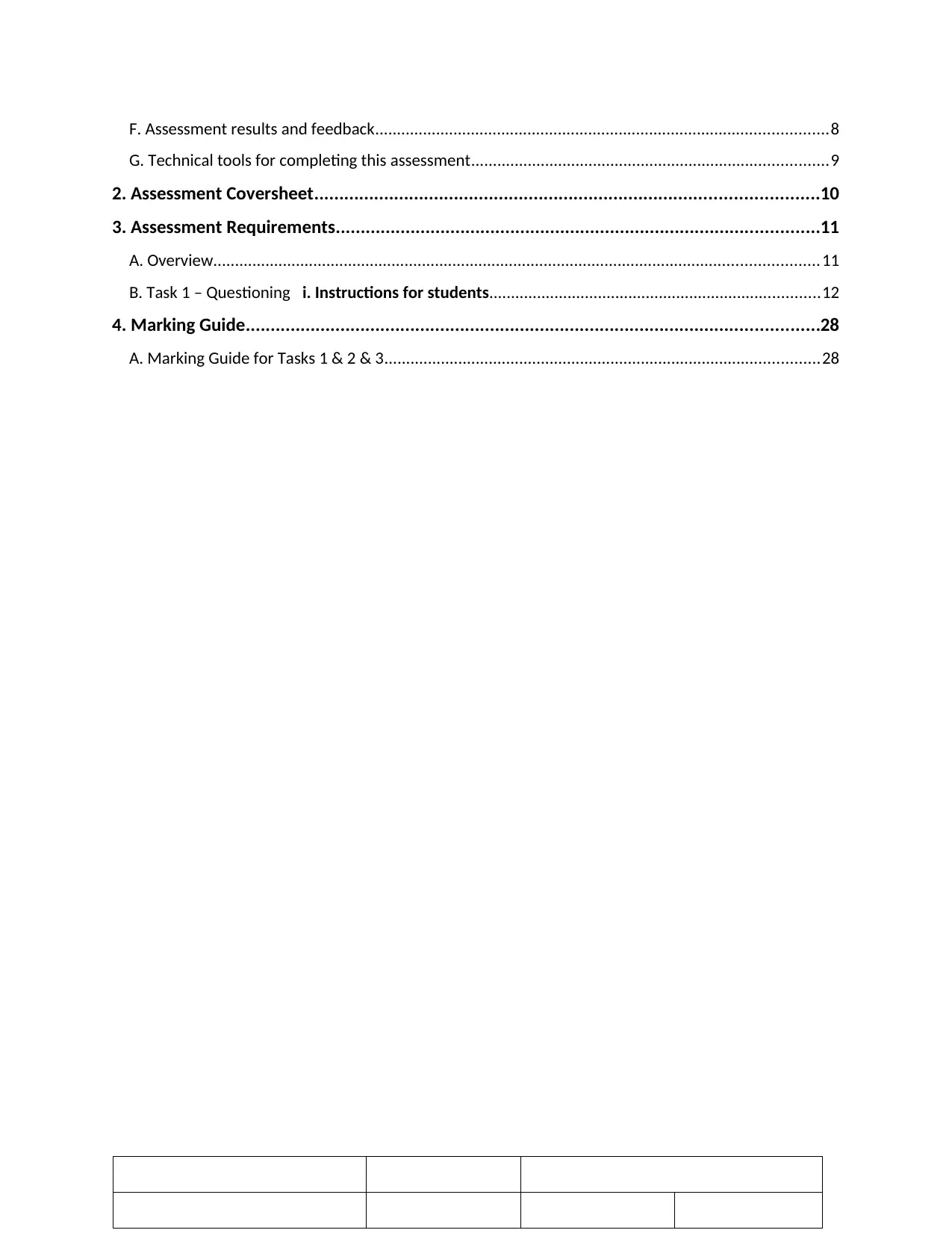
F. Assessment results and feedback........................................................................................................8
G. Technical tools for completing this assessment..................................................................................9
2. Assessment Coversheet.....................................................................................................10
3. Assessment Requirements.................................................................................................11
A. Overview...........................................................................................................................................11
B. Task 1 – Questioning i. Instructions for students............................................................................12
4. Marking Guide...................................................................................................................28
A. Marking Guide for Tasks 1 & 2 & 3....................................................................................................28
G. Technical tools for completing this assessment..................................................................................9
2. Assessment Coversheet.....................................................................................................10
3. Assessment Requirements.................................................................................................11
A. Overview...........................................................................................................................................11
B. Task 1 – Questioning i. Instructions for students............................................................................12
4. Marking Guide...................................................................................................................28
A. Marking Guide for Tasks 1 & 2 & 3....................................................................................................28
⊘ This is a preview!⊘
Do you want full access?
Subscribe today to unlock all pages.

Trusted by 1+ million students worldwide
1. Assessment Information
A. Purpose of assessment
This assessment will develop your skills and knowledge skills and knowledge required to identify,
analyse and refine project costs to produce a budget, and to use this budget as the principal mechanism
to control project cost.
The assessment is designed to help you gather evidence of your competence against the requirements
of the unit of competency, as outlined below. Your evidence may take a variety of forms and must be:
Authentic – your own work
Valid – related to the competency
Sufficient – appropriate quantity and quality
Current – recent proof of your skills and knowledge
B. Competencies being assessed
Elements
To achieve competency in this unit students must demonstrate their ability to:
1. Determine project cost
2. Monitor and control project cost
3. Complete cost-management processes
Performance Evidence
Evidence of the ability to:
Work closely with others to determine resources against budgetary frameworks
Prepare a budget and cost-management plan for a project
Monitor costs across a project's life cycle including solving cost variations and analysing possible
alternatives
Record expenditure, create accurate financial reports and review cost-management processes
Knowledge Evidence
To complete the unit requirements safely and effectively, you must:
Explain appropriate budgeting processes, tools and techniques
A. Purpose of assessment
This assessment will develop your skills and knowledge skills and knowledge required to identify,
analyse and refine project costs to produce a budget, and to use this budget as the principal mechanism
to control project cost.
The assessment is designed to help you gather evidence of your competence against the requirements
of the unit of competency, as outlined below. Your evidence may take a variety of forms and must be:
Authentic – your own work
Valid – related to the competency
Sufficient – appropriate quantity and quality
Current – recent proof of your skills and knowledge
B. Competencies being assessed
Elements
To achieve competency in this unit students must demonstrate their ability to:
1. Determine project cost
2. Monitor and control project cost
3. Complete cost-management processes
Performance Evidence
Evidence of the ability to:
Work closely with others to determine resources against budgetary frameworks
Prepare a budget and cost-management plan for a project
Monitor costs across a project's life cycle including solving cost variations and analysing possible
alternatives
Record expenditure, create accurate financial reports and review cost-management processes
Knowledge Evidence
To complete the unit requirements safely and effectively, you must:
Explain appropriate budgeting processes, tools and techniques
Paraphrase This Document
Need a fresh take? Get an instant paraphrase of this document with our AI Paraphraser
Describe methods and tools for costing and cost analysis
Explain strategies for managing costs and their application in different situations
Outline processes for reviewing costs against outcomes
Summarise key organisational policies and procedures applicable to this role
For further information on the competencies of this unit, please refer to:
https://training.gov.au/Training/Details/BSBPMG514
C. What you are required to do
This assessment requires you to answer all questions within each Assessment Task and be assessed as
“Satisfactory” in each to gain competency in BSBPMG514 Manage Project Cost.
Task 1
For Task 1, you are required to analyse different models and tools utilised in managing a project’s cost.
You will also demonstrate understanding of the various components needed in developing and
implementing a project.
Task 2
For Task 2, you are a Project Manager with OzMarket Consulting. You have been employed to project
manage a new garden for a local park. You are required to write a financial report listing the costings of
the project and to revise financial projections due to changes that occur during the implementation
phase.
Task 3
Task 3 requires you to report on the financial outcomes of the project and to summarise the financial
issues that arose in order to take into account for future projects.
For further details, please refer to the “Assessment Requirements” section of this document.
Assessment resources
To enable you to complete this assessment, the following documents have been provided in the unit
course page on Moodle unit on Moodle: BSBPMG514 Manage Project Cost Learner Guide
BSBPMG514 Manage Project Cost PowerPoint slides
PMBOK 5th edition – refer to Chapter 7, “Project Cost Management” on pages 193 - 226
Explain strategies for managing costs and their application in different situations
Outline processes for reviewing costs against outcomes
Summarise key organisational policies and procedures applicable to this role
For further information on the competencies of this unit, please refer to:
https://training.gov.au/Training/Details/BSBPMG514
C. What you are required to do
This assessment requires you to answer all questions within each Assessment Task and be assessed as
“Satisfactory” in each to gain competency in BSBPMG514 Manage Project Cost.
Task 1
For Task 1, you are required to analyse different models and tools utilised in managing a project’s cost.
You will also demonstrate understanding of the various components needed in developing and
implementing a project.
Task 2
For Task 2, you are a Project Manager with OzMarket Consulting. You have been employed to project
manage a new garden for a local park. You are required to write a financial report listing the costings of
the project and to revise financial projections due to changes that occur during the implementation
phase.
Task 3
Task 3 requires you to report on the financial outcomes of the project and to summarise the financial
issues that arose in order to take into account for future projects.
For further details, please refer to the “Assessment Requirements” section of this document.
Assessment resources
To enable you to complete this assessment, the following documents have been provided in the unit
course page on Moodle unit on Moodle: BSBPMG514 Manage Project Cost Learner Guide
BSBPMG514 Manage Project Cost PowerPoint slides
PMBOK 5th edition – refer to Chapter 7, “Project Cost Management” on pages 193 - 226
BSBPMG514 Marking Guide
Sample Project management plan
A note on plagiarism and referencing
Plagiarism is a form of theft where the work, ideas, inventions etc. of other people are presented as your
own.
When quoting or paraphrasing from a source such as the Internet, the source must be recognised. If you
are quoting a source, make sure to acknowledge this by including “quotation marks” around the
relevant words/sentences or ideas. Note the source at the point at which it is included within your
assessment, such as by using a citation. Then list the full details of the source in a ‘references’ section at
the end of your assessment.
All sources used for your assessment should be detailed in the ‘references’ section. It is advisable to
never copy another person’s work.
D. Adjustment and Support
i. Reasonable adjustment
ACBI supports individual differences in the learning environment and provides ‘reasonable adjustment’
in training and assessment activities to support every learner. If you have any special needs that make it
difficult for you to complete your learning or assessments, you should discuss this with your assessor.
ACBI will endeavour to provide you with reasonable alternatives to assist you to complete the required
tasks such as completing tests verbally or using an interpreter.
NOTE: If you have any special needs, you should discuss this with your assessor before starting your
assessment.
ii. Support
While ACBI may not be able to assist you with language training or specific Language, Literacy and
Numeracy (LLN) training, our assessors will work with you to ensure that you are supported throughout
your qualification. If you require individual tutoring this may attract an additional fee (please refer to the
ACBI Student Handbook available from https://www.acbi.edu.au). Support may be offered by your
assessor, or for more specialist support you may need to contact the RTO administration.
E. Assessment submission
Always submit assessments on time by the due date. You can find the due date in the unit course page
on Moodle.
Sample Project management plan
A note on plagiarism and referencing
Plagiarism is a form of theft where the work, ideas, inventions etc. of other people are presented as your
own.
When quoting or paraphrasing from a source such as the Internet, the source must be recognised. If you
are quoting a source, make sure to acknowledge this by including “quotation marks” around the
relevant words/sentences or ideas. Note the source at the point at which it is included within your
assessment, such as by using a citation. Then list the full details of the source in a ‘references’ section at
the end of your assessment.
All sources used for your assessment should be detailed in the ‘references’ section. It is advisable to
never copy another person’s work.
D. Adjustment and Support
i. Reasonable adjustment
ACBI supports individual differences in the learning environment and provides ‘reasonable adjustment’
in training and assessment activities to support every learner. If you have any special needs that make it
difficult for you to complete your learning or assessments, you should discuss this with your assessor.
ACBI will endeavour to provide you with reasonable alternatives to assist you to complete the required
tasks such as completing tests verbally or using an interpreter.
NOTE: If you have any special needs, you should discuss this with your assessor before starting your
assessment.
ii. Support
While ACBI may not be able to assist you with language training or specific Language, Literacy and
Numeracy (LLN) training, our assessors will work with you to ensure that you are supported throughout
your qualification. If you require individual tutoring this may attract an additional fee (please refer to the
ACBI Student Handbook available from https://www.acbi.edu.au). Support may be offered by your
assessor, or for more specialist support you may need to contact the RTO administration.
E. Assessment submission
Always submit assessments on time by the due date. You can find the due date in the unit course page
on Moodle.
⊘ This is a preview!⊘
Do you want full access?
Subscribe today to unlock all pages.
Trusted by 1+ million students worldwide
i. Assessment Coversheet
Once you have completed all the tasks of the assessment, you must complete the Assessment Cover
Sheet, including signing the declaration.
ii. File naming conventions
When submitting assessments electronically follow the following standard for naming document files
and subject line. You must insert the following information:
Unit of Competency code (ie. BSBPMG514)
‘A’ for word assessment then followed by the assessment number and a dash
Your first name and initial of last name. Capitalise only the first letter of names. Then insert a
hashtag, followed by submission attempt.
Hence as an example of incorporating the four points above your file name or subject line should appear
this way: BSBPMG514 A1 – JessieA #1
iii. Submission via Moodle
Please refer to the “Instructions for Submitting Your Assessment” on the unit course page in Moodle.
NOTE: Please take care to follow all instructions listed. Assessments uploaded with a draft status on
Moodle may not be graded.
F. Assessment results and feedback
i. Assessment results
Once you have submitted this assessment online via Moodle, your assessor will grade it and provide you
with feedback. For each task of the assessment, you will receive a grade of ‘Satisfactory’ or ‘Not
Satisfactory’. You will also receive a grade for the entire assessment of ‘Competent’ or ‘Not Competent’.
Each task of the assessment must be ‘Satisfactory’ in order to receive a grade of ‘Competent’.
ii. Resubmission
If your assessment is graded ‘Not Competent’, you receive instructions via the feedback form on
components to be amended.
Your assessor is committed to providing you with detailed feedback on the outcomes of the assessment
and will provide guidance on areas for improvement. In most instances, you should need only complete
the sections of the assessment that were deemed ‘Not Satisfactory’. However, it is important to
remember that depending on the task, it may be necessary to repeat the whole task (for example
presentations or the delivery of a training session).
Once you have completed all the tasks of the assessment, you must complete the Assessment Cover
Sheet, including signing the declaration.
ii. File naming conventions
When submitting assessments electronically follow the following standard for naming document files
and subject line. You must insert the following information:
Unit of Competency code (ie. BSBPMG514)
‘A’ for word assessment then followed by the assessment number and a dash
Your first name and initial of last name. Capitalise only the first letter of names. Then insert a
hashtag, followed by submission attempt.
Hence as an example of incorporating the four points above your file name or subject line should appear
this way: BSBPMG514 A1 – JessieA #1
iii. Submission via Moodle
Please refer to the “Instructions for Submitting Your Assessment” on the unit course page in Moodle.
NOTE: Please take care to follow all instructions listed. Assessments uploaded with a draft status on
Moodle may not be graded.
F. Assessment results and feedback
i. Assessment results
Once you have submitted this assessment online via Moodle, your assessor will grade it and provide you
with feedback. For each task of the assessment, you will receive a grade of ‘Satisfactory’ or ‘Not
Satisfactory’. You will also receive a grade for the entire assessment of ‘Competent’ or ‘Not Competent’.
Each task of the assessment must be ‘Satisfactory’ in order to receive a grade of ‘Competent’.
ii. Resubmission
If your assessment is graded ‘Not Competent’, you receive instructions via the feedback form on
components to be amended.
Your assessor is committed to providing you with detailed feedback on the outcomes of the assessment
and will provide guidance on areas for improvement. In most instances, you should need only complete
the sections of the assessment that were deemed ‘Not Satisfactory’. However, it is important to
remember that depending on the task, it may be necessary to repeat the whole task (for example
presentations or the delivery of a training session).
Paraphrase This Document
Need a fresh take? Get an instant paraphrase of this document with our AI Paraphraser
If resubmission is required, you will need to amend or update your assessment as a different version by
the required term cut-off date, as detailed on Moodle.
NOTE: For further information on late assessment, please refer to the ‘Assessment Policy’ available on
Moodle.
iii. What happens if you do not agree with the assessment result
If you do not think the assessment process is valid, or disagree with the decision once it is made, or
believe that you have been treated unfairly, you can appeal.
The first step is to discuss the matter with your trainer. If you still do not agree with the assessment, you
are able to request a re-assessment. It is possible to have your evidence assessed by a different trainer.
If you remain dissatisfied after the re-assessment, you should contact the Director of Studies. Full details
of the Appeals process are contained in your Student Handbook.
G. Technical tools for completing this assessment
To complete this assessment, you need access to:
A computer with internet
Word processing and other relevant programs to develop appropriate documentation and
reports as required
the required term cut-off date, as detailed on Moodle.
NOTE: For further information on late assessment, please refer to the ‘Assessment Policy’ available on
Moodle.
iii. What happens if you do not agree with the assessment result
If you do not think the assessment process is valid, or disagree with the decision once it is made, or
believe that you have been treated unfairly, you can appeal.
The first step is to discuss the matter with your trainer. If you still do not agree with the assessment, you
are able to request a re-assessment. It is possible to have your evidence assessed by a different trainer.
If you remain dissatisfied after the re-assessment, you should contact the Director of Studies. Full details
of the Appeals process are contained in your Student Handbook.
G. Technical tools for completing this assessment
To complete this assessment, you need access to:
A computer with internet
Word processing and other relevant programs to develop appropriate documentation and
reports as required
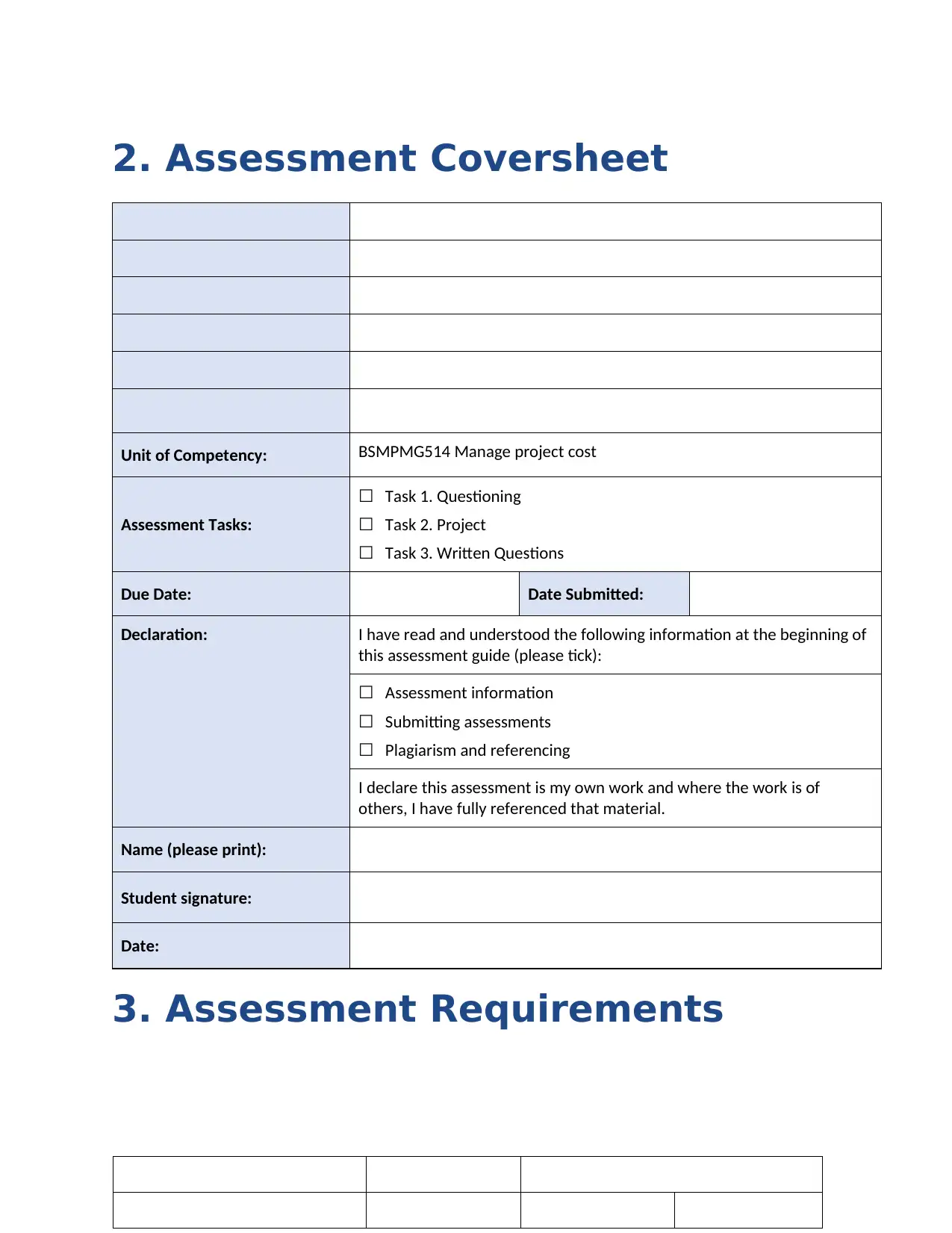
2. Assessment Coversheet
Unit of Competency: BSMPMG514 Manage project cost
Assessment Tasks:
☐ Task 1. Questioning
☐ Task 2. Project
☐ Task 3. Written Questions
Due Date: Date Submitted:
Declaration: I have read and understood the following information at the beginning of
this assessment guide (please tick):
☐ Assessment information
☐ Submitting assessments
☐ Plagiarism and referencing
I declare this assessment is my own work and where the work is of
others, I have fully referenced that material.
Name (please print):
Student signature:
Date:
3. Assessment Requirements
Unit of Competency: BSMPMG514 Manage project cost
Assessment Tasks:
☐ Task 1. Questioning
☐ Task 2. Project
☐ Task 3. Written Questions
Due Date: Date Submitted:
Declaration: I have read and understood the following information at the beginning of
this assessment guide (please tick):
☐ Assessment information
☐ Submitting assessments
☐ Plagiarism and referencing
I declare this assessment is my own work and where the work is of
others, I have fully referenced that material.
Name (please print):
Student signature:
Date:
3. Assessment Requirements
⊘ This is a preview!⊘
Do you want full access?
Subscribe today to unlock all pages.
Trusted by 1+ million students worldwide
A. Task 1 – Questioning
i. Instructions for students
Task 1 of this assessment requires you to analyse different models and tools utilised in managing a
project’s cost and gain an understanding of the various components needed in developing and
implementing a project.
Answer the questions below using the space provided:
Answer all parts of each question
Use your own words and give examples wherever possible
The quality of your answer is more important than how long it is
Enter your answers in this document
You may use various sources of information to inform your answers, including your resources provided
by ACBI, books, and online sources. You must acknowledge and cite your sources.
ii. Task 1 Questions
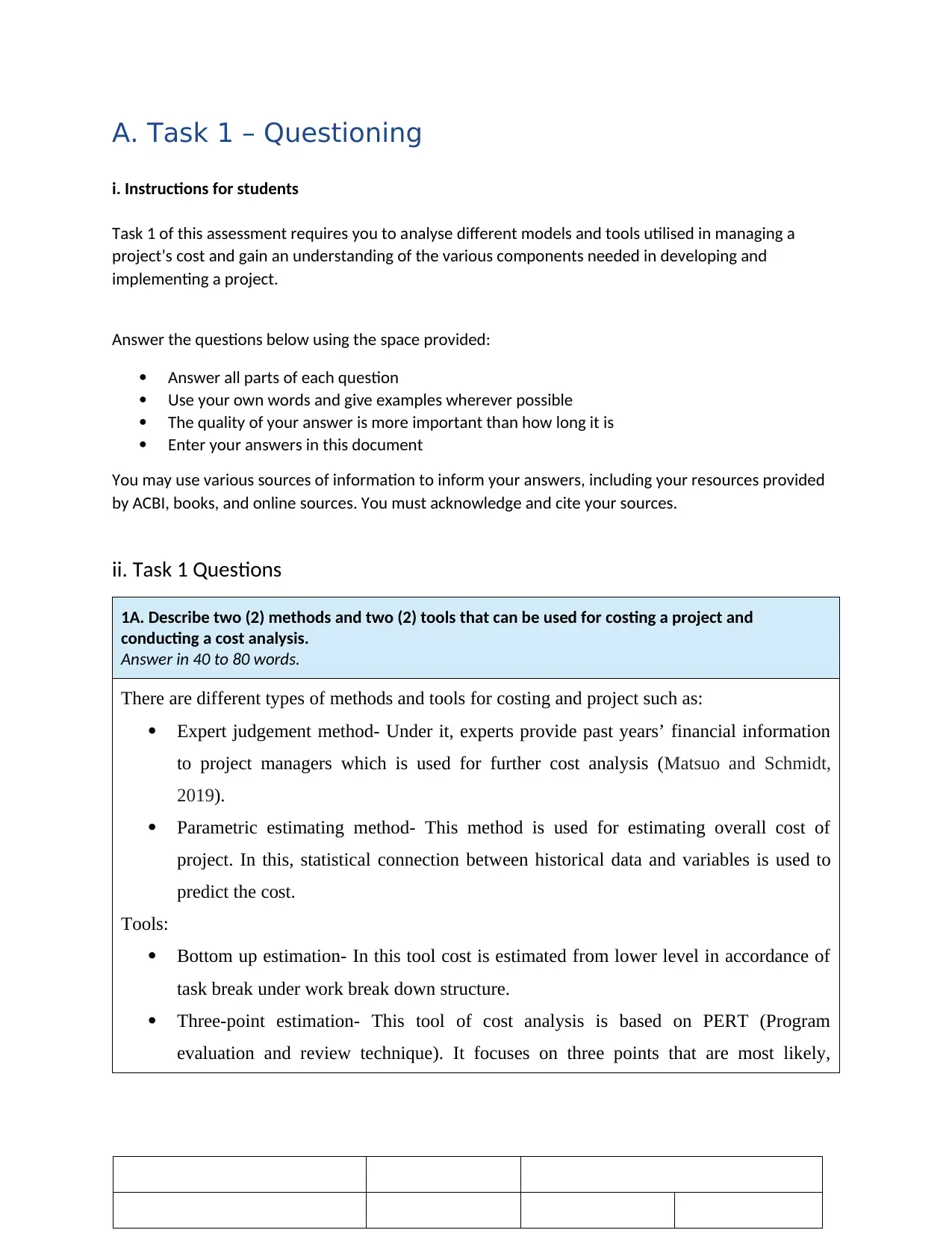
1A. Describe two (2) methods and two (2) tools that can be used for costing a project and
conducting a cost analysis.
Answer in 40 to 80 words.
There are different types of methods and tools for costing and project such as:
Expert judgement method- Under it, experts provide past years’ financial information
to project managers which is used for further cost analysis (Matsuo and Schmidt,
2019).
Parametric estimating method- This method is used for estimating overall cost of
project. In this, statistical connection between historical data and variables is used to
predict the cost.
Tools:
Bottom up estimation- In this tool cost is estimated from lower level in accordance of
task break under work break down structure.
Three-point estimation- This tool of cost analysis is based on PERT (Program
evaluation and review technique). It focuses on three points that are most likely,
i. Instructions for students
Task 1 of this assessment requires you to analyse different models and tools utilised in managing a
project’s cost and gain an understanding of the various components needed in developing and
implementing a project.
Answer the questions below using the space provided:
Answer all parts of each question
Use your own words and give examples wherever possible
The quality of your answer is more important than how long it is
Enter your answers in this document
You may use various sources of information to inform your answers, including your resources provided
by ACBI, books, and online sources. You must acknowledge and cite your sources.
ii. Task 1 Questions
1A. Describe two (2) methods and two (2) tools that can be used for costing a project and
conducting a cost analysis.
Answer in 40 to 80 words.
There are different types of methods and tools for costing and project such as:
Expert judgement method- Under it, experts provide past years’ financial information
to project managers which is used for further cost analysis (Matsuo and Schmidt,
2019).
Parametric estimating method- This method is used for estimating overall cost of
project. In this, statistical connection between historical data and variables is used to
predict the cost.
Tools:
Bottom up estimation- In this tool cost is estimated from lower level in accordance of
task break under work break down structure.
Three-point estimation- This tool of cost analysis is based on PERT (Program
evaluation and review technique). It focuses on three points that are most likely,
Paraphrase This Document
Need a fresh take? Get an instant paraphrase of this document with our AI Paraphraser
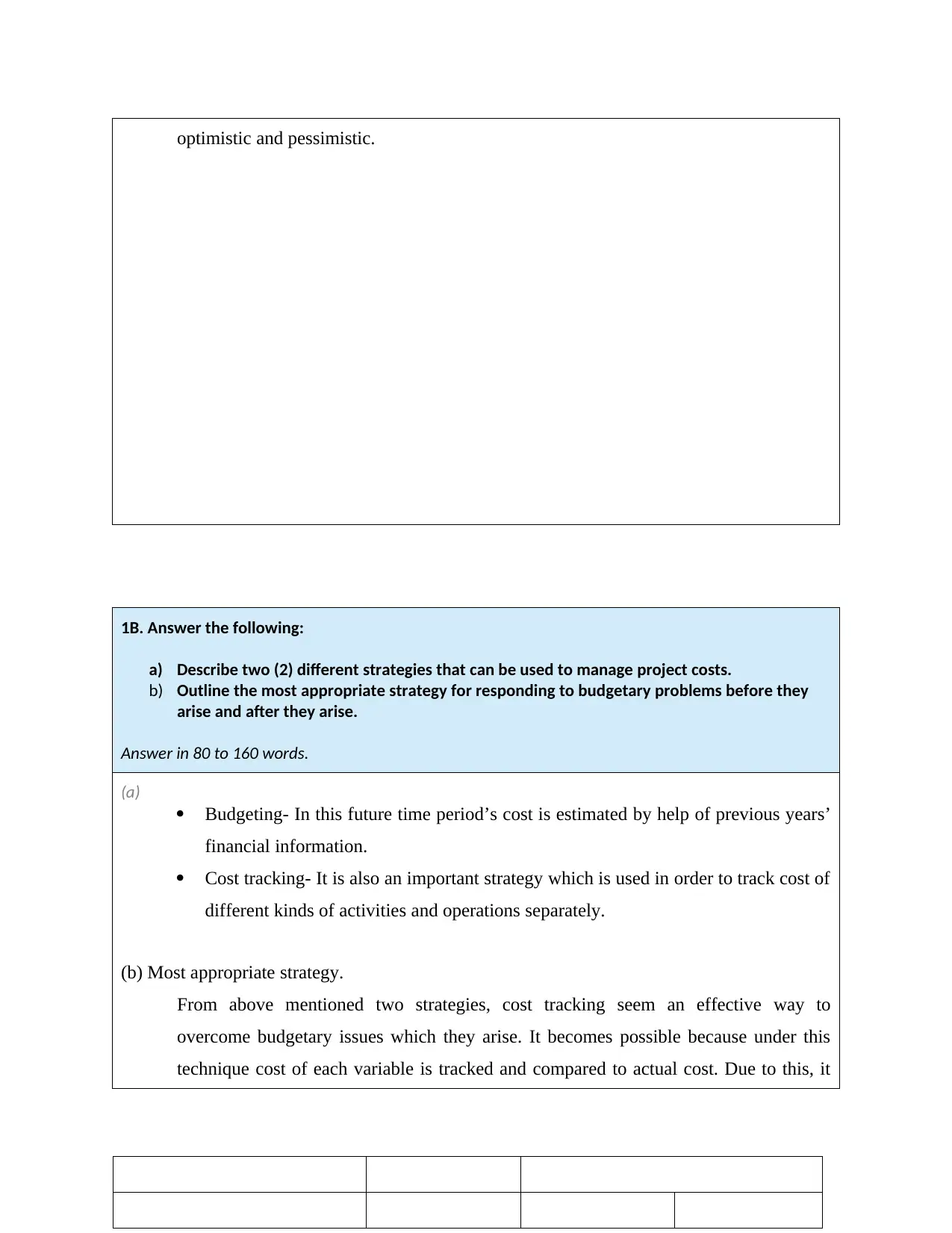
optimistic and pessimistic.
1B. Answer the following:
a) Describe two (2) different strategies that can be used to manage project costs.
b) Outline the most appropriate strategy for responding to budgetary problems before they
arise and after they arise.
Answer in 80 to 160 words.
(a)
Budgeting- In this future time period’s cost is estimated by help of previous years’
financial information.
Cost tracking- It is also an important strategy which is used in order to track cost of
different kinds of activities and operations separately.
(b) Most appropriate strategy.
From above mentioned two strategies, cost tracking seem an effective way to
overcome budgetary issues which they arise. It becomes possible because under this
technique cost of each variable is tracked and compared to actual cost. Due to this, it
1B. Answer the following:
a) Describe two (2) different strategies that can be used to manage project costs.
b) Outline the most appropriate strategy for responding to budgetary problems before they
arise and after they arise.
Answer in 80 to 160 words.
(a)
Budgeting- In this future time period’s cost is estimated by help of previous years’
financial information.
Cost tracking- It is also an important strategy which is used in order to track cost of
different kinds of activities and operations separately.
(b) Most appropriate strategy.
From above mentioned two strategies, cost tracking seem an effective way to
overcome budgetary issues which they arise. It becomes possible because under this
technique cost of each variable is tracked and compared to actual cost. Due to this, it
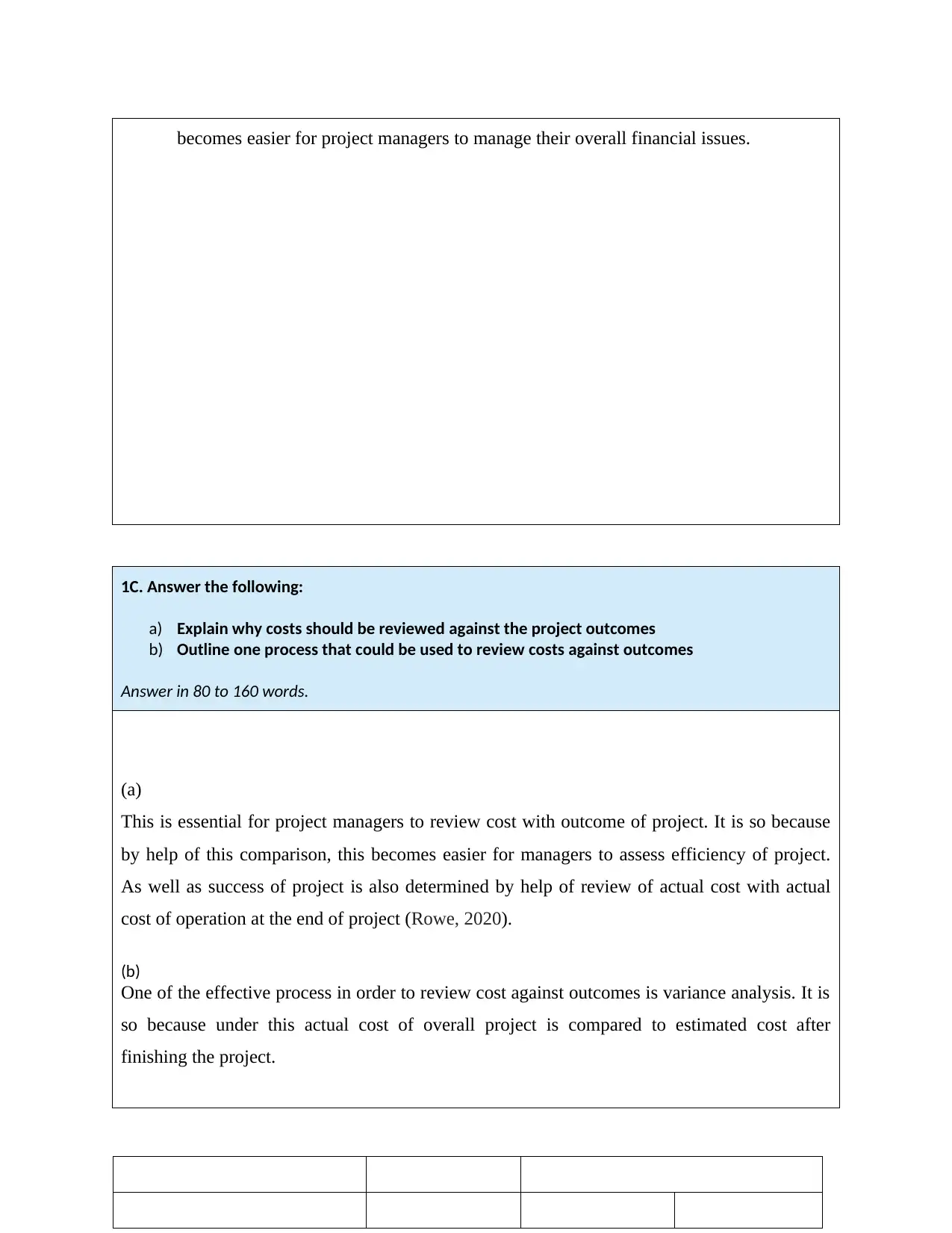
becomes easier for project managers to manage their overall financial issues.
1C. Answer the following:
a) Explain why costs should be reviewed against the project outcomes
b) Outline one process that could be used to review costs against outcomes
Answer in 80 to 160 words.
(a)
This is essential for project managers to review cost with outcome of project. It is so because
by help of this comparison, this becomes easier for managers to assess efficiency of project.
As well as success of project is also determined by help of review of actual cost with actual
cost of operation at the end of project (Rowe, 2020).
(b)
One of the effective process in order to review cost against outcomes is variance analysis. It is
so because under this actual cost of overall project is compared to estimated cost after
finishing the project.
1C. Answer the following:
a) Explain why costs should be reviewed against the project outcomes
b) Outline one process that could be used to review costs against outcomes
Answer in 80 to 160 words.
(a)
This is essential for project managers to review cost with outcome of project. It is so because
by help of this comparison, this becomes easier for managers to assess efficiency of project.
As well as success of project is also determined by help of review of actual cost with actual
cost of operation at the end of project (Rowe, 2020).
(b)
One of the effective process in order to review cost against outcomes is variance analysis. It is
so because under this actual cost of overall project is compared to estimated cost after
finishing the project.
⊘ This is a preview!⊘
Do you want full access?
Subscribe today to unlock all pages.
Trusted by 1+ million students worldwide

1 out of 37


Related Documents


Your All-in-One AI-Powered Toolkit for Academic Success.
+13062052269
info@desklib.com
Available 24*7 on WhatsApp / Email
![[object Object]](/_next/static/media/star-bottom.7253800d.svg)
Unlock your academic potential
Copyright © 2020–2026 A2Z Services. All Rights Reserved. Developed and managed by ZUCOL.