BSBRSK501 Risk Management: Complete Assessment Guide Solution
VerifiedAdded on 2023/03/31
|11
|2456
|477
Homework Assignment
AI Summary
This document provides a comprehensive solution to a risk management assignment, addressing key areas such as operational, strategic, and external risks. It outlines the importance of risk management in protecting workers and businesses, detailing the six steps of the risk management process. The solution covers essential aspects like stakeholder identification, PESTEL analysis, risk criteria, and the significance of continual communication. It further explores risk identification tools, qualitative and quantitative risk analysis, risk calculation components, and various risk treatment options. The document also discusses cost-benefit analysis, the components of a risk management plan, and the importance of monitoring and reviewing risk management activities. Desklib offers a platform to access similar solved assignments and past papers for students.
Running Head : RISK MANAGEMENT
Risk Management
Name of the Student
Name of the University
Author Note
Risk Management
Name of the Student
Name of the University
Author Note

Paraphrase This Document
Need a fresh take? Get an instant paraphrase of this document with our AI Paraphraser
1RISK MANAGEMENT
Part A:
Question 1:
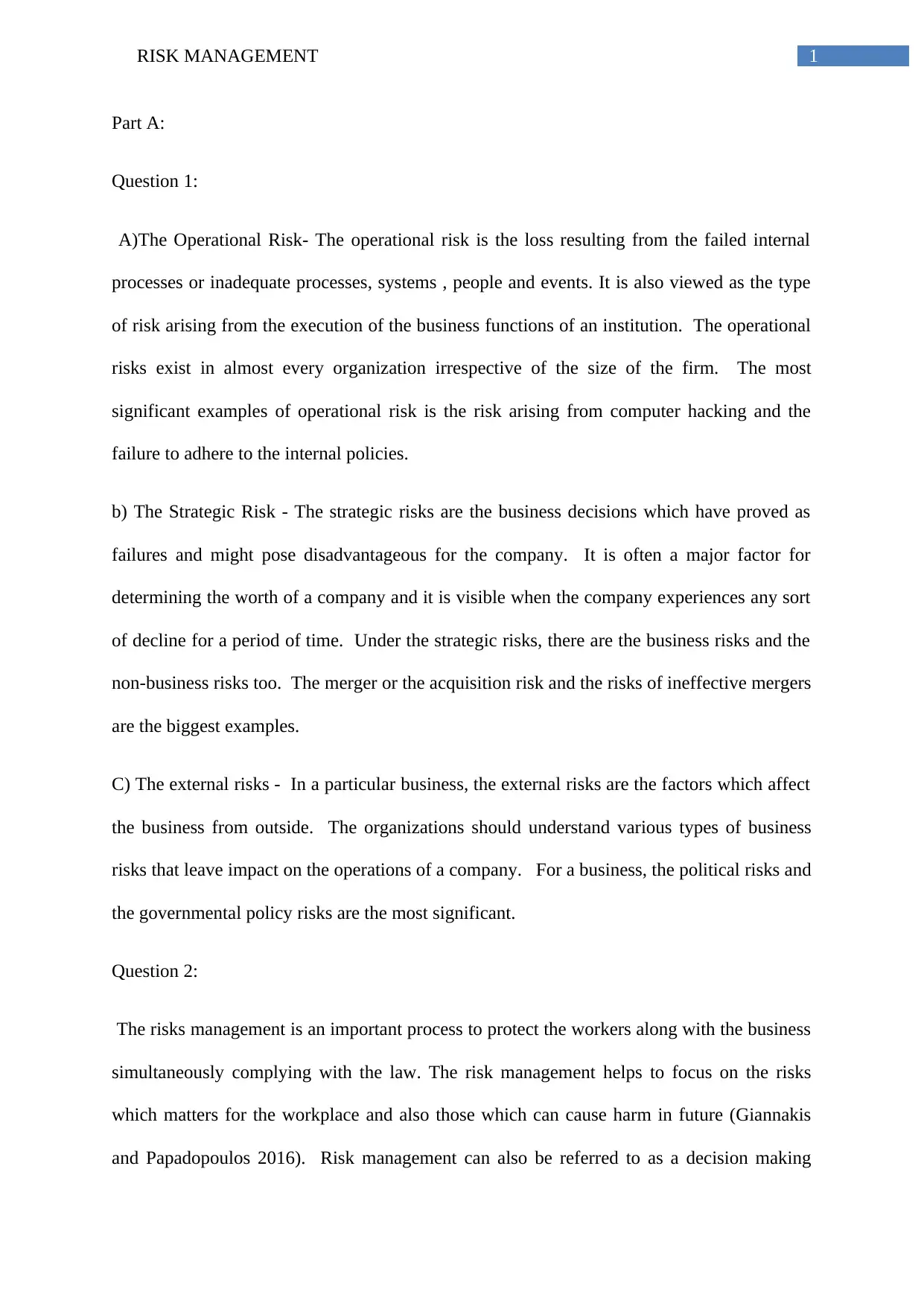
A)The Operational Risk- The operational risk is the loss resulting from the failed internal
processes or inadequate processes, systems , people and events. It is also viewed as the type
of risk arising from the execution of the business functions of an institution. The operational
risks exist in almost every organization irrespective of the size of the firm. The most
significant examples of operational risk is the risk arising from computer hacking and the
failure to adhere to the internal policies.
b) The Strategic Risk - The strategic risks are the business decisions which have proved as
failures and might pose disadvantageous for the company. It is often a major factor for
determining the worth of a company and it is visible when the company experiences any sort
of decline for a period of time. Under the strategic risks, there are the business risks and the
non-business risks too. The merger or the acquisition risk and the risks of ineffective mergers
are the biggest examples.
C) The external risks - In a particular business, the external risks are the factors which affect
the business from outside. The organizations should understand various types of business
risks that leave impact on the operations of a company. For a business, the political risks and
the governmental policy risks are the most significant.
Question 2:
The risks management is an important process to protect the workers along with the business
simultaneously complying with the law. The risk management helps to focus on the risks
which matters for the workplace and also those which can cause harm in future (Giannakis
and Papadopoulos 2016). Risk management can also be referred to as a decision making
Part A:
Question 1:
A)The Operational Risk- The operational risk is the loss resulting from the failed internal
processes or inadequate processes, systems , people and events. It is also viewed as the type
of risk arising from the execution of the business functions of an institution. The operational
risks exist in almost every organization irrespective of the size of the firm. The most
significant examples of operational risk is the risk arising from computer hacking and the
failure to adhere to the internal policies.
b) The Strategic Risk - The strategic risks are the business decisions which have proved as
failures and might pose disadvantageous for the company. It is often a major factor for
determining the worth of a company and it is visible when the company experiences any sort
of decline for a period of time. Under the strategic risks, there are the business risks and the
non-business risks too. The merger or the acquisition risk and the risks of ineffective mergers
are the biggest examples.
C) The external risks - In a particular business, the external risks are the factors which affect
the business from outside. The organizations should understand various types of business
risks that leave impact on the operations of a company. For a business, the political risks and
the governmental policy risks are the most significant.
Question 2:
The risks management is an important process to protect the workers along with the business
simultaneously complying with the law. The risk management helps to focus on the risks
which matters for the workplace and also those which can cause harm in future (Giannakis
and Papadopoulos 2016). Risk management can also be referred to as a decision making

2RISK MANAGEMENT
process which involves different social, political, engineering and economic factors. It also
involves the relevant risk assessments related to the hazards to develop, to analyze and to
compare the regulatory options and select the optimal regulatory responses from the hazards.
The 6 steps to the risk management process are the identification of risk, the assessment of
the risk, the potential risk treatments, creation of the plan and implementation of the plan and
evaluation of the plan.
Question 3:
The risk reviewing along with the risk monitoring process should occur continuously
throughout the risk management process.
Question 4:
In the risk management process the three most significant sources of information which
might be used for understanding the objectives of the organization are the financial reports,
the minutes of meetings and the other company documents(Shaikh, Drira and Hassine 2019).
.
Question 5:
In the PESTEL analysis, the main factors are the political, economic, social, technological,
environmental and legal which shape the external environment of a particular company. In
risk management process, the political elements which should be considered are the
governmental regulation for managing the hazardous components and the regulatory policies
related to that. On the other hand the economic aspects which must be considered are the
economic changes in the country or the government policies. Regarding the social concerns,
any type of socio-cultural issues should be considered. Moreover, the risks related to the use
of IT in the technical part are significant and the legal obligations should also be considered
process which involves different social, political, engineering and economic factors. It also
involves the relevant risk assessments related to the hazards to develop, to analyze and to
compare the regulatory options and select the optimal regulatory responses from the hazards.
The 6 steps to the risk management process are the identification of risk, the assessment of
the risk, the potential risk treatments, creation of the plan and implementation of the plan and
evaluation of the plan.
Question 3:
The risk reviewing along with the risk monitoring process should occur continuously
throughout the risk management process.
Question 4:
In the risk management process the three most significant sources of information which
might be used for understanding the objectives of the organization are the financial reports,
the minutes of meetings and the other company documents(Shaikh, Drira and Hassine 2019).
.
Question 5:
In the PESTEL analysis, the main factors are the political, economic, social, technological,
environmental and legal which shape the external environment of a particular company. In
risk management process, the political elements which should be considered are the
governmental regulation for managing the hazardous components and the regulatory policies
related to that. On the other hand the economic aspects which must be considered are the
economic changes in the country or the government policies. Regarding the social concerns,
any type of socio-cultural issues should be considered. Moreover, the risks related to the use
of IT in the technical part are significant and the legal obligations should also be considered
⊘ This is a preview!⊘
Do you want full access?
Subscribe today to unlock all pages.

Trusted by 1+ million students worldwide
3RISK MANAGEMENT
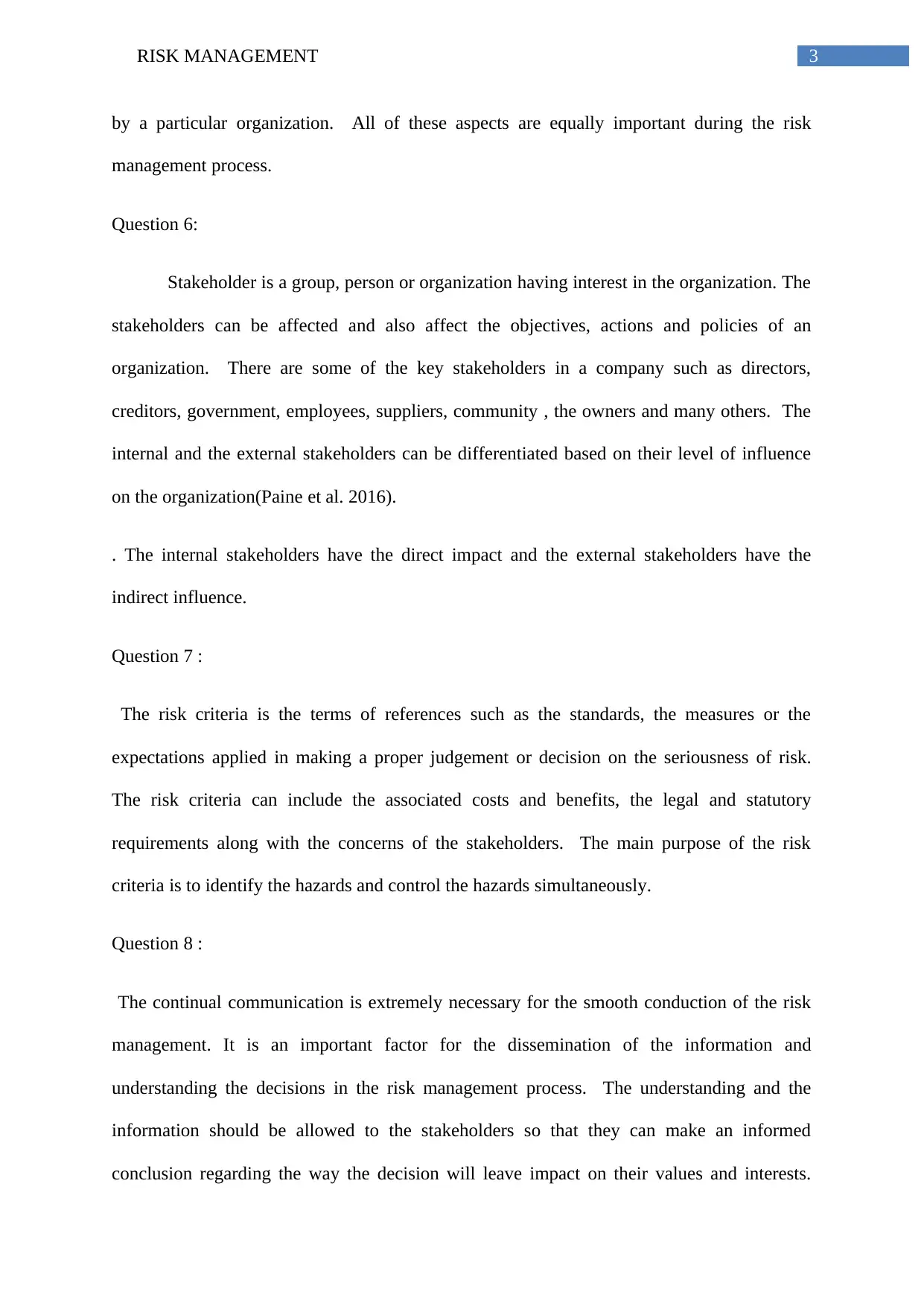
by a particular organization. All of these aspects are equally important during the risk
management process.
Question 6:
Stakeholder is a group, person or organization having interest in the organization. The
stakeholders can be affected and also affect the objectives, actions and policies of an
organization. There are some of the key stakeholders in a company such as directors,
creditors, government, employees, suppliers, community , the owners and many others. The
internal and the external stakeholders can be differentiated based on their level of influence
on the organization(Paine et al. 2016).
. The internal stakeholders have the direct impact and the external stakeholders have the
indirect influence.
Question 7 :
The risk criteria is the terms of references such as the standards, the measures or the
expectations applied in making a proper judgement or decision on the seriousness of risk.
The risk criteria can include the associated costs and benefits, the legal and statutory
requirements along with the concerns of the stakeholders. The main purpose of the risk
criteria is to identify the hazards and control the hazards simultaneously.
Question 8 :
The continual communication is extremely necessary for the smooth conduction of the risk
management. It is an important factor for the dissemination of the information and
understanding the decisions in the risk management process. The understanding and the
information should be allowed to the stakeholders so that they can make an informed
conclusion regarding the way the decision will leave impact on their values and interests.
by a particular organization. All of these aspects are equally important during the risk
management process.
Question 6:
Stakeholder is a group, person or organization having interest in the organization. The
stakeholders can be affected and also affect the objectives, actions and policies of an
organization. There are some of the key stakeholders in a company such as directors,
creditors, government, employees, suppliers, community , the owners and many others. The
internal and the external stakeholders can be differentiated based on their level of influence
on the organization(Paine et al. 2016).
. The internal stakeholders have the direct impact and the external stakeholders have the
indirect influence.
Question 7 :
The risk criteria is the terms of references such as the standards, the measures or the
expectations applied in making a proper judgement or decision on the seriousness of risk.
The risk criteria can include the associated costs and benefits, the legal and statutory
requirements along with the concerns of the stakeholders. The main purpose of the risk
criteria is to identify the hazards and control the hazards simultaneously.
Question 8 :
The continual communication is extremely necessary for the smooth conduction of the risk
management. It is an important factor for the dissemination of the information and
understanding the decisions in the risk management process. The understanding and the
information should be allowed to the stakeholders so that they can make an informed
conclusion regarding the way the decision will leave impact on their values and interests.
Paraphrase This Document
Need a fresh take? Get an instant paraphrase of this document with our AI Paraphraser
4RISK MANAGEMENT
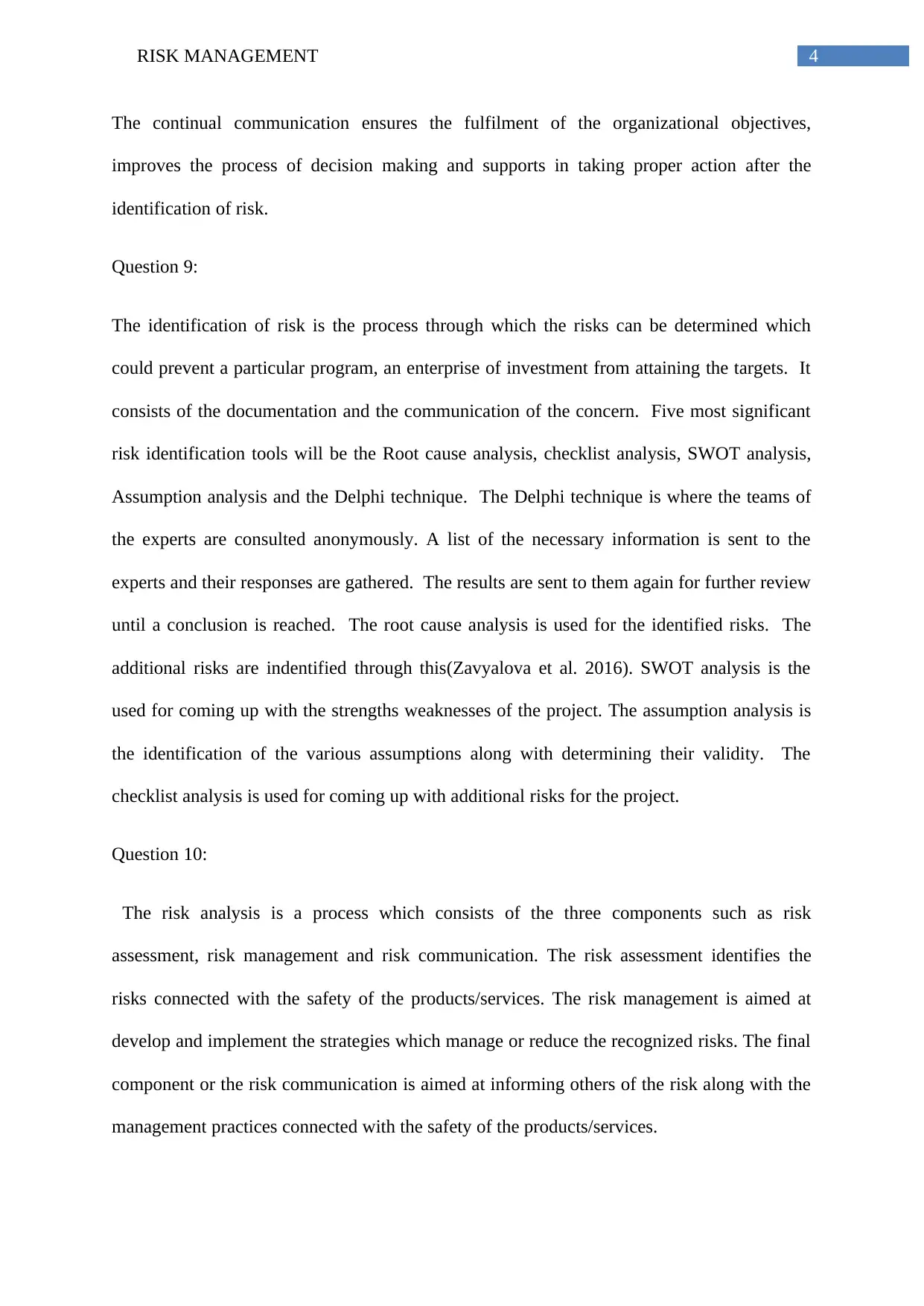
The continual communication ensures the fulfilment of the organizational objectives,
improves the process of decision making and supports in taking proper action after the
identification of risk.
Question 9:
The identification of risk is the process through which the risks can be determined which
could prevent a particular program, an enterprise of investment from attaining the targets. It
consists of the documentation and the communication of the concern. Five most significant
risk identification tools will be the Root cause analysis, checklist analysis, SWOT analysis,
Assumption analysis and the Delphi technique. The Delphi technique is where the teams of
the experts are consulted anonymously. A list of the necessary information is sent to the
experts and their responses are gathered. The results are sent to them again for further review
until a conclusion is reached. The root cause analysis is used for the identified risks. The
additional risks are indentified through this(Zavyalova et al. 2016). SWOT analysis is the
used for coming up with the strengths weaknesses of the project. The assumption analysis is
the identification of the various assumptions along with determining their validity. The
checklist analysis is used for coming up with additional risks for the project.
Question 10:
The risk analysis is a process which consists of the three components such as risk
assessment, risk management and risk communication. The risk assessment identifies the
risks connected with the safety of the products/services. The risk management is aimed at
develop and implement the strategies which manage or reduce the recognized risks. The final
component or the risk communication is aimed at informing others of the risk along with the
management practices connected with the safety of the products/services.
The continual communication ensures the fulfilment of the organizational objectives,
improves the process of decision making and supports in taking proper action after the
identification of risk.
Question 9:
The identification of risk is the process through which the risks can be determined which
could prevent a particular program, an enterprise of investment from attaining the targets. It
consists of the documentation and the communication of the concern. Five most significant
risk identification tools will be the Root cause analysis, checklist analysis, SWOT analysis,
Assumption analysis and the Delphi technique. The Delphi technique is where the teams of
the experts are consulted anonymously. A list of the necessary information is sent to the
experts and their responses are gathered. The results are sent to them again for further review
until a conclusion is reached. The root cause analysis is used for the identified risks. The
additional risks are indentified through this(Zavyalova et al. 2016). SWOT analysis is the
used for coming up with the strengths weaknesses of the project. The assumption analysis is
the identification of the various assumptions along with determining their validity. The
checklist analysis is used for coming up with additional risks for the project.
Question 10:
The risk analysis is a process which consists of the three components such as risk
assessment, risk management and risk communication. The risk assessment identifies the
risks connected with the safety of the products/services. The risk management is aimed at
develop and implement the strategies which manage or reduce the recognized risks. The final
component or the risk communication is aimed at informing others of the risk along with the
management practices connected with the safety of the products/services.
5RISK MANAGEMENT
Question 11:
In the risk management area, the qualitative risk analysis and the quantitative risk analysis
are two processes which are connected with the planning process. It can be said that while
the qualitative risk analysis can be performed on all of the risks, the quantitative risk analysis
is more limited and based on the type of project along with the availability of data. The
qualitative risks analysis mainly prioritises the recognized project risks having used pre-
defined rating scales. The risks are scored based on their likelihood or probability of
occurring. It is ranked from zero to one scale. The impact scale is defined organizationally
and this analysis includes the appropriate categorization of the either source based or effect
based risks. On the other hand, the quantitative risk analysis is an analysis of highest priority
risks while a quantitative or numerical rating is assigned for developing an analysis of a
particular project. The most prominent differences are that qualitative analysis is at the risk
level, quantitative is at the project level (Noe et al. 2017). The quantitative analysis has the
subjective evaluation and impact whereas the quantitative will have the probabilistic
estimates of time and cost too. The qualitative analysis is easy to perform but the quantitative
is time consuming. In the qualitative analysis there is no need of special software or the tools
but the quantitative analysis may not need the specialized tools.
Question 12:
The consequence table and the likelihood are the two components in the risk calculation. The
likelihood is the probability of the happening due to an impact which affects the environment.
On the other hand, the consequence is the environmental impact if an event occurs. These
two components are multiplied for generating a high risk (9) that is an alarming level of risk.
The risks matrix is prepared for understanding the level of risk. These will be used to
understand the effectiveness of risk.
Question 11:
In the risk management area, the qualitative risk analysis and the quantitative risk analysis
are two processes which are connected with the planning process. It can be said that while
the qualitative risk analysis can be performed on all of the risks, the quantitative risk analysis
is more limited and based on the type of project along with the availability of data. The
qualitative risks analysis mainly prioritises the recognized project risks having used pre-
defined rating scales. The risks are scored based on their likelihood or probability of
occurring. It is ranked from zero to one scale. The impact scale is defined organizationally
and this analysis includes the appropriate categorization of the either source based or effect
based risks. On the other hand, the quantitative risk analysis is an analysis of highest priority
risks while a quantitative or numerical rating is assigned for developing an analysis of a
particular project. The most prominent differences are that qualitative analysis is at the risk
level, quantitative is at the project level (Noe et al. 2017). The quantitative analysis has the
subjective evaluation and impact whereas the quantitative will have the probabilistic
estimates of time and cost too. The qualitative analysis is easy to perform but the quantitative
is time consuming. In the qualitative analysis there is no need of special software or the tools
but the quantitative analysis may not need the specialized tools.
Question 12:
The consequence table and the likelihood are the two components in the risk calculation. The
likelihood is the probability of the happening due to an impact which affects the environment.
On the other hand, the consequence is the environmental impact if an event occurs. These
two components are multiplied for generating a high risk (9) that is an alarming level of risk.
The risks matrix is prepared for understanding the level of risk. These will be used to
understand the effectiveness of risk.
⊘ This is a preview!⊘
Do you want full access?
Subscribe today to unlock all pages.
Trusted by 1+ million students worldwide
6RISK MANAGEMENT
Question 13:
In a particular business project, there are always chances of something going wrong. Those
aspects which might go wrong are called the risks and it is the duty of the project manager to
identify at the beginning. The five main options for the risk treatment are he avoidance of the
risk, then acceptance of the risk, the mitigation of the risk, transferring the risk and
exploitation of the risk.
Question 14:
The cost benefit analysis is a process through which the businesses analyse the
decisions. The business sums the benefits of a particular situation and subtracts the costs
connected with the taking that action(Modarres 2016). In the cost analysis, the cost should
consist of the direct and the indirect costs, the opportunity costs, intangible costs and the
potential risk costs.
Question 15:
Although the cost –benefit analysis appears as a simple process, there are some degrees of
complexity in the implementation of the costs benefit analysis. It is not because the cists
benefit analysis is obvious upon the initial assessment. There are some factors which must be
considered while conducting the cost benefit analysis such as the production of a
subcomponent, the labor force, the consequences of a loss of control, the unforeseen benefits.
Moreover, the time value of money is a central concept while doing the cost-benefit analysis.
Question 16:
The risk management plan is the way one defines and manages the risk on the project. There
are five main components which should be included in a risk management plan. The
components are the roles and responsibilities, the timing, budgeting, communication and
Question 13:
In a particular business project, there are always chances of something going wrong. Those
aspects which might go wrong are called the risks and it is the duty of the project manager to
identify at the beginning. The five main options for the risk treatment are he avoidance of the
risk, then acceptance of the risk, the mitigation of the risk, transferring the risk and
exploitation of the risk.
Question 14:
The cost benefit analysis is a process through which the businesses analyse the
decisions. The business sums the benefits of a particular situation and subtracts the costs
connected with the taking that action(Modarres 2016). In the cost analysis, the cost should
consist of the direct and the indirect costs, the opportunity costs, intangible costs and the
potential risk costs.
Question 15:
Although the cost –benefit analysis appears as a simple process, there are some degrees of
complexity in the implementation of the costs benefit analysis. It is not because the cists
benefit analysis is obvious upon the initial assessment. There are some factors which must be
considered while conducting the cost benefit analysis such as the production of a
subcomponent, the labor force, the consequences of a loss of control, the unforeseen benefits.
Moreover, the time value of money is a central concept while doing the cost-benefit analysis.
Question 16:
The risk management plan is the way one defines and manages the risk on the project. There
are five main components which should be included in a risk management plan. The
components are the roles and responsibilities, the timing, budgeting, communication and
Paraphrase This Document
Need a fresh take? Get an instant paraphrase of this document with our AI Paraphraser

7RISK MANAGEMENT
auditing. The project manager has the responsibility to lead and support the roles in all
levels. The roles can be delegate from one manager to the other. The budget for the risk
management should be set properly. The budget estimate must be made to avoid any type of
shortage in managing risk. The definition of timing is essential in the risk assessment. The
timing concerns the number of times the risk management process will be conducted in the
project life cycle. In the risk management plan, the communication is the most important to
maintain the easy flow of information. Lastly, auditing should be conducted to document all
the facets of the risk activities for the benefit of the current project. It helps to determine the
needs, the lesson learned along with how the organization should proceed in future.
Question 17:
In a risk management plan, the monitoring and the reviewing is one of the most important
steps. The review and monitoring must include regular checking and surveillance. The
results should be recorded and reported as well both internally and externally. The
monitoring and review is necessary to ensure that all the controls are effective and efficient in
design and operation. It is necessary to obtain further information for improving the risk
assessment. The monitoring and review helps to analyse the learning lessons from various
risk events, the changes, near misses and successes. Moreover, it helps to detect the changes
in the external and the internal context having included the changes in the risk criteria that
might require revision. Most importantly, it helps in identifying the emerging risks in future.
Question 18:
Since, continual monitoring is an essential part of the risk management, there are few
mechanisms used to ensure that there is continual monitoring of the activities. Firstly, the
project risks should be reassessed. This is an assessment exercise done in the form of a team
exercise at regular intervals. The risk register is updated along with the changes recognized
auditing. The project manager has the responsibility to lead and support the roles in all
levels. The roles can be delegate from one manager to the other. The budget for the risk
management should be set properly. The budget estimate must be made to avoid any type of
shortage in managing risk. The definition of timing is essential in the risk assessment. The
timing concerns the number of times the risk management process will be conducted in the
project life cycle. In the risk management plan, the communication is the most important to
maintain the easy flow of information. Lastly, auditing should be conducted to document all
the facets of the risk activities for the benefit of the current project. It helps to determine the
needs, the lesson learned along with how the organization should proceed in future.
Question 17:
In a risk management plan, the monitoring and the reviewing is one of the most important
steps. The review and monitoring must include regular checking and surveillance. The
results should be recorded and reported as well both internally and externally. The
monitoring and review is necessary to ensure that all the controls are effective and efficient in
design and operation. It is necessary to obtain further information for improving the risk
assessment. The monitoring and review helps to analyse the learning lessons from various
risk events, the changes, near misses and successes. Moreover, it helps to detect the changes
in the external and the internal context having included the changes in the risk criteria that
might require revision. Most importantly, it helps in identifying the emerging risks in future.
Question 18:
Since, continual monitoring is an essential part of the risk management, there are few
mechanisms used to ensure that there is continual monitoring of the activities. Firstly, the
project risks should be reassessed. This is an assessment exercise done in the form of a team
exercise at regular intervals. The risk register is updated along with the changes recognized
8RISK MANAGEMENT
during the reassessment exercises. The second mechanism is the analysis of the risk trends.
In the simple terms, it is about observing the project performance over a period of time
having studied the trends of cost, scope and schedule variances from the baseline and trying
to forecast whether it is a risk of any of them doing rough in the near future. The
performance analysis is another method that compares the project performance with the
planned performance.
Question 19:
The duty of care is kind of legal obligation under the law in which a person takes care of the
not doing harm to anyone by their activities. The organizations are also instructed to ensure
the there is not breach of the legal obligations otherwise the legal actions could be taken. The
contract law can support in overcoming the exposure of the people to the risks. The company
law helps to ensure that there are proper management policies executed by the board of
directors. The environmental risks ensure that the risks are recognized timely and managed
properly too. On the other hand, the privacy laws help to reduce the risk related issues.
Question 20:
The risk management standards are the significant parts of the risk management process. It
guides the risk management in different fields. The risk management standards are applicable
to the workplace which ensures the safety and hazard free areas in the workplace.
during the reassessment exercises. The second mechanism is the analysis of the risk trends.
In the simple terms, it is about observing the project performance over a period of time
having studied the trends of cost, scope and schedule variances from the baseline and trying
to forecast whether it is a risk of any of them doing rough in the near future. The
performance analysis is another method that compares the project performance with the
planned performance.
Question 19:
The duty of care is kind of legal obligation under the law in which a person takes care of the
not doing harm to anyone by their activities. The organizations are also instructed to ensure
the there is not breach of the legal obligations otherwise the legal actions could be taken. The
contract law can support in overcoming the exposure of the people to the risks. The company
law helps to ensure that there are proper management policies executed by the board of
directors. The environmental risks ensure that the risks are recognized timely and managed
properly too. On the other hand, the privacy laws help to reduce the risk related issues.
Question 20:
The risk management standards are the significant parts of the risk management process. It
guides the risk management in different fields. The risk management standards are applicable
to the workplace which ensures the safety and hazard free areas in the workplace.
⊘ This is a preview!⊘
Do you want full access?
Subscribe today to unlock all pages.
Trusted by 1+ million students worldwide
9RISK MANAGEMENT
References
Giannakis, M. and Papadopoulos, T., 2016. Supply chain sustainability: A risk management
approach. International Journal of Production Economics, 171, pp.455-470.
Hopkin, P., 2018. Fundamentals of risk management: understanding, evaluating and
implementing effective risk management. Kogan Page Publishers.
Jagoda, L.M. and Bigbee, J.L., 2016. Assessing the influences on rural women’s reproductive
life plans: A cross sectional descriptive study. Online Journal of Rural Nursing and Health
Care, 16(2), pp.27-57.
Modarres, M., 2016. Risk analysis in engineering: techniques, tools, and trends. CRC press.
Noe, R.A., Hollenbeck, J.R., Gerhart, B. and Wright, P.M., 2017. Human resource
management: Gaining a competitive advantage. New York, NY: McGraw-Hill Education.
Paine, C.W., Goel, V.V., Ely, E., Stave, C.D., Stemler, S., Zander, M. and Bonafide, C.P.,
2016. Systematic review of physiologic monitor alarm characteristics and pragmatic
interventions to reduce alarm frequency. Journal of hospital medicine, 11(2), pp.136-144.
Shaikh, I.A., Drira, M. and Hassine, S.B., 2019. What motivates directors to pursue long-term
strategic risks? Economic incentives vs. fiduciary duty. Journal of Business Research, 101,
pp.218-228.
Zavyalova, A., Pfarrer, M.D., Reger, R.K. and Hubbard, T.D., 2016. Reputation as a benefit
and a burden? How stakeholders’ organizational identification affects the role of reputation
following a negative event. Academy of Management Journal, 59(1), pp.253-276.
References
Giannakis, M. and Papadopoulos, T., 2016. Supply chain sustainability: A risk management
approach. International Journal of Production Economics, 171, pp.455-470.
Hopkin, P., 2018. Fundamentals of risk management: understanding, evaluating and
implementing effective risk management. Kogan Page Publishers.
Jagoda, L.M. and Bigbee, J.L., 2016. Assessing the influences on rural women’s reproductive
life plans: A cross sectional descriptive study. Online Journal of Rural Nursing and Health
Care, 16(2), pp.27-57.
Modarres, M., 2016. Risk analysis in engineering: techniques, tools, and trends. CRC press.
Noe, R.A., Hollenbeck, J.R., Gerhart, B. and Wright, P.M., 2017. Human resource
management: Gaining a competitive advantage. New York, NY: McGraw-Hill Education.
Paine, C.W., Goel, V.V., Ely, E., Stave, C.D., Stemler, S., Zander, M. and Bonafide, C.P.,
2016. Systematic review of physiologic monitor alarm characteristics and pragmatic
interventions to reduce alarm frequency. Journal of hospital medicine, 11(2), pp.136-144.
Shaikh, I.A., Drira, M. and Hassine, S.B., 2019. What motivates directors to pursue long-term
strategic risks? Economic incentives vs. fiduciary duty. Journal of Business Research, 101,
pp.218-228.
Zavyalova, A., Pfarrer, M.D., Reger, R.K. and Hubbard, T.D., 2016. Reputation as a benefit
and a burden? How stakeholders’ organizational identification affects the role of reputation
following a negative event. Academy of Management Journal, 59(1), pp.253-276.
Paraphrase This Document
Need a fresh take? Get an instant paraphrase of this document with our AI Paraphraser

10RISK MANAGEMENT

1 out of 11


Related Documents


Your All-in-One AI-Powered Toolkit for Academic Success.
+13062052269
info@desklib.com
Available 24*7 on WhatsApp / Email
![[object Object]](/_next/static/media/star-bottom.7253800d.svg)
Unlock your academic potential
Copyright © 2020–2026 A2Z Services. All Rights Reserved. Developed and managed by ZUCOL.