BSBSUS401 Competency Assessment: Sustainable Work Practices
VerifiedAdded on 2023/06/03
|24
|7061
|247
Practical Assignment
AI Summary
This BSBSUS401 competency assessment focuses on implementing and monitoring environmentally sustainable work practices within a workplace. It includes researching and identifying relevant environmental, employment condition, and equal opportunity legislation, analyzing the workplace's existing environmental sustainability procedures, and detailing the organization's reporting structure for environmental issues. The assessment requires identifying industry-specific environmental and efficiency issues, listing the systems and procedures in place to manage resource usage, and evaluating the scope and effectiveness of these current systems. The student also provides specific examples to demonstrate their understanding and application of these concepts.
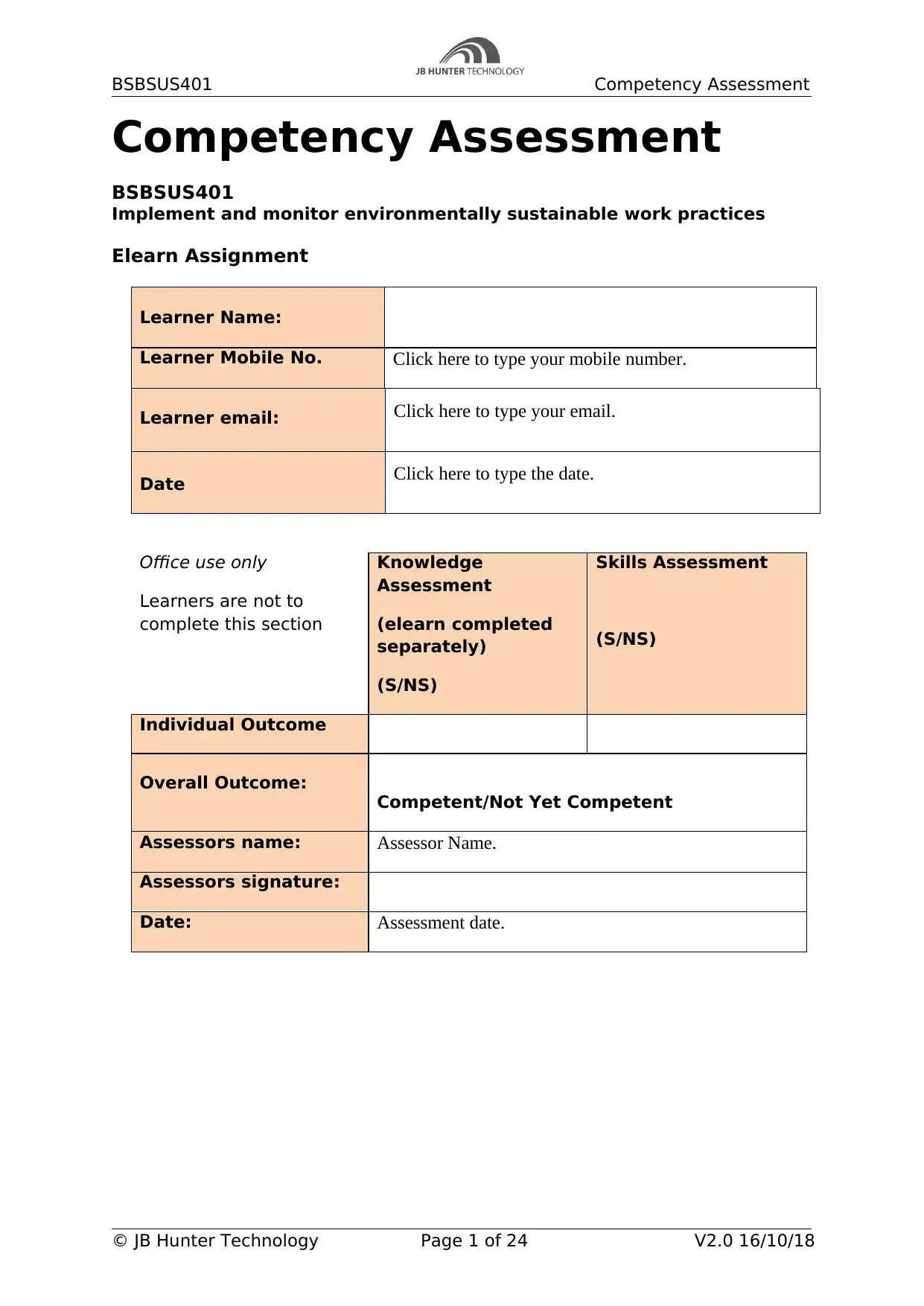
BSBSUS401 Competency Assessment
Competency Assessment
BSBSUS401
Implement and monitor environmentally sustainable work practices
Elearn Assignment
Learner Name:
Learner Mobile No. Click here to type your mobile number.
Learner email: Click here to type your email.
Date Click here to type the date.
Office use only
Learners are not to
complete this section
Knowledge
Assessment
(elearn completed
separately)
(S/NS)
Skills Assessment
(S/NS)
Individual Outcome
Overall Outcome:
Competent/Not Yet Competent
Assessors name: Assessor Name.
Assessors signature:
Date: Assessment date.
© JB Hunter Technology Page 1 of 24 V2.0 16/10/18
Competency Assessment
BSBSUS401
Implement and monitor environmentally sustainable work practices
Elearn Assignment
Learner Name:
Learner Mobile No. Click here to type your mobile number.
Learner email: Click here to type your email.
Date Click here to type the date.
Office use only
Learners are not to
complete this section
Knowledge
Assessment
(elearn completed
separately)
(S/NS)
Skills Assessment
(S/NS)
Individual Outcome
Overall Outcome:
Competent/Not Yet Competent
Assessors name: Assessor Name.
Assessors signature:
Date: Assessment date.
© JB Hunter Technology Page 1 of 24 V2.0 16/10/18

Paraphrase This Document
Need a fresh take? Get an instant paraphrase of this document with our AI Paraphraser
BSBSUS401 Competency Assessment
Record of Performance
Comments
© JB Hunter Technology Page 2 of 24 V2.0 16/10/18
Record of Performance
Comments
© JB Hunter Technology Page 2 of 24 V2.0 16/10/18
BSBSUS401 Competency Assessment
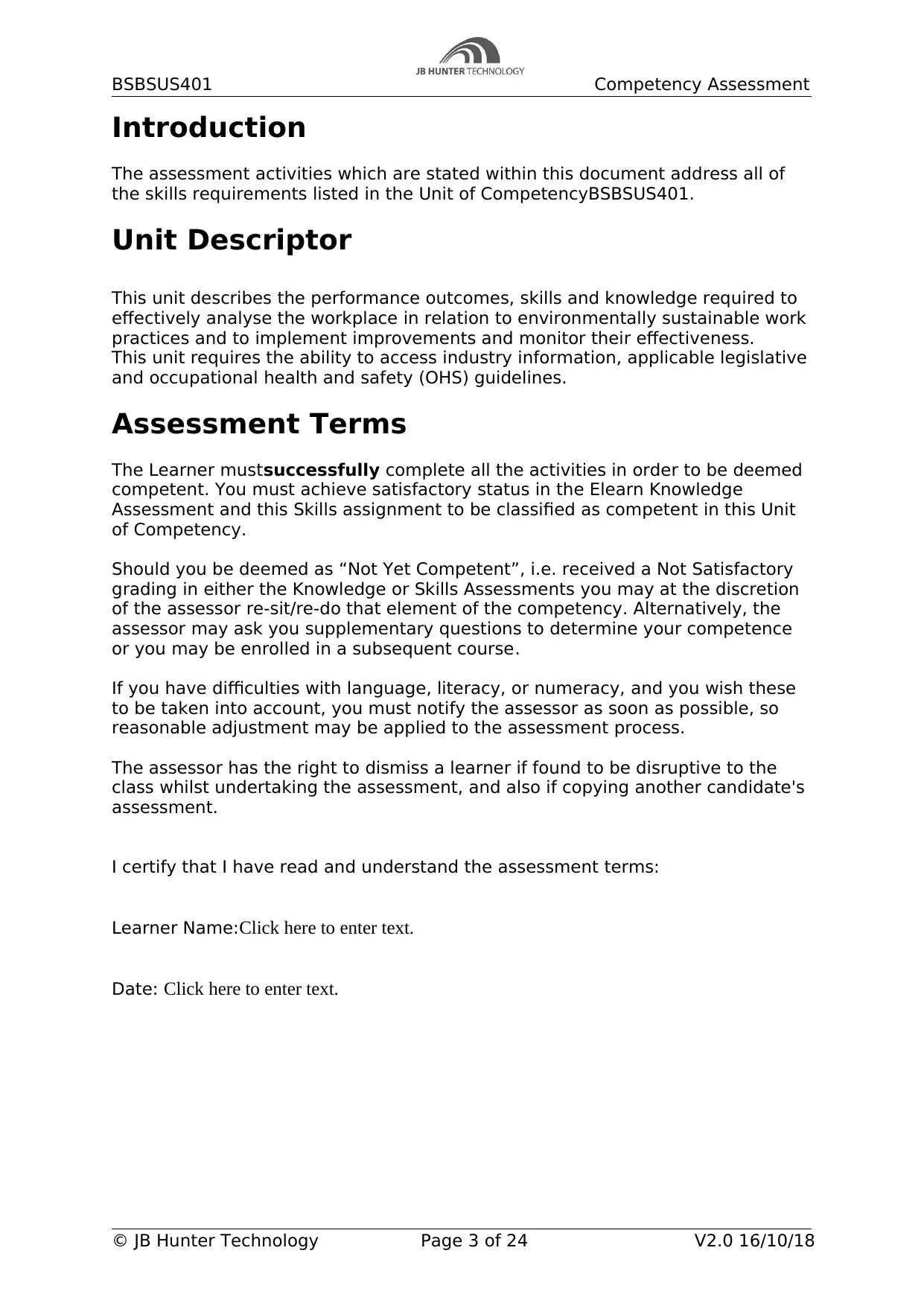
Introduction
The assessment activities which are stated within this document address all of
the skills requirements listed in the Unit of CompetencyBSBSUS401.
Unit Descriptor
This unit describes the performance outcomes, skills and knowledge required to
effectively analyse the workplace in relation to environmentally sustainable work
practices and to implement improvements and monitor their effectiveness.
This unit requires the ability to access industry information, applicable legislative
and occupational health and safety (OHS) guidelines.
Assessment Terms
The Learner mustsuccessfully complete all the activities in order to be deemed
competent. You must achieve satisfactory status in the Elearn Knowledge
Assessment and this Skills assignment to be classified as competent in this Unit
of Competency.
Should you be deemed as “Not Yet Competent”, i.e. received a Not Satisfactory
grading in either the Knowledge or Skills Assessments you may at the discretion
of the assessor re-sit/re-do that element of the competency. Alternatively, the
assessor may ask you supplementary questions to determine your competence
or you may be enrolled in a subsequent course.
If you have difficulties with language, literacy, or numeracy, and you wish these
to be taken into account, you must notify the assessor as soon as possible, so
reasonable adjustment may be applied to the assessment process.
The assessor has the right to dismiss a learner if found to be disruptive to the
class whilst undertaking the assessment, and also if copying another candidate's
assessment.
I certify that I have read and understand the assessment terms:
Learner Name:Click here to enter text.
Date: Click here to enter text.
© JB Hunter Technology Page 3 of 24 V2.0 16/10/18
Introduction
The assessment activities which are stated within this document address all of
the skills requirements listed in the Unit of CompetencyBSBSUS401.
Unit Descriptor
This unit describes the performance outcomes, skills and knowledge required to
effectively analyse the workplace in relation to environmentally sustainable work
practices and to implement improvements and monitor their effectiveness.
This unit requires the ability to access industry information, applicable legislative
and occupational health and safety (OHS) guidelines.
Assessment Terms
The Learner mustsuccessfully complete all the activities in order to be deemed
competent. You must achieve satisfactory status in the Elearn Knowledge
Assessment and this Skills assignment to be classified as competent in this Unit
of Competency.
Should you be deemed as “Not Yet Competent”, i.e. received a Not Satisfactory
grading in either the Knowledge or Skills Assessments you may at the discretion
of the assessor re-sit/re-do that element of the competency. Alternatively, the
assessor may ask you supplementary questions to determine your competence
or you may be enrolled in a subsequent course.
If you have difficulties with language, literacy, or numeracy, and you wish these
to be taken into account, you must notify the assessor as soon as possible, so
reasonable adjustment may be applied to the assessment process.
The assessor has the right to dismiss a learner if found to be disruptive to the
class whilst undertaking the assessment, and also if copying another candidate's
assessment.
I certify that I have read and understand the assessment terms:
Learner Name:Click here to enter text.
Date: Click here to enter text.
© JB Hunter Technology Page 3 of 24 V2.0 16/10/18
⊘ This is a preview!⊘
Do you want full access?
Subscribe today to unlock all pages.

Trusted by 1+ million students worldwide
BSBSUS401 Competency Assessment
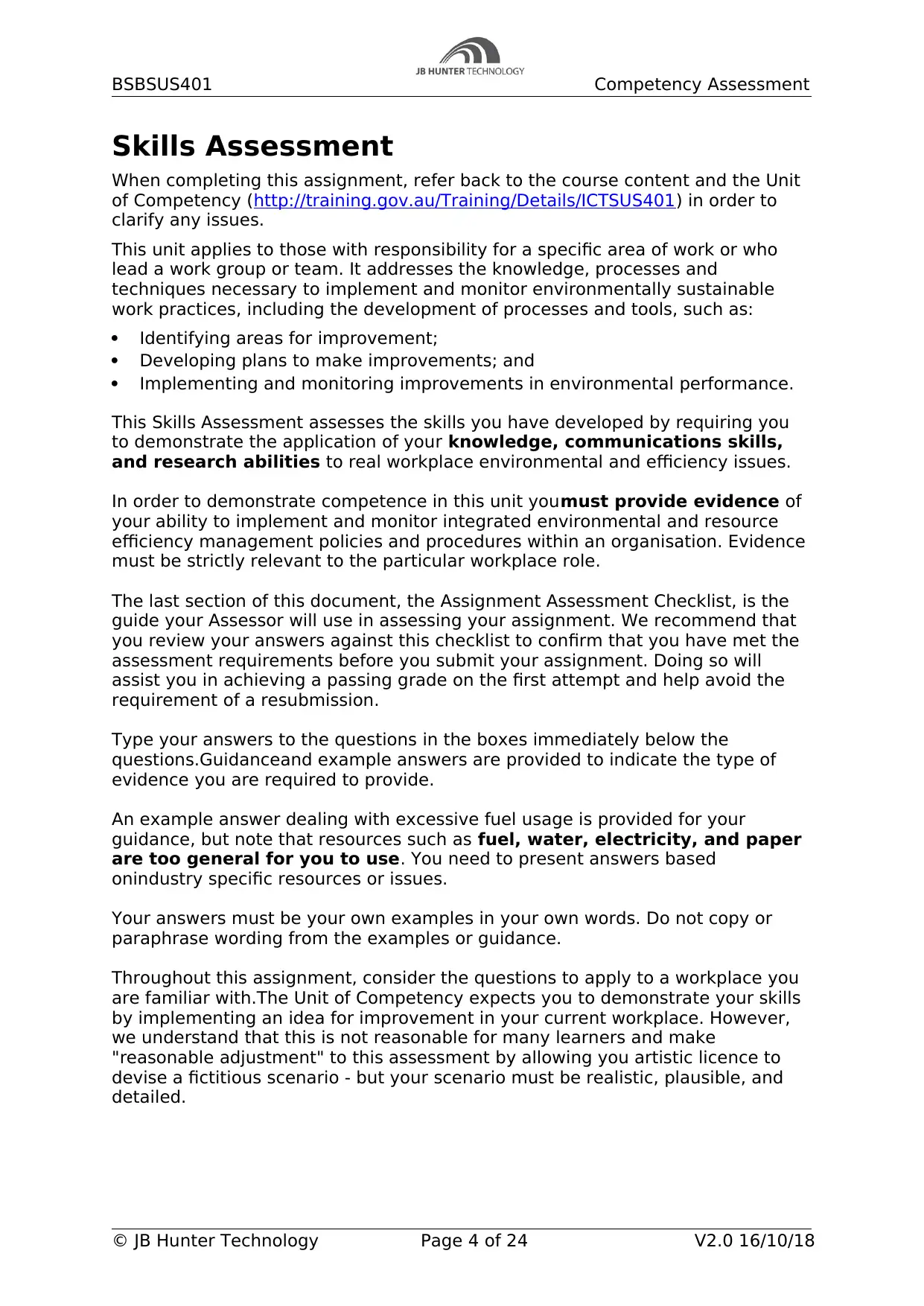
Skills Assessment
When completing this assignment, refer back to the course content and the Unit
of Competency (http://training.gov.au/Training/Details/ICTSUS401) in order to
clarify any issues.
This unit applies to those with responsibility for a specific area of work or who
lead a work group or team. It addresses the knowledge, processes and
techniques necessary to implement and monitor environmentally sustainable
work practices, including the development of processes and tools, such as:
Identifying areas for improvement;
Developing plans to make improvements; and
Implementing and monitoring improvements in environmental performance.
This Skills Assessment assesses the skills you have developed by requiring you
to demonstrate the application of your knowledge, communications skills,
and research abilities to real workplace environmental and efficiency issues.
In order to demonstrate competence in this unit youmust provide evidence of
your ability to implement and monitor integrated environmental and resource
efficiency management policies and procedures within an organisation. Evidence
must be strictly relevant to the particular workplace role.
The last section of this document, the Assignment Assessment Checklist, is the
guide your Assessor will use in assessing your assignment. We recommend that
you review your answers against this checklist to confirm that you have met the
assessment requirements before you submit your assignment. Doing so will
assist you in achieving a passing grade on the first attempt and help avoid the
requirement of a resubmission.
Type your answers to the questions in the boxes immediately below the
questions.Guidanceand example answers are provided to indicate the type of
evidence you are required to provide.
An example answer dealing with excessive fuel usage is provided for your
guidance, but note that resources such as fuel, water, electricity, and paper
are too general for you to use. You need to present answers based
onindustry specific resources or issues.
Your answers must be your own examples in your own words. Do not copy or
paraphrase wording from the examples or guidance.
Throughout this assignment, consider the questions to apply to a workplace you
are familiar with.The Unit of Competency expects you to demonstrate your skills
by implementing an idea for improvement in your current workplace. However,
we understand that this is not reasonable for many learners and make
"reasonable adjustment" to this assessment by allowing you artistic licence to
devise a fictitious scenario - but your scenario must be realistic, plausible, and
detailed.
© JB Hunter Technology Page 4 of 24 V2.0 16/10/18
Skills Assessment
When completing this assignment, refer back to the course content and the Unit
of Competency (http://training.gov.au/Training/Details/ICTSUS401) in order to
clarify any issues.
This unit applies to those with responsibility for a specific area of work or who
lead a work group or team. It addresses the knowledge, processes and
techniques necessary to implement and monitor environmentally sustainable
work practices, including the development of processes and tools, such as:
Identifying areas for improvement;
Developing plans to make improvements; and
Implementing and monitoring improvements in environmental performance.
This Skills Assessment assesses the skills you have developed by requiring you
to demonstrate the application of your knowledge, communications skills,
and research abilities to real workplace environmental and efficiency issues.
In order to demonstrate competence in this unit youmust provide evidence of
your ability to implement and monitor integrated environmental and resource
efficiency management policies and procedures within an organisation. Evidence
must be strictly relevant to the particular workplace role.
The last section of this document, the Assignment Assessment Checklist, is the
guide your Assessor will use in assessing your assignment. We recommend that
you review your answers against this checklist to confirm that you have met the
assessment requirements before you submit your assignment. Doing so will
assist you in achieving a passing grade on the first attempt and help avoid the
requirement of a resubmission.
Type your answers to the questions in the boxes immediately below the
questions.Guidanceand example answers are provided to indicate the type of
evidence you are required to provide.
An example answer dealing with excessive fuel usage is provided for your
guidance, but note that resources such as fuel, water, electricity, and paper
are too general for you to use. You need to present answers based
onindustry specific resources or issues.
Your answers must be your own examples in your own words. Do not copy or
paraphrase wording from the examples or guidance.
Throughout this assignment, consider the questions to apply to a workplace you
are familiar with.The Unit of Competency expects you to demonstrate your skills
by implementing an idea for improvement in your current workplace. However,
we understand that this is not reasonable for many learners and make
"reasonable adjustment" to this assessment by allowing you artistic licence to
devise a fictitious scenario - but your scenario must be realistic, plausible, and
detailed.
© JB Hunter Technology Page 4 of 24 V2.0 16/10/18
Paraphrase This Document
Need a fresh take? Get an instant paraphrase of this document with our AI Paraphraser
BSBSUS401 Competency Assessment
1. Investigate current practices in relation to resource usage
1.1
a) Research and identify one Federal, State, local Government, or National
Regulatory Body environmental or sustainability Legislation or
Regulation which applies to your industry.
Guidance: You may be able to look to the content of the course, your
workplace procedures, and your work colleagues, management, or other
stakeholders to do this
Example:
If you worked in the racing industry, an applicable state environmental
regulation might be:
Environmental Care Act (Racing WA) 1987 (EC(R)) Act)
Located at:
https://www.env-racing.wa.gov.au/management/non-mining/environmental-
legislation.html
(Note that this is a fictitious regulation. You need to supply a real one.)
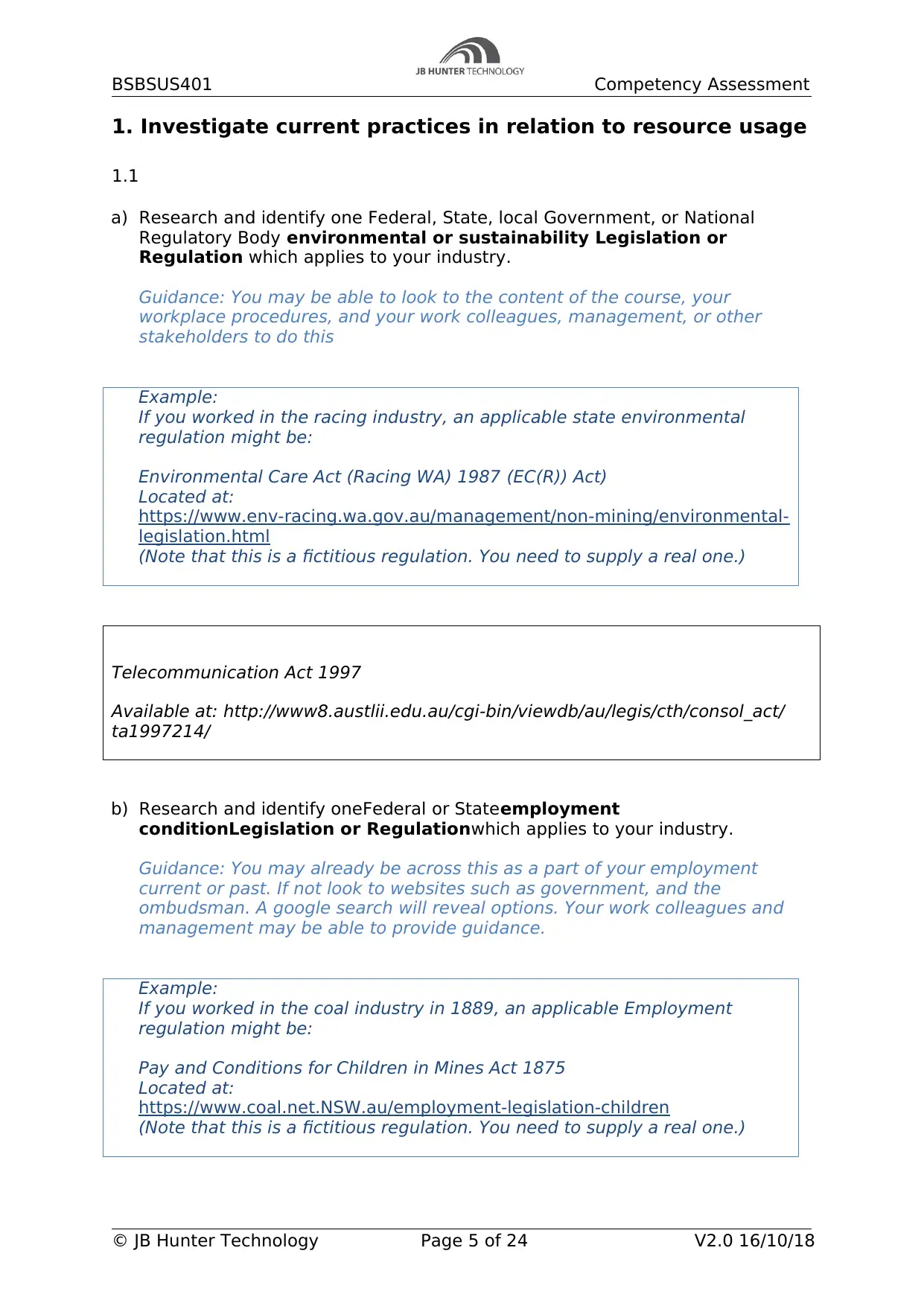
Telecommunication Act 1997
Available at: http://www8.austlii.edu.au/cgi-bin/viewdb/au/legis/cth/consol_act/
ta1997214/
b) Research and identify oneFederal or Stateemployment
conditionLegislation or Regulationwhich applies to your industry.
Guidance: You may already be across this as a part of your employment
current or past. If not look to websites such as government, and the
ombudsman. A google search will reveal options. Your work colleagues and
management may be able to provide guidance.
Example:
If you worked in the coal industry in 1889, an applicable Employment
regulation might be:
Pay and Conditions for Children in Mines Act 1875
Located at:
https://www.coal.net.NSW.au/employment-legislation-children
(Note that this is a fictitious regulation. You need to supply a real one.)
© JB Hunter Technology Page 5 of 24 V2.0 16/10/18
1. Investigate current practices in relation to resource usage
1.1
a) Research and identify one Federal, State, local Government, or National
Regulatory Body environmental or sustainability Legislation or
Regulation which applies to your industry.
Guidance: You may be able to look to the content of the course, your
workplace procedures, and your work colleagues, management, or other
stakeholders to do this
Example:
If you worked in the racing industry, an applicable state environmental
regulation might be:
Environmental Care Act (Racing WA) 1987 (EC(R)) Act)
Located at:
https://www.env-racing.wa.gov.au/management/non-mining/environmental-
legislation.html
(Note that this is a fictitious regulation. You need to supply a real one.)
Telecommunication Act 1997
Available at: http://www8.austlii.edu.au/cgi-bin/viewdb/au/legis/cth/consol_act/
ta1997214/
b) Research and identify oneFederal or Stateemployment
conditionLegislation or Regulationwhich applies to your industry.
Guidance: You may already be across this as a part of your employment
current or past. If not look to websites such as government, and the
ombudsman. A google search will reveal options. Your work colleagues and
management may be able to provide guidance.
Example:
If you worked in the coal industry in 1889, an applicable Employment
regulation might be:
Pay and Conditions for Children in Mines Act 1875
Located at:
https://www.coal.net.NSW.au/employment-legislation-children
(Note that this is a fictitious regulation. You need to supply a real one.)
© JB Hunter Technology Page 5 of 24 V2.0 16/10/18
BSBSUS401 Competency Assessment
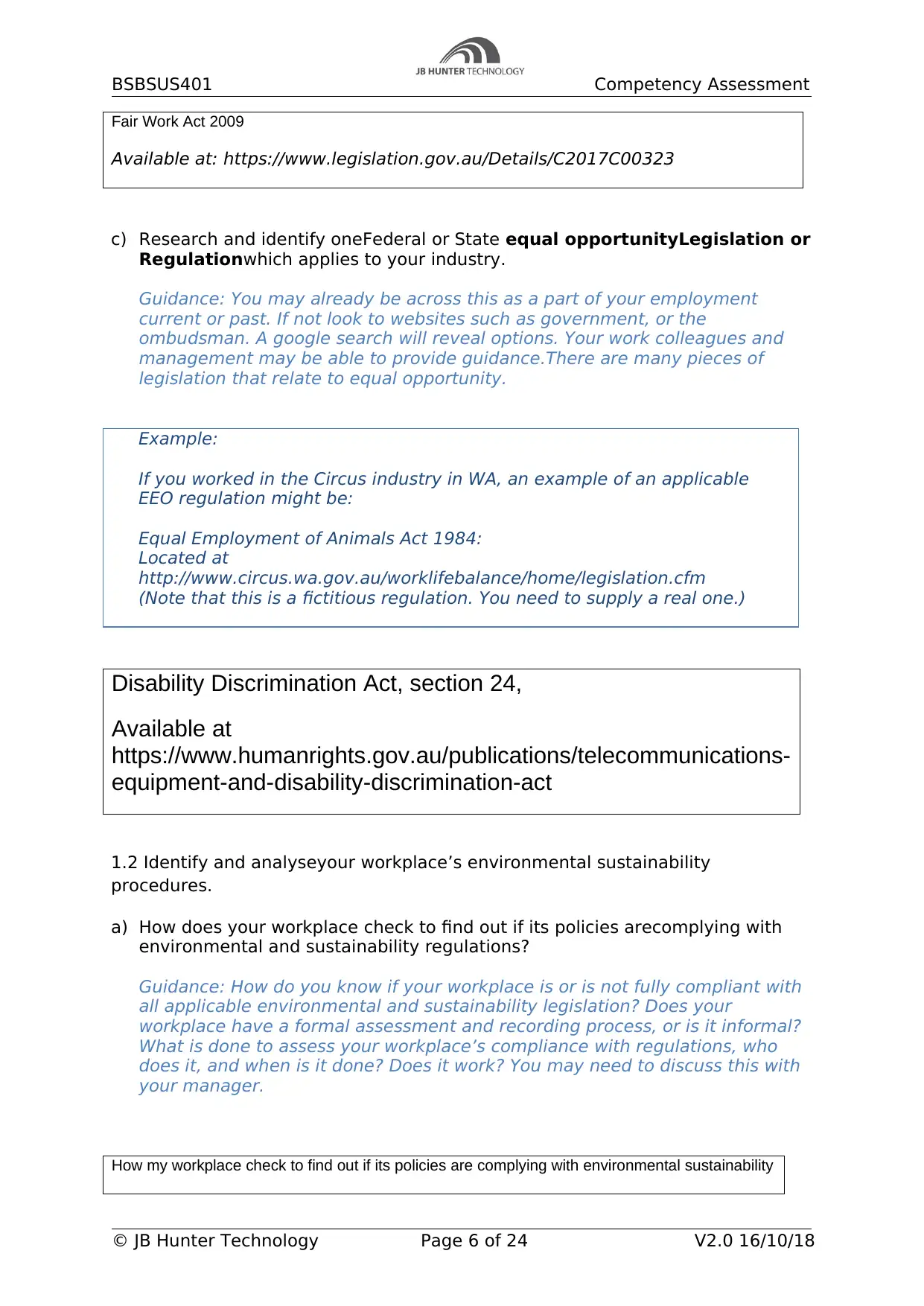
Fair Work Act 2009
Available at: https://www.legislation.gov.au/Details/C2017C00323
c) Research and identify oneFederal or State equal opportunityLegislation or
Regulationwhich applies to your industry.
Guidance: You may already be across this as a part of your employment
current or past. If not look to websites such as government, or the
ombudsman. A google search will reveal options. Your work colleagues and
management may be able to provide guidance.There are many pieces of
legislation that relate to equal opportunity.
Example:
If you worked in the Circus industry in WA, an example of an applicable
EEO regulation might be:
Equal Employment of Animals Act 1984:
Located at
http://www.circus.wa.gov.au/worklifebalance/home/legislation.cfm
(Note that this is a fictitious regulation. You need to supply a real one.)
Disability Discrimination Act, section 24,
Available at
https://www.humanrights.gov.au/publications/telecommunications-
equipment-and-disability-discrimination-act
1.2 Identify and analyseyour workplace’s environmental sustainability
procedures.
a) How does your workplace check to find out if its policies arecomplying with
environmental and sustainability regulations?
Guidance: How do you know if your workplace is or is not fully compliant with
all applicable environmental and sustainability legislation? Does your
workplace have a formal assessment and recording process, or is it informal?
What is done to assess your workplace’s compliance with regulations, who
does it, and when is it done? Does it work? You may need to discuss this with
your manager.
How my workplace check to find out if its policies are complying with environmental sustainability
© JB Hunter Technology Page 6 of 24 V2.0 16/10/18
Fair Work Act 2009
Available at: https://www.legislation.gov.au/Details/C2017C00323
c) Research and identify oneFederal or State equal opportunityLegislation or
Regulationwhich applies to your industry.
Guidance: You may already be across this as a part of your employment
current or past. If not look to websites such as government, or the
ombudsman. A google search will reveal options. Your work colleagues and
management may be able to provide guidance.There are many pieces of
legislation that relate to equal opportunity.
Example:
If you worked in the Circus industry in WA, an example of an applicable
EEO regulation might be:
Equal Employment of Animals Act 1984:
Located at
http://www.circus.wa.gov.au/worklifebalance/home/legislation.cfm
(Note that this is a fictitious regulation. You need to supply a real one.)
Disability Discrimination Act, section 24,
Available at
https://www.humanrights.gov.au/publications/telecommunications-
equipment-and-disability-discrimination-act
1.2 Identify and analyseyour workplace’s environmental sustainability
procedures.
a) How does your workplace check to find out if its policies arecomplying with
environmental and sustainability regulations?
Guidance: How do you know if your workplace is or is not fully compliant with
all applicable environmental and sustainability legislation? Does your
workplace have a formal assessment and recording process, or is it informal?
What is done to assess your workplace’s compliance with regulations, who
does it, and when is it done? Does it work? You may need to discuss this with
your manager.
How my workplace check to find out if its policies are complying with environmental sustainability
© JB Hunter Technology Page 6 of 24 V2.0 16/10/18
⊘ This is a preview!⊘
Do you want full access?
Subscribe today to unlock all pages.
Trusted by 1+ million students worldwide
BSBSUS401 Competency Assessment
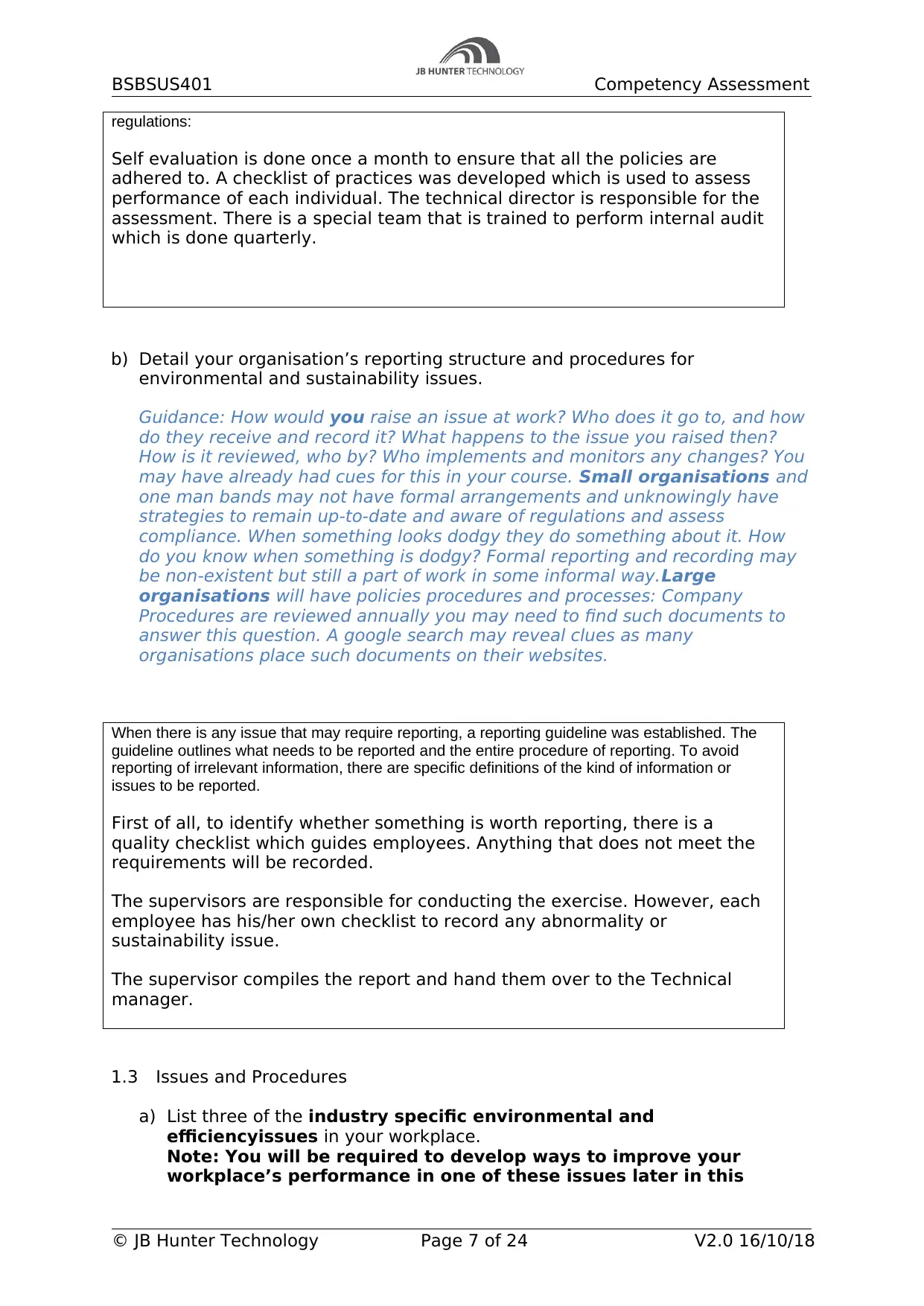
regulations:
Self evaluation is done once a month to ensure that all the policies are
adhered to. A checklist of practices was developed which is used to assess
performance of each individual. The technical director is responsible for the
assessment. There is a special team that is trained to perform internal audit
which is done quarterly.
b) Detail your organisation’s reporting structure and procedures for
environmental and sustainability issues.
Guidance: How would you raise an issue at work? Who does it go to, and how
do they receive and record it? What happens to the issue you raised then?
How is it reviewed, who by? Who implements and monitors any changes? You
may have already had cues for this in your course. Small organisations and
one man bands may not have formal arrangements and unknowingly have
strategies to remain up-to-date and aware of regulations and assess
compliance. When something looks dodgy they do something about it. How
do you know when something is dodgy? Formal reporting and recording may
be non-existent but still a part of work in some informal way.Large
organisations will have policies procedures and processes: Company
Procedures are reviewed annually you may need to find such documents to
answer this question. A google search may reveal clues as many
organisations place such documents on their websites.
When there is any issue that may require reporting, a reporting guideline was established. The
guideline outlines what needs to be reported and the entire procedure of reporting. To avoid
reporting of irrelevant information, there are specific definitions of the kind of information or
issues to be reported.
First of all, to identify whether something is worth reporting, there is a
quality checklist which guides employees. Anything that does not meet the
requirements will be recorded.
The supervisors are responsible for conducting the exercise. However, each
employee has his/her own checklist to record any abnormality or
sustainability issue.
The supervisor compiles the report and hand them over to the Technical
manager.
1.3 Issues and Procedures
a) List three of the industry specific environmental and
efficiencyissues in your workplace.
Note: You will be required to develop ways to improve your
workplace’s performance in one of these issues later in this
© JB Hunter Technology Page 7 of 24 V2.0 16/10/18
regulations:
Self evaluation is done once a month to ensure that all the policies are
adhered to. A checklist of practices was developed which is used to assess
performance of each individual. The technical director is responsible for the
assessment. There is a special team that is trained to perform internal audit
which is done quarterly.
b) Detail your organisation’s reporting structure and procedures for
environmental and sustainability issues.
Guidance: How would you raise an issue at work? Who does it go to, and how
do they receive and record it? What happens to the issue you raised then?
How is it reviewed, who by? Who implements and monitors any changes? You
may have already had cues for this in your course. Small organisations and
one man bands may not have formal arrangements and unknowingly have
strategies to remain up-to-date and aware of regulations and assess
compliance. When something looks dodgy they do something about it. How
do you know when something is dodgy? Formal reporting and recording may
be non-existent but still a part of work in some informal way.Large
organisations will have policies procedures and processes: Company
Procedures are reviewed annually you may need to find such documents to
answer this question. A google search may reveal clues as many
organisations place such documents on their websites.
When there is any issue that may require reporting, a reporting guideline was established. The
guideline outlines what needs to be reported and the entire procedure of reporting. To avoid
reporting of irrelevant information, there are specific definitions of the kind of information or
issues to be reported.
First of all, to identify whether something is worth reporting, there is a
quality checklist which guides employees. Anything that does not meet the
requirements will be recorded.
The supervisors are responsible for conducting the exercise. However, each
employee has his/her own checklist to record any abnormality or
sustainability issue.
The supervisor compiles the report and hand them over to the Technical
manager.
1.3 Issues and Procedures
a) List three of the industry specific environmental and
efficiencyissues in your workplace.
Note: You will be required to develop ways to improve your
workplace’s performance in one of these issues later in this
© JB Hunter Technology Page 7 of 24 V2.0 16/10/18
Paraphrase This Document
Need a fresh take? Get an instant paraphrase of this document with our AI Paraphraser
BSBSUS401 Competency Assessment
assignment.
Guidance: You may have already had cues for this in your course. Look at
your particular work and the telecommunications industry specifically -
such things as fuel or water are usually too general.
Example: Industry is pathology service
1. Inefficient fuel usage (Note: This is too general for a real answer).
2. Excessive chemical waste.
3. Sharps disposal.
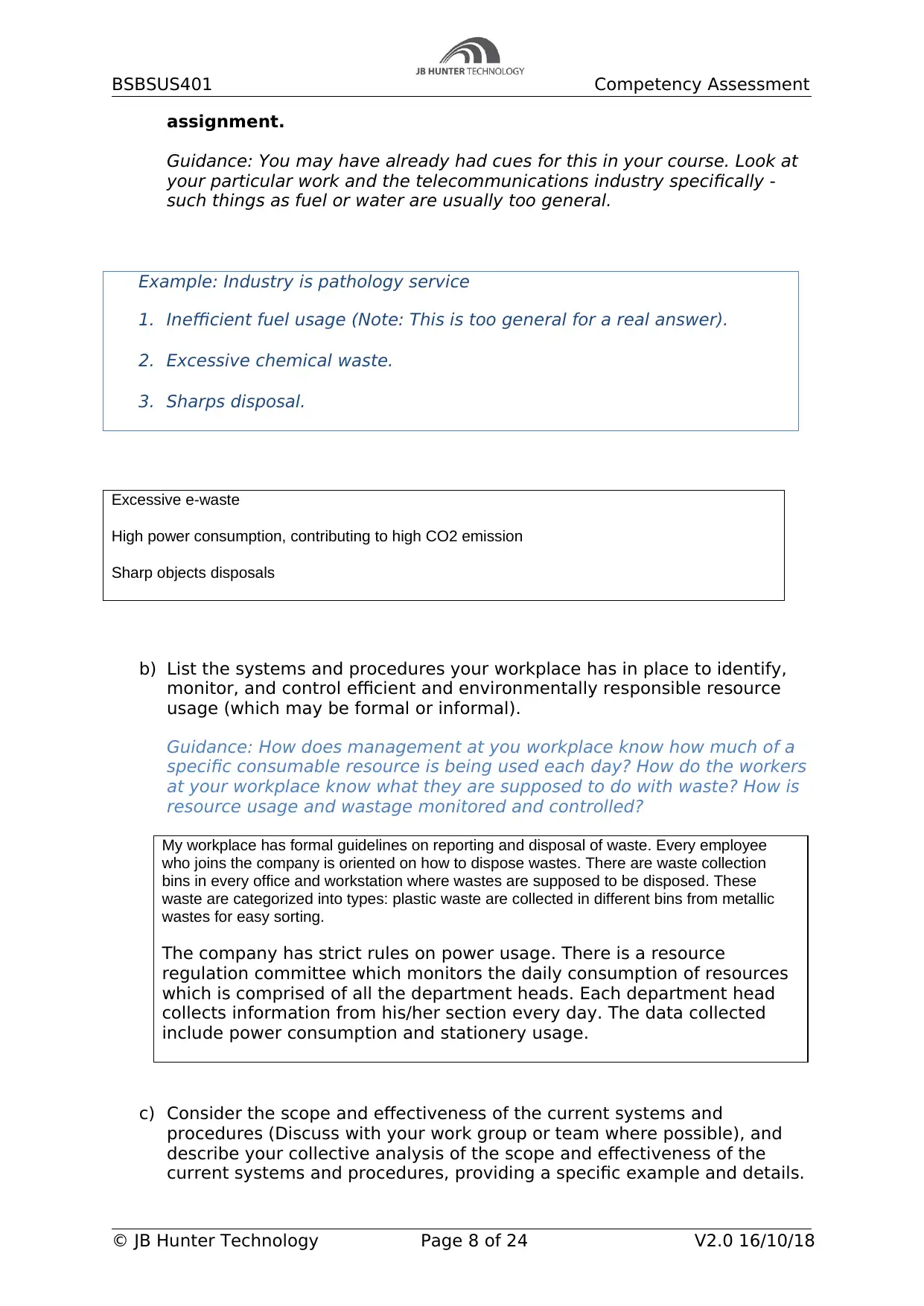
Excessive e-waste
High power consumption, contributing to high CO2 emission
Sharp objects disposals
b) List the systems and procedures your workplace has in place to identify,
monitor, and control efficient and environmentally responsible resource
usage (which may be formal or informal).
Guidance: How does management at you workplace know how much of a
specific consumable resource is being used each day? How do the workers
at your workplace know what they are supposed to do with waste? How is
resource usage and wastage monitored and controlled?
My workplace has formal guidelines on reporting and disposal of waste. Every employee
who joins the company is oriented on how to dispose wastes. There are waste collection
bins in every office and workstation where wastes are supposed to be disposed. These
waste are categorized into types: plastic waste are collected in different bins from metallic
wastes for easy sorting.
The company has strict rules on power usage. There is a resource
regulation committee which monitors the daily consumption of resources
which is comprised of all the department heads. Each department head
collects information from his/her section every day. The data collected
include power consumption and stationery usage.
c) Consider the scope and effectiveness of the current systems and
procedures (Discuss with your work group or team where possible), and
describe your collective analysis of the scope and effectiveness of the
current systems and procedures, providing a specific example and details.
© JB Hunter Technology Page 8 of 24 V2.0 16/10/18
assignment.
Guidance: You may have already had cues for this in your course. Look at
your particular work and the telecommunications industry specifically -
such things as fuel or water are usually too general.
Example: Industry is pathology service
1. Inefficient fuel usage (Note: This is too general for a real answer).
2. Excessive chemical waste.
3. Sharps disposal.
Excessive e-waste
High power consumption, contributing to high CO2 emission
Sharp objects disposals
b) List the systems and procedures your workplace has in place to identify,
monitor, and control efficient and environmentally responsible resource
usage (which may be formal or informal).
Guidance: How does management at you workplace know how much of a
specific consumable resource is being used each day? How do the workers
at your workplace know what they are supposed to do with waste? How is
resource usage and wastage monitored and controlled?
My workplace has formal guidelines on reporting and disposal of waste. Every employee
who joins the company is oriented on how to dispose wastes. There are waste collection
bins in every office and workstation where wastes are supposed to be disposed. These
waste are categorized into types: plastic waste are collected in different bins from metallic
wastes for easy sorting.
The company has strict rules on power usage. There is a resource
regulation committee which monitors the daily consumption of resources
which is comprised of all the department heads. Each department head
collects information from his/her section every day. The data collected
include power consumption and stationery usage.
c) Consider the scope and effectiveness of the current systems and
procedures (Discuss with your work group or team where possible), and
describe your collective analysis of the scope and effectiveness of the
current systems and procedures, providing a specific example and details.
© JB Hunter Technology Page 8 of 24 V2.0 16/10/18
BSBSUS401 Competency Assessment
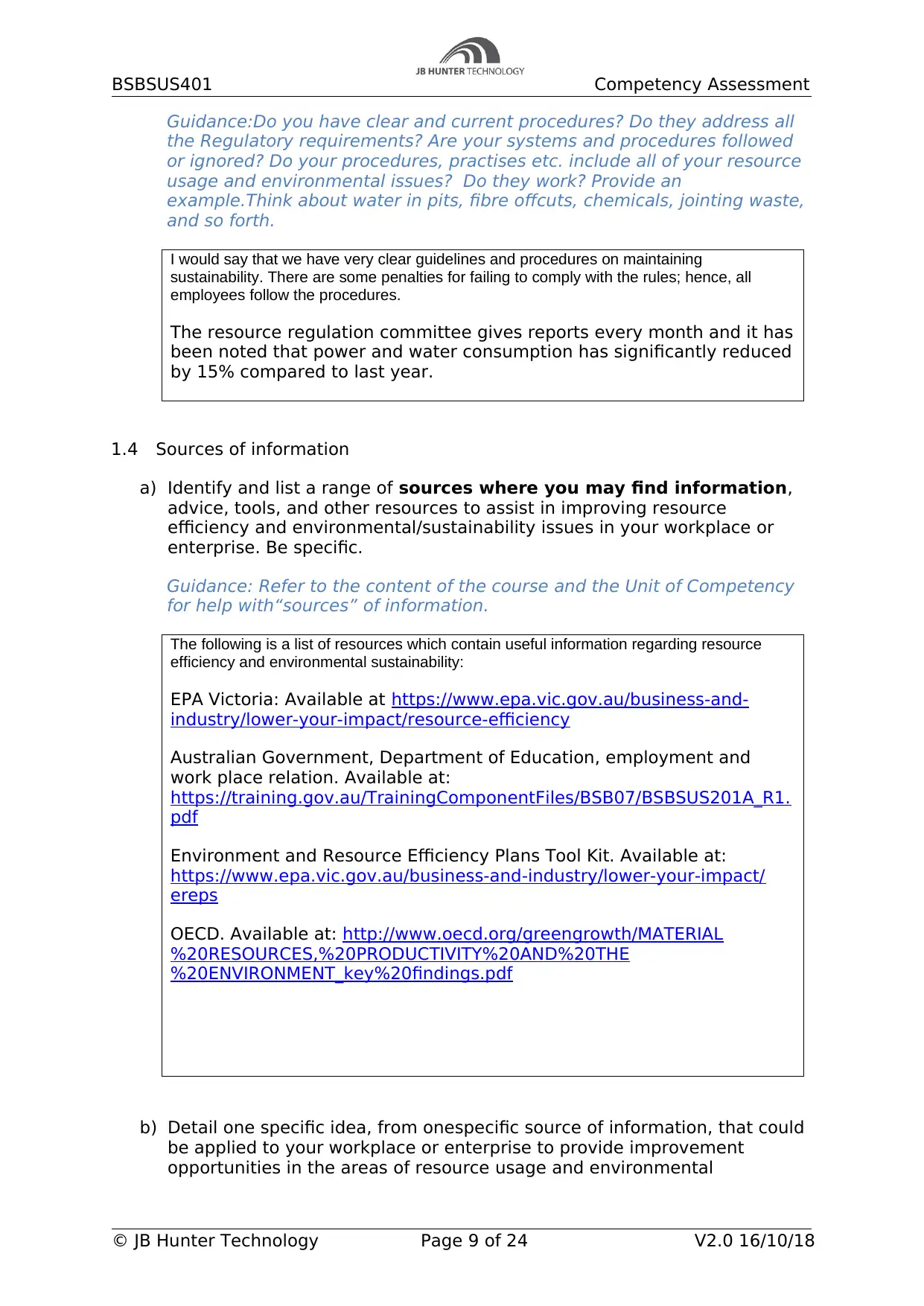
Guidance:Do you have clear and current procedures? Do they address all
the Regulatory requirements? Are your systems and procedures followed
or ignored? Do your procedures, practises etc. include all of your resource
usage and environmental issues? Do they work? Provide an
example.Think about water in pits, fibre offcuts, chemicals, jointing waste,
and so forth.
I would say that we have very clear guidelines and procedures on maintaining
sustainability. There are some penalties for failing to comply with the rules; hence, all
employees follow the procedures.
The resource regulation committee gives reports every month and it has
been noted that power and water consumption has significantly reduced
by 15% compared to last year.
1.4 Sources of information
a) Identify and list a range of sources where you may find information,
advice, tools, and other resources to assist in improving resource
efficiency and environmental/sustainability issues in your workplace or
enterprise. Be specific.
Guidance: Refer to the content of the course and the Unit of Competency
for help with“sources” of information.
The following is a list of resources which contain useful information regarding resource
efficiency and environmental sustainability:
EPA Victoria: Available at https://www.epa.vic.gov.au/business-and-
industry/lower-your-impact/resource-efficiency
Australian Government, Department of Education, employment and
work place relation. Available at:
https://training.gov.au/TrainingComponentFiles/BSB07/BSBSUS201A_R1.
pdf
Environment and Resource Efficiency Plans Tool Kit. Available at:
https://www.epa.vic.gov.au/business-and-industry/lower-your-impact/
ereps
OECD. Available at: http://www.oecd.org/greengrowth/MATERIAL
%20RESOURCES,%20PRODUCTIVITY%20AND%20THE
%20ENVIRONMENT_key%20findings.pdf
b) Detail one specific idea, from onespecific source of information, that could
be applied to your workplace or enterprise to provide improvement
opportunities in the areas of resource usage and environmental
© JB Hunter Technology Page 9 of 24 V2.0 16/10/18
Guidance:Do you have clear and current procedures? Do they address all
the Regulatory requirements? Are your systems and procedures followed
or ignored? Do your procedures, practises etc. include all of your resource
usage and environmental issues? Do they work? Provide an
example.Think about water in pits, fibre offcuts, chemicals, jointing waste,
and so forth.
I would say that we have very clear guidelines and procedures on maintaining
sustainability. There are some penalties for failing to comply with the rules; hence, all
employees follow the procedures.
The resource regulation committee gives reports every month and it has
been noted that power and water consumption has significantly reduced
by 15% compared to last year.
1.4 Sources of information
a) Identify and list a range of sources where you may find information,
advice, tools, and other resources to assist in improving resource
efficiency and environmental/sustainability issues in your workplace or
enterprise. Be specific.
Guidance: Refer to the content of the course and the Unit of Competency
for help with“sources” of information.
The following is a list of resources which contain useful information regarding resource
efficiency and environmental sustainability:
EPA Victoria: Available at https://www.epa.vic.gov.au/business-and-
industry/lower-your-impact/resource-efficiency
Australian Government, Department of Education, employment and
work place relation. Available at:
https://training.gov.au/TrainingComponentFiles/BSB07/BSBSUS201A_R1.
Environment and Resource Efficiency Plans Tool Kit. Available at:
https://www.epa.vic.gov.au/business-and-industry/lower-your-impact/
ereps
OECD. Available at: http://www.oecd.org/greengrowth/MATERIAL
%20RESOURCES,%20PRODUCTIVITY%20AND%20THE
%20ENVIRONMENT_key%20findings.pdf
b) Detail one specific idea, from onespecific source of information, that could
be applied to your workplace or enterprise to provide improvement
opportunities in the areas of resource usage and environmental
© JB Hunter Technology Page 9 of 24 V2.0 16/10/18
⊘ This is a preview!⊘
Do you want full access?
Subscribe today to unlock all pages.
Trusted by 1+ million students worldwide
BSBSUS401 Competency Assessment
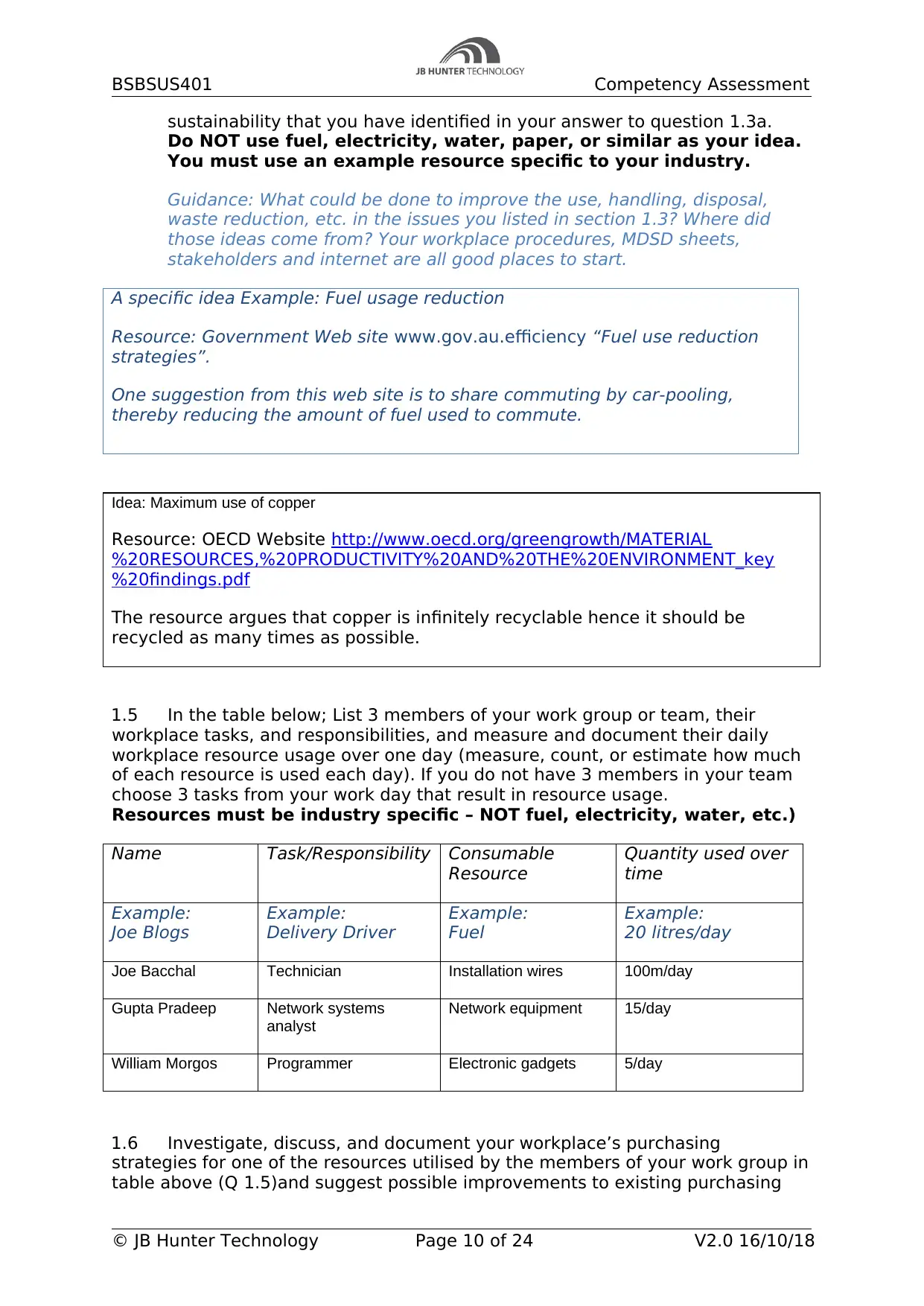
sustainability that you have identified in your answer to question 1.3a.
Do NOT use fuel, electricity, water, paper, or similar as your idea.
You must use an example resource specific to your industry.
Guidance: What could be done to improve the use, handling, disposal,
waste reduction, etc. in the issues you listed in section 1.3? Where did
those ideas come from? Your workplace procedures, MDSD sheets,
stakeholders and internet are all good places to start.
A specific idea Example: Fuel usage reduction
Resource: Government Web site www.gov.au.efficiency “Fuel use reduction
strategies”.
One suggestion from this web site is to share commuting by car-pooling,
thereby reducing the amount of fuel used to commute.
Idea: Maximum use of copper
Resource: OECD Website http://www.oecd.org/greengrowth/MATERIAL
%20RESOURCES,%20PRODUCTIVITY%20AND%20THE%20ENVIRONMENT_key
%20findings.pdf
The resource argues that copper is infinitely recyclable hence it should be
recycled as many times as possible.
1.5 In the table below; List 3 members of your work group or team, their
workplace tasks, and responsibilities, and measure and document their daily
workplace resource usage over one day (measure, count, or estimate how much
of each resource is used each day). If you do not have 3 members in your team
choose 3 tasks from your work day that result in resource usage.
Resources must be industry specific – NOT fuel, electricity, water, etc.)
Name Task/Responsibility Consumable
Resource
Quantity used over
time
Example:
Joe Blogs
Example:
Delivery Driver
Example:
Fuel
Example:
20 litres/day
Joe Bacchal Technician Installation wires 100m/day
Gupta Pradeep Network systems
analyst
Network equipment 15/day
William Morgos Programmer Electronic gadgets 5/day
1.6 Investigate, discuss, and document your workplace’s purchasing
strategies for one of the resources utilised by the members of your work group in
table above (Q 1.5)and suggest possible improvements to existing purchasing
© JB Hunter Technology Page 10 of 24 V2.0 16/10/18
sustainability that you have identified in your answer to question 1.3a.
Do NOT use fuel, electricity, water, paper, or similar as your idea.
You must use an example resource specific to your industry.
Guidance: What could be done to improve the use, handling, disposal,
waste reduction, etc. in the issues you listed in section 1.3? Where did
those ideas come from? Your workplace procedures, MDSD sheets,
stakeholders and internet are all good places to start.
A specific idea Example: Fuel usage reduction
Resource: Government Web site www.gov.au.efficiency “Fuel use reduction
strategies”.
One suggestion from this web site is to share commuting by car-pooling,
thereby reducing the amount of fuel used to commute.
Idea: Maximum use of copper
Resource: OECD Website http://www.oecd.org/greengrowth/MATERIAL
%20RESOURCES,%20PRODUCTIVITY%20AND%20THE%20ENVIRONMENT_key
%20findings.pdf
The resource argues that copper is infinitely recyclable hence it should be
recycled as many times as possible.
1.5 In the table below; List 3 members of your work group or team, their
workplace tasks, and responsibilities, and measure and document their daily
workplace resource usage over one day (measure, count, or estimate how much
of each resource is used each day). If you do not have 3 members in your team
choose 3 tasks from your work day that result in resource usage.
Resources must be industry specific – NOT fuel, electricity, water, etc.)
Name Task/Responsibility Consumable
Resource
Quantity used over
time
Example:
Joe Blogs
Example:
Delivery Driver
Example:
Fuel
Example:
20 litres/day
Joe Bacchal Technician Installation wires 100m/day
Gupta Pradeep Network systems
analyst
Network equipment 15/day
William Morgos Programmer Electronic gadgets 5/day
1.6 Investigate, discuss, and document your workplace’s purchasing
strategies for one of the resources utilised by the members of your work group in
table above (Q 1.5)and suggest possible improvements to existing purchasing
© JB Hunter Technology Page 10 of 24 V2.0 16/10/18
Paraphrase This Document
Need a fresh take? Get an instant paraphrase of this document with our AI Paraphraser
BSBSUS401 Competency Assessment
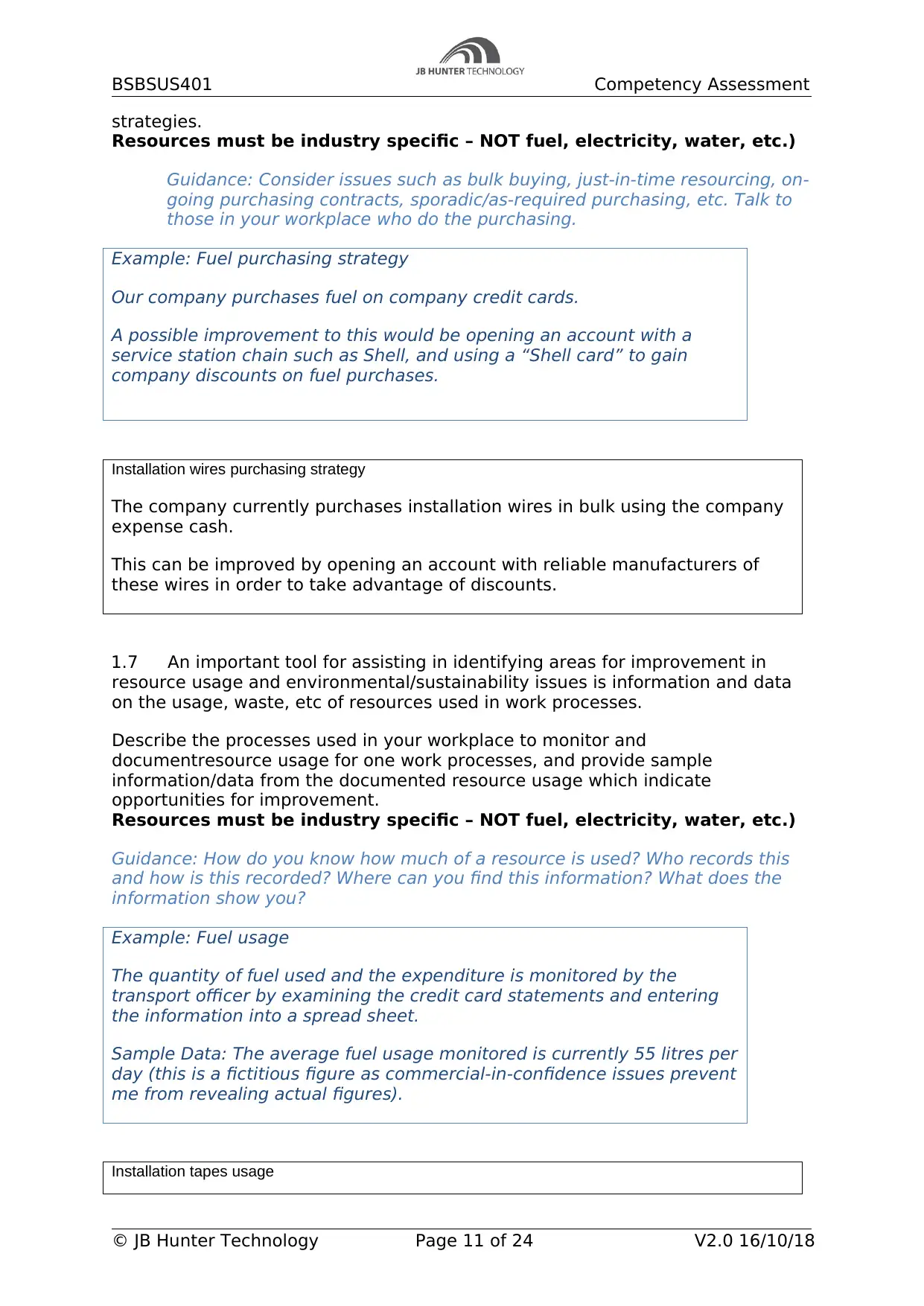
strategies.
Resources must be industry specific – NOT fuel, electricity, water, etc.)
Guidance: Consider issues such as bulk buying, just-in-time resourcing, on-
going purchasing contracts, sporadic/as-required purchasing, etc. Talk to
those in your workplace who do the purchasing.
Example: Fuel purchasing strategy
Our company purchases fuel on company credit cards.
A possible improvement to this would be opening an account with a
service station chain such as Shell, and using a “Shell card” to gain
company discounts on fuel purchases.
Installation wires purchasing strategy
The company currently purchases installation wires in bulk using the company
expense cash.
This can be improved by opening an account with reliable manufacturers of
these wires in order to take advantage of discounts.
1.7 An important tool for assisting in identifying areas for improvement in
resource usage and environmental/sustainability issues is information and data
on the usage, waste, etc of resources used in work processes.
Describe the processes used in your workplace to monitor and
documentresource usage for one work processes, and provide sample
information/data from the documented resource usage which indicate
opportunities for improvement.
Resources must be industry specific – NOT fuel, electricity, water, etc.)
Guidance: How do you know how much of a resource is used? Who records this
and how is this recorded? Where can you find this information? What does the
information show you?
Example: Fuel usage
The quantity of fuel used and the expenditure is monitored by the
transport officer by examining the credit card statements and entering
the information into a spread sheet.
Sample Data: The average fuel usage monitored is currently 55 litres per
day (this is a fictitious figure as commercial-in-confidence issues prevent
me from revealing actual figures).
Installation tapes usage
© JB Hunter Technology Page 11 of 24 V2.0 16/10/18
strategies.
Resources must be industry specific – NOT fuel, electricity, water, etc.)
Guidance: Consider issues such as bulk buying, just-in-time resourcing, on-
going purchasing contracts, sporadic/as-required purchasing, etc. Talk to
those in your workplace who do the purchasing.
Example: Fuel purchasing strategy
Our company purchases fuel on company credit cards.
A possible improvement to this would be opening an account with a
service station chain such as Shell, and using a “Shell card” to gain
company discounts on fuel purchases.
Installation wires purchasing strategy
The company currently purchases installation wires in bulk using the company
expense cash.
This can be improved by opening an account with reliable manufacturers of
these wires in order to take advantage of discounts.
1.7 An important tool for assisting in identifying areas for improvement in
resource usage and environmental/sustainability issues is information and data
on the usage, waste, etc of resources used in work processes.
Describe the processes used in your workplace to monitor and
documentresource usage for one work processes, and provide sample
information/data from the documented resource usage which indicate
opportunities for improvement.
Resources must be industry specific – NOT fuel, electricity, water, etc.)
Guidance: How do you know how much of a resource is used? Who records this
and how is this recorded? Where can you find this information? What does the
information show you?
Example: Fuel usage
The quantity of fuel used and the expenditure is monitored by the
transport officer by examining the credit card statements and entering
the information into a spread sheet.
Sample Data: The average fuel usage monitored is currently 55 litres per
day (this is a fictitious figure as commercial-in-confidence issues prevent
me from revealing actual figures).
Installation tapes usage
© JB Hunter Technology Page 11 of 24 V2.0 16/10/18
BSBSUS401 Competency Assessment
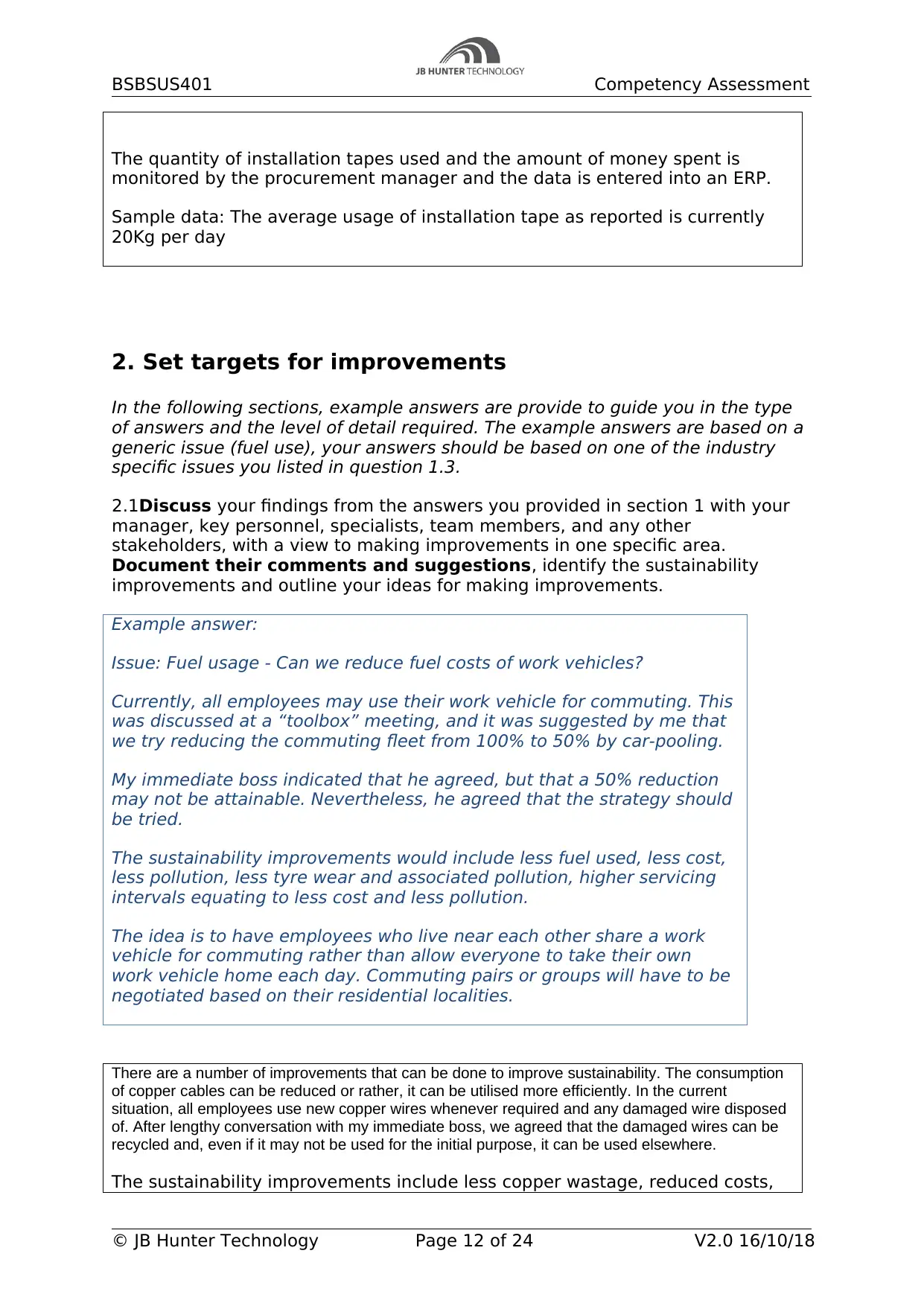
The quantity of installation tapes used and the amount of money spent is
monitored by the procurement manager and the data is entered into an ERP.
Sample data: The average usage of installation tape as reported is currently
20Kg per day
2. Set targets for improvements
In the following sections, example answers are provide to guide you in the type
of answers and the level of detail required. The example answers are based on a
generic issue (fuel use), your answers should be based on one of the industry
specific issues you listed in question 1.3.
2.1Discuss your findings from the answers you provided in section 1 with your
manager, key personnel, specialists, team members, and any other
stakeholders, with a view to making improvements in one specific area.
Document their comments and suggestions, identify the sustainability
improvements and outline your ideas for making improvements.
Example answer:
Issue: Fuel usage - Can we reduce fuel costs of work vehicles?
Currently, all employees may use their work vehicle for commuting. This
was discussed at a “toolbox” meeting, and it was suggested by me that
we try reducing the commuting fleet from 100% to 50% by car-pooling.
My immediate boss indicated that he agreed, but that a 50% reduction
may not be attainable. Nevertheless, he agreed that the strategy should
be tried.
The sustainability improvements would include less fuel used, less cost,
less pollution, less tyre wear and associated pollution, higher servicing
intervals equating to less cost and less pollution.
The idea is to have employees who live near each other share a work
vehicle for commuting rather than allow everyone to take their own
work vehicle home each day. Commuting pairs or groups will have to be
negotiated based on their residential localities.
There are a number of improvements that can be done to improve sustainability. The consumption
of copper cables can be reduced or rather, it can be utilised more efficiently. In the current
situation, all employees use new copper wires whenever required and any damaged wire disposed
of. After lengthy conversation with my immediate boss, we agreed that the damaged wires can be
recycled and, even if it may not be used for the initial purpose, it can be used elsewhere.
The sustainability improvements include less copper wastage, reduced costs,
© JB Hunter Technology Page 12 of 24 V2.0 16/10/18
The quantity of installation tapes used and the amount of money spent is
monitored by the procurement manager and the data is entered into an ERP.
Sample data: The average usage of installation tape as reported is currently
20Kg per day
2. Set targets for improvements
In the following sections, example answers are provide to guide you in the type
of answers and the level of detail required. The example answers are based on a
generic issue (fuel use), your answers should be based on one of the industry
specific issues you listed in question 1.3.
2.1Discuss your findings from the answers you provided in section 1 with your
manager, key personnel, specialists, team members, and any other
stakeholders, with a view to making improvements in one specific area.
Document their comments and suggestions, identify the sustainability
improvements and outline your ideas for making improvements.
Example answer:
Issue: Fuel usage - Can we reduce fuel costs of work vehicles?
Currently, all employees may use their work vehicle for commuting. This
was discussed at a “toolbox” meeting, and it was suggested by me that
we try reducing the commuting fleet from 100% to 50% by car-pooling.
My immediate boss indicated that he agreed, but that a 50% reduction
may not be attainable. Nevertheless, he agreed that the strategy should
be tried.
The sustainability improvements would include less fuel used, less cost,
less pollution, less tyre wear and associated pollution, higher servicing
intervals equating to less cost and less pollution.
The idea is to have employees who live near each other share a work
vehicle for commuting rather than allow everyone to take their own
work vehicle home each day. Commuting pairs or groups will have to be
negotiated based on their residential localities.
There are a number of improvements that can be done to improve sustainability. The consumption
of copper cables can be reduced or rather, it can be utilised more efficiently. In the current
situation, all employees use new copper wires whenever required and any damaged wire disposed
of. After lengthy conversation with my immediate boss, we agreed that the damaged wires can be
recycled and, even if it may not be used for the initial purpose, it can be used elsewhere.
The sustainability improvements include less copper wastage, reduced costs,
© JB Hunter Technology Page 12 of 24 V2.0 16/10/18
⊘ This is a preview!⊘
Do you want full access?
Subscribe today to unlock all pages.
Trusted by 1+ million students worldwide

1 out of 24


Related Documents


Your All-in-One AI-Powered Toolkit for Academic Success.
+13062052269
info@desklib.com
Available 24*7 on WhatsApp / Email
![[object Object]](/_next/static/media/star-bottom.7253800d.svg)
Unlock your academic potential
Copyright © 2020–2026 A2Z Services. All Rights Reserved. Developed and managed by ZUCOL.