Workplace Policy Development Report for Woolworths - BSBSUS501
VerifiedAdded on 2023/04/25
|16
|3383
|125
Report
AI Summary
This report provides a comprehensive analysis of Woolworths' workplace sustainability policy, examining its vision, mission, and objectives. It includes PEST and SWOT analyses to understand the company's position and potential challenges. The report outlines a detailed action plan with specific initiatives, desired outcomes, timelines, and responsibilities, focusing on minimizing plastic use, promoting eco-friendly packaging, and reducing energy consumption. A thorough risk assessment identifies potential financial, people, time, and equipment-related risks. Furthermore, a cost-benefit analysis compares the costs of existing and proposed sustainability systems. The report also includes a communication plan and strategies for continuous improvement, concluding with recommendations for Woolworths to enhance its environmental and community impact. Finally, the report addresses the development of a sustainable policy, its internal and external information sources, and the barriers to implementation, along with strategies for improvement.
Running head: DEVELOPING WORKPLACE POLICY
DEVELOPING WORKPLACE POLICY
Name of the student
Name of the university
Author note
DEVELOPING WORKPLACE POLICY
Name of the student
Name of the university
Author note

Paraphrase This Document
Need a fresh take? Get an instant paraphrase of this document with our AI Paraphraser
1
DEVELOPING WORKPLACE POLICY
ASSIGNMENT 1:
1. Brief Background
Woolworths Limited is a company based in Australia, which deals in supermarkets and
grocery chains. The company came into existence in 1924 and today, it is one of the biggest
companies in the country (Woolworthsgroup.com.au, 2019). In fact, as per the Australian
Financial Review (AFR), the company is presently ranked top in the list of companies in
Australia and 14th globally (Afr.com 2019).
2. Vision
Woolworth’s vision is to put its customers first across all its brands and it has enlisted
certain priorities to achieve this vision. Some of these include connected, convenient and
personalized shopping experience; accelerate innovation in drinks business and so on.
3. Mission
The primary mission of Woolworths is to be the best in everything and remain at the
community’s heart being loved by all sections – kids, family and home. Apart from that, the
company is on a mission to provide the best in quality, value and convenience to its customers.
4. Purpose
The purpose of the policy is to establish a workplace that encourages
environmental sustainability.
In developing this policy, the primary stakeholders including the employees
should be involved as well as the government.
DEVELOPING WORKPLACE POLICY
ASSIGNMENT 1:
1. Brief Background
Woolworths Limited is a company based in Australia, which deals in supermarkets and
grocery chains. The company came into existence in 1924 and today, it is one of the biggest
companies in the country (Woolworthsgroup.com.au, 2019). In fact, as per the Australian
Financial Review (AFR), the company is presently ranked top in the list of companies in
Australia and 14th globally (Afr.com 2019).
2. Vision
Woolworth’s vision is to put its customers first across all its brands and it has enlisted
certain priorities to achieve this vision. Some of these include connected, convenient and
personalized shopping experience; accelerate innovation in drinks business and so on.
3. Mission
The primary mission of Woolworths is to be the best in everything and remain at the
community’s heart being loved by all sections – kids, family and home. Apart from that, the
company is on a mission to provide the best in quality, value and convenience to its customers.
4. Purpose
The purpose of the policy is to establish a workplace that encourages
environmental sustainability.
In developing this policy, the primary stakeholders including the employees
should be involved as well as the government.
2
DEVELOPING WORKPLACE POLICY
5. PEST and SWOT Analysis
PEST (Political, Economic, Social, Technological) –
Political – The political factors are in favor of the company due to the introduction of
laws like the New White Paper. Known also as the Tesco Law, it allows the company to have its
own law company deal with legal issues and offer legal advice.
Economic factors – Due to dull consumer spending in the past few years has influenced
the company however, ease in economic regulations did help it stay put during the worldwide
economic crisis.
Social factors – The company has had poor relationships with the suppliers but now it is
on the way to improving its social image.
Technological factors – The implementation of a new merchandising system with SAP
has helped the company improve its efficiency. Apart from that, the self-service checkout
technology has also alleviated the company’s profits.
SWOT (Strengths, Weaknesses, Opportunities, Threats) –
Strengths – The Company’s biggest strength is the brand name it carries. It has been in
the business for almost a century now and people relate to the brand.
Weaknesses – The biggest weakness of Woolworths is that it is not recognized
internationally yet.
Opportunities – The retail sector is rapidly growing across the globe, which presents itself
as one of the best opportunities for Woolworths to expand.
DEVELOPING WORKPLACE POLICY
5. PEST and SWOT Analysis
PEST (Political, Economic, Social, Technological) –
Political – The political factors are in favor of the company due to the introduction of
laws like the New White Paper. Known also as the Tesco Law, it allows the company to have its
own law company deal with legal issues and offer legal advice.
Economic factors – Due to dull consumer spending in the past few years has influenced
the company however, ease in economic regulations did help it stay put during the worldwide
economic crisis.
Social factors – The company has had poor relationships with the suppliers but now it is
on the way to improving its social image.
Technological factors – The implementation of a new merchandising system with SAP
has helped the company improve its efficiency. Apart from that, the self-service checkout
technology has also alleviated the company’s profits.
SWOT (Strengths, Weaknesses, Opportunities, Threats) –
Strengths – The Company’s biggest strength is the brand name it carries. It has been in
the business for almost a century now and people relate to the brand.
Weaknesses – The biggest weakness of Woolworths is that it is not recognized
internationally yet.
Opportunities – The retail sector is rapidly growing across the globe, which presents itself
as one of the best opportunities for Woolworths to expand.
⊘ This is a preview!⊘
Do you want full access?
Subscribe today to unlock all pages.

Trusted by 1+ million students worldwide
3
DEVELOPING WORKPLACE POLICY
Threats – The other successful supermarket giants, Coles in particular, poses the biggest
threat for the company (Mortimer 2017). In addition, the new entrants in the retail business also
seem to threaten Woolworths’ position.
6. Objectives
Objective 1 – To ensure that the company promotes eco-friendly carry bags that are
customized for customers of Woolworths
Objective 2 – To encourage the manufacture of products that consume least non-
renewable energy
Objective 3 – To promote the use of products especially eatables that are naturally available
7. Action Plan
Initiatives How it will be
done
Desired Outcome Timeframe Responsibilities
1. To minimize the
use of plastic in
packaging
Request the
packaging
companies to use
eco-friendly
papers for
packaging
It will ensure that
there is minimum
risk posed to the
environment
although the cost
of packaging
might increase
1 year The higher
management
The suppliers
2. To replace
plastic bags with
Woolworths
Increase the supply
of paper bags
especially
It will motivate the
customers to make
minimum use of
6 months The suppliers
The higher
management
DEVELOPING WORKPLACE POLICY
Threats – The other successful supermarket giants, Coles in particular, poses the biggest
threat for the company (Mortimer 2017). In addition, the new entrants in the retail business also
seem to threaten Woolworths’ position.
6. Objectives
Objective 1 – To ensure that the company promotes eco-friendly carry bags that are
customized for customers of Woolworths
Objective 2 – To encourage the manufacture of products that consume least non-
renewable energy
Objective 3 – To promote the use of products especially eatables that are naturally available
7. Action Plan
Initiatives How it will be
done
Desired Outcome Timeframe Responsibilities
1. To minimize the
use of plastic in
packaging
Request the
packaging
companies to use
eco-friendly
papers for
packaging
It will ensure that
there is minimum
risk posed to the
environment
although the cost
of packaging
might increase
1 year The higher
management
The suppliers
2. To replace
plastic bags with
Woolworths
Increase the supply
of paper bags
especially
It will motivate the
customers to make
minimum use of
6 months The suppliers
The higher
management
Paraphrase This Document
Need a fresh take? Get an instant paraphrase of this document with our AI Paraphraser
4
DEVELOPING WORKPLACE POLICY
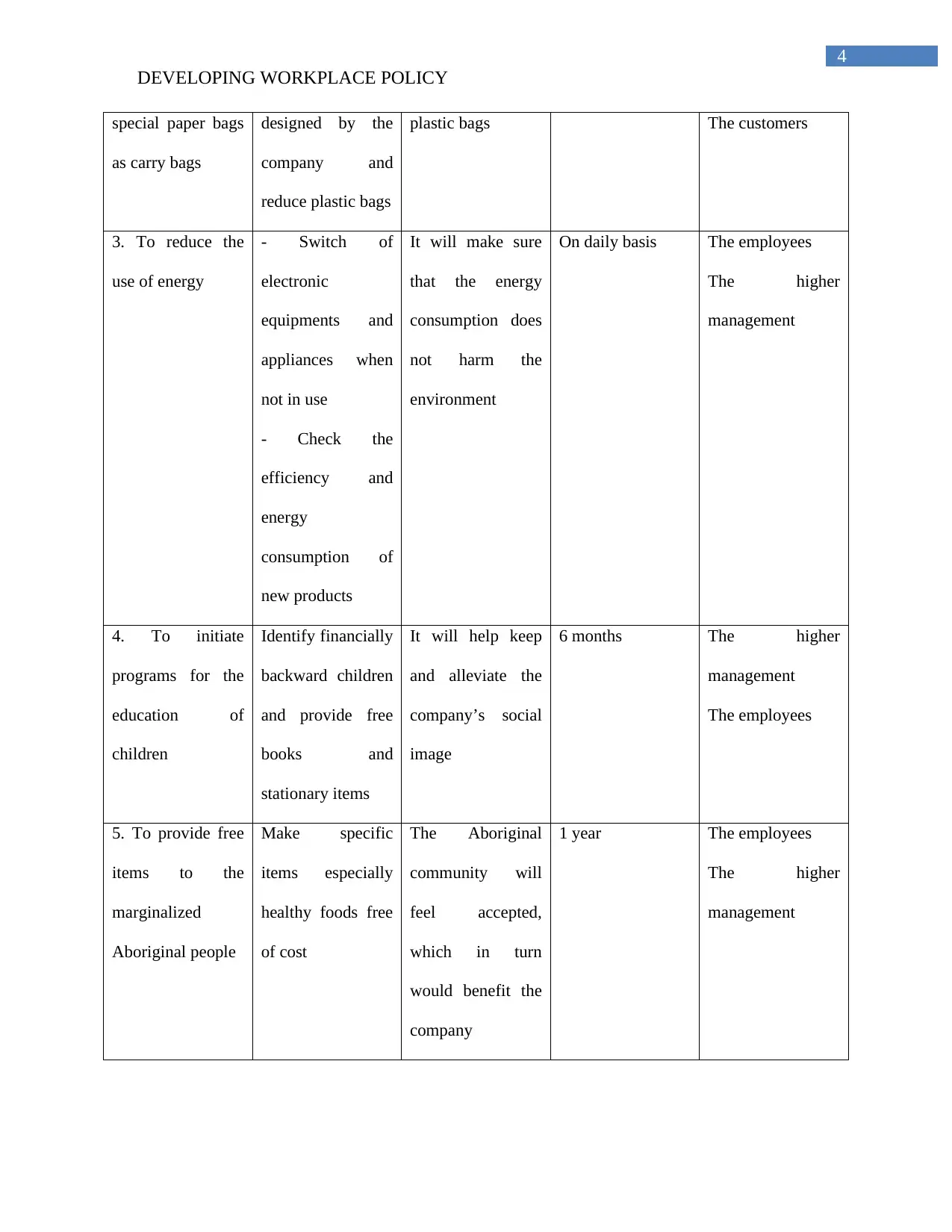
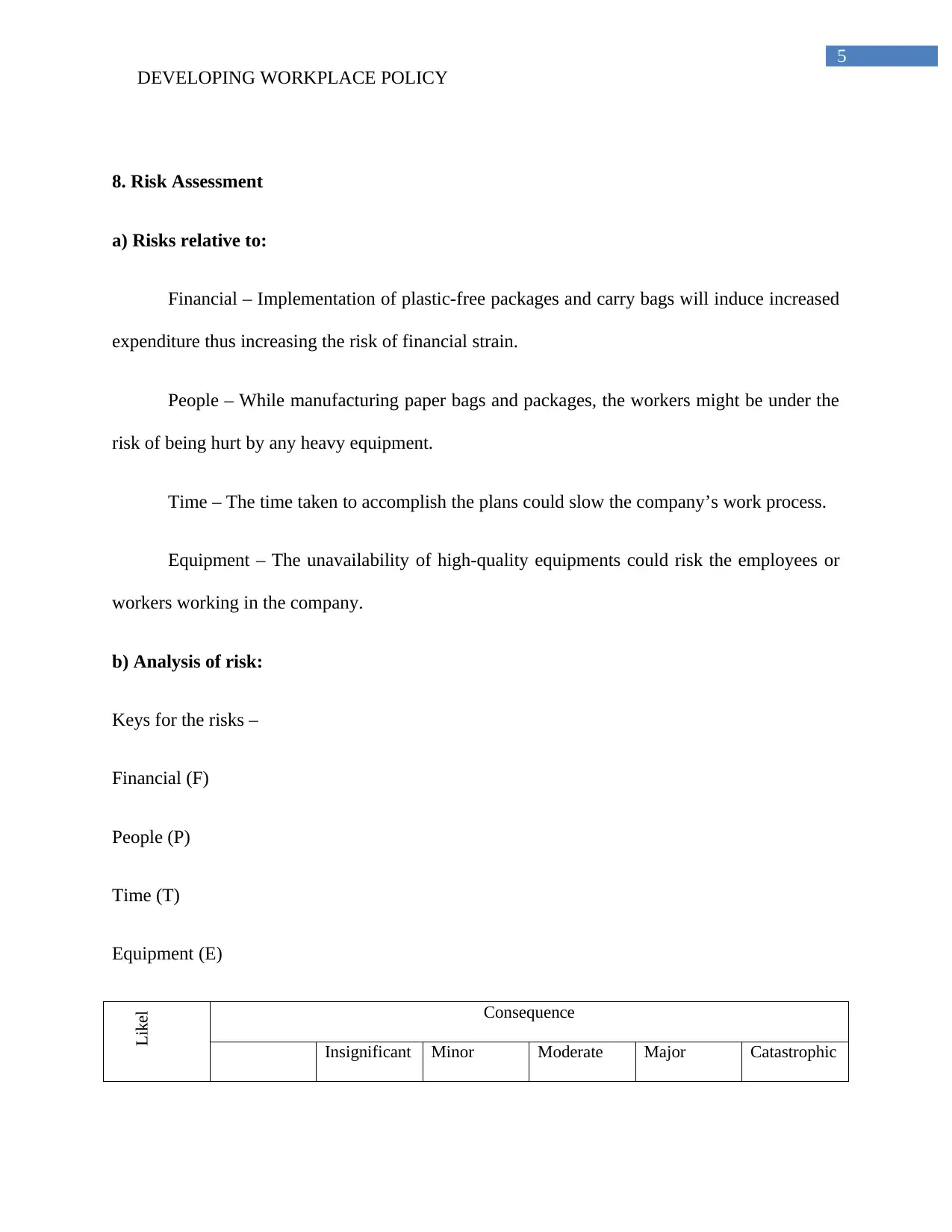
special paper bags
as carry bags
designed by the
company and
reduce plastic bags
plastic bags The customers
3. To reduce the
use of energy
- Switch of
electronic
equipments and
appliances when
not in use
- Check the
efficiency and
energy
consumption of
new products
It will make sure
that the energy
consumption does
not harm the
environment
On daily basis The employees
The higher
management
4. To initiate
programs for the
education of
children
Identify financially
backward children
and provide free
books and
stationary items
It will help keep
and alleviate the
company’s social
image
6 months The higher
management
The employees
5. To provide free
items to the
marginalized
Aboriginal people
Make specific
items especially
healthy foods free
of cost
The Aboriginal
community will
feel accepted,
which in turn
would benefit the
company
1 year The employees
The higher
management
DEVELOPING WORKPLACE POLICY
special paper bags
as carry bags
designed by the
company and
reduce plastic bags
plastic bags The customers
3. To reduce the
use of energy
- Switch of
electronic
equipments and
appliances when
not in use
- Check the
efficiency and
energy
consumption of
new products
It will make sure
that the energy
consumption does
not harm the
environment
On daily basis The employees
The higher
management
4. To initiate
programs for the
education of
children
Identify financially
backward children
and provide free
books and
stationary items
It will help keep
and alleviate the
company’s social
image
6 months The higher
management
The employees
5. To provide free
items to the
marginalized
Aboriginal people
Make specific
items especially
healthy foods free
of cost
The Aboriginal
community will
feel accepted,
which in turn
would benefit the
company
1 year The employees
The higher
management
5
DEVELOPING WORKPLACE POLICY
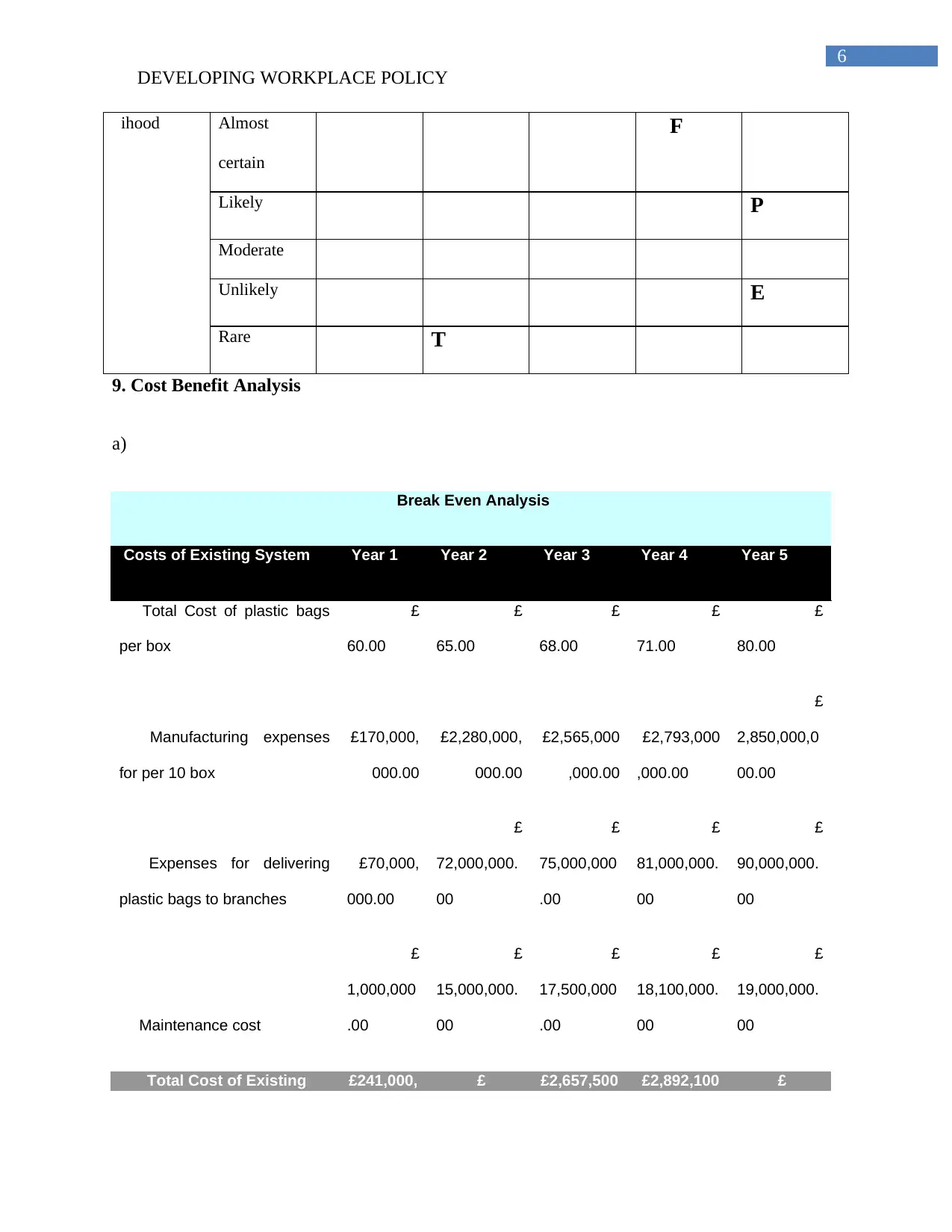
8. Risk Assessment
a) Risks relative to:
Financial – Implementation of plastic-free packages and carry bags will induce increased
expenditure thus increasing the risk of financial strain.
People – While manufacturing paper bags and packages, the workers might be under the
risk of being hurt by any heavy equipment.
Time – The time taken to accomplish the plans could slow the company’s work process.
Equipment – The unavailability of high-quality equipments could risk the employees or
workers working in the company.
b) Analysis of risk:
Keys for the risks –
Financial (F)
People (P)
Time (T)
Equipment (E)
Likel Consequence
Insignificant Minor Moderate Major Catastrophic
DEVELOPING WORKPLACE POLICY
8. Risk Assessment
a) Risks relative to:
Financial – Implementation of plastic-free packages and carry bags will induce increased
expenditure thus increasing the risk of financial strain.
People – While manufacturing paper bags and packages, the workers might be under the
risk of being hurt by any heavy equipment.
Time – The time taken to accomplish the plans could slow the company’s work process.
Equipment – The unavailability of high-quality equipments could risk the employees or
workers working in the company.
b) Analysis of risk:
Keys for the risks –
Financial (F)
People (P)
Time (T)
Equipment (E)
Likel Consequence
Insignificant Minor Moderate Major Catastrophic
⊘ This is a preview!⊘
Do you want full access?
Subscribe today to unlock all pages.
Trusted by 1+ million students worldwide
6
DEVELOPING WORKPLACE POLICY
ihood Almost
certain
F
Likely P
Moderate
Unlikely E
Rare T
9. Cost Benefit Analysis
a)
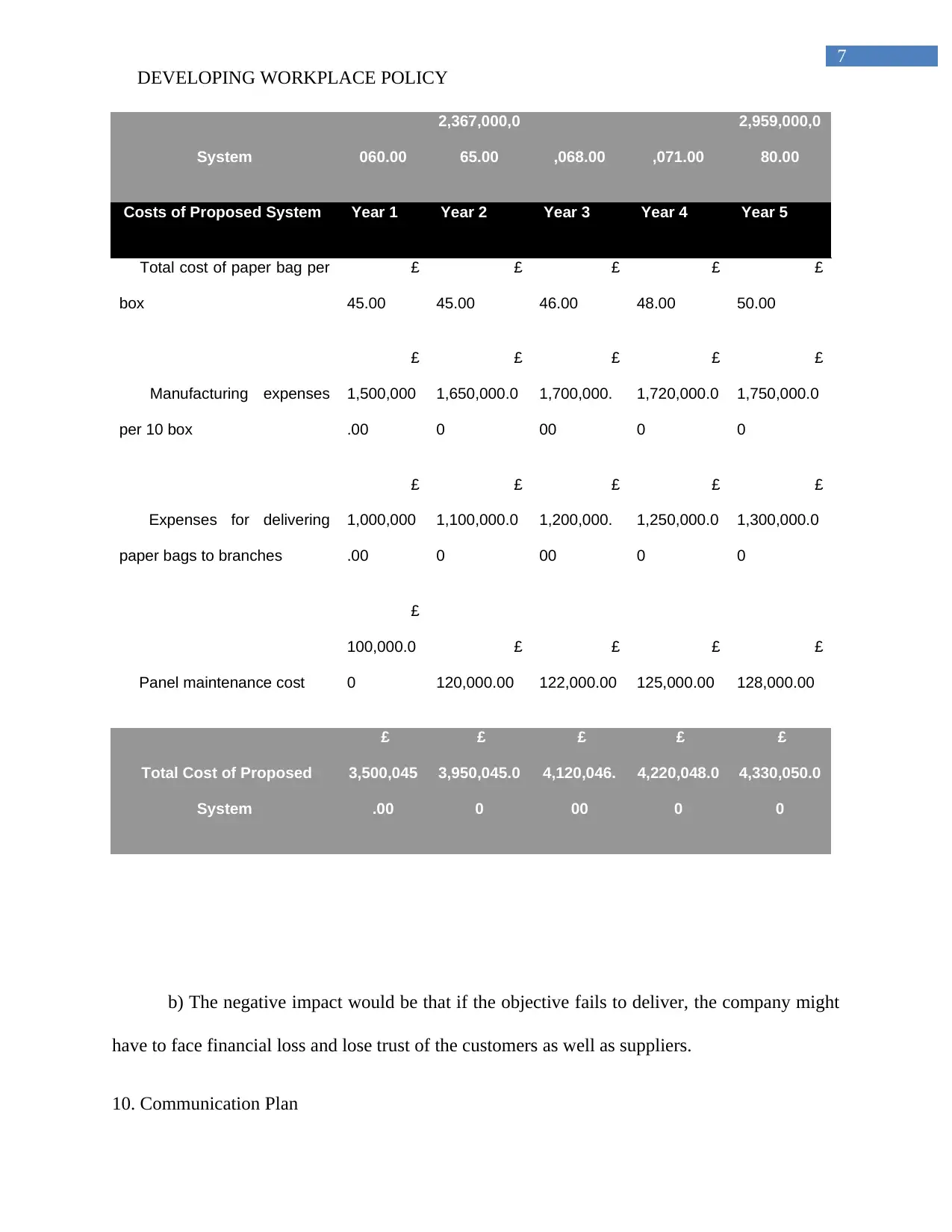
Break Even Analysis
Costs of Existing System Year 1 Year 2 Year 3 Year 4 Year 5
Total Cost of plastic bags
per box
£
60.00
£
65.00
£
68.00
£
71.00
£
80.00
Manufacturing expenses
for per 10 box
£170,000,
000.00
£2,280,000,
000.00
£2,565,000
,000.00
£2,793,000
,000.00
£
2,850,000,0
00.00
Expenses for delivering
plastic bags to branches
£70,000,
000.00
£
72,000,000.
00
£
75,000,000
.00
£
81,000,000.
00
£
90,000,000.
00
Maintenance cost
£
1,000,000
.00
£
15,000,000.
00
£
17,500,000
.00
£
18,100,000.
00
£
19,000,000.
00
Total Cost of Existing £241,000, £ £2,657,500 £2,892,100 £
DEVELOPING WORKPLACE POLICY
ihood Almost
certain
F
Likely P
Moderate
Unlikely E
Rare T
9. Cost Benefit Analysis
a)
Break Even Analysis
Costs of Existing System Year 1 Year 2 Year 3 Year 4 Year 5
Total Cost of plastic bags
per box
£
60.00
£
65.00
£
68.00
£
71.00
£
80.00
Manufacturing expenses
for per 10 box
£170,000,
000.00
£2,280,000,
000.00
£2,565,000
,000.00
£2,793,000
,000.00
£
2,850,000,0
00.00
Expenses for delivering
plastic bags to branches
£70,000,
000.00
£
72,000,000.
00
£
75,000,000
.00
£
81,000,000.
00
£
90,000,000.
00
Maintenance cost
£
1,000,000
.00
£
15,000,000.
00
£
17,500,000
.00
£
18,100,000.
00
£
19,000,000.
00
Total Cost of Existing £241,000, £ £2,657,500 £2,892,100 £
Paraphrase This Document
Need a fresh take? Get an instant paraphrase of this document with our AI Paraphraser
7
DEVELOPING WORKPLACE POLICY
System 060.00
2,367,000,0
65.00 ,068.00 ,071.00
2,959,000,0
80.00
Costs of Proposed System Year 1 Year 2 Year 3 Year 4 Year 5
Total cost of paper bag per
box
£
45.00
£
45.00
£
46.00
£
48.00
£
50.00
Manufacturing expenses
per 10 box
£
1,500,000
.00
£
1,650,000.0
0
£
1,700,000.
00
£
1,720,000.0
0
£
1,750,000.0
0
Expenses for delivering
paper bags to branches
£
1,000,000
.00
£
1,100,000.0
0
£
1,200,000.
00
£
1,250,000.0
0
£
1,300,000.0
0
Panel maintenance cost
£
100,000.0
0
£
120,000.00
£
122,000.00
£
125,000.00
£
128,000.00
Total Cost of Proposed
System
£
3,500,045
.00
£
3,950,045.0
0
£
4,120,046.
00
£
4,220,048.0
0
£
4,330,050.0
0
b) The negative impact would be that if the objective fails to deliver, the company might
have to face financial loss and lose trust of the customers as well as suppliers.
10. Communication Plan
DEVELOPING WORKPLACE POLICY
System 060.00
2,367,000,0
65.00 ,068.00 ,071.00
2,959,000,0
80.00
Costs of Proposed System Year 1 Year 2 Year 3 Year 4 Year 5
Total cost of paper bag per
box
£
45.00
£
45.00
£
46.00
£
48.00
£
50.00
Manufacturing expenses
per 10 box
£
1,500,000
.00
£
1,650,000.0
0
£
1,700,000.
00
£
1,720,000.0
0
£
1,750,000.0
0
Expenses for delivering
paper bags to branches
£
1,000,000
.00
£
1,100,000.0
0
£
1,200,000.
00
£
1,250,000.0
0
£
1,300,000.0
0
Panel maintenance cost
£
100,000.0
0
£
120,000.00
£
122,000.00
£
125,000.00
£
128,000.00
Total Cost of Proposed
System
£
3,500,045
.00
£
3,950,045.0
0
£
4,120,046.
00
£
4,220,048.0
0
£
4,330,050.0
0
b) The negative impact would be that if the objective fails to deliver, the company might
have to face financial loss and lose trust of the customers as well as suppliers.
10. Communication Plan
8
DEVELOPING WORKPLACE POLICY
Key
Stakeholders
Delivery
Method
Message How the
feedback will
be gathered
Timeline Who will be
responsible?
Customers Social Media
platforms
especially
Twitter,
Facebook
Direct message Through
personalized
application and
website
24 hours The IT team
Employees Company’s
employee
portal
Cooperating
with the higher
management
Through the
portal and
face-to-face
5 hours The higher
management
Government Press releases,
press
conferences,
emails
Informing
about approach
to new
policies, laws,
Through
meetings,
mainstream
media
Quarterly The executive
board
11. Continuous improvement
Strategy 1: Lean continuous improvement – Eliminate the wastes such as age-old
sustainability plans
Strategy 2: Value stream mapping – Check whether the value added in environmental
sustainability is enough
12. Summary and Recommendation
The analysis revealed the company’s strong position in the market.
DEVELOPING WORKPLACE POLICY
Key
Stakeholders
Delivery
Method
Message How the
feedback will
be gathered
Timeline Who will be
responsible?
Customers Social Media
platforms
especially
Twitter,
Direct message Through
personalized
application and
website
24 hours The IT team
Employees Company’s
employee
portal
Cooperating
with the higher
management
Through the
portal and
face-to-face
5 hours The higher
management
Government Press releases,
press
conferences,
emails
Informing
about approach
to new
policies, laws,
Through
meetings,
mainstream
media
Quarterly The executive
board
11. Continuous improvement
Strategy 1: Lean continuous improvement – Eliminate the wastes such as age-old
sustainability plans
Strategy 2: Value stream mapping – Check whether the value added in environmental
sustainability is enough
12. Summary and Recommendation
The analysis revealed the company’s strong position in the market.
⊘ This is a preview!⊘
Do you want full access?
Subscribe today to unlock all pages.
Trusted by 1+ million students worldwide
9
DEVELOPING WORKPLACE POLICY
It must be recommended that Woolworths should focus on helping both the environment
and the community.
ASSIGNMENT 2:
Answer to question 1 –
Developing a sustainable policy requires extensive research and analysis of both the
internal and external source of information. The internal business information includes the data
gathered and stored about the employees and other aspects of the company. These data include
personal files, board meeting minutes and trade secrets. Boudreau and Lakhani (2013) explain
that internal information might sometimes not be enough to know about the things the company
needs to change or implement. The authors explain that internal information gathered from
personal files might not benefit or yield sufficient and efficient research and development.
However, in case of developing the suggested sustainability policy, the internal source of
information is extremely crucial because it involves the employees as well.
External source of business information refer to the print information such as newsletters,
newspaper articles, magazine articles and broadcast information such as television and radio
amongst others. Nowadays, social media articles are also part of the external business
information. As Jin, Liu and Austin (2014) explain, the social media has become a great tool for
the companies as well with which they could be strategically ahead from other companies. This
information could help the company in understanding the current trend and the mindset of the
customers. Most importantly, these could help learn about the current needs of the environment.
Answer to question 2 –
DEVELOPING WORKPLACE POLICY
It must be recommended that Woolworths should focus on helping both the environment
and the community.
ASSIGNMENT 2:
Answer to question 1 –
Developing a sustainable policy requires extensive research and analysis of both the
internal and external source of information. The internal business information includes the data
gathered and stored about the employees and other aspects of the company. These data include
personal files, board meeting minutes and trade secrets. Boudreau and Lakhani (2013) explain
that internal information might sometimes not be enough to know about the things the company
needs to change or implement. The authors explain that internal information gathered from
personal files might not benefit or yield sufficient and efficient research and development.
However, in case of developing the suggested sustainability policy, the internal source of
information is extremely crucial because it involves the employees as well.
External source of business information refer to the print information such as newsletters,
newspaper articles, magazine articles and broadcast information such as television and radio
amongst others. Nowadays, social media articles are also part of the external business
information. As Jin, Liu and Austin (2014) explain, the social media has become a great tool for
the companies as well with which they could be strategically ahead from other companies. This
information could help the company in understanding the current trend and the mindset of the
customers. Most importantly, these could help learn about the current needs of the environment.
Answer to question 2 –
Paraphrase This Document
Need a fresh take? Get an instant paraphrase of this document with our AI Paraphraser
10
DEVELOPING WORKPLACE POLICY
Incorporating sustainable policy is most likely to be met with various obstacles and the
company must be aware and prepared for it. The practice has become increasingly standard and
more than 300 business firms, as per the Fortune report are implementing the sustainability
policy. The two most visible barriers that come in way of the implementing sustainable practices
include absence of proper management structure and lack of organizational support.
When there is an absence of proper management structure, which means that the general
manager and other senior managers fail to provide support, it leads to difficulties in policy
implementation. Woodrow and Guest (2014) state, “the degree of personal commitment provided
by the general manager or any senior manager decides the level of success of any policy”.
However, it becomes difficult for managers to provide this commitment all the time and hence it
becomes a barrier.
Another barrier is the lack of support from the top leadership, organizational support.
Policy implementation could not be successful without the support and motivation of the top
leadership. Sustainable practices are something that the leader has to infuse in her or his
organization and its employees, as it does not come naturally. At times, the leader fails to do
motivate the people into implementing sustainable practices and this becomes a barrier.
Answer to question 3 –
The senior management and leader of the company must identify where they are lacking
and then make the plan accordingly. The first thing that the management should do is to conduct
a survey within the organization amongst the employees regarding the sustainability practices to
be implemented (Rossi, Germani and Zamagni 2016). Then, the management should analyze the
survey results and if the majority thinks the policies are not strong enough, it must be dropped.
DEVELOPING WORKPLACE POLICY
Incorporating sustainable policy is most likely to be met with various obstacles and the
company must be aware and prepared for it. The practice has become increasingly standard and
more than 300 business firms, as per the Fortune report are implementing the sustainability
policy. The two most visible barriers that come in way of the implementing sustainable practices
include absence of proper management structure and lack of organizational support.
When there is an absence of proper management structure, which means that the general
manager and other senior managers fail to provide support, it leads to difficulties in policy
implementation. Woodrow and Guest (2014) state, “the degree of personal commitment provided
by the general manager or any senior manager decides the level of success of any policy”.
However, it becomes difficult for managers to provide this commitment all the time and hence it
becomes a barrier.
Another barrier is the lack of support from the top leadership, organizational support.
Policy implementation could not be successful without the support and motivation of the top
leadership. Sustainable practices are something that the leader has to infuse in her or his
organization and its employees, as it does not come naturally. At times, the leader fails to do
motivate the people into implementing sustainable practices and this becomes a barrier.
Answer to question 3 –
The senior management and leader of the company must identify where they are lacking
and then make the plan accordingly. The first thing that the management should do is to conduct
a survey within the organization amongst the employees regarding the sustainability practices to
be implemented (Rossi, Germani and Zamagni 2016). Then, the management should analyze the
survey results and if the majority thinks the policies are not strong enough, it must be dropped.
11
DEVELOPING WORKPLACE POLICY
The management must then hold meetings with the employees at different intervals and come up
with a better strategy. Another important step to review and modify the sustainability procedures
is to develop a competent communication plan. An effective communication with the key
stakeholders could help improve the policy.
The main task of the leader is to use her or his charisma and charm to inspire and
motivate its employees for participating actively in improving the sustainability policy or
procedure. The leader has to first identify the areas of improvement and then suggest the best
ways to bring improvements. In doing so, the leader must take the role of a good listener who
listens to all the opinions and ideas of the employees and then provides own opinion. For
example, in order to improve upon the policy of energy reduction, the leader must come up with
plans other than switching off all the equipments and electrical appliances when not in use.
Answer to question 4 (a) –
Continuous improvement strategies are essential to a company’s success in implementing
sustainable practices and policies. However, it is important that these strategies be recorded
properly in order to make them effective. One of the best ways to ensure the effectiveness of
continuous improvement strategies is to record these. Several techniques of recording continuous
improvement are available. Nonetheless, it is crucial in deciding which technique would best suit
the needs of the company. The use of IT empowered solutions is an effective way of recording
continuous improvement. Many IT companies provide Continuous Improvement Register to help
companies to record their continuous improvement (Matuga and Turos 2018). The Continuous
Improvement Register keeps track of things like procedural issues, implementation schedules,
identified risks and reported incidents amongst other things.
DEVELOPING WORKPLACE POLICY
The management must then hold meetings with the employees at different intervals and come up
with a better strategy. Another important step to review and modify the sustainability procedures
is to develop a competent communication plan. An effective communication with the key
stakeholders could help improve the policy.
The main task of the leader is to use her or his charisma and charm to inspire and
motivate its employees for participating actively in improving the sustainability policy or
procedure. The leader has to first identify the areas of improvement and then suggest the best
ways to bring improvements. In doing so, the leader must take the role of a good listener who
listens to all the opinions and ideas of the employees and then provides own opinion. For
example, in order to improve upon the policy of energy reduction, the leader must come up with
plans other than switching off all the equipments and electrical appliances when not in use.
Answer to question 4 (a) –
Continuous improvement strategies are essential to a company’s success in implementing
sustainable practices and policies. However, it is important that these strategies be recorded
properly in order to make them effective. One of the best ways to ensure the effectiveness of
continuous improvement strategies is to record these. Several techniques of recording continuous
improvement are available. Nonetheless, it is crucial in deciding which technique would best suit
the needs of the company. The use of IT empowered solutions is an effective way of recording
continuous improvement. Many IT companies provide Continuous Improvement Register to help
companies to record their continuous improvement (Matuga and Turos 2018). The Continuous
Improvement Register keeps track of things like procedural issues, implementation schedules,
identified risks and reported incidents amongst other things.
⊘ This is a preview!⊘
Do you want full access?
Subscribe today to unlock all pages.
Trusted by 1+ million students worldwide

1 out of 16


Related Documents


Your All-in-One AI-Powered Toolkit for Academic Success.
+13062052269
info@desklib.com
Available 24*7 on WhatsApp / Email
![[object Object]](/_next/static/media/star-bottom.7253800d.svg)
Unlock your academic potential
Copyright © 2020–2026 A2Z Services. All Rights Reserved. Developed and managed by ZUCOL.