BSBWOR301: Strategies for Organising Personal Work & Development
VerifiedAdded on 2023/06/18
|20
|5212
|500
Homework Assignment
AI Summary
This assignment focuses on BSBWOR301, specifically organizing personal work priorities and development. It addresses key elements such as organizing work schedules, monitoring performance, and coordinating skill development. The solution provides answers to scenario-based questions involving a Certificate III trainee, Lucy, and emphasizes the importance of communication, time management, and SMART goal setting. It includes a time management checklist and reflection on personal time management skills, highlighting strategies for improvement. Furthermore, the assignment explores the significance of constructive feedback in professional development, using examples from educator interactions to illustrate how feedback can assist in skill enhancement. This resource is helpful for students seeking guidance on managing their work priorities and professional growth. Desklib provides a platform to access more solved assignments and study resources.

Organise personal work priorities and development
Unit Purpose
The assessment tasks within this unit provide you with the opportunity to demonstrate evidence of the
required knowledge and skills you will need to organise your own work schedules, to monitor and
obtain feedback on your own performance and to maintain required levels of competence in personal
work priorities and development.
Elements
The following elements define the essential outcomes of this unit:
Element 1 Organise and complete own work schedule
Element 2 Monitor own work performance
Element 3 Co-ordinate personal skill development and learning
Assessment Requirements
001: Organising and completing own work
002: Monitor Own Work Performance
003: Co-ordinate Personal Skills Development and Learning
Required Readings
In order to complete this unit of competency you are required to access the following key resources.
Textbook
Kearns, K. (2017). The Big Picture: Working in Early Childhood Education and Care Series
(4th Ed.). Victoria: Cengage Learning Australia.
Websites
Gowrie NSW – Education Hub:
Community Early Learning Australia: https://www.cela.org.au/#modal 001 Organising and
Completing Own Work
BSBWOR301 Organise personal work priorities and development
Element 1 Organise and complete own work schedule
Element 2 Monitor own work performance
Unit Purpose
The assessment tasks within this unit provide you with the opportunity to demonstrate evidence of the
required knowledge and skills you will need to organise your own work schedules, to monitor and
obtain feedback on your own performance and to maintain required levels of competence in personal
work priorities and development.
Elements
The following elements define the essential outcomes of this unit:
Element 1 Organise and complete own work schedule
Element 2 Monitor own work performance
Element 3 Co-ordinate personal skill development and learning
Assessment Requirements
001: Organising and completing own work
002: Monitor Own Work Performance
003: Co-ordinate Personal Skills Development and Learning
Required Readings
In order to complete this unit of competency you are required to access the following key resources.
Textbook
Kearns, K. (2017). The Big Picture: Working in Early Childhood Education and Care Series
(4th Ed.). Victoria: Cengage Learning Australia.
Websites
Gowrie NSW – Education Hub:
Community Early Learning Australia: https://www.cela.org.au/#modal 001 Organising and
Completing Own Work
BSBWOR301 Organise personal work priorities and development
Element 1 Organise and complete own work schedule
Element 2 Monitor own work performance

Paraphrase This Document
Need a fresh take? Get an instant paraphrase of this document with our AI Paraphraser

Element 3 Co-ordinate personal skill development and learning
Performance Evidence
Knowledge Evidence
This task requires you to demonstrate the knowledge required to organise and complete your daily
tasks in a timely manner, monitor your own performance and identify areas for your own ongoing
learning and development.
Reading
To complete this task refer to your textbook ‘The Big Picture’.
Refer to:
Table 2.1 (pp. 48-49). The first column in this table describes the tasks that might be undertaken
by a Certificate III educator.
Figure 2.1 (p. 50) provides an example of a Job description for a Certificate III educator.
Question 4
Read the scenario and answer the questions.
Lucy I
Lucy (Certificate III trainee) has been asked by a senior educator to set out the beds and the quiet
time activities in the preschool room. Lucy has been at the service for one week and has only
assisted in this task under the direction of another educator. Lucy knows that not all of the children
have a sleep but is uncertain about the number of beds she should put out. Lucy also knows that
there are lots of different quiet time kits but doesn’t know which one or how many to put out.
a. What two questions should Lucy ask to help her complete this task to the standard required?
1. Lucy need to ask about the number of children sleep in the childcare, so that she can
identify the number of beds to put out at childcare.
2. Another question Lucy should ask to their senior is related to the different quiet time kits
in order to put the appropriate quiet time activities in the preschool room (Kearns, 2017).
a. What could Lucy do to better prepare herself for this task in the future?
Performance Evidence
Knowledge Evidence
This task requires you to demonstrate the knowledge required to organise and complete your daily
tasks in a timely manner, monitor your own performance and identify areas for your own ongoing
learning and development.
Reading
To complete this task refer to your textbook ‘The Big Picture’.
Refer to:
Table 2.1 (pp. 48-49). The first column in this table describes the tasks that might be undertaken
by a Certificate III educator.
Figure 2.1 (p. 50) provides an example of a Job description for a Certificate III educator.
Question 4
Read the scenario and answer the questions.
Lucy I
Lucy (Certificate III trainee) has been asked by a senior educator to set out the beds and the quiet
time activities in the preschool room. Lucy has been at the service for one week and has only
assisted in this task under the direction of another educator. Lucy knows that not all of the children
have a sleep but is uncertain about the number of beds she should put out. Lucy also knows that
there are lots of different quiet time kits but doesn’t know which one or how many to put out.
a. What two questions should Lucy ask to help her complete this task to the standard required?
1. Lucy need to ask about the number of children sleep in the childcare, so that she can
identify the number of beds to put out at childcare.
2. Another question Lucy should ask to their senior is related to the different quiet time kits
in order to put the appropriate quiet time activities in the preschool room (Kearns, 2017).
a. What could Lucy do to better prepare herself for this task in the future?

In order to prepare herself for this task in the near future, Lucy need to enhance their
communication and creative thinking skills (Howitt, Blake and Rennie, 2017). By this she
can understand the task requirements and serve and complete their work on time with full
accuracy.
Question 5
Read the scenario and answer the questions.
Lucy II
Its 7.15am and Lucy (Certificate III trainee) has been asked to make a start on setting up the outdoor
area. Her colleague, Matt, says he will be out in a moment to help her. Lucy knows that the outdoor
plan is posted on the verandah. She reads the days plan and decides to make a start by setting up
the digging patch and the sandpit. 15 minutes have gone by and there is no sign of Matt. It is
threatening rain and Lucy is sure she can feel some light drizzle. Lucy is unsure what to do. Should
she use her initiative and set up some equipment on the verandah or go and tell Matt she thinks it’s
going to rain? Some children will start arriving in the next 5- 10 minutes.
a. What should Lucy do? Give a reason for your answer.
In this situation, as the children are going to arrive in the next 5 – 10 minutes Lucy can use
their initiatives and set some equipment on the Verandah. But without the permission and
informing Matt she can’t adopt this step (Polat and Akay, 2020). So, here she first needs to
inform her senior Matt about the situation of rain and adopt the step as instruct by Matt. It
is because she is just a trainee in the Child care and that’s why she is not entitled to take
decision on their own without informing her senior.
a. Lucy is annoyed with Matt because she knows that the outdoor setup policy states that two
educators must work together when setting up outdoors. This is not the first time Matt has left Lucy
communication and creative thinking skills (Howitt, Blake and Rennie, 2017). By this she
can understand the task requirements and serve and complete their work on time with full
accuracy.
Question 5
Read the scenario and answer the questions.
Lucy II
Its 7.15am and Lucy (Certificate III trainee) has been asked to make a start on setting up the outdoor
area. Her colleague, Matt, says he will be out in a moment to help her. Lucy knows that the outdoor
plan is posted on the verandah. She reads the days plan and decides to make a start by setting up
the digging patch and the sandpit. 15 minutes have gone by and there is no sign of Matt. It is
threatening rain and Lucy is sure she can feel some light drizzle. Lucy is unsure what to do. Should
she use her initiative and set up some equipment on the verandah or go and tell Matt she thinks it’s
going to rain? Some children will start arriving in the next 5- 10 minutes.
a. What should Lucy do? Give a reason for your answer.
In this situation, as the children are going to arrive in the next 5 – 10 minutes Lucy can use
their initiatives and set some equipment on the Verandah. But without the permission and
informing Matt she can’t adopt this step (Polat and Akay, 2020). So, here she first needs to
inform her senior Matt about the situation of rain and adopt the step as instruct by Matt. It
is because she is just a trainee in the Child care and that’s why she is not entitled to take
decision on their own without informing her senior.
a. Lucy is annoyed with Matt because she knows that the outdoor setup policy states that two
educators must work together when setting up outdoors. This is not the first time Matt has left Lucy
⊘ This is a preview!⊘
Do you want full access?
Subscribe today to unlock all pages.

Trusted by 1+ million students worldwide
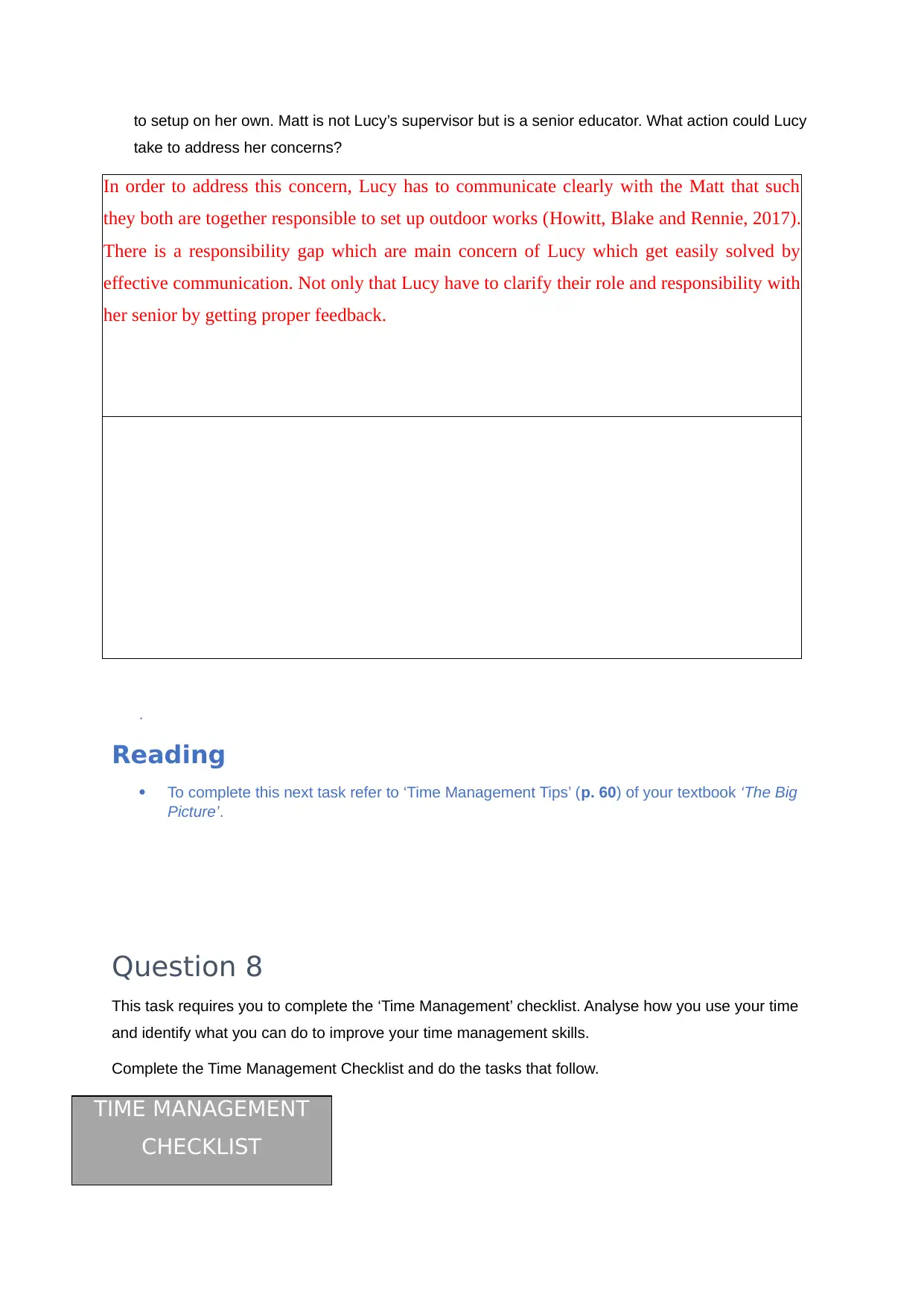
to setup on her own. Matt is not Lucy’s supervisor but is a senior educator. What action could Lucy
take to address her concerns?
In order to address this concern, Lucy has to communicate clearly with the Matt that such
they both are together responsible to set up outdoor works (Howitt, Blake and Rennie, 2017).
There is a responsibility gap which are main concern of Lucy which get easily solved by
effective communication. Not only that Lucy have to clarify their role and responsibility with
her senior by getting proper feedback.
.
Reading
To complete this next task refer to ‘Time Management Tips’ (p. 60) of your textbook ‘The Big
Picture’.
Question 8
This task requires you to complete the ‘Time Management’ checklist. Analyse how you use your time
and identify what you can do to improve your time management skills.
Complete the Time Management Checklist and do the tasks that follow.
TIME MANAGEMENT
CHECKLIST
take to address her concerns?
In order to address this concern, Lucy has to communicate clearly with the Matt that such
they both are together responsible to set up outdoor works (Howitt, Blake and Rennie, 2017).
There is a responsibility gap which are main concern of Lucy which get easily solved by
effective communication. Not only that Lucy have to clarify their role and responsibility with
her senior by getting proper feedback.
.
Reading
To complete this next task refer to ‘Time Management Tips’ (p. 60) of your textbook ‘The Big
Picture’.
Question 8
This task requires you to complete the ‘Time Management’ checklist. Analyse how you use your time
and identify what you can do to improve your time management skills.
Complete the Time Management Checklist and do the tasks that follow.
TIME MANAGEMENT
CHECKLIST
Paraphrase This Document
Need a fresh take? Get an instant paraphrase of this document with our AI Paraphraser

Behaviour/practices
F
r
e
q
u
e
n
c
y
Always Sometimes
I use a planner to plan my week ahead. ✔
I use a daily planner. ✔
I rank my daily tasks according to priority. ✔
I only check my emails/messages once or twice per day. ✔
I prepare my clothes and lunch for work each evening. ✔
I leave for work on time, having had a good breakfast. ✔
I limit my time on social media to no more than 30 minutes in the evening. ✔
I ask my work colleagues for help when needed. ✔
I am able to say no when asked to take on extra tasks when I am busy.
I get all of my daily tasks finished almost all of the time. ✔
At the end of the day I feel I have managed my time well. ✔
I schedule time each day for exercise/relaxation. ✔
I go to bed at a reasonable time and feel well-rested each morning. ✔
I feel I can cope with my workload each day. ✔
I feel that I have attained a good work-life balance. ✔
I am able to leave my work problems/issues at work and not bring them home. ✔
I feel my colleagues consider me to be a good worker who completes my tasks daily. ✔
F
r
e
q
u
e
n
c
y
Always Sometimes
I use a planner to plan my week ahead. ✔
I use a daily planner. ✔
I rank my daily tasks according to priority. ✔
I only check my emails/messages once or twice per day. ✔
I prepare my clothes and lunch for work each evening. ✔
I leave for work on time, having had a good breakfast. ✔
I limit my time on social media to no more than 30 minutes in the evening. ✔
I ask my work colleagues for help when needed. ✔
I am able to say no when asked to take on extra tasks when I am busy.
I get all of my daily tasks finished almost all of the time. ✔
At the end of the day I feel I have managed my time well. ✔
I schedule time each day for exercise/relaxation. ✔
I go to bed at a reasonable time and feel well-rested each morning. ✔
I feel I can cope with my workload each day. ✔
I feel that I have attained a good work-life balance. ✔
I am able to leave my work problems/issues at work and not bring them home. ✔
I feel my colleagues consider me to be a good worker who completes my tasks daily. ✔

I have at least a 30-minute lunch break each day where I relax and don’t do any work. ✔
I feel I can go to my supervisor for help if I feel my workload is getting on top of me.
a. Comment on how well you use your time (what you do well, what you could improve on etc.)
I follow my time management checklist very sincerely as it helps me in developing time
management and decision-making skills (Adamson and Brennan, 2017). I always used to
report my work to the supervisor so that in case if I have made any mistake must be corrected
by senior.
a. Describe one strategy you can put in place to better manage your time.
The one strategy which I need to put in place in order to manage my time is prioritizing my
task and work on the daily basis rather than sometime (Cole, 2017). Prioritizing daily task
also helpful for avoiding the mistakes which was usually occur at the time of workloads.
002 Monitor Own Work Performance
BSBWOR301 Organise personal work priorities and development
Element 2 Monitor own work performance
Element 3 Co-ordinate personal skill development and learning
Performance Evidence
Knowledge Evidence
This task requires you to demonstrate the knowledge required to reflect on your own work and
develop SMART goals.
Reading
I feel I can go to my supervisor for help if I feel my workload is getting on top of me.
a. Comment on how well you use your time (what you do well, what you could improve on etc.)
I follow my time management checklist very sincerely as it helps me in developing time
management and decision-making skills (Adamson and Brennan, 2017). I always used to
report my work to the supervisor so that in case if I have made any mistake must be corrected
by senior.
a. Describe one strategy you can put in place to better manage your time.
The one strategy which I need to put in place in order to manage my time is prioritizing my
task and work on the daily basis rather than sometime (Cole, 2017). Prioritizing daily task
also helpful for avoiding the mistakes which was usually occur at the time of workloads.
002 Monitor Own Work Performance
BSBWOR301 Organise personal work priorities and development
Element 2 Monitor own work performance
Element 3 Co-ordinate personal skill development and learning
Performance Evidence
Knowledge Evidence
This task requires you to demonstrate the knowledge required to reflect on your own work and
develop SMART goals.
Reading
⊘ This is a preview!⊘
Do you want full access?
Subscribe today to unlock all pages.
Trusted by 1+ million students worldwide

To complete this task refer to pp. 70–73 of your textbook ‘The Big Picture’.
Question 1
a. How does writing personal/professional goals support you to develop your skills as an educator?
Writing the personal and professional goals is helpful for developing the skills and also
maintain motivation at the time of workloads (Kearns, 2017). By setting goals, I am able to
complete my work on time along at right direction as it provides proper direction and focus
along with a sense of personal satisfaction.
a. Goals can be more easily achieved if they are ‘S.M.A.R.T’. What does S.M.A.R.T mean?
Smart goals mean mnemonic acronym, which gives criteria to use in order to set a goal. The
S.M.A.R.T goal means:
Specific: This means that goal must be simple, sensible and significant.
Measurable: The set goals must be measured, meaningful and motivating.
Achievable: This criteria state that goal must be achievable and agreed by all individuals.
Relevant: The goal must be relevant to the needs the individual wants to achieve.
Time-bound: Goal must be reflecting the time period in which it has to be achieved by the
individuals (Cole, 2017).
Question 1
a. How does writing personal/professional goals support you to develop your skills as an educator?
Writing the personal and professional goals is helpful for developing the skills and also
maintain motivation at the time of workloads (Kearns, 2017). By setting goals, I am able to
complete my work on time along at right direction as it provides proper direction and focus
along with a sense of personal satisfaction.
a. Goals can be more easily achieved if they are ‘S.M.A.R.T’. What does S.M.A.R.T mean?
Smart goals mean mnemonic acronym, which gives criteria to use in order to set a goal. The
S.M.A.R.T goal means:
Specific: This means that goal must be simple, sensible and significant.
Measurable: The set goals must be measured, meaningful and motivating.
Achievable: This criteria state that goal must be achievable and agreed by all individuals.
Relevant: The goal must be relevant to the needs the individual wants to achieve.
Time-bound: Goal must be reflecting the time period in which it has to be achieved by the
individuals (Cole, 2017).
Paraphrase This Document
Need a fresh take? Get an instant paraphrase of this document with our AI Paraphraser

Reading
For this task refer to pp. 80-86 of your textbook ‘The Big Picture’.
Question 2
To become an effective educator you must be able to ask questions, listen to, and act on, constructive
feedback.
Read the scenario and explain how feedback from Educator 2 will assist Lucy to develop her skills.
Lucy I
This morning Lucy took charge of Aiden (2.6yrs) who was crying and clinging to his mother. Aiden’s mother was
becoming upset which only increased Aiden’s distress.
‘Aiden, I’m going to hold your hand while you say goodbye to mummy. Give her a kiss and we’ll wave to her at
the window.’
Lucy squatted down and held both his hands. ‘Bye mummy. See you this afternoon. Have a good day.’
Mum left and Aiden continued to protest and cry.
‘Do you want to wave to mummy at the window Aiden?’
‘No! ‘Aiden screamed and ran to cushions in the book areas and threw himself down.
Lucy stood watching Aiden and then turned her attention to another child
Educator Feedback 1: ‘Boy, Aiden was sure a challenge this morning. I bet you wish you were on late shift!’
Educator Feedback 2: ‘Lucy you did a great job with Aiden this morning. You stayed calm and you were firm
but positive. You took charge and also let Aiden know what was going to happen. I know Aiden’s mum would
have appreciated what you did. Some extra things you could have done was to follow through and take him to
the window rather than give him a choice. Also, when he screamed at you and ran off to the cushions it would
have helped if you had gone to him and helped him calm down.’
From the above feedback, Lucy has found out that they need to develop some skills in order to care the
child. For this she needs to always put their attention on one child at once because putting attention on
more than one can led to harm to children. Another skill that Lucy needs to develop is patience and
calmness (Cole, 2018). Children always do whatever they want to do so in order to manage them Lucy
have to work calmly.
For this task refer to pp. 80-86 of your textbook ‘The Big Picture’.
Question 2
To become an effective educator you must be able to ask questions, listen to, and act on, constructive
feedback.
Read the scenario and explain how feedback from Educator 2 will assist Lucy to develop her skills.
Lucy I
This morning Lucy took charge of Aiden (2.6yrs) who was crying and clinging to his mother. Aiden’s mother was
becoming upset which only increased Aiden’s distress.
‘Aiden, I’m going to hold your hand while you say goodbye to mummy. Give her a kiss and we’ll wave to her at
the window.’
Lucy squatted down and held both his hands. ‘Bye mummy. See you this afternoon. Have a good day.’
Mum left and Aiden continued to protest and cry.
‘Do you want to wave to mummy at the window Aiden?’
‘No! ‘Aiden screamed and ran to cushions in the book areas and threw himself down.
Lucy stood watching Aiden and then turned her attention to another child
Educator Feedback 1: ‘Boy, Aiden was sure a challenge this morning. I bet you wish you were on late shift!’
Educator Feedback 2: ‘Lucy you did a great job with Aiden this morning. You stayed calm and you were firm
but positive. You took charge and also let Aiden know what was going to happen. I know Aiden’s mum would
have appreciated what you did. Some extra things you could have done was to follow through and take him to
the window rather than give him a choice. Also, when he screamed at you and ran off to the cushions it would
have helped if you had gone to him and helped him calm down.’
From the above feedback, Lucy has found out that they need to develop some skills in order to care the
child. For this she needs to always put their attention on one child at once because putting attention on
more than one can led to harm to children. Another skill that Lucy needs to develop is patience and
calmness (Cole, 2018). Children always do whatever they want to do so in order to manage them Lucy
have to work calmly.

Reading For this question refer to ‘Collaborative Critical Reflection’ on pp. 68-69 of your textbook ‘The
Big Picture’.
Question 3
As an educator, critical self-reflection or reflective practice involves thinking about, analysing and
discussing one’s own knowledge, skills and assumptions. The process of self-reflection requires
educators to take action to improve their practices, engage in meaningful discussion, seek
constructive feedback from others and be open-minded towards new ideas and perspectives.
Read each scenario and identify the how the educator has engaged in the process of critical self-
reflection.
a. Each week Cassi gathers her team together to talk about their week – the highs & lows. Each
team member is encouraged to contribute.
In this scenario, Cassi arranges a team meeting in order to know about each team members
weakness and strengths (Tyldesley and Nielsen, 2020). In such way, Cassi engaged in the
process of critical self-reflection. By doing this the members are able to develop their
communication skills as well as coordinate with each other by knowing each other high and
low skills.
a. Each month Cassi meets with a member of her team to constructively review an aspect of their
performance. To prepare for the meeting the team member must prepare one question they can
ask Cassi about their performance.
Another step adopted by the Cassi for employees engagement is that they ask each member
to prepare one question which they further question to her (Cole, 2018). BY doing so Cassi
able to understand the concern and issues of their team members and then further adopt the
strategy to solve those issues.
b. Each educator is required to write their ‘SMART Goals’ for themselves, as part of the process of
continuous professional improvement and workplace learning.
Big Picture’.
Question 3
As an educator, critical self-reflection or reflective practice involves thinking about, analysing and
discussing one’s own knowledge, skills and assumptions. The process of self-reflection requires
educators to take action to improve their practices, engage in meaningful discussion, seek
constructive feedback from others and be open-minded towards new ideas and perspectives.
Read each scenario and identify the how the educator has engaged in the process of critical self-
reflection.
a. Each week Cassi gathers her team together to talk about their week – the highs & lows. Each
team member is encouraged to contribute.
In this scenario, Cassi arranges a team meeting in order to know about each team members
weakness and strengths (Tyldesley and Nielsen, 2020). In such way, Cassi engaged in the
process of critical self-reflection. By doing this the members are able to develop their
communication skills as well as coordinate with each other by knowing each other high and
low skills.
a. Each month Cassi meets with a member of her team to constructively review an aspect of their
performance. To prepare for the meeting the team member must prepare one question they can
ask Cassi about their performance.
Another step adopted by the Cassi for employees engagement is that they ask each member
to prepare one question which they further question to her (Cole, 2018). BY doing so Cassi
able to understand the concern and issues of their team members and then further adopt the
strategy to solve those issues.
b. Each educator is required to write their ‘SMART Goals’ for themselves, as part of the process of
continuous professional improvement and workplace learning.
⊘ This is a preview!⊘
Do you want full access?
Subscribe today to unlock all pages.
Trusted by 1+ million students worldwide

By preparing the smart goals, each educator is able to improve their self image along with the
image of the overall team (Tyldesley and Nielsen, 2020). This is basically one of the best
ways to involve in self-reflection because it helps them to sense the past victories and
provide a stimulant for the present & future successes.
c. During the performance review Cassi praises educator Sam for encouraging the team to explore
new ways of introducing Science, Technology, Engineering, and Maths (STEM) into the curriculum
for the older children. Cassi was pleased with Sam because some educators were quite resistant
to new ideas.
In order to praise others with this new idea of STEM, Cassi need to individually state the
benefits of this new idea and also tell to everyone that Sam is also an educator and supporting
this new idea (Kearns, 2017). For this, Cassi and Sam need to provide the reason to use it to
other resist educators along with by setting a vision. This is helpful for guiding the older
children and help them in critical thinking. Using the technology helps in managing and
monitoring the tasks on time.
Reading
To complete this task, refer to p. 71 of your textbook ‘The Big Picture’.
Question 4
Self-monitoring is a process which enables educators to reflect on their current skills and knowledge
and identify learning and development needs.
Choose two self-monitoring examples listed on p. 71 of your textbook and describe how you could
use each of your selected examples to identify your own learning and development needs.
For Example
1. ‘By participating in a webinar, I can reinforce my existing skills and knowledge and identify any
gaps in my skills and knowledge (of a particular topic/skill).’
1. ‘By identifying my key strengths and providing examples form the workplace I can also identify
areas for improvement.’
image of the overall team (Tyldesley and Nielsen, 2020). This is basically one of the best
ways to involve in self-reflection because it helps them to sense the past victories and
provide a stimulant for the present & future successes.
c. During the performance review Cassi praises educator Sam for encouraging the team to explore
new ways of introducing Science, Technology, Engineering, and Maths (STEM) into the curriculum
for the older children. Cassi was pleased with Sam because some educators were quite resistant
to new ideas.
In order to praise others with this new idea of STEM, Cassi need to individually state the
benefits of this new idea and also tell to everyone that Sam is also an educator and supporting
this new idea (Kearns, 2017). For this, Cassi and Sam need to provide the reason to use it to
other resist educators along with by setting a vision. This is helpful for guiding the older
children and help them in critical thinking. Using the technology helps in managing and
monitoring the tasks on time.
Reading
To complete this task, refer to p. 71 of your textbook ‘The Big Picture’.
Question 4
Self-monitoring is a process which enables educators to reflect on their current skills and knowledge
and identify learning and development needs.
Choose two self-monitoring examples listed on p. 71 of your textbook and describe how you could
use each of your selected examples to identify your own learning and development needs.
For Example
1. ‘By participating in a webinar, I can reinforce my existing skills and knowledge and identify any
gaps in my skills and knowledge (of a particular topic/skill).’
1. ‘By identifying my key strengths and providing examples form the workplace I can also identify
areas for improvement.’
Paraphrase This Document
Need a fresh take? Get an instant paraphrase of this document with our AI Paraphraser
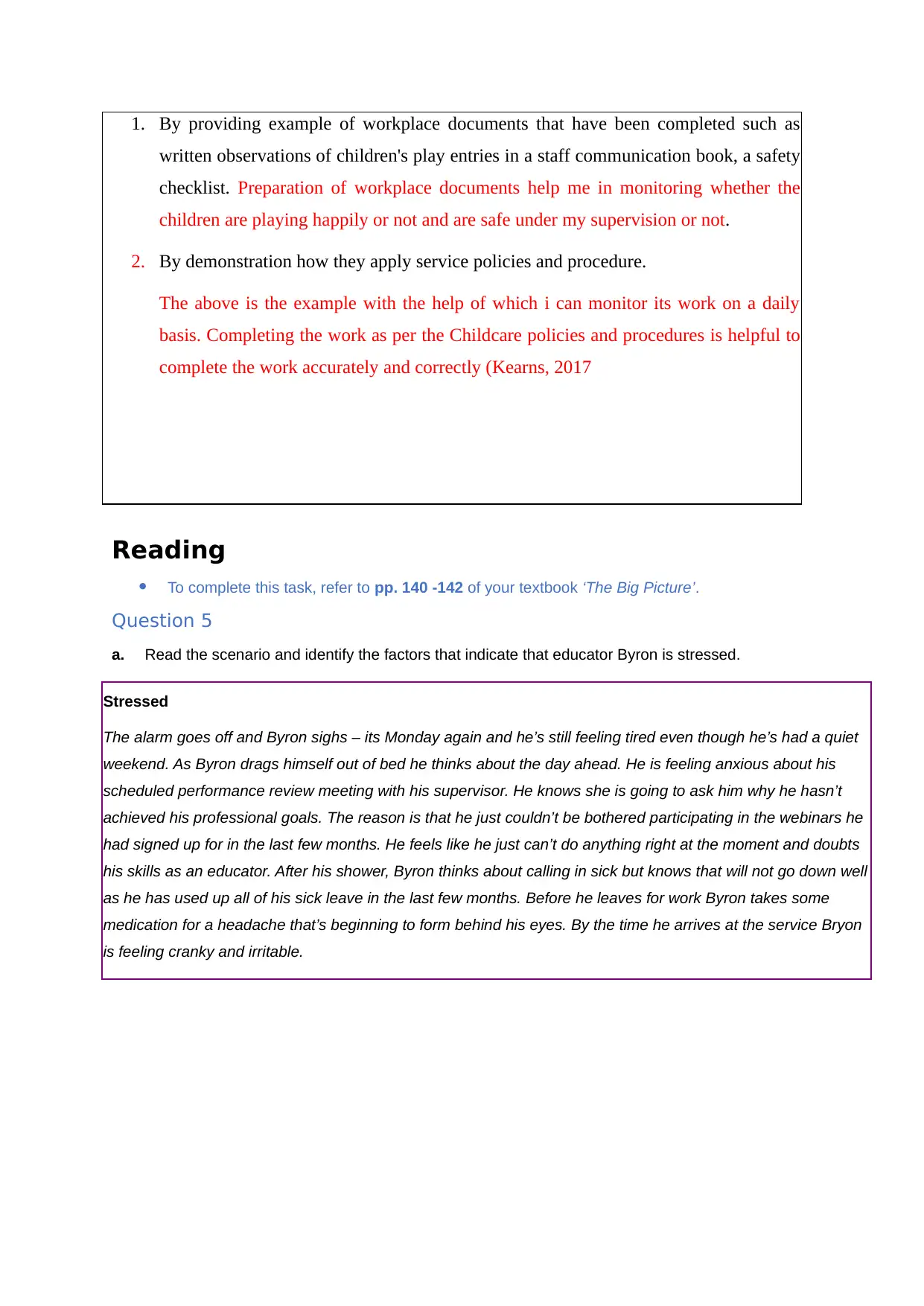
1. By providing example of workplace documents that have been completed such as
written observations of children's play entries in a staff communication book, a safety
checklist. Preparation of workplace documents help me in monitoring whether the
children are playing happily or not and are safe under my supervision or not.
2. By demonstration how they apply service policies and procedure.
The above is the example with the help of which i can monitor its work on a daily
basis. Completing the work as per the Childcare policies and procedures is helpful to
complete the work accurately and correctly (Kearns, 2017
Reading
To complete this task, refer to pp. 140 -142 of your textbook ‘The Big Picture’.
Question 5
a. Read the scenario and identify the factors that indicate that educator Byron is stressed.
Stressed
The alarm goes off and Byron sighs – its Monday again and he’s still feeling tired even though he’s had a quiet
weekend. As Byron drags himself out of bed he thinks about the day ahead. He is feeling anxious about his
scheduled performance review meeting with his supervisor. He knows she is going to ask him why he hasn’t
achieved his professional goals. The reason is that he just couldn’t be bothered participating in the webinars he
had signed up for in the last few months. He feels like he just can’t do anything right at the moment and doubts
his skills as an educator. After his shower, Byron thinks about calling in sick but knows that will not go down well
as he has used up all of his sick leave in the last few months. Before he leaves for work Byron takes some
medication for a headache that’s beginning to form behind his eyes. By the time he arrives at the service Bryon
is feeling cranky and irritable.
written observations of children's play entries in a staff communication book, a safety
checklist. Preparation of workplace documents help me in monitoring whether the
children are playing happily or not and are safe under my supervision or not.
2. By demonstration how they apply service policies and procedure.
The above is the example with the help of which i can monitor its work on a daily
basis. Completing the work as per the Childcare policies and procedures is helpful to
complete the work accurately and correctly (Kearns, 2017
Reading
To complete this task, refer to pp. 140 -142 of your textbook ‘The Big Picture’.
Question 5
a. Read the scenario and identify the factors that indicate that educator Byron is stressed.
Stressed
The alarm goes off and Byron sighs – its Monday again and he’s still feeling tired even though he’s had a quiet
weekend. As Byron drags himself out of bed he thinks about the day ahead. He is feeling anxious about his
scheduled performance review meeting with his supervisor. He knows she is going to ask him why he hasn’t
achieved his professional goals. The reason is that he just couldn’t be bothered participating in the webinars he
had signed up for in the last few months. He feels like he just can’t do anything right at the moment and doubts
his skills as an educator. After his shower, Byron thinks about calling in sick but knows that will not go down well
as he has used up all of his sick leave in the last few months. Before he leaves for work Byron takes some
medication for a headache that’s beginning to form behind his eyes. By the time he arrives at the service Bryon
is feeling cranky and irritable.

The factors which indicate educator Byron is stressed are:
Having poor management and unclear expectation of the work.
Having to give reason about why he is unable to achieve its performance goals in the
performance review meeting with his supervisor (Tyldesley and Nielsen, 2020).
Being unhappy with the job and doubting own skills development.
a. Refer to the list of factors that may contribute to workplace stress. Select one factor that you
have experienced (or would find very stressful).
Stress factors may include:
The list of factors contribute to workplace stress are:
Heaving a heavy workload and too much work responsibility.
Giving speeches in front of all the colleagues.
Facing discrimination and harassment (Dingsøyr, Moe and Seim, 2018).
Personal issues such as increase in financial obligation etc.
Working under dangerous conditions.
Insecurity and risk of termination.
Factors that I have experienced are:
Long working hours and no work-life balance.
b. Suggest one thing you could do to help you cope with this stress (answers will vary).
The one thing that can help individual to cope with the stress and which I also prefer are
prioritizing the work as per the deadlines and priority. It is because work related stress comes
when there is poor management of work and time (Kearns, 2017). That's why it is critical to
define what truly important and why so.
Having poor management and unclear expectation of the work.
Having to give reason about why he is unable to achieve its performance goals in the
performance review meeting with his supervisor (Tyldesley and Nielsen, 2020).
Being unhappy with the job and doubting own skills development.
a. Refer to the list of factors that may contribute to workplace stress. Select one factor that you
have experienced (or would find very stressful).
Stress factors may include:
The list of factors contribute to workplace stress are:
Heaving a heavy workload and too much work responsibility.
Giving speeches in front of all the colleagues.
Facing discrimination and harassment (Dingsøyr, Moe and Seim, 2018).
Personal issues such as increase in financial obligation etc.
Working under dangerous conditions.
Insecurity and risk of termination.
Factors that I have experienced are:
Long working hours and no work-life balance.
b. Suggest one thing you could do to help you cope with this stress (answers will vary).
The one thing that can help individual to cope with the stress and which I also prefer are
prioritizing the work as per the deadlines and priority. It is because work related stress comes
when there is poor management of work and time (Kearns, 2017). That's why it is critical to
define what truly important and why so.
⊘ This is a preview!⊘
Do you want full access?
Subscribe today to unlock all pages.
Trusted by 1+ million students worldwide

1 out of 20


Related Documents


Your All-in-One AI-Powered Toolkit for Academic Success.
+13062052269
info@desklib.com
Available 24*7 on WhatsApp / Email
![[object Object]](/_next/static/media/star-bottom.7253800d.svg)
Unlock your academic potential
Copyright © 2020–2025 A2Z Services. All Rights Reserved. Developed and managed by ZUCOL.