BSL305 Company Law Assignment: Questions and Answers

Verified

Added on  2022/08/13

|9
|1270
|29
Homework Assignment
AI Summary
This document presents a comprehensive solution to a Company Law assignment, addressing four key questions. The assignment explores the differences between companies limited by shares and guarantee, referencing relevant case law like Prest v Petrodel Resources Ltd and Salomon v Salomon & Co Ltd. It examines shareholder rights and remedies under the Business Corporations Act 2001, including the issue of reinstatement. Furthermore, the assignment analyzes the authority of agents, the legal capacity of companies, and the implications of the 'Doctrine of Constructive Notice' within the context of the Corporations Act 2001. Lastly, it discusses pre-incorporation contracts and the liabilities of individuals involved, referencing Kelner v Baxter. The solution provides a clear analysis, application of legal principles, and concise conclusions for each question, supported by relevant case law and legislation.
Document Page
Running head: COMPANY LAW
Company Law
Name of the Student
Name of the University
Author Note
tabler-icon-diamond-filled.svg

Paraphrase This Document

Need a fresh take? Get an instant paraphrase of this document with our AI Paraphraser
Document Page
1COMPANY LAW
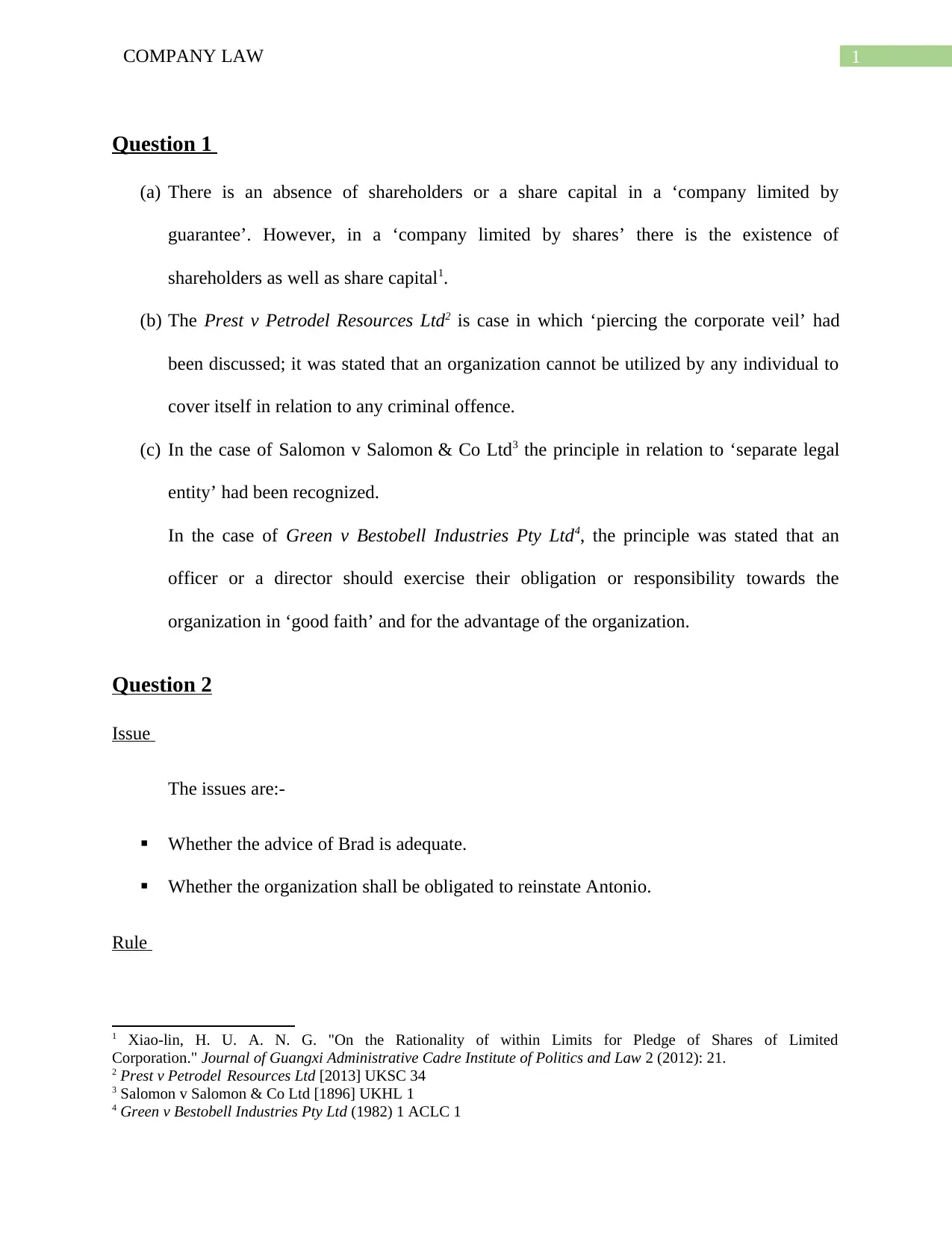
Question 1
(a) There is an absence of shareholders or a share capital in a ‘company limited by
guarantee’. However, in a ‘company limited by shares’ there is the existence of
shareholders as well as share capital1.
(b) The Prest v Petrodel Resources Ltd2 is case in which ‘piercing the corporate veil’ had
been discussed; it was stated that an organization cannot be utilized by any individual to
cover itself in relation to any criminal offence.
(c) In the case of Salomon v Salomon & Co Ltd3 the principle in relation to ‘separate legal
entity’ had been recognized.
In the case of Green v Bestobell Industries Pty Ltd4, the principle was stated that an
officer or a director should exercise their obligation or responsibility towards the
organization in ‘good faith’ and for the advantage of the organization.
Question 2
Issue
The issues are:-
Whether the advice of Brad is adequate.
Whether the organization shall be obligated to reinstate Antonio.
Rule
1 Xiao-lin, H. U. A. N. G. "On the Rationality of within Limits for Pledge of Shares of Limited
Corporation." Journal of Guangxi Administrative Cadre Institute of Politics and Law 2 (2012): 21.
2 Prest v Petrodel Resources Ltd [2013] UKSC 34
3 Salomon v Salomon & Co Ltd [1896] UKHL 1
4 Green v Bestobell Industries Pty Ltd (1982) 1 ACLC 1
Document Page
2COMPANY LAW
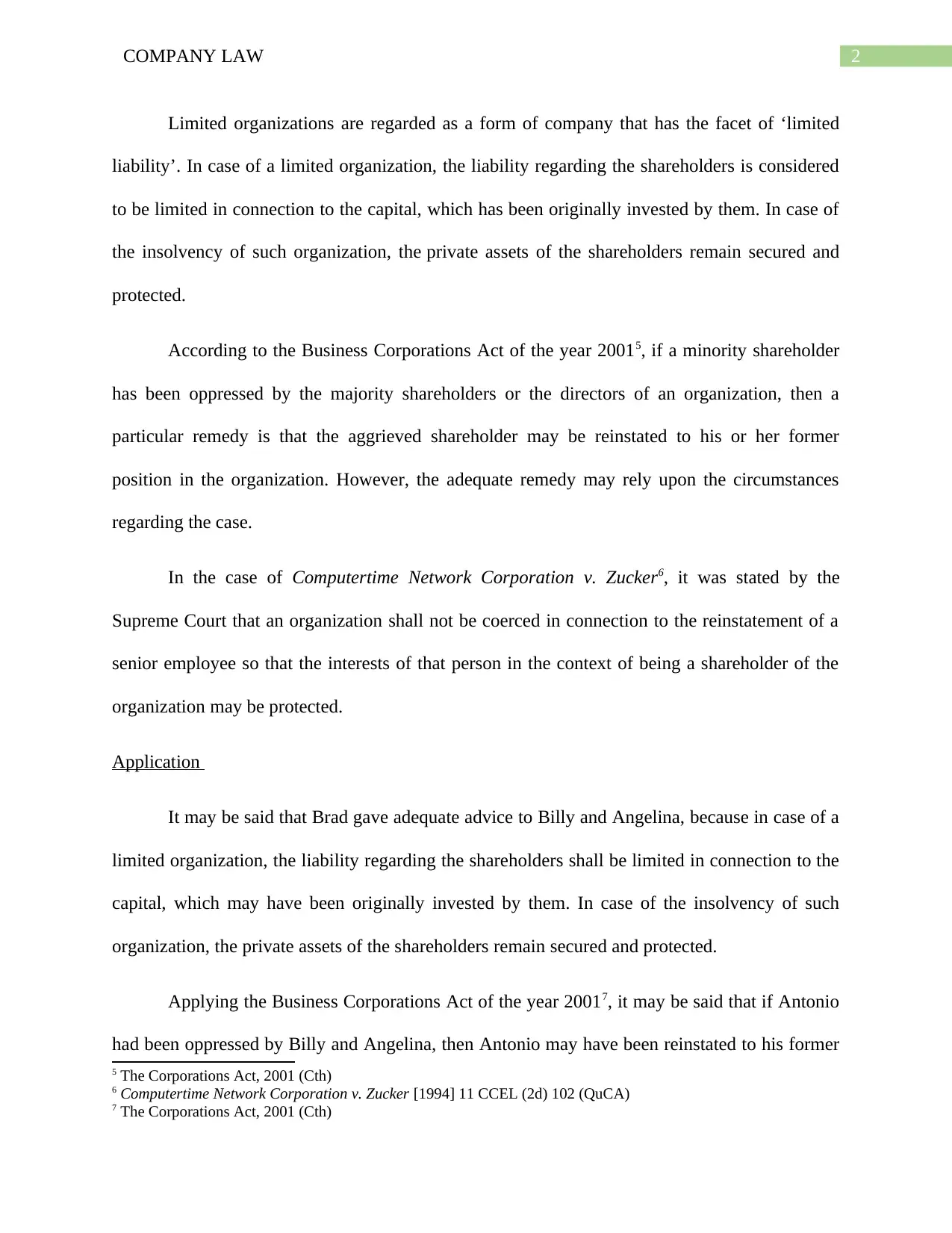
Limited organizations are regarded as a form of company that has the facet of ‘limited
liability’. In case of a limited organization, the liability regarding the shareholders is considered
to be limited in connection to the capital, which has been originally invested by them. In case of
the insolvency of such organization, the private assets of the shareholders remain secured and
protected.
According to the Business Corporations Act of the year 20015, if a minority shareholder
has been oppressed by the majority shareholders or the directors of an organization, then a
particular remedy is that the aggrieved shareholder may be reinstated to his or her former
position in the organization. However, the adequate remedy may rely upon the circumstances
regarding the case.
In the case of Computertime Network Corporation v. Zucker6, it was stated by the
Supreme Court that an organization shall not be coerced in connection to the reinstatement of a
senior employee so that the interests of that person in the context of being a shareholder of the
organization may be protected.
Application
It may be said that Brad gave adequate advice to Billy and Angelina, because in case of a
limited organization, the liability regarding the shareholders shall be limited in connection to the
capital, which may have been originally invested by them. In case of the insolvency of such
organization, the private assets of the shareholders remain secured and protected.
Applying the Business Corporations Act of the year 20017, it may be said that if Antonio
had been oppressed by Billy and Angelina, then Antonio may have been reinstated to his former
5 The Corporations Act, 2001 (Cth)
6 Computertime Network Corporation v. Zucker [1994] 11 CCEL (2d) 102 (QuCA)
7 The Corporations Act, 2001 (Cth)
Document Page
3COMPANY LAW
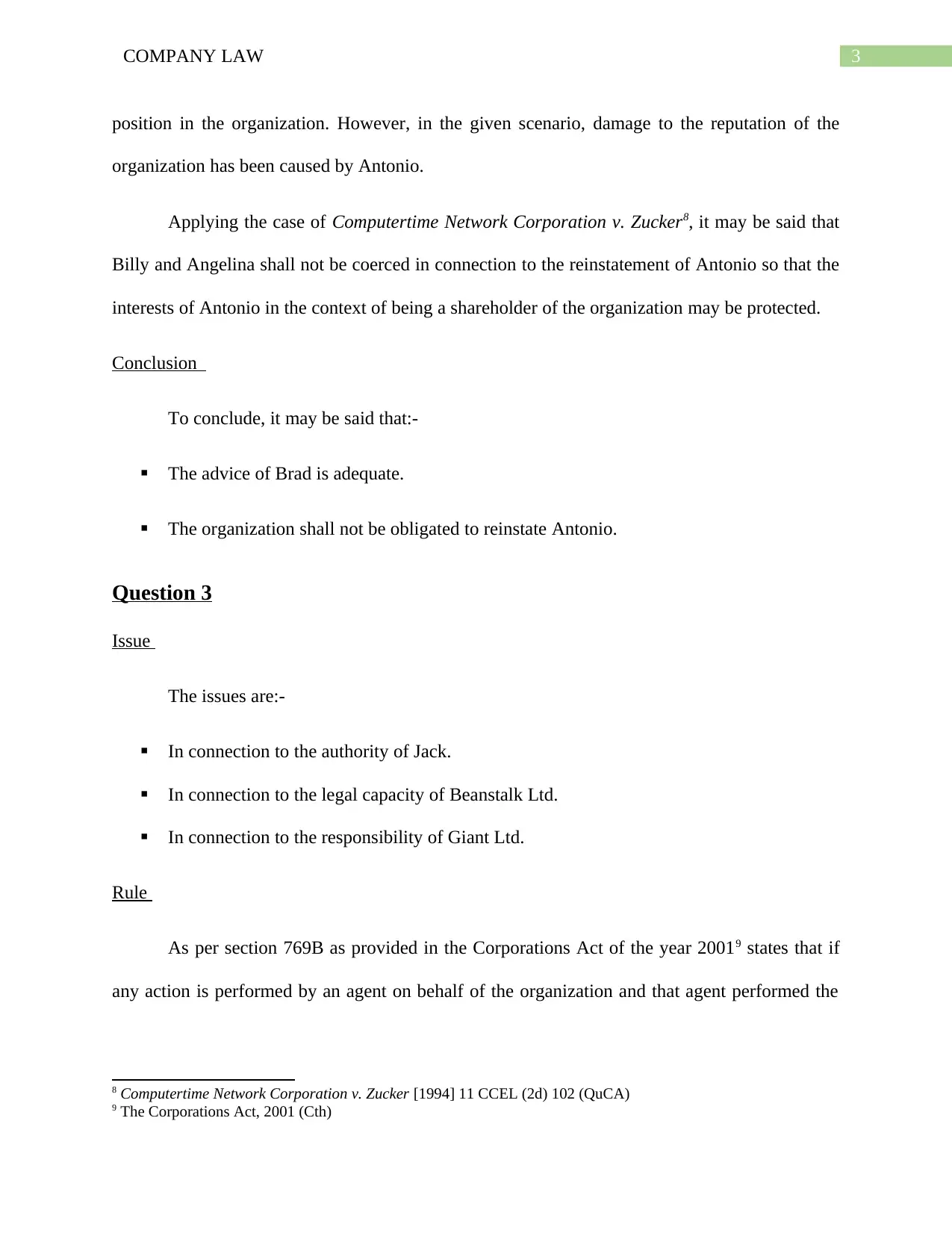
position in the organization. However, in the given scenario, damage to the reputation of the
organization has been caused by Antonio.
Applying the case of Computertime Network Corporation v. Zucker8, it may be said that
Billy and Angelina shall not be coerced in connection to the reinstatement of Antonio so that the
interests of Antonio in the context of being a shareholder of the organization may be protected.
Conclusion
To conclude, it may be said that:-
The advice of Brad is adequate.
The organization shall not be obligated to reinstate Antonio.
Question 3
Issue
The issues are:-
In connection to the authority of Jack.
In connection to the legal capacity of Beanstalk Ltd.
In connection to the responsibility of Giant Ltd.
Rule
As per section 769B as provided in the Corporations Act of the year 20019 states that if
any action is performed by an agent on behalf of the organization and that agent performed the
8 Computertime Network Corporation v. Zucker [1994] 11 CCEL (2d) 102 (QuCA)
9 The Corporations Act, 2001 (Cth)
tabler-icon-diamond-filled.svg

Paraphrase This Document

Need a fresh take? Get an instant paraphrase of this document with our AI Paraphraser
Document Page
4COMPANY LAW
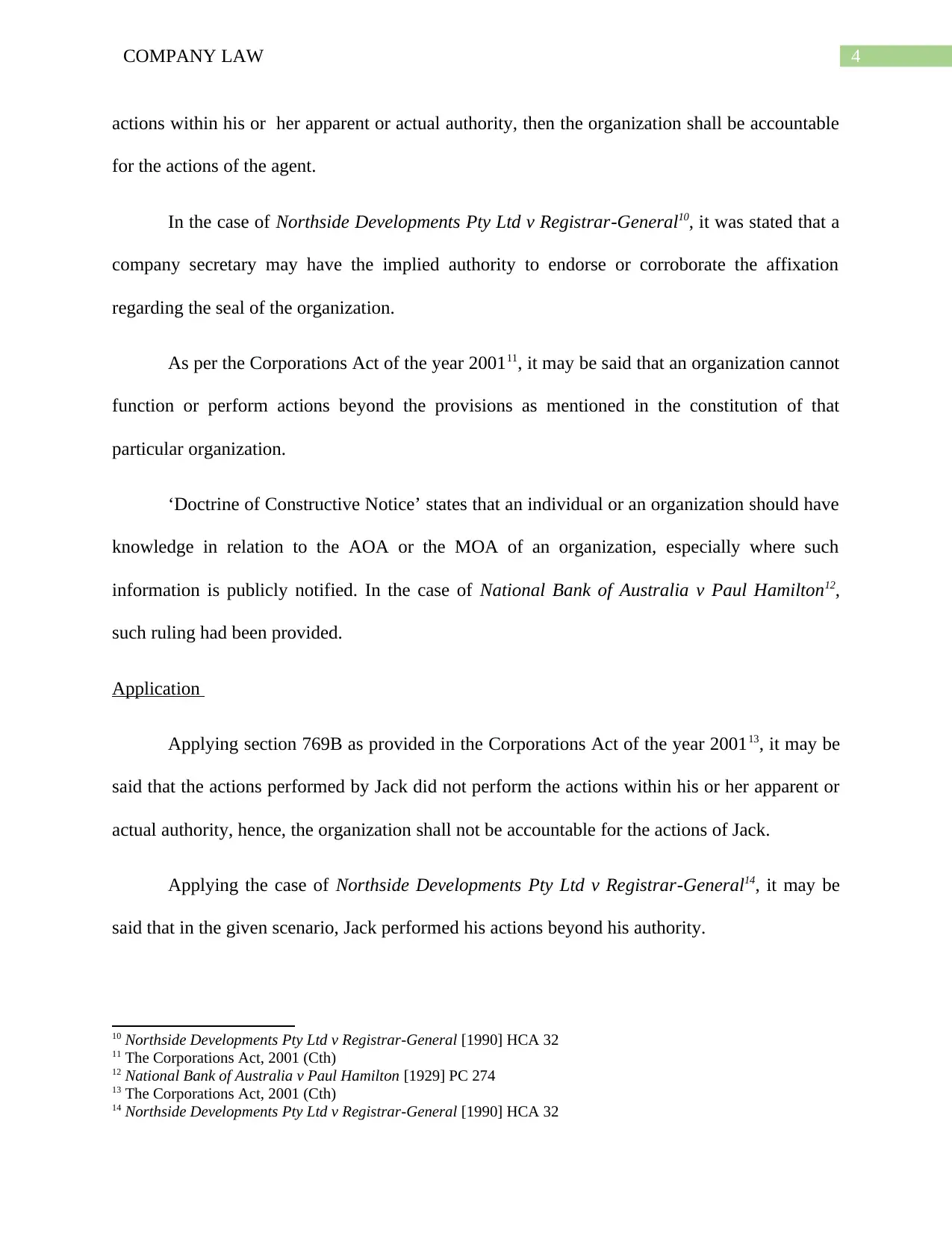
actions within his or her apparent or actual authority, then the organization shall be accountable
for the actions of the agent.
In the case of Northside Developments Pty Ltd v Registrar-General10, it was stated that a
company secretary may have the implied authority to endorse or corroborate the affixation
regarding the seal of the organization.
As per the Corporations Act of the year 200111, it may be said that an organization cannot
function or perform actions beyond the provisions as mentioned in the constitution of that
particular organization.
‘Doctrine of Constructive Notice’ states that an individual or an organization should have
knowledge in relation to the AOA or the MOA of an organization, especially where such
information is publicly notified. In the case of National Bank of Australia v Paul Hamilton12,
such ruling had been provided.
Application
Applying section 769B as provided in the Corporations Act of the year 200113, it may be
said that the actions performed by Jack did not perform the actions within his or her apparent or
actual authority, hence, the organization shall not be accountable for the actions of Jack.
Applying the case of Northside Developments Pty Ltd v Registrar-General14, it may be
said that in the given scenario, Jack performed his actions beyond his authority.
10 Northside Developments Pty Ltd v Registrar-General [1990] HCA 32
11 The Corporations Act, 2001 (Cth)
12 National Bank of Australia v Paul Hamilton [1929] PC 274
13 The Corporations Act, 2001 (Cth)
14 Northside Developments Pty Ltd v Registrar-General [1990] HCA 32
Document Page
5COMPANY LAW
Applying the Corporations Act of the year 200115, it may be said that an organization
cannot function or perform actions beyond the provisions as mentioned in the constitution of that
particular organization.
Applying ‘Doctrine of Constructive Notice’ in the given scenario, it may be said that
states that Giant Ltd should have had the knowledge in relation to the AOA or the MOA of
Beanstalk Ltd, especially where such information is publicly notified. The case of National Bank
of Australia v Paul Hamilton16 supports the statement.
Conclusion
The issues are:-
Jack did not have the authority.
Beanstalk Ltd did not have the legal capacity.
Giant Ltd should have been aware about the affairs of Beanstalk Ltd.
Question 4
The issues are:-
Whether Simon violated any obligations.
Whether Telephone Company may possess any ‘right of action’ against Simon.
In Kelner v Baxter17, it was stated that an advocate shall be privately accountable for pre-
incorporated contracts, if such contracts are not ratified after the incorporation of the company
15 The Corporations Act, 2001 (Cth)
16 National Bank of Australia v Paul Hamilton [1929] PC 274
17 Kelner v Baxter [1866] LR 2 CP 174
Document Page
6COMPANY LAW
Applying Kelner v Baxter18, it may be said that Simon shall be privately accountable because
the pre-registration contracts are not ratified by the organization.
To conclude, it may be said that:-
Simon violated any obligations.
The Telephone Company may possess any ‘right of action’ against Simon.
18 Kelner v Baxter [1866] LR 2 CP 174
tabler-icon-diamond-filled.svg

Paraphrase This Document

Need a fresh take? Get an instant paraphrase of this document with our AI Paraphraser
Document Page
7COMPANY LAW
References
Computertime Network Corporation v. Zucker [1994] 11 CCEL (2d) 102 (QuCA)
Green v Bestobell Industries Pty Ltd (1982) 1 ACLC 1
Kelner v Baxter (1866) LR 2 CP 174
National Bank of Australia v Paul Hamilton [1929] PC 274
Northside Developments Pty Ltd v Registrar-General [1990] HCA 32
Prest v Petrodel Resources Ltd [2013] UKSC 34
Salomon v Salomon & Co Ltd [1896] UKHL 1
The Corporations Act, 2001 (Cth)
Xiao-lin, H. U. A. N. G. "On the Rationality of within Limits for Pledge of Shares of Limited
Corporation." Journal of Guangxi Administrative Cadre Institute of Politics and Law 2 (2012):
21.
Document Page
8COMPANY LAW
chevron_up_icon
1 out of 9
circle_padding
hide_on_mobile
zoom_out_icon
[object Object]