BSBWRT401: Mastering Complex Documents - Assessment and Report
VerifiedAdded on 2023/03/30
|27
|5818
|187
Homework Assignment
AI Summary
This assignment provides a comprehensive assessment guide for the BSBWRT401 unit, 'Write Complex Documents.' It includes written questions covering document formatting, purpose, and audience, along with a practical demonstration involving drafting, editing, and finalizing a report based on a provided case study and style guide. The assessment requires students to demonstrate their ability to plan documents, draft text, prepare final text, and produce documents of some complexity, while adhering to enterprise style guidelines. It also emphasizes the importance of accurate information, clarity, and the incorporation of feedback. The document includes a style guide for company documentation, covering elements like acronyms, abbreviations, and apostrophes, ensuring consistency in internal and external communications. Students can find more solved assignments and past papers on Desklib to aid their studies.
ASSESSMENT
GUIDE
Student
BSBWRT401 Write complex documents
GUIDE
Student
BSBWRT401 Write complex documents

Paraphrase This Document
Need a fresh take? Get an instant paraphrase of this document with our AI Paraphraser
BSBWRT401 Write complex documents
UNIT OVERVIEW
BSBWRT401 Write complex documents
This unit describes the skills and knowledge required to plan documents, draft text, prepare final
text and produce documents of some complexity.
It applies to individuals who work in a range of business environments and are skilled in the
creation of reports, information and general promotion documents that are more complex than
basic correspondence, memos or forms and that require review and analysis of a range of
information sources.
No licensing, legislative or certification requirements apply to this unit at the time of publication.
Elements
To achieve competency in this unit students must demonstrate their ability to:
1. Plan documents
2. Draft text
3. Prepare final text
4. Produce document
Performance Evidence
Evidence of the ability to:
plan, draft and finalise complex documents that require review and analysis of a range of
information sources
use business technology to apply formatting, and incorporate graphics
edit the draft text to ensure accuracy and clarity of information, obtain feedback on the draft
and revise the draft
apply the enterprise style guide/house style.
Note: If a specific volume or frequency is not stated, then evidence must be provided at least once.
Knowledge Evidence
To complete the unit requirements safely and effectively, the individual must:
identify the enterprise style guide/house style
outline formatting styles and their impact on formatting, readability and appearance of
documents
explain rules and conventions for written English, as defined by general and specialist
sources.
Student Assessment Guide v 1 January 2019 Page 2 of 27
UNIT OVERVIEW
BSBWRT401 Write complex documents
This unit describes the skills and knowledge required to plan documents, draft text, prepare final
text and produce documents of some complexity.
It applies to individuals who work in a range of business environments and are skilled in the
creation of reports, information and general promotion documents that are more complex than
basic correspondence, memos or forms and that require review and analysis of a range of
information sources.
No licensing, legislative or certification requirements apply to this unit at the time of publication.
Elements
To achieve competency in this unit students must demonstrate their ability to:
1. Plan documents
2. Draft text
3. Prepare final text
4. Produce document
Performance Evidence
Evidence of the ability to:
plan, draft and finalise complex documents that require review and analysis of a range of
information sources
use business technology to apply formatting, and incorporate graphics
edit the draft text to ensure accuracy and clarity of information, obtain feedback on the draft
and revise the draft
apply the enterprise style guide/house style.
Note: If a specific volume or frequency is not stated, then evidence must be provided at least once.
Knowledge Evidence
To complete the unit requirements safely and effectively, the individual must:
identify the enterprise style guide/house style
outline formatting styles and their impact on formatting, readability and appearance of
documents
explain rules and conventions for written English, as defined by general and specialist
sources.
Student Assessment Guide v 1 January 2019 Page 2 of 27
BSBWRT401 Write complex documents
INFORMATION FOR STUDENTS
General Assessment Information
This information is designed to provide you with a full overview of the tasks you need to
successfully complete to be deemed competent in this unit.
You must achieve a satisfactory performance in each of the assessment tasks in order to be
deemed competent in the relevant unit. Where necessary, the assessment tasks are divided into
parts or steps. These are designed to take you through a step by step approach to completing the
activities.
Instructions
First and foremost, please contact your assessor to discuss any necessary adjustments that may
need to be made prior to completing these tasks. The instructions for each of the assessment
tasks are logically sequenced. If you have any questions, contact your assessor immediately. If
there is a practical component to your assessment, you will need to discuss the arrangements for
its completion with your assessor in advance.
Assessment Cover Sheet
Once you have completed all of the tasks, complete the Assessment Cover Sheet, sign the
declaration and forward along with your documentation to your assessor. It should be uploaded
along with the assessment on to the RTO manager.
Submitting Assessment Tasks
All written assessment tasks must be typed and submitted with the provided cover sheet.
Your trainer/assessor will tell you when assessments are due. It is your responsibility to ensure
that assessment tasks are submitted on or before their due date.
Extensions for individual assessment tasks may be negotiated with your trainer in specific
circumstances. You must request this prior to the due date, and extensions due to illness will
require a medical certificate. Extensions will be confirmed by your trainer/assessor.
Where assessment tasks are submitted following the conclusion of the unit of competency without
a medical certificate or extension, a late submission fee for each assessment task will be charged.
Assessment Outcomes
There are two outcomes of assessment tasks: S = Satisfactory and NS = Not Satisfactory (requires
more training and experience).
You will be awarded C = Competent on completion of the unit when you have achieved S for all
completed assessment tasks and by meeting all the performance criteria. If you fail to meet this
requirement, you will receive the result NYC = Not Yet Competent and will be eligible to be re-
assessed according to George Brown College policy.
If you are deemed Not Competent by your assessor and require re-assessment, you will be
informed of the process. A fee may be charged according to George Brown College policy.
If all assessment tasks are not completed for a qualification, a certificate will not be awarded. A
Statement of Attainment for completed units of competency will be provided.
Student Assessment Guide v 1 January 2019 Page 3 of 27
INFORMATION FOR STUDENTS
General Assessment Information
This information is designed to provide you with a full overview of the tasks you need to
successfully complete to be deemed competent in this unit.
You must achieve a satisfactory performance in each of the assessment tasks in order to be
deemed competent in the relevant unit. Where necessary, the assessment tasks are divided into
parts or steps. These are designed to take you through a step by step approach to completing the
activities.
Instructions
First and foremost, please contact your assessor to discuss any necessary adjustments that may
need to be made prior to completing these tasks. The instructions for each of the assessment
tasks are logically sequenced. If you have any questions, contact your assessor immediately. If
there is a practical component to your assessment, you will need to discuss the arrangements for
its completion with your assessor in advance.
Assessment Cover Sheet
Once you have completed all of the tasks, complete the Assessment Cover Sheet, sign the
declaration and forward along with your documentation to your assessor. It should be uploaded
along with the assessment on to the RTO manager.
Submitting Assessment Tasks
All written assessment tasks must be typed and submitted with the provided cover sheet.
Your trainer/assessor will tell you when assessments are due. It is your responsibility to ensure
that assessment tasks are submitted on or before their due date.
Extensions for individual assessment tasks may be negotiated with your trainer in specific
circumstances. You must request this prior to the due date, and extensions due to illness will
require a medical certificate. Extensions will be confirmed by your trainer/assessor.
Where assessment tasks are submitted following the conclusion of the unit of competency without
a medical certificate or extension, a late submission fee for each assessment task will be charged.
Assessment Outcomes
There are two outcomes of assessment tasks: S = Satisfactory and NS = Not Satisfactory (requires
more training and experience).
You will be awarded C = Competent on completion of the unit when you have achieved S for all
completed assessment tasks and by meeting all the performance criteria. If you fail to meet this
requirement, you will receive the result NYC = Not Yet Competent and will be eligible to be re-
assessed according to George Brown College policy.
If you are deemed Not Competent by your assessor and require re-assessment, you will be
informed of the process. A fee may be charged according to George Brown College policy.
If all assessment tasks are not completed for a qualification, a certificate will not be awarded. A
Statement of Attainment for completed units of competency will be provided.
Student Assessment Guide v 1 January 2019 Page 3 of 27
⊘ This is a preview!⊘
Do you want full access?
Subscribe today to unlock all pages.

Trusted by 1+ million students worldwide
BSBWRT401 Write complex documents
Your Results
Your assessor is committed to providing you with detailed feedback on the outcomes of the
assessment and will provide guidance on areas for improvement. In most instances, you should
only need to complete the sections of the assessment that were deemed not satisfactory.
However, it is important to remember that depending on the task, it may be necessary to repeat the
whole task (for example presentations or the delivery of a training session).
You are entitled to view your results at any time by viewing them once they are uploaded on
RTOManager.
Reasonable Adjustment
George Brown College supports individual differences in the learning environment and provides
‘reasonable adjustment’ in training and assessment activities to support every learner. If you have
any special needs that make it difficult for you to complete your learning or assessments, you
should discuss this with your assessor beforehand and will be provided with reasonable
alternatives to assist you to complete the required tasks such as completing tests verbally or using
an interpreter.
What happens if you do not agree with the assessment result?
If you do not think the assessment process is valid, or disagree with the decision once it is made,
or believe that you have been treated unfairly, you can appeal. The first step is to discuss the
matter with your trainer.
If you still do not agree with the results, refer to the GBC Complaints and Appeals Policy and speak
to the Student Services Team.
Support
While we may not be in a position to assist you with language training or specific LLN training, our
assessors will work with you to ensure that you are supported throughout your qualification. If you
require individual tutoring this may attract an additional fee (see Student Handbook). Support may
be offered by your assessor, or for more specialist support you may need to contact GBC
administration.
A Note on Plagiarism and Referencing
Plagiarism is a form of theft where the work, ideas, inventions etc. of other people are presented as
your own. Information, ideas etc. quoted or paraphrased from another source such as the Internet,
must be acknowledged with “quotation marks” around the relevant words/sentences or ideas and
the source listed in brackets. You must also list the sources at the end of your assessment.
Sources of information, ideas etc. must be provided in alphabetical order by author’s surname
(including author’s full name, name of document/ book / internet etc. and year and place of
publishing) or may be included in brackets in the text.
As a general rule it is advisable to never copy another person’s work. Should it appear that a
student’s work has been copied or does not appear to be authentic, you will be asked to speak to
your Course Coordinator and required to re-submit it. A fee may be charged according to George
Brown College policy.
Contacting the RTO
If you should need further support or assistance please do not hesitate to contact The Student
Services Team.
Student Assessment Guide v 1 January 2019 Page 4 of 27
Your Results
Your assessor is committed to providing you with detailed feedback on the outcomes of the
assessment and will provide guidance on areas for improvement. In most instances, you should
only need to complete the sections of the assessment that were deemed not satisfactory.
However, it is important to remember that depending on the task, it may be necessary to repeat the
whole task (for example presentations or the delivery of a training session).
You are entitled to view your results at any time by viewing them once they are uploaded on
RTOManager.
Reasonable Adjustment
George Brown College supports individual differences in the learning environment and provides
‘reasonable adjustment’ in training and assessment activities to support every learner. If you have
any special needs that make it difficult for you to complete your learning or assessments, you
should discuss this with your assessor beforehand and will be provided with reasonable
alternatives to assist you to complete the required tasks such as completing tests verbally or using
an interpreter.
What happens if you do not agree with the assessment result?
If you do not think the assessment process is valid, or disagree with the decision once it is made,
or believe that you have been treated unfairly, you can appeal. The first step is to discuss the
matter with your trainer.
If you still do not agree with the results, refer to the GBC Complaints and Appeals Policy and speak
to the Student Services Team.
Support
While we may not be in a position to assist you with language training or specific LLN training, our
assessors will work with you to ensure that you are supported throughout your qualification. If you
require individual tutoring this may attract an additional fee (see Student Handbook). Support may
be offered by your assessor, or for more specialist support you may need to contact GBC
administration.
A Note on Plagiarism and Referencing
Plagiarism is a form of theft where the work, ideas, inventions etc. of other people are presented as
your own. Information, ideas etc. quoted or paraphrased from another source such as the Internet,
must be acknowledged with “quotation marks” around the relevant words/sentences or ideas and
the source listed in brackets. You must also list the sources at the end of your assessment.
Sources of information, ideas etc. must be provided in alphabetical order by author’s surname
(including author’s full name, name of document/ book / internet etc. and year and place of
publishing) or may be included in brackets in the text.
As a general rule it is advisable to never copy another person’s work. Should it appear that a
student’s work has been copied or does not appear to be authentic, you will be asked to speak to
your Course Coordinator and required to re-submit it. A fee may be charged according to George
Brown College policy.
Contacting the RTO
If you should need further support or assistance please do not hesitate to contact The Student
Services Team.
Student Assessment Guide v 1 January 2019 Page 4 of 27
Paraphrase This Document
Need a fresh take? Get an instant paraphrase of this document with our AI Paraphraser
BSBWRT401 Write complex documents
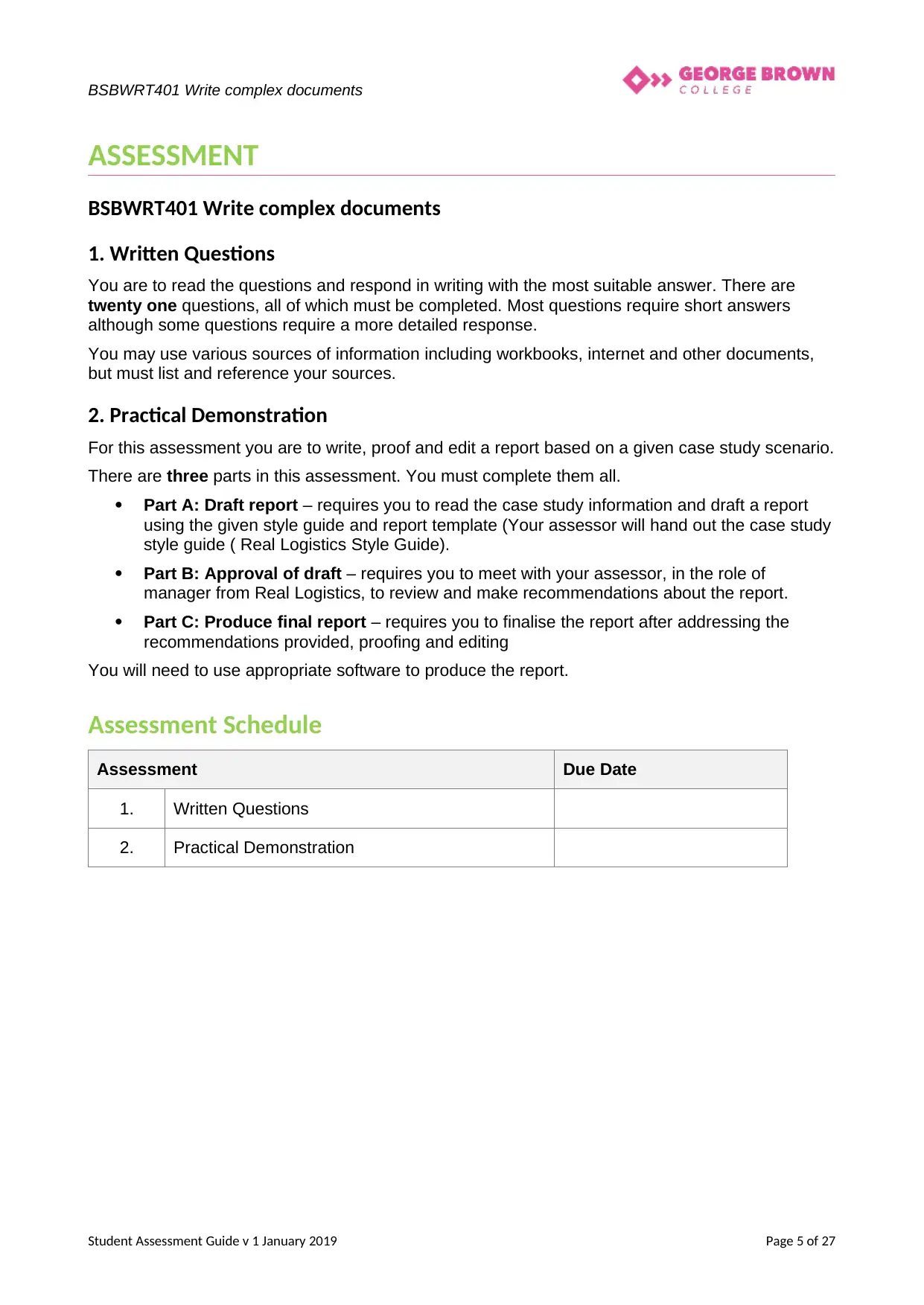
ASSESSMENT
BSBWRT401 Write complex documents
1. Written Questions
You are to read the questions and respond in writing with the most suitable answer. There are
twenty one questions, all of which must be completed. Most questions require short answers
although some questions require a more detailed response.
You may use various sources of information including workbooks, internet and other documents,
but must list and reference your sources.
2. Practical Demonstration
For this assessment you are to write, proof and edit a report based on a given case study scenario.
There are three parts in this assessment. You must complete them all.
Part A: Draft report – requires you to read the case study information and draft a report
using the given style guide and report template (Your assessor will hand out the case study
style guide ( Real Logistics Style Guide).
Part B: Approval of draft – requires you to meet with your assessor, in the role of
manager from Real Logistics, to review and make recommendations about the report.
Part C: Produce final report – requires you to finalise the report after addressing the
recommendations provided, proofing and editing
You will need to use appropriate software to produce the report.
Assessment Schedule
Assessment Due Date
1. Written Questions
2. Practical Demonstration
Student Assessment Guide v 1 January 2019 Page 5 of 27
ASSESSMENT
BSBWRT401 Write complex documents
1. Written Questions
You are to read the questions and respond in writing with the most suitable answer. There are
twenty one questions, all of which must be completed. Most questions require short answers
although some questions require a more detailed response.
You may use various sources of information including workbooks, internet and other documents,
but must list and reference your sources.
2. Practical Demonstration
For this assessment you are to write, proof and edit a report based on a given case study scenario.
There are three parts in this assessment. You must complete them all.
Part A: Draft report – requires you to read the case study information and draft a report
using the given style guide and report template (Your assessor will hand out the case study
style guide ( Real Logistics Style Guide).
Part B: Approval of draft – requires you to meet with your assessor, in the role of
manager from Real Logistics, to review and make recommendations about the report.
Part C: Produce final report – requires you to finalise the report after addressing the
recommendations provided, proofing and editing
You will need to use appropriate software to produce the report.
Assessment Schedule
Assessment Due Date
1. Written Questions
2. Practical Demonstration
Student Assessment Guide v 1 January 2019 Page 5 of 27
BSBWRT401 Write complex documents
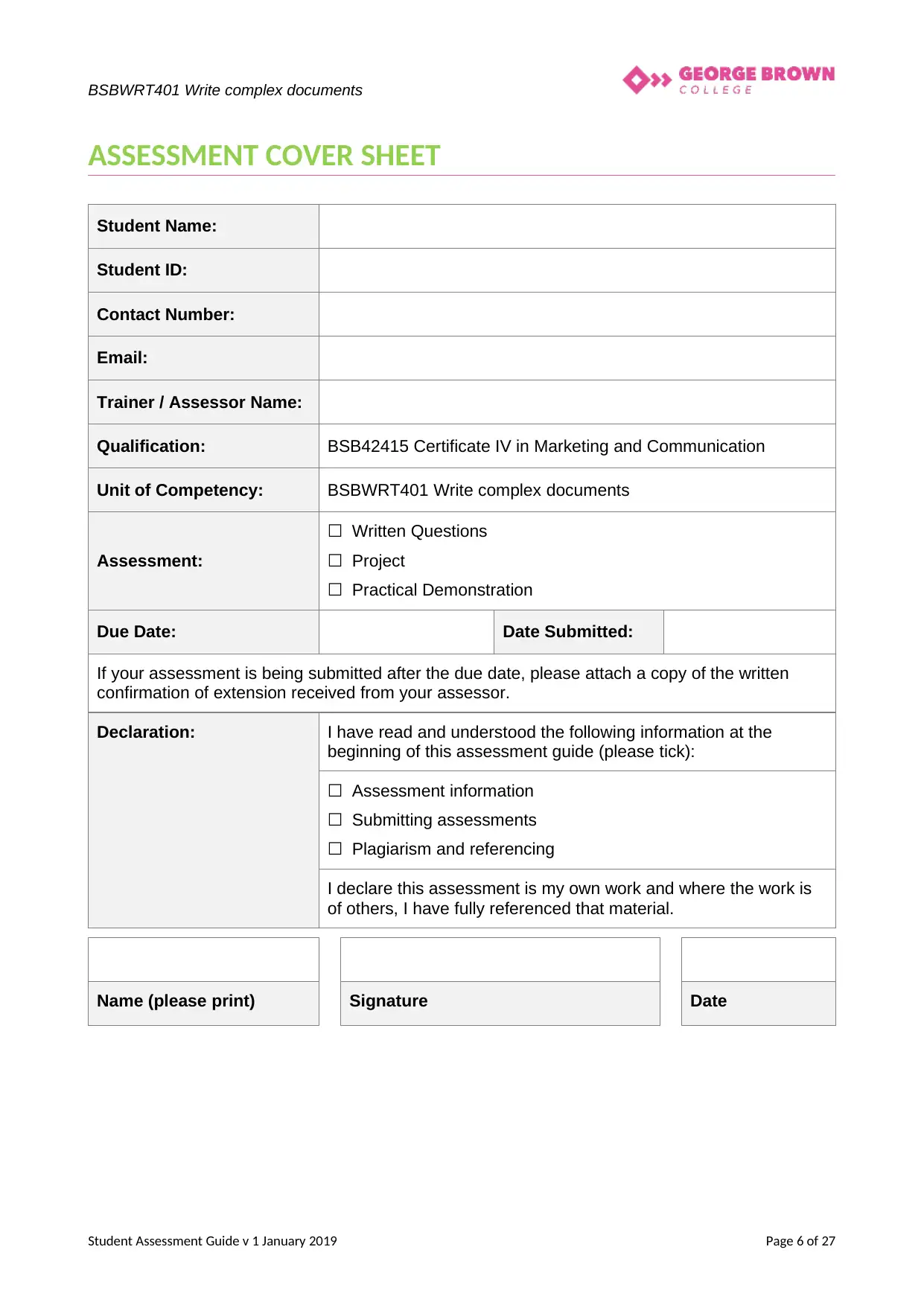
ASSESSMENT COVER SHEET
Student Name:
Student ID:
Contact Number:
Email:
Trainer / Assessor Name:
Qualification: BSB42415 Certificate IV in Marketing and Communication
Unit of Competency: BSBWRT401 Write complex documents
Assessment:
☐ Written Questions
☐ Project
☐ Practical Demonstration
Due Date: Date Submitted:
If your assessment is being submitted after the due date, please attach a copy of the written
confirmation of extension received from your assessor.
Declaration: I have read and understood the following information at the
beginning of this assessment guide (please tick):
☐ Assessment information
☐ Submitting assessments
☐ Plagiarism and referencing
I declare this assessment is my own work and where the work is
of others, I have fully referenced that material.
Name (please print) Signature Date
Student Assessment Guide v 1 January 2019 Page 6 of 27
ASSESSMENT COVER SHEET
Student Name:
Student ID:
Contact Number:
Email:
Trainer / Assessor Name:
Qualification: BSB42415 Certificate IV in Marketing and Communication
Unit of Competency: BSBWRT401 Write complex documents
Assessment:
☐ Written Questions
☐ Project
☐ Practical Demonstration
Due Date: Date Submitted:
If your assessment is being submitted after the due date, please attach a copy of the written
confirmation of extension received from your assessor.
Declaration: I have read and understood the following information at the
beginning of this assessment guide (please tick):
☐ Assessment information
☐ Submitting assessments
☐ Plagiarism and referencing
I declare this assessment is my own work and where the work is
of others, I have fully referenced that material.
Name (please print) Signature Date
Student Assessment Guide v 1 January 2019 Page 6 of 27
⊘ This is a preview!⊘
Do you want full access?
Subscribe today to unlock all pages.
Trusted by 1+ million students worldwide
BSBWRT401 Write complex documents
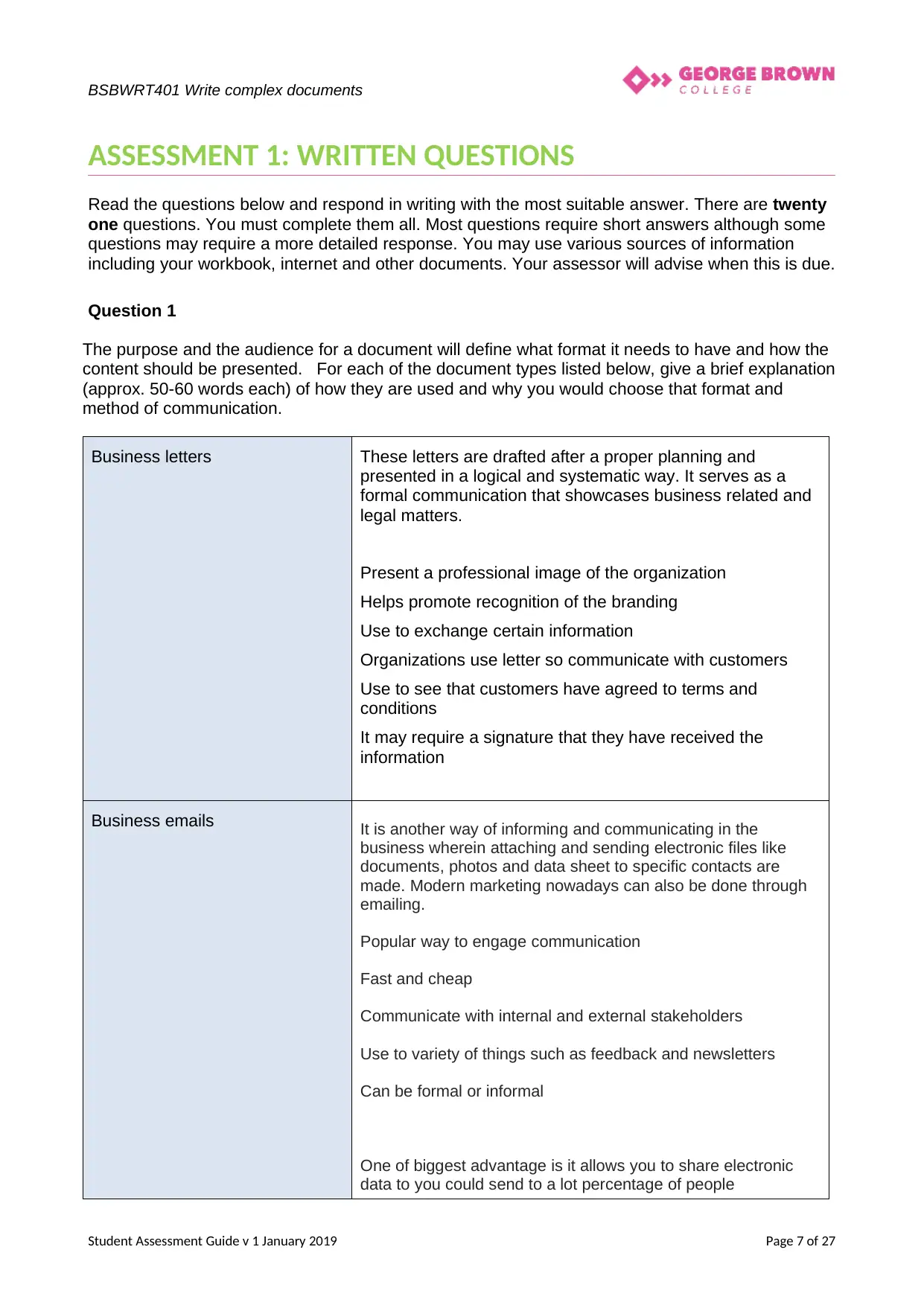
ASSESSMENT 1: WRITTEN QUESTIONS
Read the questions below and respond in writing with the most suitable answer. There are twenty
one questions. You must complete them all. Most questions require short answers although some
questions may require a more detailed response. You may use various sources of information
including your workbook, internet and other documents. Your assessor will advise when this is due.
Question 1
The purpose and the audience for a document will define what format it needs to have and how the
content should be presented. For each of the document types listed below, give a brief explanation
(approx. 50-60 words each) of how they are used and why you would choose that format and
method of communication.
Business letters These letters are drafted after a proper planning and
presented in a logical and systematic way. It serves as a
formal communication that showcases business related and
legal matters.
Present a professional image of the organization
Helps promote recognition of the branding
Use to exchange certain information
Organizations use letter so communicate with customers
Use to see that customers have agreed to terms and
conditions
It may require a signature that they have received the
information
Business emails It is another way of informing and communicating in the
business wherein attaching and sending electronic files like
documents, photos and data sheet to specific contacts are
made. Modern marketing nowadays can also be done through
emailing.
Popular way to engage communication
Fast and cheap
Communicate with internal and external stakeholders
Use to variety of things such as feedback and newsletters
Can be formal or informal
One of biggest advantage is it allows you to share electronic
data to you could send to a lot percentage of people
Student Assessment Guide v 1 January 2019 Page 7 of 27
ASSESSMENT 1: WRITTEN QUESTIONS
Read the questions below and respond in writing with the most suitable answer. There are twenty
one questions. You must complete them all. Most questions require short answers although some
questions may require a more detailed response. You may use various sources of information
including your workbook, internet and other documents. Your assessor will advise when this is due.
Question 1
The purpose and the audience for a document will define what format it needs to have and how the
content should be presented. For each of the document types listed below, give a brief explanation
(approx. 50-60 words each) of how they are used and why you would choose that format and
method of communication.
Business letters These letters are drafted after a proper planning and
presented in a logical and systematic way. It serves as a
formal communication that showcases business related and
legal matters.
Present a professional image of the organization
Helps promote recognition of the branding
Use to exchange certain information
Organizations use letter so communicate with customers
Use to see that customers have agreed to terms and
conditions
It may require a signature that they have received the
information
Business emails It is another way of informing and communicating in the
business wherein attaching and sending electronic files like
documents, photos and data sheet to specific contacts are
made. Modern marketing nowadays can also be done through
emailing.
Popular way to engage communication
Fast and cheap
Communicate with internal and external stakeholders
Use to variety of things such as feedback and newsletters
Can be formal or informal
One of biggest advantage is it allows you to share electronic
data to you could send to a lot percentage of people
Student Assessment Guide v 1 January 2019 Page 7 of 27
Paraphrase This Document
Need a fresh take? Get an instant paraphrase of this document with our AI Paraphraser
BSBWRT401 Write complex documents
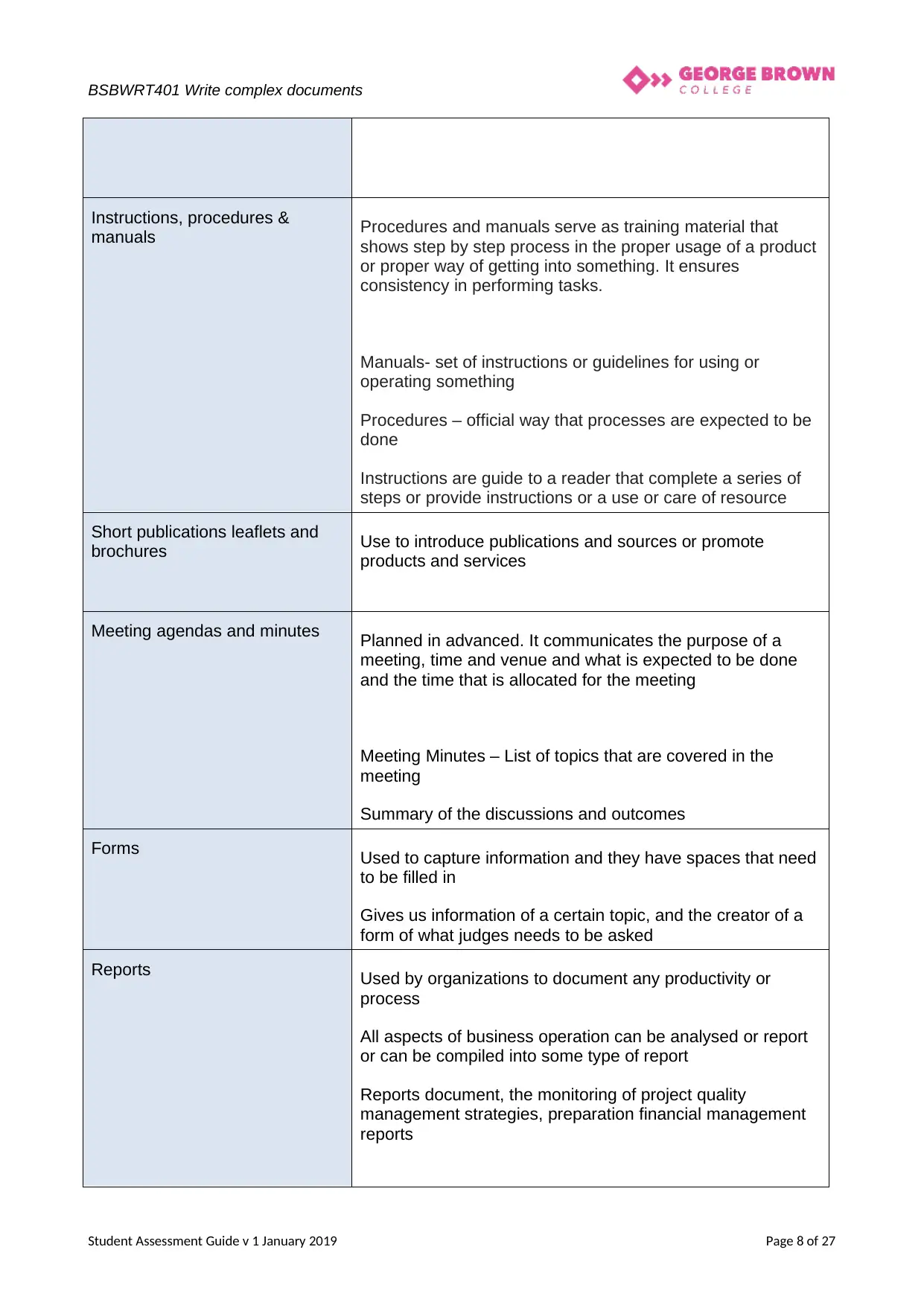
Instructions, procedures &
manuals Procedures and manuals serve as training material that
shows step by step process in the proper usage of a product
or proper way of getting into something. It ensures
consistency in performing tasks.
Manuals- set of instructions or guidelines for using or
operating something
Procedures – official way that processes are expected to be
done
Instructions are guide to a reader that complete a series of
steps or provide instructions or a use or care of resource
Short publications leaflets and
brochures Use to introduce publications and sources or promote
products and services
Meeting agendas and minutes Planned in advanced. It communicates the purpose of a
meeting, time and venue and what is expected to be done
and the time that is allocated for the meeting
Meeting Minutes – List of topics that are covered in the
meeting
Summary of the discussions and outcomes
Forms Used to capture information and they have spaces that need
to be filled in
Gives us information of a certain topic, and the creator of a
form of what judges needs to be asked
Reports Used by organizations to document any productivity or
process
All aspects of business operation can be analysed or report
or can be compiled into some type of report
Reports document, the monitoring of project quality
management strategies, preparation financial management
reports
Student Assessment Guide v 1 January 2019 Page 8 of 27
Instructions, procedures &
manuals Procedures and manuals serve as training material that
shows step by step process in the proper usage of a product
or proper way of getting into something. It ensures
consistency in performing tasks.
Manuals- set of instructions or guidelines for using or
operating something
Procedures – official way that processes are expected to be
done
Instructions are guide to a reader that complete a series of
steps or provide instructions or a use or care of resource
Short publications leaflets and
brochures Use to introduce publications and sources or promote
products and services
Meeting agendas and minutes Planned in advanced. It communicates the purpose of a
meeting, time and venue and what is expected to be done
and the time that is allocated for the meeting
Meeting Minutes – List of topics that are covered in the
meeting
Summary of the discussions and outcomes
Forms Used to capture information and they have spaces that need
to be filled in
Gives us information of a certain topic, and the creator of a
form of what judges needs to be asked
Reports Used by organizations to document any productivity or
process
All aspects of business operation can be analysed or report
or can be compiled into some type of report
Reports document, the monitoring of project quality
management strategies, preparation financial management
reports
Student Assessment Guide v 1 January 2019 Page 8 of 27
BSBWRT401 Write complex documents
Cover range of topics and can be addressed to different type
of audiences
Question 2
Explain (in a paragraph) why organisations have set standards and requirements for
documentation.
Creation of professional image and tone
All staff members have same understanding of documentations
Defines the desired level of document quality
Sets detailed steps that all staff must follow to achieve goals
Question 3
Provide details of what a ‘style-guide’ is and what type of information is usually given (Approx. 80-
100 words)
Incorporates a business logo, business address, contact details, corporate colours into their
styles
Paragraph sizing
Details style sheet and number of document templates
Question 4
Carefully read the scenario, then answer the following 3 questions
Tahlia, a supervisor working in a large warehouse has been helping her team to test different
strategies for working more efficiently. The team of ten staff members tried three different ways
of processing incoming stock to see which was the easiest to adopt and which was the fastest
way of getting the goods to their destination. The team members drew straws to allocate
themselves into trial groups and allocated a method to each group. Tahlia collected detailed
performance information over the period of a month and now needs to prepare a report for her
team and her manager.
(a) What questions should Tahlia ask herself to ensure she covers grouping and sequencing of
information in order to prepare a formal report for her team manager? (Approx. 50 words)
ADUINDECE OF THE DOCUMENT ?
PURPOSE ?
TIME REQUIRED?
Student Assessment Guide v 1 January 2019 Page 9 of 27
Cover range of topics and can be addressed to different type
of audiences
Question 2
Explain (in a paragraph) why organisations have set standards and requirements for
documentation.
Creation of professional image and tone
All staff members have same understanding of documentations
Defines the desired level of document quality
Sets detailed steps that all staff must follow to achieve goals
Question 3
Provide details of what a ‘style-guide’ is and what type of information is usually given (Approx. 80-
100 words)
Incorporates a business logo, business address, contact details, corporate colours into their
styles
Paragraph sizing
Details style sheet and number of document templates
Question 4
Carefully read the scenario, then answer the following 3 questions
Tahlia, a supervisor working in a large warehouse has been helping her team to test different
strategies for working more efficiently. The team of ten staff members tried three different ways
of processing incoming stock to see which was the easiest to adopt and which was the fastest
way of getting the goods to their destination. The team members drew straws to allocate
themselves into trial groups and allocated a method to each group. Tahlia collected detailed
performance information over the period of a month and now needs to prepare a report for her
team and her manager.
(a) What questions should Tahlia ask herself to ensure she covers grouping and sequencing of
information in order to prepare a formal report for her team manager? (Approx. 50 words)
ADUINDECE OF THE DOCUMENT ?
PURPOSE ?
TIME REQUIRED?
Student Assessment Guide v 1 January 2019 Page 9 of 27
⊘ This is a preview!⊘
Do you want full access?
Subscribe today to unlock all pages.
Trusted by 1+ million students worldwide
BSBWRT401 Write complex documents
STYLE ?
CONTENT IS FORMAL OR INFORMAL?
WHAT TYPE OF DUCMENT SHOULD SHE PREPARE ?
WHAT ORGANIZATION REQUIEMEMT DOES THE DOCUMENT NEED ?
KEY POINT OF THE DOCUMENT COVER ?
(b) List the key headings that Tahlia will need to include in her report. (Approx. 20 words)
REPORT LAYOUT
Title
Executive Summary –
Table of Contents
Introduction –Method used (Research)
A Summary of Results
Recommendation
Conclusion
Appendices
(c) For each of the sections of Tahlia’s report, what content will be included? Complete the table
below.
Report Section Content
Executive Summary short version of the report, briefly outlines purpose,
methods , findings and recommendations
Introduction purpose and context of report, it gives any background
information the reader needs to know
Methods Used Explain how research was done
Summary of the results Summarised results (graph, table, diagrams, descriptions )
Discussion Interpretation and discussion of results and what they mean
Recommendations Any recommended actions from arised finding
Conclusion Summary of the point, aims and finding and recommendation
Student Assessment Guide v 1 January 2019 Page 10 of 27
STYLE ?
CONTENT IS FORMAL OR INFORMAL?
WHAT TYPE OF DUCMENT SHOULD SHE PREPARE ?
WHAT ORGANIZATION REQUIEMEMT DOES THE DOCUMENT NEED ?
KEY POINT OF THE DOCUMENT COVER ?
(b) List the key headings that Tahlia will need to include in her report. (Approx. 20 words)
REPORT LAYOUT
Title
Executive Summary –
Table of Contents
Introduction –Method used (Research)
A Summary of Results
Recommendation
Conclusion
Appendices
(c) For each of the sections of Tahlia’s report, what content will be included? Complete the table
below.
Report Section Content
Executive Summary short version of the report, briefly outlines purpose,
methods , findings and recommendations
Introduction purpose and context of report, it gives any background
information the reader needs to know
Methods Used Explain how research was done
Summary of the results Summarised results (graph, table, diagrams, descriptions )
Discussion Interpretation and discussion of results and what they mean
Recommendations Any recommended actions from arised finding
Conclusion Summary of the point, aims and finding and recommendation
Student Assessment Guide v 1 January 2019 Page 10 of 27
Paraphrase This Document
Need a fresh take? Get an instant paraphrase of this document with our AI Paraphraser
BSBWRT401 Write complex documents
Appendixes Terminology used
Data collected during the project
Question 5
If your document includes the presentation of data and numerical results, briefly explain what you
should do with it before inserting it into the report and why. (Approx. 30 words)
Carry out the analysis of the data and only include the summary of the findings through charts,
graphs, table
Question 6
(a) From the data shown below, summarise this information into text for inclusion in a report.
WHS injury records
Injury Severity Treatment Body part
Bumped into closing door while
walking and not looking
small first aid head
Strained back while moving
furniture in office
medium doctor back
Scald from coffee machine in tea
room
medium first aid hand
Blisters from new provided
protective footwear
small first aid foot
Cut from scissors while opening
carton
small first aid hand
Jammed finger from filing cabinet
drawer closing
small first aid hand
Bee sting medium ambulance arm
Splashed with cleaning bleach
while cleaning toilet facility
small first aid arm
Treatment of which body part is affected and how severe it is and the number of injuries
Total number……
Severity….
The treatments provided was taken by ambulance, ……….
The body parts affected were…
Student Assessment Guide v 1 January 2019 Page 11 of 27
Appendixes Terminology used
Data collected during the project
Question 5
If your document includes the presentation of data and numerical results, briefly explain what you
should do with it before inserting it into the report and why. (Approx. 30 words)
Carry out the analysis of the data and only include the summary of the findings through charts,
graphs, table
Question 6
(a) From the data shown below, summarise this information into text for inclusion in a report.
WHS injury records
Injury Severity Treatment Body part
Bumped into closing door while
walking and not looking
small first aid head
Strained back while moving
furniture in office
medium doctor back
Scald from coffee machine in tea
room
medium first aid hand
Blisters from new provided
protective footwear
small first aid foot
Cut from scissors while opening
carton
small first aid hand
Jammed finger from filing cabinet
drawer closing
small first aid hand
Bee sting medium ambulance arm
Splashed with cleaning bleach
while cleaning toilet facility
small first aid arm
Treatment of which body part is affected and how severe it is and the number of injuries
Total number……
Severity….
The treatments provided was taken by ambulance, ……….
The body parts affected were…
Student Assessment Guide v 1 January 2019 Page 11 of 27
BSBWRT401 Write complex documents
(b) Draw bar graphs to represent the information in the table above for:
(a) Severity
(b) Treatment Provided
(c) Body Parts affected
3 BAR GRAPHS
Question 7
When including images, diagrams and pictures into a document, explain what things you should
consider. (Approx. 80 words)
Make sure that graphic connects with the context
Caption of the context must be below the graphic
It needs to be referenced
Copyright
Student Assessment Guide v 1 January 2019 Page 12 of 27
(b) Draw bar graphs to represent the information in the table above for:
(a) Severity
(b) Treatment Provided
(c) Body Parts affected
3 BAR GRAPHS
Question 7
When including images, diagrams and pictures into a document, explain what things you should
consider. (Approx. 80 words)
Make sure that graphic connects with the context
Caption of the context must be below the graphic
It needs to be referenced
Copyright
Student Assessment Guide v 1 January 2019 Page 12 of 27
⊘ This is a preview!⊘
Do you want full access?
Subscribe today to unlock all pages.
Trusted by 1+ million students worldwide

1 out of 27


Related Documents


Your All-in-One AI-Powered Toolkit for Academic Success.
+13062052269
info@desklib.com
Available 24*7 on WhatsApp / Email
![[object Object]](/_next/static/media/star-bottom.7253800d.svg)
Unlock your academic potential
Copyright © 2020–2026 A2Z Services. All Rights Reserved. Developed and managed by ZUCOL.