Business Strategy Report: BT Group Telecommunication Sector Analysis
VerifiedAdded on 2020/07/22
|17
|3317
|71
Report
AI Summary
This report offers a comprehensive analysis of BT Group's business strategy, focusing on its operations within the telecommunications sector. The report begins with an introduction to commercial strategy and strategic management, setting the stage for an in-depth examination of BT Group. It includes a detailed PESTEL analysis of the macro-environment, assessing the political, economic, social, technological, environmental, and legal factors impacting BT. The report further explores BT's strategic capabilities using the VRIN model, evaluating its resources and their contribution to a sustainable competitive advantage. Additionally, the report applies Porter's Five Forces model to analyze the competitive dynamics within the telecommunications sector, including threats of new entrants, supplier power, buyer power, and the threat of substitutes. The report also considers Ansoff's growth vector matrix to explore potential growth strategies for BT Group, including market penetration, market development, product development, and diversification. The report concludes with a summary of the findings and their implications for BT Group's future strategic direction.
Business Strategy

Paraphrase This Document
Need a fresh take? Get an instant paraphrase of this document with our AI Paraphraser
INTRODUCTION.....................................................................................................................................3
TASK 1....................................................................................................................................................3
P1 ......................................................................................................................................................3
TASK 2....................................................................................................................................................7
P2 ......................................................................................................................................................7
TASK 3....................................................................................................................................................9
P3 ......................................................................................................................................................9
P4 ....................................................................................................................................................12
CONCLUSION.......................................................................................................................................12
TASK 1....................................................................................................................................................3
P1 ......................................................................................................................................................3
TASK 2....................................................................................................................................................7
P2 ......................................................................................................................................................7
TASK 3....................................................................................................................................................9
P3 ......................................................................................................................................................9
P4 ....................................................................................................................................................12
CONCLUSION.......................................................................................................................................12
INTRODUCTION
Commercial strategy involves major decision of company which is taken by top level
department on behalf of owner (Acquaah, 2011). This decision must be taken after
considering internal and external both environmental factors in which firm have to compete.
Apart from this strategic management gives entire guidance to enterprise, specify objectives,
policies and involve planning which is done to achieve goal and objective of company. This
assignment is based on BT group which is telecommunication enterprise founded in 1969 and
its head office is in London, United Kingdom. Products of same company is serving
worldwide these are Broadband internet, Digital television, home security, supply chain
management and many more. Critical analysing of macro environment is done and how it’s
affecting British Telecom. It throws light on strength and weakness of organisation.
Appropriate strategy is framed for improving competitive edge.
TASK 1
P1
PESTEL analysis of BT Group
Political impact – This is one of the most important factor that has their indirect
impact on the functioning of a particular enterprise. Current political conditions have their
great influence on how a particular enterprise operates. BT is operating in a diverse external
political microenvironment which effects the day to day functions. It has to manage its daily
work in a way all the political aspects are maintained and hence no action is taken against
same. The latest policy, the Digital Agenda confirms Europe's commitment to promote new
high speeds networks. There are several types of factors which are included in poilitical
analysis and impacts on operational activities of business. Some of them which may impacts
on business of BT Group are given below:
Political Laws and rules :- Several laws and rules are made by political partoies
beacuse they are part of governmnet of copuntry and work for welfare of people living
society. BT Group have to follow all lergislatiomns or policies prepared and applied by
political entities which are mandatory to be considered while carried out procedures in
company. Following such norms are helpful to run business successfully without facing any
legasl issue.
Commercial strategy involves major decision of company which is taken by top level
department on behalf of owner (Acquaah, 2011). This decision must be taken after
considering internal and external both environmental factors in which firm have to compete.
Apart from this strategic management gives entire guidance to enterprise, specify objectives,
policies and involve planning which is done to achieve goal and objective of company. This
assignment is based on BT group which is telecommunication enterprise founded in 1969 and
its head office is in London, United Kingdom. Products of same company is serving
worldwide these are Broadband internet, Digital television, home security, supply chain
management and many more. Critical analysing of macro environment is done and how it’s
affecting British Telecom. It throws light on strength and weakness of organisation.
Appropriate strategy is framed for improving competitive edge.
TASK 1
P1
PESTEL analysis of BT Group
Political impact – This is one of the most important factor that has their indirect
impact on the functioning of a particular enterprise. Current political conditions have their
great influence on how a particular enterprise operates. BT is operating in a diverse external
political microenvironment which effects the day to day functions. It has to manage its daily
work in a way all the political aspects are maintained and hence no action is taken against
same. The latest policy, the Digital Agenda confirms Europe's commitment to promote new
high speeds networks. There are several types of factors which are included in poilitical
analysis and impacts on operational activities of business. Some of them which may impacts
on business of BT Group are given below:
Political Laws and rules :- Several laws and rules are made by political partoies
beacuse they are part of governmnet of copuntry and work for welfare of people living
society. BT Group have to follow all lergislatiomns or policies prepared and applied by
political entities which are mandatory to be considered while carried out procedures in
company. Following such norms are helpful to run business successfully without facing any
legasl issue.
⊘ This is a preview!⊘
Do you want full access?
Subscribe today to unlock all pages.

Trusted by 1+ million students worldwide
Government agencies :- There are various kinds of legislations which are made by
governmnet agencies to solve disputes and proper running of business for achieving their
desirde benefits. BT Group have to apply several legal rules to avoid problems generated by
legal agencies regarding authorised documentation of an organisation to carrying out
abusiness.
Taxation policies :- Taxation policies should be followed by different organisation as
they are m,andatoy to be considered and deposit amount of tax on time otherwise legal
authorities can seal the business sites or BT group.
The above mentioned components iof political macro environmental fcaor is all baout
the several ryules or legislations regarding legal authorisatyion of company and taxation. All
such norms must be followed to run a businesss usccessfully otherwise penalties are very
dificult to be fulfilled and it leads to huge loss for BT group.
Economic factor – economical factor included the macroeconomic factor of inflation
rate, interest rate, overseas exchange, collective demand, cycle of economic change,
investments. Although micro environment aspects such as opposition rules power of the
economic benefit of the firm. Financial feature such as evolution ratio, business monetary
displays such as Communications commerce advance degree, buyer expenses etc. to estimate
the development path of not only sectors name but also the union (Alsudiri, , Al-Karaghouli,
and Eldabi, 2013).
. Trade and industry factors that must reflect though leading PESTEL analysis are:
Expertise level of employees in Broadcastings business.
Training level in the low-cost.
Workforce management manage the costs and efficiency in the economy.
Efficiency of effective market that’s conduct the largest economy of a country.
Social factor - cultural and the society committed any kind of impact towards the
organisation (Azar, 2011). Principles and approach of the people define the major impact on
market.
Demographic level of population.
Organisational cultural
Attitude education level
Technological factor – Technology is the fastest mode of industries to reach the globally.
Shipping business is a decent item to explain this fact. Above the past 5 years the
governmnet agencies to solve disputes and proper running of business for achieving their
desirde benefits. BT Group have to apply several legal rules to avoid problems generated by
legal agencies regarding authorised documentation of an organisation to carrying out
abusiness.
Taxation policies :- Taxation policies should be followed by different organisation as
they are m,andatoy to be considered and deposit amount of tax on time otherwise legal
authorities can seal the business sites or BT group.
The above mentioned components iof political macro environmental fcaor is all baout
the several ryules or legislations regarding legal authorisatyion of company and taxation. All
such norms must be followed to run a businesss usccessfully otherwise penalties are very
dificult to be fulfilled and it leads to huge loss for BT group.
Economic factor – economical factor included the macroeconomic factor of inflation
rate, interest rate, overseas exchange, collective demand, cycle of economic change,
investments. Although micro environment aspects such as opposition rules power of the
economic benefit of the firm. Financial feature such as evolution ratio, business monetary
displays such as Communications commerce advance degree, buyer expenses etc. to estimate
the development path of not only sectors name but also the union (Alsudiri, , Al-Karaghouli,
and Eldabi, 2013).
. Trade and industry factors that must reflect though leading PESTEL analysis are:
Expertise level of employees in Broadcastings business.
Training level in the low-cost.
Workforce management manage the costs and efficiency in the economy.
Efficiency of effective market that’s conduct the largest economy of a country.
Social factor - cultural and the society committed any kind of impact towards the
organisation (Azar, 2011). Principles and approach of the people define the major impact on
market.
Demographic level of population.
Organisational cultural
Attitude education level
Technological factor – Technology is the fastest mode of industries to reach the globally.
Shipping business is a decent item to explain this fact. Above the past 5 years the
Paraphrase This Document
Need a fresh take? Get an instant paraphrase of this document with our AI Paraphraser
productiveness has been changing certainly wild, not even providing casual to the well-
known companies to handle through the variations.
Tecnology developed for the competitors.
Structural cost can be influence in communication sector.
Value chain structure can be effected by the telecommunication segment
Environmental factor - Altered marketplaces take other different models or eco-friendly
values that consists control the cost-effectiveness of a body in those markets (Barberá, and et.
al., 2012). Even inside a nation state regularly status can have different conservation acts and
responsibility acts.
Climate.
Environment transformation.
Commandments modifiable atmosphere effluence.
Regulation of air and water pollution in telecommunication sector
Reutilizing.
Discarded controlling in Telecommunications sector.
Attitudes toward “green” or ecological products.
Endangered species.
Legal factor – countries can make sure the protection act of law in which they can pose the
security major of organisation (Chang, and Chuang, 2011).
Antitrust law act in company.
Intellectual belongings, patent, government grant.
Statistics defence.
Employment law.
Well-being and security.
Ansoff’s growth vector matrix- this is known as strategic planning tool which is design
or framed for helping executive, senior managers and market device strategy for growth in
future. Matrix is given by Ansoff in 1957 he explain four growth alternatives. These are
stated below:
known companies to handle through the variations.
Tecnology developed for the competitors.
Structural cost can be influence in communication sector.
Value chain structure can be effected by the telecommunication segment
Environmental factor - Altered marketplaces take other different models or eco-friendly
values that consists control the cost-effectiveness of a body in those markets (Barberá, and et.
al., 2012). Even inside a nation state regularly status can have different conservation acts and
responsibility acts.
Climate.
Environment transformation.
Commandments modifiable atmosphere effluence.
Regulation of air and water pollution in telecommunication sector
Reutilizing.
Discarded controlling in Telecommunications sector.
Attitudes toward “green” or ecological products.
Endangered species.
Legal factor – countries can make sure the protection act of law in which they can pose the
security major of organisation (Chang, and Chuang, 2011).
Antitrust law act in company.
Intellectual belongings, patent, government grant.
Statistics defence.
Employment law.
Well-being and security.
Ansoff’s growth vector matrix- this is known as strategic planning tool which is design
or framed for helping executive, senior managers and market device strategy for growth in
future. Matrix is given by Ansoff in 1957 he explain four growth alternatives. These are
stated below:
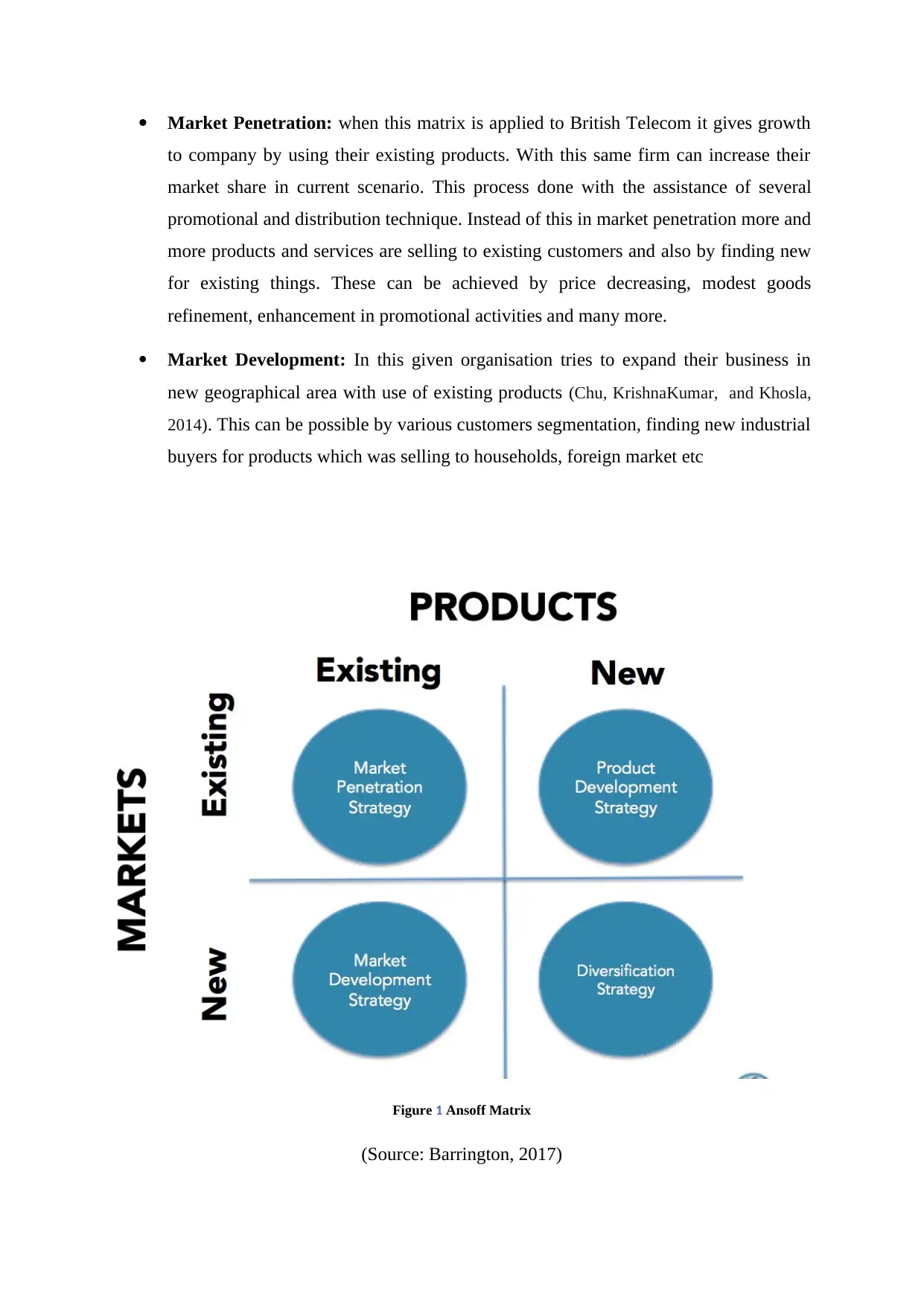
Market Penetration: when this matrix is applied to British Telecom it gives growth
to company by using their existing products. With this same firm can increase their
market share in current scenario. This process done with the assistance of several
promotional and distribution technique. Instead of this in market penetration more and
more products and services are selling to existing customers and also by finding new
for existing things. These can be achieved by price decreasing, modest goods
refinement, enhancement in promotional activities and many more.
Market Development: In this given organisation tries to expand their business in
new geographical area with use of existing products (Chu, KrishnaKumar, and Khosla,
2014). This can be possible by various customers segmentation, finding new industrial
buyers for products which was selling to households, foreign market etc
Figure 1 Ansoff Matrix
(Source: Barrington, 2017)
to company by using their existing products. With this same firm can increase their
market share in current scenario. This process done with the assistance of several
promotional and distribution technique. Instead of this in market penetration more and
more products and services are selling to existing customers and also by finding new
for existing things. These can be achieved by price decreasing, modest goods
refinement, enhancement in promotional activities and many more.
Market Development: In this given organisation tries to expand their business in
new geographical area with use of existing products (Chu, KrishnaKumar, and Khosla,
2014). This can be possible by various customers segmentation, finding new industrial
buyers for products which was selling to households, foreign market etc
Figure 1 Ansoff Matrix
(Source: Barrington, 2017)
⊘ This is a preview!⊘
Do you want full access?
Subscribe today to unlock all pages.
Trusted by 1+ million students worldwide
.
Product Development: BT group have to develop new product and services for their
existing market for achieving growth (Coad, 2011). In simple term its can be said that
goods range should be extend for existing customers and market. But firm have to do
market research before production for analysing need and demand of customers.
Diversification: through this company can grow its market share by offering new
products in new market. This strategy is risky because market and products both are
new.
TASK 2
P2
Strategic capability states that a commerce capability to efficaciously work reasonable
schemes that permit it to endure and enhance its value over time. Although there is no
particular or single process or worldwide metric for assessing or noting strategic ability is
given (Elliot, 2011). In simple term it can be said that strategic capabilities is set of skills and
knowledge that form long term competitive advantage for firm. For remaining in
environment which is full of competition strategic capability is required.
VRIN Model: - this model is founded in 1991 by Barney’s and it help in determining that
resources using by company is source of supportable for competitive advantage. VRIN model
is tool that help in identifying internal resources and capability of organisation. When this
frame work is applied in firm with its four attributes then it utilised resources and fund in
such manner that it will give competitive advantage to British Telecom Group (Ghezzi, 2013).
As per author resources should be worth, Unusual, poorly imitable and non- similar.
Valuable: First step of this framework is that is available resources adding value by allowing
BT group to exploit chances or protect against threats. If these are adding values then they
consider as valuable instead of this that can be also valuable when they helping company to
enhance the perceived customer value. It can be possible by product differentiation and
reducing price. For growth and development of business it is necessary to value resources
timely. Because dynamic business environment include external and internal factors which
make them less valuable or useless.
Product Development: BT group have to develop new product and services for their
existing market for achieving growth (Coad, 2011). In simple term its can be said that
goods range should be extend for existing customers and market. But firm have to do
market research before production for analysing need and demand of customers.
Diversification: through this company can grow its market share by offering new
products in new market. This strategy is risky because market and products both are
new.
TASK 2
P2
Strategic capability states that a commerce capability to efficaciously work reasonable
schemes that permit it to endure and enhance its value over time. Although there is no
particular or single process or worldwide metric for assessing or noting strategic ability is
given (Elliot, 2011). In simple term it can be said that strategic capabilities is set of skills and
knowledge that form long term competitive advantage for firm. For remaining in
environment which is full of competition strategic capability is required.
VRIN Model: - this model is founded in 1991 by Barney’s and it help in determining that
resources using by company is source of supportable for competitive advantage. VRIN model
is tool that help in identifying internal resources and capability of organisation. When this
frame work is applied in firm with its four attributes then it utilised resources and fund in
such manner that it will give competitive advantage to British Telecom Group (Ghezzi, 2013).
As per author resources should be worth, Unusual, poorly imitable and non- similar.
Valuable: First step of this framework is that is available resources adding value by allowing
BT group to exploit chances or protect against threats. If these are adding values then they
consider as valuable instead of this that can be also valuable when they helping company to
enhance the perceived customer value. It can be possible by product differentiation and
reducing price. For growth and development of business it is necessary to value resources
timely. Because dynamic business environment include external and internal factors which
make them less valuable or useless.
Paraphrase This Document
Need a fresh take? Get an instant paraphrase of this document with our AI Paraphraser
Rare: it simple means that which is not using by every organisation but only few companies
are using is known as rare. These give temporary competitive advantage on the other hand
when many of the enterprises are using same resources this have competitive parity. Because
of this reason administration has to use identical resources so no other can achieve superior
performance. In this situation BT Group don’t have to neglect such resources which are
common but valuable for them.
Costly to Imitate: producing goods again is costly and sometimes company cannot do this in
this situation they can buy substitute at minimum price or reasonable (Higgins, , Omer, and
Phillips, 2015). Imitation can be in two ways one is duplicating and other is substituting.
Organisation who have valuable, rare and costly to imitate resources can easily
achieve competitive advantage in market (Quartel, 2012). There are three reasons given by
Barney that why resources can be hard to imitate: historical condition, casual ambiguity and
social complexity.
are using is known as rare. These give temporary competitive advantage on the other hand
when many of the enterprises are using same resources this have competitive parity. Because
of this reason administration has to use identical resources so no other can achieve superior
performance. In this situation BT Group don’t have to neglect such resources which are
common but valuable for them.
Costly to Imitate: producing goods again is costly and sometimes company cannot do this in
this situation they can buy substitute at minimum price or reasonable (Higgins, , Omer, and
Phillips, 2015). Imitation can be in two ways one is duplicating and other is substituting.
Organisation who have valuable, rare and costly to imitate resources can easily
achieve competitive advantage in market (Quartel, 2012). There are three reasons given by
Barney that why resources can be hard to imitate: historical condition, casual ambiguity and
social complexity.
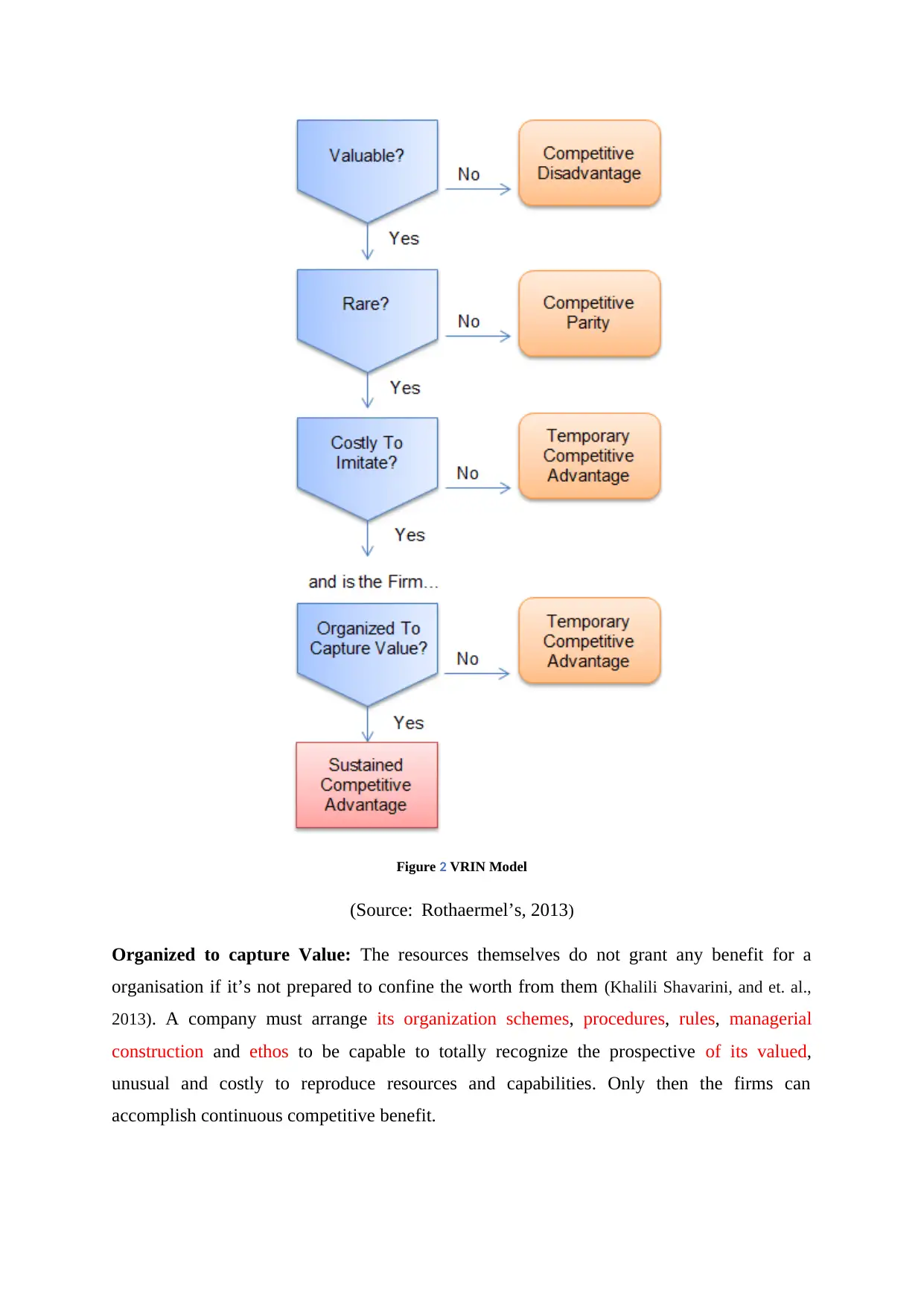
Figure 2 VRIN Model
(Source: Rothaermel’s, 2013)
Organized to capture Value: The resources themselves do not grant any benefit for a
organisation if it’s not prepared to confine the worth from them (Khalili Shavarini, and et. al.,
2013). A company must arrange its organization schemes, procedures, rules, managerial
construction and ethos to be capable to totally recognize the prospective of its valued,
unusual and costly to reproduce resources and capabilities. Only then the firms can
accomplish continuous competitive benefit.
(Source: Rothaermel’s, 2013)
Organized to capture Value: The resources themselves do not grant any benefit for a
organisation if it’s not prepared to confine the worth from them (Khalili Shavarini, and et. al.,
2013). A company must arrange its organization schemes, procedures, rules, managerial
construction and ethos to be capable to totally recognize the prospective of its valued,
unusual and costly to reproduce resources and capabilities. Only then the firms can
accomplish continuous competitive benefit.
⊘ This is a preview!⊘
Do you want full access?
Subscribe today to unlock all pages.
Trusted by 1+ million students worldwide
Strength of BT group- main strength is that they have market position because of
their brand name. As well because of their wide range of goods and services they are
providing. Like fixed line telephone, mobile phones, broad band, IT services and many more.
Name in market is the biggest strength of any business and this BT group have. Instead of
this they have healthy balance sheet which is full of cash flow from operations (Köseoglu, and
et. al., 2013). Provide satisfaction to customers with their goods and services they are serving.
Weakness of BT Group- Given company relay only on market of United Kingdom
for generating major revenues. Apart from this BT group have limited liquidity and
condemned for practices such as behavioural targeting. For this respective company have to
expand their business in several other nations also. So they can generate more and more
revenue which is necessary for sustain in environment which is full of competition.
TASK 3
P3
Porter’s five model analysis of BT group-
Threats of New Entrants: when new companies enter in telecommunication sector
they bring some innovative products and services and find new way of doing things.
These put impact on BT group with lower pricing strategy, reducing cost and
providing new values propositions to the customers (Li, and Tan, 2013). So for all these
respective enterprise build some effective barriers to come out from these.
Bargaining Power Of suppliers: for day to day activities there is requirement of raw
material which they purchase from suppliers. They are in foremost position can
reduce the margins BT Group Plc can earn in the market. Dominant suppliers in
Telecommunications sector utilize their bargaining power to remove high prices from
the enterprise in Telecommunications sector. The entire effect of high supplier
negotiating power is that it decreases the whole prosperity of Telecommunications.
Bargaining power of buyers: Buyers are those who want products at minimum price
as much as they can bargain (Maté, 2012). This results in long run profitability of BT
group. Because customer want to play less for product and services.
Threats from substitute products: when in market new products and services are
fulfilling need of customers in different way it suffers profitability of existing goods.
their brand name. As well because of their wide range of goods and services they are
providing. Like fixed line telephone, mobile phones, broad band, IT services and many more.
Name in market is the biggest strength of any business and this BT group have. Instead of
this they have healthy balance sheet which is full of cash flow from operations (Köseoglu, and
et. al., 2013). Provide satisfaction to customers with their goods and services they are serving.
Weakness of BT Group- Given company relay only on market of United Kingdom
for generating major revenues. Apart from this BT group have limited liquidity and
condemned for practices such as behavioural targeting. For this respective company have to
expand their business in several other nations also. So they can generate more and more
revenue which is necessary for sustain in environment which is full of competition.
TASK 3
P3
Porter’s five model analysis of BT group-
Threats of New Entrants: when new companies enter in telecommunication sector
they bring some innovative products and services and find new way of doing things.
These put impact on BT group with lower pricing strategy, reducing cost and
providing new values propositions to the customers (Li, and Tan, 2013). So for all these
respective enterprise build some effective barriers to come out from these.
Bargaining Power Of suppliers: for day to day activities there is requirement of raw
material which they purchase from suppliers. They are in foremost position can
reduce the margins BT Group Plc can earn in the market. Dominant suppliers in
Telecommunications sector utilize their bargaining power to remove high prices from
the enterprise in Telecommunications sector. The entire effect of high supplier
negotiating power is that it decreases the whole prosperity of Telecommunications.
Bargaining power of buyers: Buyers are those who want products at minimum price
as much as they can bargain (Maté, 2012). This results in long run profitability of BT
group. Because customer want to play less for product and services.
Threats from substitute products: when in market new products and services are
fulfilling need of customers in different way it suffers profitability of existing goods.
Paraphrase This Document
Need a fresh take? Get an instant paraphrase of this document with our AI Paraphraser
The threat of an alternative goods or service is high if it offers a value proposition that
is unique and different from existing things of the company.
Rivalry among the existing players: If the competition between the existing firms
in an industry is strong then it will force down prices and low the entire profitability
of the organisation (Trujillo, and Mylopoulos, 2012). BT Group Plc operates in an
extremely rivalry Telecommunications industry.
There are seven types of competitive strategy which improve competitive edge of British
Telecom. Because business environment is full of competition is it is not easy to remain in
this competitive industry without some edges that give advantages. These are given below:-
Cost Leadership Strategy: - cost is best competitive advantage through this
company put themselves out from the other firms by providing attractive pricing.
Because every individual want products at low price basically this is desire of
customers to purchase goods at low cost. This strategy help British telecom in
attracting more and more customers towards their goods and services which they are
offering at low price compare to others.
Differentiation strategy: - brand is the term which is using by enterprises for
creating differentiation from product of one company to other. For example Vodafone
and BT Group both have their individual brand identity which helps in differentiating
them from each other. Brand is the things through which people purchase products
after seeing their logos, image, colour etc. person executives by this method should
look for finding mainstay strength or talent that separate them from the pack (Matzler,
and et. al., 2013). Then they influence this exclusive skill or ability through raising
their visibility and the observation of its value to the company.
Innovation Strategy: - BT group provide some innovative products and services to
customer and this is the way through which company is moving towards competitive
advantages. Innovation and creation can easily attract customers towards services
because everyone wants new things. As per current scenario most of the people get
bored with existing and old goods and services as well want something new.
Operational Effectiveness Strategy: - few organisations just do what they do in
good manner than other firms. When British Telecom do their operational activities in
better manner than it help in remaining them in environment which is full of
competition. Respective enterprises don’t get affect with entry and exist of new
is unique and different from existing things of the company.
Rivalry among the existing players: If the competition between the existing firms
in an industry is strong then it will force down prices and low the entire profitability
of the organisation (Trujillo, and Mylopoulos, 2012). BT Group Plc operates in an
extremely rivalry Telecommunications industry.
There are seven types of competitive strategy which improve competitive edge of British
Telecom. Because business environment is full of competition is it is not easy to remain in
this competitive industry without some edges that give advantages. These are given below:-
Cost Leadership Strategy: - cost is best competitive advantage through this
company put themselves out from the other firms by providing attractive pricing.
Because every individual want products at low price basically this is desire of
customers to purchase goods at low cost. This strategy help British telecom in
attracting more and more customers towards their goods and services which they are
offering at low price compare to others.
Differentiation strategy: - brand is the term which is using by enterprises for
creating differentiation from product of one company to other. For example Vodafone
and BT Group both have their individual brand identity which helps in differentiating
them from each other. Brand is the things through which people purchase products
after seeing their logos, image, colour etc. person executives by this method should
look for finding mainstay strength or talent that separate them from the pack (Matzler,
and et. al., 2013). Then they influence this exclusive skill or ability through raising
their visibility and the observation of its value to the company.
Innovation Strategy: - BT group provide some innovative products and services to
customer and this is the way through which company is moving towards competitive
advantages. Innovation and creation can easily attract customers towards services
because everyone wants new things. As per current scenario most of the people get
bored with existing and old goods and services as well want something new.
Operational Effectiveness Strategy: - few organisations just do what they do in
good manner than other firms. When British Telecom do their operational activities in
better manner than it help in remaining them in environment which is full of
competition. Respective enterprises don’t get affect with entry and exist of new
organisation (Mehta, 2011). When given enterprise doing something very well they
have to do those continue because this is their competitive advantage.
Technology Based Competitive Strategy: - when company using latest and updating
technologies in their production they get fine quality of products with minimum use
of resources and funds. Now a day’s new technologies are coming with latest features
but implementing these are expensive works. For this there is requirement of training
and development program to employees which is conducted by manager or leader of
enterprise.
Adaptability competitive advantage: - As markets, economies, and former factors
modify in this more and more uneven and irregular environment, organisation that can
get used to have a different benefit. Usually this consider smaller or trendy enterprise,
Executives can get adaptability to their mainstay strength by being open to modify.
They can cross train and bring latest and more present skills to the desk. Possibly,
adaptability is primarily a situation of mind.
The Information Advantage: - exactly all the former strategies assistance from
tremendous information (Montgomery, 2011). Meaning of competitive advantage is the
skills required to outpace your competition. Generally, those come through
understanding, awareness and information. Victorious enterprises look for the latest
things in technology, strategies, and data so on.
TASK 4
P4
Bowman’s Strategy Clock Model – This model is useful for marketing to examine position
of competitive of an organisation in judgment to the offerings of competitors (Mehta, 2011).
It looks like clock.
Low Price and Low Value added: this is not extremely competitive position for a
company. Goods and services are not differentiated and clients perceive very few
values, although a low price.
Low Price: cost minimisation strategy help in success of low pricing. In this profit
margin of companies is low but when there is huge output can generate high overall
profit.
have to do those continue because this is their competitive advantage.
Technology Based Competitive Strategy: - when company using latest and updating
technologies in their production they get fine quality of products with minimum use
of resources and funds. Now a day’s new technologies are coming with latest features
but implementing these are expensive works. For this there is requirement of training
and development program to employees which is conducted by manager or leader of
enterprise.
Adaptability competitive advantage: - As markets, economies, and former factors
modify in this more and more uneven and irregular environment, organisation that can
get used to have a different benefit. Usually this consider smaller or trendy enterprise,
Executives can get adaptability to their mainstay strength by being open to modify.
They can cross train and bring latest and more present skills to the desk. Possibly,
adaptability is primarily a situation of mind.
The Information Advantage: - exactly all the former strategies assistance from
tremendous information (Montgomery, 2011). Meaning of competitive advantage is the
skills required to outpace your competition. Generally, those come through
understanding, awareness and information. Victorious enterprises look for the latest
things in technology, strategies, and data so on.
TASK 4
P4
Bowman’s Strategy Clock Model – This model is useful for marketing to examine position
of competitive of an organisation in judgment to the offerings of competitors (Mehta, 2011).
It looks like clock.
Low Price and Low Value added: this is not extremely competitive position for a
company. Goods and services are not differentiated and clients perceive very few
values, although a low price.
Low Price: cost minimisation strategy help in success of low pricing. In this profit
margin of companies is low but when there is huge output can generate high overall
profit.
⊘ This is a preview!⊘
Do you want full access?
Subscribe today to unlock all pages.
Trusted by 1+ million students worldwide

1 out of 17


Related Documents


Your All-in-One AI-Powered Toolkit for Academic Success.
+13062052269
info@desklib.com
Available 24*7 on WhatsApp / Email
![[object Object]](/_next/static/media/star-bottom.7253800d.svg)
Unlock your academic potential
Copyright © 2020–2026 A2Z Services. All Rights Reserved. Developed and managed by ZUCOL.