Unit 13 Financial Reporting: Standards and Global Market Analysis
VerifiedAdded on 2023/06/30
|14
|4033
|487
Report
AI Summary
This report provides a detailed analysis of financial reporting in global markets, focusing on the context, purpose, and evaluation of financial reporting standards. It assesses the role of financial reporting in meeting stakeholder expectations, predicting future performance, and ensuring compliance. The report evaluates the benefits of IAS and IFRS, highlighting their impact on transparency, consistency, and comparability of financial information. It also addresses the differences between IAS and IFRS and their application in global financial reporting practices. This document is available on Desklib, a platform offering a wide range of study tools and resources for students.
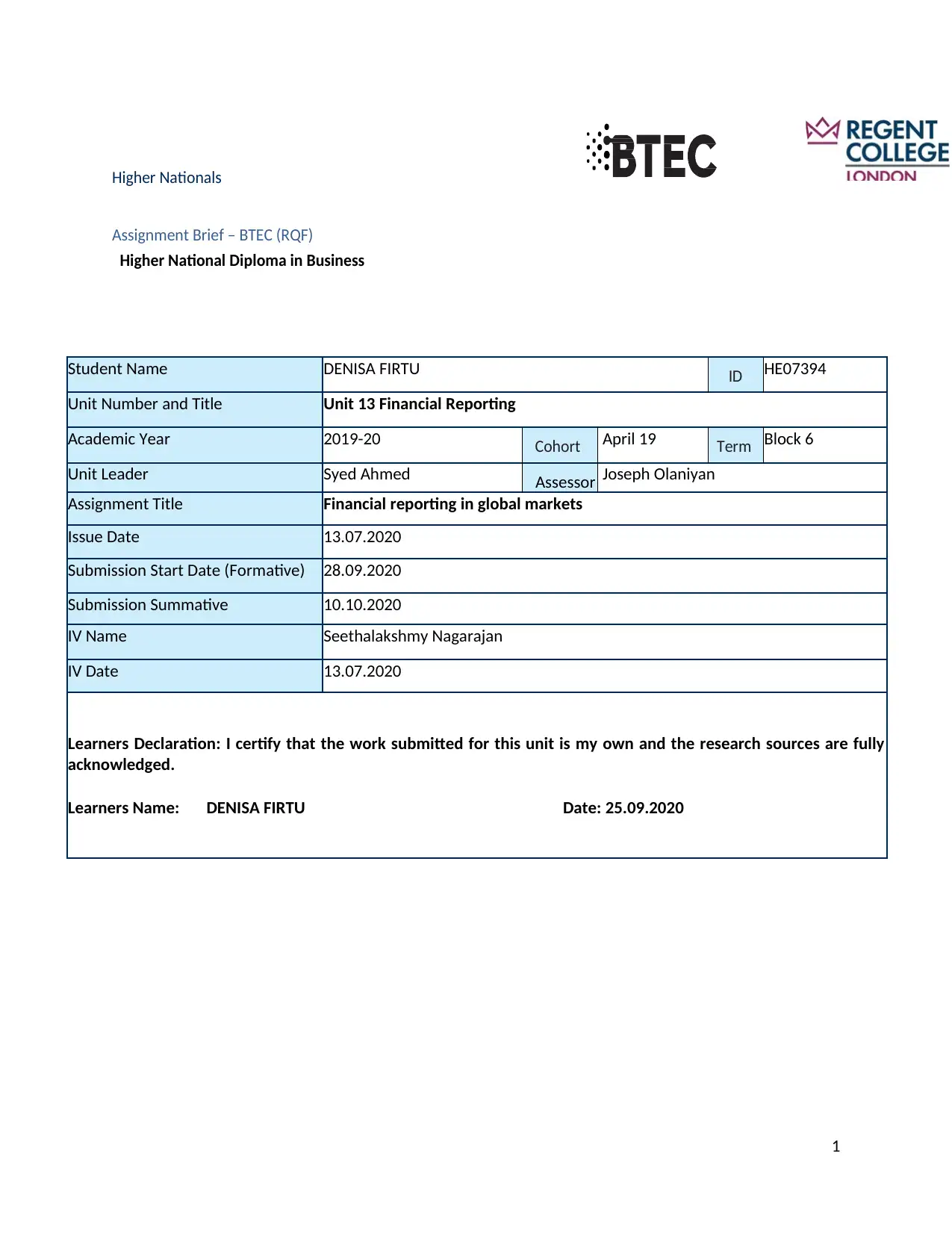
Higher Nationals
Assignment Brief – BTEC (RQF)
Higher National Diploma in Business
Student Name DENISA FIRTU ID HE07394
Unit Number and Title Unit 13 Financial Reporting
Academic Year 2019-20 Cohort April 19 Term Block 6
Unit Leader Syed Ahmed Assessor Joseph Olaniyan
Assignment Title Financial reporting in global markets
Issue Date 13.07.2020
Submission Start Date (Formative) 28.09.2020
Submission Summative 10.10.2020
IV Name Seethalakshmy Nagarajan
IV Date 13.07.2020
Learners Declaration: I certify that the work submitted for this unit is my own and the research sources are fully
acknowledged.
Learners Name: DENISA FIRTU Date: 25.09.2020
1
Assignment Brief – BTEC (RQF)
Higher National Diploma in Business
Student Name DENISA FIRTU ID HE07394
Unit Number and Title Unit 13 Financial Reporting
Academic Year 2019-20 Cohort April 19 Term Block 6
Unit Leader Syed Ahmed Assessor Joseph Olaniyan
Assignment Title Financial reporting in global markets
Issue Date 13.07.2020
Submission Start Date (Formative) 28.09.2020
Submission Summative 10.10.2020
IV Name Seethalakshmy Nagarajan
IV Date 13.07.2020
Learners Declaration: I certify that the work submitted for this unit is my own and the research sources are fully
acknowledged.
Learners Name: DENISA FIRTU Date: 25.09.2020
1

Paraphrase This Document
Need a fresh take? Get an instant paraphrase of this document with our AI Paraphraser
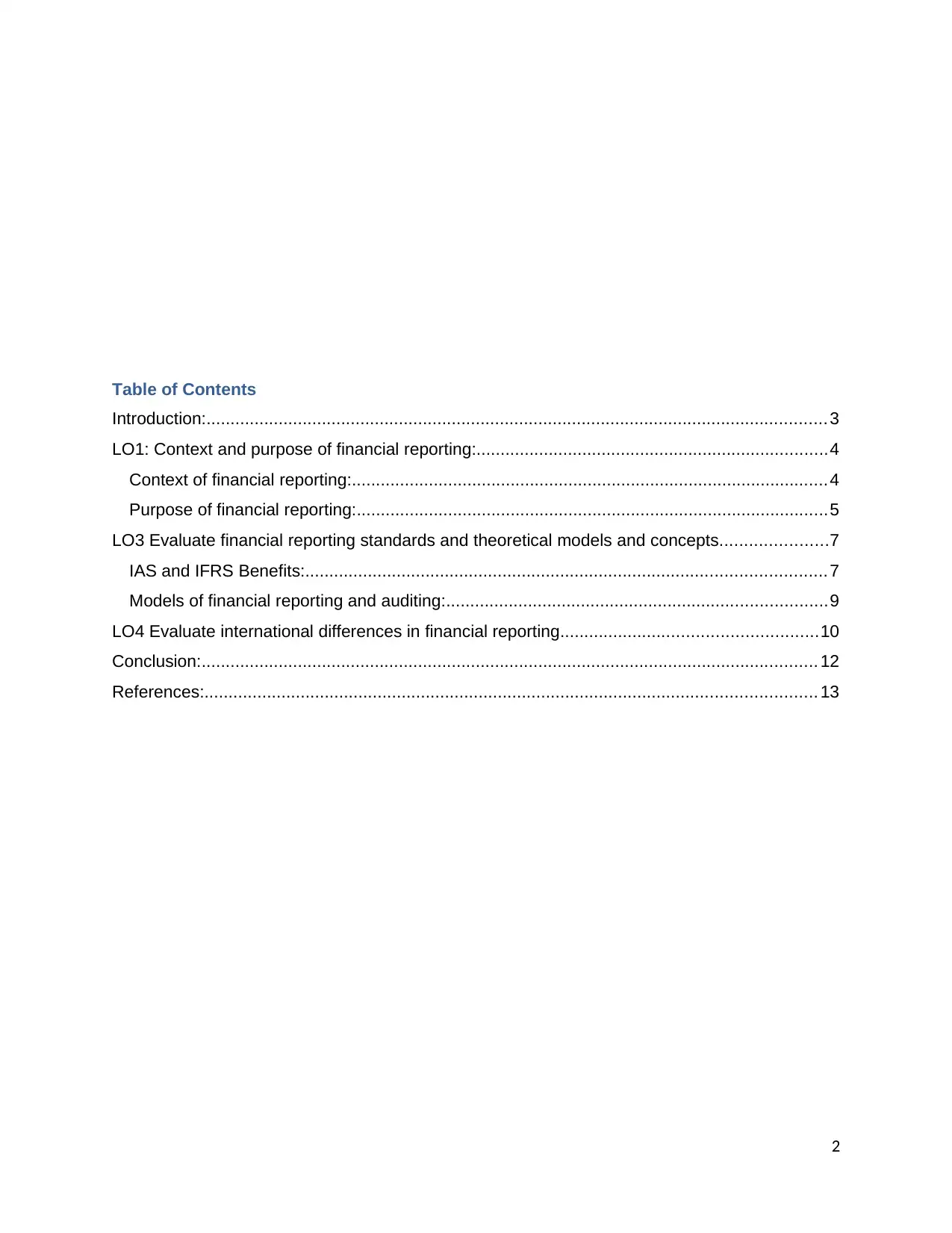
Table of Contents
Introduction:................................................................................................................................. 3
LO1: Context and purpose of financial reporting:.........................................................................4
Context of financial reporting:...................................................................................................4
Purpose of financial reporting:..................................................................................................5
LO3 Evaluate financial reporting standards and theoretical models and concepts......................7
IAS and IFRS Benefits:............................................................................................................ 7
Models of financial reporting and auditing:...............................................................................9
LO4 Evaluate international differences in financial reporting.....................................................10
Conclusion:................................................................................................................................ 12
References:............................................................................................................................... 13
2
Introduction:................................................................................................................................. 3
LO1: Context and purpose of financial reporting:.........................................................................4
Context of financial reporting:...................................................................................................4
Purpose of financial reporting:..................................................................................................5
LO3 Evaluate financial reporting standards and theoretical models and concepts......................7
IAS and IFRS Benefits:............................................................................................................ 7
Models of financial reporting and auditing:...............................................................................9
LO4 Evaluate international differences in financial reporting.....................................................10
Conclusion:................................................................................................................................ 12
References:............................................................................................................................... 13
2
Introduction:
The purpose of this research study is to analyze the financial reporting by consigning the
context and purpose of the reporting. It will include the analysis of the different objectives for
which financial reporting is made by the businesses. It will include the assessment of the
difference between the IFRS and IAS that regulates the accounting and reporting practices
within the company. In addition to this, the degree to which the businesses are abiding by the
IFRS and other standards will be analyzed in this report.
3
The purpose of this research study is to analyze the financial reporting by consigning the
context and purpose of the reporting. It will include the analysis of the different objectives for
which financial reporting is made by the businesses. It will include the assessment of the
difference between the IFRS and IAS that regulates the accounting and reporting practices
within the company. In addition to this, the degree to which the businesses are abiding by the
IFRS and other standards will be analyzed in this report.
3
⊘ This is a preview!⊘
Do you want full access?
Subscribe today to unlock all pages.

Trusted by 1+ million students worldwide
LO1: Context and purpose of financial reporting:
Context of financial reporting:
A report that is used for presenting and revealing the information to the stakeholder of the firm
to make them aware of the performance, financial issues, and other accounting information of
the company (Ankarath et al., 2010). A process of preparing the financial accounts and
developing the statements in the report can be stated as the financial reporting that can be
affected the stakeholder such as shareholders, lenders, management, suppliers, government,
and others. The financial reports must include a statement of the financial position, income
statement, change in equity, and cash flow statement along with financial notes to avail detailed
information to the users (Epstein and Jermakowicz, 2010). The report of the businesses must
be prepared by including the document such as risk management report, report of CEO,
Director’s report, and others. The compliance with guidelines mentioned in the laws and
accounting regulations must be followed by the businesses to prepare a valid report.
The regulations for the reporting are the conceptual framework to govern the process of
preparation of the financial statement and preparing the reports. It creates a strong framework
that is used for preparing the financial stamen in the report and it improves the effectiveness in
the reporting (Ankarath et al., 2010). The regulatory framework includes the law of lend,
conceptual framework, and reporting standards. The regulatory frameworks that have to be
abided by the businesses may include the regulations, guidelines, standards, procedures, code
of conduct, and others.
Law of Land is applied like legislation to govern and regulate the firms for the creation of
recording documents for all the kinds of information and for developing the statements to
publish the information. All the firms incorporated and registered are bound for preparing he
reports for the stakeholder while the firms which are not incorporated are not legally bound that
they must create reports for their self-assessment of financial performance (Louwers et al.,
2015).
Along with this, there are some standards in the compliance framework that has to be
considered by organizations while building up and develop financial reports. These standards
include GAAP, IFRS, IAS, and local accounting standards (Van Greuning et al., 2011). The
functioning and rules in each standard and reporting rules are developed by the IASC and other
4
Context of financial reporting:
A report that is used for presenting and revealing the information to the stakeholder of the firm
to make them aware of the performance, financial issues, and other accounting information of
the company (Ankarath et al., 2010). A process of preparing the financial accounts and
developing the statements in the report can be stated as the financial reporting that can be
affected the stakeholder such as shareholders, lenders, management, suppliers, government,
and others. The financial reports must include a statement of the financial position, income
statement, change in equity, and cash flow statement along with financial notes to avail detailed
information to the users (Epstein and Jermakowicz, 2010). The report of the businesses must
be prepared by including the document such as risk management report, report of CEO,
Director’s report, and others. The compliance with guidelines mentioned in the laws and
accounting regulations must be followed by the businesses to prepare a valid report.
The regulations for the reporting are the conceptual framework to govern the process of
preparation of the financial statement and preparing the reports. It creates a strong framework
that is used for preparing the financial stamen in the report and it improves the effectiveness in
the reporting (Ankarath et al., 2010). The regulatory framework includes the law of lend,
conceptual framework, and reporting standards. The regulatory frameworks that have to be
abided by the businesses may include the regulations, guidelines, standards, procedures, code
of conduct, and others.
Law of Land is applied like legislation to govern and regulate the firms for the creation of
recording documents for all the kinds of information and for developing the statements to
publish the information. All the firms incorporated and registered are bound for preparing he
reports for the stakeholder while the firms which are not incorporated are not legally bound that
they must create reports for their self-assessment of financial performance (Louwers et al.,
2015).
Along with this, there are some standards in the compliance framework that has to be
considered by organizations while building up and develop financial reports. These standards
include GAAP, IFRS, IAS, and local accounting standards (Van Greuning et al., 2011). The
functioning and rules in each standard and reporting rules are developed by the IASC and other
4
Paraphrase This Document
Need a fresh take? Get an instant paraphrase of this document with our AI Paraphraser
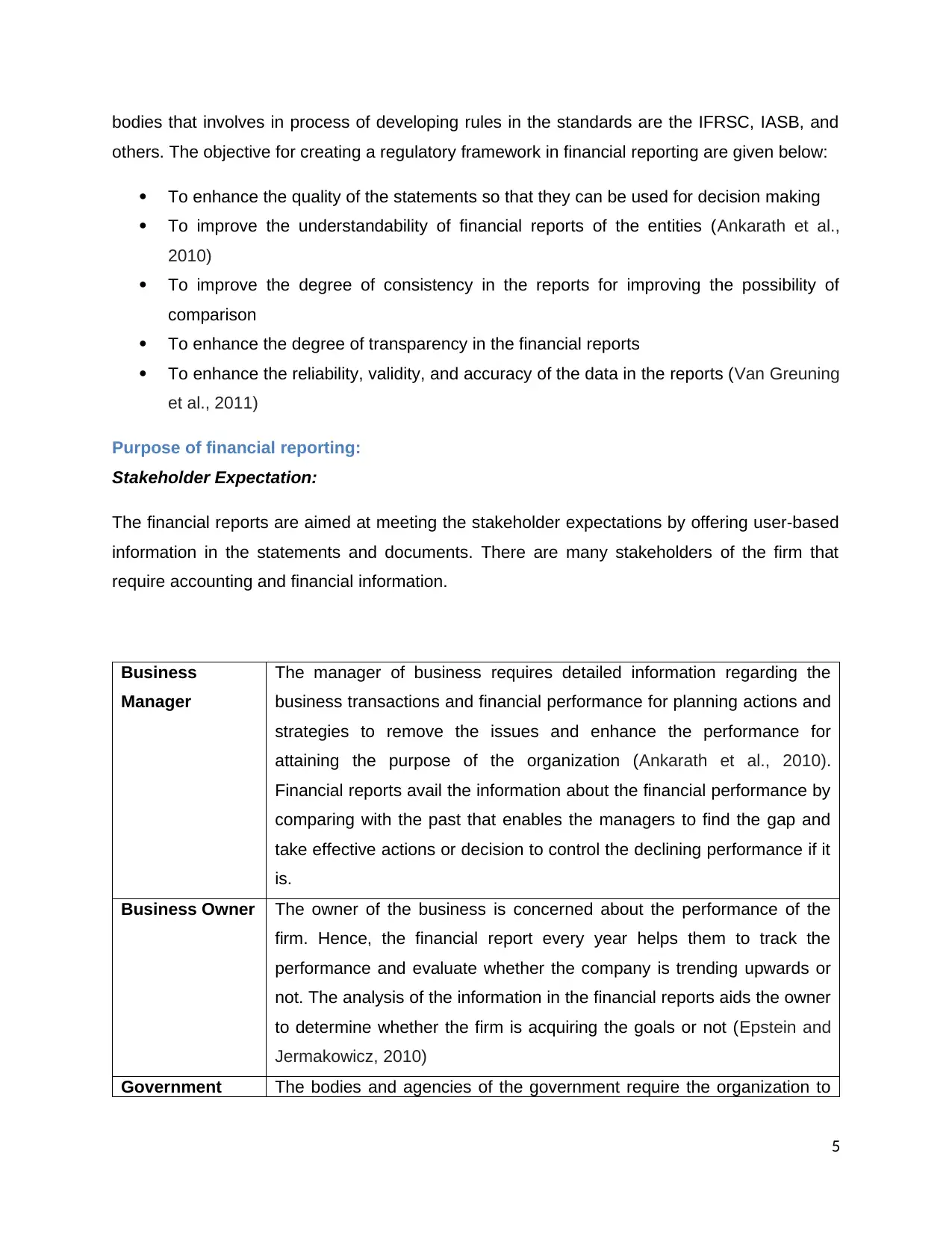
bodies that involves in process of developing rules in the standards are the IFRSC, IASB, and
others. The objective for creating a regulatory framework in financial reporting are given below:
To enhance the quality of the statements so that they can be used for decision making
To improve the understandability of financial reports of the entities (Ankarath et al.,
2010)
To improve the degree of consistency in the reports for improving the possibility of
comparison
To enhance the degree of transparency in the financial reports
To enhance the reliability, validity, and accuracy of the data in the reports (Van Greuning
et al., 2011)
Purpose of financial reporting:
Stakeholder Expectation:
The financial reports are aimed at meeting the stakeholder expectations by offering user-based
information in the statements and documents. There are many stakeholders of the firm that
require accounting and financial information.
Business
Manager
The manager of business requires detailed information regarding the
business transactions and financial performance for planning actions and
strategies to remove the issues and enhance the performance for
attaining the purpose of the organization (Ankarath et al., 2010).
Financial reports avail the information about the financial performance by
comparing with the past that enables the managers to find the gap and
take effective actions or decision to control the declining performance if it
is.
Business Owner The owner of the business is concerned about the performance of the
firm. Hence, the financial report every year helps them to track the
performance and evaluate whether the company is trending upwards or
not. The analysis of the information in the financial reports aids the owner
to determine whether the firm is acquiring the goals or not (Epstein and
Jermakowicz, 2010)
Government The bodies and agencies of the government require the organization to
5
others. The objective for creating a regulatory framework in financial reporting are given below:
To enhance the quality of the statements so that they can be used for decision making
To improve the understandability of financial reports of the entities (Ankarath et al.,
2010)
To improve the degree of consistency in the reports for improving the possibility of
comparison
To enhance the degree of transparency in the financial reports
To enhance the reliability, validity, and accuracy of the data in the reports (Van Greuning
et al., 2011)
Purpose of financial reporting:
Stakeholder Expectation:
The financial reports are aimed at meeting the stakeholder expectations by offering user-based
information in the statements and documents. There are many stakeholders of the firm that
require accounting and financial information.
Business
Manager
The manager of business requires detailed information regarding the
business transactions and financial performance for planning actions and
strategies to remove the issues and enhance the performance for
attaining the purpose of the organization (Ankarath et al., 2010).
Financial reports avail the information about the financial performance by
comparing with the past that enables the managers to find the gap and
take effective actions or decision to control the declining performance if it
is.
Business Owner The owner of the business is concerned about the performance of the
firm. Hence, the financial report every year helps them to track the
performance and evaluate whether the company is trending upwards or
not. The analysis of the information in the financial reports aids the owner
to determine whether the firm is acquiring the goals or not (Epstein and
Jermakowicz, 2010)
Government The bodies and agencies of the government require the organization to
5
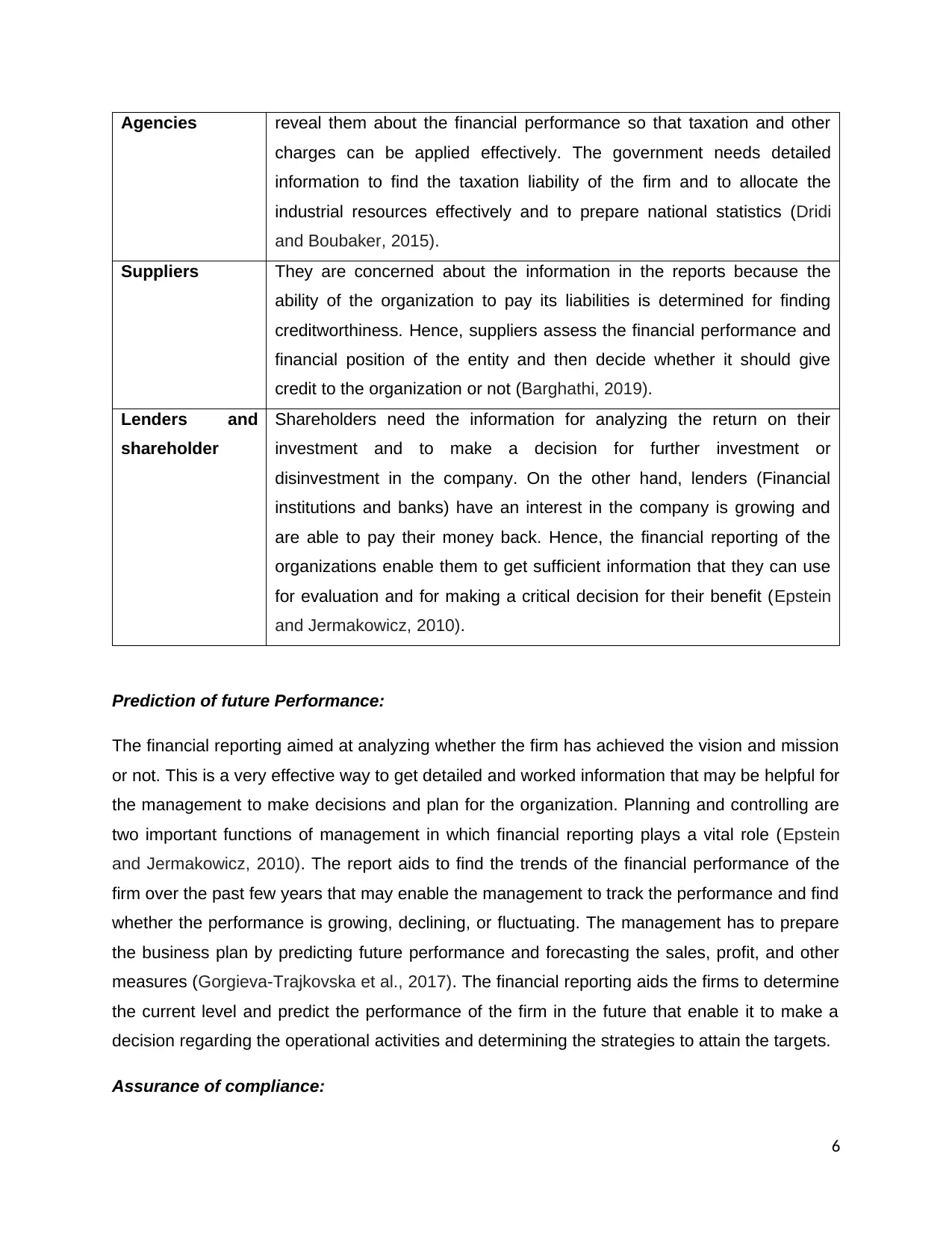
Agencies reveal them about the financial performance so that taxation and other
charges can be applied effectively. The government needs detailed
information to find the taxation liability of the firm and to allocate the
industrial resources effectively and to prepare national statistics (Dridi
and Boubaker, 2015).
Suppliers They are concerned about the information in the reports because the
ability of the organization to pay its liabilities is determined for finding
creditworthiness. Hence, suppliers assess the financial performance and
financial position of the entity and then decide whether it should give
credit to the organization or not (Barghathi, 2019).
Lenders and
shareholder
Shareholders need the information for analyzing the return on their
investment and to make a decision for further investment or
disinvestment in the company. On the other hand, lenders (Financial
institutions and banks) have an interest in the company is growing and
are able to pay their money back. Hence, the financial reporting of the
organizations enable them to get sufficient information that they can use
for evaluation and for making a critical decision for their benefit (Epstein
and Jermakowicz, 2010).
Prediction of future Performance:
The financial reporting aimed at analyzing whether the firm has achieved the vision and mission
or not. This is a very effective way to get detailed and worked information that may be helpful for
the management to make decisions and plan for the organization. Planning and controlling are
two important functions of management in which financial reporting plays a vital role (Epstein
and Jermakowicz, 2010). The report aids to find the trends of the financial performance of the
firm over the past few years that may enable the management to track the performance and find
whether the performance is growing, declining, or fluctuating. The management has to prepare
the business plan by predicting future performance and forecasting the sales, profit, and other
measures (Gorgieva-Trajkovska et al., 2017). The financial reporting aids the firms to determine
the current level and predict the performance of the firm in the future that enable it to make a
decision regarding the operational activities and determining the strategies to attain the targets.
Assurance of compliance:
6
charges can be applied effectively. The government needs detailed
information to find the taxation liability of the firm and to allocate the
industrial resources effectively and to prepare national statistics (Dridi
and Boubaker, 2015).
Suppliers They are concerned about the information in the reports because the
ability of the organization to pay its liabilities is determined for finding
creditworthiness. Hence, suppliers assess the financial performance and
financial position of the entity and then decide whether it should give
credit to the organization or not (Barghathi, 2019).
Lenders and
shareholder
Shareholders need the information for analyzing the return on their
investment and to make a decision for further investment or
disinvestment in the company. On the other hand, lenders (Financial
institutions and banks) have an interest in the company is growing and
are able to pay their money back. Hence, the financial reporting of the
organizations enable them to get sufficient information that they can use
for evaluation and for making a critical decision for their benefit (Epstein
and Jermakowicz, 2010).
Prediction of future Performance:
The financial reporting aimed at analyzing whether the firm has achieved the vision and mission
or not. This is a very effective way to get detailed and worked information that may be helpful for
the management to make decisions and plan for the organization. Planning and controlling are
two important functions of management in which financial reporting plays a vital role (Epstein
and Jermakowicz, 2010). The report aids to find the trends of the financial performance of the
firm over the past few years that may enable the management to track the performance and find
whether the performance is growing, declining, or fluctuating. The management has to prepare
the business plan by predicting future performance and forecasting the sales, profit, and other
measures (Gorgieva-Trajkovska et al., 2017). The financial reporting aids the firms to determine
the current level and predict the performance of the firm in the future that enable it to make a
decision regarding the operational activities and determining the strategies to attain the targets.
Assurance of compliance:
6
⊘ This is a preview!⊘
Do you want full access?
Subscribe today to unlock all pages.
Trusted by 1+ million students worldwide
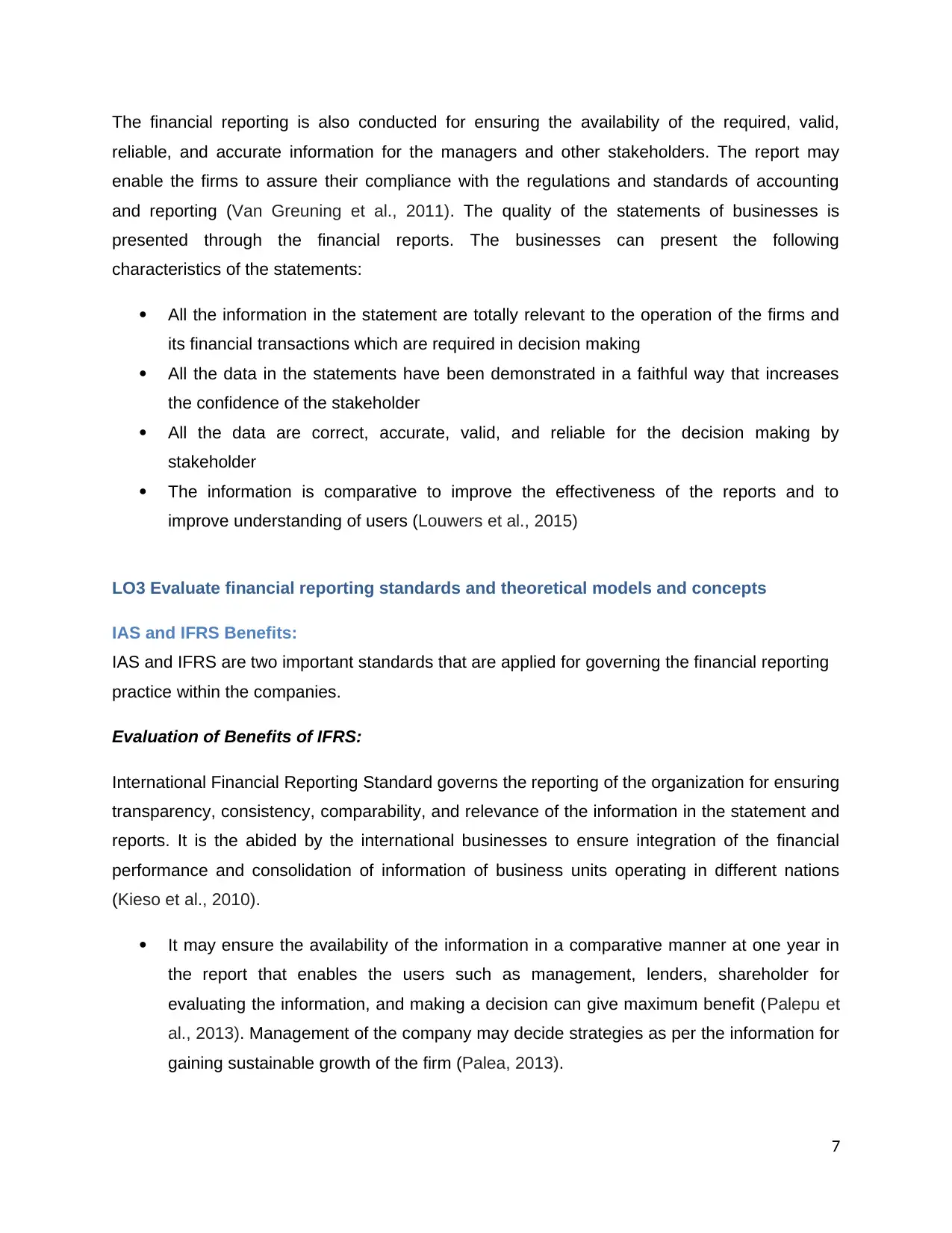
The financial reporting is also conducted for ensuring the availability of the required, valid,
reliable, and accurate information for the managers and other stakeholders. The report may
enable the firms to assure their compliance with the regulations and standards of accounting
and reporting (Van Greuning et al., 2011). The quality of the statements of businesses is
presented through the financial reports. The businesses can present the following
characteristics of the statements:
All the information in the statement are totally relevant to the operation of the firms and
its financial transactions which are required in decision making
All the data in the statements have been demonstrated in a faithful way that increases
the confidence of the stakeholder
All the data are correct, accurate, valid, and reliable for the decision making by
stakeholder
The information is comparative to improve the effectiveness of the reports and to
improve understanding of users (Louwers et al., 2015)
LO3 Evaluate financial reporting standards and theoretical models and concepts
IAS and IFRS Benefits:
IAS and IFRS are two important standards that are applied for governing the financial reporting
practice within the companies.
Evaluation of Benefits of IFRS:
International Financial Reporting Standard governs the reporting of the organization for ensuring
transparency, consistency, comparability, and relevance of the information in the statement and
reports. It is the abided by the international businesses to ensure integration of the financial
performance and consolidation of information of business units operating in different nations
(Kieso et al., 2010).
It may ensure the availability of the information in a comparative manner at one year in
the report that enables the users such as management, lenders, shareholder for
evaluating the information, and making a decision can give maximum benefit (Palepu et
al., 2013). Management of the company may decide strategies as per the information for
gaining sustainable growth of the firm (Palea, 2013).
7
reliable, and accurate information for the managers and other stakeholders. The report may
enable the firms to assure their compliance with the regulations and standards of accounting
and reporting (Van Greuning et al., 2011). The quality of the statements of businesses is
presented through the financial reports. The businesses can present the following
characteristics of the statements:
All the information in the statement are totally relevant to the operation of the firms and
its financial transactions which are required in decision making
All the data in the statements have been demonstrated in a faithful way that increases
the confidence of the stakeholder
All the data are correct, accurate, valid, and reliable for the decision making by
stakeholder
The information is comparative to improve the effectiveness of the reports and to
improve understanding of users (Louwers et al., 2015)
LO3 Evaluate financial reporting standards and theoretical models and concepts
IAS and IFRS Benefits:
IAS and IFRS are two important standards that are applied for governing the financial reporting
practice within the companies.
Evaluation of Benefits of IFRS:
International Financial Reporting Standard governs the reporting of the organization for ensuring
transparency, consistency, comparability, and relevance of the information in the statement and
reports. It is the abided by the international businesses to ensure integration of the financial
performance and consolidation of information of business units operating in different nations
(Kieso et al., 2010).
It may ensure the availability of the information in a comparative manner at one year in
the report that enables the users such as management, lenders, shareholder for
evaluating the information, and making a decision can give maximum benefit (Palepu et
al., 2013). Management of the company may decide strategies as per the information for
gaining sustainable growth of the firm (Palea, 2013).
7
Paraphrase This Document
Need a fresh take? Get an instant paraphrase of this document with our AI Paraphraser
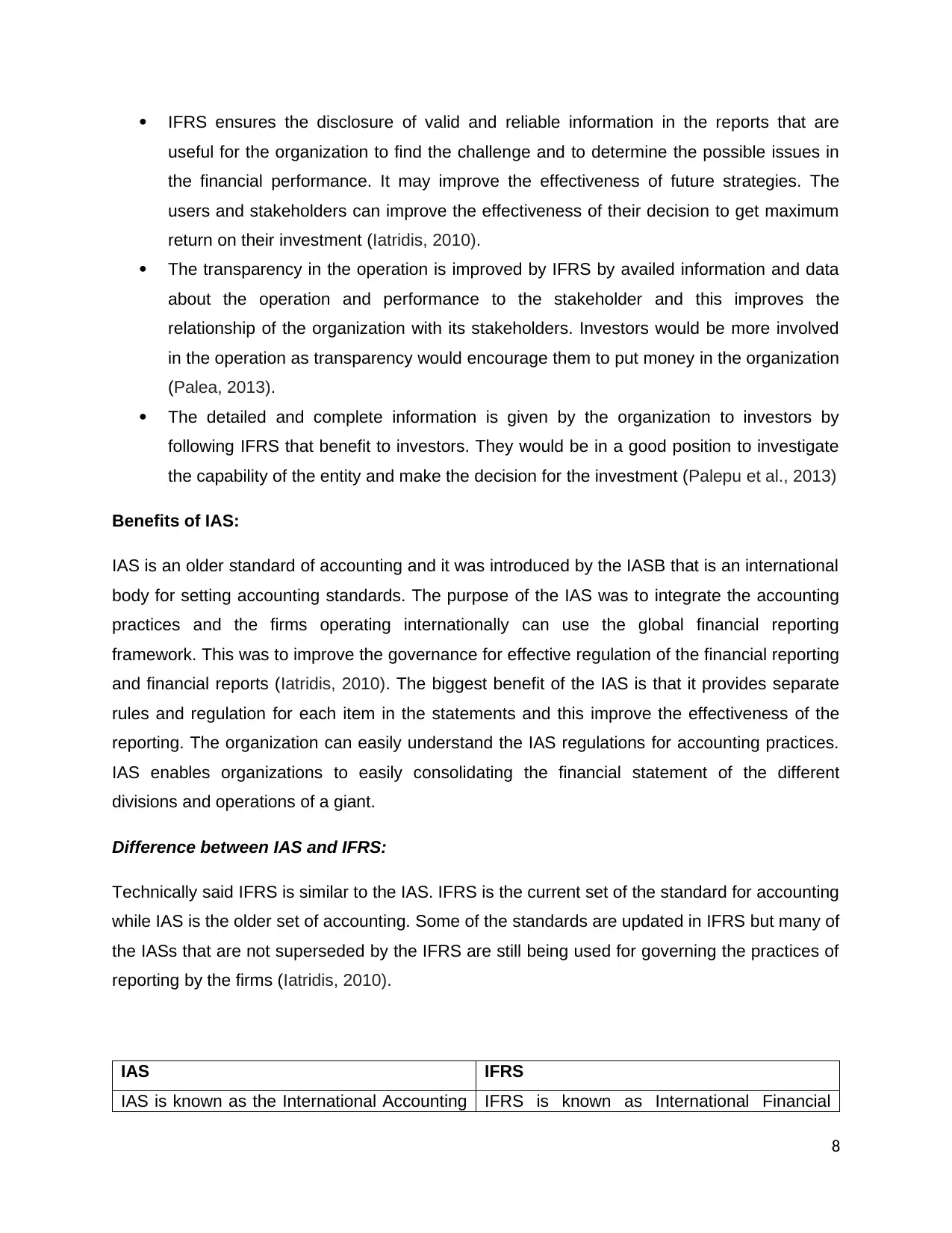
IFRS ensures the disclosure of valid and reliable information in the reports that are
useful for the organization to find the challenge and to determine the possible issues in
the financial performance. It may improve the effectiveness of future strategies. The
users and stakeholders can improve the effectiveness of their decision to get maximum
return on their investment (Iatridis, 2010).
The transparency in the operation is improved by IFRS by availed information and data
about the operation and performance to the stakeholder and this improves the
relationship of the organization with its stakeholders. Investors would be more involved
in the operation as transparency would encourage them to put money in the organization
(Palea, 2013).
The detailed and complete information is given by the organization to investors by
following IFRS that benefit to investors. They would be in a good position to investigate
the capability of the entity and make the decision for the investment (Palepu et al., 2013)
Benefits of IAS:
IAS is an older standard of accounting and it was introduced by the IASB that is an international
body for setting accounting standards. The purpose of the IAS was to integrate the accounting
practices and the firms operating internationally can use the global financial reporting
framework. This was to improve the governance for effective regulation of the financial reporting
and financial reports (Iatridis, 2010). The biggest benefit of the IAS is that it provides separate
rules and regulation for each item in the statements and this improve the effectiveness of the
reporting. The organization can easily understand the IAS regulations for accounting practices.
IAS enables organizations to easily consolidating the financial statement of the different
divisions and operations of a giant.
Difference between IAS and IFRS:
Technically said IFRS is similar to the IAS. IFRS is the current set of the standard for accounting
while IAS is the older set of accounting. Some of the standards are updated in IFRS but many of
the IASs that are not superseded by the IFRS are still being used for governing the practices of
reporting by the firms (Iatridis, 2010).
IAS IFRS
IAS is known as the International Accounting IFRS is known as International Financial
8
useful for the organization to find the challenge and to determine the possible issues in
the financial performance. It may improve the effectiveness of future strategies. The
users and stakeholders can improve the effectiveness of their decision to get maximum
return on their investment (Iatridis, 2010).
The transparency in the operation is improved by IFRS by availed information and data
about the operation and performance to the stakeholder and this improves the
relationship of the organization with its stakeholders. Investors would be more involved
in the operation as transparency would encourage them to put money in the organization
(Palea, 2013).
The detailed and complete information is given by the organization to investors by
following IFRS that benefit to investors. They would be in a good position to investigate
the capability of the entity and make the decision for the investment (Palepu et al., 2013)
Benefits of IAS:
IAS is an older standard of accounting and it was introduced by the IASB that is an international
body for setting accounting standards. The purpose of the IAS was to integrate the accounting
practices and the firms operating internationally can use the global financial reporting
framework. This was to improve the governance for effective regulation of the financial reporting
and financial reports (Iatridis, 2010). The biggest benefit of the IAS is that it provides separate
rules and regulation for each item in the statements and this improve the effectiveness of the
reporting. The organization can easily understand the IAS regulations for accounting practices.
IAS enables organizations to easily consolidating the financial statement of the different
divisions and operations of a giant.
Difference between IAS and IFRS:
Technically said IFRS is similar to the IAS. IFRS is the current set of the standard for accounting
while IAS is the older set of accounting. Some of the standards are updated in IFRS but many of
the IASs that are not superseded by the IFRS are still being used for governing the practices of
reporting by the firms (Iatridis, 2010).
IAS IFRS
IAS is known as the International Accounting IFRS is known as International Financial
8
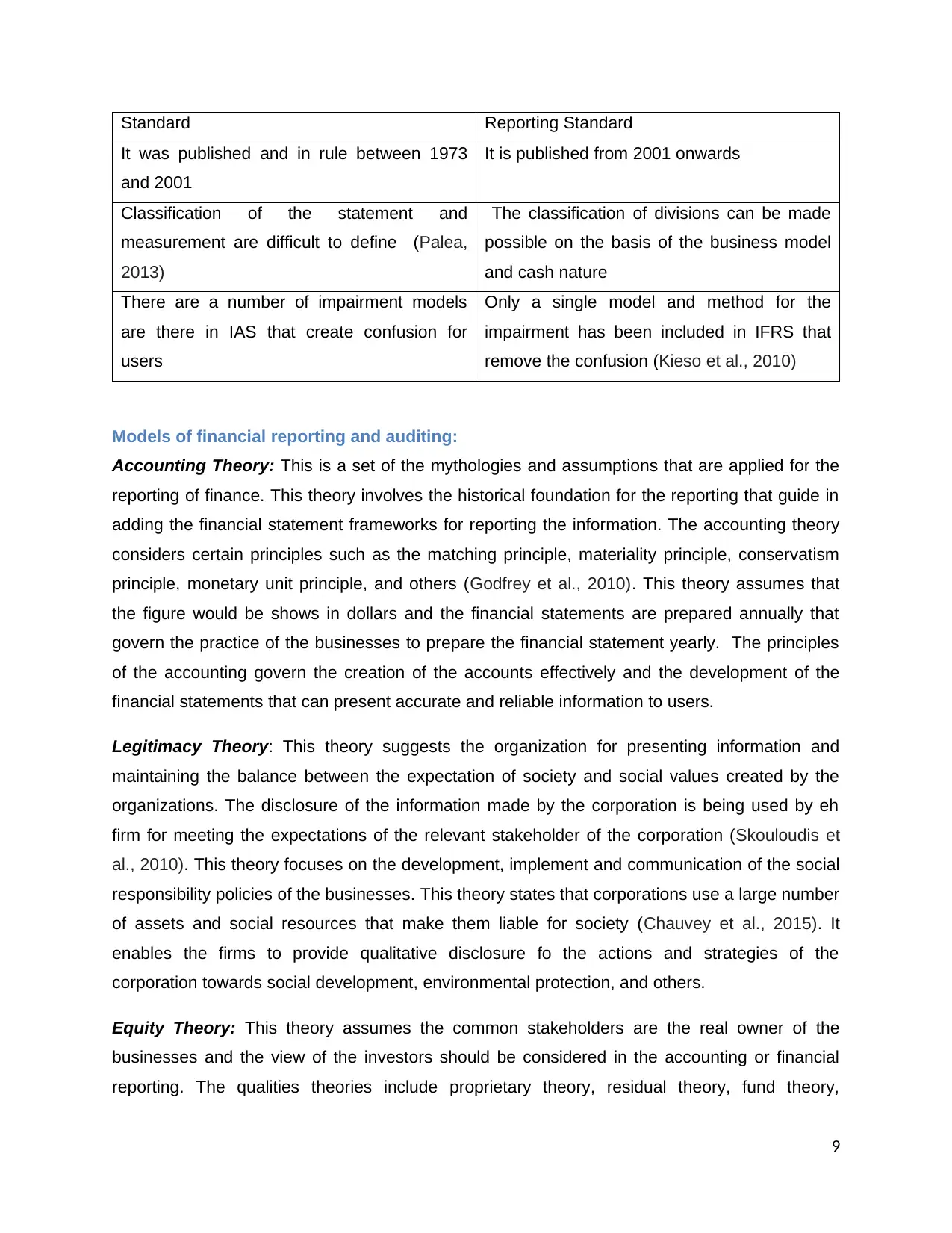
Standard Reporting Standard
It was published and in rule between 1973
and 2001
It is published from 2001 onwards
Classification of the statement and
measurement are difficult to define (Palea,
2013)
The classification of divisions can be made
possible on the basis of the business model
and cash nature
There are a number of impairment models
are there in IAS that create confusion for
users
Only a single model and method for the
impairment has been included in IFRS that
remove the confusion (Kieso et al., 2010)
Models of financial reporting and auditing:
Accounting Theory: This is a set of the mythologies and assumptions that are applied for the
reporting of finance. This theory involves the historical foundation for the reporting that guide in
adding the financial statement frameworks for reporting the information. The accounting theory
considers certain principles such as the matching principle, materiality principle, conservatism
principle, monetary unit principle, and others (Godfrey et al., 2010). This theory assumes that
the figure would be shows in dollars and the financial statements are prepared annually that
govern the practice of the businesses to prepare the financial statement yearly. The principles
of the accounting govern the creation of the accounts effectively and the development of the
financial statements that can present accurate and reliable information to users.
Legitimacy Theory: This theory suggests the organization for presenting information and
maintaining the balance between the expectation of society and social values created by the
organizations. The disclosure of the information made by the corporation is being used by eh
firm for meeting the expectations of the relevant stakeholder of the corporation (Skouloudis et
al., 2010). This theory focuses on the development, implement and communication of the social
responsibility policies of the businesses. This theory states that corporations use a large number
of assets and social resources that make them liable for society (Chauvey et al., 2015). It
enables the firms to provide qualitative disclosure fo the actions and strategies of the
corporation towards social development, environmental protection, and others.
Equity Theory: This theory assumes the common stakeholders are the real owner of the
businesses and the view of the investors should be considered in the accounting or financial
reporting. The qualities theories include proprietary theory, residual theory, fund theory,
9
It was published and in rule between 1973
and 2001
It is published from 2001 onwards
Classification of the statement and
measurement are difficult to define (Palea,
2013)
The classification of divisions can be made
possible on the basis of the business model
and cash nature
There are a number of impairment models
are there in IAS that create confusion for
users
Only a single model and method for the
impairment has been included in IFRS that
remove the confusion (Kieso et al., 2010)
Models of financial reporting and auditing:
Accounting Theory: This is a set of the mythologies and assumptions that are applied for the
reporting of finance. This theory involves the historical foundation for the reporting that guide in
adding the financial statement frameworks for reporting the information. The accounting theory
considers certain principles such as the matching principle, materiality principle, conservatism
principle, monetary unit principle, and others (Godfrey et al., 2010). This theory assumes that
the figure would be shows in dollars and the financial statements are prepared annually that
govern the practice of the businesses to prepare the financial statement yearly. The principles
of the accounting govern the creation of the accounts effectively and the development of the
financial statements that can present accurate and reliable information to users.
Legitimacy Theory: This theory suggests the organization for presenting information and
maintaining the balance between the expectation of society and social values created by the
organizations. The disclosure of the information made by the corporation is being used by eh
firm for meeting the expectations of the relevant stakeholder of the corporation (Skouloudis et
al., 2010). This theory focuses on the development, implement and communication of the social
responsibility policies of the businesses. This theory states that corporations use a large number
of assets and social resources that make them liable for society (Chauvey et al., 2015). It
enables the firms to provide qualitative disclosure fo the actions and strategies of the
corporation towards social development, environmental protection, and others.
Equity Theory: This theory assumes the common stakeholders are the real owner of the
businesses and the view of the investors should be considered in the accounting or financial
reporting. The qualities theories include proprietary theory, residual theory, fund theory,
9
⊘ This is a preview!⊘
Do you want full access?
Subscribe today to unlock all pages.
Trusted by 1+ million students worldwide
commander theory, and entity theory (Schroeder et al., 2019). All five theories influence the
items and accounting equation that affect the reporting in the statements of the firms.
Models of reporting and models for auditing:
The financial reports are affected and prested in different ways based on different methods and
models being used and followed by the business. Generally, three statement model is followed
by the businesses for reporting the financial information to the stakeholders. There are different
models such as three statements, consolidation model, the LBO model, the merger model, and
others that may cause an influence on the financial reporting of the businesses. Auditing is an
important activity in the accounting and it is conducted for ensuring quality in the accounts and
accuracy in the statement that is made complying with the certain rules and principles
mentioned in the standards (Godfrey et al., 2010). The audit report is a disclaimer by the
auditing firm that there are no mistakes in the accounts and the reporting by firms is complying
with IFRS and other GAAP. The audit of the organization is conducted by internal, external and
internal revenue service audits.
LO4 Evaluate international differences in financial reporting
The international differences occur when people from different countries use the financial
statement in one country for their decision but the lack of consistency and equity in the
statement may affect the decision. It is very hard for cross border investors to understand the
accounts and financial statements of the foreign companies that generally prepare the reports
considering their nation's accounting standards and principles. IFRS was created for removing
this issue and challenge for meeting the expectations of stakeholders and bringing equity and
consistency in the accounting practices in a comparable manner so that users can easily
understand the statement and can compare the performance for making their decisions (Nobes
and Stadler, 2018). However, there is an international difference before IFRS and financial
reporting. Businesses listed on the stock change must have to comply with the IFRS for
providing consistency and transparency in the statements. Almost 166 countries in the world are
using IFRS ad its principles for the reporting and accounting practices in the organizations.
More than 49000 domestic firms are listed on approx 93 stock exchange houses and approx
29000 of them are complying with IFRS rules and regulations. This is a senior difference before
IFRS. About 85% of the total organizations over the world are complying with the principle of the
10
items and accounting equation that affect the reporting in the statements of the firms.
Models of reporting and models for auditing:
The financial reports are affected and prested in different ways based on different methods and
models being used and followed by the business. Generally, three statement model is followed
by the businesses for reporting the financial information to the stakeholders. There are different
models such as three statements, consolidation model, the LBO model, the merger model, and
others that may cause an influence on the financial reporting of the businesses. Auditing is an
important activity in the accounting and it is conducted for ensuring quality in the accounts and
accuracy in the statement that is made complying with the certain rules and principles
mentioned in the standards (Godfrey et al., 2010). The audit report is a disclaimer by the
auditing firm that there are no mistakes in the accounts and the reporting by firms is complying
with IFRS and other GAAP. The audit of the organization is conducted by internal, external and
internal revenue service audits.
LO4 Evaluate international differences in financial reporting
The international differences occur when people from different countries use the financial
statement in one country for their decision but the lack of consistency and equity in the
statement may affect the decision. It is very hard for cross border investors to understand the
accounts and financial statements of the foreign companies that generally prepare the reports
considering their nation's accounting standards and principles. IFRS was created for removing
this issue and challenge for meeting the expectations of stakeholders and bringing equity and
consistency in the accounting practices in a comparable manner so that users can easily
understand the statement and can compare the performance for making their decisions (Nobes
and Stadler, 2018). However, there is an international difference before IFRS and financial
reporting. Businesses listed on the stock change must have to comply with the IFRS for
providing consistency and transparency in the statements. Almost 166 countries in the world are
using IFRS ad its principles for the reporting and accounting practices in the organizations.
More than 49000 domestic firms are listed on approx 93 stock exchange houses and approx
29000 of them are complying with IFRS rules and regulations. This is a senior difference before
IFRS. About 85% of the total organizations over the world are complying with the principle of the
10
Paraphrase This Document
Need a fresh take? Get an instant paraphrase of this document with our AI Paraphraser
IFRS in financial reporting and 15% of firms are not following the regulations but they are still
making reports on the basis of older rules and principles (IFRS, 2018). There are some factors
that influences the accounting practice and influence the practices of organization in countries
such as legalization and trade policies of the countries that can cause influence on the practices
of organizations to comply with IFRS. Political parties and decisions influence compliance with
IFRS by firms in the organizations (Chand et al., 2008). For instance, the USA does not permit
the organizations for using the IFRS but it allows them to follow and use GAAP only. IFRS is
facing De Jure and De Facto differences between the accounting practices in the nations. This
difference occurs because of the macro as well as micro factors. IFRS allows principle-based
accounting while certain nations are still focusing on the rule-based accounting that causes a
difference in financial reporting between different nations. Philippines Financial Reporting
Standards is a domestic standard of Philippine and certain modification has been made this
nation in IFRS before its adoption in the accounting practices. It has reduced the segment
reporting, commodity derivative contract, losses from the sale of nonperforming assets and
others in the case of banks and others in IFRS reporting (IAS Plus, 2020).
11
making reports on the basis of older rules and principles (IFRS, 2018). There are some factors
that influences the accounting practice and influence the practices of organization in countries
such as legalization and trade policies of the countries that can cause influence on the practices
of organizations to comply with IFRS. Political parties and decisions influence compliance with
IFRS by firms in the organizations (Chand et al., 2008). For instance, the USA does not permit
the organizations for using the IFRS but it allows them to follow and use GAAP only. IFRS is
facing De Jure and De Facto differences between the accounting practices in the nations. This
difference occurs because of the macro as well as micro factors. IFRS allows principle-based
accounting while certain nations are still focusing on the rule-based accounting that causes a
difference in financial reporting between different nations. Philippines Financial Reporting
Standards is a domestic standard of Philippine and certain modification has been made this
nation in IFRS before its adoption in the accounting practices. It has reduced the segment
reporting, commodity derivative contract, losses from the sale of nonperforming assets and
others in the case of banks and others in IFRS reporting (IAS Plus, 2020).
11
Conclusion:
From the analysis of the report, it can be summarized that this report has achieved the learning
outcomes. It is found that the conceptual framework fo the compliance may govern the reporting
practices in the organization and the purpose of the reporting is to meet the expectation of the
uses and predict the future performance of the firm. Furthermore, it is found that there is no
significant difference between IFRS and IAS. This report has identified that environmental
factors and other causes are there creating the international differences in financial reporting.
12
From the analysis of the report, it can be summarized that this report has achieved the learning
outcomes. It is found that the conceptual framework fo the compliance may govern the reporting
practices in the organization and the purpose of the reporting is to meet the expectation of the
uses and predict the future performance of the firm. Furthermore, it is found that there is no
significant difference between IFRS and IAS. This report has identified that environmental
factors and other causes are there creating the international differences in financial reporting.
12
⊘ This is a preview!⊘
Do you want full access?
Subscribe today to unlock all pages.
Trusted by 1+ million students worldwide

1 out of 14


Related Documents


Your All-in-One AI-Powered Toolkit for Academic Success.
+13062052269
info@desklib.com
Available 24*7 on WhatsApp / Email
![[object Object]](/_next/static/media/star-bottom.7253800d.svg)
Unlock your academic potential
Copyright © 2020–2026 A2Z Services. All Rights Reserved. Developed and managed by ZUCOL.