BTEC Level 5 Sport Massage: Cindy's Assessment and Treatment
VerifiedAdded on 2023/01/06
|52
|16414
|60
Report
AI Summary
This report presents a detailed case study on sport massage, focusing on the assessment and treatment of a client named Cindy. The introduction outlines the structure of the study, which includes seven sessions. The subjective assessment covers Cindy's medical history, including pre-existing conditions, medications, past injuries, and lifestyle factors such as occupation, exercise routine, nutrition, and sleep patterns. A pain assessment is conducted, evaluating the location, characteristics, and severity of the pain, along with intrinsic and extrinsic factors contributing to it. The objective assessment includes a postural evaluation to identify muscle imbalances and compensation patterns. The treatment plan is designed based on the assessments, and the report includes post-treatment re-assessments to evaluate the effectiveness of the interventions. The report includes detailed findings, analysis, and treatment strategies, providing a comprehensive understanding of the assessment and treatment process in sport massage. The appendices include additional information and supporting documents to enhance the case study.
SPORT MASSAGE - BTEC
LEVEL 5
LEVEL 5

Paraphrase This Document
Need a fresh take? Get an instant paraphrase of this document with our AI Paraphraser
Contents
INTRODUCTION...........................................................................................................................1
SUBJECTIVE ASSESSMENT.......................................................................................................1
Medical history............................................................................................................................1
Summary of subjective and objective findings..........................................................................16
Treatment plan...........................................................................................................................19
Post treatment Re-assessments..................................................................................................36
REFERENCES..............................................................................................................................45
Appendix A................................................................................................................................46
Appendix B................................................................................................................................47
Appendix C................................................................................................................................48
Appendix D................................................................................................................................49
Appendix E................................................................................................................................50
INTRODUCTION...........................................................................................................................1
SUBJECTIVE ASSESSMENT.......................................................................................................1
Medical history............................................................................................................................1
Summary of subjective and objective findings..........................................................................16
Treatment plan...........................................................................................................................19
Post treatment Re-assessments..................................................................................................36
REFERENCES..............................................................................................................................45
Appendix A................................................................................................................................46
Appendix B................................................................................................................................47
Appendix C................................................................................................................................48
Appendix D................................................................................................................................49
Appendix E................................................................................................................................50
INTRODUCTION
In the present case study, assessment and treatment of client is being done in about seven
sessions. First session consists of detailed subjective and objective assessment. Systematic
treatment plan has also been designed and implement to enhance health outcome of client. For
the purpose of study and confidentiality, I will call my client as Cindy which is a fictitious name
given by me.
SUBJECTIVE ASSESSMENT
Medical history
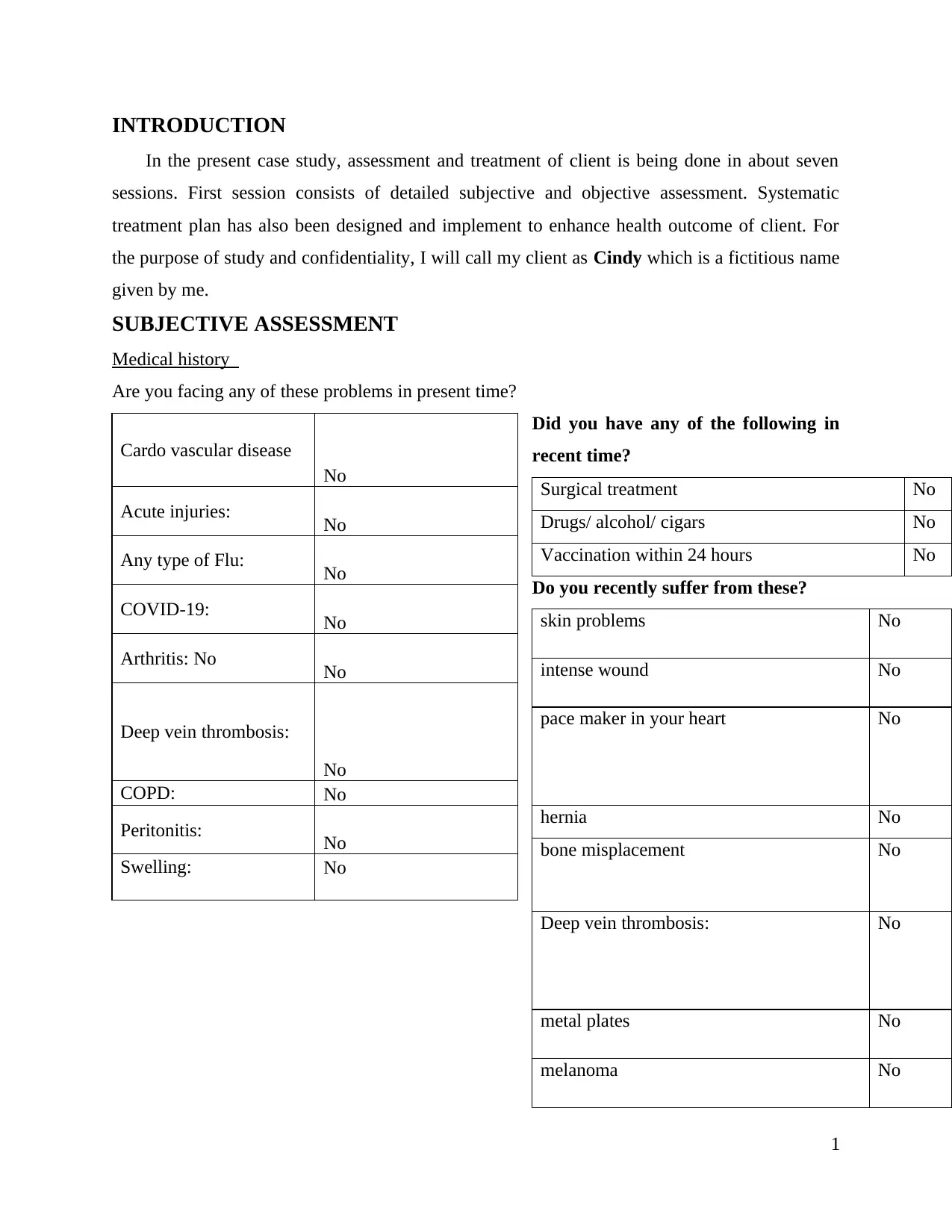
Are you facing any of these problems in present time?
Did you have any of the following in
recent time?
Surgical treatment No
Drugs/ alcohol/ cigars No
Vaccination within 24 hours No
Do you recently suffer from these?
skin problems No
intense wound No
pace maker in your heart No
hernia No
bone misplacement No
Deep vein thrombosis: No
metal plates No
melanoma No
1
Cardo vascular disease
No
Acute injuries: No
Any type of Flu: No
COVID-19: No
Arthritis: No No
Deep vein thrombosis:
No
COPD: No
Peritonitis: No
Swelling: No
In the present case study, assessment and treatment of client is being done in about seven
sessions. First session consists of detailed subjective and objective assessment. Systematic
treatment plan has also been designed and implement to enhance health outcome of client. For
the purpose of study and confidentiality, I will call my client as Cindy which is a fictitious name
given by me.
SUBJECTIVE ASSESSMENT
Medical history
Are you facing any of these problems in present time?
Did you have any of the following in
recent time?
Surgical treatment No
Drugs/ alcohol/ cigars No
Vaccination within 24 hours No
Do you recently suffer from these?
skin problems No
intense wound No
pace maker in your heart No
hernia No
bone misplacement No
Deep vein thrombosis: No
metal plates No
melanoma No
1
Cardo vascular disease
No
Acute injuries: No
Any type of Flu: No
COVID-19: No
Arthritis: No No
Deep vein thrombosis:
No
COPD: No
Peritonitis: No
Swelling: No
⊘ This is a preview!⊘
Do you want full access?
Subscribe today to unlock all pages.

Trusted by 1+ million students worldwide
eye infection No
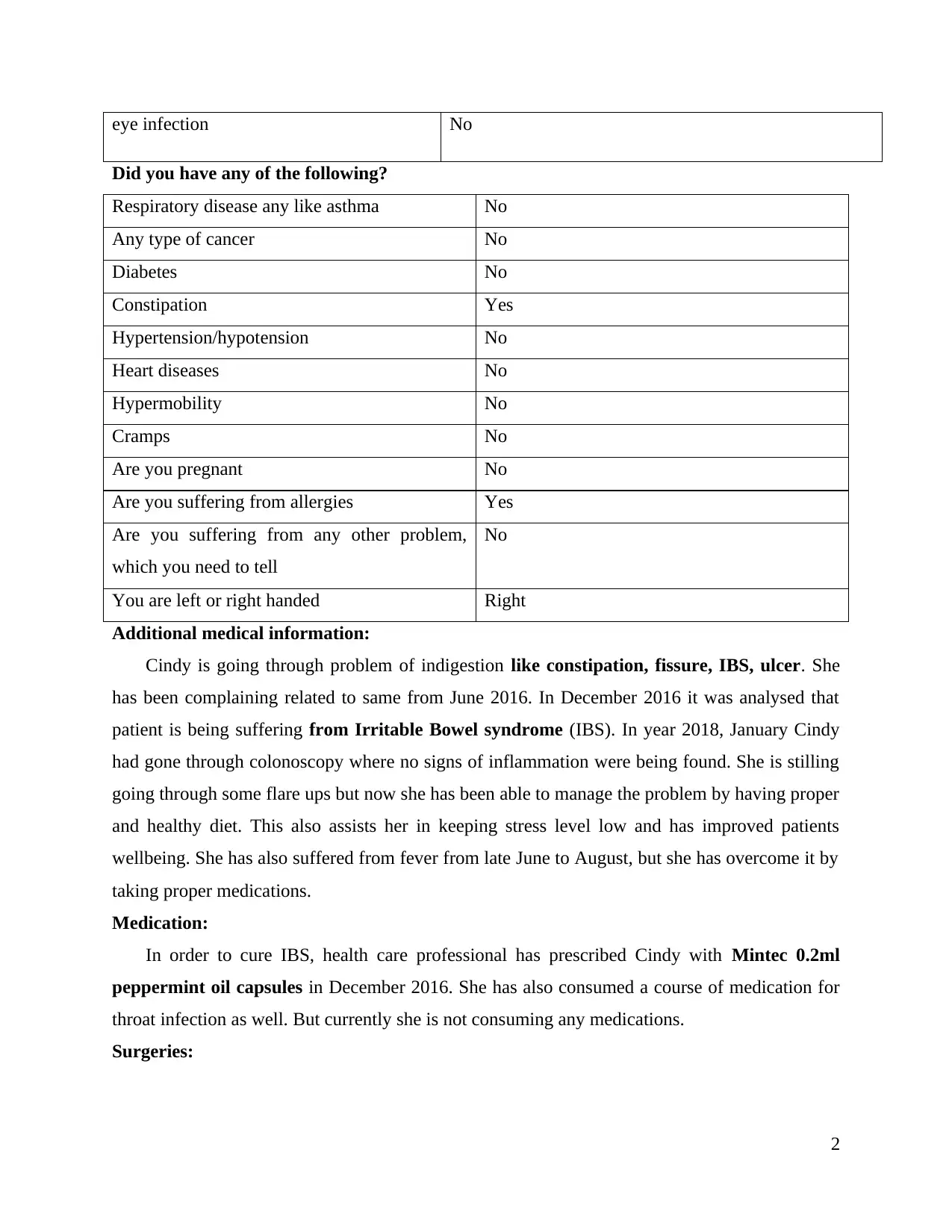
Did you have any of the following?
Respiratory disease any like asthma No
Any type of cancer No
Diabetes No
Constipation Yes
Hypertension/hypotension No
Heart diseases No
Hypermobility No
Cramps No
Are you pregnant No
Are you suffering from allergies Yes
Are you suffering from any other problem,
which you need to tell
No
You are left or right handed Right
Additional medical information:
Cindy is going through problem of indigestion like constipation, fissure, IBS, ulcer. She
has been complaining related to same from June 2016. In December 2016 it was analysed that
patient is being suffering from Irritable Bowel syndrome (IBS). In year 2018, January Cindy
had gone through colonoscopy where no signs of inflammation were being found. She is stilling
going through some flare ups but now she has been able to manage the problem by having proper
and healthy diet. This also assists her in keeping stress level low and has improved patients
wellbeing. She has also suffered from fever from late June to August, but she has overcome it by
taking proper medications.
Medication:
In order to cure IBS, health care professional has prescribed Cindy with Mintec 0.2ml
peppermint oil capsules in December 2016. She has also consumed a course of medication for
throat infection as well. But currently she is not consuming any medications.
Surgeries:
2
Did you have any of the following?
Respiratory disease any like asthma No
Any type of cancer No
Diabetes No
Constipation Yes
Hypertension/hypotension No
Heart diseases No
Hypermobility No
Cramps No
Are you pregnant No
Are you suffering from allergies Yes
Are you suffering from any other problem,
which you need to tell
No
You are left or right handed Right
Additional medical information:
Cindy is going through problem of indigestion like constipation, fissure, IBS, ulcer. She
has been complaining related to same from June 2016. In December 2016 it was analysed that
patient is being suffering from Irritable Bowel syndrome (IBS). In year 2018, January Cindy
had gone through colonoscopy where no signs of inflammation were being found. She is stilling
going through some flare ups but now she has been able to manage the problem by having proper
and healthy diet. This also assists her in keeping stress level low and has improved patients
wellbeing. She has also suffered from fever from late June to August, but she has overcome it by
taking proper medications.
Medication:
In order to cure IBS, health care professional has prescribed Cindy with Mintec 0.2ml
peppermint oil capsules in December 2016. She has also consumed a course of medication for
throat infection as well. But currently she is not consuming any medications.
Surgeries:
2
Paraphrase This Document
Need a fresh take? Get an instant paraphrase of this document with our AI Paraphraser
She has colonoscopy in January 2018, other than that she has not gone through any surgery
or even minor operations.
Past injuries:
In June, 2016 Cindy slipped from stairs on her left wrist and in next morning she was
suffering from pain and wrist got swollen. Cindy then thought of having test. A&E test was
asked to do by health care professionals. She was diagnosed with a sprain and was also
suggested the RICE procedure. She was asked to take pain killers. It was analysed that after one
week Cindy has no pain or swelling. She was also not facing any mobility issues. It was also
being evaluated that Cindy in future has also not faced any type of muscle, tendon, ligament or
bone injuries and also no further injury was faced by her.
Occupation:
Cindy is working as a manager in international organisation. She spends about 9 hours
per day in office. All day she does work on laptop by sitting on her desk. Her work space is quiet
well and she tends to keep working in free space within the office. Sometimes she also works
from sofa and on lounge tables. Cindy also takes work from home but only for one day in a
week. In home she works from dining table. She attends lots of conference calls and meetings,
because of which she has to use her cell phone for about 80 minutes. In order to reach office, she
has to take trains. Cindy walks for around sixty minute and she has to stand in a queue on her
way to office for around fifteen minutes. She also carries her bag on right shoulder so that her
personal belonging can be kept safe.
Exercise routine:
Cindy has joined gym in past but her membership expired in November 2018 and also she
decided not renew it. Before this, Cindy attended gym regularly and she was really active. Her
gym session last for an hour, she does take rest at weekends. Cindy used various cardiovascular
equipment and carried free weight. However, in past ten months other than walking Cindy is not
engaged in any type of training or exercise.
Physical activity:
Cindy has various which are listed below, other than this she does not take part in any
form of physical exercise.
Hobby:
3
or even minor operations.
Past injuries:
In June, 2016 Cindy slipped from stairs on her left wrist and in next morning she was
suffering from pain and wrist got swollen. Cindy then thought of having test. A&E test was
asked to do by health care professionals. She was diagnosed with a sprain and was also
suggested the RICE procedure. She was asked to take pain killers. It was analysed that after one
week Cindy has no pain or swelling. She was also not facing any mobility issues. It was also
being evaluated that Cindy in future has also not faced any type of muscle, tendon, ligament or
bone injuries and also no further injury was faced by her.
Occupation:
Cindy is working as a manager in international organisation. She spends about 9 hours
per day in office. All day she does work on laptop by sitting on her desk. Her work space is quiet
well and she tends to keep working in free space within the office. Sometimes she also works
from sofa and on lounge tables. Cindy also takes work from home but only for one day in a
week. In home she works from dining table. She attends lots of conference calls and meetings,
because of which she has to use her cell phone for about 80 minutes. In order to reach office, she
has to take trains. Cindy walks for around sixty minute and she has to stand in a queue on her
way to office for around fifteen minutes. She also carries her bag on right shoulder so that her
personal belonging can be kept safe.
Exercise routine:
Cindy has joined gym in past but her membership expired in November 2018 and also she
decided not renew it. Before this, Cindy attended gym regularly and she was really active. Her
gym session last for an hour, she does take rest at weekends. Cindy used various cardiovascular
equipment and carried free weight. However, in past ten months other than walking Cindy is not
engaged in any type of training or exercise.
Physical activity:
Cindy has various which are listed below, other than this she does not take part in any
form of physical exercise.
Hobby:
3
Cindy spends her weekend around walking on beaches in Kent. The walk lasts for
approximately 4 hours and that on flat terrain. She wears boots as they are comfortable and also
gives good balance and support to her ankles.
Nutrition and hydration:
Cindy says that she consumes healthy and nutritious diet. In this she eats so many fruits and
vegetables. She also has lots of protein in her diet, like she eats chicken and fish. Cindy also
consumes nuts and seeds. Client drinks at least three litres of water per day. She consumes
alcohol in about two months and she is not fond of smoking.
Sleep and stress:
Cindy take around 8 hours of sleep in night but when she has lots of work then her sleep
become disturbed as she takes lots of stress related to work. Cindy has also mentioned she feels
tired and restless in most mornings. Stress can cause her IBS to flare up and because of which
her quality of sleep is reduced down.
Massage experience:
Cindy has also taken therapeutic massage and too in a spa. It was a part of her break and
the therapist used oil so that calming massage can be created.
Alternative therapies:
Cindy has gone through other therapies too. She has consulted Colon hydro therapist who will
give required therapy to patient. Besides that, there are many other health professionals as well
whom Cindy can visit such as physiotherapist, chiropractor or acupuncturist.
Research for appointment
It is stated that Cindy has visited the therapist as she is facing continuous pain in her neck
and shoulder area. But she has not taken any treatment regarding pain or visited any health
professional. Moreover, she has not taken any medication also.
Client expectations –
Cindy want to get relief from pain but she does not know that when it will happen but she
expects to be soon. Alongside, it is necessary for her to get relief from pain as it will help in
improving her daily life. Also, she will be able to join gym also. However, she wants to get rid of
this pain first.
Pain assessment
4
approximately 4 hours and that on flat terrain. She wears boots as they are comfortable and also
gives good balance and support to her ankles.
Nutrition and hydration:
Cindy says that she consumes healthy and nutritious diet. In this she eats so many fruits and
vegetables. She also has lots of protein in her diet, like she eats chicken and fish. Cindy also
consumes nuts and seeds. Client drinks at least three litres of water per day. She consumes
alcohol in about two months and she is not fond of smoking.
Sleep and stress:
Cindy take around 8 hours of sleep in night but when she has lots of work then her sleep
become disturbed as she takes lots of stress related to work. Cindy has also mentioned she feels
tired and restless in most mornings. Stress can cause her IBS to flare up and because of which
her quality of sleep is reduced down.
Massage experience:
Cindy has also taken therapeutic massage and too in a spa. It was a part of her break and
the therapist used oil so that calming massage can be created.
Alternative therapies:
Cindy has gone through other therapies too. She has consulted Colon hydro therapist who will
give required therapy to patient. Besides that, there are many other health professionals as well
whom Cindy can visit such as physiotherapist, chiropractor or acupuncturist.
Research for appointment
It is stated that Cindy has visited the therapist as she is facing continuous pain in her neck
and shoulder area. But she has not taken any treatment regarding pain or visited any health
professional. Moreover, she has not taken any medication also.
Client expectations –
Cindy want to get relief from pain but she does not know that when it will happen but she
expects to be soon. Alongside, it is necessary for her to get relief from pain as it will help in
improving her daily life. Also, she will be able to join gym also. However, she wants to get rid of
this pain first.
Pain assessment
4
⊘ This is a preview!⊘
Do you want full access?
Subscribe today to unlock all pages.
Trusted by 1+ million students worldwide
The area where pain is located on Cindy medical border of right scapula which originate
from rhomboid minor and levator scapula insertion point. The pain arises from upper fibre of
trapezius muscle in neck and then stops at superior muchal line of occiput and radiate again
inferior down to lower fibre of trapezui muscle. Apart from this, area Cindy is not facing any
pain within the whole body.
However, Cindy describe pain as deep, dull and aching. She rates severity of pain as 7
out of 10. Besides that, she said that during morning pain is less but when day passes it gets
worse. But rating of pain remains 7 out of 10. In weekends pain is less and when there is holiday
it eases.
The pain has started around 7- 8 months ago and Cindy does not remember any event due
to which pain has started. In addition to that, Cindy is not observing any symptoms as well
related to pain. So, in order to get relief from pain she takes shower and place hot water bottle in
that area.
Intrinsic and extrinsic factors
It has been identified that there are several intrinsic and extrinsic factors which can be
associated with Cindy pain. Also, those factors need to be identified so that it can be addressed
within treatment strategy. Thus, the intrinsic factor which was determined was duration of
treatment and lack of sleep. Also, stress level is another factor in it.
The extrinsic factor in it is Cindy occupation. It is found that she does not sit in right
position and spend most day while sitting at table. Besides that, chair is not designed to work in
comfortable way for long time period. In addition, when she talks on phone call then she uses her
right hand for it.
Along with that, Cindy has not exercised for 10 months so it has directly impacted on her
tissue health and movement.
Pathology, contraindications and modification
It has been evaluated that there are no contraindications or red flags which is found out.
Also, Cindy has not presented with pathology in it. so, it is found that there is no sign of alluding
to pathology. There are clear objective assessment taken through injury and tissue health stages
at end of subjective and objective summary. It has been found that there is shoulder pain so some
modification will be required in treatment. For that it will need additional support by use of
5
from rhomboid minor and levator scapula insertion point. The pain arises from upper fibre of
trapezius muscle in neck and then stops at superior muchal line of occiput and radiate again
inferior down to lower fibre of trapezui muscle. Apart from this, area Cindy is not facing any
pain within the whole body.
However, Cindy describe pain as deep, dull and aching. She rates severity of pain as 7
out of 10. Besides that, she said that during morning pain is less but when day passes it gets
worse. But rating of pain remains 7 out of 10. In weekends pain is less and when there is holiday
it eases.
The pain has started around 7- 8 months ago and Cindy does not remember any event due
to which pain has started. In addition to that, Cindy is not observing any symptoms as well
related to pain. So, in order to get relief from pain she takes shower and place hot water bottle in
that area.
Intrinsic and extrinsic factors
It has been identified that there are several intrinsic and extrinsic factors which can be
associated with Cindy pain. Also, those factors need to be identified so that it can be addressed
within treatment strategy. Thus, the intrinsic factor which was determined was duration of
treatment and lack of sleep. Also, stress level is another factor in it.
The extrinsic factor in it is Cindy occupation. It is found that she does not sit in right
position and spend most day while sitting at table. Besides that, chair is not designed to work in
comfortable way for long time period. In addition, when she talks on phone call then she uses her
right hand for it.
Along with that, Cindy has not exercised for 10 months so it has directly impacted on her
tissue health and movement.
Pathology, contraindications and modification
It has been evaluated that there are no contraindications or red flags which is found out.
Also, Cindy has not presented with pathology in it. so, it is found that there is no sign of alluding
to pathology. There are clear objective assessment taken through injury and tissue health stages
at end of subjective and objective summary. It has been found that there is shoulder pain so some
modification will be required in treatment. For that it will need additional support by use of
5
Paraphrase This Document
Need a fresh take? Get an instant paraphrase of this document with our AI Paraphraser
towels and other technique such as speed, direction, depth, etc. through that, it will be easy to
reduce pain in each session being done.
Objective assessment
Postural assessment
It will enable in giving overview about Cindy posture by comparing both right and left
side of body. In that similarly and deviation will be identified. Apart from it, assessment will be
useful in finding out any muscle imbalance and where stress is being placed within
musculoskeletal system. beside that it will be identified if there are other compensation pattern
occurred in it.
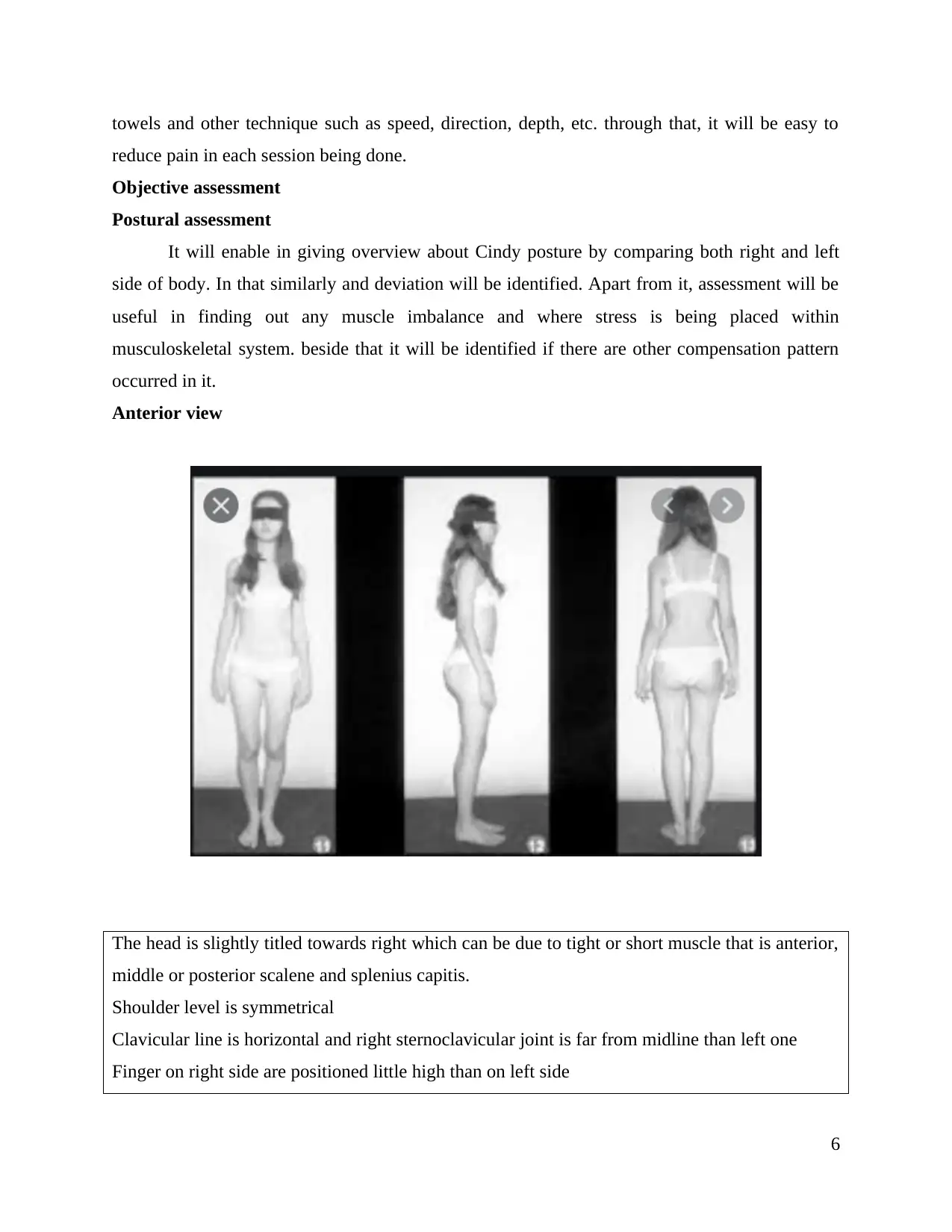
Anterior view
The head is slightly titled towards right which can be due to tight or short muscle that is anterior,
middle or posterior scalene and splenius capitis.
Shoulder level is symmetrical
Clavicular line is horizontal and right sternoclavicular joint is far from midline than left one
Finger on right side are positioned little high than on left side
6
reduce pain in each session being done.
Objective assessment
Postural assessment
It will enable in giving overview about Cindy posture by comparing both right and left
side of body. In that similarly and deviation will be identified. Apart from it, assessment will be
useful in finding out any muscle imbalance and where stress is being placed within
musculoskeletal system. beside that it will be identified if there are other compensation pattern
occurred in it.
Anterior view
The head is slightly titled towards right which can be due to tight or short muscle that is anterior,
middle or posterior scalene and splenius capitis.
Shoulder level is symmetrical
Clavicular line is horizontal and right sternoclavicular joint is far from midline than left one
Finger on right side are positioned little high than on left side
6
Hands are positioned on front body that shows protracted shoulder
ASIS level is symmetrical
Patella on each leg is rotated
Both feet is having low foot arches
The right feet is more rotated due to tight lateral hip rotators
Posterior view
In this right scapular superior and inferior angle are raised high than left. Both scapulas lift from
thorax tilt more in right scapula. This can be due to tight pectoralis minor, short head of biceps
brachii and coracobrachialis muscle.
Between two borders of scapulas there is reduce muscle tone. This shows long and weak
rhomboid major or minor trapezius muscle
There us no curvature of spine
Both arms are positioned forward on body which is sign of protracted shoulder
The right PSIS is far from mid and left PSIS is level
Gluteal creases are equal
Popliteus creases are level.
Rotation of both hips is shown where right side is more distinct that can be because of tight hip
and gluteus maximus
Both feet rotate but right side more rotatable
The both Achilles tendons little rotation
7
ASIS level is symmetrical
Patella on each leg is rotated
Both feet is having low foot arches
The right feet is more rotated due to tight lateral hip rotators
Posterior view
In this right scapular superior and inferior angle are raised high than left. Both scapulas lift from
thorax tilt more in right scapula. This can be due to tight pectoralis minor, short head of biceps
brachii and coracobrachialis muscle.
Between two borders of scapulas there is reduce muscle tone. This shows long and weak
rhomboid major or minor trapezius muscle
There us no curvature of spine
Both arms are positioned forward on body which is sign of protracted shoulder
The right PSIS is far from mid and left PSIS is level
Gluteal creases are equal
Popliteus creases are level.
Rotation of both hips is shown where right side is more distinct that can be because of tight hip
and gluteus maximus
Both feet rotate but right side more rotatable
The both Achilles tendons little rotation
7
⊘ This is a preview!⊘
Do you want full access?
Subscribe today to unlock all pages.
Trusted by 1+ million students worldwide
Right malleoli and toes are more visible than left one.
Right lateral view
Head is tilt forward which shows sternocleidomastoid, anterior, middle and posterior neck
muscle being tight and short. This means that long and weak upper trapezius and scapula muscle.
Right shoulder is little bit protracted and right arm is positioned o body. It is because of tight and
short muscle that is pectoralis, latissimus. The long and weak muscle can be a top, mid and low
trapezius muscle
Forearm rest in flexible position from elbow. This shows tight muscle that is biceps and
coracobrachialis and weak muscle as triceps.
The kyphosis spine shows short and tight pectoralis latissimus and upper abdominals muscle and
middle trapezius rhomboid muscle.
The lordosis lumbar spine shows long and weak abdominal and internal and external obliques
Pelvis is in tilt position that specify erector, spinae, QL are tight and short
Knee is in locked position which is due to short and tight quadricep muscle and long and weak
hamstring muscle
Body weight is on toes that shows flex position.
Left lateral view
Head is title forward
Left shoulder is protracted and left arm position is forward
8
Right lateral view
Head is tilt forward which shows sternocleidomastoid, anterior, middle and posterior neck
muscle being tight and short. This means that long and weak upper trapezius and scapula muscle.
Right shoulder is little bit protracted and right arm is positioned o body. It is because of tight and
short muscle that is pectoralis, latissimus. The long and weak muscle can be a top, mid and low
trapezius muscle
Forearm rest in flexible position from elbow. This shows tight muscle that is biceps and
coracobrachialis and weak muscle as triceps.
The kyphosis spine shows short and tight pectoralis latissimus and upper abdominals muscle and
middle trapezius rhomboid muscle.
The lordosis lumbar spine shows long and weak abdominal and internal and external obliques
Pelvis is in tilt position that specify erector, spinae, QL are tight and short
Knee is in locked position which is due to short and tight quadricep muscle and long and weak
hamstring muscle
Body weight is on toes that shows flex position.
Left lateral view
Head is title forward
Left shoulder is protracted and left arm position is forward
8
Paraphrase This Document
Need a fresh take? Get an instant paraphrase of this document with our AI Paraphraser
Forearm shows resting position from elbow
Pelvis is positioned in anteriorly in tilt way
Knee is extended in lock position
Body weight is rested on her toes in plantar flexed position
Palpation
It is process which enable in analysing condition of tissues, stage of injury, red flag, etc
through that it becomes easy to make changes in treatment, depth of massage technique and
many other things.
Furthermore, palpation enable in doing pain assessment in order to understand stage of
injury by taking feedback from client. Also, here physiological indicators are found out as well
related to pain in sweating, etc. moreover, it can be used to feel damp areas, change in
temperature, imbalance in muscle, etc. and examining mobility of tissue.
Palpation procedure
It can be viewed that in Cindy palpation started in side lying and then in other tissues. So,
a skin drag was done on tissues to find out temperature change, sticky areas, etc. then, palpate
was done with help of light long stroked and using hand. I used process of gentle rocking to
evaluate tissue mobility. Then, deeper palpation was done by placing hand on hand. Thus, when
restricted area was identified than technique of palpation was used with finger, thumb, by
moving it around tissues. With these two techniques as well, I used controlled movement on her
to find out level of pain. Bot longitudinally and transversely palpation was used. Thus, I
compared both side of body in order to identify what is normal and injured part.
Findings
Feet and ankle
It was found that plantar fascia was tight on both feet. There was no such movement in
tissues. The foot acrh was low of both feet. So, when palpation got deep then pain was observed
and it was difficult to find out individual muscle structure of feet. In both heals dry skin was
there and on medical side of toe as well. the plantar flexion of toe was easy as compared to
dorsiflexing. There was no inverting and everting in movement of ankle. In both ankle plantar
9
Pelvis is positioned in anteriorly in tilt way
Knee is extended in lock position
Body weight is rested on her toes in plantar flexed position
Palpation
It is process which enable in analysing condition of tissues, stage of injury, red flag, etc
through that it becomes easy to make changes in treatment, depth of massage technique and
many other things.
Furthermore, palpation enable in doing pain assessment in order to understand stage of
injury by taking feedback from client. Also, here physiological indicators are found out as well
related to pain in sweating, etc. moreover, it can be used to feel damp areas, change in
temperature, imbalance in muscle, etc. and examining mobility of tissue.
Palpation procedure
It can be viewed that in Cindy palpation started in side lying and then in other tissues. So,
a skin drag was done on tissues to find out temperature change, sticky areas, etc. then, palpate
was done with help of light long stroked and using hand. I used process of gentle rocking to
evaluate tissue mobility. Then, deeper palpation was done by placing hand on hand. Thus, when
restricted area was identified than technique of palpation was used with finger, thumb, by
moving it around tissues. With these two techniques as well, I used controlled movement on her
to find out level of pain. Bot longitudinally and transversely palpation was used. Thus, I
compared both side of body in order to identify what is normal and injured part.
Findings
Feet and ankle
It was found that plantar fascia was tight on both feet. There was no such movement in
tissues. The foot acrh was low of both feet. So, when palpation got deep then pain was observed
and it was difficult to find out individual muscle structure of feet. In both heals dry skin was
there and on medical side of toe as well. the plantar flexion of toe was easy as compared to
dorsiflexing. There was no inverting and everting in movement of ankle. In both ankle plantar
9
flexion was easy and dorsiflex was difficult. No temperature change or any other change was
observed on either foot or ankle. Alongside, no red flags or pain was in tissues.
Leg and thigh
I observed that Cindy was in supine and both legs were rotated but right was more than
left. I hold ankle and rolled legs. The movement felt fluid and it got leg heavier. Then I rocked
leg from side to side, the movement of fluid was shown in pelvis. Thus, I pulled legs down and
movement travel from fascia to pelvis.
The tissues on both legs of anterior was supple and relaxed. So, in could not felt any
restrictions on it. Besides that, on opposite side of leg soleus was tight and there was no
movement in it. Cindy found deep palpation in right soleus which was close to personal muscle
with no pai in that. The gastrocnemius muscle of leg was tight. Also, it was found that both
muscle is having equal mass and were congested. The hamstring felt relaxed as it had less
muscle mass as compared to quadricep. Thus, when knee got flexed there was movement in both
hamstring and it made it difficult to observe slide and glide of muscle. In that there was no
change in temperature, skin etc. in thigh of leg and also no sign of red flags when tissue was
palpated.
Knees
It was found that there exists no gap in table and back of knees and tissue which is being
surrounded in supple. Furthermore, there was no change in temperature, skin, etc. as well as red
flags in knee.
Gluteals
The muscle mass was equal on both side as tissue congestion was found. Similarly, there
was no sign of red flags in it.
Pelvis
Here, the pelvis felt relaxed and when ASIS was pushed down in pelvis it felt spring in
movement. Hence, when pressure was released there was no return movement in supple. Also,
no sign of red flags in palpating tissues.
Back
Here , I placed on hand on sacrum and other on back. So, there was gentle movement of
tissue in lumbar region. However, movement started from T12 to C5 and muscle mass around it
was equal. It was found that tissue fibre was restricted but I could not feel any adhesions in
10
observed on either foot or ankle. Alongside, no red flags or pain was in tissues.
Leg and thigh
I observed that Cindy was in supine and both legs were rotated but right was more than
left. I hold ankle and rolled legs. The movement felt fluid and it got leg heavier. Then I rocked
leg from side to side, the movement of fluid was shown in pelvis. Thus, I pulled legs down and
movement travel from fascia to pelvis.
The tissues on both legs of anterior was supple and relaxed. So, in could not felt any
restrictions on it. Besides that, on opposite side of leg soleus was tight and there was no
movement in it. Cindy found deep palpation in right soleus which was close to personal muscle
with no pai in that. The gastrocnemius muscle of leg was tight. Also, it was found that both
muscle is having equal mass and were congested. The hamstring felt relaxed as it had less
muscle mass as compared to quadricep. Thus, when knee got flexed there was movement in both
hamstring and it made it difficult to observe slide and glide of muscle. In that there was no
change in temperature, skin etc. in thigh of leg and also no sign of red flags when tissue was
palpated.
Knees
It was found that there exists no gap in table and back of knees and tissue which is being
surrounded in supple. Furthermore, there was no change in temperature, skin, etc. as well as red
flags in knee.
Gluteals
The muscle mass was equal on both side as tissue congestion was found. Similarly, there
was no sign of red flags in it.
Pelvis
Here, the pelvis felt relaxed and when ASIS was pushed down in pelvis it felt spring in
movement. Hence, when pressure was released there was no return movement in supple. Also,
no sign of red flags in palpating tissues.
Back
Here , I placed on hand on sacrum and other on back. So, there was gentle movement of
tissue in lumbar region. However, movement started from T12 to C5 and muscle mass around it
was equal. It was found that tissue fibre was restricted but I could not feel any adhesions in
10
⊘ This is a preview!⊘
Do you want full access?
Subscribe today to unlock all pages.
Trusted by 1+ million students worldwide

1 out of 52


Your All-in-One AI-Powered Toolkit for Academic Success.
+13062052269
info@desklib.com
Available 24*7 on WhatsApp / Email
![[object Object]](/_next/static/media/star-bottom.7253800d.svg)
Unlock your academic potential
Copyright © 2020–2026 A2Z Services. All Rights Reserved. Developed and managed by ZUCOL.