University Essay: ASR207 - Exploring Tantra's Differences in Buddhism

Verified

Added on  2022/08/30

|7
|1353
|10
Essay
AI Summary
This essay delves into the distinctive features of Tantric Buddhism, also known as Vajrayana, in comparison to the Mahayana and Theravada schools of Buddhism. It explores the unique aspects of Tantra, including its emphasis on a faster path to enlightenment through ritual and meditation practices. The essay highlights key differences, such as the role of deities, the concept of enlightenment, and the use of rituals and symbols. It also acknowledges similarities, particularly the belief in Bodhisattvas. The essay draws upon various readings from the unit, including the required Powers reading, to analyze these comparisons and contrasts, providing a comprehensive overview of Tantra's place within the broader context of Buddhist traditions. The essay also touches upon the historical and cultural influences that shaped the development of Tantric Buddhism, particularly in Tibet, and how it evolved into a distinct form of Buddhism.
Document Page
Running head: BUDDHISM
Buddhism
Name of the Student
Name of the University
Author Note
tabler-icon-diamond-filled.svg

Paraphrase This Document

Need a fresh take? Get an instant paraphrase of this document with our AI Paraphraser
Document Page
1BUDDHISM
What makes tantra different from other types of Buddhism?
Like majority of the religions present across the world, Buddhism is not organized
according to the hierarchies of power. The religion originated in India between the 4th and 6th
century B.C. and is currently the fourth largest religion across the world with a huge number of
followers (Child 2016). The three major schools of Buddhism include Mahayana, Theravada,
and Vajrayana. The Vajrayana Buddhism, popularly known as tantric Buddhism, is comprised of
a good number of unique features that are different from the two other schools of Buddhism.
This essay will provide a detailed discussion of the differences as well as similarities of tantra
from other types of Buddhism has been conducted.
While the Theravada Buddhism is considered to be the school of elders and
Mahayana Buddhism is considered to be the great way, the Vajrayana school of Buddhism s
known as the diamond way. The Vajrayana buddhism is possibly a type of Buddhism that
originated from the Mahayana tradition. It is based on a dynamic metaphysical and ritual
structure intended to lead to enlightenment (Knauft 2019). Occasionally Vajrayana is called
Tibetan Buddhism. The term Vajrayana means literally ‘the way of the diamond’. The word
Vajra refers to the hard-diamond thunderbolt used as a shield by the Hindu deity of rain and
thunder, Lord Indra. Yana refers to the journey to attain salvation, or the divine vessel.
The Buddhism of Vajrayana was founded in India around the 6th or 7th BC. Tantric ideas
were introduced into the teaching of the Buddhist universities located at Northern India, and a
new culture was slowly being established. The concept of tantric Budhhism travelled across the
Himalayas from Nepal, and in 747 BC, through a Tibetan monk, Guru Rinpoche, to Tibet. The
Document Page
2BUDDHISM
Himalayas are called Padmasambhava (Tribe 2016). This faith evolved in Tibet and became the
dominant Buddhist form. It even came to China, Mongolia and Japan.
According to Powers (2007), one of the chief differences of Tantra from the two other
schools of Budhism is that the tantric Buddhism claims to provide a faster path towards
enlightenment by reducing the requirement of experiencing several lifetimes to reach
illumination. According to Gardiner (2018), one of the major similarities of the Vajrayana
Budhhism with the Mahayana Budhhism is that the followers of tantra, like the followrs of
Mahayana Buddhism also believes in Bodhuisattvas and the third word Budhha. This concept of
Bodhisattva is supposed to be based on the local values of the ancient Kusha Dynasty, which was
considered to be the center of the sect since the Mauryan Empire collapsed 232 BC.
However, unlike the other form of Buddhism, the tantric meditation involves perceiving oneself
as an aspect of Bodisattva or Buddha nature, like compassion. While according to Theravada,
only a few devotees of Buddhism possess the potential to reach enlightenment and this is
performed by their own effort, according to both Mahayana and Vajrayana school of Budhhism,
each and every individual possesses the potential to attain enlightenment. Among the deities
venerated are multiple Buddhas and are often seen at various points in his path to illumination,
female Budhhas known as Tara and Dakinis, and formidable Deities called protectors (Tribe
2016). Along with Bodhisattva, the followers of Tantra worship other Bodhisattva who are
significant figures and who have attained a higher degree of illumination and have looked after
the of those around them.
According to Gardiner (2018), Though Buddhism's historical creation is often referred to as the
formulae on early Buddhism (Hinayana or' lesser vehicle'), Buddhism Reform (mahayana) and
Document Page
3BUDDHISM
syncretic Buddhism (Vajrayana, or "diamond vehicle"), it does not completely grasp the nature
of Buddhist practice. In a diverse and modern tradition, Tibetan Buddhism integrates in varying
degrees all the components of Buddha's "three vehicles" instruction.
Lingpa, Rinpoche and Mahapandita (2020) have stated that while Mahayana and Theravada
considers Budhha as a deity, in the Varjayana school of Buddhism, Budhha is not considered as a
deity but as a mirror of one’s own mi. The teachings of Vajrayana school of Buddhism points
directly to the perfect qualities of mind one needs to achieve.
Like the two other concepts of Buddhism, the concept of Karma is highly crucial in Tantra and
implies that every action of an individual is interconnected with the universe. Karma describes
the values and principles that play a key role in compassion. Hanging on to things and
experiences that are not permanent is considered to be the chief cause of suffering.
The rituals and sites of tantric Buddhism possess several dissimilarities with the other forms of
Buddhism. Tantric Buddhism is full of symbols and rituals, primarily directed at the creation of
illumination (Rambelli 2018). Sometimes the ceremonies contain meditations that merge the
outer and metaphysical realms of tantric activities. Rituals also contain a variety of loud
percussion sounds and a powerful incense scent that activates the senses. Considering the fact
that Tantric Buddhist believe that bodhisattva's advancement toward the Buddhahood can be
accelerated or resurrected by the techniques of ritual and yoga, and that these techniques are
disclosed to uniquely trained adherents. The tantric teachings contain an element of secrecy
(Payne 2017). These are communicated from teacher to disciples only, and this anonymity is also
a means of keeping them secret and is also upsetting to the uninitiated. The control of these
tantras was part of the Tibetan empire's political sphere. After its collapse in the 9th century,
tabler-icon-diamond-filled.svg

Paraphrase This Document

Need a fresh take? Get an instant paraphrase of this document with our AI Paraphraser
Document Page
4BUDDHISM
new political and economic trends saw not only the emergence of new approaches to the dharma
but also the revival of previous forms of religious practices, commonly referred to as Bön.
From the above discussion it can be clearly understood that Tantric Buddhism
bears several differences from the two other schools of Buddhism, that is the Mahayana and the
Tharavada schools of Buddhism. However being a sub sect of the Mahayana Buddhism, several
similarities can also be pointed out between the two. The discrepancy of the Tantra makes it a
unique school that enables all individual to gain enlightment.
Document Page
5BUDDHISM
Bibliography
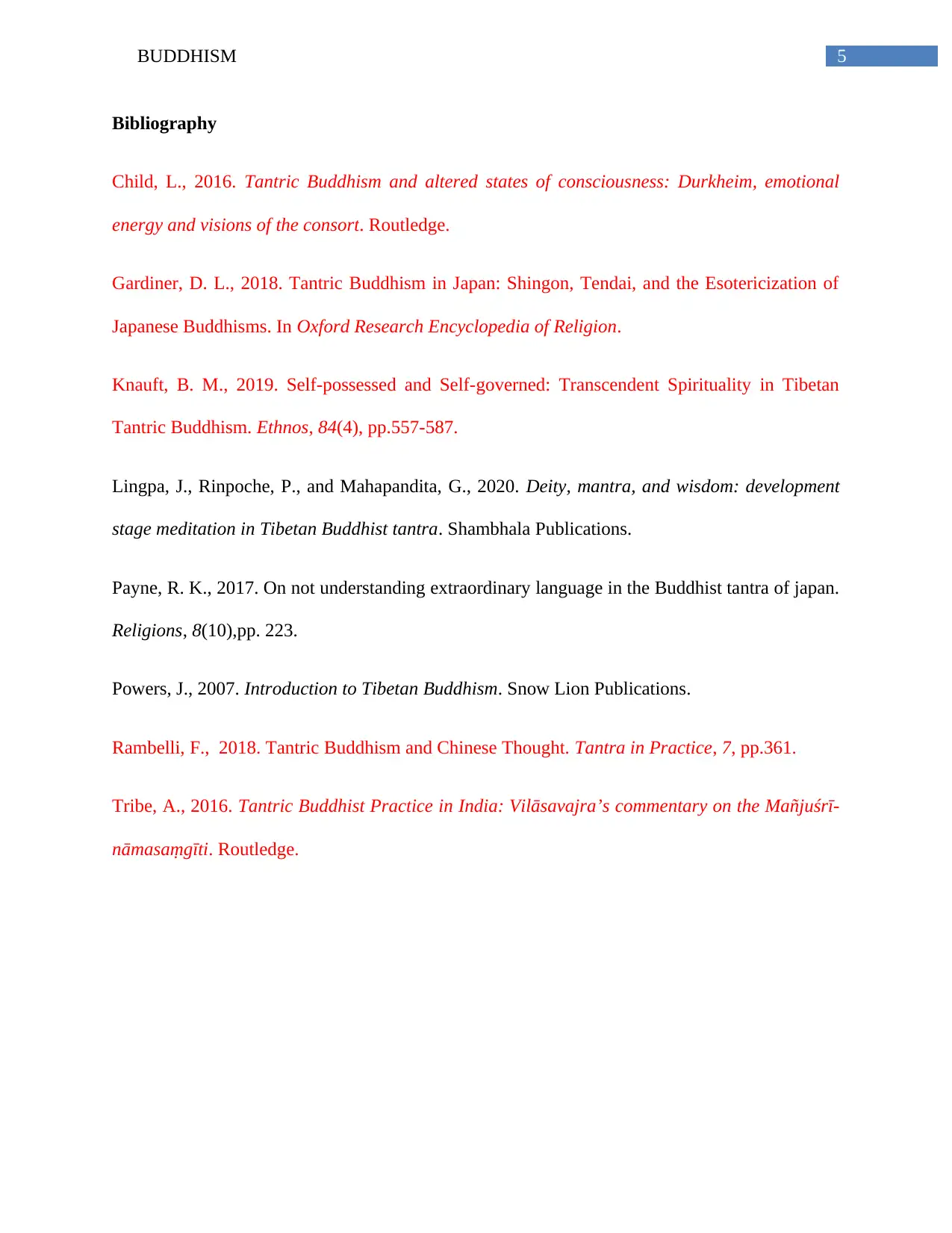
Child, L., 2016. Tantric Buddhism and altered states of consciousness: Durkheim, emotional
energy and visions of the consort. Routledge.
Gardiner, D. L., 2018. Tantric Buddhism in Japan: Shingon, Tendai, and the Esotericization of
Japanese Buddhisms. In Oxford Research Encyclopedia of Religion.
Knauft, B. M., 2019. Self-possessed and Self-governed: Transcendent Spirituality in Tibetan
Tantric Buddhism. Ethnos, 84(4), pp.557-587.
Lingpa, J., Rinpoche, P., and Mahapandita, G., 2020. Deity, mantra, and wisdom: development
stage meditation in Tibetan Buddhist tantra. Shambhala Publications.
Payne, R. K., 2017. On not understanding extraordinary language in the Buddhist tantra of japan.
Religions, 8(10),pp. 223.
Powers, J., 2007. Introduction to Tibetan Buddhism. Snow Lion Publications.
Rambelli, F., 2018. Tantric Buddhism and Chinese Thought. Tantra in Practice, 7, pp.361.
Tribe, A., 2016. Tantric Buddhist Practice in India: Vilāsavajra’s commentary on the Mañjuśrī-
nāmasaṃgīti. Routledge.
Document Page
6BUDDHISM
chevron_up_icon
1 out of 7
circle_padding
hide_on_mobile
zoom_out_icon
[object Object]