Budgetary Control's Impact on Financial Performance Analysis
VerifiedAdded on 2023/06/08
|21
|7566
|419
Report
AI Summary
This research report investigates the impact of budget and budgetary control on business operations in a competitive environment, focusing on the hospitality sector with an example of Holiday Inn. It examines the role of budgetary control in managing discrepancies between budgeted plans and actual figures, and strategies to mitigate adverse effects. The report covers various budget types, monitoring methods, and recommendations for improvement. It explores themes such as the effect of budgetary control on performance, objectives of budgetary control, and stages of budgetary control in relation to organizational performance. The research employs both qualitative and quantitative methods, including inductive and deductive reasoning, to analyze the correlation between budgetary control and financial performance. The report concludes by emphasizing the importance of budgetary control in achieving financial objectives and enhancing overall organizational effectiveness.
CONTEMPORARY
ACTION IN
FINANCE FINAL
REPORT
ACTION IN
FINANCE FINAL
REPORT

Paraphrase This Document
Need a fresh take? Get an instant paraphrase of this document with our AI Paraphraser
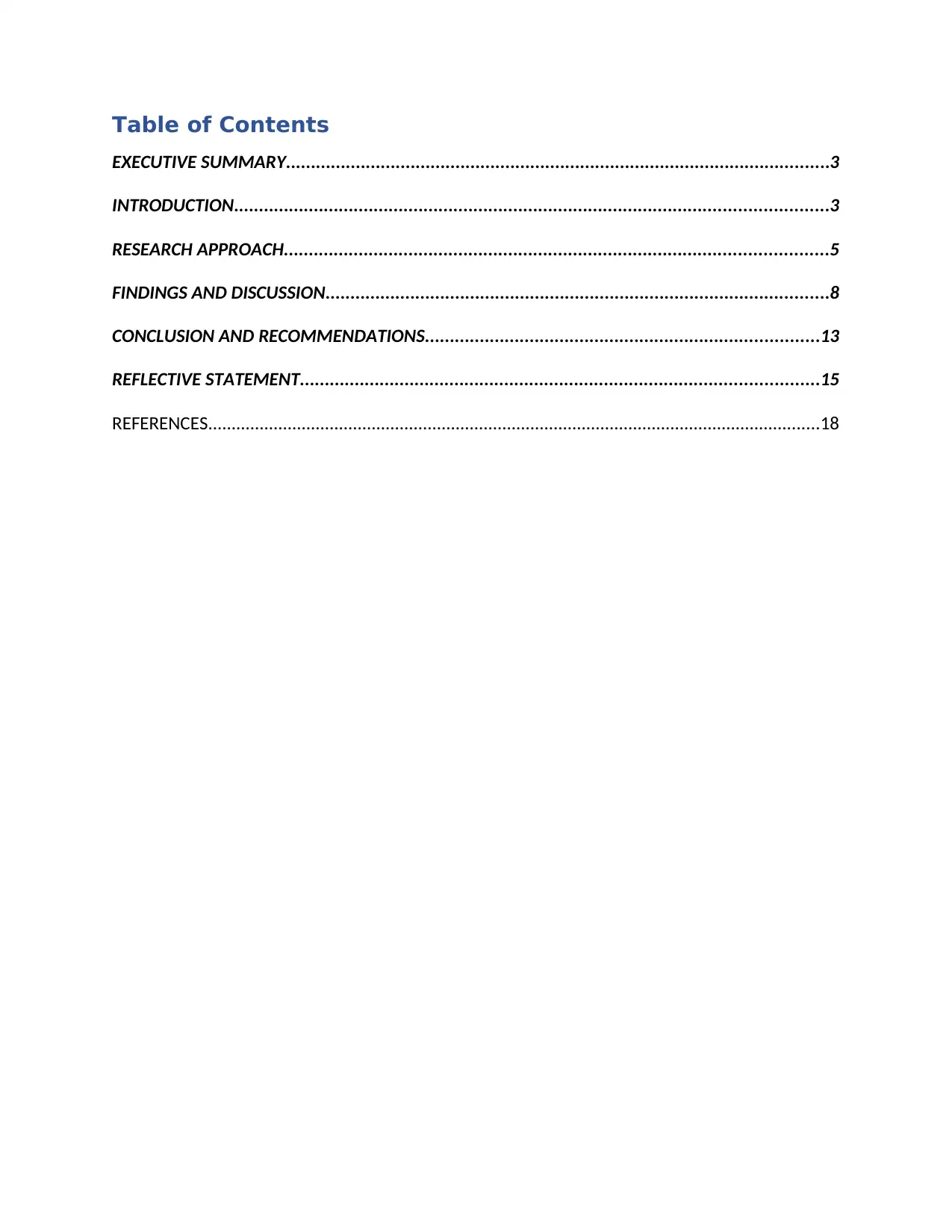
Table of Contents
EXECUTIVE SUMMARY.............................................................................................................3
INTRODUCTION.......................................................................................................................3
RESEARCH APPROACH.............................................................................................................5
FINDINGS AND DISCUSSION.....................................................................................................8
CONCLUSION AND RECOMMENDATIONS...............................................................................13
REFLECTIVE STATEMENT........................................................................................................15
REFERENCES...................................................................................................................................18
EXECUTIVE SUMMARY.............................................................................................................3
INTRODUCTION.......................................................................................................................3
RESEARCH APPROACH.............................................................................................................5
FINDINGS AND DISCUSSION.....................................................................................................8
CONCLUSION AND RECOMMENDATIONS...............................................................................13
REFLECTIVE STATEMENT........................................................................................................15
REFERENCES...................................................................................................................................18
EXECUTIVE SUMMARY
The research report prepared as under explains how budget and budgetary control would be
affecting, impacting the running and functioning of a business in a competitive environment. It
also explains what roles could be played by the budgetary control in managing the difference
between budgeted plan and actual figures. It explains in what ways the adverse effects if any
could be managed and reduced to a better level for functioning and running of firm in economy.
The report helps to understand which budgets shall be prepared and in what ways they could be
monitored and control over a time span. The report helps to provide recommendations as where
the business is lacking and lagging behind and in what ways they could prove to be beneficial if
implemented after making expected changes. The report provides an overview about the budget
and types of budgets which are taken in account by the managers and supervisors for managing
the operational activities.
INTRODUCTION
This research of hospitality sector which include holiday inn is based upon some main
important themes which helps the firm to identify and improve the financial performance of the
firm. In a very first theme firm analyse the factor of budgetary control which affect the
performance of the hospitality and industry, if company is not create proper plan before creating
the budget, then it harm the performance of hospitality and sector also it includes the
coordination of employees and control over the budget (Ballard and Pritchard, 2020). If company
having these two benefits, then it helps the firm to show improvement in the performance of the
workers and assist to make good and relevant budget with the proper analysis of each and every
component of budget. Budget create an impact on the performance of the organization and
analyse the cost which are need to be implemented at the time of performing the activity. In
another theme it analyses the objective of budgetary control in comparison to the level of
performance of the organization. It can be determined that the budgetary control is a system in
which cost can be control and the helps in preparing the budgets, create good coordination
among the departments and setting responsibilities and assist in comparing the actual
performance with the budgeted standards and more concentrates upon the performance level to
meet the highest profitability and by showing good skills and knowledge at the time of
performing the task. Budgetary control is the process of creating a spending plan and comparing
The research report prepared as under explains how budget and budgetary control would be
affecting, impacting the running and functioning of a business in a competitive environment. It
also explains what roles could be played by the budgetary control in managing the difference
between budgeted plan and actual figures. It explains in what ways the adverse effects if any
could be managed and reduced to a better level for functioning and running of firm in economy.
The report helps to understand which budgets shall be prepared and in what ways they could be
monitored and control over a time span. The report helps to provide recommendations as where
the business is lacking and lagging behind and in what ways they could prove to be beneficial if
implemented after making expected changes. The report provides an overview about the budget
and types of budgets which are taken in account by the managers and supervisors for managing
the operational activities.
INTRODUCTION
This research of hospitality sector which include holiday inn is based upon some main
important themes which helps the firm to identify and improve the financial performance of the
firm. In a very first theme firm analyse the factor of budgetary control which affect the
performance of the hospitality and industry, if company is not create proper plan before creating
the budget, then it harm the performance of hospitality and sector also it includes the
coordination of employees and control over the budget (Ballard and Pritchard, 2020). If company
having these two benefits, then it helps the firm to show improvement in the performance of the
workers and assist to make good and relevant budget with the proper analysis of each and every
component of budget. Budget create an impact on the performance of the organization and
analyse the cost which are need to be implemented at the time of performing the activity. In
another theme it analyses the objective of budgetary control in comparison to the level of
performance of the organization. It can be determined that the budgetary control is a system in
which cost can be control and the helps in preparing the budgets, create good coordination
among the departments and setting responsibilities and assist in comparing the actual
performance with the budgeted standards and more concentrates upon the performance level to
meet the highest profitability and by showing good skills and knowledge at the time of
performing the task. Budgetary control is the process of creating a spending plan and comparing
⊘ This is a preview!⊘
Do you want full access?
Subscribe today to unlock all pages.

Trusted by 1+ million students worldwide
actual spending to that plan on a regular basis to see if either one needs to be adjusted to stay on
track. This methodology is required to manage spending and achieve a number of financial
objectives. Organizations heavily rely on budgetary control to keep tabs on their spending, and
both the public and private sectors use this policy. A budgetary control system uses budgets to
plan and oversee every stage of creating and dispensing goods and services. This is true because
we frequently create revenue and expenditure variance analyses to identify areas of divergence
that management needs to be aware of to prevent embarrassment. Any unfavourable variance
will translate into the inability to achieve the corporate goal, which will eventually result in
conflict with stakeholders. Although many people criticize the budgeting process, budgets are
essential in a large, modern organization to criticize because the benefits they produce and the
control they provide far outweigh the costs. Given this, the limited resources available, along
with the fierce competition present in the majority of businesses, budgets, when used properly,
would be a useful planning and control tool, particularly for a large organization like Nepal Oil
Corporation. Performance of an organisation is influenced by its personnel, systems, processes,
and technology. It is concerned with the operation's effectiveness and efficiency. It is a metric
that assesses how successfully an organization met its goal. Major areas for performance analysis
are presented. These include the ability to repay debt as well as liquidity, profitability, and
efficiency. According to empirical research, budgetary control and financial performance are
positively correlated, and managers are motivated to work harder when they are involved in the
budgeting process and receive rewards for contributing to the achievement of the company's
goals and objectives. Budgetary control is one of the essential instruments that helps an
organisation realise improvements in its financial performance. Budgetary control entails the
creation of a budget, the documentation of actual accomplishments, the identification and
investigation of discrepancies between actual and budgeted performance, and the implementation
of 42 appropriate corrective actions to ensure that the budgeted performance is successfully
attained. The company can lower costs and boost the quality of its services based on its
budgetary allocations by implementing proper budgetary control planning. Costs are reduced as a
result, and goal achievement is improved, increasing organisational effectiveness. Managers
coordinate their efforts through budgeting so that the organization's goals and the goals of its
constituent parts are aligned. Control guarantees that the goals outlined in the budgets are met.
Financial performance is a general indicator of a company's overall financial health over a
track. This methodology is required to manage spending and achieve a number of financial
objectives. Organizations heavily rely on budgetary control to keep tabs on their spending, and
both the public and private sectors use this policy. A budgetary control system uses budgets to
plan and oversee every stage of creating and dispensing goods and services. This is true because
we frequently create revenue and expenditure variance analyses to identify areas of divergence
that management needs to be aware of to prevent embarrassment. Any unfavourable variance
will translate into the inability to achieve the corporate goal, which will eventually result in
conflict with stakeholders. Although many people criticize the budgeting process, budgets are
essential in a large, modern organization to criticize because the benefits they produce and the
control they provide far outweigh the costs. Given this, the limited resources available, along
with the fierce competition present in the majority of businesses, budgets, when used properly,
would be a useful planning and control tool, particularly for a large organization like Nepal Oil
Corporation. Performance of an organisation is influenced by its personnel, systems, processes,
and technology. It is concerned with the operation's effectiveness and efficiency. It is a metric
that assesses how successfully an organization met its goal. Major areas for performance analysis
are presented. These include the ability to repay debt as well as liquidity, profitability, and
efficiency. According to empirical research, budgetary control and financial performance are
positively correlated, and managers are motivated to work harder when they are involved in the
budgeting process and receive rewards for contributing to the achievement of the company's
goals and objectives. Budgetary control is one of the essential instruments that helps an
organisation realise improvements in its financial performance. Budgetary control entails the
creation of a budget, the documentation of actual accomplishments, the identification and
investigation of discrepancies between actual and budgeted performance, and the implementation
of 42 appropriate corrective actions to ensure that the budgeted performance is successfully
attained. The company can lower costs and boost the quality of its services based on its
budgetary allocations by implementing proper budgetary control planning. Costs are reduced as a
result, and goal achievement is improved, increasing organisational effectiveness. Managers
coordinate their efforts through budgeting so that the organization's goals and the goals of its
constituent parts are aligned. Control guarantees that the goals outlined in the budgets are met.
Financial performance is a general indicator of a company's overall financial health over a
Paraphrase This Document
Need a fresh take? Get an instant paraphrase of this document with our AI Paraphraser
specific time period, whereas performance refers to how effectively and efficiently an
organization's goals and objectives are achieved. A firm's cash flow, working capital, cost base,
borrowing, and growth can all be used to gauge its financial performance. Comparing the
employee performance with setting standards is important because it only helps the firm
understand which employee perform to achieve their targets and activity so, that firm can easily
provide them benefits and opportunity to develop their career in the organization. In another
theme it majorly discusses about the stages of budgetary control in reference to the performance
of the firm. In this particular theme hospitality sector need to setup a plan or target the
performance which assists the firm to coordinate with all the tasks of the company, after that it
record the actual performance of the business, then it compares the actual performance with the
setting plan at last it identifies and calculate the differences or variances which helps the firm to
understand the level of company performance and the reasons behind the low performance of the
organization. These are some most significant themes to determine the impact of performance in
the hospitality industry (Luttenberger, 2020).
RESEARCH APPROACH
There are two types of research qualitative and quantitative. Qualitative research is a
secondary source of data. Research utilizing strategies like member perception or contextual
investigations that produce a story, and illustrative portrayal of a circumstance or action is
known as subjective examination. Sociologists who utilize these strategies habitually reject
positivism and stick to an interpretive way of thinking. An arranged movement and subjective
examination put the spectator on the planet (Burman, 2018). It includes a progression of
interpretive, substantial activities that bring the rest of the world into the center. The world is
changed by these strategies. They change the world into various portrayals, which might
incorporate reminders to oneself, field notes, meetings, exchanges, and pictures. During this
level, subjective exploration takes on a naturalistic, interpretive point of view on the world. To
request to assess occasions as far as the implications people dole out to them, subjective
scientists explore things in their common habitats. To comprehend a peculiarity as far as the
implications people connect to it, subjective examination tries to research things right at home. It
incorporates no sort of intercession or a method for changing the climate being examined. Rather
than Randomized Clinical Trials (RCT), which intend to assess an intercession, this study
organization's goals and objectives are achieved. A firm's cash flow, working capital, cost base,
borrowing, and growth can all be used to gauge its financial performance. Comparing the
employee performance with setting standards is important because it only helps the firm
understand which employee perform to achieve their targets and activity so, that firm can easily
provide them benefits and opportunity to develop their career in the organization. In another
theme it majorly discusses about the stages of budgetary control in reference to the performance
of the firm. In this particular theme hospitality sector need to setup a plan or target the
performance which assists the firm to coordinate with all the tasks of the company, after that it
record the actual performance of the business, then it compares the actual performance with the
setting plan at last it identifies and calculate the differences or variances which helps the firm to
understand the level of company performance and the reasons behind the low performance of the
organization. These are some most significant themes to determine the impact of performance in
the hospitality industry (Luttenberger, 2020).
RESEARCH APPROACH
There are two types of research qualitative and quantitative. Qualitative research is a
secondary source of data. Research utilizing strategies like member perception or contextual
investigations that produce a story, and illustrative portrayal of a circumstance or action is
known as subjective examination. Sociologists who utilize these strategies habitually reject
positivism and stick to an interpretive way of thinking. An arranged movement and subjective
examination put the spectator on the planet (Burman, 2018). It includes a progression of
interpretive, substantial activities that bring the rest of the world into the center. The world is
changed by these strategies. They change the world into various portrayals, which might
incorporate reminders to oneself, field notes, meetings, exchanges, and pictures. During this
level, subjective exploration takes on a naturalistic, interpretive point of view on the world. To
request to assess occasions as far as the implications people dole out to them, subjective
scientists explore things in their common habitats. To comprehend a peculiarity as far as the
implications people connect to it, subjective examination tries to research things right at home. It
incorporates no sort of intercession or a method for changing the climate being examined. Rather
than Randomized Clinical Trials (RCT), which intend to assess an intercession, this study
doesn't. For example, subjective exploration can analyse individuals' perspectives or encounters.
In these cases, the review is completed in a characteristic setting to gather the information that
normally happens there. Hence, surprisingly well, we won't attempt to change the climate to
make sense of peculiarities, an occasion, a case, a thing, or an encounter.
Quantitative data are collected through equations, interviews, etc. The method involved
within-together and deciphering mathematical information is known as numerical displaying. It
very well may be utilized to recognize patterns and midpoints, form speculations, inspect
causality, and extrapolate discoveries to bigger populaces. A near report, which accumulates and
looks at non-mathematical information, is known as quantitative exploration (for example text,
video, or sound). The regular sociologies, including science, science, brain science, financial
aspects, social science, and advertising, habitually utilize quantitative examination.
Measurements can be utilized to test speculations or forecasts in both correlational and
exploratory examinations officially. Contingent upon the examining strategy utilized, the
outcomes may be extrapolated to bigger populaces (Lantis and Bloomberg, 2018). Before
information can be assessed, it could be handled whenever it is procured For example, it very
well may be important to change over test and review results from English to numbers. To
answer questions, you can then apply factual examination. Your information will be introduced
utilizing expressive insights, which likewise incorporate midpoints and changeability measures.
To picture your information and search for patterns or exceptions, you can likewise use charts,
disperse plots, and recurrence tables. You can conclude ends or speculations from your
information utilizing inferential insights. You can run a test on your hypothesis or gauge the
populace boundary utilizing the example information.
The inductive methodology, otherwise called inductive thinking, starts with perceptions, and
speculations are proposed because of those perceptions at the finish of the examination
interaction. Through a progression of speculations, inductive examination "includes the quest for
design from perception and the improvement of clarifications - speculations - for those
examples." Inductive investigations don't begin with speculations or speculations, and when the
exploration interaction has begun, the specialist is allowed to alter the concentrate's course as
they see fit. It is vital to stress that utilizing an inductive way to deal with fostering exploration
questions and goals doesn't imply that hypotheses ought to be dismissed (Li, Li, Xiang and
Djajadikerta, 2020). This strategy looks to make determinations from the informational index
In these cases, the review is completed in a characteristic setting to gather the information that
normally happens there. Hence, surprisingly well, we won't attempt to change the climate to
make sense of peculiarities, an occasion, a case, a thing, or an encounter.
Quantitative data are collected through equations, interviews, etc. The method involved
within-together and deciphering mathematical information is known as numerical displaying. It
very well may be utilized to recognize patterns and midpoints, form speculations, inspect
causality, and extrapolate discoveries to bigger populaces. A near report, which accumulates and
looks at non-mathematical information, is known as quantitative exploration (for example text,
video, or sound). The regular sociologies, including science, science, brain science, financial
aspects, social science, and advertising, habitually utilize quantitative examination.
Measurements can be utilized to test speculations or forecasts in both correlational and
exploratory examinations officially. Contingent upon the examining strategy utilized, the
outcomes may be extrapolated to bigger populaces (Lantis and Bloomberg, 2018). Before
information can be assessed, it could be handled whenever it is procured For example, it very
well may be important to change over test and review results from English to numbers. To
answer questions, you can then apply factual examination. Your information will be introduced
utilizing expressive insights, which likewise incorporate midpoints and changeability measures.
To picture your information and search for patterns or exceptions, you can likewise use charts,
disperse plots, and recurrence tables. You can conclude ends or speculations from your
information utilizing inferential insights. You can run a test on your hypothesis or gauge the
populace boundary utilizing the example information.
The inductive methodology, otherwise called inductive thinking, starts with perceptions, and
speculations are proposed because of those perceptions at the finish of the examination
interaction. Through a progression of speculations, inductive examination "includes the quest for
design from perception and the improvement of clarifications - speculations - for those
examples." Inductive investigations don't begin with speculations or speculations, and when the
exploration interaction has begun, the specialist is allowed to alter the concentrate's course as
they see fit. It is vital to stress that utilizing an inductive way to deal with fostering exploration
questions and goals doesn't imply that hypotheses ought to be dismissed (Li, Li, Xiang and
Djajadikerta, 2020). This strategy looks to make determinations from the informational index
⊘ This is a preview!⊘
Do you want full access?
Subscribe today to unlock all pages.
Trusted by 1+ million students worldwide
accumulated to detect patterns and associations that can be utilized to foster a hypothesis, yet it
doesn't block the specialist from utilizing a current hypothesis to approach the examination
question. Gaining underlies inductive thinking. Ends are drawn by searching for examples,
similitudes, and normalities in experience (premises) (or to produce a hypothesis). Beginning
with an organized impression of the world, inductive reasoning advances to addition request
thetical guesses and ideas. An expert will commonly energize observational speculations as he
travels through his assessment while utilizing an inductive system that beginnings with a subject.
No presumptions can be made in the beginning phases of the examination, and until the survey is
finished, the master is uncertain of the sort and nature of the assessment revelations.
The means illustrated for inductive exploration are trailed by logical specialists in switch
requests. They request a broader to a more unambiguous level by starting with a social
hypothesis that they find convincing and afterward testing its suggestions with information
(Corten, 2021). The strategy for research that a great many people ordinarily partner with science
is a rational one. The specialist peruses existing speculations of anything peculiarity they are
examining, concentrates on what others have done, and afterward tests speculations that outcome
from those hypotheses. For example, "There are eight legs on all bugs. An insect is a tarantula.
Tarantulas have eight legs accordingly." The speculation should be valid for rational thinking to
be solid. All bugs have eight legs, and a tarantula is a bug, which is taken to be a valid
explanation. Deductive, exploratory examination misses the mark on outlining devices like
speculation, while illustrative investigations use theories to direct estimation and measurable
tests. Hence, the functioning speculation is introduced in this article as an adaptable, down-to-
earth system that can coordinate and bring rationality all through the different phases of the
exploration cycle. Inspecting the scene of insightful, exploratory research is additionally utilized.
It presents, arranges, characterizes, and afterward applies the functioning speculation calculated
structure to policy management and similar public approach. In doing as such, this article
explains the philosophical groundworks of exploratory, rational examination, the manners by
which the functioning speculation directs the strategies and proof get-together in exploratory,
logical examination, the qualities of miniature calculated structures in exploratory, insightful
exploration, and the manners by which the functioning speculation guides information
examination in exploratory, insightful exploration.
Differences between the inductive and deductive:
doesn't block the specialist from utilizing a current hypothesis to approach the examination
question. Gaining underlies inductive thinking. Ends are drawn by searching for examples,
similitudes, and normalities in experience (premises) (or to produce a hypothesis). Beginning
with an organized impression of the world, inductive reasoning advances to addition request
thetical guesses and ideas. An expert will commonly energize observational speculations as he
travels through his assessment while utilizing an inductive system that beginnings with a subject.
No presumptions can be made in the beginning phases of the examination, and until the survey is
finished, the master is uncertain of the sort and nature of the assessment revelations.
The means illustrated for inductive exploration are trailed by logical specialists in switch
requests. They request a broader to a more unambiguous level by starting with a social
hypothesis that they find convincing and afterward testing its suggestions with information
(Corten, 2021). The strategy for research that a great many people ordinarily partner with science
is a rational one. The specialist peruses existing speculations of anything peculiarity they are
examining, concentrates on what others have done, and afterward tests speculations that outcome
from those hypotheses. For example, "There are eight legs on all bugs. An insect is a tarantula.
Tarantulas have eight legs accordingly." The speculation should be valid for rational thinking to
be solid. All bugs have eight legs, and a tarantula is a bug, which is taken to be a valid
explanation. Deductive, exploratory examination misses the mark on outlining devices like
speculation, while illustrative investigations use theories to direct estimation and measurable
tests. Hence, the functioning speculation is introduced in this article as an adaptable, down-to-
earth system that can coordinate and bring rationality all through the different phases of the
exploration cycle. Inspecting the scene of insightful, exploratory research is additionally utilized.
It presents, arranges, characterizes, and afterward applies the functioning speculation calculated
structure to policy management and similar public approach. In doing as such, this article
explains the philosophical groundworks of exploratory, rational examination, the manners by
which the functioning speculation directs the strategies and proof get-together in exploratory,
logical examination, the qualities of miniature calculated structures in exploratory, insightful
exploration, and the manners by which the functioning speculation guides information
examination in exploratory, insightful exploration.
Differences between the inductive and deductive:
Paraphrase This Document
Need a fresh take? Get an instant paraphrase of this document with our AI Paraphraser
As per my lord's theory, I chose to direct subjective examination, yet I before long
understood that I had adopted a speculation-driven strategy. Then I found web-based that rational
subjective examination in view of hypothesis could be created (Daldrup, Krahl and Bürger,
2020). My whole exploration question and thought depend on a hypothesis, despite the fact that I
can dispose of my underlying speculation. Insightful subjective exploration utilizes an alternate
technique for information assortment; however, it sticks to similar philosophical standards as
quantitative examination. Since the inductive methodology overwhelms subjective examination,
I am genuinely uncertain of how to continue. Inductive reasoning is used to synthesize data in
qualitative research, whereas deductive reasoning is used in quantitative research. Purposive
sampling, which selects a small sample size with the goal of developing a deep understanding of
the target concept, is the foundation of qualitative research.
FINDINGS AND DISCUSSION
THEME 1: The impact of budgetary control on the performance of the organization in the
hospitality industry.
In above literature review it has been discussed as what would be the influence of
budgetary control on the results being rendered in a hospitality industry such as Holiday inn. It
could be observed that Budgets and budgetary control has been playing a very significant impact
on the working and functioning of business in long run (Davies, Swilling and Wlokas, 2018). It
also helps in examining as in what ways business could control excessive wastage and minimize
the costs which are proving to be a hurdle or hindrance on the ways of growth and expansion in
context of business and companies. The impact of budgetary control would be useful as it would
be useful for organisations to understand where the companies are lacking and lagging behind
and what measures would be helping them to overcome the same in stated time period.
Budgetary control assures that is proper control and coordination is also maintained in the
working of business in long run. It also provides assistance in monitoring and managing
performance since failure for achieving the budgeted forecast which would prove to be a
measure for overall performance being rendered by hotels and its staff persons. The importance
of budgetary control is being reflected by rthe fact which states that it would help the
management in tracking its results and working on efficient and effective grounds. Such
monitoring and controlling would assure that there is deviation in business actual performance
from the budgeted one is always under the scanner and could be rectified before it would be too
understood that I had adopted a speculation-driven strategy. Then I found web-based that rational
subjective examination in view of hypothesis could be created (Daldrup, Krahl and Bürger,
2020). My whole exploration question and thought depend on a hypothesis, despite the fact that I
can dispose of my underlying speculation. Insightful subjective exploration utilizes an alternate
technique for information assortment; however, it sticks to similar philosophical standards as
quantitative examination. Since the inductive methodology overwhelms subjective examination,
I am genuinely uncertain of how to continue. Inductive reasoning is used to synthesize data in
qualitative research, whereas deductive reasoning is used in quantitative research. Purposive
sampling, which selects a small sample size with the goal of developing a deep understanding of
the target concept, is the foundation of qualitative research.
FINDINGS AND DISCUSSION
THEME 1: The impact of budgetary control on the performance of the organization in the
hospitality industry.
In above literature review it has been discussed as what would be the influence of
budgetary control on the results being rendered in a hospitality industry such as Holiday inn. It
could be observed that Budgets and budgetary control has been playing a very significant impact
on the working and functioning of business in long run (Davies, Swilling and Wlokas, 2018). It
also helps in examining as in what ways business could control excessive wastage and minimize
the costs which are proving to be a hurdle or hindrance on the ways of growth and expansion in
context of business and companies. The impact of budgetary control would be useful as it would
be useful for organisations to understand where the companies are lacking and lagging behind
and what measures would be helping them to overcome the same in stated time period.
Budgetary control assures that is proper control and coordination is also maintained in the
working of business in long run. It also provides assistance in monitoring and managing
performance since failure for achieving the budgeted forecast which would prove to be a
measure for overall performance being rendered by hotels and its staff persons. The importance
of budgetary control is being reflected by rthe fact which states that it would help the
management in tracking its results and working on efficient and effective grounds. Such
monitoring and controlling would assure that there is deviation in business actual performance
from the budgeted one is always under the scanner and could be rectified before it would be too
late. There are many benefits and advantages associated with budgetary control such as it process
to be a powerful tool for controlling expenditures. Budgets provide a yardstick for evaluating
actual performance being rendered in context of persons and departments which have been
working in business enterprises (Davis and Davis, 2021). It would be laying emphasis on proper
staff companies and would be preventing buck passing as well when the budgeted outcomes have
not been reached or achieved. It helps in management of expenses and revenues. It denotes daily
carrying out comparison of actual expenditure or income towards planned cost or income for
identifying whether corrective measure or action is being demanded or needed. It is also known
as setting or developing a particular or specific budget by management for understanding or
knowing the variation between the budgeted performance and actual performance as well. It
would also help managers in utilising such budgets for controlling and monitoring several costs
within a certain accounting year. Budgetary control is a system which helps In controlling costs
and expenses which counts development of budgets, coordinating the departments and
establishing responsibilities by carrying out comparison between performance with budgeted and
acting upon outcomes for achieving the maximum profitable. Budgeting places a cap not just on
spending the funds but also restricting thinking in a bigger way. Budgeting can also cripple
creativity and control risk taking, leading to a declining scale in overall growth of the company.
A budget is useful and contributes in creating financial stability in competitive environment by
having a track of costs and following a plan and making budgets easier to be developed and
prepared as well. A budget makes it simpler and easier for paying bills on time and building an
emergency fund as well and even saving for major costs such as home or car. As a whole, budget
would be putting a person on stronger financial footing for both long term and day to day as
well. Budgeting can also be refereed as a process in developing plan for spending the funds.
Such spending plans is known as budget, creating such spending plans helps and allows to
determine well in advance whether business would be having enough funds for doing the things
which are likely to be known and slowly sinking deeper into debts in another year (DeCorla-
Souza, 2021). Traditionally performance budgeting initiative have two major aims which are
contributing in improving allocation decisions and raising operational efficiency. Budget is
known as a controlling instrument which would help in management of taxes to be paid towards
the government authorities for running business in the environment and in what ways consumer
can reduce and manage its spending for the benefit of company. There are many types of budgets
to be a powerful tool for controlling expenditures. Budgets provide a yardstick for evaluating
actual performance being rendered in context of persons and departments which have been
working in business enterprises (Davis and Davis, 2021). It would be laying emphasis on proper
staff companies and would be preventing buck passing as well when the budgeted outcomes have
not been reached or achieved. It helps in management of expenses and revenues. It denotes daily
carrying out comparison of actual expenditure or income towards planned cost or income for
identifying whether corrective measure or action is being demanded or needed. It is also known
as setting or developing a particular or specific budget by management for understanding or
knowing the variation between the budgeted performance and actual performance as well. It
would also help managers in utilising such budgets for controlling and monitoring several costs
within a certain accounting year. Budgetary control is a system which helps In controlling costs
and expenses which counts development of budgets, coordinating the departments and
establishing responsibilities by carrying out comparison between performance with budgeted and
acting upon outcomes for achieving the maximum profitable. Budgeting places a cap not just on
spending the funds but also restricting thinking in a bigger way. Budgeting can also cripple
creativity and control risk taking, leading to a declining scale in overall growth of the company.
A budget is useful and contributes in creating financial stability in competitive environment by
having a track of costs and following a plan and making budgets easier to be developed and
prepared as well. A budget makes it simpler and easier for paying bills on time and building an
emergency fund as well and even saving for major costs such as home or car. As a whole, budget
would be putting a person on stronger financial footing for both long term and day to day as
well. Budgeting can also be refereed as a process in developing plan for spending the funds.
Such spending plans is known as budget, creating such spending plans helps and allows to
determine well in advance whether business would be having enough funds for doing the things
which are likely to be known and slowly sinking deeper into debts in another year (DeCorla-
Souza, 2021). Traditionally performance budgeting initiative have two major aims which are
contributing in improving allocation decisions and raising operational efficiency. Budget is
known as a controlling instrument which would help in management of taxes to be paid towards
the government authorities for running business in the environment and in what ways consumer
can reduce and manage its spending for the benefit of company. There are many types of budgets
⊘ This is a preview!⊘
Do you want full access?
Subscribe today to unlock all pages.
Trusted by 1+ million students worldwide
which help business to bifurcate their work into smaller scale and make it simpler to understand
and prepare as well for example: Operating, Financial and non-monetary budgets. Financial
budgets help organisation to understand from where it can expect liquidity to be generated. It
includes revenue, insurance of stocks and loans as well. Operating budgets is where the company
plans operations for a specific time duration such as sales or revenue related budgets etc. Non-
monetary budgets can explain as budgets which express sales on non-financial basis and costs as
well.
THEME 2: The role of budgetary control in relation to the performance level of the company.
Budgetary control in context of performance being served by the business organisation
can be explained in a broader and narrower sense as well. Broad budgetary control explains
entire budgeting system as a controlling system, which it is the formation after whole process
control system (Doganova, 2018). Narrow budgetary control would develop a good budget on
the basis and with the help of performance management and standards on a daily basis for
comparing actual results with the budget analysing the variation in the outcomes and taking
preventive as well as corrective measures, which would be mainly related to something in the
process of implementation of budgets in the controlling of behaviour. When linked with
controlling activities, budget control takes in account process control, system control, target
control whereas the budget as the primary means of corporate internal control that provide a
comprehensive management-based platform. Budget target of control is such that budget
management is done through strategic planning for determining the annual business aims, then
with the help of decomposition of indicators for clarifying the responsibility of the budgeted
units as the base for examination. Budgetary control mainly indicates budget which is prepared
during the execution of the budget implementation of the routine control and supervision; it is
the budget targt which must be achieved by necessary assurances and guarantees. Control
commands and functions in management of budget in the examination of the implementation of
enterprise budget management; Controlling effect of budget management through the
management process. Budgeting can be explained a pre-budget control, budget execution can be
explained as a matter of monitoring, budget examination is a sort of ex post control. As the
business external and internal conditions would alter, at times strategies of business iis required
to make related adjustments, with the help of corporate budgets in the future management which
must alter in accordance with the strategic aims of changes in the future management of
and prepare as well for example: Operating, Financial and non-monetary budgets. Financial
budgets help organisation to understand from where it can expect liquidity to be generated. It
includes revenue, insurance of stocks and loans as well. Operating budgets is where the company
plans operations for a specific time duration such as sales or revenue related budgets etc. Non-
monetary budgets can explain as budgets which express sales on non-financial basis and costs as
well.
THEME 2: The role of budgetary control in relation to the performance level of the company.
Budgetary control in context of performance being served by the business organisation
can be explained in a broader and narrower sense as well. Broad budgetary control explains
entire budgeting system as a controlling system, which it is the formation after whole process
control system (Doganova, 2018). Narrow budgetary control would develop a good budget on
the basis and with the help of performance management and standards on a daily basis for
comparing actual results with the budget analysing the variation in the outcomes and taking
preventive as well as corrective measures, which would be mainly related to something in the
process of implementation of budgets in the controlling of behaviour. When linked with
controlling activities, budget control takes in account process control, system control, target
control whereas the budget as the primary means of corporate internal control that provide a
comprehensive management-based platform. Budget target of control is such that budget
management is done through strategic planning for determining the annual business aims, then
with the help of decomposition of indicators for clarifying the responsibility of the budgeted
units as the base for examination. Budgetary control mainly indicates budget which is prepared
during the execution of the budget implementation of the routine control and supervision; it is
the budget targt which must be achieved by necessary assurances and guarantees. Control
commands and functions in management of budget in the examination of the implementation of
enterprise budget management; Controlling effect of budget management through the
management process. Budgeting can be explained a pre-budget control, budget execution can be
explained as a matter of monitoring, budget examination is a sort of ex post control. As the
business external and internal conditions would alter, at times strategies of business iis required
to make related adjustments, with the help of corporate budgets in the future management which
must alter in accordance with the strategic aims of changes in the future management of
Paraphrase This Document
Need a fresh take? Get an instant paraphrase of this document with our AI Paraphraser
cooperation’s action and activities for achieveing forward control (Frimpong, 2021). In the
budget execution procedure, from budget management, budgetary control companies in the field
and promptly finding the actual deviation from the budgeted differences, and took the required
measures for eliminating weaknesses and achieving process monitoring.
Budget management functions in the budget – budget management, feedback control and
applying main functions would be keeping the actual outcomes for comparing with budget target
on time, and deviations would be occurring message for management of budget and towards the
adjustments for ensuring the budgeted aims (Gideon and Unterhalter, 2020) In short, the advance
monitoring would be concentrating on the corporative budgets and budgeting as well of the
management. Things in the process monitoring would be focusing on every link for controlling
the implementation of company and layer feedback control would be focusing on the deviation
observe dfrom the budgets target following up controlling of data and information. Due to the
combination, only the budget would be strengthening all round management and monitoring the
abilities as well as capabilities which would enable the firm’s goals to be refined for
implementation. Budgetary control is not only a vast range of monitoring but also considered as
a range of control, budget control is expected to penetrate to the enterprise in every business-
related processes and the business linkages which would be covering all business areas, positions
and sectors as well. The application and implementation of accounting measurement and
accounting methods would be reflecting implementation of the budgeting process and oversight
for accounting monitoring and management of budget for the basic value related to management
actions and activities, the day-to-day operations of certain business sectors such as production,
sales and procurement for carrying out management control. Budgetary control organisation is a
complete company which is a primary factor for the successful development, administration and
maintenance of the project being chosen (Goetz, Williams and Damiano, 2020). A committee
advising or recommending the budget is formed which would combine head of several
departments and all those heads which are being given the responsibility of guaranteeing the
proper application and implementation of the department related budgets which have been
allocated to them. Budget main role and purpose is to manage risks and costs of the company
which are associated with it for running and managing its operations in the business. It explains
in what ways budget would help the company to increase the opportunities and chances of
growth and expansion in given time frame. Budgetary control and budget is helpful in managing
budget execution procedure, from budget management, budgetary control companies in the field
and promptly finding the actual deviation from the budgeted differences, and took the required
measures for eliminating weaknesses and achieving process monitoring.
Budget management functions in the budget – budget management, feedback control and
applying main functions would be keeping the actual outcomes for comparing with budget target
on time, and deviations would be occurring message for management of budget and towards the
adjustments for ensuring the budgeted aims (Gideon and Unterhalter, 2020) In short, the advance
monitoring would be concentrating on the corporative budgets and budgeting as well of the
management. Things in the process monitoring would be focusing on every link for controlling
the implementation of company and layer feedback control would be focusing on the deviation
observe dfrom the budgets target following up controlling of data and information. Due to the
combination, only the budget would be strengthening all round management and monitoring the
abilities as well as capabilities which would enable the firm’s goals to be refined for
implementation. Budgetary control is not only a vast range of monitoring but also considered as
a range of control, budget control is expected to penetrate to the enterprise in every business-
related processes and the business linkages which would be covering all business areas, positions
and sectors as well. The application and implementation of accounting measurement and
accounting methods would be reflecting implementation of the budgeting process and oversight
for accounting monitoring and management of budget for the basic value related to management
actions and activities, the day-to-day operations of certain business sectors such as production,
sales and procurement for carrying out management control. Budgetary control organisation is a
complete company which is a primary factor for the successful development, administration and
maintenance of the project being chosen (Goetz, Williams and Damiano, 2020). A committee
advising or recommending the budget is formed which would combine head of several
departments and all those heads which are being given the responsibility of guaranteeing the
proper application and implementation of the department related budgets which have been
allocated to them. Budget main role and purpose is to manage risks and costs of the company
which are associated with it for running and managing its operations in the business. It explains
in what ways budget would help the company to increase the opportunities and chances of
growth and expansion in given time frame. Budgetary control and budget is helpful in managing
unpredictable risks and situation which would affect business in unexpected ways and which
must be controlled well in advance through introduction and announcement of budgets in the
organisation. Budgets are observed to play a vital and crucial role to overcome issues and threats
which would be affecting the performance and running of the enterprise in the economic
environment and in what ways managers could use budgets in such a way that it would serve the
purpose made by them well in advance.
THEME 3: The stages in budgetary control in context of organizational performance.
There are 5 stages observed in case of budgetary control which would be affecting the
performance of company and organisation which would also help in ensuring budgetary control,
budgets must also be effectively controlled and managed as well (Guiral, Moon, Tan and Yu,
2020). Although the variation between controlling and managing budgets is not clearly stated,
there are certain characteristics which would be setting them apart. Some of them can be
explained such as Establishing actual position in the market, carrying out comparison with actual
budgets, computation of variances, establishment of reasons for variances and taking action for
exerting control. Organisations would be having certain form of accounting system which would
be recording and keeping an account of their earned income and costs. Depending on their
system, budgets can be found by some other or different form of budget code. Revenue or
expense is then taken in account and recorded against the budgeted code. It would then enable
budget holders for identification with their actual budget positioning at any point of time period.
Such information is being rendered in the financial management prepared report. For
establishment of actual portions, the budget holder must be examining and understanding the
data which is available. They must know current information and adjust the outstanding
transactions as well. After gathering information, one must compare the budgeted figures with
that of beginning figures at the beginning or initially in case of financial year. Such comparison
must be simple if the actual revenue or income and costs heading would be matching which were
originally being predicted (Ha, 2019). The variation between the expenditure and actual income
and expenditure is known as a variance which is a important tool for budgetary control
procedure. In relation to budgetary control, the term variance would be indicated towards the
difference among actual and budgeted income as well as expenditure. After that one must
understand reasons behind the variation and differences that are being observed among budgeted
and actual expenses. The reasons for every variance shall be known. Such process is critical for
must be controlled well in advance through introduction and announcement of budgets in the
organisation. Budgets are observed to play a vital and crucial role to overcome issues and threats
which would be affecting the performance and running of the enterprise in the economic
environment and in what ways managers could use budgets in such a way that it would serve the
purpose made by them well in advance.
THEME 3: The stages in budgetary control in context of organizational performance.
There are 5 stages observed in case of budgetary control which would be affecting the
performance of company and organisation which would also help in ensuring budgetary control,
budgets must also be effectively controlled and managed as well (Guiral, Moon, Tan and Yu,
2020). Although the variation between controlling and managing budgets is not clearly stated,
there are certain characteristics which would be setting them apart. Some of them can be
explained such as Establishing actual position in the market, carrying out comparison with actual
budgets, computation of variances, establishment of reasons for variances and taking action for
exerting control. Organisations would be having certain form of accounting system which would
be recording and keeping an account of their earned income and costs. Depending on their
system, budgets can be found by some other or different form of budget code. Revenue or
expense is then taken in account and recorded against the budgeted code. It would then enable
budget holders for identification with their actual budget positioning at any point of time period.
Such information is being rendered in the financial management prepared report. For
establishment of actual portions, the budget holder must be examining and understanding the
data which is available. They must know current information and adjust the outstanding
transactions as well. After gathering information, one must compare the budgeted figures with
that of beginning figures at the beginning or initially in case of financial year. Such comparison
must be simple if the actual revenue or income and costs heading would be matching which were
originally being predicted (Ha, 2019). The variation between the expenditure and actual income
and expenditure is known as a variance which is a important tool for budgetary control
procedure. In relation to budgetary control, the term variance would be indicated towards the
difference among actual and budgeted income as well as expenditure. After that one must
understand reasons behind the variation and differences that are being observed among budgeted
and actual expenses. The reasons for every variance shall be known. Such process is critical for
⊘ This is a preview!⊘
Do you want full access?
Subscribe today to unlock all pages.
Trusted by 1+ million students worldwide

1 out of 21


Related Documents


Your All-in-One AI-Powered Toolkit for Academic Success.
+13062052269
info@desklib.com
Available 24*7 on WhatsApp / Email
![[object Object]](/_next/static/media/star-bottom.7253800d.svg)
Unlock your academic potential
Copyright © 2020–2026 A2Z Services. All Rights Reserved. Developed and managed by ZUCOL.