Budgeting Report: Types, Benefits, and Investment Risk Analysis
VerifiedAdded on 2023/04/21
|13
|2943
|130
Report
AI Summary
This report provides a comprehensive overview of budgeting, examining its core concepts, objectives, and the steps involved in the budgeting process. It delves into the advantages and disadvantages of budgeting, highlighting its role in financial planning, expenditure control, and resource allocation while also acknowledging its limitations. The report further explores various types of budgets, including sales, production, capital, operating, and master budgets, detailing their key characteristics and functions within an organization. A significant portion of the report is dedicated to illustrating how budgeting minimizes investment risks by providing a clear understanding of financial situations and enabling informed decision-making. The report emphasizes the importance of budgeting in forecasting, coordinating activities, and fostering financial stability within organizations. This report aims to educate and inform the reader about the importance of budgeting.
Running head: BUDGETING
BUDGETING
Name of the student
Name of the university
Author note
BUDGETING
Name of the student
Name of the university
Author note

Paraphrase This Document
Need a fresh take? Get an instant paraphrase of this document with our AI Paraphraser
1BUDGETING
Executive Summary
Budgeting is identified as one of the major approach for the corporate organisations to
evaluate its financial situation. In this regard, the purpose of this report is to discuss and
highlight different aspects of the budget and facilitates better understanding of different
attributes of budget in terms of the advantages and disadvantages of the budget in an
organisation. Moreover, there are also different types of budgets and its key characteristics
are also illustrated in course of the discussion. Further, the discussion also cares to develop a
perception regarding the role of budget in reducing the risks in investments.
Executive Summary
Budgeting is identified as one of the major approach for the corporate organisations to
evaluate its financial situation. In this regard, the purpose of this report is to discuss and
highlight different aspects of the budget and facilitates better understanding of different
attributes of budget in terms of the advantages and disadvantages of the budget in an
organisation. Moreover, there are also different types of budgets and its key characteristics
are also illustrated in course of the discussion. Further, the discussion also cares to develop a
perception regarding the role of budget in reducing the risks in investments.
2BUDGETING
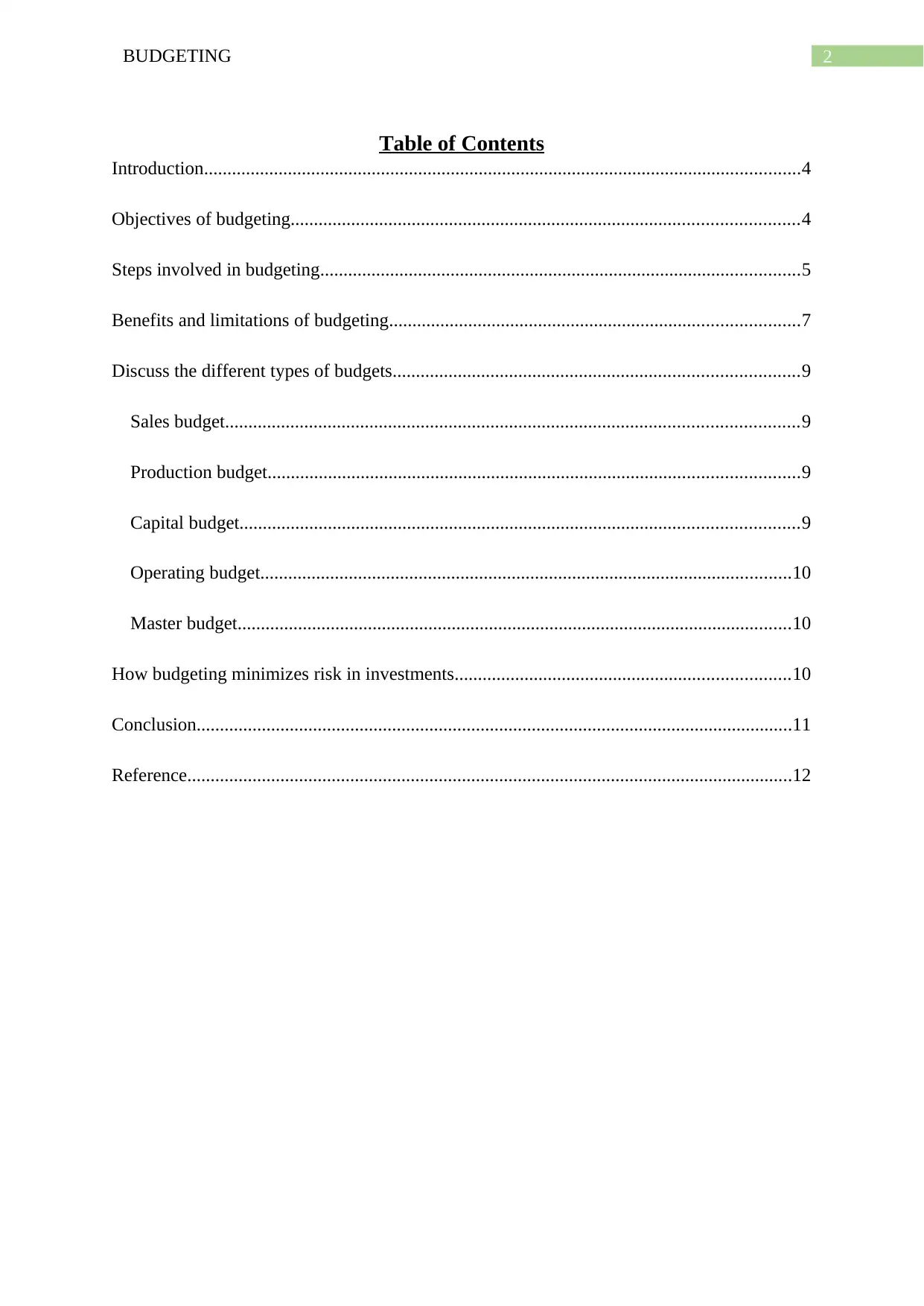
Table of Contents
Introduction................................................................................................................................4
Objectives of budgeting.............................................................................................................4
Steps involved in budgeting.......................................................................................................5
Benefits and limitations of budgeting........................................................................................7
Discuss the different types of budgets.......................................................................................9
Sales budget...........................................................................................................................9
Production budget..................................................................................................................9
Capital budget........................................................................................................................9
Operating budget..................................................................................................................10
Master budget.......................................................................................................................10
How budgeting minimizes risk in investments........................................................................10
Conclusion................................................................................................................................11
Reference..................................................................................................................................12
Table of Contents
Introduction................................................................................................................................4
Objectives of budgeting.............................................................................................................4
Steps involved in budgeting.......................................................................................................5
Benefits and limitations of budgeting........................................................................................7
Discuss the different types of budgets.......................................................................................9
Sales budget...........................................................................................................................9
Production budget..................................................................................................................9
Capital budget........................................................................................................................9
Operating budget..................................................................................................................10
Master budget.......................................................................................................................10
How budgeting minimizes risk in investments........................................................................10
Conclusion................................................................................................................................11
Reference..................................................................................................................................12
⊘ This is a preview!⊘
Do you want full access?
Subscribe today to unlock all pages.

Trusted by 1+ million students worldwide
3BUDGETING
Introduction
This report has aimed to evaluate and highlight the different aspect of budgeting. The
report will describe the main purpose and objective of performing budgeting. It will also
describe in detail the steps involved in developing a budget. The different advantages and
disadvantages of forming a budget will also be described along with the diverse types of
budget. The process of risk minimization by using budgeting will also be highlighted.
Budgeting is the process of operating, designing and implementing budgets. This is a
managerial process consisting of budget control, preparation, planning and other related
processes. It is used in majority of the managerial policies consisting of cash flow, project
management, capital expenditure and long-range planning.
Objectives of budgeting
The overall purpose of budgeting is to strategize the diverse stages of operation in
business. It also makes sure that there is effective control over all the organizational activities
and coordinate the diverse activities in the departments (Vlaicu et al., 2014). In order to
achieve the above mentioned purposes of budgeting, followings objectives are developed to
fulfill the budget aims:
To predict the future expenses, production cost and sales in order to reach the optimal
amount of sales based by minimizing the chances of losses in business
To forestall the future financial needs and condition of the organization so that
necessary funds can be employed to maintain solvency of the firm
To analyze and develop the composition of the capitalization required so that funds
can be gathered at reasonable costs
To ensure that actions taken from different departments are coordinated so that
common objectives can be obtained
Introduction
This report has aimed to evaluate and highlight the different aspect of budgeting. The
report will describe the main purpose and objective of performing budgeting. It will also
describe in detail the steps involved in developing a budget. The different advantages and
disadvantages of forming a budget will also be described along with the diverse types of
budget. The process of risk minimization by using budgeting will also be highlighted.
Budgeting is the process of operating, designing and implementing budgets. This is a
managerial process consisting of budget control, preparation, planning and other related
processes. It is used in majority of the managerial policies consisting of cash flow, project
management, capital expenditure and long-range planning.
Objectives of budgeting
The overall purpose of budgeting is to strategize the diverse stages of operation in
business. It also makes sure that there is effective control over all the organizational activities
and coordinate the diverse activities in the departments (Vlaicu et al., 2014). In order to
achieve the above mentioned purposes of budgeting, followings objectives are developed to
fulfill the budget aims:
To predict the future expenses, production cost and sales in order to reach the optimal
amount of sales based by minimizing the chances of losses in business
To forestall the future financial needs and condition of the organization so that
necessary funds can be employed to maintain solvency of the firm
To analyze and develop the composition of the capitalization required so that funds
can be gathered at reasonable costs
To ensure that actions taken from different departments are coordinated so that
common objectives can be obtained
Paraphrase This Document
Need a fresh take? Get an instant paraphrase of this document with our AI Paraphraser
4BUDGETING
To hasten the efficiency of processes in diverse departments, cost centers and
divisions of the organization
To provide fixed responsibilities to all the departmental heads
To make sure that there is efficient control on inventory, sales and cash of the
business entity
To assist in developing centralized control by using effective budgetary systems
Steps involved in budgeting
The budgeting process initiates when they receive objectives of a new project for
upcoming years. The budget is prepared based on the objectives and the time table developed
by the top level of management. These act as a guideline for preparing budget for each of the
department in the industry. The initial step of budgeting is estimating the sales of the
organization as other activities of the business entity is dependent on the sales of the
organization (McNulty, 2015). This will require analysis of the current situation in the
market and projection of the position that the organization wants to stay in the market based
on the objective. This consists of evaluation of external and internal factors that would affect
the market position of the organization.
The marketing manager would then submit the sales estimate prepared to the budget
committee for approval. The budget consists of the top level of management that evaluates
the proposed budget keeping in mind the past results and the future recommendations made
by the analysts (Rossi, 2014). They would provide recommendations for making changes the
budget based on their evaluation. They can recommend a complete revision in the proposed
budget or slight alteration based on their evaluation. The approval and recommendation of
the budget committee is sent to the president of the business entity (Bas, 2014). The president
approves the budget which then officially becomes the sales budget. The sales budget
To hasten the efficiency of processes in diverse departments, cost centers and
divisions of the organization
To provide fixed responsibilities to all the departmental heads
To make sure that there is efficient control on inventory, sales and cash of the
business entity
To assist in developing centralized control by using effective budgetary systems
Steps involved in budgeting
The budgeting process initiates when they receive objectives of a new project for
upcoming years. The budget is prepared based on the objectives and the time table developed
by the top level of management. These act as a guideline for preparing budget for each of the
department in the industry. The initial step of budgeting is estimating the sales of the
organization as other activities of the business entity is dependent on the sales of the
organization (McNulty, 2015). This will require analysis of the current situation in the
market and projection of the position that the organization wants to stay in the market based
on the objective. This consists of evaluation of external and internal factors that would affect
the market position of the organization.
The marketing manager would then submit the sales estimate prepared to the budget
committee for approval. The budget consists of the top level of management that evaluates
the proposed budget keeping in mind the past results and the future recommendations made
by the analysts (Rossi, 2014). They would provide recommendations for making changes the
budget based on their evaluation. They can recommend a complete revision in the proposed
budget or slight alteration based on their evaluation. The approval and recommendation of
the budget committee is sent to the president of the business entity (Bas, 2014). The president
approves the budget which then officially becomes the sales budget. The sales budget
5BUDGETING
includes budget for expenses in distribution and selling which when combined provides the
estimate of the net sales revenue for the next year.
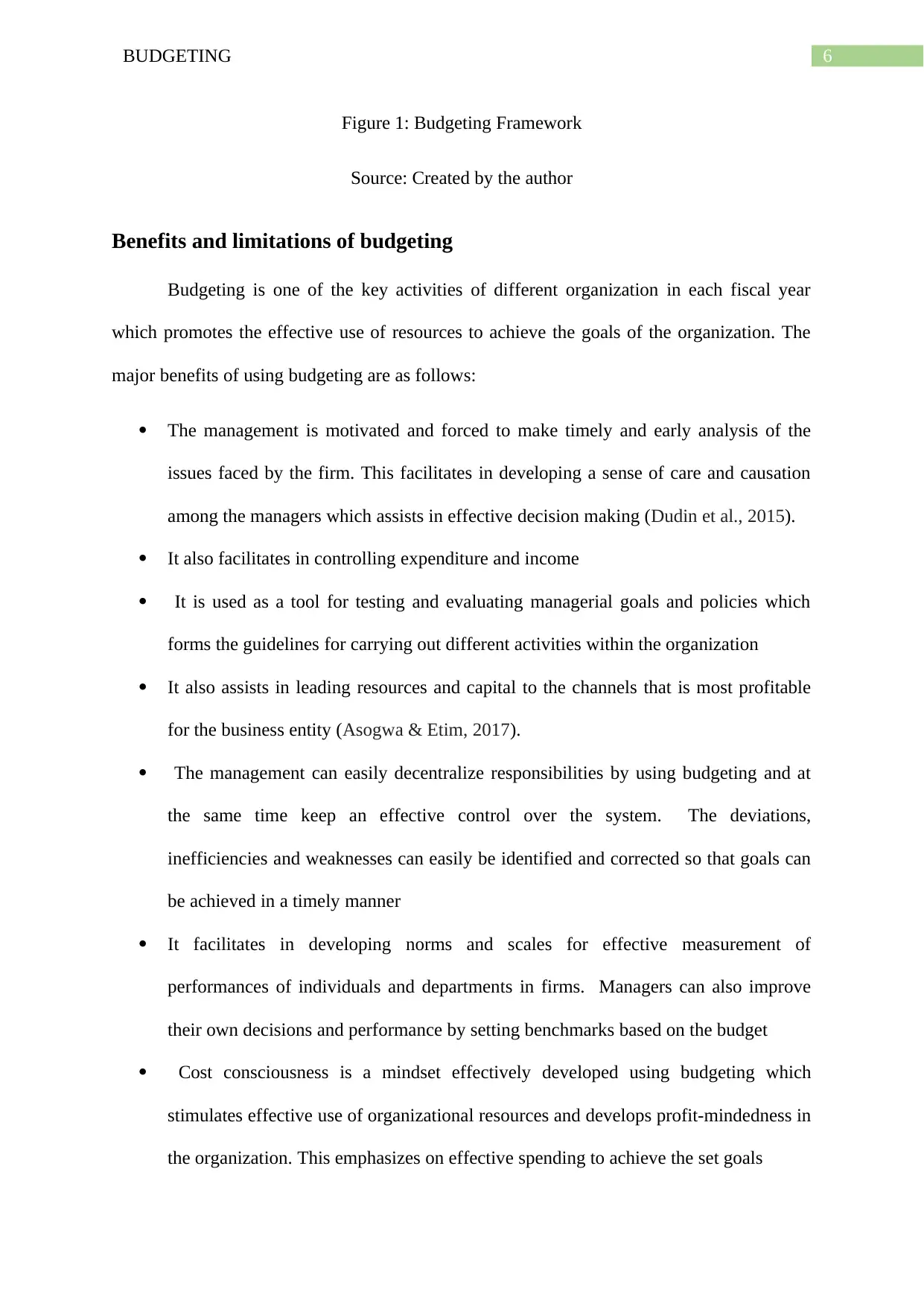
Production budget is prepared after the completion of the distribution and selling cost
budget and sales budget. The production budget is based on forecasts made on various
factors such as sales budget, plant capacity, different production factors and minimum, and
maximum inventory of finished product to be kept. Production budget is transformed into
product cost budget after the specific target of production has been chosen (Klakegg &
Lichtenberg, 2016). This consists of elements such as labor cost budget, overheads budget
and material costs budget. These budgets have to be prepared individually by different
departments and complete product budget is formed after the completion of these estimation.
The production budget is presented in the form of cost sheet. The organization also takes
budget of research and development into account as development of new product and
processes are essential for sustainable competitive advantage in organizations (Fuior &
Guțan, 2015).
includes budget for expenses in distribution and selling which when combined provides the
estimate of the net sales revenue for the next year.
Production budget is prepared after the completion of the distribution and selling cost
budget and sales budget. The production budget is based on forecasts made on various
factors such as sales budget, plant capacity, different production factors and minimum, and
maximum inventory of finished product to be kept. Production budget is transformed into
product cost budget after the specific target of production has been chosen (Klakegg &
Lichtenberg, 2016). This consists of elements such as labor cost budget, overheads budget
and material costs budget. These budgets have to be prepared individually by different
departments and complete product budget is formed after the completion of these estimation.
The production budget is presented in the form of cost sheet. The organization also takes
budget of research and development into account as development of new product and
processes are essential for sustainable competitive advantage in organizations (Fuior &
Guțan, 2015).
⊘ This is a preview!⊘
Do you want full access?
Subscribe today to unlock all pages.
Trusted by 1+ million students worldwide
6BUDGETING
Figure 1: Budgeting Framework
Source: Created by the author
Benefits and limitations of budgeting
Budgeting is one of the key activities of different organization in each fiscal year
which promotes the effective use of resources to achieve the goals of the organization. The
major benefits of using budgeting are as follows:
The management is motivated and forced to make timely and early analysis of the
issues faced by the firm. This facilitates in developing a sense of care and causation
among the managers which assists in effective decision making (Dudin et al., 2015).
It also facilitates in controlling expenditure and income
It is used as a tool for testing and evaluating managerial goals and policies which
forms the guidelines for carrying out different activities within the organization
It also assists in leading resources and capital to the channels that is most profitable
for the business entity (Asogwa & Etim, 2017).
The management can easily decentralize responsibilities by using budgeting and at
the same time keep an effective control over the system. The deviations,
inefficiencies and weaknesses can easily be identified and corrected so that goals can
be achieved in a timely manner
It facilitates in developing norms and scales for effective measurement of
performances of individuals and departments in firms. Managers can also improve
their own decisions and performance by setting benchmarks based on the budget
Cost consciousness is a mindset effectively developed using budgeting which
stimulates effective use of organizational resources and develops profit-mindedness in
the organization. This emphasizes on effective spending to achieve the set goals
Figure 1: Budgeting Framework
Source: Created by the author
Benefits and limitations of budgeting
Budgeting is one of the key activities of different organization in each fiscal year
which promotes the effective use of resources to achieve the goals of the organization. The
major benefits of using budgeting are as follows:
The management is motivated and forced to make timely and early analysis of the
issues faced by the firm. This facilitates in developing a sense of care and causation
among the managers which assists in effective decision making (Dudin et al., 2015).
It also facilitates in controlling expenditure and income
It is used as a tool for testing and evaluating managerial goals and policies which
forms the guidelines for carrying out different activities within the organization
It also assists in leading resources and capital to the channels that is most profitable
for the business entity (Asogwa & Etim, 2017).
The management can easily decentralize responsibilities by using budgeting and at
the same time keep an effective control over the system. The deviations,
inefficiencies and weaknesses can easily be identified and corrected so that goals can
be achieved in a timely manner
It facilitates in developing norms and scales for effective measurement of
performances of individuals and departments in firms. Managers can also improve
their own decisions and performance by setting benchmarks based on the budget
Cost consciousness is a mindset effectively developed using budgeting which
stimulates effective use of organizational resources and develops profit-mindedness in
the organization. This emphasizes on effective spending to achieve the set goals
Paraphrase This Document
Need a fresh take? Get an instant paraphrase of this document with our AI Paraphraser
7BUDGETING
It also facilitates in developing competition, perform effectively and sense of purpose
to the individuals working in the organization. This improves the overall productivity
and output of the employees
It also assists in developing systematic approach to solving problems within
organizations
It also facilitates in effective management to waste and stability to all aspects in
organizational processes
Even though there are multiple advantages of using budgeting but there are certain
limitations which needs to be considered while developing the budget and they are as
follows:
Forecasting, budgeting and planning is based on assumptions, judgment and
approximations which is not fully accurate. Budget is only a process of estimation so
precise forecasting is not possible as it is not a scientific method
The management and its members needs to cooperate and participate effectively as
the utility and success depends on it. This means that efforts need to be directed based
on the plan and cooperation of the top management to achieve success. The process of
budgeting fails multiple times due to the faulty execution from the executive
management team (Shaw, 2016).
Budgeting process is time consuming in nature and as it is based on estimation, often
budgets does not fulfill the expectation of the internal stakeholders. This results in
conflict within the organization. In order to develop an effective budget program it is
crucial to comprehend the objective, essentials and philosophy of the organization
Companies emphasizing on budgeting too much will result in bucking of the system
due to the inappropriate estimates of future revenue and costs (Shaw, 2016).
It also facilitates in developing competition, perform effectively and sense of purpose
to the individuals working in the organization. This improves the overall productivity
and output of the employees
It also assists in developing systematic approach to solving problems within
organizations
It also facilitates in effective management to waste and stability to all aspects in
organizational processes
Even though there are multiple advantages of using budgeting but there are certain
limitations which needs to be considered while developing the budget and they are as
follows:
Forecasting, budgeting and planning is based on assumptions, judgment and
approximations which is not fully accurate. Budget is only a process of estimation so
precise forecasting is not possible as it is not a scientific method
The management and its members needs to cooperate and participate effectively as
the utility and success depends on it. This means that efforts need to be directed based
on the plan and cooperation of the top management to achieve success. The process of
budgeting fails multiple times due to the faulty execution from the executive
management team (Shaw, 2016).
Budgeting process is time consuming in nature and as it is based on estimation, often
budgets does not fulfill the expectation of the internal stakeholders. This results in
conflict within the organization. In order to develop an effective budget program it is
crucial to comprehend the objective, essentials and philosophy of the organization
Companies emphasizing on budgeting too much will result in bucking of the system
due to the inappropriate estimates of future revenue and costs (Shaw, 2016).
8BUDGETING
Discuss the different types of budgets
Sales budget
Sales budget is referred as the estimation of sales by the management for a financial
period. The futuristic feature of the sales budget makes it more effective to set goals for the
business departments and forecasting the earnings and product requirements. From that point
of view, it can be argued that the sales budget provides a strategic advantage to the business
orientation of a company by estimating the expenses and managing profits effectively
(Mohamad & Karbhari, 2016).
Production budget
The concept of production budget is associated with a financial plan that comprised of
number of units in a single period of time. In this regard, the purpose of the managers is to
estimate the way units will be requires in a production process accompanied with the time
and scheduling. As a matter of fact, the managers intends to make a budget estimation based
on the estimated sales number in future (Nakata et al., 2015). However, the costs will not be
shown in the production budget. Instead, the number of production units are incorporated into
the production budget.
Capital budget
As far as the capital budget is concerned, it can be stated that there are the capital
receipts and payments that are identified as the capital budget. The capital receipts can be
identified as loans raised by the government for the public whereas the capital payments are
resembled with the perception of capital expenditure on assets like land, buildings, equipment
Discuss the different types of budgets
Sales budget
Sales budget is referred as the estimation of sales by the management for a financial
period. The futuristic feature of the sales budget makes it more effective to set goals for the
business departments and forecasting the earnings and product requirements. From that point
of view, it can be argued that the sales budget provides a strategic advantage to the business
orientation of a company by estimating the expenses and managing profits effectively
(Mohamad & Karbhari, 2016).
Production budget
The concept of production budget is associated with a financial plan that comprised of
number of units in a single period of time. In this regard, the purpose of the managers is to
estimate the way units will be requires in a production process accompanied with the time
and scheduling. As a matter of fact, the managers intends to make a budget estimation based
on the estimated sales number in future (Nakata et al., 2015). However, the costs will not be
shown in the production budget. Instead, the number of production units are incorporated into
the production budget.
Capital budget
As far as the capital budget is concerned, it can be stated that there are the capital
receipts and payments that are identified as the capital budget. The capital receipts can be
identified as loans raised by the government for the public whereas the capital payments are
resembled with the perception of capital expenditure on assets like land, buildings, equipment
⊘ This is a preview!⊘
Do you want full access?
Subscribe today to unlock all pages.
Trusted by 1+ million students worldwide
9BUDGETING
and machinery (Ogujiuba & Ehigiamusoe, 2014). Moreover, it can be argued that the role of
the capital budget is to portray the financial transactions in the public accounts.
Operating budget
It can be argued that the operating budget is a detailed projection of the overall
income and expenses on the basis of the sales revenue. However, it is important to know that
the operating budget is relied on a given period of time and includes the sub-budgets, sales
budget. Moreover, it is associated with the goals and objectives of a company and dedicated
to facilitate strategic advantage for the organisation in course of the progress in business.
Master budget
As far as the master budget is concerned, the components of future sales, purchases,
future expenses, production levels and the capital investments are considered to be the part of
the master budget. It is also identified as an expensive business strategy in association with
the income statement and the balance sheet as well (Cox, 2014). It is generally presented in a
monthly or yearly basis and covers the entire fiscal year of a company.
How budgeting minimizes risk in investments
It can be stated that there is a direct correlation between budget and financial
investment. Based on the empirical studies it can be stated that the primary task of the budget
is to highlight the real case scenario of the financial situation for an individual or a company.
As a result of that it becomes a core competency of the budgeting to illustrate the achievable
objectives and goals. As a matter of fact, it can be stated that there are income and expense
overview of the company or an individual that facilitate a better understanding of different
investment techniques and possibilities resembled with the financial condition. Moreover,
one of the major factors of budgeting is to highlight the financial matters and possibilities of
further investment. Therefore, having a clear understanding about different aspects of the
and machinery (Ogujiuba & Ehigiamusoe, 2014). Moreover, it can be argued that the role of
the capital budget is to portray the financial transactions in the public accounts.
Operating budget
It can be argued that the operating budget is a detailed projection of the overall
income and expenses on the basis of the sales revenue. However, it is important to know that
the operating budget is relied on a given period of time and includes the sub-budgets, sales
budget. Moreover, it is associated with the goals and objectives of a company and dedicated
to facilitate strategic advantage for the organisation in course of the progress in business.
Master budget
As far as the master budget is concerned, the components of future sales, purchases,
future expenses, production levels and the capital investments are considered to be the part of
the master budget. It is also identified as an expensive business strategy in association with
the income statement and the balance sheet as well (Cox, 2014). It is generally presented in a
monthly or yearly basis and covers the entire fiscal year of a company.
How budgeting minimizes risk in investments
It can be stated that there is a direct correlation between budget and financial
investment. Based on the empirical studies it can be stated that the primary task of the budget
is to highlight the real case scenario of the financial situation for an individual or a company.
As a result of that it becomes a core competency of the budgeting to illustrate the achievable
objectives and goals. As a matter of fact, it can be stated that there are income and expense
overview of the company or an individual that facilitate a better understanding of different
investment techniques and possibilities resembled with the financial condition. Moreover,
one of the major factors of budgeting is to highlight the financial matters and possibilities of
further investment. Therefore, having a clear understanding about different aspects of the
Paraphrase This Document
Need a fresh take? Get an instant paraphrase of this document with our AI Paraphraser
10BUDGETING
financial details provides a strategic advantage for the organisation to measure and set its
investments. In addition to this, it can be seen that there is always a risk in procuring big
investments because the organisation does not have clear idea about the market fluctuation.
They can only anticipate the possible outcome of the market. However, the role of budget in
this process is to deliver a better framework for the organisation in accordance with the
financial situation of the organisation. It may also include the loss and gain for the
organisation so that the company can maneuver its investment.
Conclusion
Based on the above discussion, it can be argued that the report tries to put emphasis
on different aspects and attributes of the budget for a corporate organisation. In this regard,
the objectives and investment risk reducing practices are incorporated into the discussion.
Moreover, the report also discusses different steps of budget that can formulate an effective
and efficient budget for the organisation. In addition to this, various types of budget are
taking into the discussion with the purpose to highlight distinctive purposes and objectives of
budgeting. The advantages and disadvantages of budgeting signifies the competencies and
drawbacks that a budget can create in the business orientation of an organisation. From that
point of view, it can be argued that the report is highly relevant and contextual.
financial details provides a strategic advantage for the organisation to measure and set its
investments. In addition to this, it can be seen that there is always a risk in procuring big
investments because the organisation does not have clear idea about the market fluctuation.
They can only anticipate the possible outcome of the market. However, the role of budget in
this process is to deliver a better framework for the organisation in accordance with the
financial situation of the organisation. It may also include the loss and gain for the
organisation so that the company can maneuver its investment.
Conclusion
Based on the above discussion, it can be argued that the report tries to put emphasis
on different aspects and attributes of the budget for a corporate organisation. In this regard,
the objectives and investment risk reducing practices are incorporated into the discussion.
Moreover, the report also discusses different steps of budget that can formulate an effective
and efficient budget for the organisation. In addition to this, various types of budget are
taking into the discussion with the purpose to highlight distinctive purposes and objectives of
budgeting. The advantages and disadvantages of budgeting signifies the competencies and
drawbacks that a budget can create in the business orientation of an organisation. From that
point of view, it can be argued that the report is highly relevant and contextual.
11BUDGETING
Reference
Asogwa, I. E., & Etim, O. E. (2017). Traditional Budgeting in Today's Business
Environment. Journal of Applied Finance and Banking, 7(3), 111.
Bas, E. (2014). An integrated quality function deployment and capital budgeting
methodology for occupational safety and health as a systems thinking approach: The
case of the construction industry. Accident Analysis & Prevention, 68, 42-56.
Cox, P. (2014). Master budget project: analysis of cash budget report. Strategic
Finance, 19(3), 52-54.
Dudin, M., Kucuri, G., Fedorova, I., Dzusova, S., & Namitulina, A. (2015). The innovative
business model canvas in the system of effective budgeting. Asian Social
Science, 11(7), 290-296.
Fuior, E., & GUȚAN, V. (2015). The Budgeting based on the Performance: Conceptual
Framework and Implementation Details. Economy Transdisciplinarity
Cognition, 18(1).
Klakegg, O. J., & Lichtenberg, S. (2016). Successive cost estimation–successful budgeting of
major projects. Procedia-Social and Behavioral Sciences, 226, 176-183.
McNulty, S. L. (2015). Barriers to participation: Exploring gender in Peru’s participatory
budget process. The Journal of Development Studies, 51(11), 1429-1443.
Mohamad, M. H. S., & Karbhari, Y. (2016). The NPFM in emerging economies: The
modified budgeting system (mbs) in malaysian government. Indonesian Management
and Accounting Research (IMAR), 9(1), 1-26.
Reference
Asogwa, I. E., & Etim, O. E. (2017). Traditional Budgeting in Today's Business
Environment. Journal of Applied Finance and Banking, 7(3), 111.
Bas, E. (2014). An integrated quality function deployment and capital budgeting
methodology for occupational safety and health as a systems thinking approach: The
case of the construction industry. Accident Analysis & Prevention, 68, 42-56.
Cox, P. (2014). Master budget project: analysis of cash budget report. Strategic
Finance, 19(3), 52-54.
Dudin, M., Kucuri, G., Fedorova, I., Dzusova, S., & Namitulina, A. (2015). The innovative
business model canvas in the system of effective budgeting. Asian Social
Science, 11(7), 290-296.
Fuior, E., & GUȚAN, V. (2015). The Budgeting based on the Performance: Conceptual
Framework and Implementation Details. Economy Transdisciplinarity
Cognition, 18(1).
Klakegg, O. J., & Lichtenberg, S. (2016). Successive cost estimation–successful budgeting of
major projects. Procedia-Social and Behavioral Sciences, 226, 176-183.
McNulty, S. L. (2015). Barriers to participation: Exploring gender in Peru’s participatory
budget process. The Journal of Development Studies, 51(11), 1429-1443.
Mohamad, M. H. S., & Karbhari, Y. (2016). The NPFM in emerging economies: The
modified budgeting system (mbs) in malaysian government. Indonesian Management
and Accounting Research (IMAR), 9(1), 1-26.
⊘ This is a preview!⊘
Do you want full access?
Subscribe today to unlock all pages.
Trusted by 1+ million students worldwide

1 out of 13


Related Documents


Your All-in-One AI-Powered Toolkit for Academic Success.
+13062052269
info@desklib.com
Available 24*7 on WhatsApp / Email
![[object Object]](/_next/static/media/star-bottom.7253800d.svg)
Unlock your academic potential
Copyright © 2020–2026 A2Z Services. All Rights Reserved. Developed and managed by ZUCOL.