Financial Management: Budgeting, Compliance & Software Evaluation
VerifiedAdded on 2023/04/07
|22
|3806
|233
Report
AI Summary
This report provides a comprehensive analysis of financial management, covering key areas such as compliance with the Corporations Act 2001 and tax law, the principles of accounting, and financial systems. It addresses research questions related to obligations under the Corporations Act, Australian and international legislation, and tax law compliance for various taxes including GST, payroll tax, income tax, fringe benefit tax, PAYG withholding, and company tax. The report also discusses the principles of accounting, financial systems, and the requirements and implications of financial probity. Furthermore, it recommends commercially available software suitable for financial management. The report includes a case study analysis of Habitania Pty Ltd, involving the development of sales, profit, and cash flow budgets, as well as a debtors analysis budget. It identifies reasons for previous year's profits and losses, comments on the effectiveness of existing financial management approaches, and outlines assumptions made in creating the budgets. The report also addresses the implementation and monitoring of budget expenditure, statutory requirements for tax compliance, and compliance requirements under the Corporations Act 20XX, concluding with a review of commercially available financial management software for Habitania Pty Ltd.

Running head: MANAGE FINANCES
Manage finances
Name of the student
Name if the university
Author’s note
Manage finances
Name of the student
Name if the university
Author’s note
Paraphrase This Document
Need a fresh take? Get an instant paraphrase of this document with our AI Paraphraser

1MANAGE FINANCES
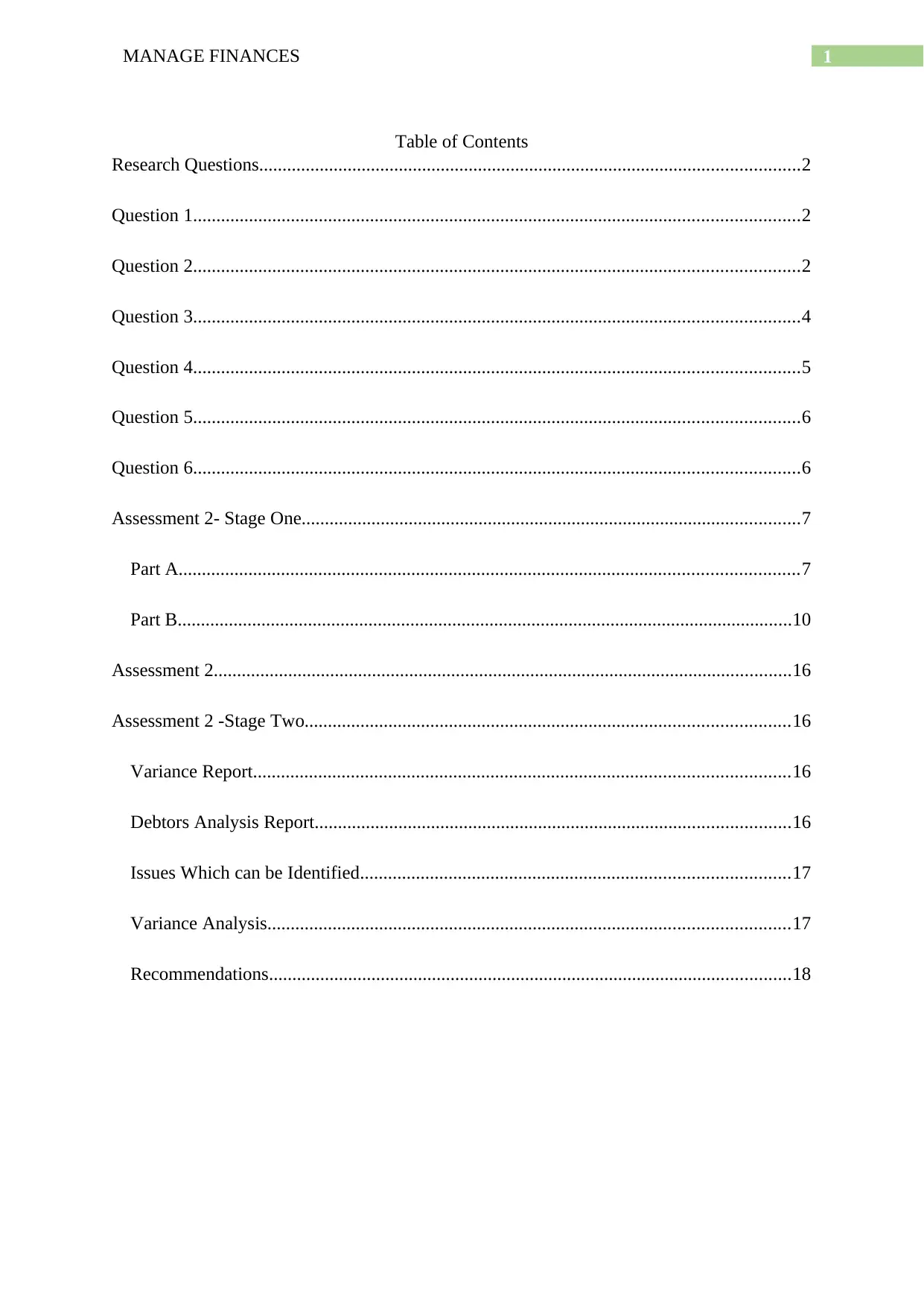
Table of Contents
Research Questions....................................................................................................................2
Question 1..................................................................................................................................2
Question 2..................................................................................................................................2
Question 3..................................................................................................................................4
Question 4..................................................................................................................................5
Question 5..................................................................................................................................6
Question 6..................................................................................................................................6
Assessment 2- Stage One...........................................................................................................7
Part A.....................................................................................................................................7
Part B....................................................................................................................................10
Assessment 2............................................................................................................................16
Assessment 2 -Stage Two........................................................................................................16
Variance Report...................................................................................................................16
Debtors Analysis Report......................................................................................................16
Issues Which can be Identified............................................................................................17
Variance Analysis................................................................................................................17
Recommendations................................................................................................................18
Table of Contents
Research Questions....................................................................................................................2
Question 1..................................................................................................................................2
Question 2..................................................................................................................................2
Question 3..................................................................................................................................4
Question 4..................................................................................................................................5
Question 5..................................................................................................................................6
Question 6..................................................................................................................................6
Assessment 2- Stage One...........................................................................................................7
Part A.....................................................................................................................................7
Part B....................................................................................................................................10
Assessment 2............................................................................................................................16
Assessment 2 -Stage Two........................................................................................................16
Variance Report...................................................................................................................16
Debtors Analysis Report......................................................................................................16
Issues Which can be Identified............................................................................................17
Variance Analysis................................................................................................................17
Recommendations................................................................................................................18

2MANAGE FINANCES
Research Questions
Question 1
List the obligations under the Corporations Act 2001 List at least six (6) obligations)
The six obligations of Corporation Act 2001 are as follows;
a. Preparation of financial report under section 295 of the Act
b. Preparation of director’s report under section 298 of the Act
c. Having the audit of financial reporting and obtaining the auditor’s report under
section 301, 307, 308 of the Act (Warren and Jones 2018).
d. Providing the financial report, directors report and auditors report to the related
members of the company under section 314 of the Act.
e. Lodging the financial report, directors report and auditors report with the ASIC
under section 319 of the Act.
f. Laying down the financial report, directors report and auditors report at the annual
general meeting under section 317 of the Act.
Question 2
Briefly explain the following Australian, international and local legislation and conventions
that are relevant to financial management in the organisation
(a) Australian Accounting Standards
The Australian Accounting Standards is regarded as the Australian government agency
which is accountable for development, issuing and maintaining the accounting standards
applicable under the Australian company law. It contributes to the global financial
Research Questions
Question 1
List the obligations under the Corporations Act 2001 List at least six (6) obligations)
The six obligations of Corporation Act 2001 are as follows;
a. Preparation of financial report under section 295 of the Act
b. Preparation of director’s report under section 298 of the Act
c. Having the audit of financial reporting and obtaining the auditor’s report under
section 301, 307, 308 of the Act (Warren and Jones 2018).
d. Providing the financial report, directors report and auditors report to the related
members of the company under section 314 of the Act.
e. Lodging the financial report, directors report and auditors report with the ASIC
under section 319 of the Act.
f. Laying down the financial report, directors report and auditors report at the annual
general meeting under section 317 of the Act.
Question 2
Briefly explain the following Australian, international and local legislation and conventions
that are relevant to financial management in the organisation
(a) Australian Accounting Standards
The Australian Accounting Standards is regarded as the Australian government agency
which is accountable for development, issuing and maintaining the accounting standards
applicable under the Australian company law. It contributes to the global financial
⊘ This is a preview!⊘
Do you want full access?
Subscribe today to unlock all pages.

Trusted by 1+ million students worldwide

3MANAGE FINANCES
reporting standard and sets a standard in the Australian community globally.
(b) Australian Securities and Investments Commission
The Australian Securities and Investments Commission is an independent government
body which takes part in corporate regulator in Australia (Kimmel et al., 2016). The role of
the ASIC is to enforce and control the company along with their financial services laws for
safeguarding the consumers, investors and creditors. Apart from that they enforce and
make the law implacable for the Australian government.
(c) Privacy Acts and Principles
The Privacy Acts and Principles comprises of the thirteen Australian Privacy Principles
which are applicable to some of the private sector companies along with majority of
Australian and Norfolk Island Government Agencies. Together they are called as the APP
entities. The APP sets down the standards, rights as well as obligations for handling,
maintaining and rectifying the personal information as well. Apart from that their role is to
safeguard the personal information.
(d) International regulations (a brief overview)
reporting standard and sets a standard in the Australian community globally.
(b) Australian Securities and Investments Commission
The Australian Securities and Investments Commission is an independent government
body which takes part in corporate regulator in Australia (Kimmel et al., 2016). The role of
the ASIC is to enforce and control the company along with their financial services laws for
safeguarding the consumers, investors and creditors. Apart from that they enforce and
make the law implacable for the Australian government.
(c) Privacy Acts and Principles
The Privacy Acts and Principles comprises of the thirteen Australian Privacy Principles
which are applicable to some of the private sector companies along with majority of
Australian and Norfolk Island Government Agencies. Together they are called as the APP
entities. The APP sets down the standards, rights as well as obligations for handling,
maintaining and rectifying the personal information as well. Apart from that their role is to
safeguard the personal information.
(d) International regulations (a brief overview)
Paraphrase This Document
Need a fresh take? Get an instant paraphrase of this document with our AI Paraphraser

4MANAGE FINANCES
International regulations takes place at the international level that is regularly exercised by
the overseas organizations (Avi-Yonah 2014). The advantage of the international
regulations is that it permits the localities and the individuals by holding them responsible
for the impact of their acts on the localities.
Question 3
Research tax law compliance and outline statutory requirements related to each of the
following:
Tax Requirements
(a) Goods and Services Tax All the Australian business that are having the
turnover of greater than minimum threshold limit of
$75,000 per year are required to be registered under
the GST. However Business limiting below to that
standard might consider to register if they want to.
(b) Payroll tax If an individual bill is $75,000 then they are required
to obtain the registration for the payroll tax under the
NSW (Woellner et al., 2016).
(c) Income tax If an individual being an Australian resident is
eligible for taxation, then the first $18,200 of the
annual income is not held for tax. This is known as
tax-free threshold. A tax rate of 19c is applied for
each greater than $1 over $37,000 with the highest
rate of 45% for over $180,000.
International regulations takes place at the international level that is regularly exercised by
the overseas organizations (Avi-Yonah 2014). The advantage of the international
regulations is that it permits the localities and the individuals by holding them responsible
for the impact of their acts on the localities.
Question 3
Research tax law compliance and outline statutory requirements related to each of the
following:
Tax Requirements
(a) Goods and Services Tax All the Australian business that are having the
turnover of greater than minimum threshold limit of
$75,000 per year are required to be registered under
the GST. However Business limiting below to that
standard might consider to register if they want to.
(b) Payroll tax If an individual bill is $75,000 then they are required
to obtain the registration for the payroll tax under the
NSW (Woellner et al., 2016).
(c) Income tax If an individual being an Australian resident is
eligible for taxation, then the first $18,200 of the
annual income is not held for tax. This is known as
tax-free threshold. A tax rate of 19c is applied for
each greater than $1 over $37,000 with the highest
rate of 45% for over $180,000.

5MANAGE FINANCES
(d) Fringe benefit tax The statutory requirements for fringe benefit tax is to
lodge return during the FBT year from (1st April to
31st March). An individual is required to lodge return
and pay the FBT for the total amount that is owed to
them for the year ended 31st March by 21 May.
(e) PAYG withholding payable A taxpayer is required to register for the PAYG
withholding in order to withhold the tax from the
payments for the works and businesses. The PAYG
should be reported by 14th August (Barkoczy 2016).
(f) Company tax Business in Australia are required to lodge the
income tax return within 1st July to 30 June. The
company tax rates for the base rate entities is
27.5% while for the other entities the tax rate is
30%.
Question 4
Describe the “principles of accounting” and financial systems.
The principles of accounting are as follows;
a. Cost Principles
b. Principles of Full Disclosure
c. Matching Principles
d. Principles of Going Principles
e. Principles of Revenue Recognition
(d) Fringe benefit tax The statutory requirements for fringe benefit tax is to
lodge return during the FBT year from (1st April to
31st March). An individual is required to lodge return
and pay the FBT for the total amount that is owed to
them for the year ended 31st March by 21 May.
(e) PAYG withholding payable A taxpayer is required to register for the PAYG
withholding in order to withhold the tax from the
payments for the works and businesses. The PAYG
should be reported by 14th August (Barkoczy 2016).
(f) Company tax Business in Australia are required to lodge the
income tax return within 1st July to 30 June. The
company tax rates for the base rate entities is
27.5% while for the other entities the tax rate is
30%.
Question 4
Describe the “principles of accounting” and financial systems.
The principles of accounting are as follows;
a. Cost Principles
b. Principles of Full Disclosure
c. Matching Principles
d. Principles of Going Principles
e. Principles of Revenue Recognition
⊘ This is a preview!⊘
Do you want full access?
Subscribe today to unlock all pages.

Trusted by 1+ million students worldwide

6MANAGE FINANCES
Financial systems: Financial systems can be defined as the system which permits the
exchange of funds among the lenders, borrowers and investors (Bryce, Ali and Mather
2015). Financial systems are widely used nowadays in businesses for the purpose of taking
major financial decisions and also analyzing various financial information of the business.
Financial systems are the wider regional systems which encompasses all the financial
institutions, lenders and borrowers inside the international economy.
Question 5
Describe the requirements and implications of “financial probity”.
Financial probity can be defined as the accountability and transparency of funds in an
organization irrespective of only providing advice or transaction (Bosire 2016). It helps in
protecting the customer’s interest, shares and employees interest from the illegal behavior
that may damage the reputations of client and company as well (Kimmel et al., 2016).
The organization should maintain records within the period of seven years. However
changing of information may lead to lawful actions and breach of Corporation Act. It helps
in avoiding the conflict of interest or clash of ideas.
Question 6
Recommend commercially available software that is suitable for financial management.
The commercially available software which is suitable for the financial management are as
follows;
a. Logic Account
b. Busy Accounting Software
Financial systems: Financial systems can be defined as the system which permits the
exchange of funds among the lenders, borrowers and investors (Bryce, Ali and Mather
2015). Financial systems are widely used nowadays in businesses for the purpose of taking
major financial decisions and also analyzing various financial information of the business.
Financial systems are the wider regional systems which encompasses all the financial
institutions, lenders and borrowers inside the international economy.
Question 5
Describe the requirements and implications of “financial probity”.
Financial probity can be defined as the accountability and transparency of funds in an
organization irrespective of only providing advice or transaction (Bosire 2016). It helps in
protecting the customer’s interest, shares and employees interest from the illegal behavior
that may damage the reputations of client and company as well (Kimmel et al., 2016).
The organization should maintain records within the period of seven years. However
changing of information may lead to lawful actions and breach of Corporation Act. It helps
in avoiding the conflict of interest or clash of ideas.
Question 6
Recommend commercially available software that is suitable for financial management.
The commercially available software which is suitable for the financial management are as
follows;
a. Logic Account
b. Busy Accounting Software
Paraphrase This Document
Need a fresh take? Get an instant paraphrase of this document with our AI Paraphraser

7MANAGE FINANCES
c. Invest Plus
d. Profit Books
e. NEESA Enterprise Resource Planning
f. SAG Project Finance
Assessment 2- Stage One
Part A
Sales Budget
Profit Budget
c. Invest Plus
d. Profit Books
e. NEESA Enterprise Resource Planning
f. SAG Project Finance
Assessment 2- Stage One
Part A
Sales Budget
Profit Budget

8MANAGE FINANCES
Cash Flow Budget
Debtors Analysis Budget
Cash Flow Budget
Debtors Analysis Budget
⊘ This is a preview!⊘
Do you want full access?
Subscribe today to unlock all pages.

Trusted by 1+ million students worldwide

9MANAGE FINANCES
(a) Previous year’s profits and losses
Identify the reasons for the previous year’s profits and losses.
The profits in the previous year’s income statement are mainly affected due to rise in the
costs of the business. The costs of the business shown is increasing steadily while in sales
there has been a marginal increase over the years.
b) Financial management approaches
Comment on the effectiveness of existing financial management approaches
The management of Habitation Pvt Ltd is shown to be using the budgeting system for the
purpose of making future plans and also make comparisons with previous year
performance. The current financial management practices which is applied by the business
is not efficient as the business has ineffective cash management structure and even the
asset management structure of the business. In addition to this reconciliation of debtor
balances are not done on monthly basis.
c) Budget assumptions
What assumptions did you make in creating the budgets?
(a) Previous year’s profits and losses
Identify the reasons for the previous year’s profits and losses.
The profits in the previous year’s income statement are mainly affected due to rise in the
costs of the business. The costs of the business shown is increasing steadily while in sales
there has been a marginal increase over the years.
b) Financial management approaches
Comment on the effectiveness of existing financial management approaches
The management of Habitation Pvt Ltd is shown to be using the budgeting system for the
purpose of making future plans and also make comparisons with previous year
performance. The current financial management practices which is applied by the business
is not efficient as the business has ineffective cash management structure and even the
asset management structure of the business. In addition to this reconciliation of debtor
balances are not done on monthly basis.
c) Budget assumptions
What assumptions did you make in creating the budgets?
Paraphrase This Document
Need a fresh take? Get an instant paraphrase of this document with our AI Paraphraser

10MANAGE FINANCES
The major assumptions which are applied for the preparation of the budget is that all the
figures are based on the financial figures for the company taken from previous year. It is
also assumed that no massive changes take place in the market and there is a steady
demand for the products which is offered by the business (Chalmers et al. 2013). The sales
growth rate is assumed which is shown in the sales budget and it is also assumed that the
all the units which are produced by the management will be sold during the period.
d) Implementation and monitoring of budget
What relevant thoughts do you have regarding the implementation and monitoring of budget
expenditure?
The management of the company needs to take appropriate steps for maintaining and
lowering the costs of the business for which the management needs to formulate
appropriate plans for the same. The implementation and monitoring of budget expenses are
an important part of the control plan of the business and this ensures that proper
supervision is maintained by the business for the activities of the business. The managers
need to ensure that the plans which are included in the budget are carried out by different
departments and proper targets are being achieved as per the plan of the management.
Part B
1. Identify the current statutory requirements for tax compliance and list and calculate the tax
liabilities for Habitania Pty Ltd under taxation legislation.
The major assumptions which are applied for the preparation of the budget is that all the
figures are based on the financial figures for the company taken from previous year. It is
also assumed that no massive changes take place in the market and there is a steady
demand for the products which is offered by the business (Chalmers et al. 2013). The sales
growth rate is assumed which is shown in the sales budget and it is also assumed that the
all the units which are produced by the management will be sold during the period.
d) Implementation and monitoring of budget
What relevant thoughts do you have regarding the implementation and monitoring of budget
expenditure?
The management of the company needs to take appropriate steps for maintaining and
lowering the costs of the business for which the management needs to formulate
appropriate plans for the same. The implementation and monitoring of budget expenses are
an important part of the control plan of the business and this ensures that proper
supervision is maintained by the business for the activities of the business. The managers
need to ensure that the plans which are included in the budget are carried out by different
departments and proper targets are being achieved as per the plan of the management.
Part B
1. Identify the current statutory requirements for tax compliance and list and calculate the tax
liabilities for Habitania Pty Ltd under taxation legislation.

11MANAGE FINANCES
The management of Habitania Pty Ltd needs to follows the tax rules and regulations which are
established by Australian Tax Offices and adhere to the provisions of the same. The
management of Habitania Pty Ltd needs to follow income tax provisions, GST provisions and
other types of taxes which are applicable to the business.
The liabilities for Habitania which can be identified from the case study and budgets which is
provided for the business are:
GST liability for the business ($1,571,411 (collected) – 987,626 (paid) = $583,785)
Income tax $436, 928
Pay As You Go (PAYG) Withholding payable $44,872.
2. Identify the current compliance requirements and liabilities for this organisation under the
Corporations Act 20XX.
The management of Habitania Pty Ltd needs to comply with the requirements of
section 111 AA and the division 2 and 3 in order to maintain with all rules and
regulations. In addition to this, the management of the company needs to follow all
relevant taxation and civil rules which are applicable to the business. There are
several other legislations and compliance requirements which the management of the
company need to consider and the same are listed below in details:
The management of the company needs to file an annual return containing all
information regarding the core activities and regarding new projects with the
Australian Securities and Investment Commission.
The management needs to maintain appropriate financial records to have proper
explanation regarding the records which is maintained by the business and the
records needs to be maintained for a period of 7 years.
The management of Habitania Pty Ltd needs to follows the tax rules and regulations which are
established by Australian Tax Offices and adhere to the provisions of the same. The
management of Habitania Pty Ltd needs to follow income tax provisions, GST provisions and
other types of taxes which are applicable to the business.
The liabilities for Habitania which can be identified from the case study and budgets which is
provided for the business are:
GST liability for the business ($1,571,411 (collected) – 987,626 (paid) = $583,785)
Income tax $436, 928
Pay As You Go (PAYG) Withholding payable $44,872.
2. Identify the current compliance requirements and liabilities for this organisation under the
Corporations Act 20XX.
The management of Habitania Pty Ltd needs to comply with the requirements of
section 111 AA and the division 2 and 3 in order to maintain with all rules and
regulations. In addition to this, the management of the company needs to follow all
relevant taxation and civil rules which are applicable to the business. There are
several other legislations and compliance requirements which the management of the
company need to consider and the same are listed below in details:
The management of the company needs to file an annual return containing all
information regarding the core activities and regarding new projects with the
Australian Securities and Investment Commission.
The management needs to maintain appropriate financial records to have proper
explanation regarding the records which is maintained by the business and the
records needs to be maintained for a period of 7 years.
⊘ This is a preview!⊘
Do you want full access?
Subscribe today to unlock all pages.

Trusted by 1+ million students worldwide
1 out of 22
Related Documents
Your All-in-One AI-Powered Toolkit for Academic Success.
+13062052269
info@desklib.com
Available 24*7 on WhatsApp / Email
Unlock your academic potential
Copyright © 2020–2026 A2Z Services. All Rights Reserved. Developed and managed by ZUCOL.