Western Sydney TAFE: Building Codes and Standards Homework Assignment
VerifiedAdded on 2022/12/14
|19
|3145
|448
Homework Assignment
AI Summary
This assignment, a student workbook for the CPCCBC4001A unit at TAFE NSW, focuses on applying building codes and standards to low-rise building projects. It covers key aspects of the National Construction Code (NCC), including performance requirements, deemed-to-satisfy solutions, and various Australian Standards. The assignment includes short answer questions assessing understanding of NCC compliance, definitions of key terms, and the selection of appropriate performance requirements and DTS provisions for different construction methods and problems. It also explores building classifications, requiring the definition of criteria for each classification and the provision of photographic evidence. The document emphasizes the importance of understanding and applying building codes and standards to ensure compliance and safety in construction projects. The assessment is divided into two main tasks: Short Answers on Building Codes and Standards and Short Answers on Building Classifications.
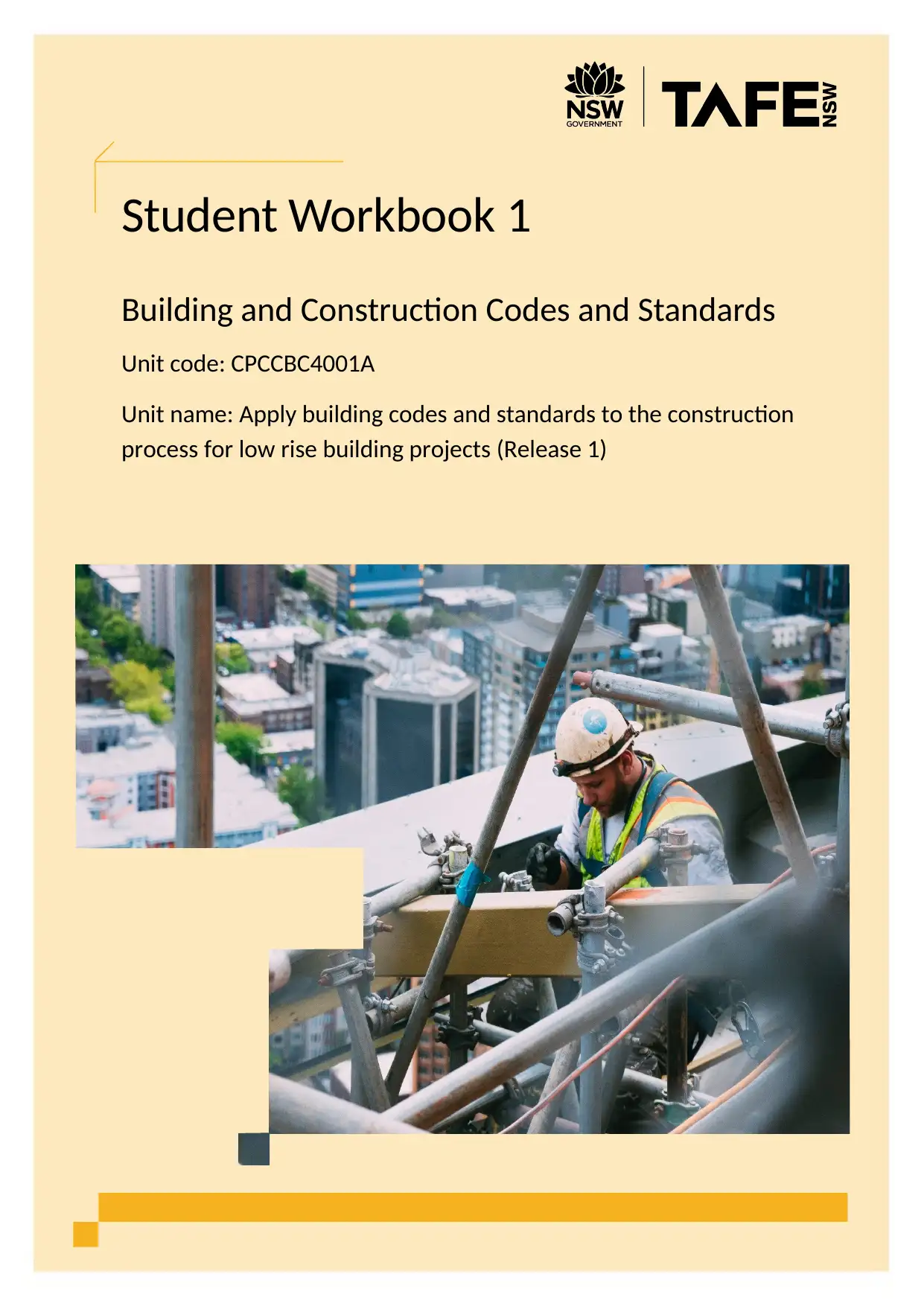
Student Workbook 1
Building and Construction Codes and Standards
Unit code: CPCCBC4001A
Unit name: Apply building codes and standards to the construction
process for low rise building projects (Release 1)
Building and Construction Codes and Standards
Unit code: CPCCBC4001A
Unit name: Apply building codes and standards to the construction
process for low rise building projects (Release 1)

Paraphrase This Document
Need a fresh take? Get an instant paraphrase of this document with our AI Paraphraser
TAFE NSW – Western Sydney Region
Created: 7/11/2018
Version: 1.0
5361563637579808878.docx
Modified: 3/01/2025
Page 2 of 19
Created: 7/11/2018
Version: 1.0
5361563637579808878.docx
Modified: 3/01/2025
Page 2 of 19
TAFE NSW would like to pay our respect and acknowledge Aboriginal and Torres Strait
Islander Peoples as the Traditional Custodians of the Land, Rivers and Sea. We
acknowledge and pay our respect to the Elders, both past and present of all Nations.
Version: 1.0
Date created: 02/08/2018
Date modified: 03/01/2025
For queries, please contact:
Infrastructure, Energy and Construction
Mount Druitt
© 2018 TAFE NSW, Sydney
RTO Provider Number 90003 | CRICOS Provider Code: 00591E
This assessment can be found in the: Learning Bank
The contents in this document is copyright © TAFE NSW 2018, and should not be reproduced without the
permission of the TAFE NSW. Information contained in this document is correct at time of printing: 3 January
2025. For current information please refer to our website or your teacher as appropriate.
Document title:CPCCBC4001A_AE_WkBk_1 Page 3 of 19
Resource ID: IEC_18_005_U03 © NSW TAFE Commission
Islander Peoples as the Traditional Custodians of the Land, Rivers and Sea. We
acknowledge and pay our respect to the Elders, both past and present of all Nations.
Version: 1.0
Date created: 02/08/2018
Date modified: 03/01/2025
For queries, please contact:
Infrastructure, Energy and Construction
Mount Druitt
© 2018 TAFE NSW, Sydney
RTO Provider Number 90003 | CRICOS Provider Code: 00591E
This assessment can be found in the: Learning Bank
The contents in this document is copyright © TAFE NSW 2018, and should not be reproduced without the
permission of the TAFE NSW. Information contained in this document is correct at time of printing: 3 January
2025. For current information please refer to our website or your teacher as appropriate.
Document title:CPCCBC4001A_AE_WkBk_1 Page 3 of 19
Resource ID: IEC_18_005_U03 © NSW TAFE Commission
⊘ This is a preview!⊘
Do you want full access?
Subscribe today to unlock all pages.

Trusted by 1+ million students worldwide
Contents
Assessment Instructions...........................................................................................................................
Task 1: Short Answers – Building Codes and Standards............................................................................
Task 2: Short Answers – Building Classifications.....................................................................................
Assessment Feedback.............................................................................................................................
Document title:CPCCBC4001A_AE_WkBk_1 Page 4 of 19
Resource ID: IEC_18_005_U03 © NSW TAFE Commission
Assessment Instructions...........................................................................................................................
Task 1: Short Answers – Building Codes and Standards............................................................................
Task 2: Short Answers – Building Classifications.....................................................................................
Assessment Feedback.............................................................................................................................
Document title:CPCCBC4001A_AE_WkBk_1 Page 4 of 19
Resource ID: IEC_18_005_U03 © NSW TAFE Commission
Paraphrase This Document
Need a fresh take? Get an instant paraphrase of this document with our AI Paraphraser
Task
Building Codes
And Standards
Document title:CPCCBC4001A_AE_WkBk_1 Page 5 of 19
Resource ID: IEC_18_005_U03 © NSW TAFE Commission
Building Codes
And Standards
Document title:CPCCBC4001A_AE_WkBk_1 Page 5 of 19
Resource ID: IEC_18_005_U03 © NSW TAFE Commission
Assessment instructions
Table 1 Assessment instructions
Assessment details Instructions
Assessment overview The objective of this assessment is to assess your knowledge as would
be required to access, interpret and apply relevant building codes and
standards applicable to the construction processes of residential and
low rise commercial buildings (low rise' licensing classification with
reference to Class 1 and 10 construction and Classes 2 to 9 with a gross
floor area not exceeding 2000 square metres, not including Type A or
Type B construction).
To successfully construct low rise buildings requires a thorough
knowledge of the purpose and content of the Building Code of
Australia (BCA), coupled with the ability to interpret other codes and
standards related to a specific building.
Assessment Event
number
1
Instructions for this
assessment
This is a written assessment and it will be assessing you on your
knowledge of the unit.
This assessment is in 3 parts:
1. Short answer question - Building and Construction Codes
2. Short answer question - Building Classifications
3. Assessment feedback
Submission instructions On completion of this assessment, you are required to hand it to your
trainer for marking.
What do I need to do to
achieve a satisfactory
result?
To achieve a satisfactory result for this assessment all questions must
be answered correctly.
What do I need to
provide?
Calculator, pens, measuring equipment, reference documents
Due date/time allowed Your teacher will confirm the assessment requirements when you
Document title:CPCCBC4001A_AE_WkBk_1 Page 6 of 19
Resource ID: IEC_18_005_U03 © NSW TAFE Commission
Table 1 Assessment instructions
Assessment details Instructions
Assessment overview The objective of this assessment is to assess your knowledge as would
be required to access, interpret and apply relevant building codes and
standards applicable to the construction processes of residential and
low rise commercial buildings (low rise' licensing classification with
reference to Class 1 and 10 construction and Classes 2 to 9 with a gross
floor area not exceeding 2000 square metres, not including Type A or
Type B construction).
To successfully construct low rise buildings requires a thorough
knowledge of the purpose and content of the Building Code of
Australia (BCA), coupled with the ability to interpret other codes and
standards related to a specific building.
Assessment Event
number
1
Instructions for this
assessment
This is a written assessment and it will be assessing you on your
knowledge of the unit.
This assessment is in 3 parts:
1. Short answer question - Building and Construction Codes
2. Short answer question - Building Classifications
3. Assessment feedback
Submission instructions On completion of this assessment, you are required to hand it to your
trainer for marking.
What do I need to do to
achieve a satisfactory
result?
To achieve a satisfactory result for this assessment all questions must
be answered correctly.
What do I need to
provide?
Calculator, pens, measuring equipment, reference documents
Due date/time allowed Your teacher will confirm the assessment requirements when you
Document title:CPCCBC4001A_AE_WkBk_1 Page 6 of 19
Resource ID: IEC_18_005_U03 © NSW TAFE Commission
⊘ This is a preview!⊘
Do you want full access?
Subscribe today to unlock all pages.
Trusted by 1+ million students worldwide
Assessment details Instructions
receive this assessment document.
Assessment feedback,
review or appeals
Appeals are addressed in accordance with Assessment Guidelines for
TAFE NSW.
Document title:CPCCBC4001A_AE_WkBk_1 Page 7 of 19
Resource ID: IEC_18_005_U03 © NSW TAFE Commission
receive this assessment document.
Assessment feedback,
review or appeals
Appeals are addressed in accordance with Assessment Guidelines for
TAFE NSW.
Document title:CPCCBC4001A_AE_WkBk_1 Page 7 of 19
Resource ID: IEC_18_005_U03 © NSW TAFE Commission
Paraphrase This Document
Need a fresh take? Get an instant paraphrase of this document with our AI Paraphraser
Task 1: Short answers – Building Codes and Standards
Read each question carefully.
1.1 Explain the NCC compliance structure, how compliance achieved and how can you satisfy the
performance requirements:
The NCC is a uniform set of technical provisions for the design and construction of buildings and
other structures in Australia while putting into consideration the variations in geological, climatic
or geographical conditions. The NCC compliance structure refers to the set performance based
code that has incorporated all the Performance Requirements for the construction of buildings.
The code contains a set standards for construction, design, safety and health, sustainability in the
design, performance, accessibility and amenity as well as liveability of new buildings. Compliance
is achieved by meeting a set of technical provisions for drainage installations, plumbing and
building works. The performance requirements are attained since all the construction
requirements have been incorporated into one code which is the NCC. The NCC furthermore
entails the Building Code of Australia (BCA), Volume One and Two; as well as the Plumbing Code
of Australia (PCA), Volume Three.
1.2 Define the following (in your own words) terms from the NCC:
Term Definition
a. Performance
Requirement
This is the minimum level that is set for all the building elements,
buildings as well plumbing and drainage systems. They are a
must if the building is to be NCC compliant.
b. Deemed to satisfy
solution (DTS)
These are solutions that are provided by NCC in trying to solve
issues pertaining to the construction methods, materials, design
factors and components so that they meet the Performance
Requirements.
c. Performance solution These are the technological solutions and innovative designs that
are usually used in addressing the issues brought about by
Performance Requirements with the aid of either one or more
Document title:CPCCBC4001A_AE_WkBk_1 Page 8 of 19
Resource ID: IEC_18_005_U03 © NSW TAFE Commission
Read each question carefully.
1.1 Explain the NCC compliance structure, how compliance achieved and how can you satisfy the
performance requirements:
The NCC is a uniform set of technical provisions for the design and construction of buildings and
other structures in Australia while putting into consideration the variations in geological, climatic
or geographical conditions. The NCC compliance structure refers to the set performance based
code that has incorporated all the Performance Requirements for the construction of buildings.
The code contains a set standards for construction, design, safety and health, sustainability in the
design, performance, accessibility and amenity as well as liveability of new buildings. Compliance
is achieved by meeting a set of technical provisions for drainage installations, plumbing and
building works. The performance requirements are attained since all the construction
requirements have been incorporated into one code which is the NCC. The NCC furthermore
entails the Building Code of Australia (BCA), Volume One and Two; as well as the Plumbing Code
of Australia (PCA), Volume Three.
1.2 Define the following (in your own words) terms from the NCC:
Term Definition
a. Performance
Requirement
This is the minimum level that is set for all the building elements,
buildings as well plumbing and drainage systems. They are a
must if the building is to be NCC compliant.
b. Deemed to satisfy
solution (DTS)
These are solutions that are provided by NCC in trying to solve
issues pertaining to the construction methods, materials, design
factors and components so that they meet the Performance
Requirements.
c. Performance solution These are the technological solutions and innovative designs that
are usually used in addressing the issues brought about by
Performance Requirements with the aid of either one or more
Document title:CPCCBC4001A_AE_WkBk_1 Page 8 of 19
Resource ID: IEC_18_005_U03 © NSW TAFE Commission
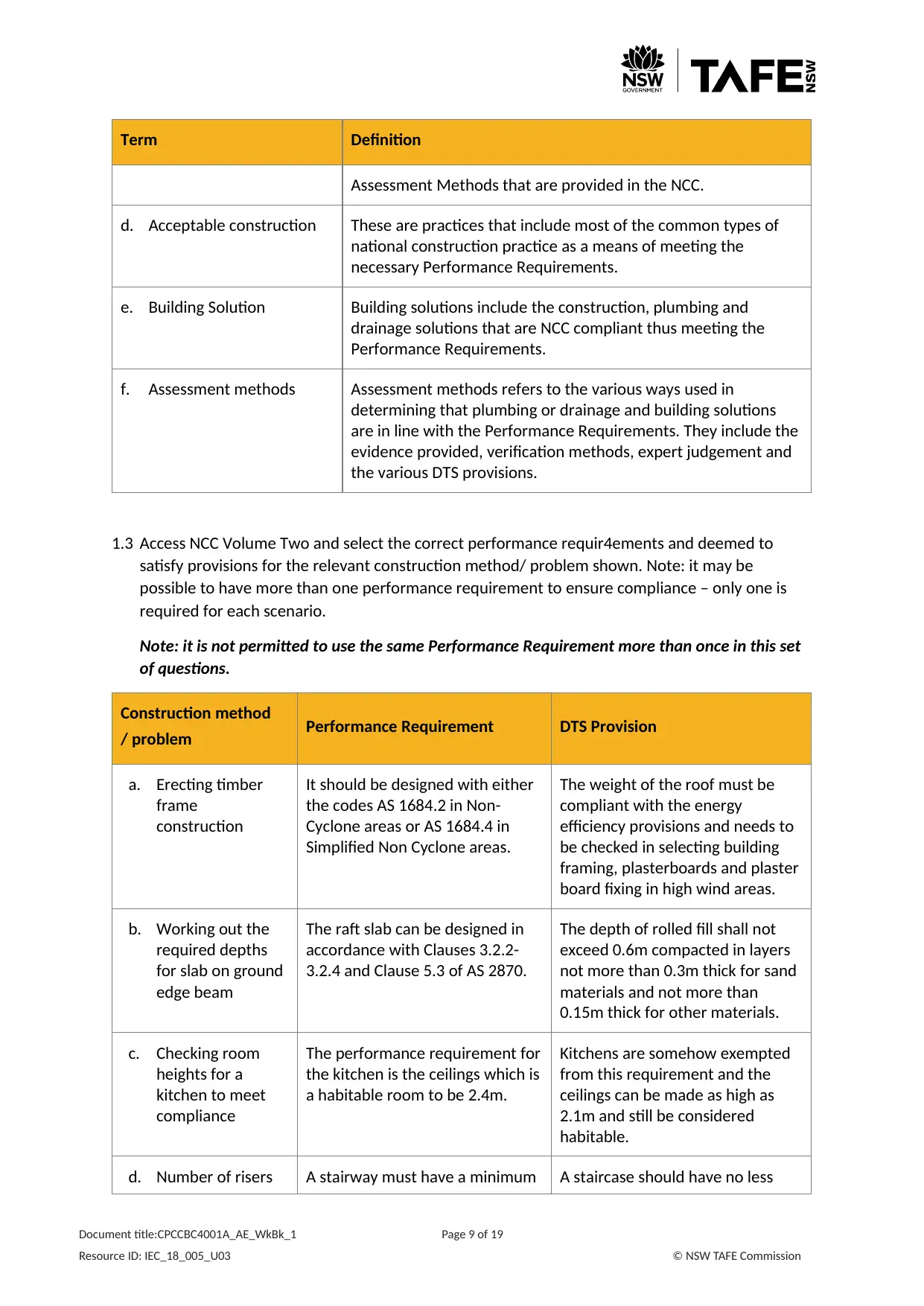
Term Definition
Assessment Methods that are provided in the NCC.
d. Acceptable construction These are practices that include most of the common types of
national construction practice as a means of meeting the
necessary Performance Requirements.
e. Building Solution Building solutions include the construction, plumbing and
drainage solutions that are NCC compliant thus meeting the
Performance Requirements.
f. Assessment methods Assessment methods refers to the various ways used in
determining that plumbing or drainage and building solutions
are in line with the Performance Requirements. They include the
evidence provided, verification methods, expert judgement and
the various DTS provisions.
1.3 Access NCC Volume Two and select the correct performance requir4ements and deemed to
satisfy provisions for the relevant construction method/ problem shown. Note: it may be
possible to have more than one performance requirement to ensure compliance – only one is
required for each scenario.
Note: it is not permitted to use the same Performance Requirement more than once in this set
of questions.
Construction method
/ problem Performance Requirement DTS Provision
a. Erecting timber
frame
construction
It should be designed with either
the codes AS 1684.2 in Non-
Cyclone areas or AS 1684.4 in
Simplified Non Cyclone areas.
The weight of the roof must be
compliant with the energy
efficiency provisions and needs to
be checked in selecting building
framing, plasterboards and plaster
board fixing in high wind areas.
b. Working out the
required depths
for slab on ground
edge beam
The raft slab can be designed in
accordance with Clauses 3.2.2-
3.2.4 and Clause 5.3 of AS 2870.
The depth of rolled fill shall not
exceed 0.6m compacted in layers
not more than 0.3m thick for sand
materials and not more than
0.15m thick for other materials.
c. Checking room
heights for a
kitchen to meet
compliance
The performance requirement for
the kitchen is the ceilings which is
a habitable room to be 2.4m.
Kitchens are somehow exempted
from this requirement and the
ceilings can be made as high as
2.1m and still be considered
habitable.
d. Number of risers A stairway must have a minimum A staircase should have no less
Document title:CPCCBC4001A_AE_WkBk_1 Page 9 of 19
Resource ID: IEC_18_005_U03 © NSW TAFE Commission
Assessment Methods that are provided in the NCC.
d. Acceptable construction These are practices that include most of the common types of
national construction practice as a means of meeting the
necessary Performance Requirements.
e. Building Solution Building solutions include the construction, plumbing and
drainage solutions that are NCC compliant thus meeting the
Performance Requirements.
f. Assessment methods Assessment methods refers to the various ways used in
determining that plumbing or drainage and building solutions
are in line with the Performance Requirements. They include the
evidence provided, verification methods, expert judgement and
the various DTS provisions.
1.3 Access NCC Volume Two and select the correct performance requir4ements and deemed to
satisfy provisions for the relevant construction method/ problem shown. Note: it may be
possible to have more than one performance requirement to ensure compliance – only one is
required for each scenario.
Note: it is not permitted to use the same Performance Requirement more than once in this set
of questions.
Construction method
/ problem Performance Requirement DTS Provision
a. Erecting timber
frame
construction
It should be designed with either
the codes AS 1684.2 in Non-
Cyclone areas or AS 1684.4 in
Simplified Non Cyclone areas.
The weight of the roof must be
compliant with the energy
efficiency provisions and needs to
be checked in selecting building
framing, plasterboards and plaster
board fixing in high wind areas.
b. Working out the
required depths
for slab on ground
edge beam
The raft slab can be designed in
accordance with Clauses 3.2.2-
3.2.4 and Clause 5.3 of AS 2870.
The depth of rolled fill shall not
exceed 0.6m compacted in layers
not more than 0.3m thick for sand
materials and not more than
0.15m thick for other materials.
c. Checking room
heights for a
kitchen to meet
compliance
The performance requirement for
the kitchen is the ceilings which is
a habitable room to be 2.4m.
Kitchens are somehow exempted
from this requirement and the
ceilings can be made as high as
2.1m and still be considered
habitable.
d. Number of risers A stairway must have a minimum A staircase should have no less
Document title:CPCCBC4001A_AE_WkBk_1 Page 9 of 19
Resource ID: IEC_18_005_U03 © NSW TAFE Commission
⊘ This is a preview!⊘
Do you want full access?
Subscribe today to unlock all pages.
Trusted by 1+ million students worldwide
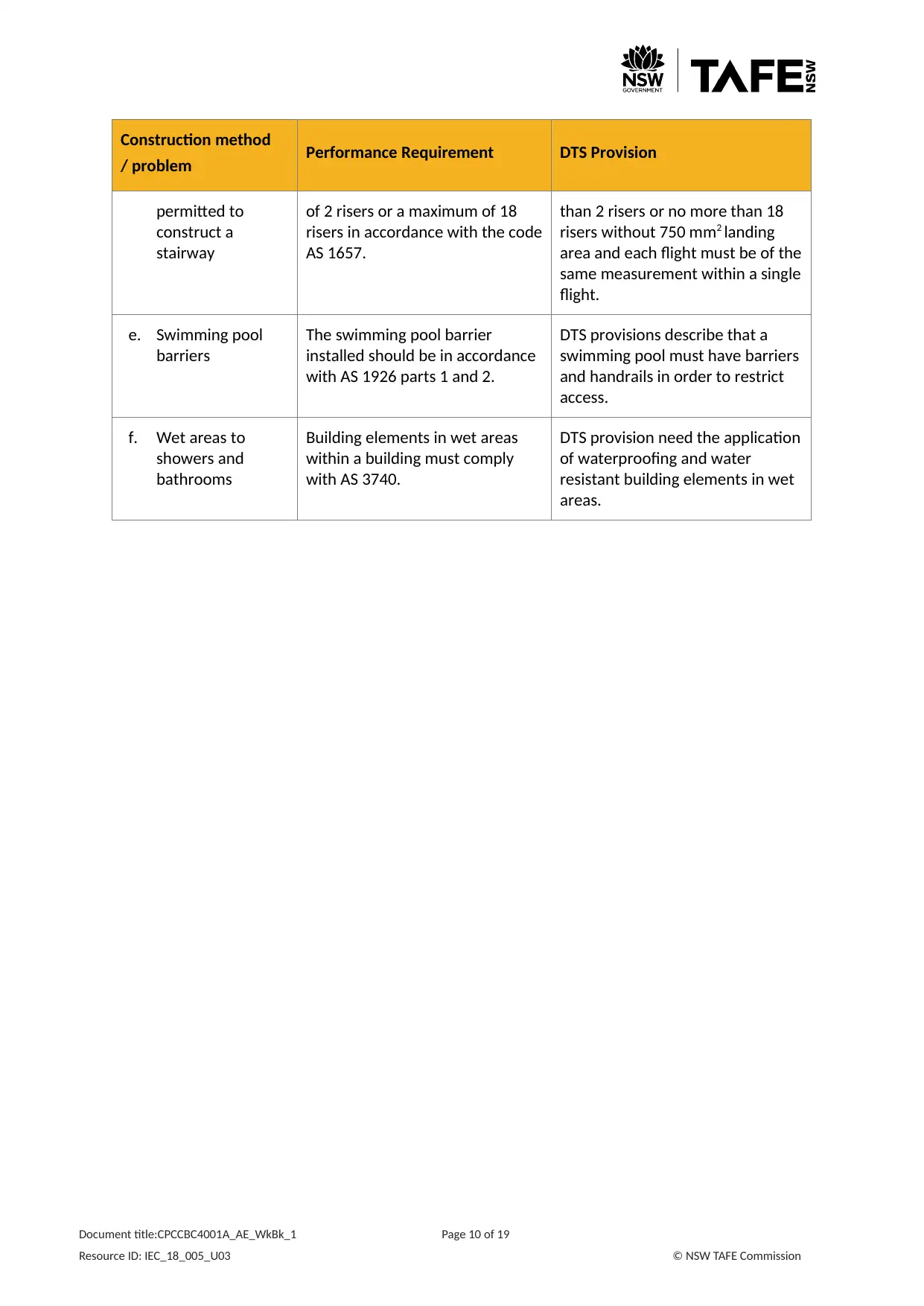
Construction method
/ problem Performance Requirement DTS Provision
permitted to
construct a
stairway
of 2 risers or a maximum of 18
risers in accordance with the code
AS 1657.
than 2 risers or no more than 18
risers without 750 mm2 landing
area and each flight must be of the
same measurement within a single
flight.
e. Swimming pool
barriers
The swimming pool barrier
installed should be in accordance
with AS 1926 parts 1 and 2.
DTS provisions describe that a
swimming pool must have barriers
and handrails in order to restrict
access.
f. Wet areas to
showers and
bathrooms
Building elements in wet areas
within a building must comply
with AS 3740.
DTS provision need the application
of waterproofing and water
resistant building elements in wet
areas.
Document title:CPCCBC4001A_AE_WkBk_1 Page 10 of 19
Resource ID: IEC_18_005_U03 © NSW TAFE Commission
/ problem Performance Requirement DTS Provision
permitted to
construct a
stairway
of 2 risers or a maximum of 18
risers in accordance with the code
AS 1657.
than 2 risers or no more than 18
risers without 750 mm2 landing
area and each flight must be of the
same measurement within a single
flight.
e. Swimming pool
barriers
The swimming pool barrier
installed should be in accordance
with AS 1926 parts 1 and 2.
DTS provisions describe that a
swimming pool must have barriers
and handrails in order to restrict
access.
f. Wet areas to
showers and
bathrooms
Building elements in wet areas
within a building must comply
with AS 3740.
DTS provision need the application
of waterproofing and water
resistant building elements in wet
areas.
Document title:CPCCBC4001A_AE_WkBk_1 Page 10 of 19
Resource ID: IEC_18_005_U03 © NSW TAFE Commission
Paraphrase This Document
Need a fresh take? Get an instant paraphrase of this document with our AI Paraphraser
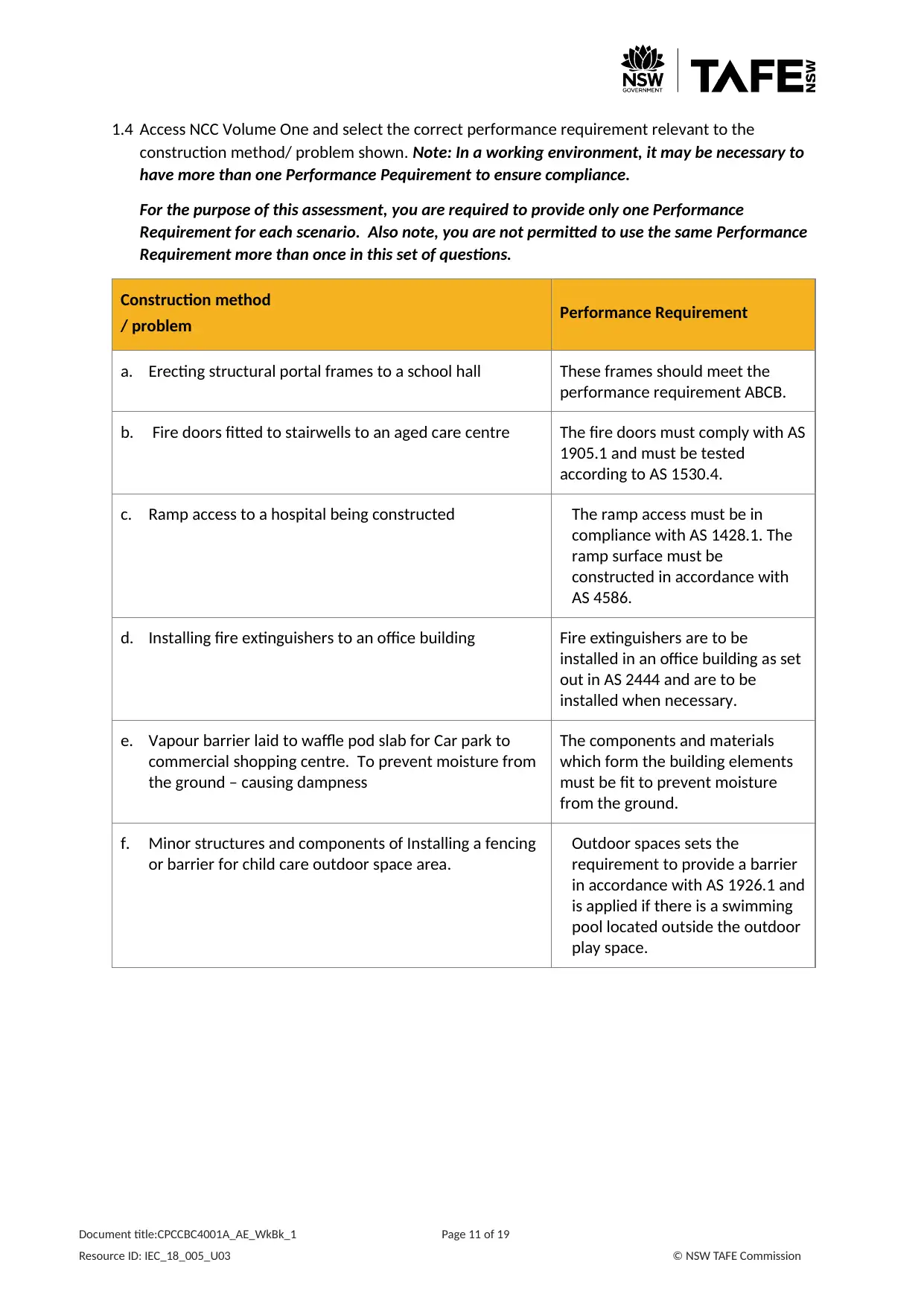
1.4 Access NCC Volume One and select the correct performance requirement relevant to the
construction method/ problem shown. Note: In a working environment, it may be necessary to
have more than one Performance Pequirement to ensure compliance.
For the purpose of this assessment, you are required to provide only one Performance
Requirement for each scenario. Also note, you are not permitted to use the same Performance
Requirement more than once in this set of questions.
Construction method
/ problem Performance Requirement
a. Erecting structural portal frames to a school hall These frames should meet the
performance requirement ABCB.
b. Fire doors fitted to stairwells to an aged care centre The fire doors must comply with AS
1905.1 and must be tested
according to AS 1530.4.
c. Ramp access to a hospital being constructed The ramp access must be in
compliance with AS 1428.1. The
ramp surface must be
constructed in accordance with
AS 4586.
d. Installing fire extinguishers to an office building Fire extinguishers are to be
installed in an office building as set
out in AS 2444 and are to be
installed when necessary.
e. Vapour barrier laid to waffle pod slab for Car park to
commercial shopping centre. To prevent moisture from
the ground – causing dampness
The components and materials
which form the building elements
must be fit to prevent moisture
from the ground.
f. Minor structures and components of Installing a fencing
or barrier for child care outdoor space area.
Outdoor spaces sets the
requirement to provide a barrier
in accordance with AS 1926.1 and
is applied if there is a swimming
pool located outside the outdoor
play space.
Document title:CPCCBC4001A_AE_WkBk_1 Page 11 of 19
Resource ID: IEC_18_005_U03 © NSW TAFE Commission
construction method/ problem shown. Note: In a working environment, it may be necessary to
have more than one Performance Pequirement to ensure compliance.
For the purpose of this assessment, you are required to provide only one Performance
Requirement for each scenario. Also note, you are not permitted to use the same Performance
Requirement more than once in this set of questions.
Construction method
/ problem Performance Requirement
a. Erecting structural portal frames to a school hall These frames should meet the
performance requirement ABCB.
b. Fire doors fitted to stairwells to an aged care centre The fire doors must comply with AS
1905.1 and must be tested
according to AS 1530.4.
c. Ramp access to a hospital being constructed The ramp access must be in
compliance with AS 1428.1. The
ramp surface must be
constructed in accordance with
AS 4586.
d. Installing fire extinguishers to an office building Fire extinguishers are to be
installed in an office building as set
out in AS 2444 and are to be
installed when necessary.
e. Vapour barrier laid to waffle pod slab for Car park to
commercial shopping centre. To prevent moisture from
the ground – causing dampness
The components and materials
which form the building elements
must be fit to prevent moisture
from the ground.
f. Minor structures and components of Installing a fencing
or barrier for child care outdoor space area.
Outdoor spaces sets the
requirement to provide a barrier
in accordance with AS 1926.1 and
is applied if there is a swimming
pool located outside the outdoor
play space.
Document title:CPCCBC4001A_AE_WkBk_1 Page 11 of 19
Resource ID: IEC_18_005_U03 © NSW TAFE Commission
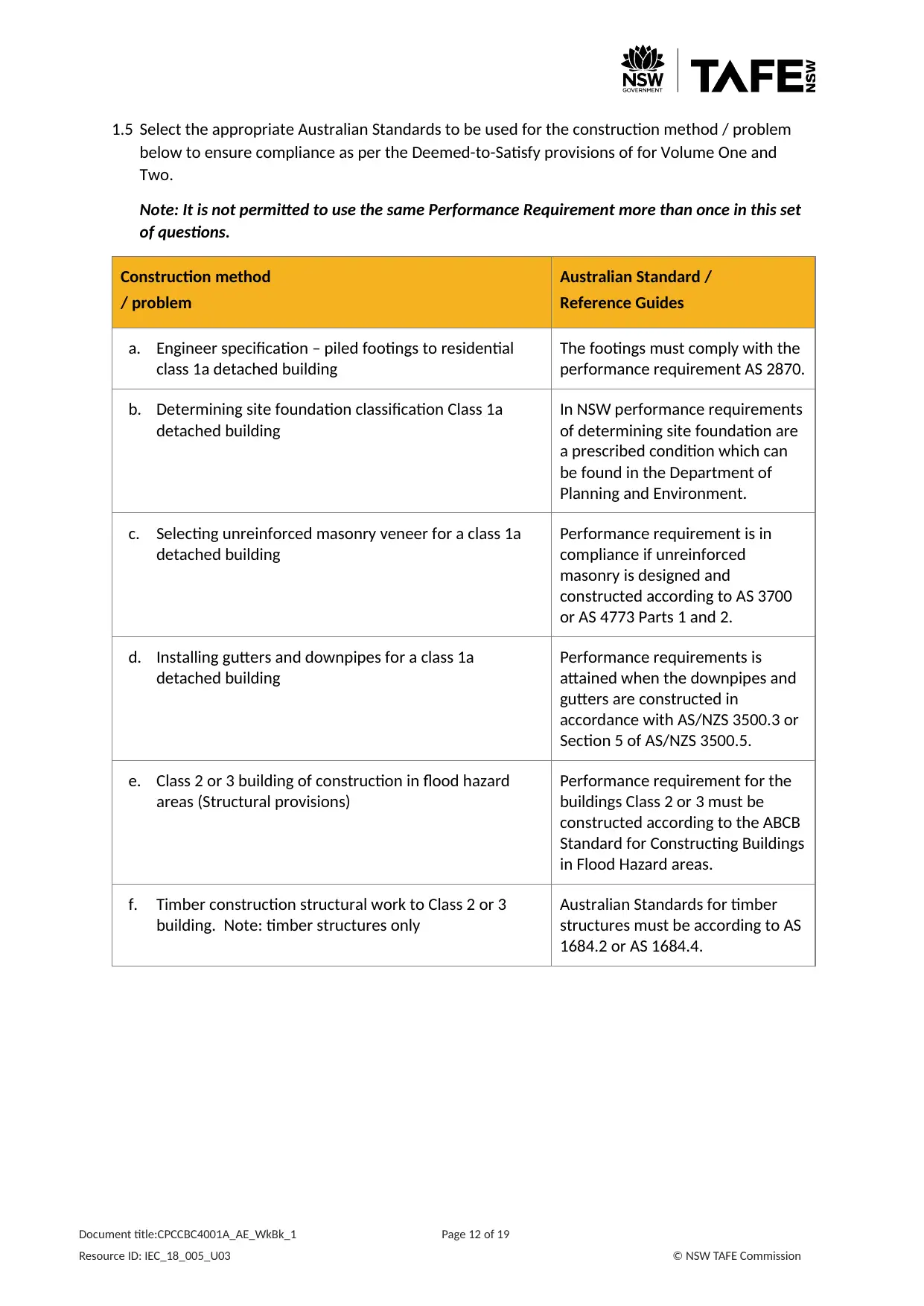
1.5 Select the appropriate Australian Standards to be used for the construction method / problem
below to ensure compliance as per the Deemed-to-Satisfy provisions of for Volume One and
Two.
Note: It is not permitted to use the same Performance Requirement more than once in this set
of questions.
Construction method
/ problem
Australian Standard /
Reference Guides
a. Engineer specification – piled footings to residential
class 1a detached building
The footings must comply with the
performance requirement AS 2870.
b. Determining site foundation classification Class 1a
detached building
In NSW performance requirements
of determining site foundation are
a prescribed condition which can
be found in the Department of
Planning and Environment.
c. Selecting unreinforced masonry veneer for a class 1a
detached building
Performance requirement is in
compliance if unreinforced
masonry is designed and
constructed according to AS 3700
or AS 4773 Parts 1 and 2.
d. Installing gutters and downpipes for a class 1a
detached building
Performance requirements is
attained when the downpipes and
gutters are constructed in
accordance with AS/NZS 3500.3 or
Section 5 of AS/NZS 3500.5.
e. Class 2 or 3 building of construction in flood hazard
areas (Structural provisions)
Performance requirement for the
buildings Class 2 or 3 must be
constructed according to the ABCB
Standard for Constructing Buildings
in Flood Hazard areas.
f. Timber construction structural work to Class 2 or 3
building. Note: timber structures only
Australian Standards for timber
structures must be according to AS
1684.2 or AS 1684.4.
Document title:CPCCBC4001A_AE_WkBk_1 Page 12 of 19
Resource ID: IEC_18_005_U03 © NSW TAFE Commission
below to ensure compliance as per the Deemed-to-Satisfy provisions of for Volume One and
Two.
Note: It is not permitted to use the same Performance Requirement more than once in this set
of questions.
Construction method
/ problem
Australian Standard /
Reference Guides
a. Engineer specification – piled footings to residential
class 1a detached building
The footings must comply with the
performance requirement AS 2870.
b. Determining site foundation classification Class 1a
detached building
In NSW performance requirements
of determining site foundation are
a prescribed condition which can
be found in the Department of
Planning and Environment.
c. Selecting unreinforced masonry veneer for a class 1a
detached building
Performance requirement is in
compliance if unreinforced
masonry is designed and
constructed according to AS 3700
or AS 4773 Parts 1 and 2.
d. Installing gutters and downpipes for a class 1a
detached building
Performance requirements is
attained when the downpipes and
gutters are constructed in
accordance with AS/NZS 3500.3 or
Section 5 of AS/NZS 3500.5.
e. Class 2 or 3 building of construction in flood hazard
areas (Structural provisions)
Performance requirement for the
buildings Class 2 or 3 must be
constructed according to the ABCB
Standard for Constructing Buildings
in Flood Hazard areas.
f. Timber construction structural work to Class 2 or 3
building. Note: timber structures only
Australian Standards for timber
structures must be according to AS
1684.2 or AS 1684.4.
Document title:CPCCBC4001A_AE_WkBk_1 Page 12 of 19
Resource ID: IEC_18_005_U03 © NSW TAFE Commission
⊘ This is a preview!⊘
Do you want full access?
Subscribe today to unlock all pages.
Trusted by 1+ million students worldwide

1 out of 19


Related Documents


Your All-in-One AI-Powered Toolkit for Academic Success.
+13062052269
info@desklib.com
Available 24*7 on WhatsApp / Email
![[object Object]](/_next/static/media/star-bottom.7253800d.svg)
Unlock your academic potential
Copyright © 2020–2026 A2Z Services. All Rights Reserved. Developed and managed by ZUCOL.