Construction Technology 5: Building Design in Auckland, NZ Climate
VerifiedAdded on 2022/11/13
|13
|2065
|326
Report
AI Summary
This report provides a comprehensive analysis of Auckland, New Zealand's subtropical climate, including temperatures, rainfall, frosts, wind patterns, and sunshine levels. It delves into design considerations for buildings in this climate, emphasizing the importance of balancing conflicting needs such as solar gain and shading, wind protection and ventilation, and thermal mass. The report suggests specific design strategies, including street layout, building orientation, and structural considerations, to maximize natural energy use and create comfortable living conditions. It references various studies and research papers to support its findings, concluding that incorporating climate considerations early in the design process is essential for achieving sustainable and energy-efficient buildings in Auckland. The report highlights traditional building solutions and their adaptation to similar climatic conditions to derive possible solutions for the location.
CONSTRUCTION TECHNOLOGY 5
By Name
Course
Instructor
Institution
Location
Date
By Name
Course
Instructor
Institution
Location
Date

Paraphrase This Document
Need a fresh take? Get an instant paraphrase of this document with our AI Paraphraser
Contents
CLIMATE OF AUCKLAND, NEW ZEALAND.....................................................................................................3
Introduction.............................................................................................................................................3
Temperatures..........................................................................................................................................3
Rainfall.....................................................................................................................................................4
Frosts.......................................................................................................................................................4
Wind........................................................................................................................................................5
Sunshine and Solar radiation...................................................................................................................6
DESIGN CONSIDERATION FOR SUBTROPICAL CLIMATE...............................................................................7
Design Strategies.....................................................................................................................................8
Street layout........................................................................................................................................9
Planning and Form...............................................................................................................................9
The orientation of the building..........................................................................................................10
Structure of Building..........................................................................................................................10
Roof design........................................................................................................................................11
CONCLUSION.............................................................................................................................................11
REFERENCES..............................................................................................................................................12
CLIMATE OF AUCKLAND, NEW ZEALAND.....................................................................................................3
Introduction.............................................................................................................................................3
Temperatures..........................................................................................................................................3
Rainfall.....................................................................................................................................................4
Frosts.......................................................................................................................................................4
Wind........................................................................................................................................................5
Sunshine and Solar radiation...................................................................................................................6
DESIGN CONSIDERATION FOR SUBTROPICAL CLIMATE...............................................................................7
Design Strategies.....................................................................................................................................8
Street layout........................................................................................................................................9
Planning and Form...............................................................................................................................9
The orientation of the building..........................................................................................................10
Structure of Building..........................................................................................................................10
Roof design........................................................................................................................................11
CONCLUSION.............................................................................................................................................11
REFERENCES..............................................................................................................................................12
CLIMATE OF AUCKLAND, NEW ZEALAND
Introduction
Auckland, New Zealand experiences a subtropical climate with the region lying about 13⁰ of
latitude south of Tropic of Capricorn. The region does not experience any extreme temperatures
with the climate being generally warm and coastal. The summers are often warm and have high
humidity while the winters tend to be mild and damp. Rainfall is received throughout the year
with most of it being experienced during the winter season that lasts from June to August (Chen,
Yang, and Wang, 2017).
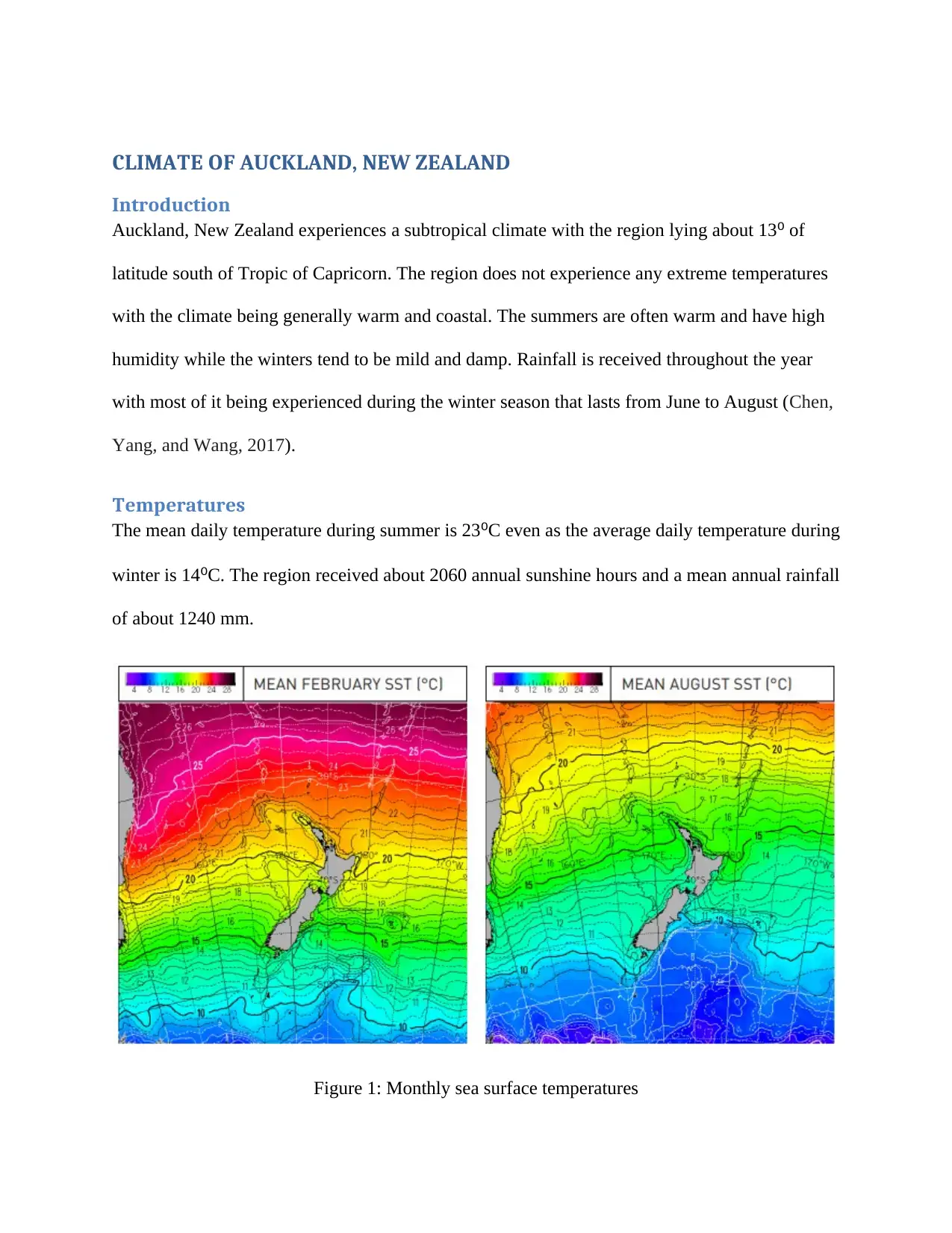
Temperatures
The mean daily temperature during summer is 23⁰C even as the average daily temperature during
winter is 14⁰C. The region received about 2060 annual sunshine hours and a mean annual rainfall
of about 1240 mm.
Figure 1: Monthly sea surface temperatures
Introduction
Auckland, New Zealand experiences a subtropical climate with the region lying about 13⁰ of
latitude south of Tropic of Capricorn. The region does not experience any extreme temperatures
with the climate being generally warm and coastal. The summers are often warm and have high
humidity while the winters tend to be mild and damp. Rainfall is received throughout the year
with most of it being experienced during the winter season that lasts from June to August (Chen,
Yang, and Wang, 2017).
Temperatures
The mean daily temperature during summer is 23⁰C even as the average daily temperature during
winter is 14⁰C. The region received about 2060 annual sunshine hours and a mean annual rainfall
of about 1240 mm.
Figure 1: Monthly sea surface temperatures
⊘ This is a preview!⊘
Do you want full access?
Subscribe today to unlock all pages.

Trusted by 1+ million students worldwide
Rainfall
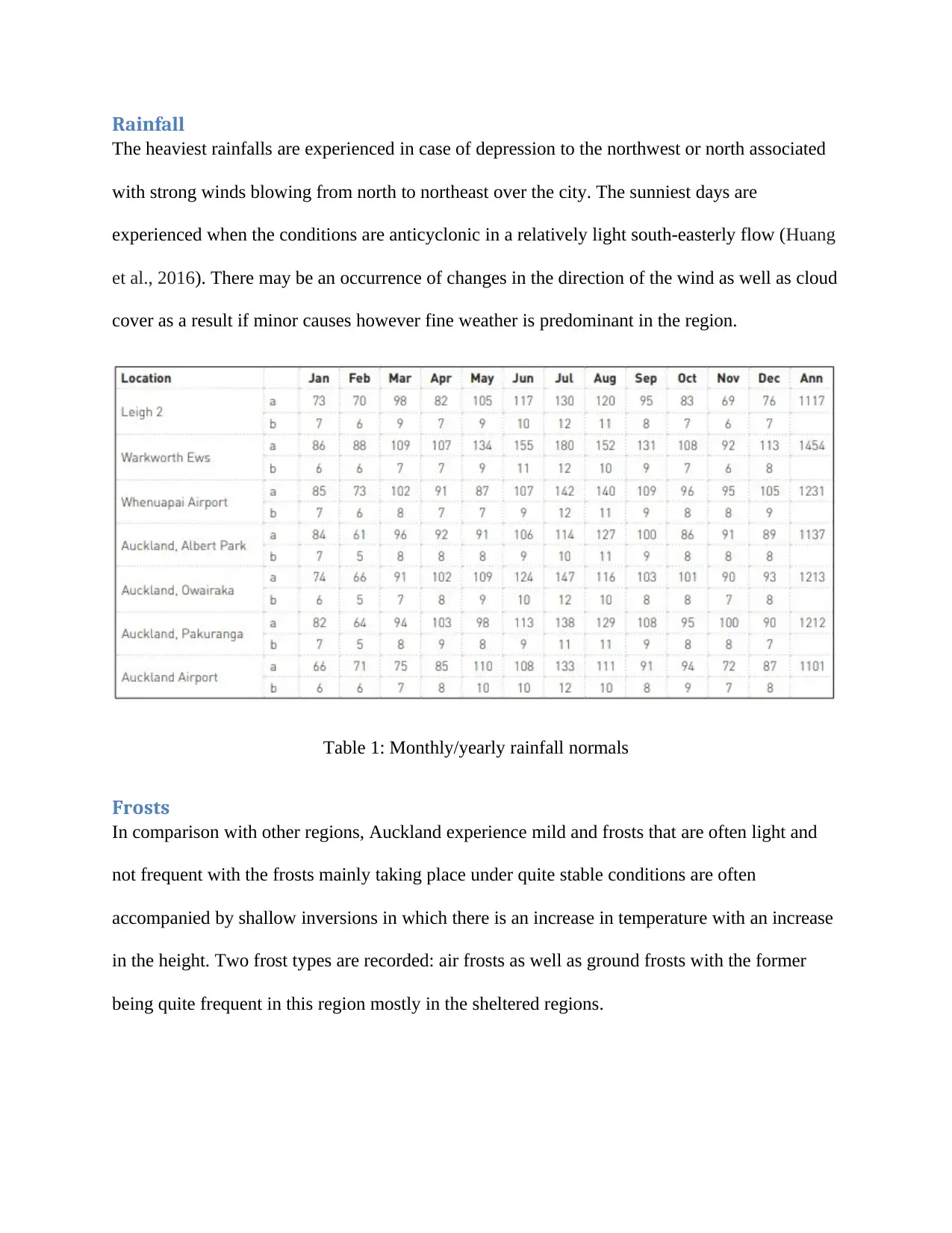
The heaviest rainfalls are experienced in case of depression to the northwest or north associated
with strong winds blowing from north to northeast over the city. The sunniest days are
experienced when the conditions are anticyclonic in a relatively light south-easterly flow (Huang
et al., 2016). There may be an occurrence of changes in the direction of the wind as well as cloud
cover as a result if minor causes however fine weather is predominant in the region.
Table 1: Monthly/yearly rainfall normals
Frosts
In comparison with other regions, Auckland experience mild and frosts that are often light and
not frequent with the frosts mainly taking place under quite stable conditions are often
accompanied by shallow inversions in which there is an increase in temperature with an increase
in the height. Two frost types are recorded: air frosts as well as ground frosts with the former
being quite frequent in this region mostly in the sheltered regions.
The heaviest rainfalls are experienced in case of depression to the northwest or north associated
with strong winds blowing from north to northeast over the city. The sunniest days are
experienced when the conditions are anticyclonic in a relatively light south-easterly flow (Huang
et al., 2016). There may be an occurrence of changes in the direction of the wind as well as cloud
cover as a result if minor causes however fine weather is predominant in the region.
Table 1: Monthly/yearly rainfall normals
Frosts
In comparison with other regions, Auckland experience mild and frosts that are often light and
not frequent with the frosts mainly taking place under quite stable conditions are often
accompanied by shallow inversions in which there is an increase in temperature with an increase
in the height. Two frost types are recorded: air frosts as well as ground frosts with the former
being quite frequent in this region mostly in the sheltered regions.
Paraphrase This Document
Need a fresh take? Get an instant paraphrase of this document with our AI Paraphraser
Wind
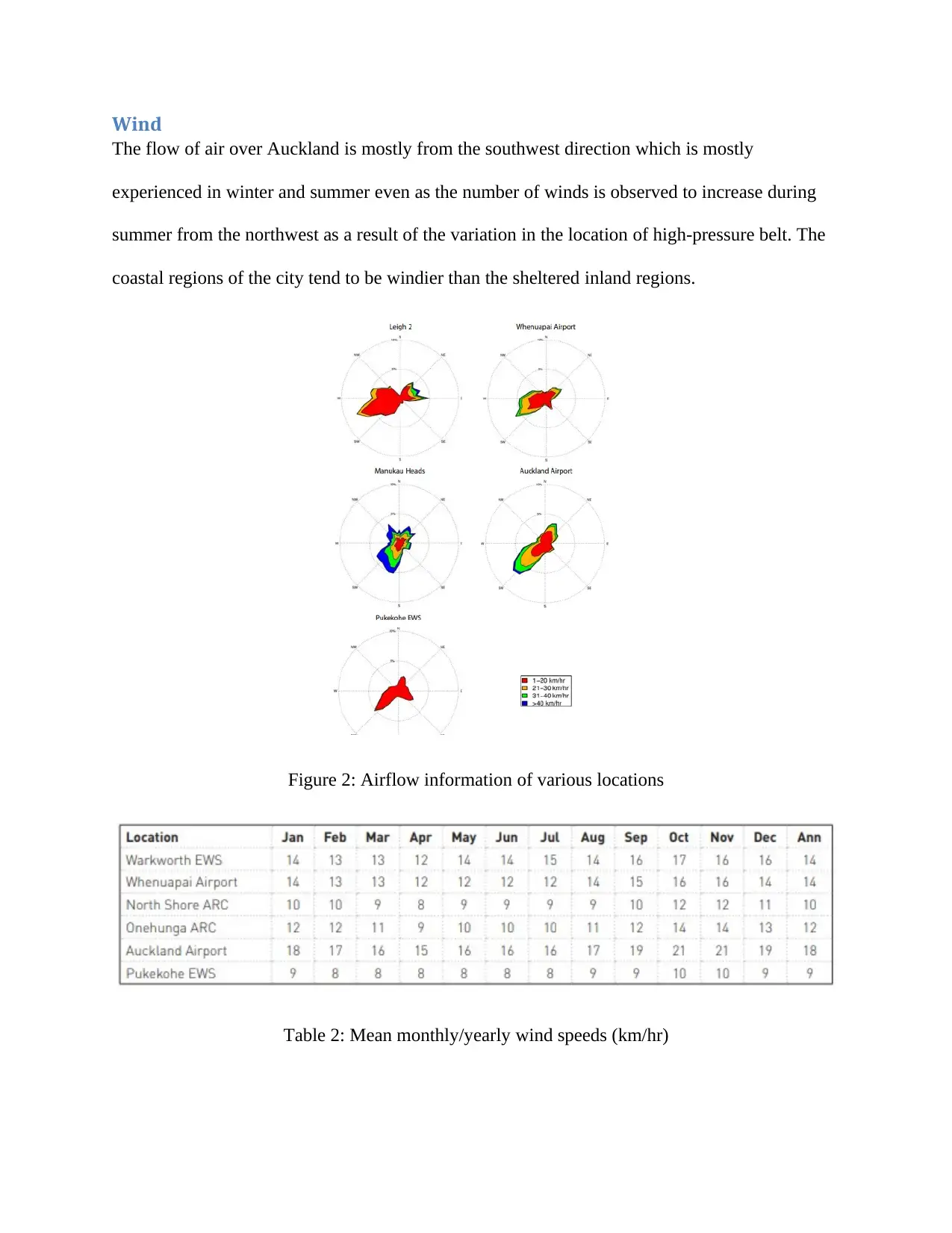
The flow of air over Auckland is mostly from the southwest direction which is mostly
experienced in winter and summer even as the number of winds is observed to increase during
summer from the northwest as a result of the variation in the location of high-pressure belt. The
coastal regions of the city tend to be windier than the sheltered inland regions.
Figure 2: Airflow information of various locations
Table 2: Mean monthly/yearly wind speeds (km/hr)
The flow of air over Auckland is mostly from the southwest direction which is mostly
experienced in winter and summer even as the number of winds is observed to increase during
summer from the northwest as a result of the variation in the location of high-pressure belt. The
coastal regions of the city tend to be windier than the sheltered inland regions.
Figure 2: Airflow information of various locations
Table 2: Mean monthly/yearly wind speeds (km/hr)
Spring season tends to be the windiest while the largest number of light wind days is recorded in
summer and autumn. The diurnal changes in the speed of the wind are properly marked where
the largest wind speeds are experienced in the early fraction of the afternoon since land surface
heating at the time tends to be more intense and most of the stronger winds are brought to the
ground level.
Sunshine and Solar radiation
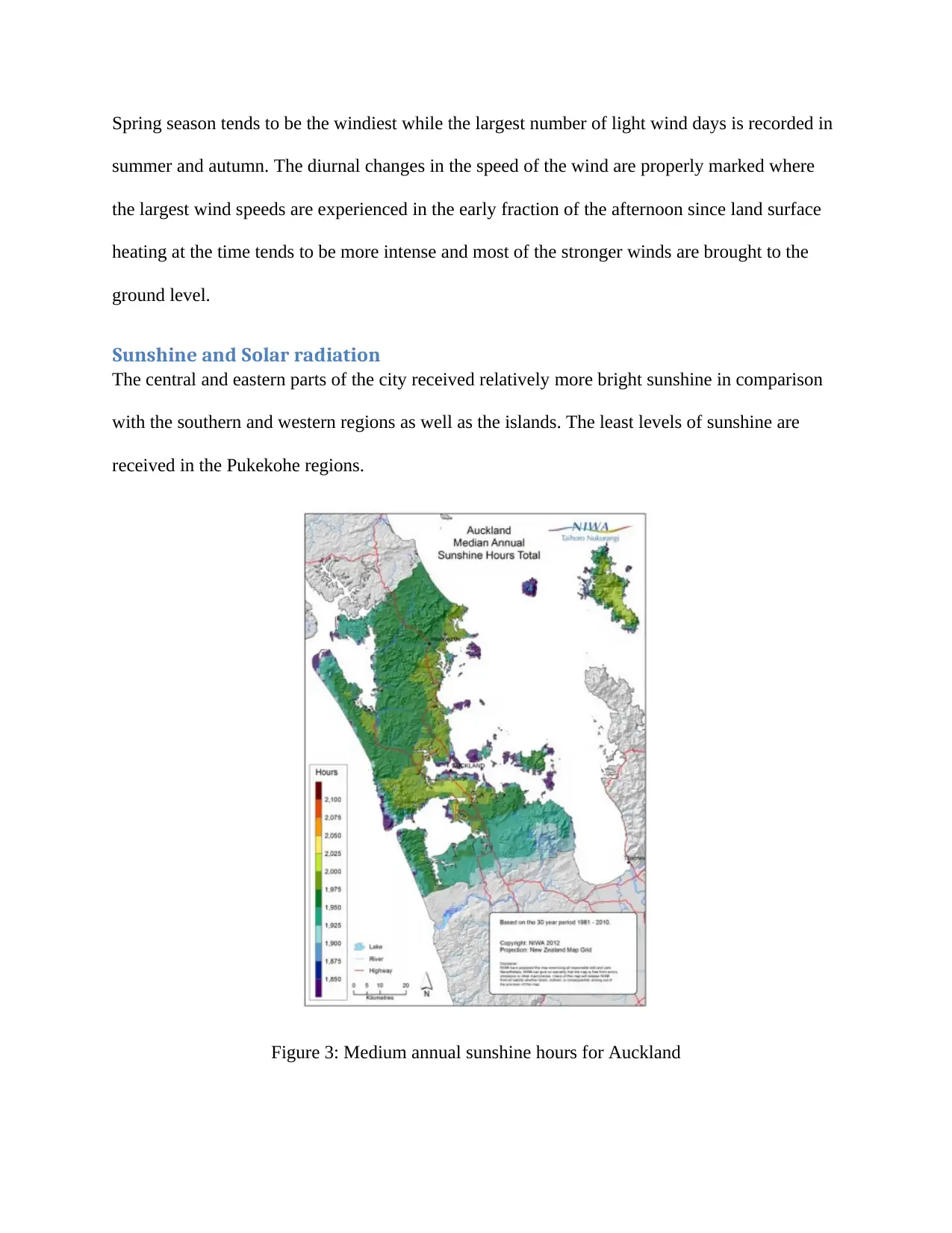
The central and eastern parts of the city received relatively more bright sunshine in comparison
with the southern and western regions as well as the islands. The least levels of sunshine are
received in the Pukekohe regions.
Figure 3: Medium annual sunshine hours for Auckland
summer and autumn. The diurnal changes in the speed of the wind are properly marked where
the largest wind speeds are experienced in the early fraction of the afternoon since land surface
heating at the time tends to be more intense and most of the stronger winds are brought to the
ground level.
Sunshine and Solar radiation
The central and eastern parts of the city received relatively more bright sunshine in comparison
with the southern and western regions as well as the islands. The least levels of sunshine are
received in the Pukekohe regions.
Figure 3: Medium annual sunshine hours for Auckland
⊘ This is a preview!⊘
Do you want full access?
Subscribe today to unlock all pages.
Trusted by 1+ million students worldwide
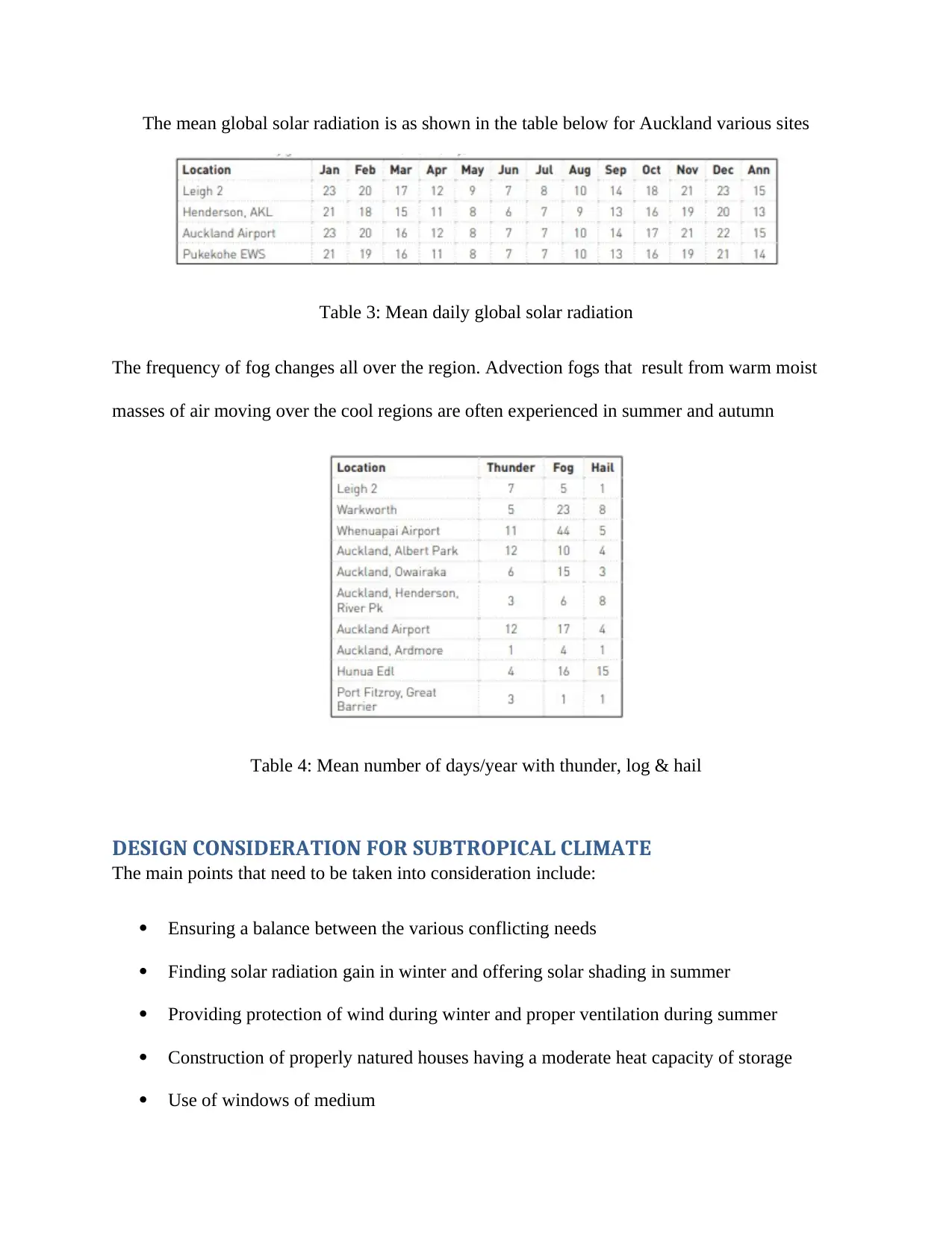
The mean global solar radiation is as shown in the table below for Auckland various sites
Table 3: Mean daily global solar radiation
The frequency of fog changes all over the region. Advection fogs that result from warm moist
masses of air moving over the cool regions are often experienced in summer and autumn
Table 4: Mean number of days/year with thunder, log & hail
DESIGN CONSIDERATION FOR SUBTROPICAL CLIMATE
The main points that need to be taken into consideration include:
Ensuring a balance between the various conflicting needs
Finding solar radiation gain in winter and offering solar shading in summer
Providing protection of wind during winter and proper ventilation during summer
Construction of properly natured houses having a moderate heat capacity of storage
Use of windows of medium
Table 3: Mean daily global solar radiation
The frequency of fog changes all over the region. Advection fogs that result from warm moist
masses of air moving over the cool regions are often experienced in summer and autumn
Table 4: Mean number of days/year with thunder, log & hail
DESIGN CONSIDERATION FOR SUBTROPICAL CLIMATE
The main points that need to be taken into consideration include:
Ensuring a balance between the various conflicting needs
Finding solar radiation gain in winter and offering solar shading in summer
Providing protection of wind during winter and proper ventilation during summer
Construction of properly natured houses having a moderate heat capacity of storage
Use of windows of medium
Paraphrase This Document
Need a fresh take? Get an instant paraphrase of this document with our AI Paraphraser
The recommended design specifications for Auckland as per the analyzed climate and other
geographical features are as outlined:
Layout: The orientation of the building should be in the North to south direction having
compact courtyard planning (Kennedy, 2017)
Spacing: Open spacing should be provided to allow for penetration of breeze
Movement of air: The rooms should be singly blanked with permanent provision for
movement of air
Opening: The opening should be large, occupying between 40% to 80% of the total wall
area and mostly aligned in the North and south walls at body heights mostly on the
windward side
Walls: The walls should be light and of low thermal capacity.
Roofs: The roofing materials used should be a cavity, light as well as reflective
Outdoor sleeping: There should be provided spaces for outdoor sleeping to be used
especially during summer (Khoshbakht et al., 2018).
Rain protection: Proper and enough rainwater drainage should be provided to ensure
proper drainage during the rainy months.
Design Strategies
The strategies of design are developed in consideration of the comfort analysis as well as the
preliminary recommendations given above. The design strategies are geared toward offering an
elaborate and schematic outline of the process of design to ensure there is no missing of the main
opportunities. The strategies of design include:
geographical features are as outlined:
Layout: The orientation of the building should be in the North to south direction having
compact courtyard planning (Kennedy, 2017)
Spacing: Open spacing should be provided to allow for penetration of breeze
Movement of air: The rooms should be singly blanked with permanent provision for
movement of air
Opening: The opening should be large, occupying between 40% to 80% of the total wall
area and mostly aligned in the North and south walls at body heights mostly on the
windward side
Walls: The walls should be light and of low thermal capacity.
Roofs: The roofing materials used should be a cavity, light as well as reflective
Outdoor sleeping: There should be provided spaces for outdoor sleeping to be used
especially during summer (Khoshbakht et al., 2018).
Rain protection: Proper and enough rainwater drainage should be provided to ensure
proper drainage during the rainy months.
Design Strategies
The strategies of design are developed in consideration of the comfort analysis as well as the
preliminary recommendations given above. The design strategies are geared toward offering an
elaborate and schematic outline of the process of design to ensure there is no missing of the main
opportunities. The strategies of design include:
Street layout
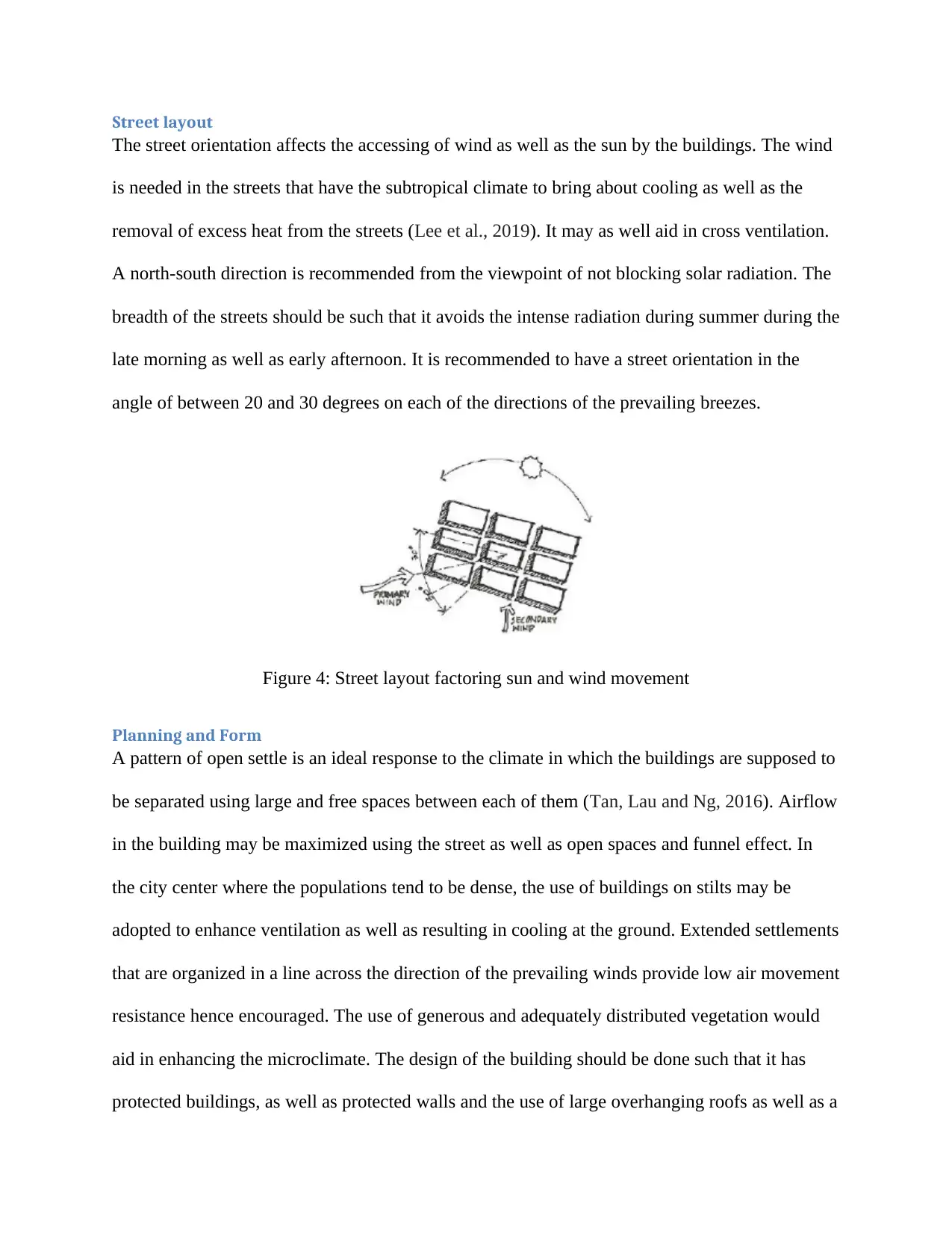
The street orientation affects the accessing of wind as well as the sun by the buildings. The wind
is needed in the streets that have the subtropical climate to bring about cooling as well as the
removal of excess heat from the streets (Lee et al., 2019). It may as well aid in cross ventilation.
A north-south direction is recommended from the viewpoint of not blocking solar radiation. The
breadth of the streets should be such that it avoids the intense radiation during summer during the
late morning as well as early afternoon. It is recommended to have a street orientation in the
angle of between 20 and 30 degrees on each of the directions of the prevailing breezes.
Figure 4: Street layout factoring sun and wind movement
Planning and Form
A pattern of open settle is an ideal response to the climate in which the buildings are supposed to
be separated using large and free spaces between each of them (Tan, Lau and Ng, 2016). Airflow
in the building may be maximized using the street as well as open spaces and funnel effect. In
the city center where the populations tend to be dense, the use of buildings on stilts may be
adopted to enhance ventilation as well as resulting in cooling at the ground. Extended settlements
that are organized in a line across the direction of the prevailing winds provide low air movement
resistance hence encouraged. The use of generous and adequately distributed vegetation would
aid in enhancing the microclimate. The design of the building should be done such that it has
protected buildings, as well as protected walls and the use of large overhanging roofs as well as a
The street orientation affects the accessing of wind as well as the sun by the buildings. The wind
is needed in the streets that have the subtropical climate to bring about cooling as well as the
removal of excess heat from the streets (Lee et al., 2019). It may as well aid in cross ventilation.
A north-south direction is recommended from the viewpoint of not blocking solar radiation. The
breadth of the streets should be such that it avoids the intense radiation during summer during the
late morning as well as early afternoon. It is recommended to have a street orientation in the
angle of between 20 and 30 degrees on each of the directions of the prevailing breezes.
Figure 4: Street layout factoring sun and wind movement
Planning and Form
A pattern of open settle is an ideal response to the climate in which the buildings are supposed to
be separated using large and free spaces between each of them (Tan, Lau and Ng, 2016). Airflow
in the building may be maximized using the street as well as open spaces and funnel effect. In
the city center where the populations tend to be dense, the use of buildings on stilts may be
adopted to enhance ventilation as well as resulting in cooling at the ground. Extended settlements
that are organized in a line across the direction of the prevailing winds provide low air movement
resistance hence encouraged. The use of generous and adequately distributed vegetation would
aid in enhancing the microclimate. The design of the building should be done such that it has
protected buildings, as well as protected walls and the use of large overhanging roofs as well as a
⊘ This is a preview!⊘
Do you want full access?
Subscribe today to unlock all pages.
Trusted by 1+ million students worldwide
wide shaded veranda, may adopt in regulation the intense diffuse solar radiation (Tan, Lau and
Ng, 2017).
The orientation of the building
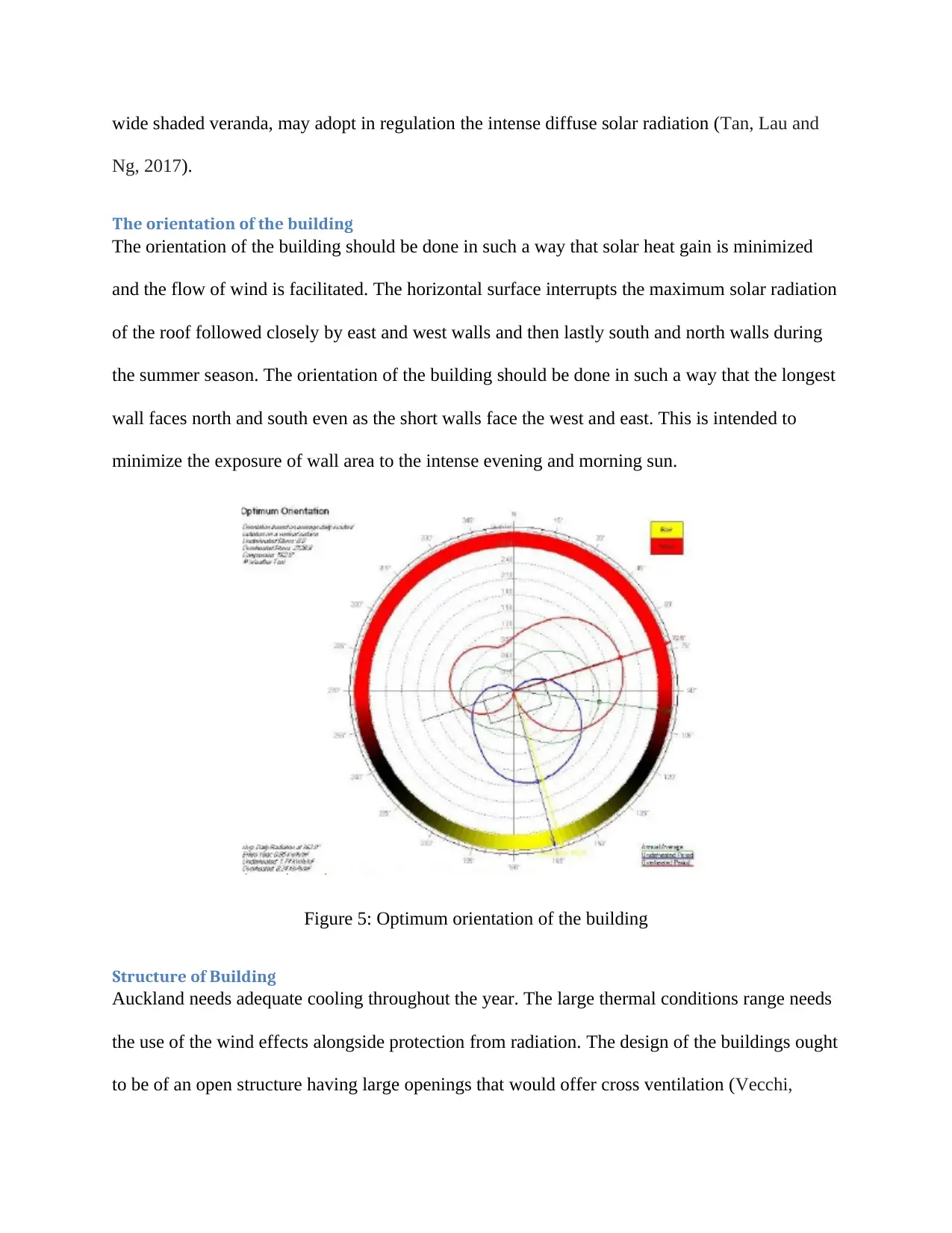
The orientation of the building should be done in such a way that solar heat gain is minimized
and the flow of wind is facilitated. The horizontal surface interrupts the maximum solar radiation
of the roof followed closely by east and west walls and then lastly south and north walls during
the summer season. The orientation of the building should be done in such a way that the longest
wall faces north and south even as the short walls face the west and east. This is intended to
minimize the exposure of wall area to the intense evening and morning sun.
Figure 5: Optimum orientation of the building
Structure of Building
Auckland needs adequate cooling throughout the year. The large thermal conditions range needs
the use of the wind effects alongside protection from radiation. The design of the buildings ought
to be of an open structure having large openings that would offer cross ventilation (Vecchi,
Ng, 2017).
The orientation of the building
The orientation of the building should be done in such a way that solar heat gain is minimized
and the flow of wind is facilitated. The horizontal surface interrupts the maximum solar radiation
of the roof followed closely by east and west walls and then lastly south and north walls during
the summer season. The orientation of the building should be done in such a way that the longest
wall faces north and south even as the short walls face the west and east. This is intended to
minimize the exposure of wall area to the intense evening and morning sun.
Figure 5: Optimum orientation of the building
Structure of Building
Auckland needs adequate cooling throughout the year. The large thermal conditions range needs
the use of the wind effects alongside protection from radiation. The design of the buildings ought
to be of an open structure having large openings that would offer cross ventilation (Vecchi,
Paraphrase This Document
Need a fresh take? Get an instant paraphrase of this document with our AI Paraphraser
Cândido and Lamberts, 2016). The entire building ought to be lightweight to enable rapid
cooling at night while the storage of heat and time lag is kept as minimal as possible. Thermal
insulation would not be as effective not unless on surfaces that are subjected to direct sunlight
and the materials used should be permeable air.
Roof design
Summer horizontal radiation tends to be quite high in Auckland and the extended sunshine hours
imparts heat flux coming from the roof. The material of the roof should be lightweight and have
a low thermal capacity as well as high reflectivity (Vecchi, Cândido and Lamberts, 2016). The
reflectivity may be enhanced through the painting of the surfaces with light colors.
CONCLUSION
Climate has an obvious effect on the design and planning of a building. Sustainable as well as
energy efficient design strategies should be incorporated as some of the integral parts of the
design. Incorporating the climate early enough in terms of street layout, allocation of building
spaces, building orientation and daily operation of the building aid in maximization of use of
natural energy in attaining comfort conditions. This investigation demonstrates specific design
and planning ideas of buildings for Auckland as borrowed from a case study of a region that has
similar climatic conditions that may utilize natural energies in attaining comfort within a
building.
cooling at night while the storage of heat and time lag is kept as minimal as possible. Thermal
insulation would not be as effective not unless on surfaces that are subjected to direct sunlight
and the materials used should be permeable air.
Roof design
Summer horizontal radiation tends to be quite high in Auckland and the extended sunshine hours
imparts heat flux coming from the roof. The material of the roof should be lightweight and have
a low thermal capacity as well as high reflectivity (Vecchi, Cândido and Lamberts, 2016). The
reflectivity may be enhanced through the painting of the surfaces with light colors.
CONCLUSION
Climate has an obvious effect on the design and planning of a building. Sustainable as well as
energy efficient design strategies should be incorporated as some of the integral parts of the
design. Incorporating the climate early enough in terms of street layout, allocation of building
spaces, building orientation and daily operation of the building aid in maximization of use of
natural energy in attaining comfort conditions. This investigation demonstrates specific design
and planning ideas of buildings for Auckland as borrowed from a case study of a region that has
similar climatic conditions that may utilize natural energies in attaining comfort within a
building.
REFERENCES
Chen, X., Yang, H. and Wang, Y., 2017. Parametric study of passive design strategies for high-
rise residential buildings in hot and humid climates: miscellaneous impact factors. Renewable
and Sustainable Energy Reviews, 69, pp.442-460
Huang, J., Zhou, C., Zhuo, Y., Xu, L. and Jiang, Y., 2016. Outdoor thermal environments and
activities in open space: an experimental study in humid subtropical climates. Building and
Environment, 103, pp.238-249
Kennedy, R., 2017. Where planning regulations and development practice collide: The multi-
story apartment building in subtropical Brisbane Australia. In Conference Proceedings of World
Sustainable Built Environment Conference 2017 Hong Kong: Transforming Our Built
Environment through Innovation and Integration: Putting Ideas into Action (pp. 1961-1966).
Construction Industry Council (CIC) and Hong Kong Green Building Council Limited
Khoshbakht, M., Gou, Z., Dupre, K. and Best, R., 2018. Occupant Satisfaction and Comfort in
Green Buildings: A Longitudinal Occupant Survey in a Green Building in the Subtropical
Climate in Australia. In International Conference of the Architectural Science Association (pp.
371-381)
Lee, P., Chan, E.H., Qian, Q.K. and Lam, P.T., 2019. Development of a user-friendly regression
model to evaluate carbon emissions of office buildings design in the subtropics. Facilities
Tan, Z., Lau, K.K.L. and Ng, E., 2016. Urban tree design approaches for mitigating daytime
urban heat island effects in a high-density urban environment. Energy and Buildings, 114,
pp.265-274
Chen, X., Yang, H. and Wang, Y., 2017. Parametric study of passive design strategies for high-
rise residential buildings in hot and humid climates: miscellaneous impact factors. Renewable
and Sustainable Energy Reviews, 69, pp.442-460
Huang, J., Zhou, C., Zhuo, Y., Xu, L. and Jiang, Y., 2016. Outdoor thermal environments and
activities in open space: an experimental study in humid subtropical climates. Building and
Environment, 103, pp.238-249
Kennedy, R., 2017. Where planning regulations and development practice collide: The multi-
story apartment building in subtropical Brisbane Australia. In Conference Proceedings of World
Sustainable Built Environment Conference 2017 Hong Kong: Transforming Our Built
Environment through Innovation and Integration: Putting Ideas into Action (pp. 1961-1966).
Construction Industry Council (CIC) and Hong Kong Green Building Council Limited
Khoshbakht, M., Gou, Z., Dupre, K. and Best, R., 2018. Occupant Satisfaction and Comfort in
Green Buildings: A Longitudinal Occupant Survey in a Green Building in the Subtropical
Climate in Australia. In International Conference of the Architectural Science Association (pp.
371-381)
Lee, P., Chan, E.H., Qian, Q.K. and Lam, P.T., 2019. Development of a user-friendly regression
model to evaluate carbon emissions of office buildings design in the subtropics. Facilities
Tan, Z., Lau, K.K.L. and Ng, E., 2016. Urban tree design approaches for mitigating daytime
urban heat island effects in a high-density urban environment. Energy and Buildings, 114,
pp.265-274
⊘ This is a preview!⊘
Do you want full access?
Subscribe today to unlock all pages.
Trusted by 1+ million students worldwide

1 out of 13


Related Documents


Your All-in-One AI-Powered Toolkit for Academic Success.
+13062052269
info@desklib.com
Available 24*7 on WhatsApp / Email
![[object Object]](/_next/static/media/star-bottom.7253800d.svg)
Unlock your academic potential
Copyright © 2020–2026 A2Z Services. All Rights Reserved. Developed and managed by ZUCOL.