Comprehensive Report: Safety and Health Practices in Building Industry
VerifiedAdded on 2023/06/05
|8
|2021
|273
Report
AI Summary
This report comprehensively examines safety and health practices within the building industry, focusing on key areas such as scaffold regulations, risk management using risk matrices and the hierarchy of controls, and hazards addressed by the Workplace Safety and Health (WSH) Act in Singapore. It discusses the importance of reporting incidents to authorities, safety measures in tunneling and excavation projects, and the underlying principles of the WSH Act, including risk reduction, industry ownership of safety, and increased penalties for non-compliance. The report also addresses the concept of 'reasonably practicable' in ensuring workplace safety, referencing potential risks, knowledge of preventive measures, and the costs associated with minimizing hazards. Key topics covered include asbestos-related illnesses, silica-induced diseases, noise-induced hearing loss, musculoskeletal ailments, and limb loss, along with the measures prescribed to mitigate these risks. The document emphasizes the critical role of stakeholders in minimizing risks and promoting a culture of safety and health within construction and related industries. Desklib provides access to this and other solved assignments for students.
Safety and Health 1
Safety and Health Practices in the Building Industry
Student Name
Name of the Course
Professor Name
Name of the School
City or State located
Date
Safety and Health Practices in the Building Industry
Student Name
Name of the Course
Professor Name
Name of the School
City or State located
Date
Paraphrase This Document
Need a fresh take? Get an instant paraphrase of this document with our AI Paraphraser

Safety and Health 2
1) Scaffold regulations
Employment relationships automatically impose a duty on the company management
towards the workers. This obligation covers a rational liability of care owed to the workers when
they carry out responsibilities or functions that are related to their job descriptions (Vogt, 2014,
pg. 135). The obligation of care in this kind of relationship arises at collective laws and under
company statutes. As a result, the work place health and safety Acts emphasizes on the safety
and health concerns among employees (Vogt, 2014, pg. 144).
It is vital to note that scaffolding has a variety of applications. It is used in new
constructions and routine maintenance of project which includes renovation, painting and
repairs. A scaffold can be explained as a temporarily raised or suspended working area that is
used to support workers (Champion, 2016, p. 259). The process of scaffolding offers a more safe
and comfortable work organization for employees. This is a good regulation as it ensures that
employee welfare is observed and also acts as a motivation for the employees. With the work
place health and safety act in place, employees in such work environments are taken care of
reducing the risk of injuries and even death in fatal cases (Champion, 2016, p. 261).
2) Risk matrix and hierarchy of controls
Work place safety and health risk management is increasingly being established and
implemented in Singapore as the duty holders recognize the usefulness of such in ensuring that
health and safety is observed (Popov et al, 2016, pp. 186-187). The risk management code of
conduct provides a layout on how the duty holders are required to perform their duties in
accordance with the act. The risk matrix is used to classify the levels of risk in different
organizations. These matrixes differ and are developed to ensure that they suit the needs of each
organization and are relevant to their operations.
1) Scaffold regulations
Employment relationships automatically impose a duty on the company management
towards the workers. This obligation covers a rational liability of care owed to the workers when
they carry out responsibilities or functions that are related to their job descriptions (Vogt, 2014,
pg. 135). The obligation of care in this kind of relationship arises at collective laws and under
company statutes. As a result, the work place health and safety Acts emphasizes on the safety
and health concerns among employees (Vogt, 2014, pg. 144).
It is vital to note that scaffolding has a variety of applications. It is used in new
constructions and routine maintenance of project which includes renovation, painting and
repairs. A scaffold can be explained as a temporarily raised or suspended working area that is
used to support workers (Champion, 2016, p. 259). The process of scaffolding offers a more safe
and comfortable work organization for employees. This is a good regulation as it ensures that
employee welfare is observed and also acts as a motivation for the employees. With the work
place health and safety act in place, employees in such work environments are taken care of
reducing the risk of injuries and even death in fatal cases (Champion, 2016, p. 261).
2) Risk matrix and hierarchy of controls
Work place safety and health risk management is increasingly being established and
implemented in Singapore as the duty holders recognize the usefulness of such in ensuring that
health and safety is observed (Popov et al, 2016, pp. 186-187). The risk management code of
conduct provides a layout on how the duty holders are required to perform their duties in
accordance with the act. The risk matrix is used to classify the levels of risk in different
organizations. These matrixes differ and are developed to ensure that they suit the needs of each
organization and are relevant to their operations.

Safety and Health 3
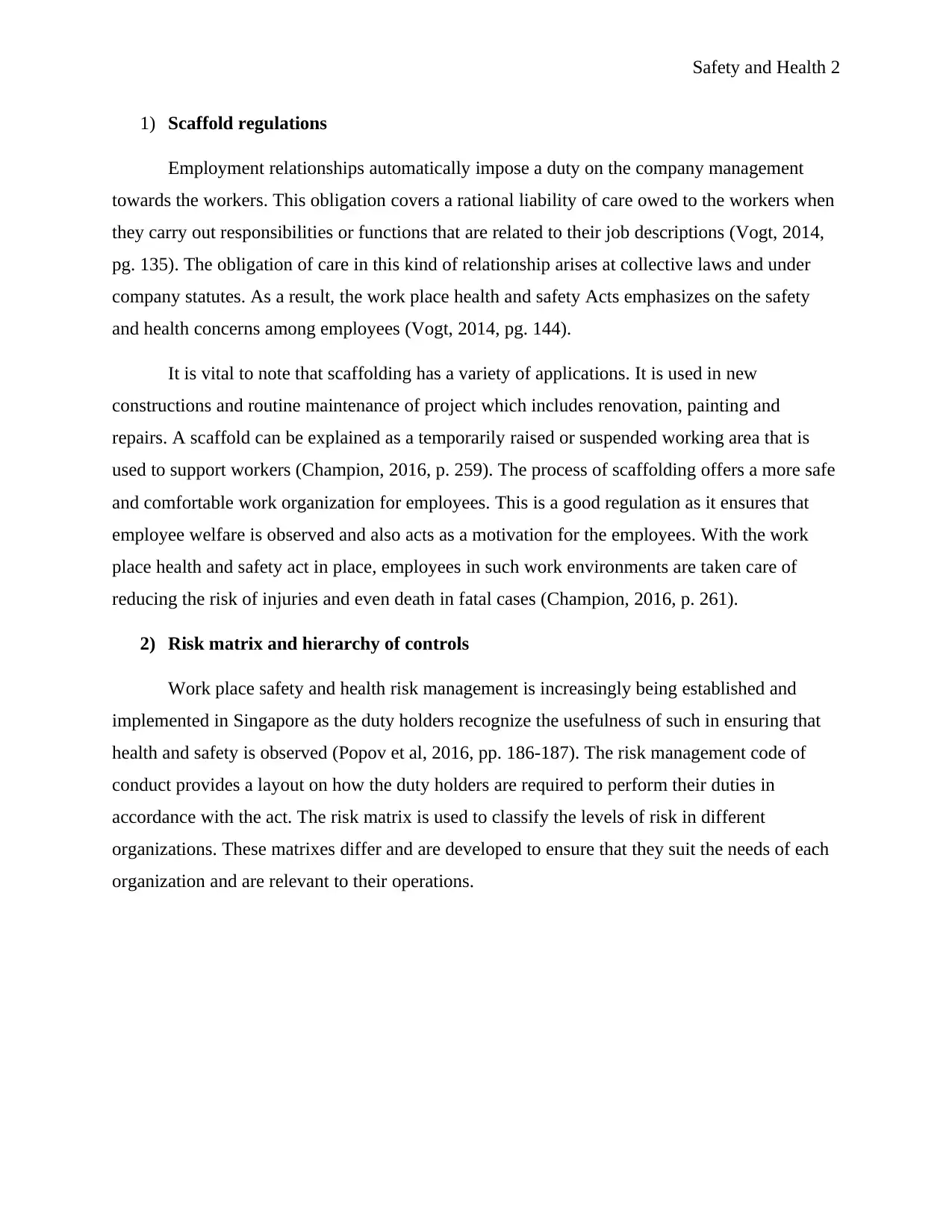
Retrieved from: https://slideplayer.com/slide/677831/
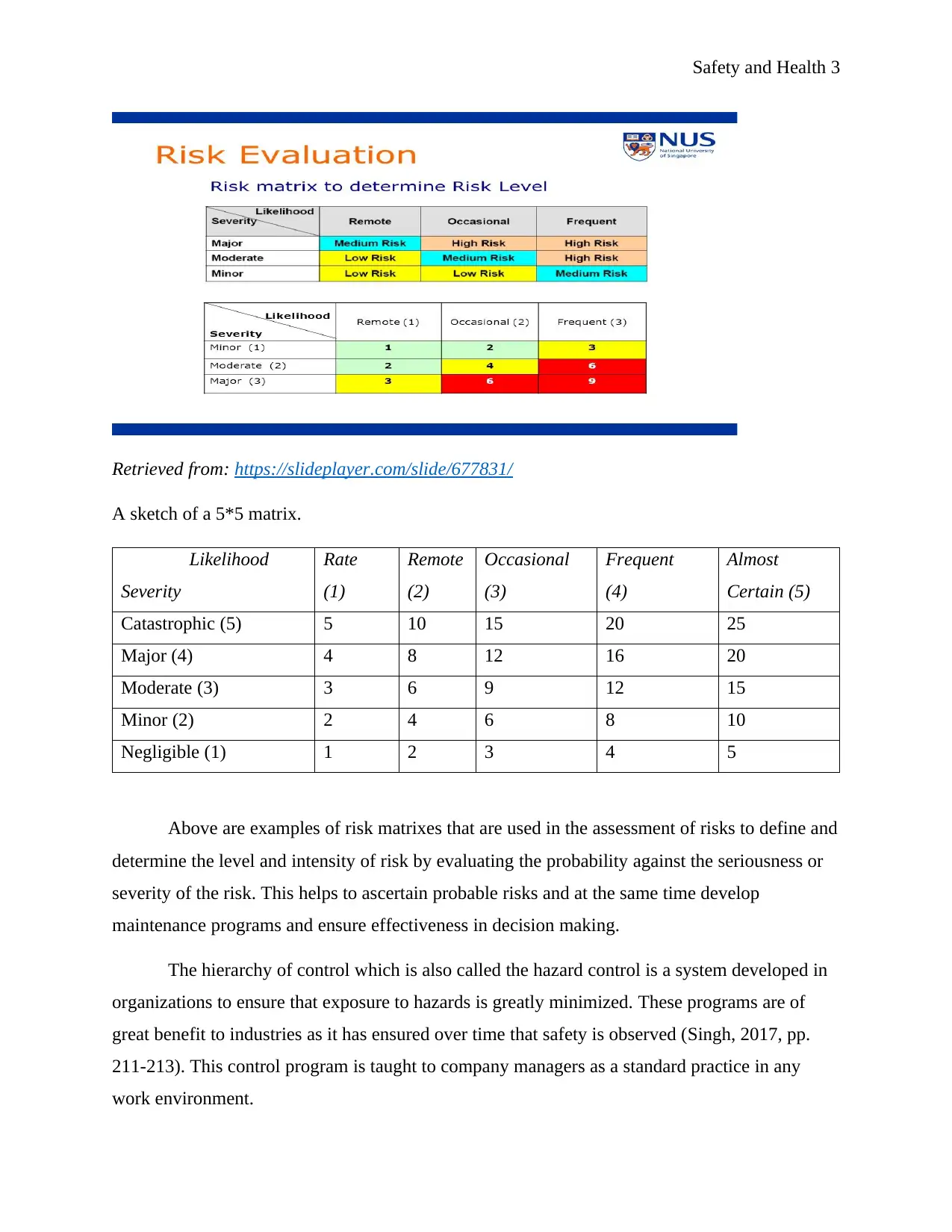
A sketch of a 5*5 matrix.
Likelihood
Severity
Rate
(1)
Remote
(2)
Occasional
(3)
Frequent
(4)
Almost
Certain (5)
Catastrophic (5) 5 10 15 20 25
Major (4) 4 8 12 16 20
Moderate (3) 3 6 9 12 15
Minor (2) 2 4 6 8 10
Negligible (1) 1 2 3 4 5
Above are examples of risk matrixes that are used in the assessment of risks to define and
determine the level and intensity of risk by evaluating the probability against the seriousness or
severity of the risk. This helps to ascertain probable risks and at the same time develop
maintenance programs and ensure effectiveness in decision making.
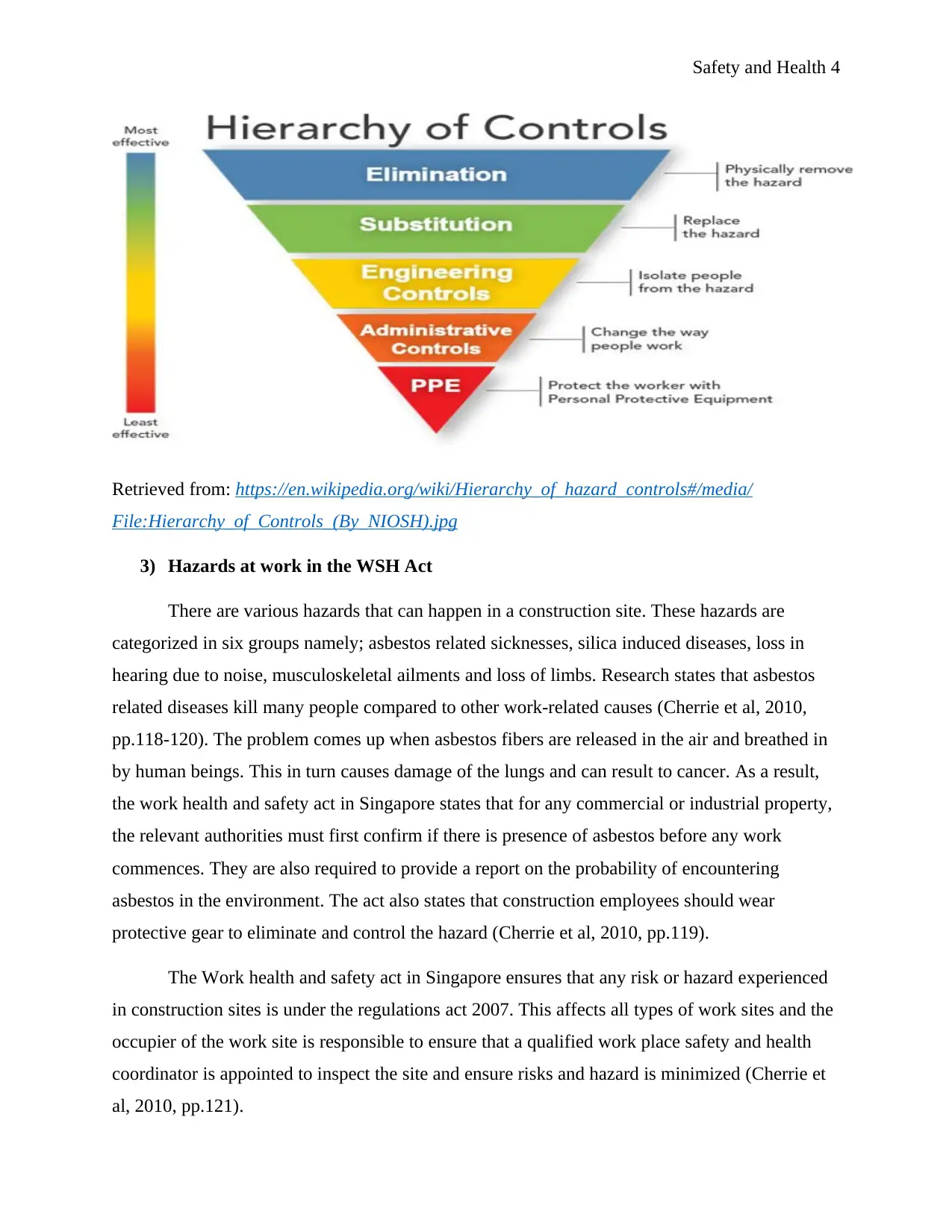
The hierarchy of control which is also called the hazard control is a system developed in
organizations to ensure that exposure to hazards is greatly minimized. These programs are of
great benefit to industries as it has ensured over time that safety is observed (Singh, 2017, pp.
211-213). This control program is taught to company managers as a standard practice in any
work environment.
Retrieved from: https://slideplayer.com/slide/677831/
A sketch of a 5*5 matrix.
Likelihood
Severity
Rate
(1)
Remote
(2)
Occasional
(3)
Frequent
(4)
Almost
Certain (5)
Catastrophic (5) 5 10 15 20 25
Major (4) 4 8 12 16 20
Moderate (3) 3 6 9 12 15
Minor (2) 2 4 6 8 10
Negligible (1) 1 2 3 4 5
Above are examples of risk matrixes that are used in the assessment of risks to define and
determine the level and intensity of risk by evaluating the probability against the seriousness or
severity of the risk. This helps to ascertain probable risks and at the same time develop
maintenance programs and ensure effectiveness in decision making.
The hierarchy of control which is also called the hazard control is a system developed in
organizations to ensure that exposure to hazards is greatly minimized. These programs are of
great benefit to industries as it has ensured over time that safety is observed (Singh, 2017, pp.
211-213). This control program is taught to company managers as a standard practice in any
work environment.
⊘ This is a preview!⊘
Do you want full access?
Subscribe today to unlock all pages.

Trusted by 1+ million students worldwide

Safety and Health 4
Retrieved from: https://en.wikipedia.org/wiki/Hierarchy_of_hazard_controls#/media/
File:Hierarchy_of_Controls_(By_NIOSH).jpg
3) Hazards at work in the WSH Act
There are various hazards that can happen in a construction site. These hazards are
categorized in six groups namely; asbestos related sicknesses, silica induced diseases, loss in
hearing due to noise, musculoskeletal ailments and loss of limbs. Research states that asbestos
related diseases kill many people compared to other work-related causes (Cherrie et al, 2010,
pp.118-120). The problem comes up when asbestos fibers are released in the air and breathed in
by human beings. This in turn causes damage of the lungs and can result to cancer. As a result,
the work health and safety act in Singapore states that for any commercial or industrial property,
the relevant authorities must first confirm if there is presence of asbestos before any work
commences. They are also required to provide a report on the probability of encountering
asbestos in the environment. The act also states that construction employees should wear
protective gear to eliminate and control the hazard (Cherrie et al, 2010, pp.119).
The Work health and safety act in Singapore ensures that any risk or hazard experienced
in construction sites is under the regulations act 2007. This affects all types of work sites and the
occupier of the work site is responsible to ensure that a qualified work place safety and health
coordinator is appointed to inspect the site and ensure risks and hazard is minimized (Cherrie et
al, 2010, pp.121).
Retrieved from: https://en.wikipedia.org/wiki/Hierarchy_of_hazard_controls#/media/
File:Hierarchy_of_Controls_(By_NIOSH).jpg
3) Hazards at work in the WSH Act
There are various hazards that can happen in a construction site. These hazards are
categorized in six groups namely; asbestos related sicknesses, silica induced diseases, loss in
hearing due to noise, musculoskeletal ailments and loss of limbs. Research states that asbestos
related diseases kill many people compared to other work-related causes (Cherrie et al, 2010,
pp.118-120). The problem comes up when asbestos fibers are released in the air and breathed in
by human beings. This in turn causes damage of the lungs and can result to cancer. As a result,
the work health and safety act in Singapore states that for any commercial or industrial property,
the relevant authorities must first confirm if there is presence of asbestos before any work
commences. They are also required to provide a report on the probability of encountering
asbestos in the environment. The act also states that construction employees should wear
protective gear to eliminate and control the hazard (Cherrie et al, 2010, pp.119).
The Work health and safety act in Singapore ensures that any risk or hazard experienced
in construction sites is under the regulations act 2007. This affects all types of work sites and the
occupier of the work site is responsible to ensure that a qualified work place safety and health
coordinator is appointed to inspect the site and ensure risks and hazard is minimized (Cherrie et
al, 2010, pp.121).
Paraphrase This Document
Need a fresh take? Get an instant paraphrase of this document with our AI Paraphraser

Safety and Health 5
4) Reporting incidences to authorities
In any organization, the procedure of solving problems or reporting incidents is always
provided. It is vital to note that accidents or incidences in an organization could be detrimental
and affect the operations of the organization. Recording and investigating issues in the work
place helps to reduce similar occurrences in the future (Reese, 2012, pg. 64). In some
organizations, it is a legal obligation for employees to report issues that cause harm in the
organization.
For instance, a serious work-related injury should be reported to relevant authorities
within twenty fours. For all temporary and permanent injuries that can cause disablement, a
report should be written explaining the circumstances that caused the injury. This is done to
ensure that treatment and compensation is done soonest and that any potential hazards are
addressed.
Work place related issues should first be raised to the immediate supervisor first. The
immediate boss is mainly considered as the most appropriate person since they understand your
scope of work better than other managers (Reese, 2012, pg. 65). However, supervisors can also
seek help and report incidences to the relevant human resource officer since they are responsible
in dealing with employees and anything that concerns them. In cases where escalation is needed,
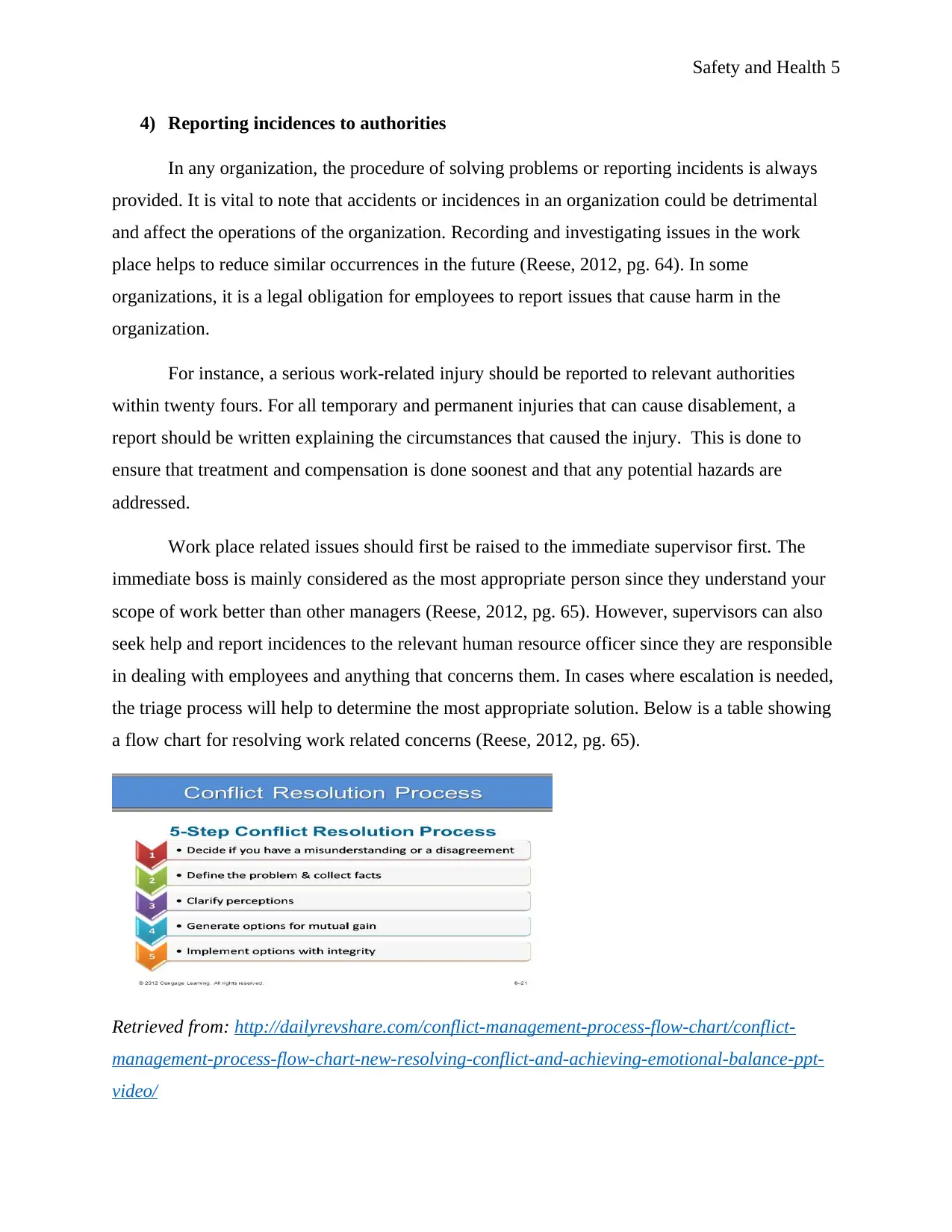
the triage process will help to determine the most appropriate solution. Below is a table showing
a flow chart for resolving work related concerns (Reese, 2012, pg. 65).
Retrieved from: http://dailyrevshare.com/conflict-management-process-flow-chart/conflict-
management-process-flow-chart-new-resolving-conflict-and-achieving-emotional-balance-ppt-
video/
4) Reporting incidences to authorities
In any organization, the procedure of solving problems or reporting incidents is always
provided. It is vital to note that accidents or incidences in an organization could be detrimental
and affect the operations of the organization. Recording and investigating issues in the work
place helps to reduce similar occurrences in the future (Reese, 2012, pg. 64). In some
organizations, it is a legal obligation for employees to report issues that cause harm in the
organization.
For instance, a serious work-related injury should be reported to relevant authorities
within twenty fours. For all temporary and permanent injuries that can cause disablement, a
report should be written explaining the circumstances that caused the injury. This is done to
ensure that treatment and compensation is done soonest and that any potential hazards are
addressed.
Work place related issues should first be raised to the immediate supervisor first. The
immediate boss is mainly considered as the most appropriate person since they understand your
scope of work better than other managers (Reese, 2012, pg. 65). However, supervisors can also
seek help and report incidences to the relevant human resource officer since they are responsible
in dealing with employees and anything that concerns them. In cases where escalation is needed,
the triage process will help to determine the most appropriate solution. Below is a table showing
a flow chart for resolving work related concerns (Reese, 2012, pg. 65).
Retrieved from: http://dailyrevshare.com/conflict-management-process-flow-chart/conflict-
management-process-flow-chart-new-resolving-conflict-and-achieving-emotional-balance-ppt-
video/

Safety and Health 6
5) Tunneling and excavation
Tunneling is a process where underground passages are created that may pass through
mountainous places, under buildings and roads or even under whole cities (Chew, 2001, pg. 43).
Excavation on the other hand means the removal of soil and rock from the earth using tools and
machinery including explosives which aid in creating underground tunnels, holes or cavities
(Chew, 2001, pg. 46). One of the major projects in Singapore that involved tunneling and
excavation is the down town line 2 project. This is an approximately 16.6 km underground
transit passage that was approved and implemented several years later (Krishnan, 2000, pg. 93).
The regulation state that the occupier should ensure that the work complies with
paragraph 2 to 11 of the general regulations in health and safety. Practicable measures should be
observed to ensure that no employee is trapped inside the holes, exposure to dangerous fumes
among other risks. Communication is also very important in the tunneling and excavation
process (Chew, 2001, pg. 44). Professional engineers are also responsible to ensure that the
entire process is done according to the set standards of construction.
6) Principles of the WSH act
Reducing the risk by ensuring that the stake holders minimize the risks they create.
Stake holders are key people in ensuring the success or failure of an organization. This is
because they are directly involved in the company’s process. They can help to reduce the
risk by ensuring that they support and work towards the achievement of the company’s
objectives. For example, stake holders are key people in the decision-making process.
Making sound and well-informed decisions helps to counter potential risks thus
minimizing the risks expected.
Encourage industries to adapt greater ownership of safety and health
This principle is very vital in ensuring that organizations are responsible for the safety of
the employees. This can be achieved by training them of the potential risks and measures
to take in minimizing the same. The use of protective gear and incorporating experts help
reduce risks in a greater measure.
Increased penalties for poor safety procedures
5) Tunneling and excavation
Tunneling is a process where underground passages are created that may pass through
mountainous places, under buildings and roads or even under whole cities (Chew, 2001, pg. 43).
Excavation on the other hand means the removal of soil and rock from the earth using tools and
machinery including explosives which aid in creating underground tunnels, holes or cavities
(Chew, 2001, pg. 46). One of the major projects in Singapore that involved tunneling and
excavation is the down town line 2 project. This is an approximately 16.6 km underground
transit passage that was approved and implemented several years later (Krishnan, 2000, pg. 93).
The regulation state that the occupier should ensure that the work complies with
paragraph 2 to 11 of the general regulations in health and safety. Practicable measures should be
observed to ensure that no employee is trapped inside the holes, exposure to dangerous fumes
among other risks. Communication is also very important in the tunneling and excavation
process (Chew, 2001, pg. 44). Professional engineers are also responsible to ensure that the
entire process is done according to the set standards of construction.
6) Principles of the WSH act
Reducing the risk by ensuring that the stake holders minimize the risks they create.
Stake holders are key people in ensuring the success or failure of an organization. This is
because they are directly involved in the company’s process. They can help to reduce the
risk by ensuring that they support and work towards the achievement of the company’s
objectives. For example, stake holders are key people in the decision-making process.
Making sound and well-informed decisions helps to counter potential risks thus
minimizing the risks expected.
Encourage industries to adapt greater ownership of safety and health
This principle is very vital in ensuring that organizations are responsible for the safety of
the employees. This can be achieved by training them of the potential risks and measures
to take in minimizing the same. The use of protective gear and incorporating experts help
reduce risks in a greater measure.
Increased penalties for poor safety procedures
⊘ This is a preview!⊘
Do you want full access?
Subscribe today to unlock all pages.

Trusted by 1+ million students worldwide

Safety and Health 7
When high fines are imposed on organizations that have poor safety procedures, risks
will be greatly reduced. This will ensure that organization are very keen on any
procedures that would result to risks due to the fear of being heavily fined. Organizations
will be more serious in implementing the health and safety procedures thus reducing the
chances of risks and hazards.
7) Reasonably Practicable
Reasonably practicable is a term that means, an instance currently or was at a particular
time where it was realistically possible to do something to ensure health and safety is achieved.
Matters that must be taken into account include;
The possibility of the risk occurring – e.g. digging trenches and making excavations on
loose soil or in a rain season, there is the risk of the excavated ground crumbling down
and this can be a hazard to the employees.
Knowledge of any information necessary to prevent occurrence of risks – e.g. when the
expert handling the process knows any information that can cause risk such as the
presence of dangerous gases; it can be termed as a reasonably practicable issue.
Costs involved in reducing and minimizing risk – organizations that are more concerned
with cutting down the operation costs at the expense of the employees’ safety is a
reasonably practicable issue.
References
Champion, S. (2016). Access scaffolding. Routledge, pp.259-272.
When high fines are imposed on organizations that have poor safety procedures, risks
will be greatly reduced. This will ensure that organization are very keen on any
procedures that would result to risks due to the fear of being heavily fined. Organizations
will be more serious in implementing the health and safety procedures thus reducing the
chances of risks and hazards.
7) Reasonably Practicable
Reasonably practicable is a term that means, an instance currently or was at a particular
time where it was realistically possible to do something to ensure health and safety is achieved.
Matters that must be taken into account include;
The possibility of the risk occurring – e.g. digging trenches and making excavations on
loose soil or in a rain season, there is the risk of the excavated ground crumbling down
and this can be a hazard to the employees.
Knowledge of any information necessary to prevent occurrence of risks – e.g. when the
expert handling the process knows any information that can cause risk such as the
presence of dangerous gases; it can be termed as a reasonably practicable issue.
Costs involved in reducing and minimizing risk – organizations that are more concerned
with cutting down the operation costs at the expense of the employees’ safety is a
reasonably practicable issue.
References
Champion, S. (2016). Access scaffolding. Routledge, pp.259-272.
Paraphrase This Document
Need a fresh take? Get an instant paraphrase of this document with our AI Paraphraser

Safety and Health 8
Cherrie, J. W., Howie, R., Semple, S., & Ashton, I. (2010). Monitoring for health hazards at
work. Chichester, West Sussex, Wiley-Blackwell, pp. 118-121.
Chew, Y. (2001). Construction Technology for Tall Buildings (2nd Edition). Singapore: World
Scientific Publishing Company, pp, 43-46.
KrishnanR (2000). Tunnels and Underground Structures. CRC Press, p.93.
POPOV, G., LYON, B. K., & HOLLCROFT, B. (2016). Risk assessment: a practical guide to
assessing operational risks. pp. 186-190. Retrieved from:
https://ebookcentral.proquest.com/lib/usherbrookemgh-ebooks/detail.action?docID=4538959
Reese, C. (2012). Accident/incident prevention techniques. Boca Raton: Taylor & Francis, pp.64-
65.
SINGH, A. (2017). Quantitative risk management and decision making in construction. pp. 211-
215. Retrieved from: http://public.eblib.com/choice/publicfullrecord.aspx?p=5164349
Vogt, F. (2014). Residential construction academy. Cengage Learning, pp.135-278.
Cherrie, J. W., Howie, R., Semple, S., & Ashton, I. (2010). Monitoring for health hazards at
work. Chichester, West Sussex, Wiley-Blackwell, pp. 118-121.
Chew, Y. (2001). Construction Technology for Tall Buildings (2nd Edition). Singapore: World
Scientific Publishing Company, pp, 43-46.
KrishnanR (2000). Tunnels and Underground Structures. CRC Press, p.93.
POPOV, G., LYON, B. K., & HOLLCROFT, B. (2016). Risk assessment: a practical guide to
assessing operational risks. pp. 186-190. Retrieved from:
https://ebookcentral.proquest.com/lib/usherbrookemgh-ebooks/detail.action?docID=4538959
Reese, C. (2012). Accident/incident prevention techniques. Boca Raton: Taylor & Francis, pp.64-
65.
SINGH, A. (2017). Quantitative risk management and decision making in construction. pp. 211-
215. Retrieved from: http://public.eblib.com/choice/publicfullrecord.aspx?p=5164349
Vogt, F. (2014). Residential construction academy. Cengage Learning, pp.135-278.
1 out of 8
Related Documents
Your All-in-One AI-Powered Toolkit for Academic Success.
+13062052269
info@desklib.com
Available 24*7 on WhatsApp / Email
Unlock your academic potential
Copyright © 2020–2025 A2Z Services. All Rights Reserved. Developed and managed by ZUCOL.