Civil Engineering: BIM Understanding and Activities Report
VerifiedAdded on 2022/08/15
|12
|6240
|16
Report
AI Summary
This report, based on a literature review, investigates the understanding and implementation of Building Information Modelling (BIM) within the AECOO (architects, engineers, contractors, operators, owners) industry. It explores the dominant perception of BIM, which often focuses on software usage and technical aspects rather than the broader process of information management and collaboration. The study utilizes Integrated Design and Delivery Solutions (IDDS) as a framework to analyze findings from scientific papers, industry newsletters, ISO standards, and BIM guidance. The research reveals a disparity between the industry's understanding of BIM as a technological tool versus a process for transforming industry practices. The report emphasizes the importance of a shared understanding of BIM to facilitate more effective implementation and achieve objectives for improving the AECOO industry. The study highlights the need for a shift in focus towards the development of skills in information management, collaboration, and the adoption of BIM as a process, not just a program.
BIM UNDERSTANDING AND ACTIVITIES
EILIF HJELSETH
Department of Civil Engineering and Energy Technology, Faculty of Technology, Art, and Design,
Oslo and Akershus University College of Applied Sciences, Norway
ABSTRACT
The AECOO (architects, engineers, contractors, operators, owners) industry is moving toward
increased digitalization. This unstoppable process requires a clear understanding of the important
elements required to reach the defined objectives. The change of process – how we work and interact
– is often highlighted as one of the most important objectives for the AECOO industry. BIM, which
can stand for building information model, modelling, or management, is one of the enablers and most
highlighted initiatives in digitalisation, but there is no joint understanding of BIM. However, our
understating of BIM, and especially the M, will directly influence our actions related to implementing
BIM with objectives that can be documented. This study is based on a literature review of scientific
papers, the buildingSMART Norway newsletter, an overview of BIM-related ISO standards and BIM
guidance, and experiences with the digital implementation of BIM guidance. Integrated design and
delivery solutions (IDDS) focus on the integration of collaboration between people, integrated
processes, and interoperable technology. It has, therefore, been used as a framework for exploring the
dominating understanding of BIM. The findings from this study indicate that BIM primary is
understood as the use of software programs. Activities for implementation are related to solving the
technical aspect of the development of software as well as the exchange of files. Software skills and
the use of software are used as indicators of the degree of BIM implementation. Activities related to
the development of skills for information management were hard to identify, except in large projects.
The understanding of BIM revealed in this study stands in contradiction to numerous statements
claiming BIM as a process for changing the AECOO industry. An increased awareness of our real
understanding and how this influences our activities can contribute to more targeted activities for
implementing BIM to realize objectives for improving the AECOO industry.
Keywords: BIM, building information model, building information modelling, building information
management, BIM guidance, BIM manuals, BIM standards.
1 IMPORTANCE OF JOINT UNDERSTANDING OF BIM
BIM is nowadays a widely used term in the AECOO (architects, engineers, contractors,
operators, owners) industry. However, “widely used” does not imply “well understood.”
Understanding a term has a direct influence on one’s response to it. This understanding is
often considered tacit knowledge, which makes it easy to underestimate the impact of the
term. There is general agreement in the AECOO industry that the current level of
implementation of BIM is far below what was expected about five or 10 years ago [1]–[5].
Could this have some connection to how we understand BIM and the efforts on which we
focus when implementing BIM in individual companies or in the industry in general?
This paper explores and critically reviews the use and understanding of BIM in the
AECOO industry. In the widely used BIM-handbook by Eastman et al. [6], BIM can be
treated as a single term, and not necessarily as an abbreviation for building information
modelling, building information model, or building information management. An alternative
approach is, of course, to state from the beginning that BIM is all three of these or to use all
of the words instead of the abbreviation. However, each of these elements/perspectives still
needs to be understood in full, not just recognized.
Numerous presentations state clearly that BIM is an abbreviation for building information
modelling, and where modelling indicates that BIM is about processes, it is a new way of
www.witpress.com, ISSN 1746-4498 (on-line)
WIT Transactions on The Built Environment, Vol 169, © 2017 WIT Press
Building Information Modelling (BIM) in Design, Construction and Operations II 3
doi:10.2495/BIM170011
EILIF HJELSETH
Department of Civil Engineering and Energy Technology, Faculty of Technology, Art, and Design,
Oslo and Akershus University College of Applied Sciences, Norway
ABSTRACT
The AECOO (architects, engineers, contractors, operators, owners) industry is moving toward
increased digitalization. This unstoppable process requires a clear understanding of the important
elements required to reach the defined objectives. The change of process – how we work and interact
– is often highlighted as one of the most important objectives for the AECOO industry. BIM, which
can stand for building information model, modelling, or management, is one of the enablers and most
highlighted initiatives in digitalisation, but there is no joint understanding of BIM. However, our
understating of BIM, and especially the M, will directly influence our actions related to implementing
BIM with objectives that can be documented. This study is based on a literature review of scientific
papers, the buildingSMART Norway newsletter, an overview of BIM-related ISO standards and BIM
guidance, and experiences with the digital implementation of BIM guidance. Integrated design and
delivery solutions (IDDS) focus on the integration of collaboration between people, integrated
processes, and interoperable technology. It has, therefore, been used as a framework for exploring the
dominating understanding of BIM. The findings from this study indicate that BIM primary is
understood as the use of software programs. Activities for implementation are related to solving the
technical aspect of the development of software as well as the exchange of files. Software skills and
the use of software are used as indicators of the degree of BIM implementation. Activities related to
the development of skills for information management were hard to identify, except in large projects.
The understanding of BIM revealed in this study stands in contradiction to numerous statements
claiming BIM as a process for changing the AECOO industry. An increased awareness of our real
understanding and how this influences our activities can contribute to more targeted activities for
implementing BIM to realize objectives for improving the AECOO industry.
Keywords: BIM, building information model, building information modelling, building information
management, BIM guidance, BIM manuals, BIM standards.
1 IMPORTANCE OF JOINT UNDERSTANDING OF BIM
BIM is nowadays a widely used term in the AECOO (architects, engineers, contractors,
operators, owners) industry. However, “widely used” does not imply “well understood.”
Understanding a term has a direct influence on one’s response to it. This understanding is
often considered tacit knowledge, which makes it easy to underestimate the impact of the
term. There is general agreement in the AECOO industry that the current level of
implementation of BIM is far below what was expected about five or 10 years ago [1]–[5].
Could this have some connection to how we understand BIM and the efforts on which we
focus when implementing BIM in individual companies or in the industry in general?
This paper explores and critically reviews the use and understanding of BIM in the
AECOO industry. In the widely used BIM-handbook by Eastman et al. [6], BIM can be
treated as a single term, and not necessarily as an abbreviation for building information
modelling, building information model, or building information management. An alternative
approach is, of course, to state from the beginning that BIM is all three of these or to use all
of the words instead of the abbreviation. However, each of these elements/perspectives still
needs to be understood in full, not just recognized.
Numerous presentations state clearly that BIM is an abbreviation for building information
modelling, and where modelling indicates that BIM is about processes, it is a new way of
www.witpress.com, ISSN 1746-4498 (on-line)
WIT Transactions on The Built Environment, Vol 169, © 2017 WIT Press
Building Information Modelling (BIM) in Design, Construction and Operations II 3
doi:10.2495/BIM170011

Paraphrase This Document
Need a fresh take? Get an instant paraphrase of this document with our AI Paraphraser
working and collaborating. These types of presentations have received recognizing nods and
applause. “BIM is a process that’s enabled by technology. You can’t buy it in a box, it’s not
a software solution, and it’s something you can’t do in isolation” [7, p. 349]. Also,
“Measuring BIM benefits and cost consistently apportioning to who get what’s benefit and
why is difficult. The reality is that everyone in the supply chain benefits when using BIM in
a collaborative way” [7, p. 352].
The BS PAS1192 series of standards for information management from the United
Kingdom (UK) is going to be developed as ISO [8] and CEN [9] standards. These standards
can have an important impact on the understanding of the BIM-based process in the AEC
industry.
This study focuses on whether BIM is understood as a program versus a process. A
program includes software tools, training and hardware, things that can be bought as generic
product or services. A process includes documented descriptions of procedures for ways of
working and collaborating with BIM in projects. The project (or company) specify this in
separate documents like BIM guidance (BIM manuals), or documents describing how
defined parts in specified standards, BIM guidance from third part (e.g. national or industry
BIM guidance) or other normative documents shall be used in the project.
This can be identified by exploring how much effort is placed on software versus
development of soft skills (implementing standards, procedures), versus new ways of
collaborating. The research question is aimed at uncovering this by exploring the options
of program versus process versus people.
The research question in this study is: What is the dominating understanding of BIM?
2 THEORETICAL FRAMEWORK
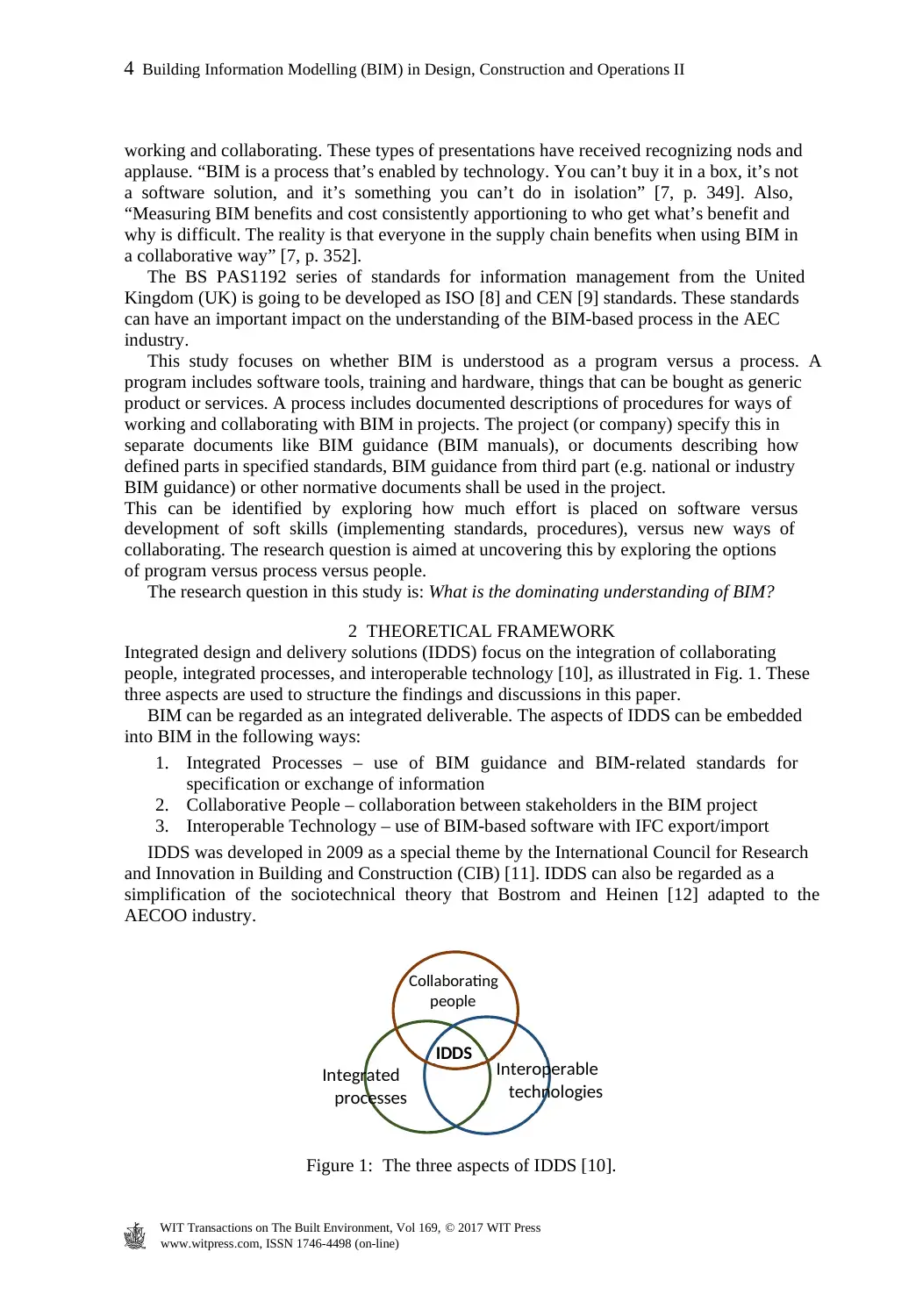
Integrated design and delivery solutions (IDDS) focus on the integration of collaborating
people, integrated processes, and interoperable technology [10], as illustrated in Fig. 1. These
three aspects are used to structure the findings and discussions in this paper.
BIM can be regarded as an integrated deliverable. The aspects of IDDS can be embedded
into BIM in the following ways:
1. Integrated Processes – use of BIM guidance and BIM-related standards for
specification or exchange of information
2. Collaborative People – collaboration between stakeholders in the BIM project
3. Interoperable Technology – use of BIM-based software with IFC export/import
IDDS was developed in 2009 as a special theme by the International Council for Research
and Innovation in Building and Construction (CIB) [11]. IDDS can also be regarded as a
simplification of the sociotechnical theory that Bostrom and Heinen [12] adapted to the
AECOO industry.
Figure 1: The three aspects of IDDS [10].
Collaborating
people
IDDS Interoperable
technologies
Integrated
processes
www.witpress.com, ISSN 1746-4498 (on-line)
WIT Transactions on The Built Environment, Vol 169, © 2017 WIT Press
4 Building Information Modelling (BIM) in Design, Construction and Operations II
applause. “BIM is a process that’s enabled by technology. You can’t buy it in a box, it’s not
a software solution, and it’s something you can’t do in isolation” [7, p. 349]. Also,
“Measuring BIM benefits and cost consistently apportioning to who get what’s benefit and
why is difficult. The reality is that everyone in the supply chain benefits when using BIM in
a collaborative way” [7, p. 352].
The BS PAS1192 series of standards for information management from the United
Kingdom (UK) is going to be developed as ISO [8] and CEN [9] standards. These standards
can have an important impact on the understanding of the BIM-based process in the AEC
industry.
This study focuses on whether BIM is understood as a program versus a process. A
program includes software tools, training and hardware, things that can be bought as generic
product or services. A process includes documented descriptions of procedures for ways of
working and collaborating with BIM in projects. The project (or company) specify this in
separate documents like BIM guidance (BIM manuals), or documents describing how
defined parts in specified standards, BIM guidance from third part (e.g. national or industry
BIM guidance) or other normative documents shall be used in the project.
This can be identified by exploring how much effort is placed on software versus
development of soft skills (implementing standards, procedures), versus new ways of
collaborating. The research question is aimed at uncovering this by exploring the options
of program versus process versus people.
The research question in this study is: What is the dominating understanding of BIM?
2 THEORETICAL FRAMEWORK
Integrated design and delivery solutions (IDDS) focus on the integration of collaborating
people, integrated processes, and interoperable technology [10], as illustrated in Fig. 1. These
three aspects are used to structure the findings and discussions in this paper.
BIM can be regarded as an integrated deliverable. The aspects of IDDS can be embedded
into BIM in the following ways:
1. Integrated Processes – use of BIM guidance and BIM-related standards for
specification or exchange of information
2. Collaborative People – collaboration between stakeholders in the BIM project
3. Interoperable Technology – use of BIM-based software with IFC export/import
IDDS was developed in 2009 as a special theme by the International Council for Research
and Innovation in Building and Construction (CIB) [11]. IDDS can also be regarded as a
simplification of the sociotechnical theory that Bostrom and Heinen [12] adapted to the
AECOO industry.
Figure 1: The three aspects of IDDS [10].
Collaborating
people
IDDS Interoperable
technologies
Integrated
processes
www.witpress.com, ISSN 1746-4498 (on-line)
WIT Transactions on The Built Environment, Vol 169, © 2017 WIT Press
4 Building Information Modelling (BIM) in Design, Construction and Operations II
3 METHODS AND MATERIALS
This study used a qualitative approach based on a literature review of multiple sources to
obtain an overview of the situation in the AECOO industry. By using multiple sources, this
study identifies sources that could be applicable to further studies, either qualitative or
quantitative ones. Where numbers are compared, the precision of the numbers helps to
illustrate a situation and trend, not a short time comparison. The multiple sources used come
from around the world to provide a general impression either program of process is given
priority. This study therefore does not include national queries. National differences can be
expected, and more in-depth studies including queries could be used to explore and compare
situations, but this is not the scope of this study. IDDS is used as the framework for the
classification of findings.
This study includes (1) the classification of papers from AutoCON from 2013 to 2017 to
explore the focus on the research and to determine where the development in the industry has
taken place. To explore which themes are in focus in the industry, an (almost) bi-monthly
newsletter (2) from buildingSMART Norway has been used. An overview of ISO standards
(3) and BIM guidance (4), as well as when they were developed, is included to illustrate that
support for BIM as a process has been available for long time. BIM guidance is made for the
manual validation of content in BIM files. A survey (5) about the automatic validation
processing of BIM requirements is included to illustrate that processes can be supported by
programs such as BIM-based model checkers. Each (#) above refers to a subchapter of
Section 4 below.
4 FINDINGS
4.1 Research perspectives in AutoCON papers
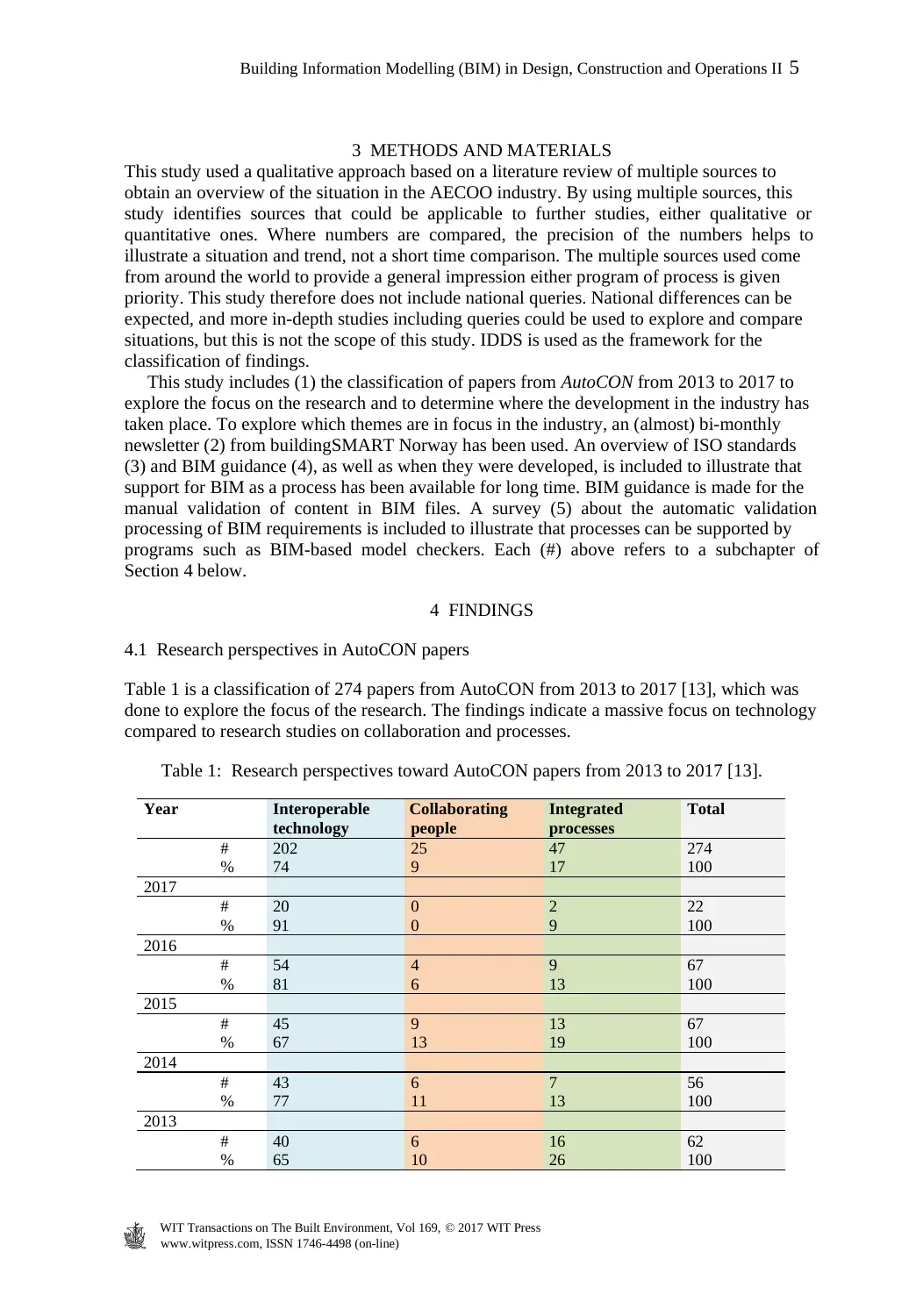
Table 1 is a classification of 274 papers from AutoCON from 2013 to 2017 [13], which was
done to explore the focus of the research. The findings indicate a massive focus on technology
compared to research studies on collaboration and processes.
Table 1: Research perspectives toward AutoCON papers from 2013 to 2017 [13].
Year Interoperable
technology
Collaborating
people
Integrated
processes
Total
# 202 25 47 274
% 74 9 17 100
2017
# 20 0 2 22
% 91 0 9 100
2016
# 54 4 9 67
% 81 6 13 100
2015
# 45 9 13 67
% 67 13 19 100
2014
# 43 6 7 56
% 77 11 13 100
2013
# 40 6 16 62
% 65 10 26 100
www.witpress.com, ISSN 1746-4498 (on-line)
WIT Transactions on The Built Environment, Vol 169, © 2017 WIT Press
Building Information Modelling (BIM) in Design, Construction and Operations II 5
This study used a qualitative approach based on a literature review of multiple sources to
obtain an overview of the situation in the AECOO industry. By using multiple sources, this
study identifies sources that could be applicable to further studies, either qualitative or
quantitative ones. Where numbers are compared, the precision of the numbers helps to
illustrate a situation and trend, not a short time comparison. The multiple sources used come
from around the world to provide a general impression either program of process is given
priority. This study therefore does not include national queries. National differences can be
expected, and more in-depth studies including queries could be used to explore and compare
situations, but this is not the scope of this study. IDDS is used as the framework for the
classification of findings.
This study includes (1) the classification of papers from AutoCON from 2013 to 2017 to
explore the focus on the research and to determine where the development in the industry has
taken place. To explore which themes are in focus in the industry, an (almost) bi-monthly
newsletter (2) from buildingSMART Norway has been used. An overview of ISO standards
(3) and BIM guidance (4), as well as when they were developed, is included to illustrate that
support for BIM as a process has been available for long time. BIM guidance is made for the
manual validation of content in BIM files. A survey (5) about the automatic validation
processing of BIM requirements is included to illustrate that processes can be supported by
programs such as BIM-based model checkers. Each (#) above refers to a subchapter of
Section 4 below.
4 FINDINGS
4.1 Research perspectives in AutoCON papers
Table 1 is a classification of 274 papers from AutoCON from 2013 to 2017 [13], which was
done to explore the focus of the research. The findings indicate a massive focus on technology
compared to research studies on collaboration and processes.
Table 1: Research perspectives toward AutoCON papers from 2013 to 2017 [13].
Year Interoperable
technology
Collaborating
people
Integrated
processes
Total
# 202 25 47 274
% 74 9 17 100
2017
# 20 0 2 22
% 91 0 9 100
2016
# 54 4 9 67
% 81 6 13 100
2015
# 45 9 13 67
% 67 13 19 100
2014
# 43 6 7 56
% 77 11 13 100
2013
# 40 6 16 62
% 65 10 26 100
www.witpress.com, ISSN 1746-4498 (on-line)
WIT Transactions on The Built Environment, Vol 169, © 2017 WIT Press
Building Information Modelling (BIM) in Design, Construction and Operations II 5
⊘ This is a preview!⊘
Do you want full access?
Subscribe today to unlock all pages.

Trusted by 1+ million students worldwide
4.2 buildingSMART Norway’s Newsletter
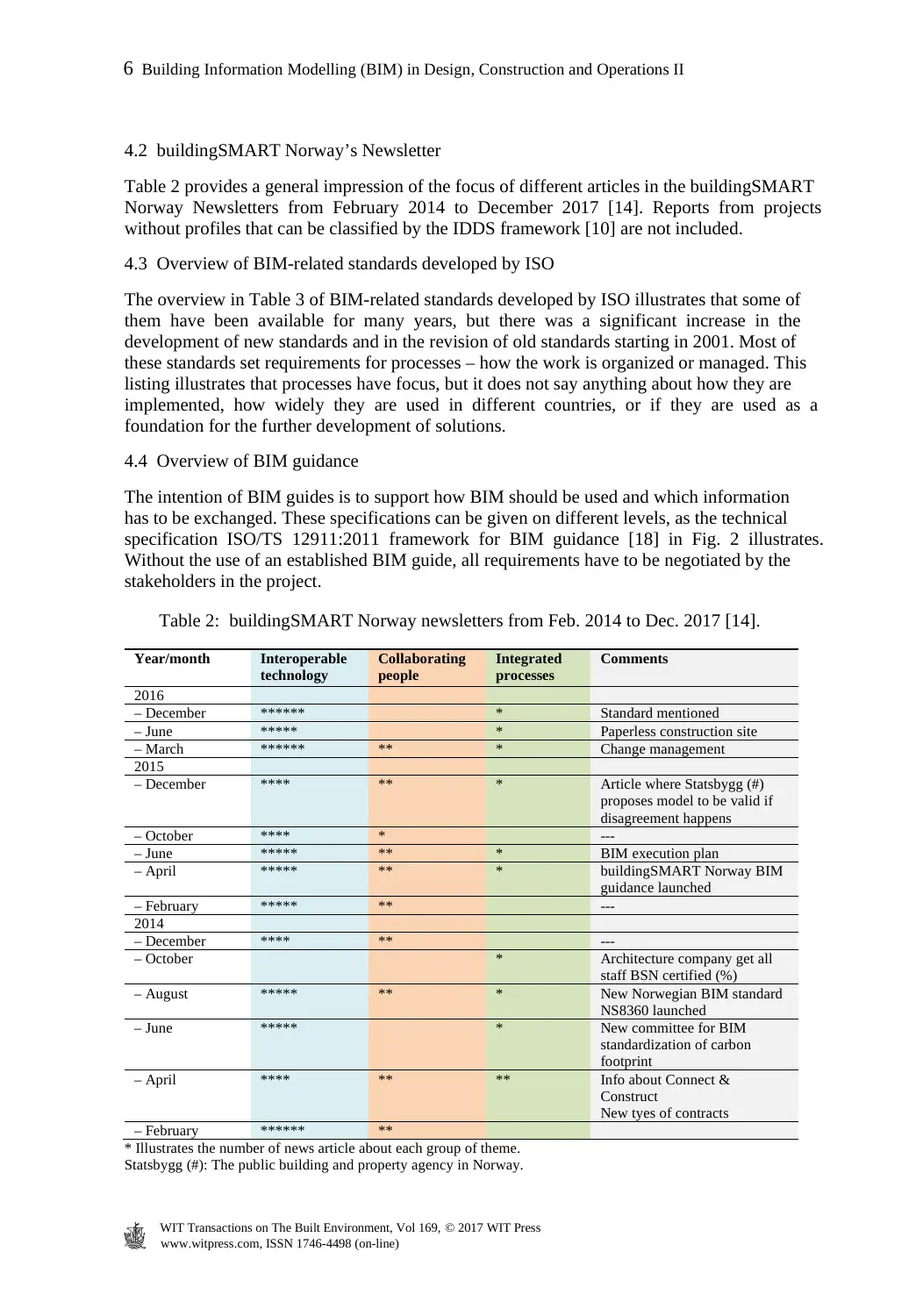
Table 2 provides a general impression of the focus of different articles in the buildingSMART
Norway Newsletters from February 2014 to December 2017 [14]. Reports from projects
without profiles that can be classified by the IDDS framework [10] are not included.
4.3 Overview of BIM-related standards developed by ISO
The overview in Table 3 of BIM-related standards developed by ISO illustrates that some of
them have been available for many years, but there was a significant increase in the
development of new standards and in the revision of old standards starting in 2001. Most of
these standards set requirements for processes – how the work is organized or managed. This
listing illustrates that processes have focus, but it does not say anything about how they are
implemented, how widely they are used in different countries, or if they are used as a
foundation for the further development of solutions.
4.4 Overview of BIM guidance
The intention of BIM guides is to support how BIM should be used and which information
has to be exchanged. These specifications can be given on different levels, as the technical
specification ISO/TS 12911:2011 framework for BIM guidance [18] in Fig. 2 illustrates.
Without the use of an established BIM guide, all requirements have to be negotiated by the
stakeholders in the project.
Table 2: buildingSMART Norway newsletters from Feb. 2014 to Dec. 2017 [14].
Year/month Interoperable
technology
Collaborating
people
Integrated
processes
Comments
2016
– December ****** * Standard mentioned
– June ***** * Paperless construction site
– March ****** ** * Change management
2015
– December **** ** * Article where Statsbygg (#)
proposes model to be valid if
disagreement happens
– October **** * ---
– June ***** ** * BIM execution plan
– April ***** ** * buildingSMART Norway BIM
guidance launched
– February ***** ** ---
2014
– December **** ** ---
– October * Architecture company get all
staff BSN certified (%)
– August ***** ** * New Norwegian BIM standard
NS8360 launched
– June ***** * New committee for BIM
standardization of carbon
footprint
– April **** ** ** Info about Connect &
Construct
New tyes of contracts
– February ****** **
* Illustrates the number of news article about each group of theme.
Statsbygg (#): The public building and property agency in Norway.
www.witpress.com, ISSN 1746-4498 (on-line)
WIT Transactions on The Built Environment, Vol 169, © 2017 WIT Press
6 Building Information Modelling (BIM) in Design, Construction and Operations II
Table 2 provides a general impression of the focus of different articles in the buildingSMART
Norway Newsletters from February 2014 to December 2017 [14]. Reports from projects
without profiles that can be classified by the IDDS framework [10] are not included.
4.3 Overview of BIM-related standards developed by ISO
The overview in Table 3 of BIM-related standards developed by ISO illustrates that some of
them have been available for many years, but there was a significant increase in the
development of new standards and in the revision of old standards starting in 2001. Most of
these standards set requirements for processes – how the work is organized or managed. This
listing illustrates that processes have focus, but it does not say anything about how they are
implemented, how widely they are used in different countries, or if they are used as a
foundation for the further development of solutions.
4.4 Overview of BIM guidance
The intention of BIM guides is to support how BIM should be used and which information
has to be exchanged. These specifications can be given on different levels, as the technical
specification ISO/TS 12911:2011 framework for BIM guidance [18] in Fig. 2 illustrates.
Without the use of an established BIM guide, all requirements have to be negotiated by the
stakeholders in the project.
Table 2: buildingSMART Norway newsletters from Feb. 2014 to Dec. 2017 [14].
Year/month Interoperable
technology
Collaborating
people
Integrated
processes
Comments
2016
– December ****** * Standard mentioned
– June ***** * Paperless construction site
– March ****** ** * Change management
2015
– December **** ** * Article where Statsbygg (#)
proposes model to be valid if
disagreement happens
– October **** * ---
– June ***** ** * BIM execution plan
– April ***** ** * buildingSMART Norway BIM
guidance launched
– February ***** ** ---
2014
– December **** ** ---
– October * Architecture company get all
staff BSN certified (%)
– August ***** ** * New Norwegian BIM standard
NS8360 launched
– June ***** * New committee for BIM
standardization of carbon
footprint
– April **** ** ** Info about Connect &
Construct
New tyes of contracts
– February ****** **
* Illustrates the number of news article about each group of theme.
Statsbygg (#): The public building and property agency in Norway.
www.witpress.com, ISSN 1746-4498 (on-line)
WIT Transactions on The Built Environment, Vol 169, © 2017 WIT Press
6 Building Information Modelling (BIM) in Design, Construction and Operations II
Paraphrase This Document
Need a fresh take? Get an instant paraphrase of this document with our AI Paraphraser
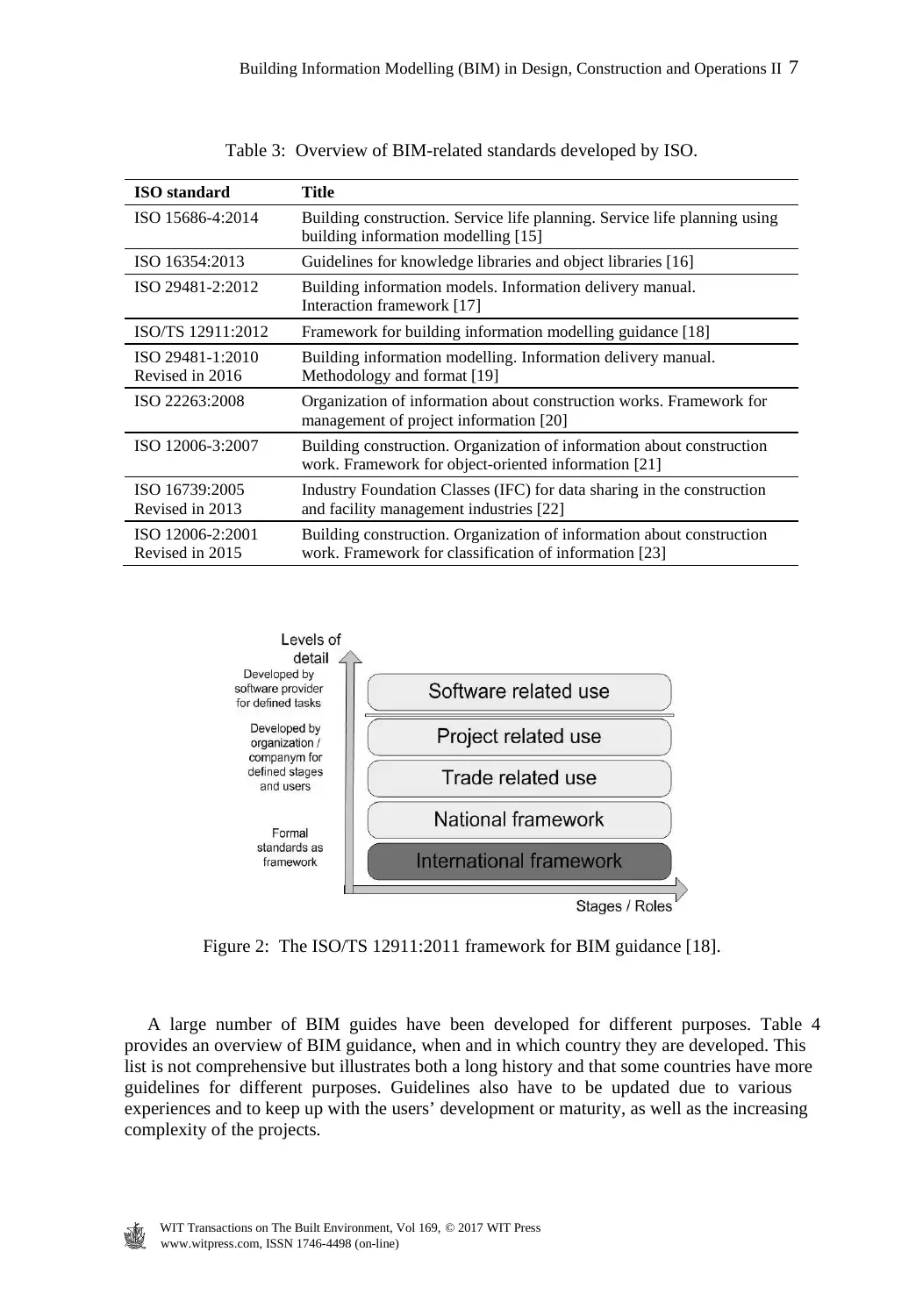
Table 3: Overview of BIM-related standards developed by ISO.
ISO standard Title
ISO 15686-4:2014 Building construction. Service life planning. Service life planning using
building information modelling [15]
ISO 16354:2013 Guidelines for knowledge libraries and object libraries [16]
ISO 29481-2:2012 Building information models. Information delivery manual.
Interaction framework [17]
ISO/TS 12911:2012 Framework for building information modelling guidance [18]
ISO 29481-1:2010
Revised in 2016
Building information modelling. Information delivery manual.
Methodology and format [19]
ISO 22263:2008 Organization of information about construction works. Framework for
management of project information [20]
ISO 12006-3:2007 Building construction. Organization of information about construction
work. Framework for object-oriented information [21]
ISO 16739:2005
Revised in 2013
Industry Foundation Classes (IFC) for data sharing in the construction
and facility management industries [22]
ISO 12006-2:2001
Revised in 2015
Building construction. Organization of information about construction
work. Framework for classification of information [23]
Figure 2: The ISO/TS 12911:2011 framework for BIM guidance [18].
A large number of BIM guides have been developed for different purposes. Table 4
provides an overview of BIM guidance, when and in which country they are developed. This
list is not comprehensive but illustrates both a long history and that some countries have more
guidelines for different purposes. Guidelines also have to be updated due to various
experiences and to keep up with the users’ development or maturity, as well as the increasing
complexity of the projects.
www.witpress.com, ISSN 1746-4498 (on-line)
WIT Transactions on The Built Environment, Vol 169, © 2017 WIT Press
Building Information Modelling (BIM) in Design, Construction and Operations II 7
ISO standard Title
ISO 15686-4:2014 Building construction. Service life planning. Service life planning using
building information modelling [15]
ISO 16354:2013 Guidelines for knowledge libraries and object libraries [16]
ISO 29481-2:2012 Building information models. Information delivery manual.
Interaction framework [17]
ISO/TS 12911:2012 Framework for building information modelling guidance [18]
ISO 29481-1:2010
Revised in 2016
Building information modelling. Information delivery manual.
Methodology and format [19]
ISO 22263:2008 Organization of information about construction works. Framework for
management of project information [20]
ISO 12006-3:2007 Building construction. Organization of information about construction
work. Framework for object-oriented information [21]
ISO 16739:2005
Revised in 2013
Industry Foundation Classes (IFC) for data sharing in the construction
and facility management industries [22]
ISO 12006-2:2001
Revised in 2015
Building construction. Organization of information about construction
work. Framework for classification of information [23]
Figure 2: The ISO/TS 12911:2011 framework for BIM guidance [18].
A large number of BIM guides have been developed for different purposes. Table 4
provides an overview of BIM guidance, when and in which country they are developed. This
list is not comprehensive but illustrates both a long history and that some countries have more
guidelines for different purposes. Guidelines also have to be updated due to various
experiences and to keep up with the users’ development or maturity, as well as the increasing
complexity of the projects.
www.witpress.com, ISSN 1746-4498 (on-line)
WIT Transactions on The Built Environment, Vol 169, © 2017 WIT Press
Building Information Modelling (BIM) in Design, Construction and Operations II 7
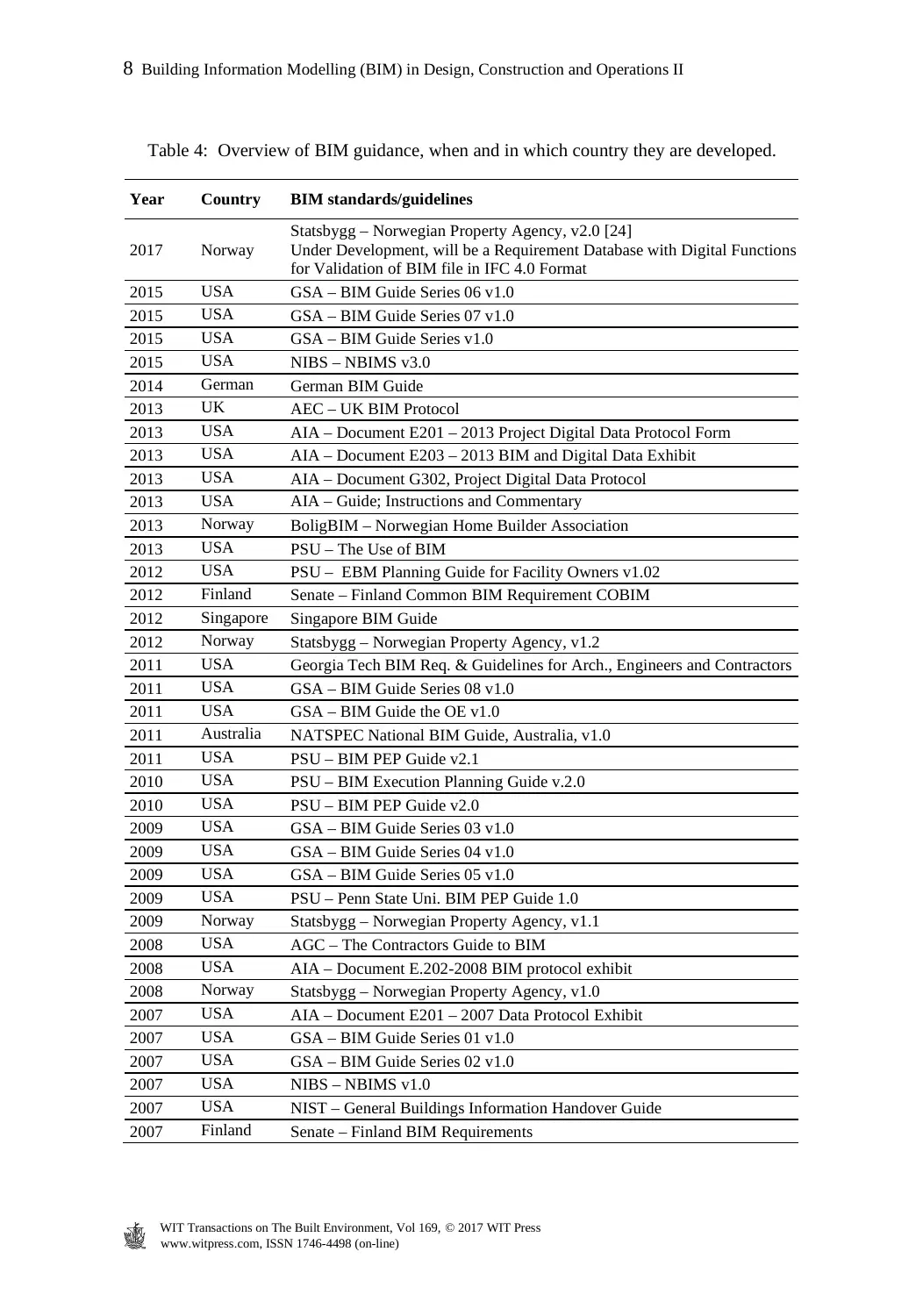
Table 4: Overview of BIM guidance, when and in which country they are developed.
Year Country BIM standards/guidelines
2017 Norway
Statsbygg – Norwegian Property Agency, v2.0 [24]
Under Development, will be a Requirement Database with Digital Functions
for Validation of BIM file in IFC 4.0 Format
2015 USA GSA – BIM Guide Series 06 v1.0
2015 USA GSA – BIM Guide Series 07 v1.0
2015 USA GSA – BIM Guide Series v1.0
2015 USA NIBS – NBIMS v3.0
2014 German German BIM Guide
2013 UK AEC – UK BIM Protocol
2013 USA AIA – Document E201 – 2013 Project Digital Data Protocol Form
2013 USA AIA – Document E203 – 2013 BIM and Digital Data Exhibit
2013 USA AIA – Document G302, Project Digital Data Protocol
2013 USA AIA – Guide; Instructions and Commentary
2013 Norway BoligBIM – Norwegian Home Builder Association
2013 USA PSU – The Use of BIM
2012 USA PSU – EBM Planning Guide for Facility Owners v1.02
2012 Finland Senate – Finland Common BIM Requirement COBIM
2012 Singapore Singapore BIM Guide
2012 Norway Statsbygg – Norwegian Property Agency, v1.2
2011 USA Georgia Tech BIM Req. & Guidelines for Arch., Engineers and Contractors
2011 USA GSA – BIM Guide Series 08 v1.0
2011 USA GSA – BIM Guide the OE v1.0
2011 Australia NATSPEC National BIM Guide, Australia, v1.0
2011 USA PSU – BIM PEP Guide v2.1
2010 USA PSU – BIM Execution Planning Guide v.2.0
2010 USA PSU – BIM PEP Guide v2.0
2009 USA GSA – BIM Guide Series 03 v1.0
2009 USA GSA – BIM Guide Series 04 v1.0
2009 USA GSA – BIM Guide Series 05 v1.0
2009 USA PSU – Penn State Uni. BIM PEP Guide 1.0
2009 Norway Statsbygg – Norwegian Property Agency, v1.1
2008 USA AGC – The Contractors Guide to BIM
2008 USA AIA – Document E.202-2008 BIM protocol exhibit
2008 Norway Statsbygg – Norwegian Property Agency, v1.0
2007 USA AIA – Document E201 – 2007 Data Protocol Exhibit
2007 USA GSA – BIM Guide Series 01 v1.0
2007 USA GSA – BIM Guide Series 02 v1.0
2007 USA NIBS – NBIMS v1.0
2007 USA NIST – General Buildings Information Handover Guide
2007 Finland Senate – Finland BIM Requirements
www.witpress.com, ISSN 1746-4498 (on-line)
WIT Transactions on The Built Environment, Vol 169, © 2017 WIT Press
8 Building Information Modelling (BIM) in Design, Construction and Operations II
Year Country BIM standards/guidelines
2017 Norway
Statsbygg – Norwegian Property Agency, v2.0 [24]
Under Development, will be a Requirement Database with Digital Functions
for Validation of BIM file in IFC 4.0 Format
2015 USA GSA – BIM Guide Series 06 v1.0
2015 USA GSA – BIM Guide Series 07 v1.0
2015 USA GSA – BIM Guide Series v1.0
2015 USA NIBS – NBIMS v3.0
2014 German German BIM Guide
2013 UK AEC – UK BIM Protocol
2013 USA AIA – Document E201 – 2013 Project Digital Data Protocol Form
2013 USA AIA – Document E203 – 2013 BIM and Digital Data Exhibit
2013 USA AIA – Document G302, Project Digital Data Protocol
2013 USA AIA – Guide; Instructions and Commentary
2013 Norway BoligBIM – Norwegian Home Builder Association
2013 USA PSU – The Use of BIM
2012 USA PSU – EBM Planning Guide for Facility Owners v1.02
2012 Finland Senate – Finland Common BIM Requirement COBIM
2012 Singapore Singapore BIM Guide
2012 Norway Statsbygg – Norwegian Property Agency, v1.2
2011 USA Georgia Tech BIM Req. & Guidelines for Arch., Engineers and Contractors
2011 USA GSA – BIM Guide Series 08 v1.0
2011 USA GSA – BIM Guide the OE v1.0
2011 Australia NATSPEC National BIM Guide, Australia, v1.0
2011 USA PSU – BIM PEP Guide v2.1
2010 USA PSU – BIM Execution Planning Guide v.2.0
2010 USA PSU – BIM PEP Guide v2.0
2009 USA GSA – BIM Guide Series 03 v1.0
2009 USA GSA – BIM Guide Series 04 v1.0
2009 USA GSA – BIM Guide Series 05 v1.0
2009 USA PSU – Penn State Uni. BIM PEP Guide 1.0
2009 Norway Statsbygg – Norwegian Property Agency, v1.1
2008 USA AGC – The Contractors Guide to BIM
2008 USA AIA – Document E.202-2008 BIM protocol exhibit
2008 Norway Statsbygg – Norwegian Property Agency, v1.0
2007 USA AIA – Document E201 – 2007 Data Protocol Exhibit
2007 USA GSA – BIM Guide Series 01 v1.0
2007 USA GSA – BIM Guide Series 02 v1.0
2007 USA NIBS – NBIMS v1.0
2007 USA NIST – General Buildings Information Handover Guide
2007 Finland Senate – Finland BIM Requirements
www.witpress.com, ISSN 1746-4498 (on-line)
WIT Transactions on The Built Environment, Vol 169, © 2017 WIT Press
8 Building Information Modelling (BIM) in Design, Construction and Operations II
⊘ This is a preview!⊘
Do you want full access?
Subscribe today to unlock all pages.
Trusted by 1+ million students worldwide
Please note that BIM guidance is presented as reports in pdf-format. The work has to be
done manually to validate whether or not specified requirements are fulfilled. This is a time-
consuming process that requires a high level of competence with BIM. Statsbygg, the
Norwegian property agency, is in its final phase of developing its new generation of BIM
guidance. This guidance will be a requirement database with digital functions for the
validation of BIM files in IFC 4.0 format [24]. This is a significant step toward enabling
digital-supported working processes.
4.5 Automatic processing of Statsbygg’s BIM requirements
This study focuses on the degree of the automatic processing of digital rulesets and is based
on the 1.2 version of BIM guidance from Statsbygg [26], the Norwegian public construction
and property management agency. Statsbygg has developed BIM guidelines since 2008, and
the current version, 1.2, from 2012 is its third. It is available in both Norwegian and English
versions [26]. This BIM guidance is used as a mandatory requirement for all projects above
€5 mill. The BIM-guidance document contains 131 requirements for the specification of
information in the IFC file. These requirements were implemented as a separate ruleset by
Solibri Model Checker and are included in version 7 and newer [28]. At first glance in Solibri
Model Checker, it can be easy to believe that all requirements in the BIM manual version 1.2
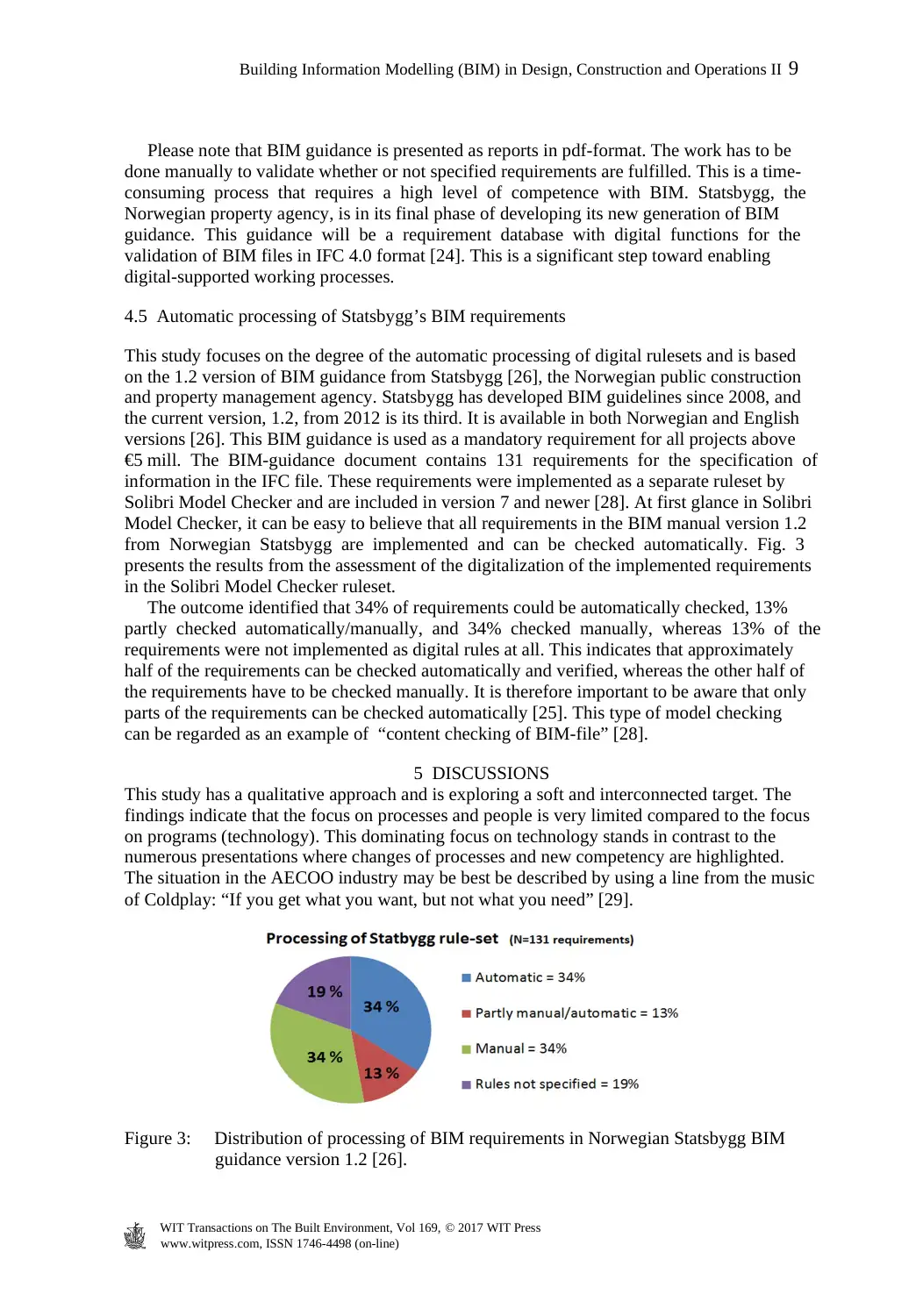
from Norwegian Statsbygg are implemented and can be checked automatically. Fig. 3
presents the results from the assessment of the digitalization of the implemented requirements
in the Solibri Model Checker ruleset.
The outcome identified that 34% of requirements could be automatically checked, 13%
partly checked automatically/manually, and 34% checked manually, whereas 13% of the
requirements were not implemented as digital rules at all. This indicates that approximately
half of the requirements can be checked automatically and verified, whereas the other half of
the requirements have to be checked manually. It is therefore important to be aware that only
parts of the requirements can be checked automatically [25]. This type of model checking
can be regarded as an example of “content checking of BIM-file” [28].
5 DISCUSSIONS
This study has a qualitative approach and is exploring a soft and interconnected target. The
findings indicate that the focus on processes and people is very limited compared to the focus
on programs (technology). This dominating focus on technology stands in contrast to the
numerous presentations where changes of processes and new competency are highlighted.
The situation in the AECOO industry may be best be described by using a line from the music
of Coldplay: “If you get what you want, but not what you need” [29].
Figure 3: Distribution of processing of BIM requirements in Norwegian Statsbygg BIM
guidance version 1.2 [26].
www.witpress.com, ISSN 1746-4498 (on-line)
WIT Transactions on The Built Environment, Vol 169, © 2017 WIT Press
Building Information Modelling (BIM) in Design, Construction and Operations II 9
done manually to validate whether or not specified requirements are fulfilled. This is a time-
consuming process that requires a high level of competence with BIM. Statsbygg, the
Norwegian property agency, is in its final phase of developing its new generation of BIM
guidance. This guidance will be a requirement database with digital functions for the
validation of BIM files in IFC 4.0 format [24]. This is a significant step toward enabling
digital-supported working processes.
4.5 Automatic processing of Statsbygg’s BIM requirements
This study focuses on the degree of the automatic processing of digital rulesets and is based
on the 1.2 version of BIM guidance from Statsbygg [26], the Norwegian public construction
and property management agency. Statsbygg has developed BIM guidelines since 2008, and
the current version, 1.2, from 2012 is its third. It is available in both Norwegian and English
versions [26]. This BIM guidance is used as a mandatory requirement for all projects above
€5 mill. The BIM-guidance document contains 131 requirements for the specification of
information in the IFC file. These requirements were implemented as a separate ruleset by
Solibri Model Checker and are included in version 7 and newer [28]. At first glance in Solibri
Model Checker, it can be easy to believe that all requirements in the BIM manual version 1.2
from Norwegian Statsbygg are implemented and can be checked automatically. Fig. 3
presents the results from the assessment of the digitalization of the implemented requirements
in the Solibri Model Checker ruleset.
The outcome identified that 34% of requirements could be automatically checked, 13%
partly checked automatically/manually, and 34% checked manually, whereas 13% of the
requirements were not implemented as digital rules at all. This indicates that approximately
half of the requirements can be checked automatically and verified, whereas the other half of
the requirements have to be checked manually. It is therefore important to be aware that only
parts of the requirements can be checked automatically [25]. This type of model checking
can be regarded as an example of “content checking of BIM-file” [28].
5 DISCUSSIONS
This study has a qualitative approach and is exploring a soft and interconnected target. The
findings indicate that the focus on processes and people is very limited compared to the focus
on programs (technology). This dominating focus on technology stands in contrast to the
numerous presentations where changes of processes and new competency are highlighted.
The situation in the AECOO industry may be best be described by using a line from the music
of Coldplay: “If you get what you want, but not what you need” [29].
Figure 3: Distribution of processing of BIM requirements in Norwegian Statsbygg BIM
guidance version 1.2 [26].
www.witpress.com, ISSN 1746-4498 (on-line)
WIT Transactions on The Built Environment, Vol 169, © 2017 WIT Press
Building Information Modelling (BIM) in Design, Construction and Operations II 9
Paraphrase This Document
Need a fresh take? Get an instant paraphrase of this document with our AI Paraphraser
Even if BIM guidance is a comprehensive document, all of the documents build on simple
modules connecting information to a task [30]. This can be further developed by connecting
exchanged or relevant information to both the role and life cycle in the project [31].
According to studies by Arayicia et al. [32], construction companies are facing barriers
and challenges with BIM adoption. There is no clear guidance or best practice study from
which they can learn and build up their capacity for BIM use to increase productivity,
efficiency, and quality; to attain competitive advantages in the global market; and to achieve
their targets in environmental sustainability [32].
There is also a limited focus on development of business models compared to solving the
technical aspects of BIM. Business models are fundamental to realizing the latent value of
new ideas or technologies. Magretta [33] described business models as “the story about how
an enterprise works,” defining who the target customers are, how the business makes money,
and what the customer values. More recent definitions include a componential perspective,
for example, the canvas model by Osterwalder et al. [34]. An article in Harvard Business
School illustrates the importance of the development of new business models by stating: “A
new model is often needed, however, to leverage a new technology is generally required
when the opportunity addresses an entirely new group of customers; and is surely in order
when an established company needs to fend off a successful disruptor” [35]. The
development of information models should therefore be supported by the development of
business models.
There is a need for monitoring the implementation of processes. The increased
use of maturity assessment criteria will in this respect be very useful. Works by Succar et
al. [36]–[38] can be used as foundations. If further studies on real implementation do not
indicate real improvements, the implementation strategy for the AECOO industry should
be challenged. Skills and plans for implementation of processes are what are missing.
Learning for other project-oriented industries, such as oil and gas, is highlighted as an
approach for the increased implementation of BIM [39]. A general experience is that
technology is just an enabler, whereas new business models or opportunities, public
regulations and standards, and a shift in market trends and the customer’s preference (e.g.
sustainability/green buildings) act as the real drivers of change.
Industry 4.0 will have a significant impact on the engineering and construction industry
in the next five years [40], challenging both technology and business models.
In this respect, the use of IDDS framework may prove invaluable [10]. IDDS is focused on
addressing complex and transformative development challenges through integrated solutions
that incorporate technology and innovation, the cross-practice delivery of solutions, and the
global sharing of knowledge and good practices.
There is a need for addressing implementation up to national or international strategies.
In this respect can the new BIM-related CEN standards under development by technical
committee TC442 – Building Information Modelling (BIM) [8] have a significant impact in
Europe. Likewise, will the implementation of the BIM-related standards from
ISO/TC59/SC13 – Organization of information about construction works [9] have an
international impact.
The AECOO industry has an “engineering” culture with a focus on quantitative factors
that can be calculated. When it comes to qualitative factors, the industry has reduced its
awareness. Even if some people agrees about importance of soft skills there is generally less
awareness about it compared to hard skills in use and development of BIM.
A joint understanding and the use of indicators for BIM processes are necessary to make
measurable deliverables similar to other project-related deliverables. This will transform the
process from having soft targets to having hard, measurable ones.
www.witpress.com, ISSN 1746-4498 (on-line)
WIT Transactions on The Built Environment, Vol 169, © 2017 WIT Press
10 Building Information Modelling (BIM) in Design, Construction and Operations II
modules connecting information to a task [30]. This can be further developed by connecting
exchanged or relevant information to both the role and life cycle in the project [31].
According to studies by Arayicia et al. [32], construction companies are facing barriers
and challenges with BIM adoption. There is no clear guidance or best practice study from
which they can learn and build up their capacity for BIM use to increase productivity,
efficiency, and quality; to attain competitive advantages in the global market; and to achieve
their targets in environmental sustainability [32].
There is also a limited focus on development of business models compared to solving the
technical aspects of BIM. Business models are fundamental to realizing the latent value of
new ideas or technologies. Magretta [33] described business models as “the story about how
an enterprise works,” defining who the target customers are, how the business makes money,
and what the customer values. More recent definitions include a componential perspective,
for example, the canvas model by Osterwalder et al. [34]. An article in Harvard Business
School illustrates the importance of the development of new business models by stating: “A
new model is often needed, however, to leverage a new technology is generally required
when the opportunity addresses an entirely new group of customers; and is surely in order
when an established company needs to fend off a successful disruptor” [35]. The
development of information models should therefore be supported by the development of
business models.
There is a need for monitoring the implementation of processes. The increased
use of maturity assessment criteria will in this respect be very useful. Works by Succar et
al. [36]–[38] can be used as foundations. If further studies on real implementation do not
indicate real improvements, the implementation strategy for the AECOO industry should
be challenged. Skills and plans for implementation of processes are what are missing.
Learning for other project-oriented industries, such as oil and gas, is highlighted as an
approach for the increased implementation of BIM [39]. A general experience is that
technology is just an enabler, whereas new business models or opportunities, public
regulations and standards, and a shift in market trends and the customer’s preference (e.g.
sustainability/green buildings) act as the real drivers of change.
Industry 4.0 will have a significant impact on the engineering and construction industry
in the next five years [40], challenging both technology and business models.
In this respect, the use of IDDS framework may prove invaluable [10]. IDDS is focused on
addressing complex and transformative development challenges through integrated solutions
that incorporate technology and innovation, the cross-practice delivery of solutions, and the
global sharing of knowledge and good practices.
There is a need for addressing implementation up to national or international strategies.
In this respect can the new BIM-related CEN standards under development by technical
committee TC442 – Building Information Modelling (BIM) [8] have a significant impact in
Europe. Likewise, will the implementation of the BIM-related standards from
ISO/TC59/SC13 – Organization of information about construction works [9] have an
international impact.
The AECOO industry has an “engineering” culture with a focus on quantitative factors
that can be calculated. When it comes to qualitative factors, the industry has reduced its
awareness. Even if some people agrees about importance of soft skills there is generally less
awareness about it compared to hard skills in use and development of BIM.
A joint understanding and the use of indicators for BIM processes are necessary to make
measurable deliverables similar to other project-related deliverables. This will transform the
process from having soft targets to having hard, measurable ones.
www.witpress.com, ISSN 1746-4498 (on-line)
WIT Transactions on The Built Environment, Vol 169, © 2017 WIT Press
10 Building Information Modelling (BIM) in Design, Construction and Operations II
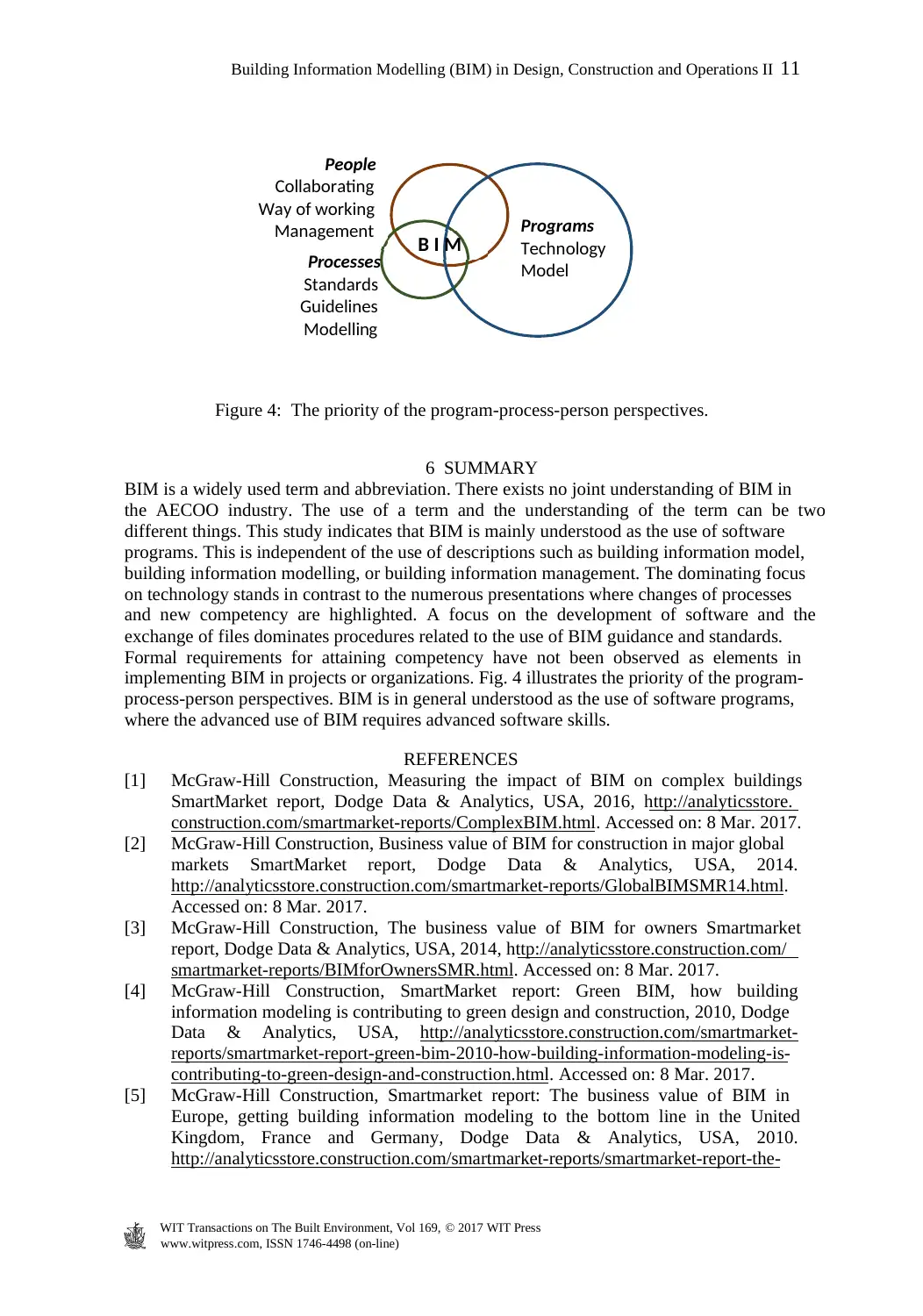
Figure 4: The priority of the program-process-person perspectives.
6 SUMMARY
BIM is a widely used term and abbreviation. There exists no joint understanding of BIM in
the AECOO industry. The use of a term and the understanding of the term can be two
different things. This study indicates that BIM is mainly understood as the use of software
programs. This is independent of the use of descriptions such as building information model,
building information modelling, or building information management. The dominating focus
on technology stands in contrast to the numerous presentations where changes of processes
and new competency are highlighted. A focus on the development of software and the
exchange of files dominates procedures related to the use of BIM guidance and standards.
Formal requirements for attaining competency have not been observed as elements in
implementing BIM in projects or organizations. Fig. 4 illustrates the priority of the program-
process-person perspectives. BIM is in general understood as the use of software programs,
where the advanced use of BIM requires advanced software skills.
REFERENCES
[1] McGraw-Hill Construction, Measuring the impact of BIM on complex buildings
SmartMarket report, Dodge Data & Analytics, USA, 2016, http://analyticsstore.
construction.com/smartmarket-reports/ComplexBIM.html. Accessed on: 8 Mar. 2017.
[2] McGraw-Hill Construction, Business value of BIM for construction in major global
markets SmartMarket report, Dodge Data & Analytics, USA, 2014.
http://analyticsstore.construction.com/smartmarket-reports/GlobalBIMSMR14.html.
Accessed on: 8 Mar. 2017.
[3] McGraw-Hill Construction, The business value of BIM for owners Smartmarket
report, Dodge Data & Analytics, USA, 2014, http://analyticsstore.construction.com/
smartmarket-reports/BIMforOwnersSMR.html. Accessed on: 8 Mar. 2017.
[4] McGraw-Hill Construction, SmartMarket report: Green BIM, how building
information modeling is contributing to green design and construction, 2010, Dodge
Data & Analytics, USA, http://analyticsstore.construction.com/smartmarket-
reports/smartmarket-report-green-bim-2010-how-building-information-modeling-is-
contributing-to-green-design-and-construction.html. Accessed on: 8 Mar. 2017.
[5] McGraw-Hill Construction, Smartmarket report: The business value of BIM in
Europe, getting building information modeling to the bottom line in the United
Kingdom, France and Germany, Dodge Data & Analytics, USA, 2010.
http://analyticsstore.construction.com/smartmarket-reports/smartmarket-report-the-
People
Collaborating
Way of working
Management
Processes
Standards
Guidelines
Modelling
B I M Programs
Technology
Model
www.witpress.com, ISSN 1746-4498 (on-line)
WIT Transactions on The Built Environment, Vol 169, © 2017 WIT Press
Building Information Modelling (BIM) in Design, Construction and Operations II 11
6 SUMMARY
BIM is a widely used term and abbreviation. There exists no joint understanding of BIM in
the AECOO industry. The use of a term and the understanding of the term can be two
different things. This study indicates that BIM is mainly understood as the use of software
programs. This is independent of the use of descriptions such as building information model,
building information modelling, or building information management. The dominating focus
on technology stands in contrast to the numerous presentations where changes of processes
and new competency are highlighted. A focus on the development of software and the
exchange of files dominates procedures related to the use of BIM guidance and standards.
Formal requirements for attaining competency have not been observed as elements in
implementing BIM in projects or organizations. Fig. 4 illustrates the priority of the program-
process-person perspectives. BIM is in general understood as the use of software programs,
where the advanced use of BIM requires advanced software skills.
REFERENCES
[1] McGraw-Hill Construction, Measuring the impact of BIM on complex buildings
SmartMarket report, Dodge Data & Analytics, USA, 2016, http://analyticsstore.
construction.com/smartmarket-reports/ComplexBIM.html. Accessed on: 8 Mar. 2017.
[2] McGraw-Hill Construction, Business value of BIM for construction in major global
markets SmartMarket report, Dodge Data & Analytics, USA, 2014.
http://analyticsstore.construction.com/smartmarket-reports/GlobalBIMSMR14.html.
Accessed on: 8 Mar. 2017.
[3] McGraw-Hill Construction, The business value of BIM for owners Smartmarket
report, Dodge Data & Analytics, USA, 2014, http://analyticsstore.construction.com/
smartmarket-reports/BIMforOwnersSMR.html. Accessed on: 8 Mar. 2017.
[4] McGraw-Hill Construction, SmartMarket report: Green BIM, how building
information modeling is contributing to green design and construction, 2010, Dodge
Data & Analytics, USA, http://analyticsstore.construction.com/smartmarket-
reports/smartmarket-report-green-bim-2010-how-building-information-modeling-is-
contributing-to-green-design-and-construction.html. Accessed on: 8 Mar. 2017.
[5] McGraw-Hill Construction, Smartmarket report: The business value of BIM in
Europe, getting building information modeling to the bottom line in the United
Kingdom, France and Germany, Dodge Data & Analytics, USA, 2010.
http://analyticsstore.construction.com/smartmarket-reports/smartmarket-report-the-
People
Collaborating
Way of working
Management
Processes
Standards
Guidelines
Modelling
B I M Programs
Technology
Model
www.witpress.com, ISSN 1746-4498 (on-line)
WIT Transactions on The Built Environment, Vol 169, © 2017 WIT Press
Building Information Modelling (BIM) in Design, Construction and Operations II 11
⊘ This is a preview!⊘
Do you want full access?
Subscribe today to unlock all pages.
Trusted by 1+ million students worldwide
business-value-of-bim-in-europe-2010-getting-building-information-modeling-to-
the-bottom-line-in-the-united-kingdom-france-and-germany.html. Accessed on: 8
Mar. 2017.
[6] Eastman, C., Teicholz, P., Sacks, R. & Liston, K., BIM Handbook: A Guide to Building
Information Modeling for Owners, Managers, Designers, Engineers and Contractors,
John Wiley & Sons, 2nd ed., 640 pp., 2011.
[7] Mordue, S., Swaddle, P. & Philp, D., BIM for Dummies, Building Information
Modeling For Dummies, John Wiley & Sons, Inc., p. 349, 2015.
[8] ISO/TC59/SC13. Organization of information about construction works, International
Organization for Standardization, https://www.iso.org/committee/49180.html.
Accessed on: 8 Mar. 2017.
[9] CEN/TC 442. Building Information Modelling (BIM), European Committee for
Standardization (CEN), https://standards.cen.eu/dyn/www/f?p=204:7:0::::FSP_ ORG
_ID:1991542&cs=16AAC0F2C377A541DCA571910561FC17F. Accessed on: 8
Mar. 2017.
[10] Owen, R. Research Roadmap Report CIB Integrated Design and Delivery Solutions
(IDDS), CIB Publication 370, International Council for Building, 2013,
http://site.cibworld.nl/dl/publications/pub_370.pdf. Accessed on: 8 Mar. 2017.
[11] International Council for Research and Innovation in Building and Construction,
International Council for Building, Integrated Design and Delivery Solutions (IDDS),
2015, http://www.cibworld.nl/site/programme/priority_themes/integrated_design_
and_delivery_solutions.html. Accessed on: 8 Mar. 2017.
[12] Bostrom, R.P. & Heinen, J.S., MIS problems and failures: A socio-technical
perspective. MIS Quarterly, 1(3), pp. 17–32, 1977. http://misq.org/cat-articles/mis-
problems-and-failiures-a-socio-technical-perspective-part-i-the-causes.html
[13] Skibniewski, M.J. (Editor-in-Chief), Automation in Construction, An International
Research Journal, Elsevier B.V., https://www.journals.elsevier.com/ automation-in-
construction/. Accessed on: 8 Mar. 2017.
[14] buildingSMART Norway, bsN Newsletter, https://buildingsmart.no/nyhetsbrev/.
Accessed on: 8 Mar. 2017.
[15] ISO 15686-4:2014. Building Construction. Service Life Planning. Service Life
Planning using Building Information Modelling, International Organization for
Standardization, https://www.iso.org/standard/59150.html. Accessed on: 8 Mar. 2017.
[16] ISO 16354:2013. Guidelines for knowledge libraries and object libraries, Organization
for Standardization, https://www.iso.org/standard/56434.html. Accessed on: 8 Mar.
2017.
[17] ISO 29481-2:2012. Building information models. Information delivery manual. Part
2, Interaction framework, https://www.iso.org/standard/55691.html. Accessed on: 8
Mar. 2017.
[18] ISO/TS 12911:2012. Framework for building information modelling (BIM) guidance,
Organization for Standardization, https://www.iso.org/standard/52155.html. Accessed
on: 8 Mar. 2017.
[19] ISO 29481-1:2016. Building information modelling. Information delivery manual –
Part 1: Methodology and format, Organization for Standardization,
https://www.iso.org/standard/60553.html. Accessed on: 8 Mar. 2017.
[20] ISO 22263:2008. Organization of information about construction works. Framework
for management of project information, https://www.iso.org/standard/40835.html.
Accessed on: 8 Mar. 2017.
www.witpress.com, ISSN 1746-4498 (on-line)
WIT Transactions on The Built Environment, Vol 169, © 2017 WIT Press
12 Building Information Modelling (BIM) in Design, Construction and Operations II
the-bottom-line-in-the-united-kingdom-france-and-germany.html. Accessed on: 8
Mar. 2017.
[6] Eastman, C., Teicholz, P., Sacks, R. & Liston, K., BIM Handbook: A Guide to Building
Information Modeling for Owners, Managers, Designers, Engineers and Contractors,
John Wiley & Sons, 2nd ed., 640 pp., 2011.
[7] Mordue, S., Swaddle, P. & Philp, D., BIM for Dummies, Building Information
Modeling For Dummies, John Wiley & Sons, Inc., p. 349, 2015.
[8] ISO/TC59/SC13. Organization of information about construction works, International
Organization for Standardization, https://www.iso.org/committee/49180.html.
Accessed on: 8 Mar. 2017.
[9] CEN/TC 442. Building Information Modelling (BIM), European Committee for
Standardization (CEN), https://standards.cen.eu/dyn/www/f?p=204:7:0::::FSP_ ORG
_ID:1991542&cs=16AAC0F2C377A541DCA571910561FC17F. Accessed on: 8
Mar. 2017.
[10] Owen, R. Research Roadmap Report CIB Integrated Design and Delivery Solutions
(IDDS), CIB Publication 370, International Council for Building, 2013,
http://site.cibworld.nl/dl/publications/pub_370.pdf. Accessed on: 8 Mar. 2017.
[11] International Council for Research and Innovation in Building and Construction,
International Council for Building, Integrated Design and Delivery Solutions (IDDS),
2015, http://www.cibworld.nl/site/programme/priority_themes/integrated_design_
and_delivery_solutions.html. Accessed on: 8 Mar. 2017.
[12] Bostrom, R.P. & Heinen, J.S., MIS problems and failures: A socio-technical
perspective. MIS Quarterly, 1(3), pp. 17–32, 1977. http://misq.org/cat-articles/mis-
problems-and-failiures-a-socio-technical-perspective-part-i-the-causes.html
[13] Skibniewski, M.J. (Editor-in-Chief), Automation in Construction, An International
Research Journal, Elsevier B.V., https://www.journals.elsevier.com/ automation-in-
construction/. Accessed on: 8 Mar. 2017.
[14] buildingSMART Norway, bsN Newsletter, https://buildingsmart.no/nyhetsbrev/.
Accessed on: 8 Mar. 2017.
[15] ISO 15686-4:2014. Building Construction. Service Life Planning. Service Life
Planning using Building Information Modelling, International Organization for
Standardization, https://www.iso.org/standard/59150.html. Accessed on: 8 Mar. 2017.
[16] ISO 16354:2013. Guidelines for knowledge libraries and object libraries, Organization
for Standardization, https://www.iso.org/standard/56434.html. Accessed on: 8 Mar.
2017.
[17] ISO 29481-2:2012. Building information models. Information delivery manual. Part
2, Interaction framework, https://www.iso.org/standard/55691.html. Accessed on: 8
Mar. 2017.
[18] ISO/TS 12911:2012. Framework for building information modelling (BIM) guidance,
Organization for Standardization, https://www.iso.org/standard/52155.html. Accessed
on: 8 Mar. 2017.
[19] ISO 29481-1:2016. Building information modelling. Information delivery manual –
Part 1: Methodology and format, Organization for Standardization,
https://www.iso.org/standard/60553.html. Accessed on: 8 Mar. 2017.
[20] ISO 22263:2008. Organization of information about construction works. Framework
for management of project information, https://www.iso.org/standard/40835.html.
Accessed on: 8 Mar. 2017.
www.witpress.com, ISSN 1746-4498 (on-line)
WIT Transactions on The Built Environment, Vol 169, © 2017 WIT Press
12 Building Information Modelling (BIM) in Design, Construction and Operations II
Paraphrase This Document
Need a fresh take? Get an instant paraphrase of this document with our AI Paraphraser
[21] ISO 12006-3:2007. Building construction. Organization of information about
construction works. Framework for object-oriented information, Organization for
Standardization, https://www.iso.org/standard/38706.html. Accessed on: 8 Mar. 2017.
[22] ISO 16739:2013. Industry Foundation Classes (IFC) for data sharing in the
construction and facility management industries, Organization for Standardization,
https://www.iso.org/standard/51622.html. Accessed on: 8 Mar. 2017.
[23] ISO 12006-2:2015. Building construction. Organization of information about
construction works. Framework for classification of information, Organization for
Standardization, https://www.iso.org/standard/61753.html. Accessed on: 8 Mar. 2017.
[24] Haug, D. (Project Manager, Agency for Public Management and eGovernment (Difi)
Oslo), Statsbygg BIM Manual 2.0. Presented 6 Sep. 2016. https://www.difi.no/
sites/difino/files/statsbygg_0.pdf. Accessed on: 8 Mar. 2017.
[25] Hjelseth, E., BIM-based Model Checking (BMC), Building Information Modeling:
Applications and Practices in the AEC Industry, American Society of Civil Engineer,
pp. 33–61, 2015. http://ascelibrary.org/doi/10.1061/9780784413982.ch02
[26] Statsbygg BIM Guideline 1.2.1 (Statsbygg Building Information Modeling Guideline),
English version, 2011, http://www.statsbygg.no/Files/publikasjoner/manualer/
Statsbygg BIM-manual-ver1-2-1eng-2013-12-17.pdf. Accessed on: 5 Mar. 2017.
[27] Solibri Model Checker, 2017, https://www.solibri.com/products/solibri-model-
checker/. Accessed on: 8 Mar. 2017.
[28] Hjelseth, E., Classification of BIM-based model checking concepts. ITcon, 21,
pp. 354–369, 2016. http://www.itcon.org/2016/23 ISSN 1874-4753 .
[29] Martin, C.A.J., Berryman, G.R., Buckland, J.M. & Champion, W., Coldplay, Fix you,
2015, http://www.me2015)trolyrics.com/fix-you-lyrics-coldplay.html. Accessed on: 8
Mar. 2017.
[30] Hjelseth, E., Modular BIM guidelines. CIB-W078 Conference, Sophia-Antipolis,
France, 23–26 Oct. 2011, http://2011-cibw078-w102.cstb.fr/index.html
[31] Hjelseth, E., Exchange of relevant information in BIM objects defined by the role- and
life-cycle information model. Architectural Engineering and Design Management,
Special Issue: Integrated Design and Delivery Solutions, (9), pp. 279–287, 2010.
[32] Arayicia, Y., Coatesa, P., Koskelaa, L., Kagiogloua, M., Usherb, C. & O’Reilly, K.,
Technology adoption in the BIM implementation for lean architectural practice.
Automation in Construction, 20(2), pp. 189–195, 2011. http://dx.doi.org/10.1016/
j.autcon.2010.09.016. Accessed on: 8 Mar. 2017.
[33] Magretta, J., Why business models matter. Harvard Business Review, May 2002,
Business School Publishing, USA, 2002, https://hbr.org/2002/05/why-business-
models-matter. Accessed on: 8 Mar. 2017.
[34] Osterwalder, A., Pigneur, Y. & Tucci, C.L., Clarifying Business Models: Origins,
Present and Future of the Concept, Communication of the Association for Information
Science (CAIS), 2005.
[35] Johnson, M.W., Christensen, C.M. & Kagermann, H., Reinventing. Your Business
Model, Harvard Business School Review, Dec. 2008, Business School Publishing,
USA, 2008. https://hbr.org/2008/12/reinventing-your-business-model. Accessed on: 8
Mar. 2017.
[36] Succar, B., Sher, W. & Williams, A., Measuring BIM performance: Five metrics.
Architectural Engineering and Design Management, 8(2), pp. 120–142, 2012.
http://dx.doi.org/10.1080/17452007.2012.659506
www.witpress.com, ISSN 1746-4498 (on-line)
WIT Transactions on The Built Environment, Vol 169, © 2017 WIT Press
Building Information Modelling (BIM) in Design, Construction and Operations II 13
construction works. Framework for object-oriented information, Organization for
Standardization, https://www.iso.org/standard/38706.html. Accessed on: 8 Mar. 2017.
[22] ISO 16739:2013. Industry Foundation Classes (IFC) for data sharing in the
construction and facility management industries, Organization for Standardization,
https://www.iso.org/standard/51622.html. Accessed on: 8 Mar. 2017.
[23] ISO 12006-2:2015. Building construction. Organization of information about
construction works. Framework for classification of information, Organization for
Standardization, https://www.iso.org/standard/61753.html. Accessed on: 8 Mar. 2017.
[24] Haug, D. (Project Manager, Agency for Public Management and eGovernment (Difi)
Oslo), Statsbygg BIM Manual 2.0. Presented 6 Sep. 2016. https://www.difi.no/
sites/difino/files/statsbygg_0.pdf. Accessed on: 8 Mar. 2017.
[25] Hjelseth, E., BIM-based Model Checking (BMC), Building Information Modeling:
Applications and Practices in the AEC Industry, American Society of Civil Engineer,
pp. 33–61, 2015. http://ascelibrary.org/doi/10.1061/9780784413982.ch02
[26] Statsbygg BIM Guideline 1.2.1 (Statsbygg Building Information Modeling Guideline),
English version, 2011, http://www.statsbygg.no/Files/publikasjoner/manualer/
Statsbygg BIM-manual-ver1-2-1eng-2013-12-17.pdf. Accessed on: 5 Mar. 2017.
[27] Solibri Model Checker, 2017, https://www.solibri.com/products/solibri-model-
checker/. Accessed on: 8 Mar. 2017.
[28] Hjelseth, E., Classification of BIM-based model checking concepts. ITcon, 21,
pp. 354–369, 2016. http://www.itcon.org/2016/23 ISSN 1874-4753 .
[29] Martin, C.A.J., Berryman, G.R., Buckland, J.M. & Champion, W., Coldplay, Fix you,
2015, http://www.me2015)trolyrics.com/fix-you-lyrics-coldplay.html. Accessed on: 8
Mar. 2017.
[30] Hjelseth, E., Modular BIM guidelines. CIB-W078 Conference, Sophia-Antipolis,
France, 23–26 Oct. 2011, http://2011-cibw078-w102.cstb.fr/index.html
[31] Hjelseth, E., Exchange of relevant information in BIM objects defined by the role- and
life-cycle information model. Architectural Engineering and Design Management,
Special Issue: Integrated Design and Delivery Solutions, (9), pp. 279–287, 2010.
[32] Arayicia, Y., Coatesa, P., Koskelaa, L., Kagiogloua, M., Usherb, C. & O’Reilly, K.,
Technology adoption in the BIM implementation for lean architectural practice.
Automation in Construction, 20(2), pp. 189–195, 2011. http://dx.doi.org/10.1016/
j.autcon.2010.09.016. Accessed on: 8 Mar. 2017.
[33] Magretta, J., Why business models matter. Harvard Business Review, May 2002,
Business School Publishing, USA, 2002, https://hbr.org/2002/05/why-business-
models-matter. Accessed on: 8 Mar. 2017.
[34] Osterwalder, A., Pigneur, Y. & Tucci, C.L., Clarifying Business Models: Origins,
Present and Future of the Concept, Communication of the Association for Information
Science (CAIS), 2005.
[35] Johnson, M.W., Christensen, C.M. & Kagermann, H., Reinventing. Your Business
Model, Harvard Business School Review, Dec. 2008, Business School Publishing,
USA, 2008. https://hbr.org/2008/12/reinventing-your-business-model. Accessed on: 8
Mar. 2017.
[36] Succar, B., Sher, W. & Williams, A., Measuring BIM performance: Five metrics.
Architectural Engineering and Design Management, 8(2), pp. 120–142, 2012.
http://dx.doi.org/10.1080/17452007.2012.659506
www.witpress.com, ISSN 1746-4498 (on-line)
WIT Transactions on The Built Environment, Vol 169, © 2017 WIT Press
Building Information Modelling (BIM) in Design, Construction and Operations II 13
[37] Succar, B., Sher, W. & Williams, A., An integrated approach to BIM competency
assessment, acquisition and application. Automation in Construction, 35, pp. 174–189,
2013. http://dx.doi.org/10.1016/j.autcon.2013.05.016
[38] Succar, B., The difference between BIM capability and BIM maturity,
BIM ThinkSpace Blog, 2009, http://www.bimthinkspace.com/2009/06/index.html.
Accessed on: 5 Mar. 2017.
[39] Mejlænder-Larsen, Ø., Generalising via the case studies and adapting the oil and gas
industry’s project execution concepts to the construction industry. Procedia
Economics and Finance, 21, pp. 271–278, 2015.
[40] Industry 4.0: Building the digital enterprise: Engineering and construction key
findings, PwC Global Industry 4.0 Survey – Industry key findings, 2016,
http://www.pwc.com/gx/en/engineering-construction/publications/industry-4.0-
engineering-and-construction-key-findings.pdf. Accessed on: 18 Mar. 2017.
www.witpress.com, ISSN 1746-4498 (on-line)
WIT Transactions on The Built Environment, Vol 169, © 2017 WIT Press
14 Building Information Modelling (BIM) in Design, Construction and Operations II
assessment, acquisition and application. Automation in Construction, 35, pp. 174–189,
2013. http://dx.doi.org/10.1016/j.autcon.2013.05.016
[38] Succar, B., The difference between BIM capability and BIM maturity,
BIM ThinkSpace Blog, 2009, http://www.bimthinkspace.com/2009/06/index.html.
Accessed on: 5 Mar. 2017.
[39] Mejlænder-Larsen, Ø., Generalising via the case studies and adapting the oil and gas
industry’s project execution concepts to the construction industry. Procedia
Economics and Finance, 21, pp. 271–278, 2015.
[40] Industry 4.0: Building the digital enterprise: Engineering and construction key
findings, PwC Global Industry 4.0 Survey – Industry key findings, 2016,
http://www.pwc.com/gx/en/engineering-construction/publications/industry-4.0-
engineering-and-construction-key-findings.pdf. Accessed on: 18 Mar. 2017.
www.witpress.com, ISSN 1746-4498 (on-line)
WIT Transactions on The Built Environment, Vol 169, © 2017 WIT Press
14 Building Information Modelling (BIM) in Design, Construction and Operations II
⊘ This is a preview!⊘
Do you want full access?
Subscribe today to unlock all pages.
Trusted by 1+ million students worldwide

1 out of 12


Related Documents


Your All-in-One AI-Powered Toolkit for Academic Success.
+13062052269
info@desklib.com
Available 24*7 on WhatsApp / Email
![[object Object]](/_next/static/media/star-bottom.7253800d.svg)
Unlock your academic potential
Copyright © 2020–2026 A2Z Services. All Rights Reserved. Developed and managed by ZUCOL.