Framework for Recycling Building Material Waste During Demolition
VerifiedAdded on 2021/04/17
|22
|4998
|29
Report
AI Summary
This report delves into the critical topic of recycling building material waste during demolition, addressing the growing concerns of waste management and environmental sustainability. The report begins by establishing the research background, outlining the research questions, aims, and objectives, and defining the scope and boundaries of the study. It then details the research methodology, including the research philosophy, approach, and design, as well as the data collection and analysis methods employed. A comprehensive literature review follows, providing an overview of waste and its recycling, focusing on construction and demolition waste, drivers, and barriers to recycling, and the development of a framework to improve recycling practices. The framework includes setting goals for the recovery system, exploring collection methods (kerbside, bring systems), and discussing the implementation of the process. The report also examines the current status of waste generation, practices followed in recycling building waste, barriers to recycling, and potential solutions. The report concludes with data analysis, research gaps, and a conclusion summarizing the key findings and recommendations for future research. The report emphasizes the importance of recycling in reducing landfill space, minimizing project expenses, and promoting sustainable construction practices.
Running head: RECYCLING OF BUILDING MATERIAL WASTE DURING DEMOLITION
Recycling of building material waste during demolition
Name of the Student:
Name of the University:
Author note:
Recycling of building material waste during demolition
Name of the Student:
Name of the University:
Author note:

Paraphrase This Document
Need a fresh take? Get an instant paraphrase of this document with our AI Paraphraser
2RECYCLING OF BUILDING MATERIAL WASTE DURING DEMOLITION
Table of Contents
Chapter 1: Introduction....................................................................................................................4
1.1 Research background.............................................................................................................4
1.2 Research questions.................................................................................................................4
1.3 Research aim..........................................................................................................................4
1.4 Research objectives...............................................................................................................4
1.5 Research scope and boundaries.............................................................................................5
2. Research Methodology................................................................................................................5
2.1 Research philosophy:.............................................................................................................5
2.2 Research approach:................................................................................................................6
2.3 Research design:....................................................................................................................6
2.4 Data collection and analysis..................................................................................................6
3. Research diagram.........................................................................................................................7
4. Literature review..........................................................................................................................7
4.1 Overview of waste and its recycling......................................................................................7
4.2 Construction and demolition waste.......................................................................................8
4.3 Drivers and barriers...............................................................................................................9
4.4 Development of framework to improve recycling practices of construction/ demolition
waste............................................................................................................................................9
4.4.1 Setting goals of the recovery system................................................................................10
4.4.2 Collection methods...........................................................................................................10
4.4.3 Kerbside collection system...............................................................................................10
4.4.4 Bring system.....................................................................................................................11
4.5 Implementation of the process.............................................................................................11
4.6 Current status of waste generation.......................................................................................11
4.7 Practices followed in recycling the building waste.............................................................12
4.8 Barriers of recycling............................................................................................................13
4.9 Solutions for recycling the Construction/ demolition waste................................................14
5. Research gap..............................................................................................................................15
6. Data analysis..............................................................................................................................15
7. Conclusion.................................................................................................................................16
8. Research scope and boundaries.................................................................................................17
References......................................................................................................................................18
Table of Contents
Chapter 1: Introduction....................................................................................................................4
1.1 Research background.............................................................................................................4
1.2 Research questions.................................................................................................................4
1.3 Research aim..........................................................................................................................4
1.4 Research objectives...............................................................................................................4
1.5 Research scope and boundaries.............................................................................................5
2. Research Methodology................................................................................................................5
2.1 Research philosophy:.............................................................................................................5
2.2 Research approach:................................................................................................................6
2.3 Research design:....................................................................................................................6
2.4 Data collection and analysis..................................................................................................6
3. Research diagram.........................................................................................................................7
4. Literature review..........................................................................................................................7
4.1 Overview of waste and its recycling......................................................................................7
4.2 Construction and demolition waste.......................................................................................8
4.3 Drivers and barriers...............................................................................................................9
4.4 Development of framework to improve recycling practices of construction/ demolition
waste............................................................................................................................................9
4.4.1 Setting goals of the recovery system................................................................................10
4.4.2 Collection methods...........................................................................................................10
4.4.3 Kerbside collection system...............................................................................................10
4.4.4 Bring system.....................................................................................................................11
4.5 Implementation of the process.............................................................................................11
4.6 Current status of waste generation.......................................................................................11
4.7 Practices followed in recycling the building waste.............................................................12
4.8 Barriers of recycling............................................................................................................13
4.9 Solutions for recycling the Construction/ demolition waste................................................14
5. Research gap..............................................................................................................................15
6. Data analysis..............................................................................................................................15
7. Conclusion.................................................................................................................................16
8. Research scope and boundaries.................................................................................................17
References......................................................................................................................................18

3RECYCLING OF BUILDING MATERIAL WASTE DURING DEMOLITION
⊘ This is a preview!⊘
Do you want full access?
Subscribe today to unlock all pages.

Trusted by 1+ million students worldwide
4RECYCLING OF BUILDING MATERIAL WASTE DURING DEMOLITION
Chapter 1: Introduction
1.1 Research background
The impact of recycling efforts on the demolition becomes important for having several
advantages such as reducing tippage and associated freight charges and reduction of landfill
space needed for concrete debris. Construction and demolition waste is considered as central
element of solid waste stream. It is amounting to nearly 25% of total solid waste nationally
(Gomathi and Pradeep 2017). On the other hand, there are 70% of construction and demolition
material before recycling encompassed. With the pressure of land fields continuing to mount, the
diversion of materials and concrete remain a significant area of interest to the policymakers.
Hence, it is important to evaluate recycling of building material waste during demolition.
1.2 Research questions
The research questions can be listed as followed.
What are the benefits of recycling of building material waste during demolition?
What is the best suited building materials used during demolition?
What is the best demolition practices for future?
1.3 Research aim
The research aims to development of framework to improve recycling practices of
construction/ demolition waste.
1.4 Research objectives
The research objectives are followed.
Chapter 1: Introduction
1.1 Research background
The impact of recycling efforts on the demolition becomes important for having several
advantages such as reducing tippage and associated freight charges and reduction of landfill
space needed for concrete debris. Construction and demolition waste is considered as central
element of solid waste stream. It is amounting to nearly 25% of total solid waste nationally
(Gomathi and Pradeep 2017). On the other hand, there are 70% of construction and demolition
material before recycling encompassed. With the pressure of land fields continuing to mount, the
diversion of materials and concrete remain a significant area of interest to the policymakers.
Hence, it is important to evaluate recycling of building material waste during demolition.
1.2 Research questions
The research questions can be listed as followed.
What are the benefits of recycling of building material waste during demolition?
What is the best suited building materials used during demolition?
What is the best demolition practices for future?
1.3 Research aim
The research aims to development of framework to improve recycling practices of
construction/ demolition waste.
1.4 Research objectives
The research objectives are followed.
Paraphrase This Document
Need a fresh take? Get an instant paraphrase of this document with our AI Paraphraser
5RECYCLING OF BUILDING MATERIAL WASTE DURING DEMOLITION
To develop framework to improve recycling practices of construction/ demolition
waste
To critically analyze the advantages of recycling and reused of demolished
building materials
To identify the materials best suited for reuse or recycle
To recommend best practices for demolition in future
1.5 Research scope and boundaries
The research will be helpful to identify the best demolition practices by using solid waste
management technique. It can minimize overall building project expenses by avoiding purchase
or disposal costs along with donation of recovered materials to the qualified charities. In
addition, the research will be helpful for being used as secondary sources of the study.
2. Research Methodology
Selection of methodological tools is useful for conduction of the research in proper way.
Below are the selections of methodological tools to frame effective research methodology for the
research.
2.1 Research philosophy:
Lewis (2015) stated that positivism, interpritivism and realism are the types of research
philosophy. It is a belief about the ways in which data regarding a phenomenon need to be
collected, analyzed as well as used. In the research, positivism philosophy is selected as it is
helpful in the present context and assists in better analysis of the hidden facts along with
To develop framework to improve recycling practices of construction/ demolition
waste
To critically analyze the advantages of recycling and reused of demolished
building materials
To identify the materials best suited for reuse or recycle
To recommend best practices for demolition in future
1.5 Research scope and boundaries
The research will be helpful to identify the best demolition practices by using solid waste
management technique. It can minimize overall building project expenses by avoiding purchase
or disposal costs along with donation of recovered materials to the qualified charities. In
addition, the research will be helpful for being used as secondary sources of the study.
2. Research Methodology
Selection of methodological tools is useful for conduction of the research in proper way.
Below are the selections of methodological tools to frame effective research methodology for the
research.
2.1 Research philosophy:
Lewis (2015) stated that positivism, interpritivism and realism are the types of research
philosophy. It is a belief about the ways in which data regarding a phenomenon need to be
collected, analyzed as well as used. In the research, positivism philosophy is selected as it is
helpful in the present context and assists in better analysis of the hidden facts along with
6RECYCLING OF BUILDING MATERIAL WASTE DURING DEMOLITION
information regarding recycling of building material waste during demolition. Moreover, it
assists in generation proper results by reducing errors in the research.
2.2 Research approach:
Selection of appropriate research approach is helpful to revealing the format of the
research. A research topic is undertaken for studying into two broader ways like inductive and
deductive research approach (Vaioleti 2016). In the current context, deductive research is
followed as theories and information related to recycling of building material waste during
demolition are analyzed in the research. On the other hand, as the aim of the study is not
inducing theory and model related to the research topic, inductive approach is discarded in the
current research.
2.3 Research design:
Research design assists in describing the research framework, which will be helpful for
selecting the analysis pattern of the research. Descriptive, exploratory and explanatory research
design are the types of research designs selected in academic research. In the present case,
descriptive research design is used for defining detailed procedure engaged in the application of
recycling of building material waste during demolition.
2.4 Data collection and analysis
There are two types of data collection used in research such as primary data collection
and secondary data collection. In the present research, secondary data collection method is
followed for collecting data for the research. The sources like books, journals, websites and
books are used as secondary data sources. Qualitative data analysis method is followed for
analyzing data gathered related to recycling of building material waste during demolition.
information regarding recycling of building material waste during demolition. Moreover, it
assists in generation proper results by reducing errors in the research.
2.2 Research approach:
Selection of appropriate research approach is helpful to revealing the format of the
research. A research topic is undertaken for studying into two broader ways like inductive and
deductive research approach (Vaioleti 2016). In the current context, deductive research is
followed as theories and information related to recycling of building material waste during
demolition are analyzed in the research. On the other hand, as the aim of the study is not
inducing theory and model related to the research topic, inductive approach is discarded in the
current research.
2.3 Research design:
Research design assists in describing the research framework, which will be helpful for
selecting the analysis pattern of the research. Descriptive, exploratory and explanatory research
design are the types of research designs selected in academic research. In the present case,
descriptive research design is used for defining detailed procedure engaged in the application of
recycling of building material waste during demolition.
2.4 Data collection and analysis
There are two types of data collection used in research such as primary data collection
and secondary data collection. In the present research, secondary data collection method is
followed for collecting data for the research. The sources like books, journals, websites and
books are used as secondary data sources. Qualitative data analysis method is followed for
analyzing data gathered related to recycling of building material waste during demolition.
⊘ This is a preview!⊘
Do you want full access?
Subscribe today to unlock all pages.
Trusted by 1+ million students worldwide
7RECYCLING OF BUILDING MATERIAL WASTE DURING DEMOLITION
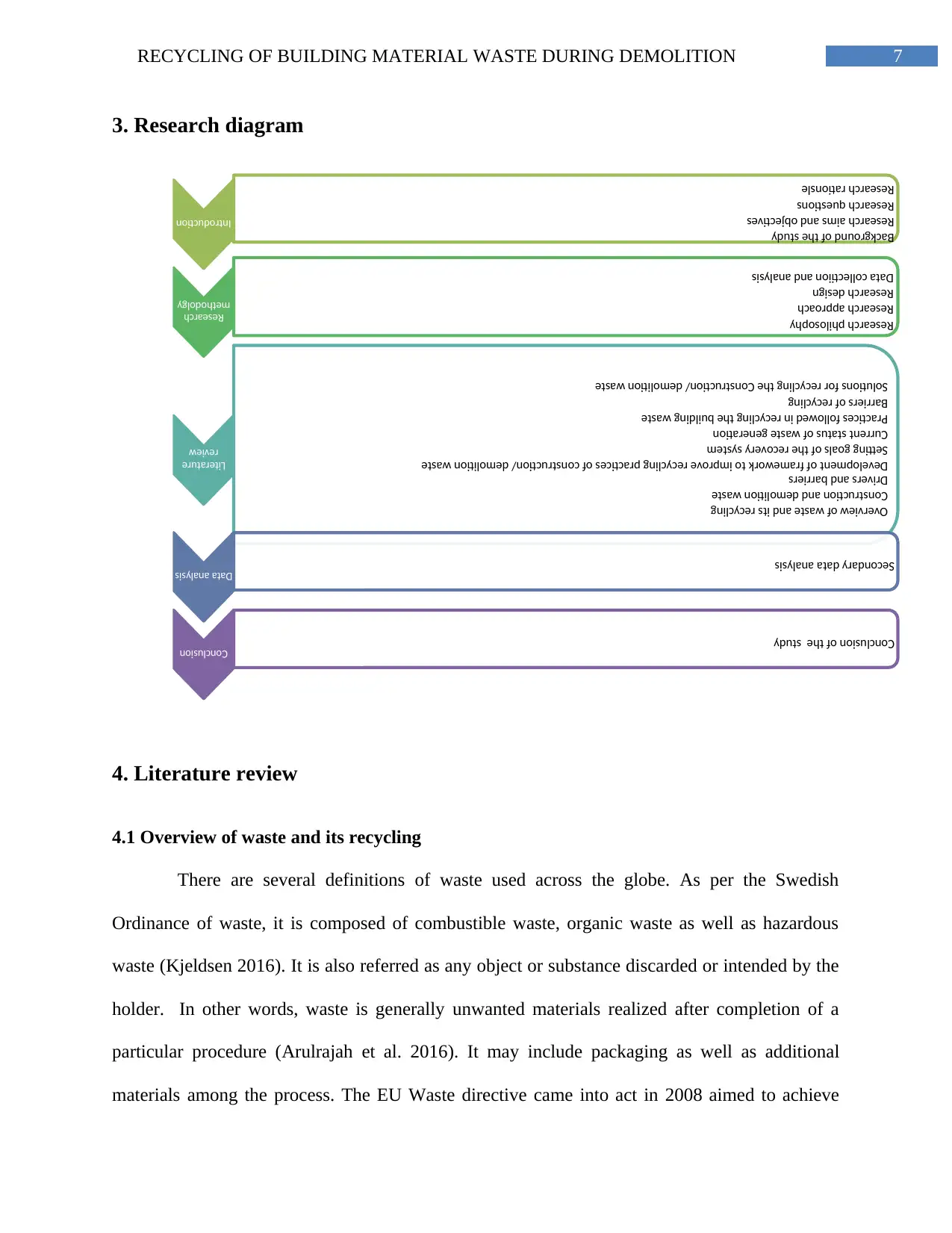
3. Research diagram
4. Literature review
4.1 Overview of waste and its recycling
There are several definitions of waste used across the globe. As per the Swedish
Ordinance of waste, it is composed of combustible waste, organic waste as well as hazardous
waste (Kjeldsen 2016). It is also referred as any object or substance discarded or intended by the
holder. In other words, waste is generally unwanted materials realized after completion of a
particular procedure (Arulrajah et al. 2016). It may include packaging as well as additional
materials among the process. The EU Waste directive came into act in 2008 aimed to achieve
Introduction
Background of the study
Research aims and objectives
Research questions
Research rationsle
Research
methodolgy
Research philosophy
Research approach
Research design
Data collectiion and analysis
Literature
review
Overview of waste and its recycling
Construction and demolition waste
Drivers and barriers
Development of framework to improve recycling practices of construction/ demolition waste
Setting goals of the recovery system
Current status of waste generation
Practices followed in recycling the building waste
Barriers of recycling
Solutions for recycling the Construction/ demolition waste
Data analysis
Secondary data analysis
Conclusion
Conclusion of the study
3. Research diagram
4. Literature review
4.1 Overview of waste and its recycling
There are several definitions of waste used across the globe. As per the Swedish
Ordinance of waste, it is composed of combustible waste, organic waste as well as hazardous
waste (Kjeldsen 2016). It is also referred as any object or substance discarded or intended by the
holder. In other words, waste is generally unwanted materials realized after completion of a
particular procedure (Arulrajah et al. 2016). It may include packaging as well as additional
materials among the process. The EU Waste directive came into act in 2008 aimed to achieve
Introduction
Background of the study
Research aims and objectives
Research questions
Research rationsle
Research
methodolgy
Research philosophy
Research approach
Research design
Data collectiion and analysis
Literature
review
Overview of waste and its recycling
Construction and demolition waste
Drivers and barriers
Development of framework to improve recycling practices of construction/ demolition waste
Setting goals of the recovery system
Current status of waste generation
Practices followed in recycling the building waste
Barriers of recycling
Solutions for recycling the Construction/ demolition waste
Data analysis
Secondary data analysis
Conclusion
Conclusion of the study
Paraphrase This Document
Need a fresh take? Get an instant paraphrase of this document with our AI Paraphraser
8RECYCLING OF BUILDING MATERIAL WASTE DURING DEMOLITION
greater resource efficiency (Vegas et al. 2015). It is designed in order to assist the member states
promoting better resource use as well as turn minimization of environmental impact. The
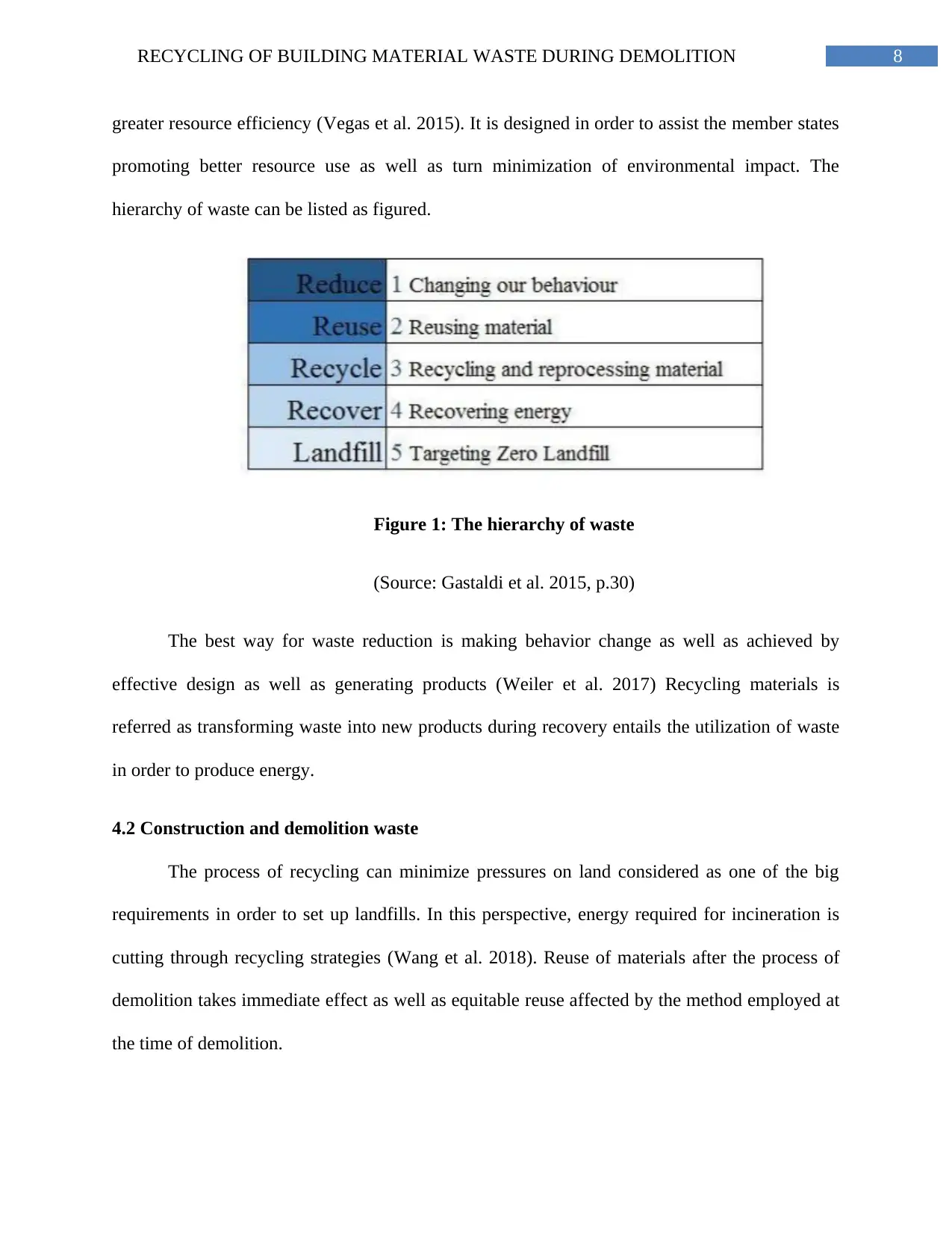
hierarchy of waste can be listed as figured.
Figure 1: The hierarchy of waste
(Source: Gastaldi et al. 2015, p.30)
The best way for waste reduction is making behavior change as well as achieved by
effective design as well as generating products (Weiler et al. 2017) Recycling materials is
referred as transforming waste into new products during recovery entails the utilization of waste
in order to produce energy.
4.2 Construction and demolition waste
The process of recycling can minimize pressures on land considered as one of the big
requirements in order to set up landfills. In this perspective, energy required for incineration is
cutting through recycling strategies (Wang et al. 2018). Reuse of materials after the process of
demolition takes immediate effect as well as equitable reuse affected by the method employed at
the time of demolition.
greater resource efficiency (Vegas et al. 2015). It is designed in order to assist the member states
promoting better resource use as well as turn minimization of environmental impact. The
hierarchy of waste can be listed as figured.
Figure 1: The hierarchy of waste
(Source: Gastaldi et al. 2015, p.30)
The best way for waste reduction is making behavior change as well as achieved by
effective design as well as generating products (Weiler et al. 2017) Recycling materials is
referred as transforming waste into new products during recovery entails the utilization of waste
in order to produce energy.
4.2 Construction and demolition waste
The process of recycling can minimize pressures on land considered as one of the big
requirements in order to set up landfills. In this perspective, energy required for incineration is
cutting through recycling strategies (Wang et al. 2018). Reuse of materials after the process of
demolition takes immediate effect as well as equitable reuse affected by the method employed at
the time of demolition.
9RECYCLING OF BUILDING MATERIAL WASTE DURING DEMOLITION
4.3 Drivers and barriers
C&D waste recycling is influenced by multiple factors. Perception of public as well as
acceptance is varied among several stakeholders. For an example, one of the major barriers to the
process of recycling reduce land filling. The factors for increasing legislation and EU recovery is
targeted where the EU recovery targets prefer recycling of high density waste types during the
latest impact on the environment (Ossa et al. 2016). However, they do not consider as the most
sustainable recovery operations. The resources are required for supervision through authorities’
limitation. Data on CDW are generated for reuse and inadequate. Thus, collection of data as well
as challenging new methods applied in the process. The stakeholders lead to face several
challenges for waste management and prevention varies in waste prevention program. However,
lack of quality control guidelines as well as data on technical properties of waste is lacking (Wu
et al. 2014). The regional aspects of waste are sparsely populated with the regions and generally
worthy for the advanced recycling process.
4.4 Development of framework to improve recycling practices of construction/ demolition
waste
Construction and demolition waste occupies as the latest share of overall waste
generation in several countries. On the other hand, waste management practices as well as
outcome may be differed in various countries. It is important to develop effective framework that
will be helpful to enhance recycling practices of construction or demolition waste (Gomathi and
Pradeep 2017). The main of the strategy is to develop community-based approach to enhance
recycling practices of construction waste. By encouraging responsibility of producer of waste, a
grater option of the land filling water waste. It generally ends up at the dumpsites, which can be
recovered efficiently at low cost (Martínez et al. 2016). The program will be helpful to seek
4.3 Drivers and barriers
C&D waste recycling is influenced by multiple factors. Perception of public as well as
acceptance is varied among several stakeholders. For an example, one of the major barriers to the
process of recycling reduce land filling. The factors for increasing legislation and EU recovery is
targeted where the EU recovery targets prefer recycling of high density waste types during the
latest impact on the environment (Ossa et al. 2016). However, they do not consider as the most
sustainable recovery operations. The resources are required for supervision through authorities’
limitation. Data on CDW are generated for reuse and inadequate. Thus, collection of data as well
as challenging new methods applied in the process. The stakeholders lead to face several
challenges for waste management and prevention varies in waste prevention program. However,
lack of quality control guidelines as well as data on technical properties of waste is lacking (Wu
et al. 2014). The regional aspects of waste are sparsely populated with the regions and generally
worthy for the advanced recycling process.
4.4 Development of framework to improve recycling practices of construction/ demolition
waste
Construction and demolition waste occupies as the latest share of overall waste
generation in several countries. On the other hand, waste management practices as well as
outcome may be differed in various countries. It is important to develop effective framework that
will be helpful to enhance recycling practices of construction or demolition waste (Gomathi and
Pradeep 2017). The main of the strategy is to develop community-based approach to enhance
recycling practices of construction waste. By encouraging responsibility of producer of waste, a
grater option of the land filling water waste. It generally ends up at the dumpsites, which can be
recovered efficiently at low cost (Martínez et al. 2016). The program will be helpful to seek
⊘ This is a preview!⊘
Do you want full access?
Subscribe today to unlock all pages.
Trusted by 1+ million students worldwide
10RECYCLING OF BUILDING MATERIAL WASTE DURING DEMOLITION
functionalized and a multi-stakeholder return and buy back system. In addition, the process will
be helpful to facilitate the process of collection as well as return for the process of recycling. It
normally finds the way into the environment. The concepts of the program are described as
follow.
4.4.1 Setting goals of the recovery system
There are multiple ways of deploying a recovery system in order to achieve desirable
goal (Kjeldsen 2016). However, the major goal is increasing collection as well as recycling of
waste of the products after construction and encourage producers to be more environmentally
responsible.
4.4.2 Collection methods
It is a system where deposits of construction materials will be recycled during handing in
the utilized product. The customer receives financial composition when it is returning a
discarded product that can correspond to a particular deposit paid. Natural systems have real
value of the container that induces the producers for recovering them (Vegas et al. 2015). In
addition, the refunds on the particular products need to be high so that it will assist to motivate
for own purposes (Xi et al. 2016). Deposit refund systems have several examples seen as the best
solution during very high collection rates desired. Several traditional deposit fund systems for
recycling of construction waste are required to lead 100% rate of return.
4.4.3 Kerbside collection system
In the system, the discarded products are usually collected in close proximity to the
customers similar to the way that are collected. However, the large-scale kerbside collection
system is a Germen packaging system that has high rates of collection in the system. On the
functionalized and a multi-stakeholder return and buy back system. In addition, the process will
be helpful to facilitate the process of collection as well as return for the process of recycling. It
normally finds the way into the environment. The concepts of the program are described as
follow.
4.4.1 Setting goals of the recovery system
There are multiple ways of deploying a recovery system in order to achieve desirable
goal (Kjeldsen 2016). However, the major goal is increasing collection as well as recycling of
waste of the products after construction and encourage producers to be more environmentally
responsible.
4.4.2 Collection methods
It is a system where deposits of construction materials will be recycled during handing in
the utilized product. The customer receives financial composition when it is returning a
discarded product that can correspond to a particular deposit paid. Natural systems have real
value of the container that induces the producers for recovering them (Vegas et al. 2015). In
addition, the refunds on the particular products need to be high so that it will assist to motivate
for own purposes (Xi et al. 2016). Deposit refund systems have several examples seen as the best
solution during very high collection rates desired. Several traditional deposit fund systems for
recycling of construction waste are required to lead 100% rate of return.
4.4.3 Kerbside collection system
In the system, the discarded products are usually collected in close proximity to the
customers similar to the way that are collected. However, the large-scale kerbside collection
system is a Germen packaging system that has high rates of collection in the system. On the
Paraphrase This Document
Need a fresh take? Get an instant paraphrase of this document with our AI Paraphraser
11RECYCLING OF BUILDING MATERIAL WASTE DURING DEMOLITION
other hand, it is important for the consumers to consider dropping of construction waste at the
points of collection (Wu et al. 2016). However, these are convenient as well as easy access in
order to encourage maximum collection.
4.4.4 Bring system
It is the system where customers are usually expected for bringing down the discarded
products to container that is required to be placed in shorter or longer distance from the place of
construction. The systems include drop-off centers as well as recycling stations among different
things (Rashid and Yusoff 2015). The packaging waste collection is required to organize that in
mainly relied on the customers in order to bring the discarded products to the containers. These
are distributed in several parts of the cities (Lockrey et al. 2016). In addition, the collection
results are generally mixed. However, the system needs to be used for recovering waste.
4.5 Implementation of the process
The extended producer responsibility is a strategy designed for promoting the process of
integration of the environmental costs related to the products throughout the life cycle into the
market price of the products (Silva et al. 2016). However, there is several numbers of
instruments used for shifting responsibility in order to manage products as well as packaging
waste from the government along with taxpayer to the producers as well as consumers (Weiler et
al. 2017). It includes regulatory instruments like mandatory take-back schemes and minimum
recycled standards for content. In addition, materials as well as products bans and restrictions are
included in the process. .
other hand, it is important for the consumers to consider dropping of construction waste at the
points of collection (Wu et al. 2016). However, these are convenient as well as easy access in
order to encourage maximum collection.
4.4.4 Bring system
It is the system where customers are usually expected for bringing down the discarded
products to container that is required to be placed in shorter or longer distance from the place of
construction. The systems include drop-off centers as well as recycling stations among different
things (Rashid and Yusoff 2015). The packaging waste collection is required to organize that in
mainly relied on the customers in order to bring the discarded products to the containers. These
are distributed in several parts of the cities (Lockrey et al. 2016). In addition, the collection
results are generally mixed. However, the system needs to be used for recovering waste.
4.5 Implementation of the process
The extended producer responsibility is a strategy designed for promoting the process of
integration of the environmental costs related to the products throughout the life cycle into the
market price of the products (Silva et al. 2016). However, there is several numbers of
instruments used for shifting responsibility in order to manage products as well as packaging
waste from the government along with taxpayer to the producers as well as consumers (Weiler et
al. 2017). It includes regulatory instruments like mandatory take-back schemes and minimum
recycled standards for content. In addition, materials as well as products bans and restrictions are
included in the process. .
12RECYCLING OF BUILDING MATERIAL WASTE DURING DEMOLITION
4.6 Current status of waste generation
The past building materials associated with construction and demolition waste generation
in the high-rise construction buildings (Gastaldi et al. 2015). There are four categories of waste
analyzed namely as residential construction, residential demolition, non-residential construction
as well as non-residential demolition. The average rates of generating waste from residential
construction as well as non-residential construction have been estimated as 56.23 kg/m2 and
30.47 kg/m2. In 2005, there is 1,675,675 m2 of the residential building as well as 1,135,161 m2
of non-residential construction waste were produced in 2005 (Gómez-Meijide et al. 2016).
However, the average generation rate of waste from residential demolition has been estimated as
984.66 kg/m2 and 1803.94 kg/m2 (Silva et al. 2014). However, there is no record of permitting
demolition. The total amount of waste used in building related construction as well as demolition
waste was produced. There is no agency is directly responsible for the process of date collection
in order to estimate waste. The building permits data collected with the help of National
Statistics Office in 2014.
4.7 Practices followed in recycling the building waste
Builders, teams of construction as well as design practioners have ability to divert
construction as well as demolition materials from disposal though buying used as well as
recycled products. Practicing source minimization and preserving the existing structures and
salvaging the existing materials are also included in it. Designing the process of building in order
to support adaption, reuse as well as disassembly can minimize waste along with extend the
useful life (Sabai et al. 2014). It provides economic as well as environmental analysis for the
owners and occupants. By designing for the process of adaptability can design the practioners as
finding new scopes in the process of design.
4.6 Current status of waste generation
The past building materials associated with construction and demolition waste generation
in the high-rise construction buildings (Gastaldi et al. 2015). There are four categories of waste
analyzed namely as residential construction, residential demolition, non-residential construction
as well as non-residential demolition. The average rates of generating waste from residential
construction as well as non-residential construction have been estimated as 56.23 kg/m2 and
30.47 kg/m2. In 2005, there is 1,675,675 m2 of the residential building as well as 1,135,161 m2
of non-residential construction waste were produced in 2005 (Gómez-Meijide et al. 2016).
However, the average generation rate of waste from residential demolition has been estimated as
984.66 kg/m2 and 1803.94 kg/m2 (Silva et al. 2014). However, there is no record of permitting
demolition. The total amount of waste used in building related construction as well as demolition
waste was produced. There is no agency is directly responsible for the process of date collection
in order to estimate waste. The building permits data collected with the help of National
Statistics Office in 2014.
4.7 Practices followed in recycling the building waste
Builders, teams of construction as well as design practioners have ability to divert
construction as well as demolition materials from disposal though buying used as well as
recycled products. Practicing source minimization and preserving the existing structures and
salvaging the existing materials are also included in it. Designing the process of building in order
to support adaption, reuse as well as disassembly can minimize waste along with extend the
useful life (Sabai et al. 2014). It provides economic as well as environmental analysis for the
owners and occupants. By designing for the process of adaptability can design the practioners as
finding new scopes in the process of design.
⊘ This is a preview!⊘
Do you want full access?
Subscribe today to unlock all pages.
Trusted by 1+ million students worldwide

1 out of 22


Related Documents


Your All-in-One AI-Powered Toolkit for Academic Success.
+13062052269
info@desklib.com
Available 24*7 on WhatsApp / Email
![[object Object]](/_next/static/media/star-bottom.7253800d.svg)
Unlock your academic potential
Copyright © 2020–2026 A2Z Services. All Rights Reserved. Developed and managed by ZUCOL.