Building Regulations and Dwelling House Construction in England, 2018
VerifiedAdded on 2021/02/18
|10
|2254
|35
Report
AI Summary
This report provides a comprehensive overview of dwelling house construction in England in 2018, focusing on the relevant building regulations and town planning legislation. The introduction defines dwelling houses and highlights their distinction from commercial properties. The main body delves into the construction trends, referencing the undersupply of houses in the UK and the importance of affordable housing. It examines the building regulations, detailing the minimum standards for design, construction, and alterations, and presents a table outlining regulations for different areas. The report also addresses Town and Country Planning legislation, emphasizing its role in land use and sustainable economic development. A discussion section underscores the necessity of complying with both building regulations and town planning legislation for legal compliance and economic viability, touching on sustainability, climate change, and social aspects. The conclusion reiterates the importance of adhering to planning commissions and regulations, whether construction is undertaken by the owner or a contractor. The report references various books and journals to support its findings.
Dwelling Houses constructed in the England
in 2018
in 2018

Paraphrase This Document
Need a fresh take? Get an instant paraphrase of this document with our AI Paraphraser
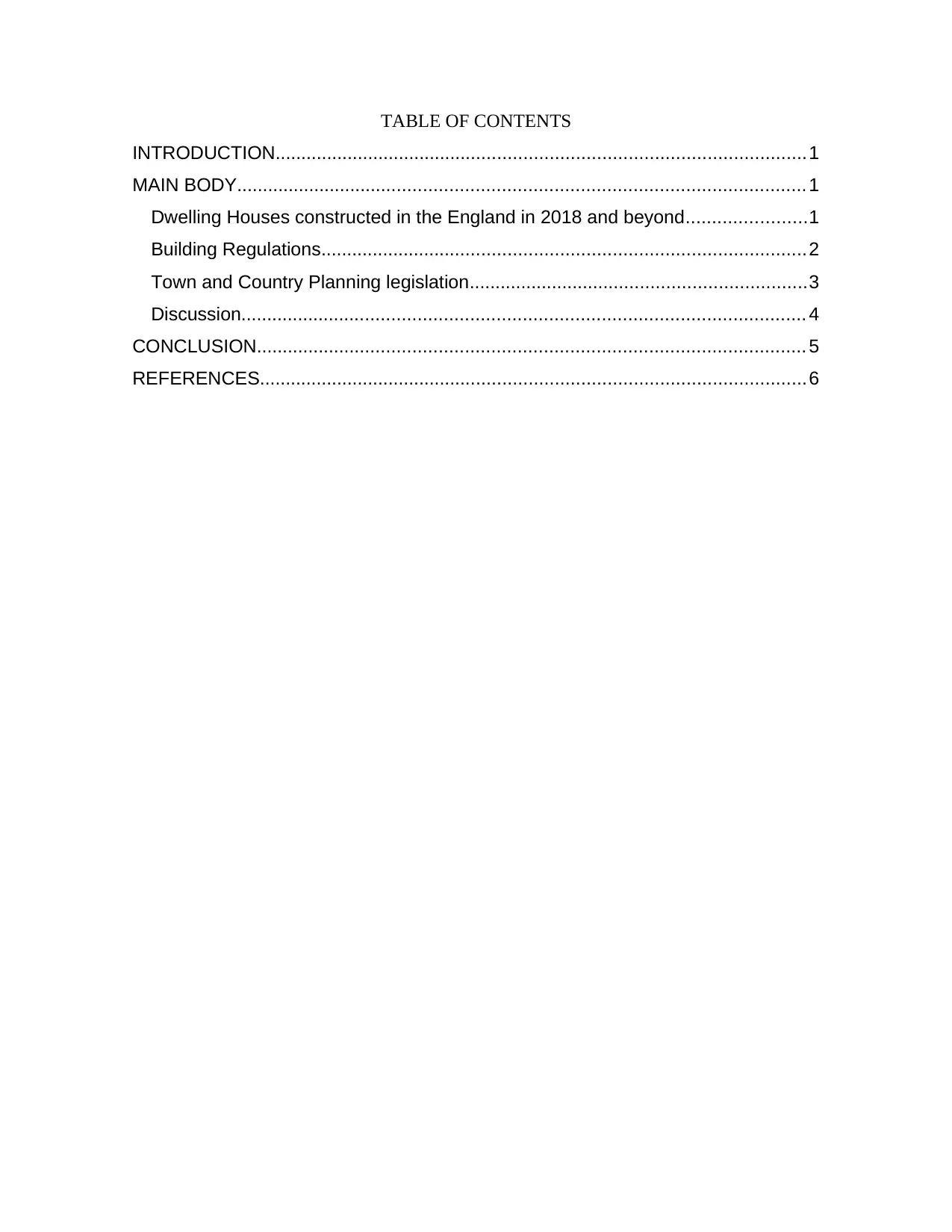
TABLE OF CONTENTS
INTRODUCTION......................................................................................................1
MAIN BODY............................................................................................................. 1
Dwelling Houses constructed in the England in 2018 and beyond.......................1
Building Regulations.............................................................................................2
Town and Country Planning legislation.................................................................3
Discussion............................................................................................................ 4
CONCLUSION......................................................................................................... 5
REFERENCES.........................................................................................................6
INTRODUCTION......................................................................................................1
MAIN BODY............................................................................................................. 1
Dwelling Houses constructed in the England in 2018 and beyond.......................1
Building Regulations.............................................................................................2
Town and Country Planning legislation.................................................................3
Discussion............................................................................................................ 4
CONCLUSION......................................................................................................... 5
REFERENCES.........................................................................................................6
INTRODUCTION
Dwelling house is that type of which is self-contained unit for purpose of
accommodation to be used with one or more household like that of house, mobile
home, apartment and houseboat as well (Williams and Wood, 2018). This type of
house is completely different as compared to apartment used for commercial
purpose and is due to relation with seizure of property. In terms with the legal
manner this is that type of building which is operated or occupied as self-contained
substantial unit of accommodation like that of building or part of it and into this type
tent is not generally considered to as substantial dwelling house.
So this particular essay will be based on construction of dwelling house in
England in 2018 which must be complying with relevant building regulation and
town planning legislation and to be economically viable for both builder and owner
with giving 4 reason behind it statement.
MAIN BODY
Dwelling Houses constructed in the England in 2018 and beyond
As per the English law a dwelling house is that of kind which is developed or
builds as the self-contained substantial unit in way of accommodation like that part
of building, houseboat or other caravan which is not at all including tent into it. it
was included in one of the research that there are on an average every year about
2.5 billion house which are built which is not including the number of reduction into
existing house stock in UK (Gurran, Gallent and Chiu, 2016). There is report which
is published based on net additional dwelling on annual bases by the Ministry of
Housing, Communities and Local government which will be measuring the housing
supply. While it was included that in year 2013 there was undersupply of houses in
UK and then was marked by Mark Prisk who was then housing minister that he
would help in accelerating the rate of building (Housebuilding Report, 2018). Only
1.2 billion house was built at that time which was fighting with the post crisis
trough.
Thus it is getting more importance with the affordable housing based on
both economic and political factor in most of the larger cities of UK. The statistic of
30th June 2018 which was presenting the nationwide statistic of number of house
1
Dwelling house is that type of which is self-contained unit for purpose of
accommodation to be used with one or more household like that of house, mobile
home, apartment and houseboat as well (Williams and Wood, 2018). This type of
house is completely different as compared to apartment used for commercial
purpose and is due to relation with seizure of property. In terms with the legal
manner this is that type of building which is operated or occupied as self-contained
substantial unit of accommodation like that of building or part of it and into this type
tent is not generally considered to as substantial dwelling house.
So this particular essay will be based on construction of dwelling house in
England in 2018 which must be complying with relevant building regulation and
town planning legislation and to be economically viable for both builder and owner
with giving 4 reason behind it statement.
MAIN BODY
Dwelling Houses constructed in the England in 2018 and beyond
As per the English law a dwelling house is that of kind which is developed or
builds as the self-contained substantial unit in way of accommodation like that part
of building, houseboat or other caravan which is not at all including tent into it. it
was included in one of the research that there are on an average every year about
2.5 billion house which are built which is not including the number of reduction into
existing house stock in UK (Gurran, Gallent and Chiu, 2016). There is report which
is published based on net additional dwelling on annual bases by the Ministry of
Housing, Communities and Local government which will be measuring the housing
supply. While it was included that in year 2013 there was undersupply of houses in
UK and then was marked by Mark Prisk who was then housing minister that he
would help in accelerating the rate of building (Housebuilding Report, 2018). Only
1.2 billion house was built at that time which was fighting with the post crisis
trough.
Thus it is getting more importance with the affordable housing based on
both economic and political factor in most of the larger cities of UK. The statistic of
30th June 2018 which was presenting the nationwide statistic of number of house
1
⊘ This is a preview!⊘
Do you want full access?
Subscribe today to unlock all pages.

Trusted by 1+ million students worldwide
which stated and which completed in dwelling within each quarter. All the new
building which is shown into the release which will be regarding with whole supply
of house per year or quarterly bases. The Ministry of Housing, Communities and
Local government (MHCLG) will also be publishing the year wise data that is
having or containing additional dwelling and measuring number of housing supply.
All the data will be based on controlling inspection data, number of house built and
number of them which are under construction so that it could be submitted to
ministry so that approval of them could be gathered.
Building Regulations
The building regulations are those minimum standard for way of designing,
constructing and different type of alteration to every building. It was developed by
government of UK with approval of Parliament.
Only building up house or residential building will not be sufficient it is very
important that they are following the building regulations which will be helping into
planning and following the correct standards as well (Scanlon, Whitehead and
Arrigoitia, 2014). The builder or owner should be knowing the planning permission
to be taken, regulations to be followed and standards to be maintained so that they
are not facing any sort of problem. These regulations must be considered in way of
building up of house which includes objective, planning permission that will pass
the judgement about is the building as per regulation or not.
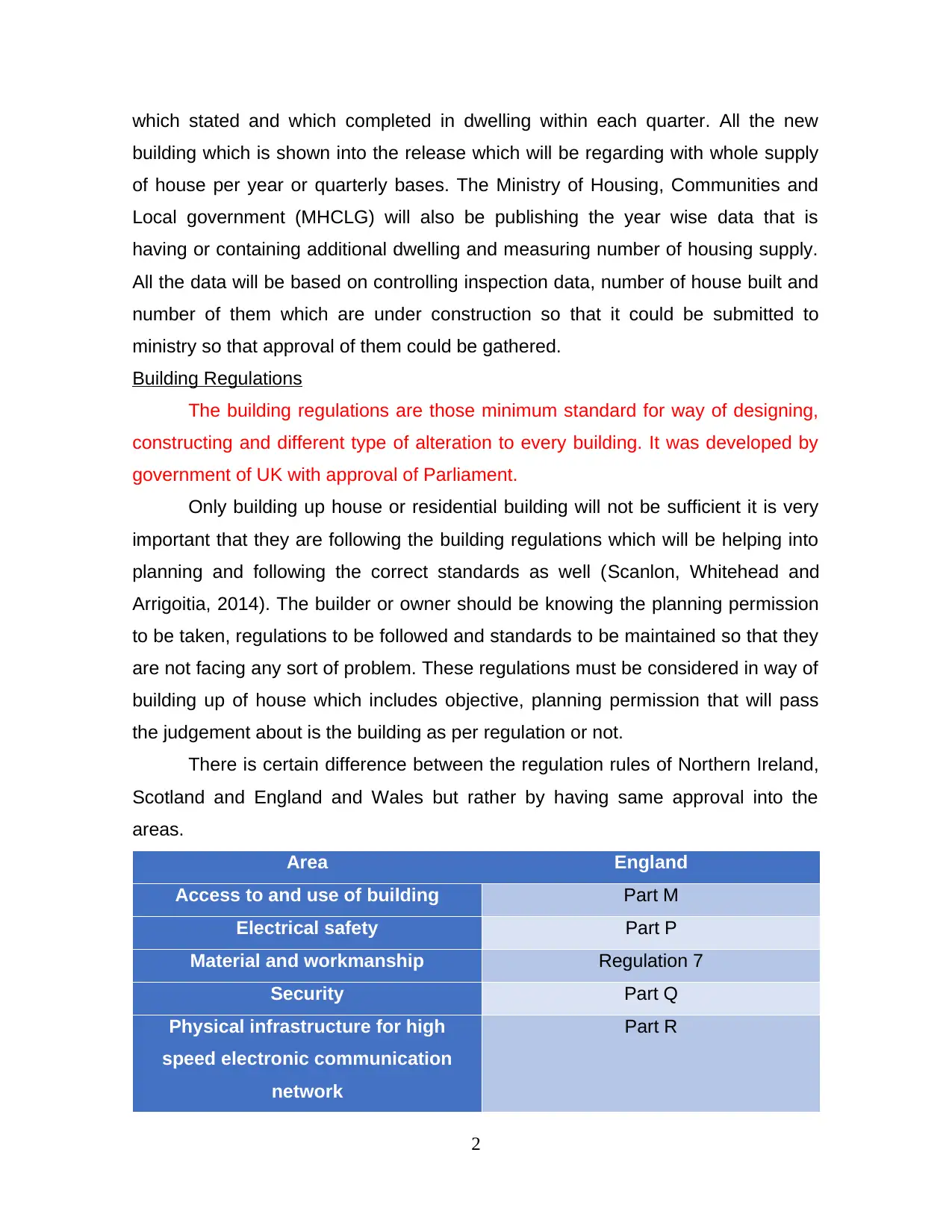
There is certain difference between the regulation rules of Northern Ireland,
Scotland and England and Wales but rather by having same approval into the
areas.
Area England
Access to and use of building Part M
Electrical safety Part P
Material and workmanship Regulation 7
Security Part Q
Physical infrastructure for high
speed electronic communication
network
Part R
2
building which is shown into the release which will be regarding with whole supply
of house per year or quarterly bases. The Ministry of Housing, Communities and
Local government (MHCLG) will also be publishing the year wise data that is
having or containing additional dwelling and measuring number of housing supply.
All the data will be based on controlling inspection data, number of house built and
number of them which are under construction so that it could be submitted to
ministry so that approval of them could be gathered.
Building Regulations
The building regulations are those minimum standard for way of designing,
constructing and different type of alteration to every building. It was developed by
government of UK with approval of Parliament.
Only building up house or residential building will not be sufficient it is very
important that they are following the building regulations which will be helping into
planning and following the correct standards as well (Scanlon, Whitehead and
Arrigoitia, 2014). The builder or owner should be knowing the planning permission
to be taken, regulations to be followed and standards to be maintained so that they
are not facing any sort of problem. These regulations must be considered in way of
building up of house which includes objective, planning permission that will pass
the judgement about is the building as per regulation or not.
There is certain difference between the regulation rules of Northern Ireland,
Scotland and England and Wales but rather by having same approval into the
areas.
Area England
Access to and use of building Part M
Electrical safety Part P
Material and workmanship Regulation 7
Security Part Q
Physical infrastructure for high
speed electronic communication
network
Part R
2
Paraphrase This Document
Need a fresh take? Get an instant paraphrase of this document with our AI Paraphraser
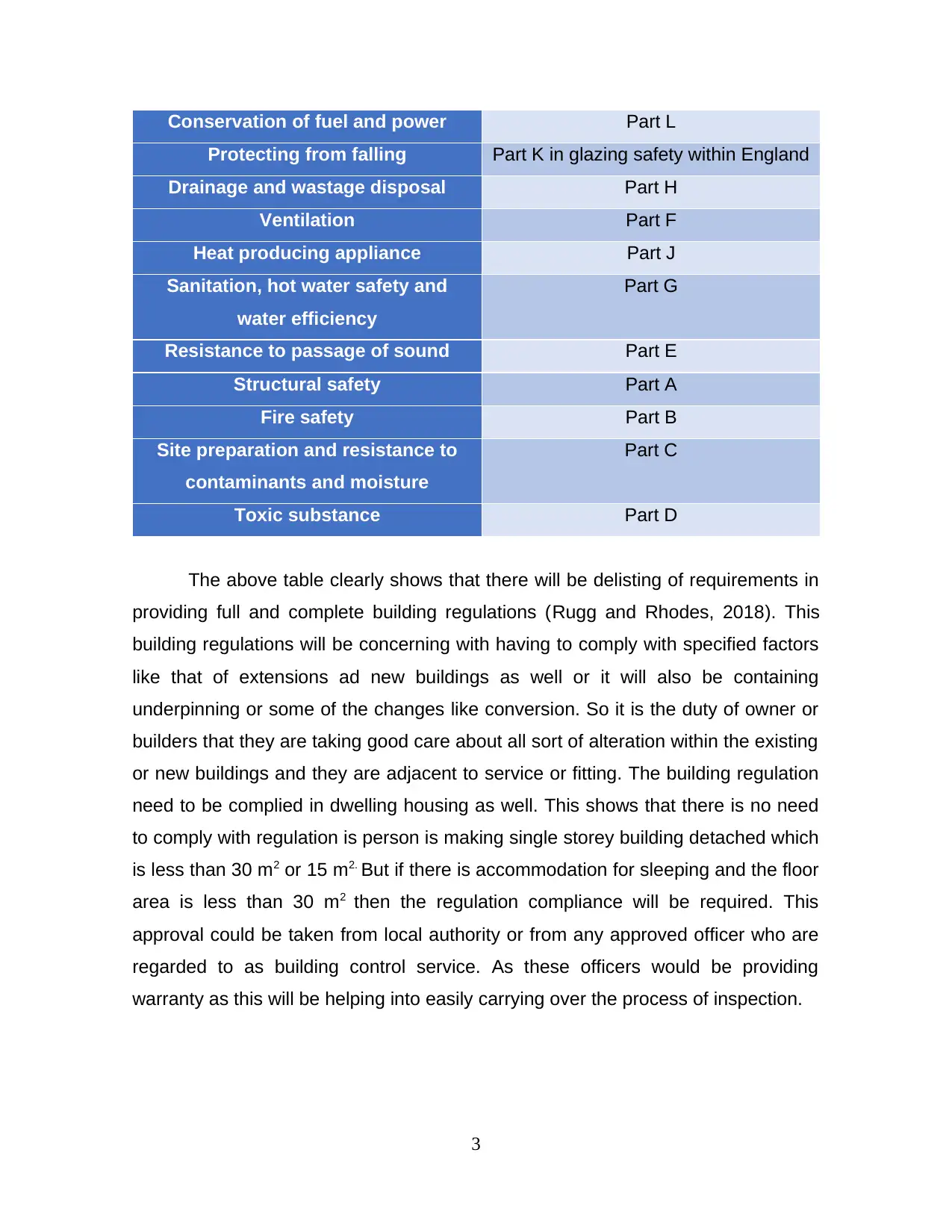
Conservation of fuel and power Part L
Protecting from falling Part K in glazing safety within England
Drainage and wastage disposal Part H
Ventilation Part F
Heat producing appliance Part J
Sanitation, hot water safety and
water efficiency
Part G
Resistance to passage of sound Part E
Structural safety Part A
Fire safety Part B
Site preparation and resistance to
contaminants and moisture
Part C
Toxic substance Part D
The above table clearly shows that there will be delisting of requirements in
providing full and complete building regulations (Rugg and Rhodes, 2018). This
building regulations will be concerning with having to comply with specified factors
like that of extensions ad new buildings as well or it will also be containing
underpinning or some of the changes like conversion. So it is the duty of owner or
builders that they are taking good care about all sort of alteration within the existing
or new buildings and they are adjacent to service or fitting. The building regulation
need to be complied in dwelling housing as well. This shows that there is no need
to comply with regulation is person is making single storey building detached which
is less than 30 m2 or 15 m2. But if there is accommodation for sleeping and the floor
area is less than 30 m2 then the regulation compliance will be required. This
approval could be taken from local authority or from any approved officer who are
regarded to as building control service. As these officers would be providing
warranty as this will be helping into easily carrying over the process of inspection.
3
Protecting from falling Part K in glazing safety within England
Drainage and wastage disposal Part H
Ventilation Part F
Heat producing appliance Part J
Sanitation, hot water safety and
water efficiency
Part G
Resistance to passage of sound Part E
Structural safety Part A
Fire safety Part B
Site preparation and resistance to
contaminants and moisture
Part C
Toxic substance Part D
The above table clearly shows that there will be delisting of requirements in
providing full and complete building regulations (Rugg and Rhodes, 2018). This
building regulations will be concerning with having to comply with specified factors
like that of extensions ad new buildings as well or it will also be containing
underpinning or some of the changes like conversion. So it is the duty of owner or
builders that they are taking good care about all sort of alteration within the existing
or new buildings and they are adjacent to service or fitting. The building regulation
need to be complied in dwelling housing as well. This shows that there is no need
to comply with regulation is person is making single storey building detached which
is less than 30 m2 or 15 m2. But if there is accommodation for sleeping and the floor
area is less than 30 m2 then the regulation compliance will be required. This
approval could be taken from local authority or from any approved officer who are
regarded to as building control service. As these officers would be providing
warranty as this will be helping into easily carrying over the process of inspection.
3
Town and Country Planning legislation
The Town and Country Planning is that act which is wholly concerned with
the use of land for planning and ensuring sustainable economic development with
the better environment as well.
As per the Town and Country Planning act of 1990 it could be included
development of land within region of England and Wales. This is also called to as
central part of English land law which includes country and town planning within
UK. As it was revoked from part of Planning and Compensation act 1991 and
added by Planning and Compulsory Purchase Act 2004 (Tunstall and Pleace,
2018). There are in total 15 parts within this act with having 337 section and with
17 schedules. All the 15 parts will be very important and essential as they will be
including within the planning authority and other parts.
Planning authority will be considering with having subsection 1-2 which
concern with having all functions conferred to local planning authority (LPA) should
be under both district and country planning.
Discussion
It is very much important and relevant that all builders are complying with
Town and Country Planning legislation and Building Regulations. Thus the
legislations must be complied with so that there are not certain legal objections or
regulations that are onto them (Nelson, 2018). For the consideration view of Mayor
of London it could be included that there is such circumstance that are laid down
into Town and Country Planning that it is very much important to comply with rules
and regulations. It is also important that the owner or builder is dealing with
Building regulations so that process of documentation work could be easily down
or concluded as well.
There will be permission related to bundling up of house that require to
either fail or pass the registration that is required before starting construction. All
the dwelling house constructed in England in year 2018 and beyond would need to
strictly comply with relevant Building Regulation and Town or Country Planning
legislations as well so that it could be economically viable for both builder and
owner (House building in England, 2018). As it include that it becomes important to
4
The Town and Country Planning is that act which is wholly concerned with
the use of land for planning and ensuring sustainable economic development with
the better environment as well.
As per the Town and Country Planning act of 1990 it could be included
development of land within region of England and Wales. This is also called to as
central part of English land law which includes country and town planning within
UK. As it was revoked from part of Planning and Compensation act 1991 and
added by Planning and Compulsory Purchase Act 2004 (Tunstall and Pleace,
2018). There are in total 15 parts within this act with having 337 section and with
17 schedules. All the 15 parts will be very important and essential as they will be
including within the planning authority and other parts.
Planning authority will be considering with having subsection 1-2 which
concern with having all functions conferred to local planning authority (LPA) should
be under both district and country planning.
Discussion
It is very much important and relevant that all builders are complying with
Town and Country Planning legislation and Building Regulations. Thus the
legislations must be complied with so that there are not certain legal objections or
regulations that are onto them (Nelson, 2018). For the consideration view of Mayor
of London it could be included that there is such circumstance that are laid down
into Town and Country Planning that it is very much important to comply with rules
and regulations. It is also important that the owner or builder is dealing with
Building regulations so that process of documentation work could be easily down
or concluded as well.
There will be permission related to bundling up of house that require to
either fail or pass the registration that is required before starting construction. All
the dwelling house constructed in England in year 2018 and beyond would need to
strictly comply with relevant Building Regulation and Town or Country Planning
legislations as well so that it could be economically viable for both builder and
owner (House building in England, 2018). As it include that it becomes important to
4
⊘ This is a preview!⊘
Do you want full access?
Subscribe today to unlock all pages.
Trusted by 1+ million students worldwide
carry out the approval before staring of the construction. As if the person himself is
constructing building then responsibility will be theirs and if it is required to
construct with help of contractor then responsibility will be theirs.
So all work must be meeting out with relevant technical requirement and
must be complying with all part including that of materials to be used, service to be
rendered, fitting and fixtures as well (Hodgson, James and Webb, 2018). Like the
provision of replacement double glazing must not make compliance worse into
relation to means of escape, air supply for combustion appliance and their flues
and ventilation for health purpose as well. In carrying out the health and safety
purpose also compliance is necessary that will be developing with notifying the
executive who are having these duties of keeping health and safety.
Sustainability, health and safety-
As there will be very high demand for pollution and wastage reduction in
year 2018 which makes it very much essential to comply with all building regulation
and Town and Country planning. Sustainability construction is the issue which is
every builder need to consider within their construction purpose. This will be
helping them to develop and conserve natural resources.
Climate change-
The increased amount of climate change and energy or pollution will be
another need for dwelling houses to be comply with building regulation and Town
and Country planning.
Measuring sustainability in construction industry-
It is very important that all builders are measuring their sustainability that till
what extent is the following environment protection rules and regulations.
Social aspect-
As per the society also it is required to comply or follow the building
regulation and Town and Country planning.
So there is responsibility of builder that they are complying with all sort of
alteration or following safety regulations as well (Tapsuwan, Walker and Barnett,
2018). All the regulations will be setting up of designing up of building in way of
ensuring safety or health for the people who are working there. The Town and
5
constructing building then responsibility will be theirs and if it is required to
construct with help of contractor then responsibility will be theirs.
So all work must be meeting out with relevant technical requirement and
must be complying with all part including that of materials to be used, service to be
rendered, fitting and fixtures as well (Hodgson, James and Webb, 2018). Like the
provision of replacement double glazing must not make compliance worse into
relation to means of escape, air supply for combustion appliance and their flues
and ventilation for health purpose as well. In carrying out the health and safety
purpose also compliance is necessary that will be developing with notifying the
executive who are having these duties of keeping health and safety.
Sustainability, health and safety-
As there will be very high demand for pollution and wastage reduction in
year 2018 which makes it very much essential to comply with all building regulation
and Town and Country planning. Sustainability construction is the issue which is
every builder need to consider within their construction purpose. This will be
helping them to develop and conserve natural resources.
Climate change-
The increased amount of climate change and energy or pollution will be
another need for dwelling houses to be comply with building regulation and Town
and Country planning.
Measuring sustainability in construction industry-
It is very important that all builders are measuring their sustainability that till
what extent is the following environment protection rules and regulations.
Social aspect-
As per the society also it is required to comply or follow the building
regulation and Town and Country planning.
So there is responsibility of builder that they are complying with all sort of
alteration or following safety regulations as well (Tapsuwan, Walker and Barnett,
2018). All the regulations will be setting up of designing up of building in way of
ensuring safety or health for the people who are working there. The Town and
5
Paraphrase This Document
Need a fresh take? Get an instant paraphrase of this document with our AI Paraphraser
Country Planning will be helping into proper planning up of cities and towns so that
they are all evenly developed. So it could clearly understood that all dwelling house
which are constructed after or on 2018 must be complying with both Town and
Country Planning and Building Regulations.
The building could be economically viable for both owner and builder as if
the owner is planning to give their building as lease or for rent then they could be
earning money. For builder it could be viable as if they are building an apartment
and then giving out that for rent then they could earn higher income from them.
CONCLUSION
From the above report it could be concluded that all houses need to comply
with planning commission and regulations whether built by self or with appointment
of builder or contractor. With the help when they are following the regulation it will
be included that all houses would be built as per planning and regulated by law as
well so that there are not legal obligations over them.
6
they are all evenly developed. So it could clearly understood that all dwelling house
which are constructed after or on 2018 must be complying with both Town and
Country Planning and Building Regulations.
The building could be economically viable for both owner and builder as if
the owner is planning to give their building as lease or for rent then they could be
earning money. For builder it could be viable as if they are building an apartment
and then giving out that for rent then they could earn higher income from them.
CONCLUSION
From the above report it could be concluded that all houses need to comply
with planning commission and regulations whether built by self or with appointment
of builder or contractor. With the help when they are following the regulation it will
be included that all houses would be built as per planning and regulated by law as
well so that there are not legal obligations over them.
6
REFERENCES
Books and Journals:
Gurran, N., Gallent, N. and Chiu, R.L., 2016. Politics, planning and housing supply
in Australia, England and Hong Kong. Routledge.
Hodgson, H., James, A. and Webb, E., 2018. OLDER RENTERS IN THE
WESTERN AUSTRALIAN PRIVATE RENTAL SECTOR.
Nelson, A., 2018. Small is Necessary: Shared Living on a Shared Planet. Pluto
Press.
Rugg, J.J. and Rhodes, D.J., 2018. The Evolving Private Rented Sector: Its
Contribution and Potential.
Scanlon, K., Whitehead, C. and Arrigoitia, M.F. eds., 2014. Social housing in
Europe. John Wiley & Sons.
Tapsuwan, S., Walker, I. and Barnett, G., 2018. Preferences for sustainable,
liveable and resilient neighbourhoods and homes: A case of Canberra,
Australia. Sustainable cities and society, 37, pp.133-145.
Tunstall, R.K. and Pleace, N., 2018. Social Housing: Evidence Review.
Williams, R.H. and Wood, B., 2018. Urban land and property markets in the United
Kingdom (Vol. 23). Routledge.
Online:
House building in England. 2018. [Online]. Accessed through:
<https://fullfact.org/economy/house-building-england/>.
Housebuilding Report. 2018. [pdf]. Accessed through:
<https://content.knightfrank.com/research/297/documents/en/uk-
housebuilding-report-2018-5682.pdf>.
7
Books and Journals:
Gurran, N., Gallent, N. and Chiu, R.L., 2016. Politics, planning and housing supply
in Australia, England and Hong Kong. Routledge.
Hodgson, H., James, A. and Webb, E., 2018. OLDER RENTERS IN THE
WESTERN AUSTRALIAN PRIVATE RENTAL SECTOR.
Nelson, A., 2018. Small is Necessary: Shared Living on a Shared Planet. Pluto
Press.
Rugg, J.J. and Rhodes, D.J., 2018. The Evolving Private Rented Sector: Its
Contribution and Potential.
Scanlon, K., Whitehead, C. and Arrigoitia, M.F. eds., 2014. Social housing in
Europe. John Wiley & Sons.
Tapsuwan, S., Walker, I. and Barnett, G., 2018. Preferences for sustainable,
liveable and resilient neighbourhoods and homes: A case of Canberra,
Australia. Sustainable cities and society, 37, pp.133-145.
Tunstall, R.K. and Pleace, N., 2018. Social Housing: Evidence Review.
Williams, R.H. and Wood, B., 2018. Urban land and property markets in the United
Kingdom (Vol. 23). Routledge.
Online:
House building in England. 2018. [Online]. Accessed through:
<https://fullfact.org/economy/house-building-england/>.
Housebuilding Report. 2018. [pdf]. Accessed through:
<https://content.knightfrank.com/research/297/documents/en/uk-
housebuilding-report-2018-5682.pdf>.
7
⊘ This is a preview!⊘
Do you want full access?
Subscribe today to unlock all pages.
Trusted by 1+ million students worldwide

Word count- 1814
8
8

1 out of 10


Your All-in-One AI-Powered Toolkit for Academic Success.
+13062052269
info@desklib.com
Available 24*7 on WhatsApp / Email
![[object Object]](/_next/static/media/star-bottom.7253800d.svg)
Unlock your academic potential
Copyright © 2020–2026 A2Z Services. All Rights Reserved. Developed and managed by ZUCOL.