Understanding and Building Relationships Among Different Cultures

Verified

Added on  2023/04/21

|6
|726
|402
Essay
AI Summary
This essay explores the significance of building relationships across diverse cultures. It emphasizes the universally understood importance of cross-cultural connections and highlights how relationship-building approaches vary across different cultures. The essay delves into the complexities of cultural dynamics, referencing concepts like guanxi and Wasta to illustrate how networking and influence operate in different societies. It also outlines key steps for fostering relationships with people from diverse backgrounds, including making a conscious effort to engage with other cultures, examining personal biases, and practicing active listening. The essay concludes by underscoring the transformative power of cross-cultural relationships in driving positive change within communities and emphasizes the importance of understanding and appreciating diverse perspectives for societal development. The essay references several sources to support its arguments, including academic articles and reports on cultural competence and diversity.
Document Page
Running head: BUILDING RELATIONSHIP AMONG DIFFERENT CULTURES
BUILDING RELATIONSHIP AMONG DIFFERENT CULTURES
Name of the Student:
Name of the University:
Author note:
tabler-icon-diamond-filled.svg

Paraphrase This Document

Need a fresh take? Get an instant paraphrase of this document with our AI Paraphraser
Document Page
1BUILDING RELATIONSHIP AMONG DIFFERENT CULTURES
Introduction- The primary significance of building relations or connection with other
culture people is something that is already accepted and universally understood among
people. The way in which relationship is established and expanded differ from one culture to
other. Culture is a difficult and complex concept, which refers to a community with whom
one shares mutual experiences in modelling the way to interpret the world irrespective of
cultural, traditional, socio-economic or religious group (Ctb.ku.edu, 2018). In a specific
culture, individuals might network in a different way depending on circumstances.
Networking can be a challenge for a stranger in order to acquire all the delicacies of
networking of another culture.
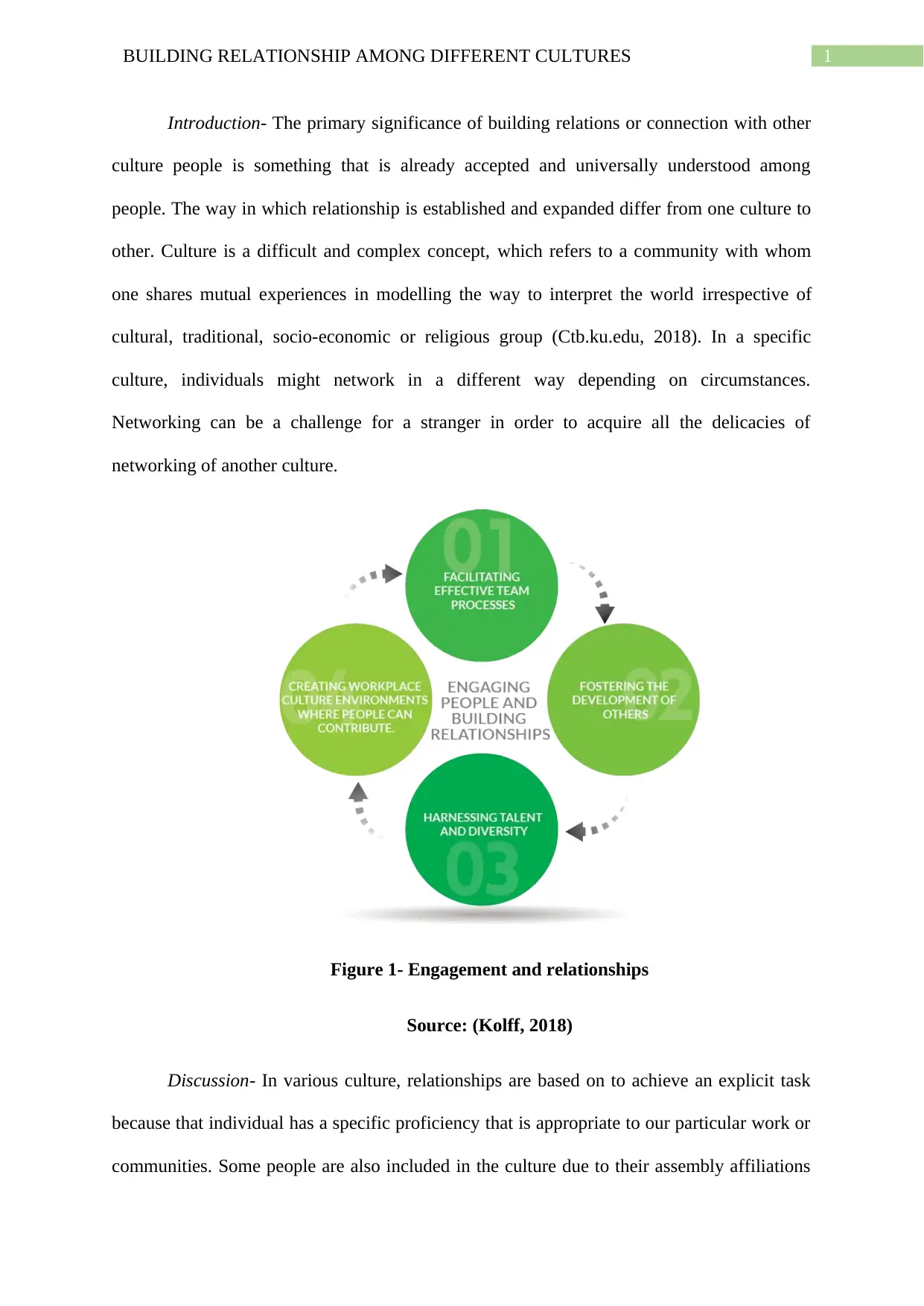
Figure 1- Engagement and relationships
Source: (Kolff, 2018)
Discussion- In various culture, relationships are based on to achieve an explicit task
because that individual has a specific proficiency that is appropriate to our particular work or
communities. Some people are also included in the culture due to their assembly affiliations
Document Page
2BUILDING RELATIONSHIP AMONG DIFFERENT CULTURES
other than their own discrete expertise or accomplishments. The main goal of this is to
develop long-term planned relationships other than focusing on short-term relationship
(University Committee for Diversity, Equity and Affirmative Action, 2011).
Figure 2- Cultural diversity
Source: (Ctb.ku.edu, 2018)
In some cultures, relationships are more intricate, well defined and long term
depending on the superiority of group dynamics (Ethnoconnect.com, 2019). Emerging
networks and influence in building relationship is critical for victory. In China, the skill of
interacting in corporate world revolves around an arrangement of constructing social assets
recognised as guanxi (gwan-shee). In some portion of Arab World, concept of Wasta is
followed, which refers to the concept of getting things done by using other’s connection or
influence which can include government work like application of visa , business license, job
recommendations, selling or buying of property (Kolff, 2018). Similar schemes for building
relationship exist in many countries like Colombia, Chile, and Mexico known as “Palanca”.
Document Page
3BUILDING RELATIONSHIP AMONG DIFFERENT CULTURES
Figure 3- Cultural dimensions
Source: (Kolff, 2018)
Some of the major steps taken into consideration to build relationship with different
class of people of other culture or community are as follows (Ctb.ku.edu, 2018):
1. Make a mindful choice to begin relationships with individual from other cultures.
2. Place yourself in circumstances to encounter individual of other cultures.
3. Scrutinize your preferences about individual from other cultures.
4. Enquire questions relating to their values, customs, and opinions.
5. Read briefly about other person's philosophy's and histories
6. Pay close attention to people
7. Notice the dissimilarities in communication and beliefs
8. Risk creating mistakes
9. Acquire qualities to be a helper and friend.
tabler-icon-diamond-filled.svg

Paraphrase This Document

Need a fresh take? Get an instant paraphrase of this document with our AI Paraphraser
Document Page
4BUILDING RELATIONSHIP AMONG DIFFERENT CULTURES
Conclusion- The caring nature for each other is what encourages people to create change.
Founding relations with individuals from various backgrounds is a key for substantial
modifications in our communities. As individual personality, or in groups, different people
from different culture can together change our societies.
Document Page
5BUILDING RELATIONSHIP AMONG DIFFERENT CULTURES
References:
Ctb.ku.edu. (2018). Section 2. Building Relationships with People from Different Cultures.
Retrieved from https://ctb.ku.edu/en/table-of-contents/culture/cultural-competence/
building-relationships/main
Ethnoconnect.com. (2019). Cultural diversity. Retrieved from
https://www.ethnoconnect.com/pdf/1_what_is_cultural_diversity.pdf
Kolff, S. V. D. (2018). Building Communities Through Citizen Participation: Societal
initiatives and the effects on social cohesion. Retrieved from
https://theses.ubn.ru.nl/bitstream/handle/123456789/7069/Kolff
%2c_Solange_van_der_1.pdf?sequence=1
University Committee for Diversity, Equity and Affirmative Action. (2011). Booklet of
Interactive Exercises to Explore Our Differences. Retrieved from
https://intraweb.stockton.edu/eyos/affirmative_action/content/docs/Interactive
%20Diversity%20Booklet%2010-14-2011%20Rev%203_1_16.pdf
chevron_up_icon
1 out of 6
circle_padding
hide_on_mobile
zoom_out_icon
[object Object]