Strategic Leadership and Sustainability: A Business Report
VerifiedAdded on 2023/06/04
|9
|2355
|493
Report
AI Summary
This report delves into the core principles of building a sustainable organization, emphasizing the importance of eco-friendly practices and their impact on brand image and societal well-being. It explores the roles and responsibilities of strategic leaders, including performance management, planning, data analysis, risk management, and crisis management. The report also outlines key concepts and tools for strategic business management, such as life cycle assessment, energy efficiency tools, and carbon footprint analysis, highlighting their application in developing sustainable environment strategies. Furthermore, it addresses the economic and ethical dilemmas faced by strategic leaders in balancing short-term and long-term goals, considering external factors, environmental concerns, market dynamics, and financial conditions, while recommending a focus on product quality for customer satisfaction. The report concludes by summarizing the findings and reiterating the significance of sustainability and strategic leadership in achieving organizational success.
Building a Sustainable
Organisation
Table of Contents
Organisation
Table of Contents

Paraphrase This Document
Need a fresh take? Get an instant paraphrase of this document with our AI Paraphraser
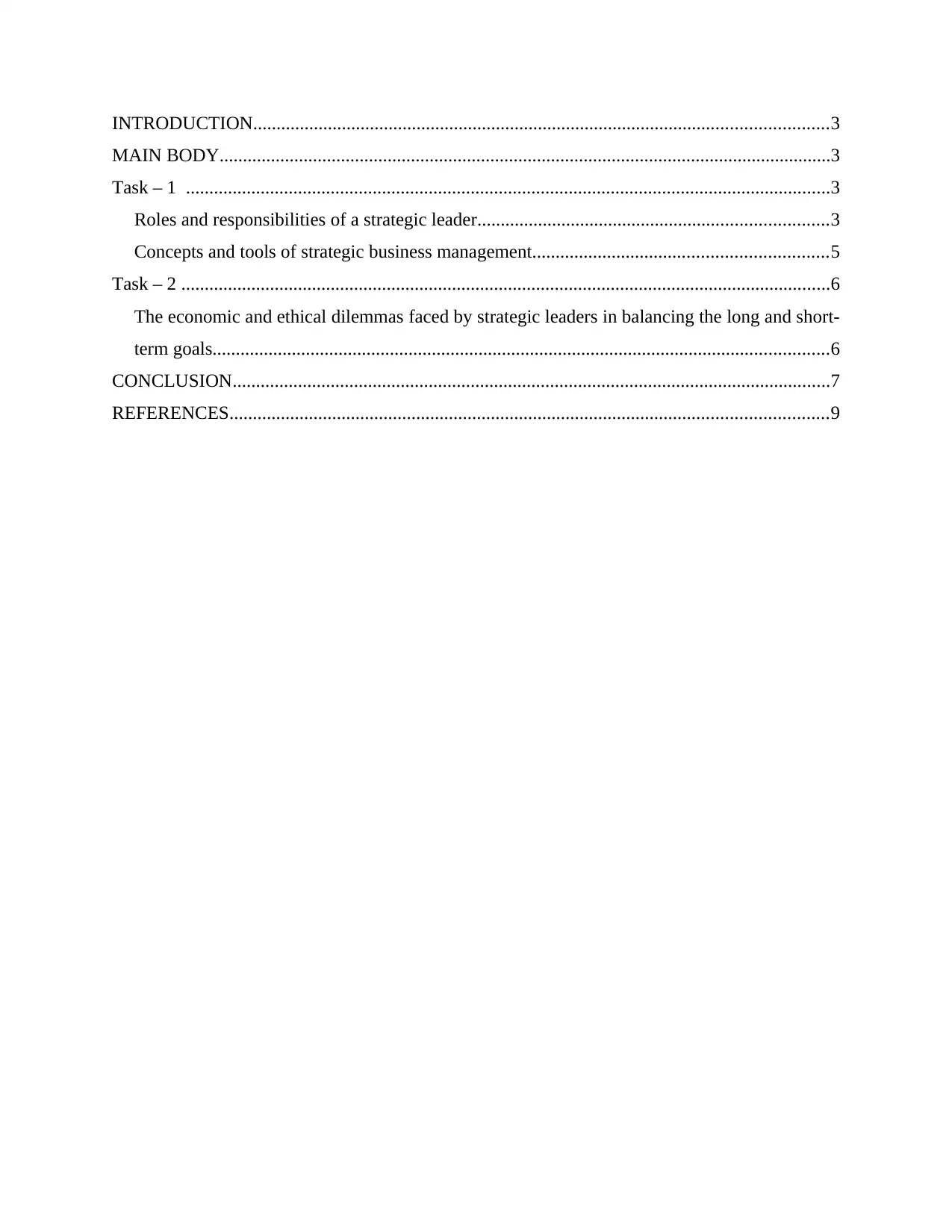
INTRODUCTION...........................................................................................................................3
MAIN BODY...................................................................................................................................3
Task – 1 ..........................................................................................................................................3
Roles and responsibilities of a strategic leader...........................................................................3
Concepts and tools of strategic business management...............................................................5
Task – 2 ...........................................................................................................................................6
The economic and ethical dilemmas faced by strategic leaders in balancing the long and short-
term goals....................................................................................................................................6
CONCLUSION................................................................................................................................7
REFERENCES................................................................................................................................9
MAIN BODY...................................................................................................................................3
Task – 1 ..........................................................................................................................................3
Roles and responsibilities of a strategic leader...........................................................................3
Concepts and tools of strategic business management...............................................................5
Task – 2 ...........................................................................................................................................6
The economic and ethical dilemmas faced by strategic leaders in balancing the long and short-
term goals....................................................................................................................................6
CONCLUSION................................................................................................................................7
REFERENCES................................................................................................................................9
INTRODUCTION
Sustainability is an act of pursuing business activities without harming the environment
or impacting the society. Businesses adopts sustainability for improvement in their brand image
in the market and cracking competition. Sustainable organisation is basically the implementation
of advanced principles of sustainability in the firm(Martins and Pato, 2019). It means companies
will develop eco-friendly products which will help them in the reduction of such gases and
chemicals which are harmful for environment. There will be less pollution from any industry if it
is using sustainability principle which will be beneficial for the society also. Strategic managers
are responsible for planning, analysing and identifying risk factors in a business. This report will
cover the roles and responsibilities of a strategic manager. There will be concepts and tools of
strategic business management in this report. This report will also cover the economic and
ethical dilemmas that a strategic leader face in balancing short term and long term goals.
MAIN BODY
Task – 1
Roles and responsibilities of a strategic leader
A strategic leader has the responsibility of plan, lead and a strategic vision towards the
organisation to motivate and persuade others. They are responsible to manage employees in the
organisation. Its objective is to develop an environment for the employees in which they could
identify their job needs in the future. Following are some major roles of Christoph Gebald and
Jan Wurzbacher as strategic leader:
Performance management: It is helpful for the organisation in identifying the working
performance of an employee. It is the role of a strategic leader which is a bit tough task as
they have to manage KPI ( key performance indicators ) of the business. It will be helpful
in identifying the future needs and performance of the company. It will also be helpful in
deciding goals, setting budget and planning for resources for the business.
Planning: Strategic managers are responsible for planning the operations of the
company. They have the responsibility to plan objective as per the requirement of the
company and the desires of the customers. They develop suitable strategies for the
businesses to maintain sustainability. They are responsible considering the strategic
priorities in to action plans.
Sustainability is an act of pursuing business activities without harming the environment
or impacting the society. Businesses adopts sustainability for improvement in their brand image
in the market and cracking competition. Sustainable organisation is basically the implementation
of advanced principles of sustainability in the firm(Martins and Pato, 2019). It means companies
will develop eco-friendly products which will help them in the reduction of such gases and
chemicals which are harmful for environment. There will be less pollution from any industry if it
is using sustainability principle which will be beneficial for the society also. Strategic managers
are responsible for planning, analysing and identifying risk factors in a business. This report will
cover the roles and responsibilities of a strategic manager. There will be concepts and tools of
strategic business management in this report. This report will also cover the economic and
ethical dilemmas that a strategic leader face in balancing short term and long term goals.
MAIN BODY
Task – 1
Roles and responsibilities of a strategic leader
A strategic leader has the responsibility of plan, lead and a strategic vision towards the
organisation to motivate and persuade others. They are responsible to manage employees in the
organisation. Its objective is to develop an environment for the employees in which they could
identify their job needs in the future. Following are some major roles of Christoph Gebald and
Jan Wurzbacher as strategic leader:
Performance management: It is helpful for the organisation in identifying the working
performance of an employee. It is the role of a strategic leader which is a bit tough task as
they have to manage KPI ( key performance indicators ) of the business. It will be helpful
in identifying the future needs and performance of the company. It will also be helpful in
deciding goals, setting budget and planning for resources for the business.
Planning: Strategic managers are responsible for planning the operations of the
company. They have the responsibility to plan objective as per the requirement of the
company and the desires of the customers. They develop suitable strategies for the
businesses to maintain sustainability. They are responsible considering the strategic
priorities in to action plans.
⊘ This is a preview!⊘
Do you want full access?
Subscribe today to unlock all pages.

Trusted by 1+ million students worldwide
Analysing data: Taking into consideration the aforementioned points, it is their
responsibility to gather relevant data and evaluate the outcomes of their plans. They can
examine their successful strategies and potential areas for improvement as a result of this.
Later on, they use those analytics to set standards for measuring long-term market
strategies that help them make decisions about money and resources. The managers are
obligated to collect and evaluate their data due to the company's primary focus on
sustainability.
Management of risk: It is simple that in achieving any goal, there are various risks
which a manager have to face to reach at the final goal of the company. It helps a
business improve its relationships with its employees, customers and suppliers by
allowing it to comprehend, interpret, and manage expectations. The managers need to
concentrate on forecasting any potential risks that the company might face in the near
future.
Management in crisis situation: The strategic managers of the any business are the ones
who help them recover from difficult circumstances in times of crisis. They frequently
devise and modify such strategies in times of crisis that aid in cost reduction and
customer value enhancement. In addition, they investigate the situation's underlying
causes and offer helpful solutions to stop it from happening again. In such a
circumstance, they must be able to act in the most constructive and effective manner, in
accordance.
Coaching: It is the responsibility of a strategic manager to coach department supervisors
and assist them in developing plans to achieve organizational objectives. They assist
supervisors in developing strategies for each department before reviewing, analysing and
managing all department plans to ensure that all departments are focused on the same
organizational objective. The managers ensure that every department's head or supervisor
receives the necessary training to ensure the alignment's achievement of its goals.
Following are the responsibilities of Christoph Gebald and Jan Wurzbacher as strategic leader:
They are in charge of analysing the market's trends and competitors for the company.
With the strategies, they make sure that all of the company's departments are aware of the
goals, procedures and resources.
Additionally, they assist in the organization's development of long-term strategies.
responsibility to gather relevant data and evaluate the outcomes of their plans. They can
examine their successful strategies and potential areas for improvement as a result of this.
Later on, they use those analytics to set standards for measuring long-term market
strategies that help them make decisions about money and resources. The managers are
obligated to collect and evaluate their data due to the company's primary focus on
sustainability.
Management of risk: It is simple that in achieving any goal, there are various risks
which a manager have to face to reach at the final goal of the company. It helps a
business improve its relationships with its employees, customers and suppliers by
allowing it to comprehend, interpret, and manage expectations. The managers need to
concentrate on forecasting any potential risks that the company might face in the near
future.
Management in crisis situation: The strategic managers of the any business are the ones
who help them recover from difficult circumstances in times of crisis. They frequently
devise and modify such strategies in times of crisis that aid in cost reduction and
customer value enhancement. In addition, they investigate the situation's underlying
causes and offer helpful solutions to stop it from happening again. In such a
circumstance, they must be able to act in the most constructive and effective manner, in
accordance.
Coaching: It is the responsibility of a strategic manager to coach department supervisors
and assist them in developing plans to achieve organizational objectives. They assist
supervisors in developing strategies for each department before reviewing, analysing and
managing all department plans to ensure that all departments are focused on the same
organizational objective. The managers ensure that every department's head or supervisor
receives the necessary training to ensure the alignment's achievement of its goals.
Following are the responsibilities of Christoph Gebald and Jan Wurzbacher as strategic leader:
They are in charge of analysing the market's trends and competitors for the company.
With the strategies, they make sure that all of the company's departments are aware of the
goals, procedures and resources.
Additionally, they assist in the organization's development of long-term strategies.
Paraphrase This Document
Need a fresh take? Get an instant paraphrase of this document with our AI Paraphraser
Assistance in determining all of the threats and opportunities(Chang, Octoyuda and
Arisanti, 2022).
They plan, implement and manage the given projects and ideas. Observing and reporting
on projects is another responsibility of them.
Conducting research and evaluating the efficiency of shareholders, processes and
operations. Presenting new findings, projections and suggested actions to the company.
They help senior executives in decision-making process.
Concepts and tools of strategic business management
Strategic business management ensures the formulation and achievement of an
organization's primary goals. In the operational areas of the organization, extensive examination
of the internal and external environments and consideration of the company's resources and
strategies are formed. A business is able to properly allocate its resources. It also has a clear path
to follow through the definition of its objectives and the creation of strategies and guidelines to
help it achieve those objectives. Some tools for strategic business management are listed below:
Assessment tool for the life cycle: The business can use this tool to get a basic
understanding of LCA and to allocate important parts of the method. This is
predetermined for use by businesses, academic campuses and other organizations to
explain how to incorporate environmental performance based on the life cycle into
decision-making.
Tool for energy efficiency: The resources on trends in energy use and the amount of
energy utilized by industries are provided by this tool. This can be useful for identifying
areas for improvement and measuring any energy enhancing options.
Tool for carbon footprint: It helps managers and businesses keep track of their solid
waste and creates a report on how to reduce greenhouse gas emissions through various
waste management strategies.
Instrument for preventing pollution and toxic chemicals: It aids in the estimation of
workplace fumes and toxic damage spread by skin contact with a chemical during
commercial and industrial operations. This also looks at how chemicals or toxicants are
released into the air, land and water(O'Keefe and Brien, 2018).
Tool for community development: Companies can use this tool to find, compare, and
thoroughly examine communities in new ways to grow their businesses. The company is
Arisanti, 2022).
They plan, implement and manage the given projects and ideas. Observing and reporting
on projects is another responsibility of them.
Conducting research and evaluating the efficiency of shareholders, processes and
operations. Presenting new findings, projections and suggested actions to the company.
They help senior executives in decision-making process.
Concepts and tools of strategic business management
Strategic business management ensures the formulation and achievement of an
organization's primary goals. In the operational areas of the organization, extensive examination
of the internal and external environments and consideration of the company's resources and
strategies are formed. A business is able to properly allocate its resources. It also has a clear path
to follow through the definition of its objectives and the creation of strategies and guidelines to
help it achieve those objectives. Some tools for strategic business management are listed below:
Assessment tool for the life cycle: The business can use this tool to get a basic
understanding of LCA and to allocate important parts of the method. This is
predetermined for use by businesses, academic campuses and other organizations to
explain how to incorporate environmental performance based on the life cycle into
decision-making.
Tool for energy efficiency: The resources on trends in energy use and the amount of
energy utilized by industries are provided by this tool. This can be useful for identifying
areas for improvement and measuring any energy enhancing options.
Tool for carbon footprint: It helps managers and businesses keep track of their solid
waste and creates a report on how to reduce greenhouse gas emissions through various
waste management strategies.
Instrument for preventing pollution and toxic chemicals: It aids in the estimation of
workplace fumes and toxic damage spread by skin contact with a chemical during
commercial and industrial operations. This also looks at how chemicals or toxicants are
released into the air, land and water(O'Keefe and Brien, 2018).
Tool for community development: Companies can use this tool to find, compare, and
thoroughly examine communities in new ways to grow their businesses. The company is
able to quickly and accurately make decisions based on numerical data sets, which
include sociological, industrial, transpositional and property information, as a result.
Tool for workforce development: This is a cyberspace for online learning and
knowledge sharing. This provides an ever changing system with cutting edge solutions to
professionals in workplaces, employers, academia, and economic development.
Tool for worker safety: This interactive tool is intended for use in workplace health and
safety training. The training uses a user interface and provides clear explanations.
Advance modules are used by some organizations to get solid ideas.
All the above explained tools are considered in developing sustainable environment strategies by
Christoph Gebald and Jan Wurzbacher.
Task – 2
The economic and ethical dilemmas faced by strategic leaders in balancing the long and short-
term goals
External factors: Strategic leaders frequently face this challenge when trying to strike a
balance between their short-term and long-term objectives. They typically encounter this
obstacle because the market is a dynamic and ever-changing environment, and managers
cannot rely on the same strategies after a certain amount of time. They must devise new
plans and strategies to support their organization's stability and risk reduction in the event
of adverse changes.
Environmental factors: The organisations are usually concerned with the maximum
utilisation of their resources allowing them produce maximum revenue generation. But
this does not imply that the organisations are allowed to exploit the their surroundings
and harm the society in any possible manner. In order to reduce this, the managers make
certain plans to ensure no such exploitations takes place. Christoph Gebald and Jan
Wurzbacher have taken the initiative by developing such technology that claims to slow
down the massive challenge of climate changing through capturing CO2 directly from the
air. This effects the long term goals of the business
Control of other business in marketplace: The managers also perceive this as a
significant economic issue as a challenge. Due to the presence of other dominant players,
the market can be challenging for most start-up businesses. Christoph Gebald and Jan
include sociological, industrial, transpositional and property information, as a result.
Tool for workforce development: This is a cyberspace for online learning and
knowledge sharing. This provides an ever changing system with cutting edge solutions to
professionals in workplaces, employers, academia, and economic development.
Tool for worker safety: This interactive tool is intended for use in workplace health and
safety training. The training uses a user interface and provides clear explanations.
Advance modules are used by some organizations to get solid ideas.
All the above explained tools are considered in developing sustainable environment strategies by
Christoph Gebald and Jan Wurzbacher.
Task – 2
The economic and ethical dilemmas faced by strategic leaders in balancing the long and short-
term goals
External factors: Strategic leaders frequently face this challenge when trying to strike a
balance between their short-term and long-term objectives. They typically encounter this
obstacle because the market is a dynamic and ever-changing environment, and managers
cannot rely on the same strategies after a certain amount of time. They must devise new
plans and strategies to support their organization's stability and risk reduction in the event
of adverse changes.
Environmental factors: The organisations are usually concerned with the maximum
utilisation of their resources allowing them produce maximum revenue generation. But
this does not imply that the organisations are allowed to exploit the their surroundings
and harm the society in any possible manner. In order to reduce this, the managers make
certain plans to ensure no such exploitations takes place. Christoph Gebald and Jan
Wurzbacher have taken the initiative by developing such technology that claims to slow
down the massive challenge of climate changing through capturing CO2 directly from the
air. This effects the long term goals of the business
Control of other business in marketplace: The managers also perceive this as a
significant economic issue as a challenge. Due to the presence of other dominant players,
the market can be challenging for most start-up businesses. Christoph Gebald and Jan
⊘ This is a preview!⊘
Do you want full access?
Subscribe today to unlock all pages.
Trusted by 1+ million students worldwide
Wurzbacher aren't much affected by this because the company came up with a great idea
to help the environment. However, this doesn't mean they shouldn't think of other ideas,
and it affects both the short-term and long-term goals(Golensky and Hager, 2020).
Financial condition: Another factor that has a negative effect on strategic managers'
decision-making process is recession. Gross domestic product (GDP) decreases in two
consecutive quarters. Typically indicate a temporary downswing in economic growth.
There is a decrease in economic activities like trading and manufacturing. This has an
impact on the short-term objectives as well as the decision-making processes of the
managers of the chosen business.
Compromise with quality product: Leaders in businesses frequently commit this error
in order to reduce production costs without sacrificing product quality. Although this
does assist business leaders in generating additional revenue, there is a risk that
customers will notice the low quality of the product. When customers notice the quality
of the product, which can have a negative impact on the company's goodwill.
Recommendation
Customers will choose a brand over inferior products solely based on quality, so it is
essential for businesses to offer high-quality goods to their clients. Even if this happens because
of technical issues, they must check the product's quality before putting it on the market, and if
there are any problems, they shouldn't put those products on the market. Christoph Gebald and
Jan Wurzbacher focuses at more quality products should be produced in the organisation.
CONCLUSION
It is concluded from the report that sustainability is the implementation of principles
which are in favour of producing products which are less or not harmful for environment and
society. Strategic manager plays a crucial role in an organisation in performance management,
planning, analysing data and others. They have the responsibility of analysing market trends,
setting company's goals, developing long term strategies and others. There are different tools
such as: assessment tool for the life cycle, tool for energy efficiency, tool for carbon footprint
and others which are helpful in maintaining a strategic business. There are various economic and
ethical dilemmas such as: external factors, environmental issues, recession and others which are
responsible for balancing long term and short term goals of the organisation. It is also
to help the environment. However, this doesn't mean they shouldn't think of other ideas,
and it affects both the short-term and long-term goals(Golensky and Hager, 2020).
Financial condition: Another factor that has a negative effect on strategic managers'
decision-making process is recession. Gross domestic product (GDP) decreases in two
consecutive quarters. Typically indicate a temporary downswing in economic growth.
There is a decrease in economic activities like trading and manufacturing. This has an
impact on the short-term objectives as well as the decision-making processes of the
managers of the chosen business.
Compromise with quality product: Leaders in businesses frequently commit this error
in order to reduce production costs without sacrificing product quality. Although this
does assist business leaders in generating additional revenue, there is a risk that
customers will notice the low quality of the product. When customers notice the quality
of the product, which can have a negative impact on the company's goodwill.
Recommendation
Customers will choose a brand over inferior products solely based on quality, so it is
essential for businesses to offer high-quality goods to their clients. Even if this happens because
of technical issues, they must check the product's quality before putting it on the market, and if
there are any problems, they shouldn't put those products on the market. Christoph Gebald and
Jan Wurzbacher focuses at more quality products should be produced in the organisation.
CONCLUSION
It is concluded from the report that sustainability is the implementation of principles
which are in favour of producing products which are less or not harmful for environment and
society. Strategic manager plays a crucial role in an organisation in performance management,
planning, analysing data and others. They have the responsibility of analysing market trends,
setting company's goals, developing long term strategies and others. There are different tools
such as: assessment tool for the life cycle, tool for energy efficiency, tool for carbon footprint
and others which are helpful in maintaining a strategic business. There are various economic and
ethical dilemmas such as: external factors, environmental issues, recession and others which are
responsible for balancing long term and short term goals of the organisation. It is also
Paraphrase This Document
Need a fresh take? Get an instant paraphrase of this document with our AI Paraphraser

recommended to the businesses to maintain quality of the product for the betterment of their sale
and foe enhancing their customer base.
and foe enhancing their customer base.
REFERENCES
Books and Journal
Martins, C.L. and Pato, M.V., 2019. Supply chain sustainability: A tertiary literature
review. Journal of Cleaner Production, 225, pp.995-1016.
Rana, S., 2019. Sustainability in business: Some research perspectives. FIIB Business
review, 8(2), pp.77-78.
Snelson-Powell, A.C., Grosvold, J. and Millington, A.I., 2020. Organizational hypocrisy in
business schools with sustainability commitments: The drivers of talk-action
inconsistency. Journal of Business Research, 114, pp.408-420.
Chang, C.L., Octoyuda, E. and Arisanti, I., 2022, May. The Role of Digital Transformation on
Strategic Leader: A Systematic Literature Review. In 2022 7th International
Conference on Business and Industrial Research (ICBIR) (pp. 289-294). IEEE.
Pitelis, C.N. and Wagner, J.D., 2019. Strategic shared leadership and organizational dynamic
capabilities. The Leadership Quarterly, 30(2), pp.233-242.
O'Keefe, K. and Brien, D.O., 2018. Ethical data and information management: concepts, tools
and methods. Kogan Page Publishers.
Golensky, M. and Hager, M., 2020. Strategic leadership and management in nonprofit
organizations: Theory and practice. Oxford University Press.
Dyer, J.H., Godfrey, P., Jensen, R. and Bryce, D., 2021. Strategic management. John Wiley &
Sons.
Books and Journal
Martins, C.L. and Pato, M.V., 2019. Supply chain sustainability: A tertiary literature
review. Journal of Cleaner Production, 225, pp.995-1016.
Rana, S., 2019. Sustainability in business: Some research perspectives. FIIB Business
review, 8(2), pp.77-78.
Snelson-Powell, A.C., Grosvold, J. and Millington, A.I., 2020. Organizational hypocrisy in
business schools with sustainability commitments: The drivers of talk-action
inconsistency. Journal of Business Research, 114, pp.408-420.
Chang, C.L., Octoyuda, E. and Arisanti, I., 2022, May. The Role of Digital Transformation on
Strategic Leader: A Systematic Literature Review. In 2022 7th International
Conference on Business and Industrial Research (ICBIR) (pp. 289-294). IEEE.
Pitelis, C.N. and Wagner, J.D., 2019. Strategic shared leadership and organizational dynamic
capabilities. The Leadership Quarterly, 30(2), pp.233-242.
O'Keefe, K. and Brien, D.O., 2018. Ethical data and information management: concepts, tools
and methods. Kogan Page Publishers.
Golensky, M. and Hager, M., 2020. Strategic leadership and management in nonprofit
organizations: Theory and practice. Oxford University Press.
Dyer, J.H., Godfrey, P., Jensen, R. and Bryce, D., 2021. Strategic management. John Wiley &
Sons.
⊘ This is a preview!⊘
Do you want full access?
Subscribe today to unlock all pages.
Trusted by 1+ million students worldwide

1 out of 9


Related Documents


Your All-in-One AI-Powered Toolkit for Academic Success.
+13062052269
info@desklib.com
Available 24*7 on WhatsApp / Email
![[object Object]](/_next/static/media/star-bottom.7253800d.svg)
Unlock your academic potential
Copyright © 2020–2026 A2Z Services. All Rights Reserved. Developed and managed by ZUCOL.