Research: Bullying Prevention for Disabled Children
VerifiedAdded on 2020/06/03
|23
|7932
|51
Project
AI Summary
This research project delves into the critical issue of bullying prevention and intervention strategies specifically designed for children with disabilities. The project begins with an introduction that outlines the significance of the research, followed by a comprehensive literature review that critically analyzes existing studies on bullying, its various forms (physical, verbal, social, and electronic), and its impact on children with disabilities. The research then details the methodology, including the research approach, time schedule, data collection and recording methods. Data analysis techniques and the interpretation of research specifications are also discussed. The project aims to evaluate current strategies, address the specific needs of children with disabilities, and recommend improvements. The project explores the aims, objectives, and research questions, providing a foundation for understanding the complexities of bullying in this context. The study highlights the vulnerability of children with disabilities, the importance of understanding bullying, and the need for effective strategies to create safer environments. The project includes an analysis of existing legislation and intervention methods, and the importance of community partnerships to combat bullying effectively.
Research Project- “Bullying
Prevention and Intervention
Strategies for Children with
disabilities”
Prevention and Intervention
Strategies for Children with
disabilities”

Paraphrase This Document
Need a fresh take? Get an instant paraphrase of this document with our AI Paraphraser
TABLE OF CONTENTS
TOPIC - “Bullying Prevention and Intervention Strategies for Children with disabilities”............1
CHAPTER 1: INTRODUCTION ...................................................................................................1
1.1 Description of the research project ......................................................................................1
1.2 Importance of this research ..................................................................................................2
CHAPTER 2: LITERATURE REVIEW ........................................................................................3
1.3 Critical review ......................................................................................................................3
RESEARCH METHODOLOGY ....................................................................................................7
1.4 Research Methodology .........................................................................................................7
1.5 Time schedule and plan.........................................................................................................9
CHAPTER 3: METHODOLOGY ................................................................................................11
2.1 Proposed research investigation .........................................................................................11
2.2 Undertaking the proposed research investigation ..............................................................11
2.3 Recording and collecting data ............................................................................................12
CHAPTER 4: DATA ANALYSIS ...............................................................................................12
3.1 Appropriate research evaluation techniques ......................................................................12
3.2 Interpretation and analysis of research specifications ........................................................12
CHAPTER 5: CONCLUSION AND RECOMMENDATIONS ..................................................17
Conclusion ................................................................................................................................17
Recommendation.......................................................................................................................17
REFERENCES..............................................................................................................................19
TOPIC - “Bullying Prevention and Intervention Strategies for Children with disabilities”............1
CHAPTER 1: INTRODUCTION ...................................................................................................1
1.1 Description of the research project ......................................................................................1
1.2 Importance of this research ..................................................................................................2
CHAPTER 2: LITERATURE REVIEW ........................................................................................3
1.3 Critical review ......................................................................................................................3
RESEARCH METHODOLOGY ....................................................................................................7
1.4 Research Methodology .........................................................................................................7
1.5 Time schedule and plan.........................................................................................................9
CHAPTER 3: METHODOLOGY ................................................................................................11
2.1 Proposed research investigation .........................................................................................11
2.2 Undertaking the proposed research investigation ..............................................................11
2.3 Recording and collecting data ............................................................................................12
CHAPTER 4: DATA ANALYSIS ...............................................................................................12
3.1 Appropriate research evaluation techniques ......................................................................12
3.2 Interpretation and analysis of research specifications ........................................................12
CHAPTER 5: CONCLUSION AND RECOMMENDATIONS ..................................................17
Conclusion ................................................................................................................................17
Recommendation.......................................................................................................................17
REFERENCES..............................................................................................................................19

⊘ This is a preview!⊘
Do you want full access?
Subscribe today to unlock all pages.

Trusted by 1+ million students worldwide
TOPIC - “Bullying Prevention and Intervention Strategies for Children with
disabilities”
CHAPTER 1: INTRODUCTION
1.1 Description of the research project
Impairments can happen due to birth defects or due to certain accidental incident.
Childhood is a phase that is quite tender to every action and reaction that is obtained from
society and near by individuals especially when they have certain form of disability. If in such
situations, bullying becomes prevalent then diverse impact is addressed by the victim (Rose and
Monda-Amaya, 2012). Despite of various prevention and intervening strategies, the number of
cases of bullying in schools, educational centres or other premises did not reduce drastically. The
use of specific strategies to prevent the occurrence of bullying cases is made in such a way that
only the victim is safeguarded but the accused doesn't realise his mistake.
Bullying takes place in different forms and figures for the children. It is possible that
peers who are completely fit may torture or harass a child with certain type of impairment or the
teacher or staff members in an association bully the child (Cappadocia, Weiss and Pepler, 2012).
The prevention strategies applicable in this area should be effective enough in bringing change of
perception. The accomplishment of specific needs of children with disabilities is possible
through proper structuring and design of the intervention as well as prevention strategies
(Swearer, Espelage and Napolitano, 2012). This research study is based on evaluation of
strategies that are deployed in this respect for gaining a better understanding.
Rationale for this research:
The purpose for which this research project has been undertaken is important to be
depicted by the researcher. There are certain gaps in literature when considering bullying
prevention and intervention strategies especially in case of children with certain impairments.
This study shall help in eliminating this literature gap and provide new perspectives on presence
of prevention and intervention strategies. On the other hand, this research is also devised for
contributing to professional development of the researcher. The knowledge obtained from this
research study shall help in having deeper insight in the area of bullying of children.
1
disabilities”
CHAPTER 1: INTRODUCTION
1.1 Description of the research project
Impairments can happen due to birth defects or due to certain accidental incident.
Childhood is a phase that is quite tender to every action and reaction that is obtained from
society and near by individuals especially when they have certain form of disability. If in such
situations, bullying becomes prevalent then diverse impact is addressed by the victim (Rose and
Monda-Amaya, 2012). Despite of various prevention and intervening strategies, the number of
cases of bullying in schools, educational centres or other premises did not reduce drastically. The
use of specific strategies to prevent the occurrence of bullying cases is made in such a way that
only the victim is safeguarded but the accused doesn't realise his mistake.
Bullying takes place in different forms and figures for the children. It is possible that
peers who are completely fit may torture or harass a child with certain type of impairment or the
teacher or staff members in an association bully the child (Cappadocia, Weiss and Pepler, 2012).
The prevention strategies applicable in this area should be effective enough in bringing change of
perception. The accomplishment of specific needs of children with disabilities is possible
through proper structuring and design of the intervention as well as prevention strategies
(Swearer, Espelage and Napolitano, 2012). This research study is based on evaluation of
strategies that are deployed in this respect for gaining a better understanding.
Rationale for this research:
The purpose for which this research project has been undertaken is important to be
depicted by the researcher. There are certain gaps in literature when considering bullying
prevention and intervention strategies especially in case of children with certain impairments.
This study shall help in eliminating this literature gap and provide new perspectives on presence
of prevention and intervention strategies. On the other hand, this research is also devised for
contributing to professional development of the researcher. The knowledge obtained from this
research study shall help in having deeper insight in the area of bullying of children.
1
Paraphrase This Document
Need a fresh take? Get an instant paraphrase of this document with our AI Paraphraser
1.2 Importance of this research
Accumulation and analysis of information can be important only when it becomes useful
in the applicable area. This research on the evaluation of bullying prevention and intervention
strategies helps in understanding actual impact addressed by disabled children. This research is
useful for educational centres and institutions that enrol both disabled and normal kids because it
helps in managing incidences of bullying quite effectively. Every suitable measure which has
been deployed for reducing the impact of bullying has to be evaluated in terms of effectiveness.
Through this study one can get an idea about this effectiveness and make individuals in the
society and communities more responsible towards disabled children who are affected by
bullying.
Aim:
Aims are formulated to gain a particular path for conducting the research. For the present
study, the aim developed is - “To evaluate bullying prevention and intervention strategies for
children with disabilities.”
Objective:
The research objectives are always to be developed according to SMART (Specific,
Measurable, Accurate/Attainable, Realistic and Time bound) principle and in accordance with
aim. This research on Bullying prevention and intervention strategies for disabled children has
following objectives:
To understand the specific needs of children with disabilities.
To analyse the need for bullying prevention and intervention strategies for disabled
children.
To evaluate bullying prevention and intervention strategies for children with disabilities.
To recommend ways in which bullying prevention and intervention strategies for children
with disabilities can be improved.
Research Questions
The research topic is a pathway for arousal of doubts and questions that help in getting
information through each aspect. Often there are certain elements which are missed by the
researcher due to lack of knowledge or access to the respective element. The research questions
are helpful in attaining qualitative information regarding every aspect without leaving any
2
Accumulation and analysis of information can be important only when it becomes useful
in the applicable area. This research on the evaluation of bullying prevention and intervention
strategies helps in understanding actual impact addressed by disabled children. This research is
useful for educational centres and institutions that enrol both disabled and normal kids because it
helps in managing incidences of bullying quite effectively. Every suitable measure which has
been deployed for reducing the impact of bullying has to be evaluated in terms of effectiveness.
Through this study one can get an idea about this effectiveness and make individuals in the
society and communities more responsible towards disabled children who are affected by
bullying.
Aim:
Aims are formulated to gain a particular path for conducting the research. For the present
study, the aim developed is - “To evaluate bullying prevention and intervention strategies for
children with disabilities.”
Objective:
The research objectives are always to be developed according to SMART (Specific,
Measurable, Accurate/Attainable, Realistic and Time bound) principle and in accordance with
aim. This research on Bullying prevention and intervention strategies for disabled children has
following objectives:
To understand the specific needs of children with disabilities.
To analyse the need for bullying prevention and intervention strategies for disabled
children.
To evaluate bullying prevention and intervention strategies for children with disabilities.
To recommend ways in which bullying prevention and intervention strategies for children
with disabilities can be improved.
Research Questions
The research topic is a pathway for arousal of doubts and questions that help in getting
information through each aspect. Often there are certain elements which are missed by the
researcher due to lack of knowledge or access to the respective element. The research questions
are helpful in attaining qualitative information regarding every aspect without leaving any
2
possibility of not achieving the aim and objectives. Below mentioned are some of the research
questions whose answers shall lead to accomplishment of main motive of the study.
What is bullying?
What kinds of needs are specifically addressed by children with disability?
What are the major prevention strategies applicable in reducing bullying cases with
disabled children?
What is the effect of bullying on disabled children?
What is the impact of different strategies as prevention and intervention of bullying on
disabled children?
In what ways can the on-going strategies be improved?
CHAPTER 2: LITERATURE REVIEW
1.3 Critical review
Bullying
An act of aggression and repetitive behaviour which makes an individual live in fear and
distress is known as bullying (Johnson and Schools, 2012). There is a hairline difference between
bullying and abuse. The person who bullies another person is intending to cause harm, create
fear and develop an environment which is full of negativity so that depiction of greater power
can be achieved. This kind of behaviour is typically repetitive and takes several forms like
physical, verbal and social. When cases of bullying are reported, it is important for the respective
authority to analyse the psychological factors that enforce an individual to take such steps and
bully innocent people. Swearer, Espelage and Napolitano (2012) accounted for the existence of
maintained schools which have proper facilitation for special students.
Physical bullying involves several activities which are violent in one form. These include
kicking, beating, spitting, shoving and even damaging properties. The children with specific
needs are highly vulnerable to physical bullying because of their impairment. Smith (2014)
stated that victims' race, religion and ethnic background is one of the primary factors that
influence people belonging to so-called higher backgrounds or communities to bully the disabled
(Pepler and Craig, 2014). This kind of bullying is categorised as social bullying. It also involves
social exclusion and developing an atmosphere which is not so supportive in their development
(American Educational Research Association, 2013). For instance, a person makes racist jokes
3
questions whose answers shall lead to accomplishment of main motive of the study.
What is bullying?
What kinds of needs are specifically addressed by children with disability?
What are the major prevention strategies applicable in reducing bullying cases with
disabled children?
What is the effect of bullying on disabled children?
What is the impact of different strategies as prevention and intervention of bullying on
disabled children?
In what ways can the on-going strategies be improved?
CHAPTER 2: LITERATURE REVIEW
1.3 Critical review
Bullying
An act of aggression and repetitive behaviour which makes an individual live in fear and
distress is known as bullying (Johnson and Schools, 2012). There is a hairline difference between
bullying and abuse. The person who bullies another person is intending to cause harm, create
fear and develop an environment which is full of negativity so that depiction of greater power
can be achieved. This kind of behaviour is typically repetitive and takes several forms like
physical, verbal and social. When cases of bullying are reported, it is important for the respective
authority to analyse the psychological factors that enforce an individual to take such steps and
bully innocent people. Swearer, Espelage and Napolitano (2012) accounted for the existence of
maintained schools which have proper facilitation for special students.
Physical bullying involves several activities which are violent in one form. These include
kicking, beating, spitting, shoving and even damaging properties. The children with specific
needs are highly vulnerable to physical bullying because of their impairment. Smith (2014)
stated that victims' race, religion and ethnic background is one of the primary factors that
influence people belonging to so-called higher backgrounds or communities to bully the disabled
(Pepler and Craig, 2014). This kind of bullying is categorised as social bullying. It also involves
social exclusion and developing an atmosphere which is not so supportive in their development
(American Educational Research Association, 2013). For instance, a person makes racist jokes
3
⊘ This is a preview!⊘
Do you want full access?
Subscribe today to unlock all pages.
Trusted by 1+ million students worldwide
on a handicapped child who has dark complexion. He also restricts this child to get involved with
other individuals which means he damages friendships and spreads irrelevant rumours to spoil
the child's social image.
On the contrary, verbal bullying is another type of bullying which involves use of
offensive words and comments for harassing the respective disabled child (McLaughlin, Byers,
and Vaughan, 2010). According to Rose, Swearer and Espelage (2012), name calling, mocking
and racist comments are most common verbal bullying. With technological advancements, there
is an increase in the use of electronic devices for developing communication channels. This
mode of communication soon became a source of bullying which is known as electronic bullying
(Freeman, 2014). It involves threatening or embarrassing a person for his/her physical or social
backgrounds on the communication channel developed electronically. It also involves use of
rumours, personal pictures, videos or information for degrading the reputation of a person over
social media and connectivity channels (Sterzing and et. al., 2012).
Impact of bullying on disabled children
Swearer and et. al., (2012) stated that there is a great difference between teasing and
bullying. The level of aggression determines whether an offensive act is bullying or teasing.
Negative teasing when performed in excess results in bullying. Power imbalance when
experienced between a child and an adult or a younger child results in personal teasing which is a
form of bullying. Cappadocia, Weiss and Pepler (2012) scaled the prevalence of bullying when
considering autism struck children. The research was conducted amongst parents that had
adolescents suffering from ASD (Autism Spectrum Disorder) and school members of these
children. It was found that about 46.3% children were victimised and 14.8% experienced
perpetration. These bullying activities took place due to difference in ethnic backgrounds. On the
contrary, Hong and Espelage, (2012) stated that teachers have to understand the strategic
methodologies which bridges barriers and gaps that have taken place due to different types of
ethnic differences.
Children with specific needs are also known as children with disabilities. The type of
impairment is the only way to provide specific facilitation (Strohmeier and Noam, 2012). For
instance, a blind child requires assistance in walking and moving around in the educational
centre or in any place of social gathering. However, a child with hearing disability requires
assistance in understanding the vocal thoughts of other people. According to Yoon and Bauman
4
other individuals which means he damages friendships and spreads irrelevant rumours to spoil
the child's social image.
On the contrary, verbal bullying is another type of bullying which involves use of
offensive words and comments for harassing the respective disabled child (McLaughlin, Byers,
and Vaughan, 2010). According to Rose, Swearer and Espelage (2012), name calling, mocking
and racist comments are most common verbal bullying. With technological advancements, there
is an increase in the use of electronic devices for developing communication channels. This
mode of communication soon became a source of bullying which is known as electronic bullying
(Freeman, 2014). It involves threatening or embarrassing a person for his/her physical or social
backgrounds on the communication channel developed electronically. It also involves use of
rumours, personal pictures, videos or information for degrading the reputation of a person over
social media and connectivity channels (Sterzing and et. al., 2012).
Impact of bullying on disabled children
Swearer and et. al., (2012) stated that there is a great difference between teasing and
bullying. The level of aggression determines whether an offensive act is bullying or teasing.
Negative teasing when performed in excess results in bullying. Power imbalance when
experienced between a child and an adult or a younger child results in personal teasing which is a
form of bullying. Cappadocia, Weiss and Pepler (2012) scaled the prevalence of bullying when
considering autism struck children. The research was conducted amongst parents that had
adolescents suffering from ASD (Autism Spectrum Disorder) and school members of these
children. It was found that about 46.3% children were victimised and 14.8% experienced
perpetration. These bullying activities took place due to difference in ethnic backgrounds. On the
contrary, Hong and Espelage, (2012) stated that teachers have to understand the strategic
methodologies which bridges barriers and gaps that have taken place due to different types of
ethnic differences.
Children with specific needs are also known as children with disabilities. The type of
impairment is the only way to provide specific facilitation (Strohmeier and Noam, 2012). For
instance, a blind child requires assistance in walking and moving around in the educational
centre or in any place of social gathering. However, a child with hearing disability requires
assistance in understanding the vocal thoughts of other people. According to Yoon and Bauman
4
Paraphrase This Document
Need a fresh take? Get an instant paraphrase of this document with our AI Paraphraser
(2014), children that have mental disorders or disabilities are more prone to bullying. It is quite
astonishing that disabled children who have mental health problems like bipolar disease or
schizophrenia are more vulnerable to bullying and teasing by colleagues and peer students. A
primary reason behind this type of psychological action is power imbalance. When healthy
individuals experience acquisition of power, they try to bully people that are weak or cannot hold
back their strategic position (Mishna, 2012). This results in development of trauma and mental
torture for the disabled child.
Prevention and intervention strategies
As per the views of (), the rates of victimisation or getting bullied is more adults that
grow with disabilities. For instance, children that have autism spectrum disorder have higher
rates of getting bullied as compared to normal children with weaker backgrounds. This kind of
aggression behind produced amongst children is quite dangerous for the societies. Hence, a need
of preventive strategies and intervention programs to reduce the cases of bullying is felt in areas
where disabled children are more subjected to this type of violence (Bullying and Harassment of
Students with Disabilities, 2017). Several legislations like the Independent School Standard
Regulations 2010, Education and Inspections Act 2006, Equality Act 2010, etc. have been
devised by the government of UK for taking strict actions against those individuals that cause
trouble to innocent children with disabilities in the form of bullying acts (Preventing and
tackling bullying, 2014).
The maintained schools or institutions that are build for disabled children are covered
under Section 89 of the Education and Inspections Act 2006. This act discloses and motivates
school authorities to develop techniques that help in building an atmosphere which promotes
good behaviour and reduces the occurrence of bullying (Education and Inspections Act 2006,
2017). On the other hand, there are some more legislations which are effectively prevalent in
educational institutions that involves disabled children. The most important intervention for
reducing or tackling bullying situation is to identify the source. () stated that behaviour of
children with special needs when reciprocates or transforms into a more aggressive one then
individuals are said to be experiencing bullying situation. Furthermore, the school and institution
where a child spends most of his/her time develops a whole school approach. It is based on the
increasing awareness amongst every student and growing atmosphere of togetherness amongst
5
astonishing that disabled children who have mental health problems like bipolar disease or
schizophrenia are more vulnerable to bullying and teasing by colleagues and peer students. A
primary reason behind this type of psychological action is power imbalance. When healthy
individuals experience acquisition of power, they try to bully people that are weak or cannot hold
back their strategic position (Mishna, 2012). This results in development of trauma and mental
torture for the disabled child.
Prevention and intervention strategies
As per the views of (), the rates of victimisation or getting bullied is more adults that
grow with disabilities. For instance, children that have autism spectrum disorder have higher
rates of getting bullied as compared to normal children with weaker backgrounds. This kind of
aggression behind produced amongst children is quite dangerous for the societies. Hence, a need
of preventive strategies and intervention programs to reduce the cases of bullying is felt in areas
where disabled children are more subjected to this type of violence (Bullying and Harassment of
Students with Disabilities, 2017). Several legislations like the Independent School Standard
Regulations 2010, Education and Inspections Act 2006, Equality Act 2010, etc. have been
devised by the government of UK for taking strict actions against those individuals that cause
trouble to innocent children with disabilities in the form of bullying acts (Preventing and
tackling bullying, 2014).
The maintained schools or institutions that are build for disabled children are covered
under Section 89 of the Education and Inspections Act 2006. This act discloses and motivates
school authorities to develop techniques that help in building an atmosphere which promotes
good behaviour and reduces the occurrence of bullying (Education and Inspections Act 2006,
2017). On the other hand, there are some more legislations which are effectively prevalent in
educational institutions that involves disabled children. The most important intervention for
reducing or tackling bullying situation is to identify the source. () stated that behaviour of
children with special needs when reciprocates or transforms into a more aggressive one then
individuals are said to be experiencing bullying situation. Furthermore, the school and institution
where a child spends most of his/her time develops a whole school approach. It is based on the
increasing awareness amongst every student and growing atmosphere of togetherness amongst
5
children from all categories (Preventing school bullying of children with Special Educational
Needs or Disability, 2017).
Community partnerships are another type of intervention which is prevalent for tackling
bullying situations. As per the views of Sterzing and et. al. (2012), cooperation from potential
partners of community like paramedics, spokesperson for disabled groups, health professionals,
local advocates, etc. helps in developing an approach that safeguards every child with specific
disability from bullying. The reason behind development of such an approach is increasing the
security access beyond school premises. School authorities might or might not be able to protect
and monitor the activities of children outside the premise (Langevin and Prasad, 2012). But
cooperation and collaborative partnerships with community individuals helps in achieving this
aspect of safeguarding.
Effectiveness of prevention and intervention strategies
Peer victimisation is a serious issue which needs to be handled with utmost care. Children
especially the ones with specialised needs are tender and vulnerable to traumatic situations. If
they are subjected to continuous bullying at schools or even in family gatherings then severe
impact is addressed over their mental state. According to Hong and Espelage (2012), the
prevention and intervention strategies are successful only when there is proper analysis in
context of micro, macro or meso-factors. As per the Ecological System theory proposed in “A
review of research on bullying and peer victimization in school: An ecological system analysis”,
the micro factors includes relationships with parents, youngster and peers. On the other hand,
macro factors include cultural acceptance, religious and various changes which occur in the
societal or family structure. Teachers, peers and individuals at educational institutions are part of
the meso-factors. This theoretical consideration helps in getting an insight regarding the
effectiveness of prevention and intervention strategies which have been deployed currently in
context of bullying of children with disability (Farmer and et. al., 2012).
The environment which is developed due to prevention and intervention strategies should
be supportive and contributing to the progress of children with disabilities. According to Pepler
and Craig (2014), teachers and parents at formal and informal level are more responsible in
enhancing a situation or degrading the instance with no cooperation. The respective strategy
which has been deployed for recognising whether a disabled child is experiencing bullying. The
6
Needs or Disability, 2017).
Community partnerships are another type of intervention which is prevalent for tackling
bullying situations. As per the views of Sterzing and et. al. (2012), cooperation from potential
partners of community like paramedics, spokesperson for disabled groups, health professionals,
local advocates, etc. helps in developing an approach that safeguards every child with specific
disability from bullying. The reason behind development of such an approach is increasing the
security access beyond school premises. School authorities might or might not be able to protect
and monitor the activities of children outside the premise (Langevin and Prasad, 2012). But
cooperation and collaborative partnerships with community individuals helps in achieving this
aspect of safeguarding.
Effectiveness of prevention and intervention strategies
Peer victimisation is a serious issue which needs to be handled with utmost care. Children
especially the ones with specialised needs are tender and vulnerable to traumatic situations. If
they are subjected to continuous bullying at schools or even in family gatherings then severe
impact is addressed over their mental state. According to Hong and Espelage (2012), the
prevention and intervention strategies are successful only when there is proper analysis in
context of micro, macro or meso-factors. As per the Ecological System theory proposed in “A
review of research on bullying and peer victimization in school: An ecological system analysis”,
the micro factors includes relationships with parents, youngster and peers. On the other hand,
macro factors include cultural acceptance, religious and various changes which occur in the
societal or family structure. Teachers, peers and individuals at educational institutions are part of
the meso-factors. This theoretical consideration helps in getting an insight regarding the
effectiveness of prevention and intervention strategies which have been deployed currently in
context of bullying of children with disability (Farmer and et. al., 2012).
The environment which is developed due to prevention and intervention strategies should
be supportive and contributing to the progress of children with disabilities. According to Pepler
and Craig (2014), teachers and parents at formal and informal level are more responsible in
enhancing a situation or degrading the instance with no cooperation. The respective strategy
which has been deployed for recognising whether a disabled child is experiencing bullying. The
6
⊘ This is a preview!⊘
Do you want full access?
Subscribe today to unlock all pages.
Trusted by 1+ million students worldwide
support from voluntary and public sector health care organisations in terms of psychological is
helpful in enhancing the application of respective prevention and intervention strategy.
RESEARCH METHODOLOGY
1.4 Research Methodology
Introduction:
There are large number of tools and techniques which a researcher adopts for conducting
the entire study. The research methodology is this area of the research which depicts specific
details about the selected tools used for concerned study. Research proposal is considered as the
guiding light for development of research methodology (RM). Following details depict the
various tools and attributes used for developing this research on Bullying prevention and
intervention strategies for disabled children:
Research Approach:
Amongst the two major research approaches i.e. Inductive and Deductive, this study is
based on Inductive approach. This approach has been selected for concerned research study
because it helps in achieving the goals with powerful judgements that are based on laws and
theories. According to the observations and patterns obtained a new theory or conclusion is
obtained through this approach.
Research Philosophy:
For this research on Bullying Prevention and Intervention Strategies for disabled
children, interpretivism is selected as the research philosophy. This selection has been based on
the attribute that this philosophy helps in developing qualitative research with in-depth findings
through small samples.
Research Design:
It is quite essential for the researcher to have good understanding about the design of
his/her research (Yoon and Bauman, 2014). This provides a strong build up and appropriate
layout of the study. For this research on Bullying Prevention, descriptive research design has
been selected because this research is more specific in terms of the area in which actions have to
be taken. Furthermore, there is generation of certain conclusions through the findings of this
research; hence, the selection has been made.
Data Collection:
7
helpful in enhancing the application of respective prevention and intervention strategy.
RESEARCH METHODOLOGY
1.4 Research Methodology
Introduction:
There are large number of tools and techniques which a researcher adopts for conducting
the entire study. The research methodology is this area of the research which depicts specific
details about the selected tools used for concerned study. Research proposal is considered as the
guiding light for development of research methodology (RM). Following details depict the
various tools and attributes used for developing this research on Bullying prevention and
intervention strategies for disabled children:
Research Approach:
Amongst the two major research approaches i.e. Inductive and Deductive, this study is
based on Inductive approach. This approach has been selected for concerned research study
because it helps in achieving the goals with powerful judgements that are based on laws and
theories. According to the observations and patterns obtained a new theory or conclusion is
obtained through this approach.
Research Philosophy:
For this research on Bullying Prevention and Intervention Strategies for disabled
children, interpretivism is selected as the research philosophy. This selection has been based on
the attribute that this philosophy helps in developing qualitative research with in-depth findings
through small samples.
Research Design:
It is quite essential for the researcher to have good understanding about the design of
his/her research (Yoon and Bauman, 2014). This provides a strong build up and appropriate
layout of the study. For this research on Bullying Prevention, descriptive research design has
been selected because this research is more specific in terms of the area in which actions have to
be taken. Furthermore, there is generation of certain conclusions through the findings of this
research; hence, the selection has been made.
Data Collection:
7
Paraphrase This Document
Need a fresh take? Get an instant paraphrase of this document with our AI Paraphraser
The information which has to be analysed, interpreted and produced in the research for
developing respective quality is through two types of collection i.e. primary and secondary
(Mishna, 2012). The use of interviews, surveys or focus groups is made in primary and data from
publications like journals, books and articles is said to be collected from secondary. The present
research is conducted on Secondary Data collection technique with reference to books and
journals specifically and some online publications.
Sampling:
The present research is qualitative and involves use of secondary sources for gathering
information. Since, there are no individuals involved for developing the study, sampling won't be
performed. It is a technique of selecting people whose experiences or opinions are recorded in
primary research for developing conclusions and matching the findings of research.
Data Analysis:
This part of the research methodology depicts the type of analysis method to be implied
for gaining accurate or precise conclusions (Sterzing and et. al., 2012). Since, this study on
Bullying prevention and intervention strategies is qualitative in nature, the use of thematic
analysis is concentrated. It involves figures, graphs and relevant interpretations for
accomplishing aim and objectives.
Reliability and Validity:
The extent up-to which the conclusions and information of one research is acquired in
same proportions through other tools depicts the reliability. The accurateness of collected
information in terms of meeting requirements depicts the validity. For this research, data used is
not very old and the sources are authentic in nature. Furthermore, subjectivity issues do not arise
because of highly reliable information acquired for the concerned research.
Ethical Considerations:
Ethics are mandatory to be followed and applied so that any sort of obligatory remarks
are not obtained for the research. The bargain of data is avoided in this research. No harm or
abuse of any category was caused to any individual during the course of this research. Moreover,
access to information was given to authorised personnels which indicates that third party
disclosures were not ignored.
Research Limitations:
8
developing respective quality is through two types of collection i.e. primary and secondary
(Mishna, 2012). The use of interviews, surveys or focus groups is made in primary and data from
publications like journals, books and articles is said to be collected from secondary. The present
research is conducted on Secondary Data collection technique with reference to books and
journals specifically and some online publications.
Sampling:
The present research is qualitative and involves use of secondary sources for gathering
information. Since, there are no individuals involved for developing the study, sampling won't be
performed. It is a technique of selecting people whose experiences or opinions are recorded in
primary research for developing conclusions and matching the findings of research.
Data Analysis:
This part of the research methodology depicts the type of analysis method to be implied
for gaining accurate or precise conclusions (Sterzing and et. al., 2012). Since, this study on
Bullying prevention and intervention strategies is qualitative in nature, the use of thematic
analysis is concentrated. It involves figures, graphs and relevant interpretations for
accomplishing aim and objectives.
Reliability and Validity:
The extent up-to which the conclusions and information of one research is acquired in
same proportions through other tools depicts the reliability. The accurateness of collected
information in terms of meeting requirements depicts the validity. For this research, data used is
not very old and the sources are authentic in nature. Furthermore, subjectivity issues do not arise
because of highly reliable information acquired for the concerned research.
Ethical Considerations:
Ethics are mandatory to be followed and applied so that any sort of obligatory remarks
are not obtained for the research. The bargain of data is avoided in this research. No harm or
abuse of any category was caused to any individual during the course of this research. Moreover,
access to information was given to authorised personnels which indicates that third party
disclosures were not ignored.
Research Limitations:
8
Acknowledging research limitations helps in developing an honest approach of producing
findings and analysis of concerned research (Farmer and et. al., 2012). For this study, the major
limitation was insufficiency in time. The information available was vast but primary literature
has been included in the research. Scope of discussion is compromised due to lesser experience
in production of research works when comparing with those of well established scholars.
1.5 Time schedule and plan
An efficient researcher divides the entire research journey into fragments as per the time
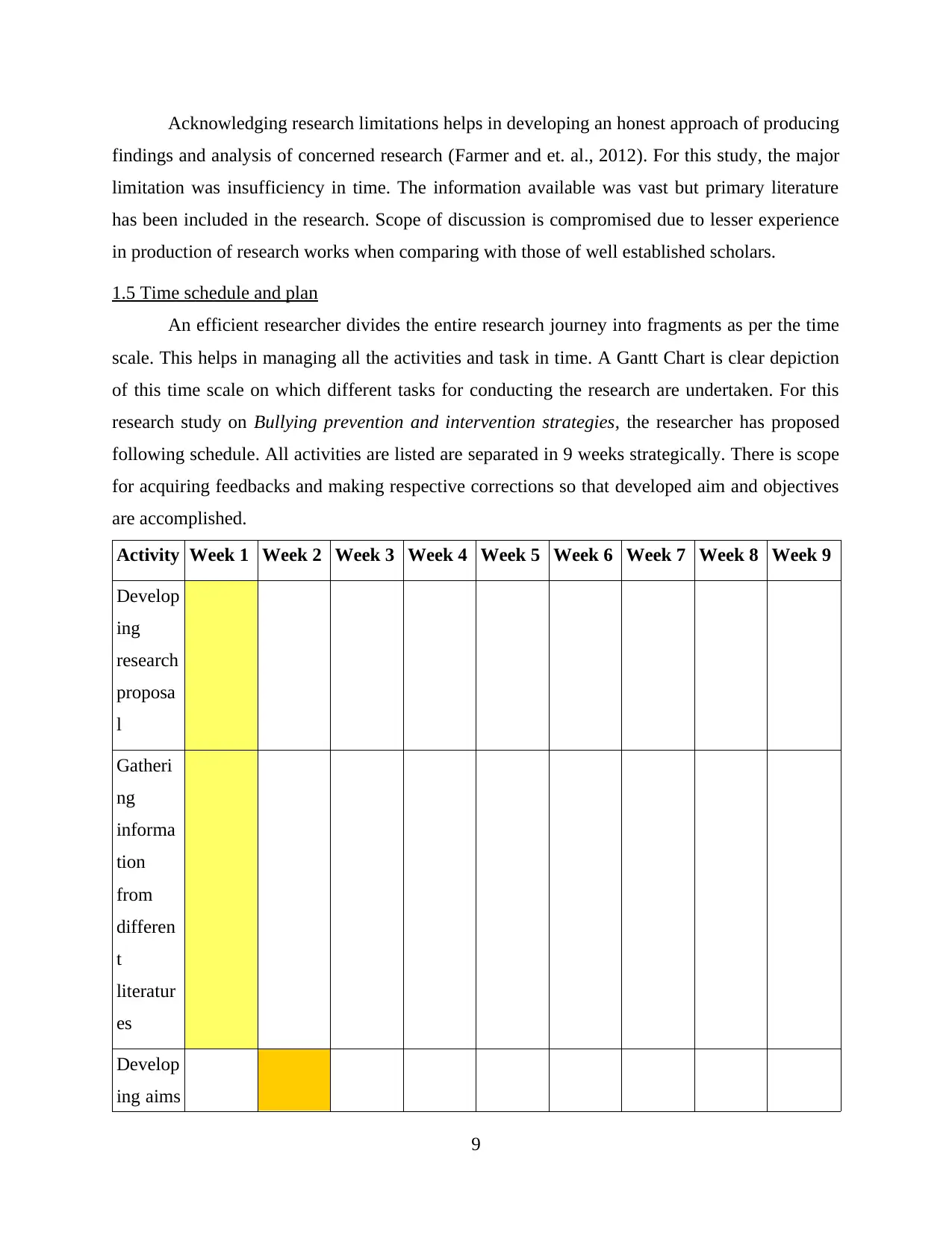
scale. This helps in managing all the activities and task in time. A Gantt Chart is clear depiction
of this time scale on which different tasks for conducting the research are undertaken. For this
research study on Bullying prevention and intervention strategies, the researcher has proposed
following schedule. All activities are listed are separated in 9 weeks strategically. There is scope
for acquiring feedbacks and making respective corrections so that developed aim and objectives
are accomplished.
Activity Week 1 Week 2 Week 3 Week 4 Week 5 Week 6 Week 7 Week 8 Week 9
Develop
ing
research
proposa
l
Gatheri
ng
informa
tion
from
differen
t
literatur
es
Develop
ing aims
9
findings and analysis of concerned research (Farmer and et. al., 2012). For this study, the major
limitation was insufficiency in time. The information available was vast but primary literature
has been included in the research. Scope of discussion is compromised due to lesser experience
in production of research works when comparing with those of well established scholars.
1.5 Time schedule and plan
An efficient researcher divides the entire research journey into fragments as per the time
scale. This helps in managing all the activities and task in time. A Gantt Chart is clear depiction
of this time scale on which different tasks for conducting the research are undertaken. For this
research study on Bullying prevention and intervention strategies, the researcher has proposed
following schedule. All activities are listed are separated in 9 weeks strategically. There is scope
for acquiring feedbacks and making respective corrections so that developed aim and objectives
are accomplished.
Activity Week 1 Week 2 Week 3 Week 4 Week 5 Week 6 Week 7 Week 8 Week 9
Develop
ing
research
proposa
l
Gatheri
ng
informa
tion
from
differen
t
literatur
es
Develop
ing aims
9
⊘ This is a preview!⊘
Do you want full access?
Subscribe today to unlock all pages.
Trusted by 1+ million students worldwide

1 out of 23


Related Documents


Your All-in-One AI-Powered Toolkit for Academic Success.
+13062052269
info@desklib.com
Available 24*7 on WhatsApp / Email
![[object Object]](/_next/static/media/star-bottom.7253800d.svg)
Unlock your academic potential
Copyright © 2020–2026 A2Z Services. All Rights Reserved. Developed and managed by ZUCOL.