An Analysis of Bureaucracy in Management and Organizational Behavior
VerifiedAdded on 2021/06/16
|10
|2941
|88
Essay
AI Summary
This essay provides a comprehensive analysis of bureaucracy in management and organizational behavior. It begins by defining bureaucracy and its role in decision-making, emphasizing the importance of structured processes and control. The essay then delves into the merits of bureaucracy, such as its ability to establish clear guidelines, facilitate efficient decision-making, and manage complex issues, leading to a smooth flow of operations. However, the essay also explores the demerits of bureaucratic systems, including reduced creativity, decreased employee empowerment, and a lack of flexibility. The essay concludes by highlighting the need for organizations to carefully evaluate the advantages and disadvantages of bureaucracy to determine its suitability for their specific needs and goals, ensuring a balance between structure and adaptability for sustainable success. The essay also covers the benefits of bureaucracy and the demerits of bureaucracy.
Running head: MANAGEMENT AND ORGANIZATIONAL BEHAVIOR 1
Name:
Institution:
Course title:
Tutor:
Date:
Name:
Institution:
Course title:
Tutor:
Date:

Paraphrase This Document
Need a fresh take? Get an instant paraphrase of this document with our AI Paraphraser
MANAGEMENT AND ORGANIZATIONAL BEHAVIOR 2
Introduction
The organizational management is required to develop a proper decision-making process
that will maximize production. The decision implemented by the business is required to consider
the vision and mission to the market. According to Francu (2014) bureaucracy in the
organization is where there is a high level of formality in the decision-making process for a
sustainable flow of the business. The formality is used to ensure that the staffs can understand
the protocol to follow in reaching the top management of the company. The procedures are tight
thus individuals should follow strictly for the accomplishment of the desired level of production.
The control command by the management provides a proper plan for the staff to follow in
dealing with issues in the market. Bureaucracy in the organization maintains the organizational
culture which is needed for proper implementation of rules and regulation for market
development (Karo & Kattel 2015). The power hierarchy is defined by the stakeholders in
providing a sustainable flow of operations in the market. The definition of prowler and
administration in the business reduces cases of confusion during the production process. The
study will evaluate the merits and demerits of implementing bureaucracy in the organization
bureaucracy in the organization.
Bureaucracy in the organization
The private and, public sectors have focused on the bureaucracy in business production
which provides proper guidelines to the employees. Formulation of power and control systems in
the business is necessary for the accomplishment of the desired production level. It is important
for an organization to focus on assigning duties to a specific group of people and evaluating their
performance after a specific period (Macdonald, Burke & Stewart 2017). The continuous
Introduction
The organizational management is required to develop a proper decision-making process
that will maximize production. The decision implemented by the business is required to consider
the vision and mission to the market. According to Francu (2014) bureaucracy in the
organization is where there is a high level of formality in the decision-making process for a
sustainable flow of the business. The formality is used to ensure that the staffs can understand
the protocol to follow in reaching the top management of the company. The procedures are tight
thus individuals should follow strictly for the accomplishment of the desired level of production.
The control command by the management provides a proper plan for the staff to follow in
dealing with issues in the market. Bureaucracy in the organization maintains the organizational
culture which is needed for proper implementation of rules and regulation for market
development (Karo & Kattel 2015). The power hierarchy is defined by the stakeholders in
providing a sustainable flow of operations in the market. The definition of prowler and
administration in the business reduces cases of confusion during the production process. The
study will evaluate the merits and demerits of implementing bureaucracy in the organization
bureaucracy in the organization.
Bureaucracy in the organization
The private and, public sectors have focused on the bureaucracy in business production
which provides proper guidelines to the employees. Formulation of power and control systems in
the business is necessary for the accomplishment of the desired production level. It is important
for an organization to focus on assigning duties to a specific group of people and evaluating their
performance after a specific period (Macdonald, Burke & Stewart 2017). The continuous
MANAGEMENT AND ORGANIZATIONAL BEHAVIOR 3
evaluation of performance in bureaucratic organizations assists in maintaining a competitive
advantage in the market. The formal operations are maintained through memos in the production
process. The memos and reports in bureaucratic organizations are used in driving the business
towards the accomplishment of desired production goals. The public sector is required to focus
on the bureaucratic system to effectively deal with the issues facing the community (Mintzberg
1996). The proper control in the systems assists in properly allocating resources to projects that
will contribute to social and economic growth. It is important for the management to identify the
plans that require priority to reduce cases of breakdown during the production process. The
public service program performance is increased through monitoring and control of the resources
in acquiring the desired profits from the project.
An organization is required to properly identify the elements of bureaucracy towards the
accomplishment of the desired production level in the market. According to Quinn et al. (2011),
it is important for the human resources to effectively allocated responsibilities to the staffs for a
high productivity level in the market. Proper staffing policies in a bureaucratic organization
assist in providing a continuous increase of operations in the industry. The duties should be
allocated based on the experience, skills, and knowledge of the individuals to enhance the
production level. The standard rules in bureaucratic organizations are uniform for all employees
towards an increase of production levels (Heifetz & Linksy, 2011). Quality is managed in the
business through the following of rules and procedures. A reputation of the company is increased
through the continuous focus on quality production practices in the market. The manufacturing
sector is ideal for implementing the bureaucracy organizational structure to reduce errors by the
staff. In the public sector, it is important to consider power and politics when implementing a
bureaucratic system to reduce conflict of interests during production (Buchanan & Badham
evaluation of performance in bureaucratic organizations assists in maintaining a competitive
advantage in the market. The formal operations are maintained through memos in the production
process. The memos and reports in bureaucratic organizations are used in driving the business
towards the accomplishment of desired production goals. The public sector is required to focus
on the bureaucratic system to effectively deal with the issues facing the community (Mintzberg
1996). The proper control in the systems assists in properly allocating resources to projects that
will contribute to social and economic growth. It is important for the management to identify the
plans that require priority to reduce cases of breakdown during the production process. The
public service program performance is increased through monitoring and control of the resources
in acquiring the desired profits from the project.
An organization is required to properly identify the elements of bureaucracy towards the
accomplishment of the desired production level in the market. According to Quinn et al. (2011),
it is important for the human resources to effectively allocated responsibilities to the staffs for a
high productivity level in the market. Proper staffing policies in a bureaucratic organization
assist in providing a continuous increase of operations in the industry. The duties should be
allocated based on the experience, skills, and knowledge of the individuals to enhance the
production level. The standard rules in bureaucratic organizations are uniform for all employees
towards an increase of production levels (Heifetz & Linksy, 2011). Quality is managed in the
business through the following of rules and procedures. A reputation of the company is increased
through the continuous focus on quality production practices in the market. The manufacturing
sector is ideal for implementing the bureaucracy organizational structure to reduce errors by the
staff. In the public sector, it is important to consider power and politics when implementing a
bureaucratic system to reduce conflict of interests during production (Buchanan & Badham
⊘ This is a preview!⊘
Do you want full access?
Subscribe today to unlock all pages.

Trusted by 1+ million students worldwide
MANAGEMENT AND ORGANIZATIONAL BEHAVIOR 4
1999). The use of experienced managers for the business assists in acquiring a high individual
and corporate performance.
Organizational behavior is considered by the management while implementing the
bureaucratic management. The valuation of organizational culture makes certain that there is a
reduced level of resistance to the set rules and restriction implemented in guiding the production
process of the organization. Walton (2005) explains the need for evaluating the bureaucratic
control practiced in the business for a continuous increase of production process. The system
requires a business to use a fixed labor division systems and administration as indicated in the
company’s policy. The general rules implemented in the business makes it hard to acquire a high
production level due to the changes in the business environment. The employees in the
bureaucratic management are required to offer a full commitment to delivering products and
services following the set rules.
Benefits of bureaucracy in the organization
The bureaucratic control is beneficial to the company through the set of rules and
regulations to follow during production. The management is required to effectively evaluate the
business environment and stakeholders’ interests in developing a proper guideline for the
business. The guidelines are used to reduce cases of errors and omission in the production
process. The errors and omissions negatively impact the performance of the business in the
market. Walton (2005), states that the control is used by the business in tracing the progress of a
project which is vital in acquiring a sustainable flow in the targeted market. The traceability of
operations in the bureaucratic management is used in identifying the need to change the
production guidelines by the business. Secondly, the employees are well provided with the
1999). The use of experienced managers for the business assists in acquiring a high individual
and corporate performance.
Organizational behavior is considered by the management while implementing the
bureaucratic management. The valuation of organizational culture makes certain that there is a
reduced level of resistance to the set rules and restriction implemented in guiding the production
process of the organization. Walton (2005) explains the need for evaluating the bureaucratic
control practiced in the business for a continuous increase of production process. The system
requires a business to use a fixed labor division systems and administration as indicated in the
company’s policy. The general rules implemented in the business makes it hard to acquire a high
production level due to the changes in the business environment. The employees in the
bureaucratic management are required to offer a full commitment to delivering products and
services following the set rules.
Benefits of bureaucracy in the organization
The bureaucratic control is beneficial to the company through the set of rules and
regulations to follow during production. The management is required to effectively evaluate the
business environment and stakeholders’ interests in developing a proper guideline for the
business. The guidelines are used to reduce cases of errors and omission in the production
process. The errors and omissions negatively impact the performance of the business in the
market. Walton (2005), states that the control is used by the business in tracing the progress of a
project which is vital in acquiring a sustainable flow in the targeted market. The traceability of
operations in the bureaucratic management is used in identifying the need to change the
production guidelines by the business. Secondly, the employees are well provided with the
Paraphrase This Document
Need a fresh take? Get an instant paraphrase of this document with our AI Paraphraser
MANAGEMENT AND ORGANIZATIONAL BEHAVIOR 5
targets to meet through the production processes. According to Moore (1995), the managers are
required to reflect on the resources available to increase the value of the business. In the public
sector, the public managers are expected to create public value through social and economic
progress in the industry. The bureaucratic control is highly dependent on the innovation and
creativity of the management to add value to the organization.
Third, bureaucratic control facilitates a fast decision-making process in production. The
management is required to identify the need for change in the industry and implement the
decision that is likely to assists in enhancing the profit margin and sales volume. It is important
for an organization to use a critical thinker for developing decisions that will positively impact
the performance of the business (Michael et al. 2014). The approach does not provide a chance
for arguments with different parties in the organization to save time in production. The evidence-
based decision making is presented to the business where the employees are expected to follow
the new policies implemented by the management. The evaluation of past models is used in
developing a plan that will increase production level in the market (Heifetz & Linksy, 2011).
Fourth is a smooth flow operation in different business layers which is needed in acquiring the
targeted production volume. The business layers are task-oriented thus providing a proper
partnership that will increase the profits. It is important for an organization to have trust with
different layers of production in dealing with various issues in the market (Garsten & Grey
2001). A proper evaluation of the culture of staff assists in developing a proper bureaucratic
control that will be widely accepted in different business units.
Fifth, the bureaucratic control is necessarily dealing with complex issues that face an
organization. The public sector is complicated requiring the management to provide staffs with
guidelines to follow for proper service delivery to the society (Mintzberg1996). The public
targets to meet through the production processes. According to Moore (1995), the managers are
required to reflect on the resources available to increase the value of the business. In the public
sector, the public managers are expected to create public value through social and economic
progress in the industry. The bureaucratic control is highly dependent on the innovation and
creativity of the management to add value to the organization.
Third, bureaucratic control facilitates a fast decision-making process in production. The
management is required to identify the need for change in the industry and implement the
decision that is likely to assists in enhancing the profit margin and sales volume. It is important
for an organization to use a critical thinker for developing decisions that will positively impact
the performance of the business (Michael et al. 2014). The approach does not provide a chance
for arguments with different parties in the organization to save time in production. The evidence-
based decision making is presented to the business where the employees are expected to follow
the new policies implemented by the management. The evaluation of past models is used in
developing a plan that will increase production level in the market (Heifetz & Linksy, 2011).
Fourth is a smooth flow operation in different business layers which is needed in acquiring the
targeted production volume. The business layers are task-oriented thus providing a proper
partnership that will increase the profits. It is important for an organization to have trust with
different layers of production in dealing with various issues in the market (Garsten & Grey
2001). A proper evaluation of the culture of staff assists in developing a proper bureaucratic
control that will be widely accepted in different business units.
Fifth, the bureaucratic control is necessarily dealing with complex issues that face an
organization. The public sector is complicated requiring the management to provide staffs with
guidelines to follow for proper service delivery to the society (Mintzberg1996). The public
MANAGEMENT AND ORGANIZATIONAL BEHAVIOR 6
employees are required to be trained and developed to deal with various issues facing the nation.
In the public sector, it is important to focus on properly distributing the resources to provide the
social and economic development in the nation. The macroeconomic goals of a nation are
achieved through the proper control of the available resources (Allen, Metternicht & Wiedmann
2016). The projects implemented by the business should positively influence the long run
performance in the market. The bureaucratic assists the management to identify the capability of
the business and employees. It is important for a business to focus on developing strategies
focusing on the ability of the staffs. The control of operations based on the capability reduces the
cases of market failure in a nation. According to Wanna and Rhodes (2007), it is the purpose of
the government to develop plans that will enhance the living standards of the citizens. The
bureaucratic control controls are used by the government to develop policies that are focused on
creating public value through effective administration.
Demerits of bureaucracy
The evaluation of the disadvantages of bureaucratic management is essential for a
business to evaluate the organizational structure. First is reduced creativity through the
implementation of the bureaucratic control system as employees are required to follow the set
rules and regulations in production. It is essential for an organization to focus on innovation and
creativity of employees in achieving the desired level of production. Kleinknecht, Kwee, and
Budyanto (2016) explain that an organization implementing the bureaucratic management is
unable to identify the full potential of staff due to the strict rules. The procedures to follow in
bureaucratic control make it hard for the staff to try new techniques that would increase the
productivity. The new ideas and methods from employees are evident in flat organizational
employees are required to be trained and developed to deal with various issues facing the nation.
In the public sector, it is important to focus on properly distributing the resources to provide the
social and economic development in the nation. The macroeconomic goals of a nation are
achieved through the proper control of the available resources (Allen, Metternicht & Wiedmann
2016). The projects implemented by the business should positively influence the long run
performance in the market. The bureaucratic assists the management to identify the capability of
the business and employees. It is important for a business to focus on developing strategies
focusing on the ability of the staffs. The control of operations based on the capability reduces the
cases of market failure in a nation. According to Wanna and Rhodes (2007), it is the purpose of
the government to develop plans that will enhance the living standards of the citizens. The
bureaucratic control controls are used by the government to develop policies that are focused on
creating public value through effective administration.
Demerits of bureaucracy
The evaluation of the disadvantages of bureaucratic management is essential for a
business to evaluate the organizational structure. First is reduced creativity through the
implementation of the bureaucratic control system as employees are required to follow the set
rules and regulations in production. It is essential for an organization to focus on innovation and
creativity of employees in achieving the desired level of production. Kleinknecht, Kwee, and
Budyanto (2016) explain that an organization implementing the bureaucratic management is
unable to identify the full potential of staff due to the strict rules. The procedures to follow in
bureaucratic control make it hard for the staff to try new techniques that would increase the
productivity. The new ideas and methods from employees are evident in flat organizational
⊘ This is a preview!⊘
Do you want full access?
Subscribe today to unlock all pages.
Trusted by 1+ million students worldwide
MANAGEMENT AND ORGANIZATIONAL BEHAVIOR 7
structures due to the reduced rules in the production process. Bardach (1977) the bureaucratic
management strict regulations hinders a continuous increase in production.
Second bureaucratic management reduces employee empowerment due to reduced
involvement in the decision-making process. It is essential for a business to focus on employee
empowerment for a continuous flow of operations in the market. The strict control provides the
top management with the mandate to develop strategies and plans for the business. According to
Michael et al. (2014), it is vital for a business to identify the needs and desires of employees in
developing a proper staffing policy. The staffing policies implemented by a business are required
to evaluate the views of employees and other stakeholders in the business for a sustainable flow
of operations (Heifetz & Linksy, 2011). Job satisfaction in the public sector is necessary through
the evaluation of staff feedback regarding labor laws implemented in the nation. Proper staffing
strategies are used in acquiring a proper production level in the market. The nation is required to
empower public officers with the aim of increasing the social development through the services
offered to the community (Fernandez & Moldogaziev 2015). The accountability in the business
in increased through the focus on empowerment of staff in the production processes. According
to Drucker (1980), public administration is required to evaluate the community needs in
developing proper rules to govern the nation.
Third, the risk of fast decision making due to bureaucratic management reduces the
effectiveness of service delivery in the organization. Garsten and Grey (2001) the management is
required to focus on increasing trust in the organization for a proper flow of the business. In the
public sector, the government is expected to develop a plan that will involve the community in
the decision-making process to reduce cases of unnecessary decisions. The fast decision making
in bureaucratic management is performed by the top management which leads to resistant to
structures due to the reduced rules in the production process. Bardach (1977) the bureaucratic
management strict regulations hinders a continuous increase in production.
Second bureaucratic management reduces employee empowerment due to reduced
involvement in the decision-making process. It is essential for a business to focus on employee
empowerment for a continuous flow of operations in the market. The strict control provides the
top management with the mandate to develop strategies and plans for the business. According to
Michael et al. (2014), it is vital for a business to identify the needs and desires of employees in
developing a proper staffing policy. The staffing policies implemented by a business are required
to evaluate the views of employees and other stakeholders in the business for a sustainable flow
of operations (Heifetz & Linksy, 2011). Job satisfaction in the public sector is necessary through
the evaluation of staff feedback regarding labor laws implemented in the nation. Proper staffing
strategies are used in acquiring a proper production level in the market. The nation is required to
empower public officers with the aim of increasing the social development through the services
offered to the community (Fernandez & Moldogaziev 2015). The accountability in the business
in increased through the focus on empowerment of staff in the production processes. According
to Drucker (1980), public administration is required to evaluate the community needs in
developing proper rules to govern the nation.
Third, the risk of fast decision making due to bureaucratic management reduces the
effectiveness of service delivery in the organization. Garsten and Grey (2001) the management is
required to focus on increasing trust in the organization for a proper flow of the business. In the
public sector, the government is expected to develop a plan that will involve the community in
the decision-making process to reduce cases of unnecessary decisions. The fast decision making
in bureaucratic management is performed by the top management which leads to resistant to
Paraphrase This Document
Need a fresh take? Get an instant paraphrase of this document with our AI Paraphraser
MANAGEMENT AND ORGANIZATIONAL BEHAVIOR 8
change in the organization. Munro and Huber (2012) require an organization to implement a
decision that makes sense to achieve the production objectives. The top management should
develop a decision considering the feedback from the employees to reduce the risk of production.
Lastly, bureaucratic control lacks flexibility which makes it hard to acquire a sustainable
competitive edge in the market. It is essential for the nation to develop laws that are flexible to
motivate social and economic development (Pettigrew 2014). The flexibility in decision-making
process aims at dealing with the future uncertainties in the market.
Conclusion
Bureaucratic management requires the staff to follow the set rules and regulation for the
achievement of desired production level. The strict rules are aimed at reducing the confusions in
the market towards a smooth flow of operations. However, in the long run, the decision making
the process by top management without considering the needs of staff reduces the ability of a
business to acquire an increased market share. Bureaucratic control reduces the flexibility in
decision making and does not focus on empowerment of employees for stable performance in the
market.
change in the organization. Munro and Huber (2012) require an organization to implement a
decision that makes sense to achieve the production objectives. The top management should
develop a decision considering the feedback from the employees to reduce the risk of production.
Lastly, bureaucratic control lacks flexibility which makes it hard to acquire a sustainable
competitive edge in the market. It is essential for the nation to develop laws that are flexible to
motivate social and economic development (Pettigrew 2014). The flexibility in decision-making
process aims at dealing with the future uncertainties in the market.
Conclusion
Bureaucratic management requires the staff to follow the set rules and regulation for the
achievement of desired production level. The strict rules are aimed at reducing the confusions in
the market towards a smooth flow of operations. However, in the long run, the decision making
the process by top management without considering the needs of staff reduces the ability of a
business to acquire an increased market share. Bureaucratic control reduces the flexibility in
decision making and does not focus on empowerment of employees for stable performance in the
market.
MANAGEMENT AND ORGANIZATIONAL BEHAVIOR 9
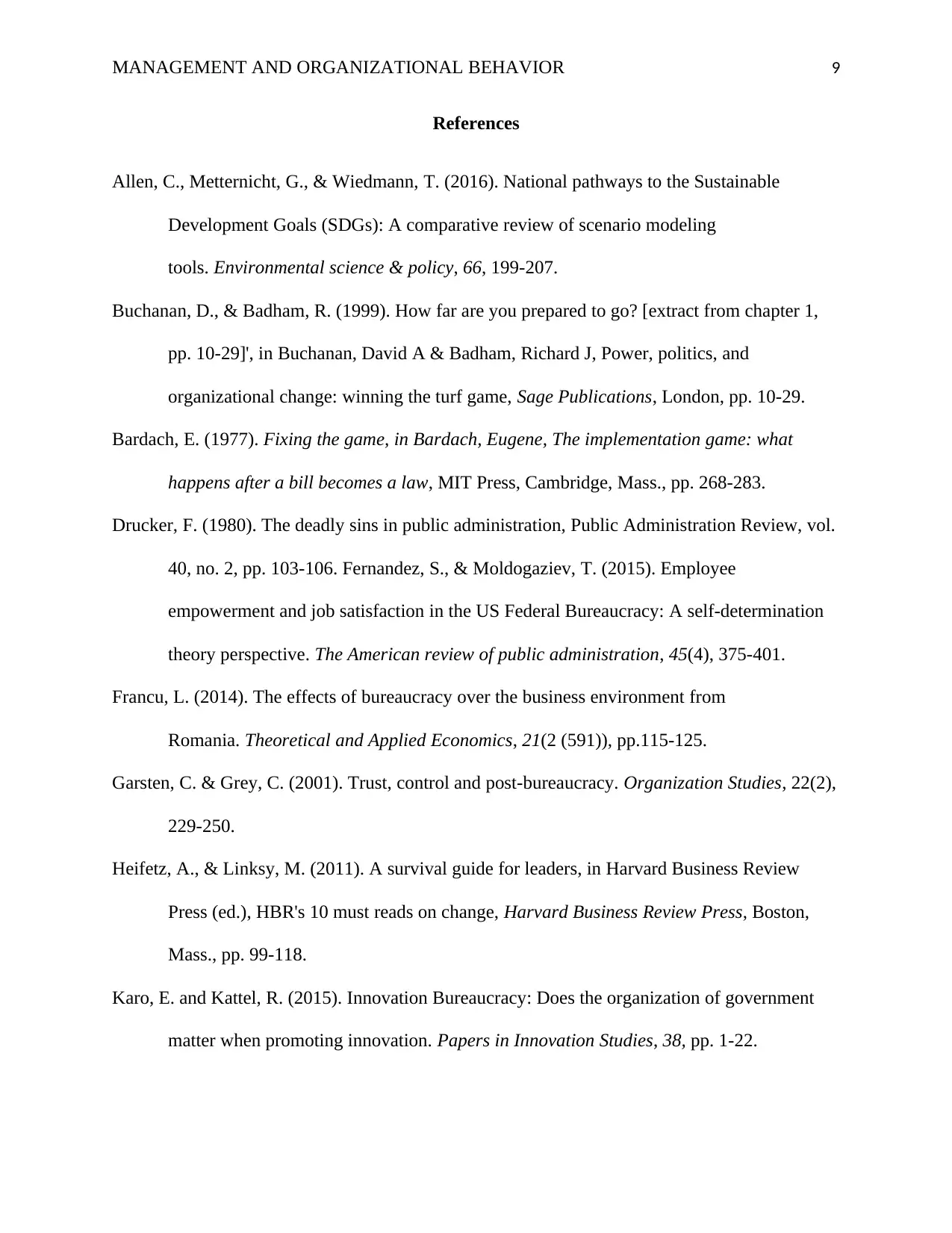
References
Allen, C., Metternicht, G., & Wiedmann, T. (2016). National pathways to the Sustainable
Development Goals (SDGs): A comparative review of scenario modeling
tools. Environmental science & policy, 66, 199-207.
Buchanan, D., & Badham, R. (1999). How far are you prepared to go? [extract from chapter 1,
pp. 10-29]', in Buchanan, David A & Badham, Richard J, Power, politics, and
organizational change: winning the turf game, Sage Publications, London, pp. 10-29.
Bardach, E. (1977). Fixing the game, in Bardach, Eugene, The implementation game: what
happens after a bill becomes a law, MIT Press, Cambridge, Mass., pp. 268-283.
Drucker, F. (1980). The deadly sins in public administration, Public Administration Review, vol.
40, no. 2, pp. 103-106. Fernandez, S., & Moldogaziev, T. (2015). Employee
empowerment and job satisfaction in the US Federal Bureaucracy: A self-determination
theory perspective. The American review of public administration, 45(4), 375-401.
Francu, L. (2014). The effects of bureaucracy over the business environment from
Romania. Theoretical and Applied Economics, 21(2 (591)), pp.115-125.
Garsten, C. & Grey, C. (2001). Trust, control and post-bureaucracy. Organization Studies, 22(2),
229-250.
Heifetz, A., & Linksy, M. (2011). A survival guide for leaders, in Harvard Business Review
Press (ed.), HBR's 10 must reads on change, Harvard Business Review Press, Boston,
Mass., pp. 99-118.
Karo, E. and Kattel, R. (2015). Innovation Bureaucracy: Does the organization of government
matter when promoting innovation. Papers in Innovation Studies, 38, pp. 1-22.
References
Allen, C., Metternicht, G., & Wiedmann, T. (2016). National pathways to the Sustainable
Development Goals (SDGs): A comparative review of scenario modeling
tools. Environmental science & policy, 66, 199-207.
Buchanan, D., & Badham, R. (1999). How far are you prepared to go? [extract from chapter 1,
pp. 10-29]', in Buchanan, David A & Badham, Richard J, Power, politics, and
organizational change: winning the turf game, Sage Publications, London, pp. 10-29.
Bardach, E. (1977). Fixing the game, in Bardach, Eugene, The implementation game: what
happens after a bill becomes a law, MIT Press, Cambridge, Mass., pp. 268-283.
Drucker, F. (1980). The deadly sins in public administration, Public Administration Review, vol.
40, no. 2, pp. 103-106. Fernandez, S., & Moldogaziev, T. (2015). Employee
empowerment and job satisfaction in the US Federal Bureaucracy: A self-determination
theory perspective. The American review of public administration, 45(4), 375-401.
Francu, L. (2014). The effects of bureaucracy over the business environment from
Romania. Theoretical and Applied Economics, 21(2 (591)), pp.115-125.
Garsten, C. & Grey, C. (2001). Trust, control and post-bureaucracy. Organization Studies, 22(2),
229-250.
Heifetz, A., & Linksy, M. (2011). A survival guide for leaders, in Harvard Business Review
Press (ed.), HBR's 10 must reads on change, Harvard Business Review Press, Boston,
Mass., pp. 99-118.
Karo, E. and Kattel, R. (2015). Innovation Bureaucracy: Does the organization of government
matter when promoting innovation. Papers in Innovation Studies, 38, pp. 1-22.
⊘ This is a preview!⊘
Do you want full access?
Subscribe today to unlock all pages.
Trusted by 1+ million students worldwide
MANAGEMENT AND ORGANIZATIONAL BEHAVIOR 10
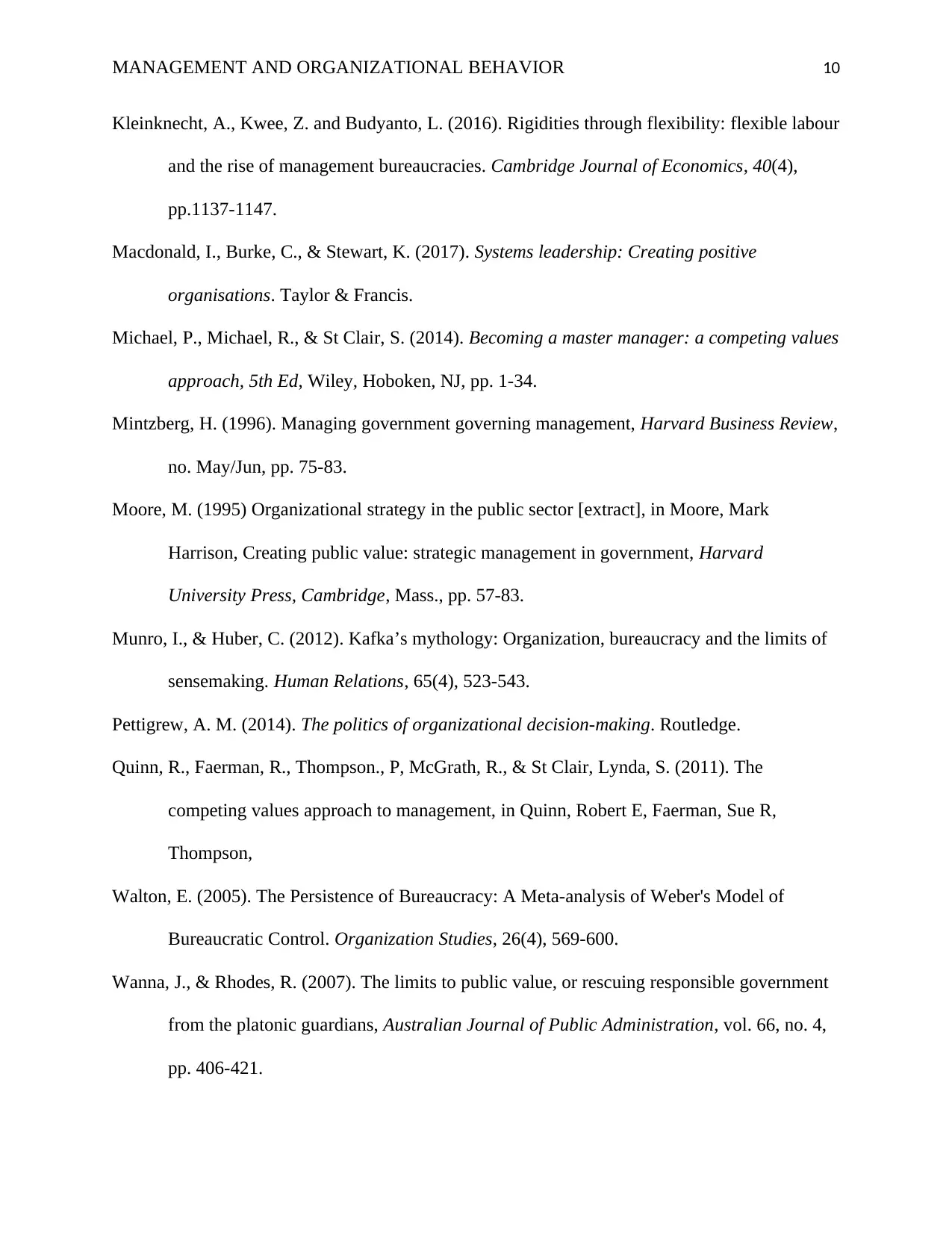
Kleinknecht, A., Kwee, Z. and Budyanto, L. (2016). Rigidities through flexibility: flexible labour
and the rise of management bureaucracies. Cambridge Journal of Economics, 40(4),
pp.1137-1147.
Macdonald, I., Burke, C., & Stewart, K. (2017). Systems leadership: Creating positive
organisations. Taylor & Francis.
Michael, P., Michael, R., & St Clair, S. (2014). Becoming a master manager: a competing values
approach, 5th Ed, Wiley, Hoboken, NJ, pp. 1-34.
Mintzberg, H. (1996). Managing government governing management, Harvard Business Review,
no. May/Jun, pp. 75-83.
Moore, M. (1995) Organizational strategy in the public sector [extract], in Moore, Mark
Harrison, Creating public value: strategic management in government, Harvard
University Press, Cambridge, Mass., pp. 57-83.
Munro, I., & Huber, C. (2012). Kafka’s mythology: Organization, bureaucracy and the limits of
sensemaking. Human Relations, 65(4), 523-543.
Pettigrew, A. M. (2014). The politics of organizational decision-making. Routledge.
Quinn, R., Faerman, R., Thompson., P, McGrath, R., & St Clair, Lynda, S. (2011). The
competing values approach to management, in Quinn, Robert E, Faerman, Sue R,
Thompson,
Walton, E. (2005). The Persistence of Bureaucracy: A Meta-analysis of Weber's Model of
Bureaucratic Control. Organization Studies, 26(4), 569-600.
Wanna, J., & Rhodes, R. (2007). The limits to public value, or rescuing responsible government
from the platonic guardians, Australian Journal of Public Administration, vol. 66, no. 4,
pp. 406-421.
Kleinknecht, A., Kwee, Z. and Budyanto, L. (2016). Rigidities through flexibility: flexible labour
and the rise of management bureaucracies. Cambridge Journal of Economics, 40(4),
pp.1137-1147.
Macdonald, I., Burke, C., & Stewart, K. (2017). Systems leadership: Creating positive
organisations. Taylor & Francis.
Michael, P., Michael, R., & St Clair, S. (2014). Becoming a master manager: a competing values
approach, 5th Ed, Wiley, Hoboken, NJ, pp. 1-34.
Mintzberg, H. (1996). Managing government governing management, Harvard Business Review,
no. May/Jun, pp. 75-83.
Moore, M. (1995) Organizational strategy in the public sector [extract], in Moore, Mark
Harrison, Creating public value: strategic management in government, Harvard
University Press, Cambridge, Mass., pp. 57-83.
Munro, I., & Huber, C. (2012). Kafka’s mythology: Organization, bureaucracy and the limits of
sensemaking. Human Relations, 65(4), 523-543.
Pettigrew, A. M. (2014). The politics of organizational decision-making. Routledge.
Quinn, R., Faerman, R., Thompson., P, McGrath, R., & St Clair, Lynda, S. (2011). The
competing values approach to management, in Quinn, Robert E, Faerman, Sue R,
Thompson,
Walton, E. (2005). The Persistence of Bureaucracy: A Meta-analysis of Weber's Model of
Bureaucratic Control. Organization Studies, 26(4), 569-600.
Wanna, J., & Rhodes, R. (2007). The limits to public value, or rescuing responsible government
from the platonic guardians, Australian Journal of Public Administration, vol. 66, no. 4,
pp. 406-421.

1 out of 10


Related Documents


Your All-in-One AI-Powered Toolkit for Academic Success.
+13062052269
info@desklib.com
Available 24*7 on WhatsApp / Email
![[object Object]](/_next/static/media/star-bottom.7253800d.svg)
Unlock your academic potential
Copyright © 2020–2026 A2Z Services. All Rights Reserved. Developed and managed by ZUCOL.