NSB026: Case Study Analysis: Burkitt's Lymphoma Nursing Practice
VerifiedAdded on 2020/03/01
|4
|1625
|40
Case Study
AI Summary
This case study presents a detailed analysis of a patient diagnosed with immunodeficiency-associated Burkitt's Lymphoma, a form of Non-Hodgkin's Lymphoma. The case explores the patient's presentation, including symptoms like abdominal pain, nausea, and the progression of the disease, including the involvement of multiple organs. It highlights the nursing assessment, clinical priorities such as pain and anxiety management, and the interventions implemented, including chemotherapy, pain medication, and supportive care. The study also addresses the patient's anxiety related to the diagnosis and the impact of HIV and HAART therapy. Evaluation of the interventions reveals the challenges in managing the aggressive lymphoma and the importance of early diagnosis. The case study concludes with reflective points on the disease, social stigma, and the significance of early detection and intervention for improving patient outcomes, emphasizing the need for continued vigilance and comprehensive care in managing Burkitt's Lymphoma.
NSB026: Nursing Practice Capstone Insert student name and number here
Insert tutorial class time and tutor name here
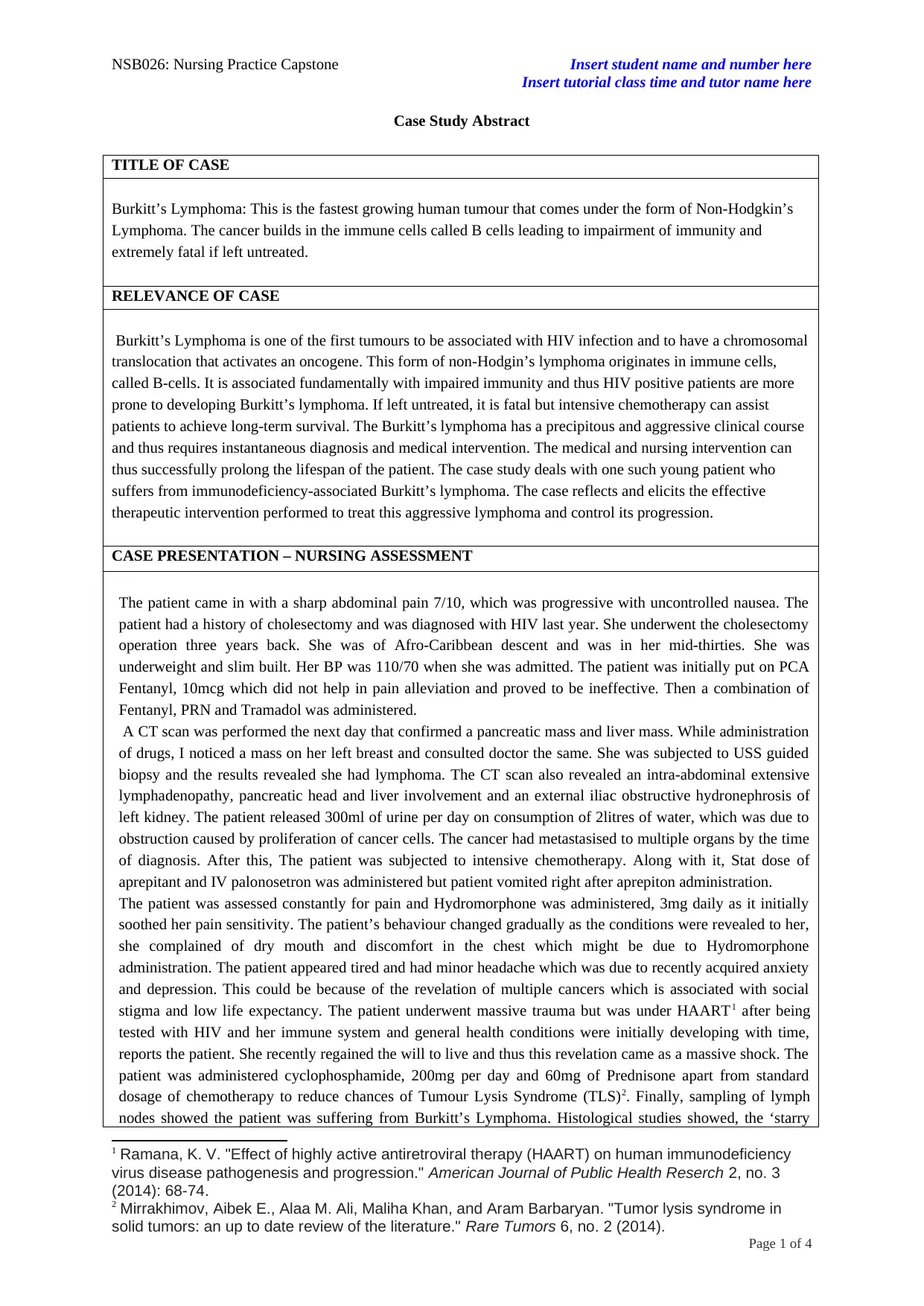
Case Study Abstract
TITLE OF CASE
Burkitt’s Lymphoma: This is the fastest growing human tumour that comes under the form of Non-Hodgkin’s
Lymphoma. The cancer builds in the immune cells called B cells leading to impairment of immunity and
extremely fatal if left untreated.
RELEVANCE OF CASE
Burkitt’s Lymphoma is one of the first tumours to be associated with HIV infection and to have a chromosomal
translocation that activates an oncogene. This form of non-Hodgin’s lymphoma originates in immune cells,
called B-cells. It is associated fundamentally with impaired immunity and thus HIV positive patients are more
prone to developing Burkitt’s lymphoma. If left untreated, it is fatal but intensive chemotherapy can assist
patients to achieve long-term survival. The Burkitt’s lymphoma has a precipitous and aggressive clinical course
and thus requires instantaneous diagnosis and medical intervention. The medical and nursing intervention can
thus successfully prolong the lifespan of the patient. The case study deals with one such young patient who
suffers from immunodeficiency-associated Burkitt’s lymphoma. The case reflects and elicits the effective
therapeutic intervention performed to treat this aggressive lymphoma and control its progression.
CASE PRESENTATION – NURSING ASSESSMENT
The patient came in with a sharp abdominal pain 7/10, which was progressive with uncontrolled nausea. The
patient had a history of cholesectomy and was diagnosed with HIV last year. She underwent the cholesectomy
operation three years back. She was of Afro-Caribbean descent and was in her mid-thirties. She was
underweight and slim built. Her BP was 110/70 when she was admitted. The patient was initially put on PCA
Fentanyl, 10mcg which did not help in pain alleviation and proved to be ineffective. Then a combination of
Fentanyl, PRN and Tramadol was administered.
A CT scan was performed the next day that confirmed a pancreatic mass and liver mass. While administration
of drugs, I noticed a mass on her left breast and consulted doctor the same. She was subjected to USS guided
biopsy and the results revealed she had lymphoma. The CT scan also revealed an intra-abdominal extensive
lymphadenopathy, pancreatic head and liver involvement and an external iliac obstructive hydronephrosis of
left kidney. The patient released 300ml of urine per day on consumption of 2litres of water, which was due to
obstruction caused by proliferation of cancer cells. The cancer had metastasised to multiple organs by the time
of diagnosis. After this, The patient was subjected to intensive chemotherapy. Along with it, Stat dose of
aprepitant and IV palonosetron was administered but patient vomited right after aprepiton administration.
The patient was assessed constantly for pain and Hydromorphone was administered, 3mg daily as it initially
soothed her pain sensitivity. The patient’s behaviour changed gradually as the conditions were revealed to her,
she complained of dry mouth and discomfort in the chest which might be due to Hydromorphone
administration. The patient appeared tired and had minor headache which was due to recently acquired anxiety
and depression. This could be because of the revelation of multiple cancers which is associated with social
stigma and low life expectancy. The patient underwent massive trauma but was under HAART1 after being
tested with HIV and her immune system and general health conditions were initially developing with time,
reports the patient. She recently regained the will to live and thus this revelation came as a massive shock. The
patient was administered cyclophosphamide, 200mg per day and 60mg of Prednisone apart from standard
dosage of chemotherapy to reduce chances of Tumour Lysis Syndrome (TLS)2. Finally, sampling of lymph
nodes showed the patient was suffering from Burkitt’s Lymphoma. Histological studies showed, the ‘starry
1 Ramana, K. V. "Effect of highly active antiretroviral therapy (HAART) on human immunodeficiency
virus disease pathogenesis and progression." American Journal of Public Health Reserch 2, no. 3
(2014): 68-74.
2 Mirrakhimov, Aibek E., Alaa M. Ali, Maliha Khan, and Aram Barbaryan. "Tumor lysis syndrome in
solid tumors: an up to date review of the literature." Rare Tumors 6, no. 2 (2014).
Page 1 of 4
Insert tutorial class time and tutor name here
Case Study Abstract
TITLE OF CASE
Burkitt’s Lymphoma: This is the fastest growing human tumour that comes under the form of Non-Hodgkin’s
Lymphoma. The cancer builds in the immune cells called B cells leading to impairment of immunity and
extremely fatal if left untreated.
RELEVANCE OF CASE
Burkitt’s Lymphoma is one of the first tumours to be associated with HIV infection and to have a chromosomal
translocation that activates an oncogene. This form of non-Hodgin’s lymphoma originates in immune cells,
called B-cells. It is associated fundamentally with impaired immunity and thus HIV positive patients are more
prone to developing Burkitt’s lymphoma. If left untreated, it is fatal but intensive chemotherapy can assist
patients to achieve long-term survival. The Burkitt’s lymphoma has a precipitous and aggressive clinical course
and thus requires instantaneous diagnosis and medical intervention. The medical and nursing intervention can
thus successfully prolong the lifespan of the patient. The case study deals with one such young patient who
suffers from immunodeficiency-associated Burkitt’s lymphoma. The case reflects and elicits the effective
therapeutic intervention performed to treat this aggressive lymphoma and control its progression.
CASE PRESENTATION – NURSING ASSESSMENT
The patient came in with a sharp abdominal pain 7/10, which was progressive with uncontrolled nausea. The
patient had a history of cholesectomy and was diagnosed with HIV last year. She underwent the cholesectomy
operation three years back. She was of Afro-Caribbean descent and was in her mid-thirties. She was
underweight and slim built. Her BP was 110/70 when she was admitted. The patient was initially put on PCA
Fentanyl, 10mcg which did not help in pain alleviation and proved to be ineffective. Then a combination of
Fentanyl, PRN and Tramadol was administered.
A CT scan was performed the next day that confirmed a pancreatic mass and liver mass. While administration
of drugs, I noticed a mass on her left breast and consulted doctor the same. She was subjected to USS guided
biopsy and the results revealed she had lymphoma. The CT scan also revealed an intra-abdominal extensive
lymphadenopathy, pancreatic head and liver involvement and an external iliac obstructive hydronephrosis of
left kidney. The patient released 300ml of urine per day on consumption of 2litres of water, which was due to
obstruction caused by proliferation of cancer cells. The cancer had metastasised to multiple organs by the time
of diagnosis. After this, The patient was subjected to intensive chemotherapy. Along with it, Stat dose of
aprepitant and IV palonosetron was administered but patient vomited right after aprepiton administration.
The patient was assessed constantly for pain and Hydromorphone was administered, 3mg daily as it initially
soothed her pain sensitivity. The patient’s behaviour changed gradually as the conditions were revealed to her,
she complained of dry mouth and discomfort in the chest which might be due to Hydromorphone
administration. The patient appeared tired and had minor headache which was due to recently acquired anxiety
and depression. This could be because of the revelation of multiple cancers which is associated with social
stigma and low life expectancy. The patient underwent massive trauma but was under HAART1 after being
tested with HIV and her immune system and general health conditions were initially developing with time,
reports the patient. She recently regained the will to live and thus this revelation came as a massive shock. The
patient was administered cyclophosphamide, 200mg per day and 60mg of Prednisone apart from standard
dosage of chemotherapy to reduce chances of Tumour Lysis Syndrome (TLS)2. Finally, sampling of lymph
nodes showed the patient was suffering from Burkitt’s Lymphoma. Histological studies showed, the ‘starry
1 Ramana, K. V. "Effect of highly active antiretroviral therapy (HAART) on human immunodeficiency
virus disease pathogenesis and progression." American Journal of Public Health Reserch 2, no. 3
(2014): 68-74.
2 Mirrakhimov, Aibek E., Alaa M. Ali, Maliha Khan, and Aram Barbaryan. "Tumor lysis syndrome in
solid tumors: an up to date review of the literature." Rare Tumors 6, no. 2 (2014).
Page 1 of 4

Paraphrase This Document
Need a fresh take? Get an instant paraphrase of this document with our AI Paraphraser
NSB026: Nursing Practice Capstone Insert student name and number here
Insert tutorial class time and tutor name here
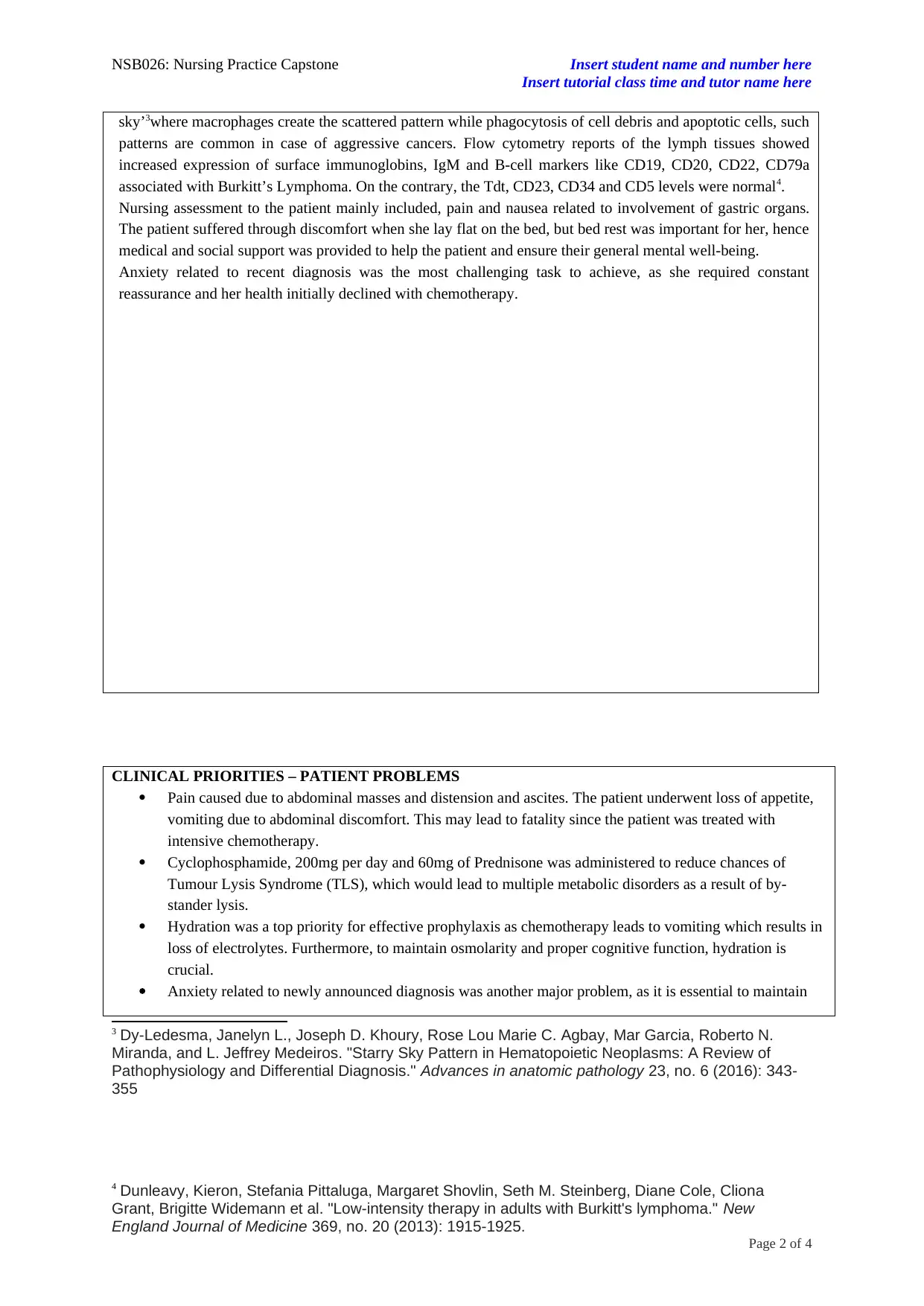
sky’3where macrophages create the scattered pattern while phagocytosis of cell debris and apoptotic cells, such
patterns are common in case of aggressive cancers. Flow cytometry reports of the lymph tissues showed
increased expression of surface immunoglobins, IgM and B-cell markers like CD19, CD20, CD22, CD79a
associated with Burkitt’s Lymphoma. On the contrary, the Tdt, CD23, CD34 and CD5 levels were normal4.
Nursing assessment to the patient mainly included, pain and nausea related to involvement of gastric organs.
The patient suffered through discomfort when she lay flat on the bed, but bed rest was important for her, hence
medical and social support was provided to help the patient and ensure their general mental well-being.
Anxiety related to recent diagnosis was the most challenging task to achieve, as she required constant
reassurance and her health initially declined with chemotherapy.
CLINICAL PRIORITIES – PATIENT PROBLEMS
Pain caused due to abdominal masses and distension and ascites. The patient underwent loss of appetite,
vomiting due to abdominal discomfort. This may lead to fatality since the patient was treated with
intensive chemotherapy.
Cyclophosphamide, 200mg per day and 60mg of Prednisone was administered to reduce chances of
Tumour Lysis Syndrome (TLS), which would lead to multiple metabolic disorders as a result of by-
stander lysis.
Hydration was a top priority for effective prophylaxis as chemotherapy leads to vomiting which results in
loss of electrolytes. Furthermore, to maintain osmolarity and proper cognitive function, hydration is
crucial.
Anxiety related to newly announced diagnosis was another major problem, as it is essential to maintain
3 Dy-Ledesma, Janelyn L., Joseph D. Khoury, Rose Lou Marie C. Agbay, Mar Garcia, Roberto N.
Miranda, and L. Jeffrey Medeiros. "Starry Sky Pattern in Hematopoietic Neoplasms: A Review of
Pathophysiology and Differential Diagnosis." Advances in anatomic pathology 23, no. 6 (2016): 343-
355
4 Dunleavy, Kieron, Stefania Pittaluga, Margaret Shovlin, Seth M. Steinberg, Diane Cole, Cliona
Grant, Brigitte Widemann et al. "Low-intensity therapy in adults with Burkitt's lymphoma." New
England Journal of Medicine 369, no. 20 (2013): 1915-1925.
Page 2 of 4
Insert tutorial class time and tutor name here
sky’3where macrophages create the scattered pattern while phagocytosis of cell debris and apoptotic cells, such
patterns are common in case of aggressive cancers. Flow cytometry reports of the lymph tissues showed
increased expression of surface immunoglobins, IgM and B-cell markers like CD19, CD20, CD22, CD79a
associated with Burkitt’s Lymphoma. On the contrary, the Tdt, CD23, CD34 and CD5 levels were normal4.
Nursing assessment to the patient mainly included, pain and nausea related to involvement of gastric organs.
The patient suffered through discomfort when she lay flat on the bed, but bed rest was important for her, hence
medical and social support was provided to help the patient and ensure their general mental well-being.
Anxiety related to recent diagnosis was the most challenging task to achieve, as she required constant
reassurance and her health initially declined with chemotherapy.
CLINICAL PRIORITIES – PATIENT PROBLEMS
Pain caused due to abdominal masses and distension and ascites. The patient underwent loss of appetite,
vomiting due to abdominal discomfort. This may lead to fatality since the patient was treated with
intensive chemotherapy.
Cyclophosphamide, 200mg per day and 60mg of Prednisone was administered to reduce chances of
Tumour Lysis Syndrome (TLS), which would lead to multiple metabolic disorders as a result of by-
stander lysis.
Hydration was a top priority for effective prophylaxis as chemotherapy leads to vomiting which results in
loss of electrolytes. Furthermore, to maintain osmolarity and proper cognitive function, hydration is
crucial.
Anxiety related to newly announced diagnosis was another major problem, as it is essential to maintain
3 Dy-Ledesma, Janelyn L., Joseph D. Khoury, Rose Lou Marie C. Agbay, Mar Garcia, Roberto N.
Miranda, and L. Jeffrey Medeiros. "Starry Sky Pattern in Hematopoietic Neoplasms: A Review of
Pathophysiology and Differential Diagnosis." Advances in anatomic pathology 23, no. 6 (2016): 343-
355
4 Dunleavy, Kieron, Stefania Pittaluga, Margaret Shovlin, Seth M. Steinberg, Diane Cole, Cliona
Grant, Brigitte Widemann et al. "Low-intensity therapy in adults with Burkitt's lymphoma." New
England Journal of Medicine 369, no. 20 (2013): 1915-1925.
Page 2 of 4
NSB026: Nursing Practice Capstone Insert student name and number here
Insert tutorial class time and tutor name here
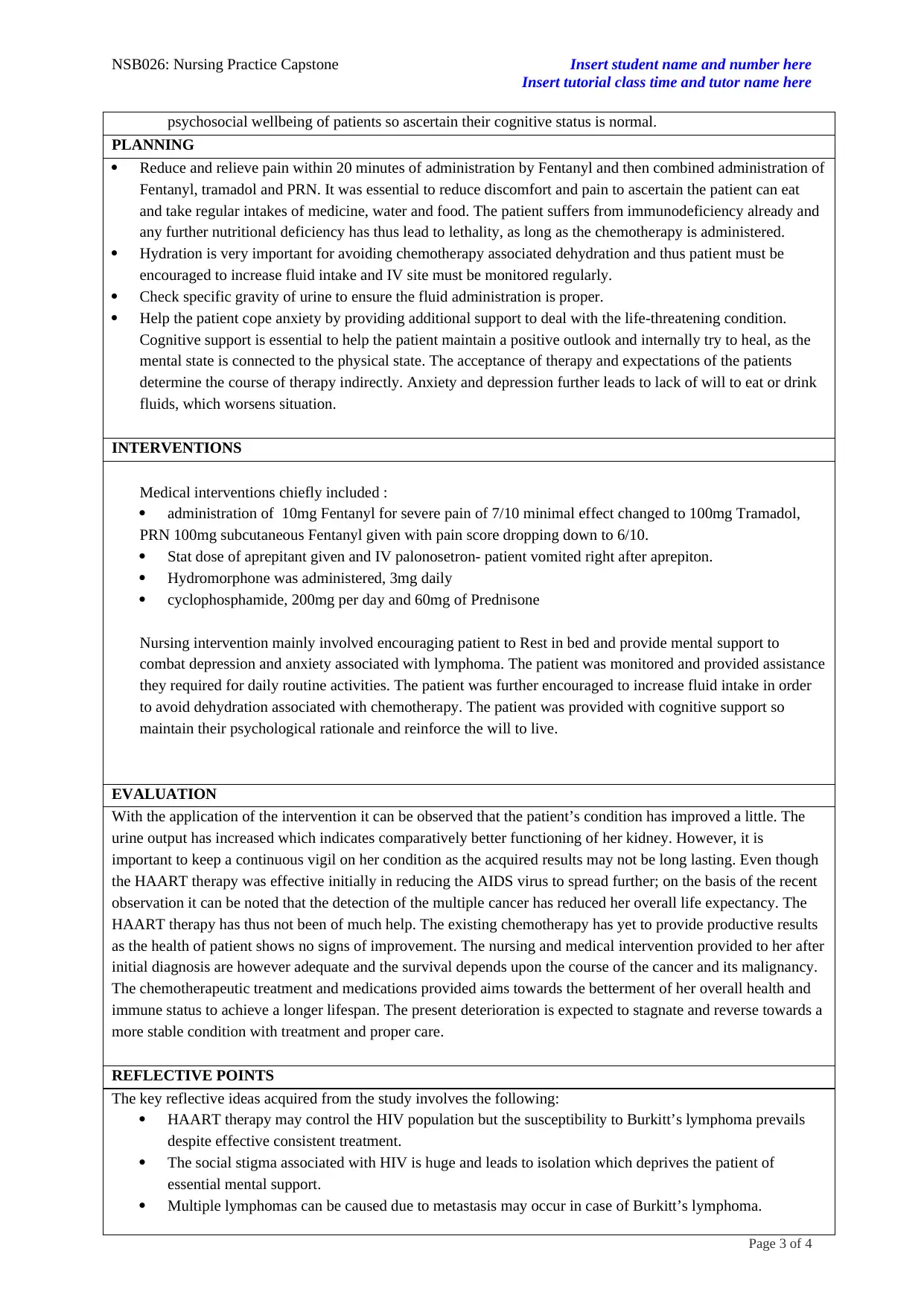
psychosocial wellbeing of patients so ascertain their cognitive status is normal.
PLANNING
Reduce and relieve pain within 20 minutes of administration by Fentanyl and then combined administration of
Fentanyl, tramadol and PRN. It was essential to reduce discomfort and pain to ascertain the patient can eat
and take regular intakes of medicine, water and food. The patient suffers from immunodeficiency already and
any further nutritional deficiency has thus lead to lethality, as long as the chemotherapy is administered.
Hydration is very important for avoiding chemotherapy associated dehydration and thus patient must be
encouraged to increase fluid intake and IV site must be monitored regularly.
Check specific gravity of urine to ensure the fluid administration is proper.
Help the patient cope anxiety by providing additional support to deal with the life-threatening condition.
Cognitive support is essential to help the patient maintain a positive outlook and internally try to heal, as the
mental state is connected to the physical state. The acceptance of therapy and expectations of the patients
determine the course of therapy indirectly. Anxiety and depression further leads to lack of will to eat or drink
fluids, which worsens situation.
INTERVENTIONS
Medical interventions chiefly included :
administration of 10mg Fentanyl for severe pain of 7/10 minimal effect changed to 100mg Tramadol,
PRN 100mg subcutaneous Fentanyl given with pain score dropping down to 6/10.
Stat dose of aprepitant given and IV palonosetron- patient vomited right after aprepiton.
Hydromorphone was administered, 3mg daily
cyclophosphamide, 200mg per day and 60mg of Prednisone
Nursing intervention mainly involved encouraging patient to Rest in bed and provide mental support to
combat depression and anxiety associated with lymphoma. The patient was monitored and provided assistance
they required for daily routine activities. The patient was further encouraged to increase fluid intake in order
to avoid dehydration associated with chemotherapy. The patient was provided with cognitive support so
maintain their psychological rationale and reinforce the will to live.
EVALUATION
With the application of the intervention it can be observed that the patient’s condition has improved a little. The
urine output has increased which indicates comparatively better functioning of her kidney. However, it is
important to keep a continuous vigil on her condition as the acquired results may not be long lasting. Even though
the HAART therapy was effective initially in reducing the AIDS virus to spread further; on the basis of the recent
observation it can be noted that the detection of the multiple cancer has reduced her overall life expectancy. The
HAART therapy has thus not been of much help. The existing chemotherapy has yet to provide productive results
as the health of patient shows no signs of improvement. The nursing and medical intervention provided to her after
initial diagnosis are however adequate and the survival depends upon the course of the cancer and its malignancy.
The chemotherapeutic treatment and medications provided aims towards the betterment of her overall health and
immune status to achieve a longer lifespan. The present deterioration is expected to stagnate and reverse towards a
more stable condition with treatment and proper care.
REFLECTIVE POINTS
The key reflective ideas acquired from the study involves the following:
HAART therapy may control the HIV population but the susceptibility to Burkitt’s lymphoma prevails
despite effective consistent treatment.
The social stigma associated with HIV is huge and leads to isolation which deprives the patient of
essential mental support.
Multiple lymphomas can be caused due to metastasis may occur in case of Burkitt’s lymphoma.
Page 3 of 4
Insert tutorial class time and tutor name here
psychosocial wellbeing of patients so ascertain their cognitive status is normal.
PLANNING
Reduce and relieve pain within 20 minutes of administration by Fentanyl and then combined administration of
Fentanyl, tramadol and PRN. It was essential to reduce discomfort and pain to ascertain the patient can eat
and take regular intakes of medicine, water and food. The patient suffers from immunodeficiency already and
any further nutritional deficiency has thus lead to lethality, as long as the chemotherapy is administered.
Hydration is very important for avoiding chemotherapy associated dehydration and thus patient must be
encouraged to increase fluid intake and IV site must be monitored regularly.
Check specific gravity of urine to ensure the fluid administration is proper.
Help the patient cope anxiety by providing additional support to deal with the life-threatening condition.
Cognitive support is essential to help the patient maintain a positive outlook and internally try to heal, as the
mental state is connected to the physical state. The acceptance of therapy and expectations of the patients
determine the course of therapy indirectly. Anxiety and depression further leads to lack of will to eat or drink
fluids, which worsens situation.
INTERVENTIONS
Medical interventions chiefly included :
administration of 10mg Fentanyl for severe pain of 7/10 minimal effect changed to 100mg Tramadol,
PRN 100mg subcutaneous Fentanyl given with pain score dropping down to 6/10.
Stat dose of aprepitant given and IV palonosetron- patient vomited right after aprepiton.
Hydromorphone was administered, 3mg daily
cyclophosphamide, 200mg per day and 60mg of Prednisone
Nursing intervention mainly involved encouraging patient to Rest in bed and provide mental support to
combat depression and anxiety associated with lymphoma. The patient was monitored and provided assistance
they required for daily routine activities. The patient was further encouraged to increase fluid intake in order
to avoid dehydration associated with chemotherapy. The patient was provided with cognitive support so
maintain their psychological rationale and reinforce the will to live.
EVALUATION
With the application of the intervention it can be observed that the patient’s condition has improved a little. The
urine output has increased which indicates comparatively better functioning of her kidney. However, it is
important to keep a continuous vigil on her condition as the acquired results may not be long lasting. Even though
the HAART therapy was effective initially in reducing the AIDS virus to spread further; on the basis of the recent
observation it can be noted that the detection of the multiple cancer has reduced her overall life expectancy. The
HAART therapy has thus not been of much help. The existing chemotherapy has yet to provide productive results
as the health of patient shows no signs of improvement. The nursing and medical intervention provided to her after
initial diagnosis are however adequate and the survival depends upon the course of the cancer and its malignancy.
The chemotherapeutic treatment and medications provided aims towards the betterment of her overall health and
immune status to achieve a longer lifespan. The present deterioration is expected to stagnate and reverse towards a
more stable condition with treatment and proper care.
REFLECTIVE POINTS
The key reflective ideas acquired from the study involves the following:
HAART therapy may control the HIV population but the susceptibility to Burkitt’s lymphoma prevails
despite effective consistent treatment.
The social stigma associated with HIV is huge and leads to isolation which deprives the patient of
essential mental support.
Multiple lymphomas can be caused due to metastasis may occur in case of Burkitt’s lymphoma.
Page 3 of 4
⊘ This is a preview!⊘
Do you want full access?
Subscribe today to unlock all pages.

Trusted by 1+ million students worldwide

NSB026: Nursing Practice Capstone Insert student name and number here
Insert tutorial class time and tutor name here
It is essential to notice initial signs to increase probability of survival, had she been diagnosed before
metasis, a localised cancer could have been controlled better.
Page 4 of 4
Insert tutorial class time and tutor name here
It is essential to notice initial signs to increase probability of survival, had she been diagnosed before
metasis, a localised cancer could have been controlled better.
Page 4 of 4

1 out of 4


Your All-in-One AI-Powered Toolkit for Academic Success.
+13062052269
info@desklib.com
Available 24*7 on WhatsApp / Email
![[object Object]](/_next/static/media/star-bottom.7253800d.svg)
Unlock your academic potential
Copyright © 2020–2026 A2Z Services. All Rights Reserved. Developed and managed by ZUCOL.