In-depth Report: Systematic Review of Burnout Among Oncology Nurses
VerifiedAdded on 2023/06/07
|12
|3150
|277
Report
AI Summary
This assignment provides a comprehensive analysis of a systematic review investigating the prevalence, risk factors, and levels of burnout among oncology nurses. The report uses the JBI critique tool to evaluate the review's methodology, including the clarity of the research question, appropriateness of inclusion criteria, search strategy, and appraisal methods. It examines the review's effectiveness in assessing emotional exhaustion, depersonalization, and personal accomplishment among oncology nurses. The critique identifies strengths such as the use of multiple reviewers and appropriate databases but also points out limitations like the lack of specific search terms, absence of meta-analysis, and failure to provide concrete recommendations for policy or future research. The assignment concludes that while the review identifies key reasons for burnout, it lacks robust data support for recommendations and fails to identify clear avenues for further investigation. Desklib offers similar solved assignments and resources for students.
Running head: NURSING ASSIGNMENT
NURSING ASSIGNMENT
Name of the Student:
Name of the University:
Author Note:
NURSING ASSIGNMENT
Name of the Student:
Name of the University:
Author Note:

Paraphrase This Document
Need a fresh take? Get an instant paraphrase of this document with our AI Paraphraser
1NURSING ASSIGNMENT
Prevalence, Risk Factors, and levels of burnout among oncology nurses: A systematic
review
Introduction:
The healthcare sector comprises of a diverse range of patients and care givers entrusted
with the responsibility of providing care to the patients (Davis, Lind & Sorensen, 2013).
However, research studies have revealed that on account of excessive work load and work
pressure a major dearth of burnout among the nursing professionals have been witnessed on a
global scale (Drury et al., 2014). Typically the issues that have been co related as an outcome of
the burnout in oncology nursing professionals can be enlisted as emotional exhaustion,
depersonalization and feelings associated with stagnant personal growth and achievement
(Gomez-Urquiza et al., 2016). Burnout can be characteristically defined as a psychological
condition, where in the nurses on being regularly exposed to occupational stress turn out to be
emotionally barren and at the same time it affects the person centered relationship with the client
(Foureur et al., 2013). Reports have revealed that due to the lack of interventions and programs
aimed at promoting positive outcomes to nullify the effect of the burnout syndrome, the
prevalence of the issue is at a hike (Guveli et al., 2015). With the nursing profession being
associated as the noblest of profession to nurture mankind, this particular issue can be considered
extremely significant as it would help in critically evaluating the factors that have contributed to
the present scenario. This particular paper revolves around the critical analysis of the systematic
review presented by the authors. It would constructively create a critique with the use of an
authentic critical appraisal tool and would delve deeper into the seriousness of the scenario.
Prevalence, Risk Factors, and levels of burnout among oncology nurses: A systematic
review
Introduction:
The healthcare sector comprises of a diverse range of patients and care givers entrusted
with the responsibility of providing care to the patients (Davis, Lind & Sorensen, 2013).
However, research studies have revealed that on account of excessive work load and work
pressure a major dearth of burnout among the nursing professionals have been witnessed on a
global scale (Drury et al., 2014). Typically the issues that have been co related as an outcome of
the burnout in oncology nursing professionals can be enlisted as emotional exhaustion,
depersonalization and feelings associated with stagnant personal growth and achievement
(Gomez-Urquiza et al., 2016). Burnout can be characteristically defined as a psychological
condition, where in the nurses on being regularly exposed to occupational stress turn out to be
emotionally barren and at the same time it affects the person centered relationship with the client
(Foureur et al., 2013). Reports have revealed that due to the lack of interventions and programs
aimed at promoting positive outcomes to nullify the effect of the burnout syndrome, the
prevalence of the issue is at a hike (Guveli et al., 2015). With the nursing profession being
associated as the noblest of profession to nurture mankind, this particular issue can be considered
extremely significant as it would help in critically evaluating the factors that have contributed to
the present scenario. This particular paper revolves around the critical analysis of the systematic
review presented by the authors. It would constructively create a critique with the use of an
authentic critical appraisal tool and would delve deeper into the seriousness of the scenario.
2NURSING ASSIGNMENT
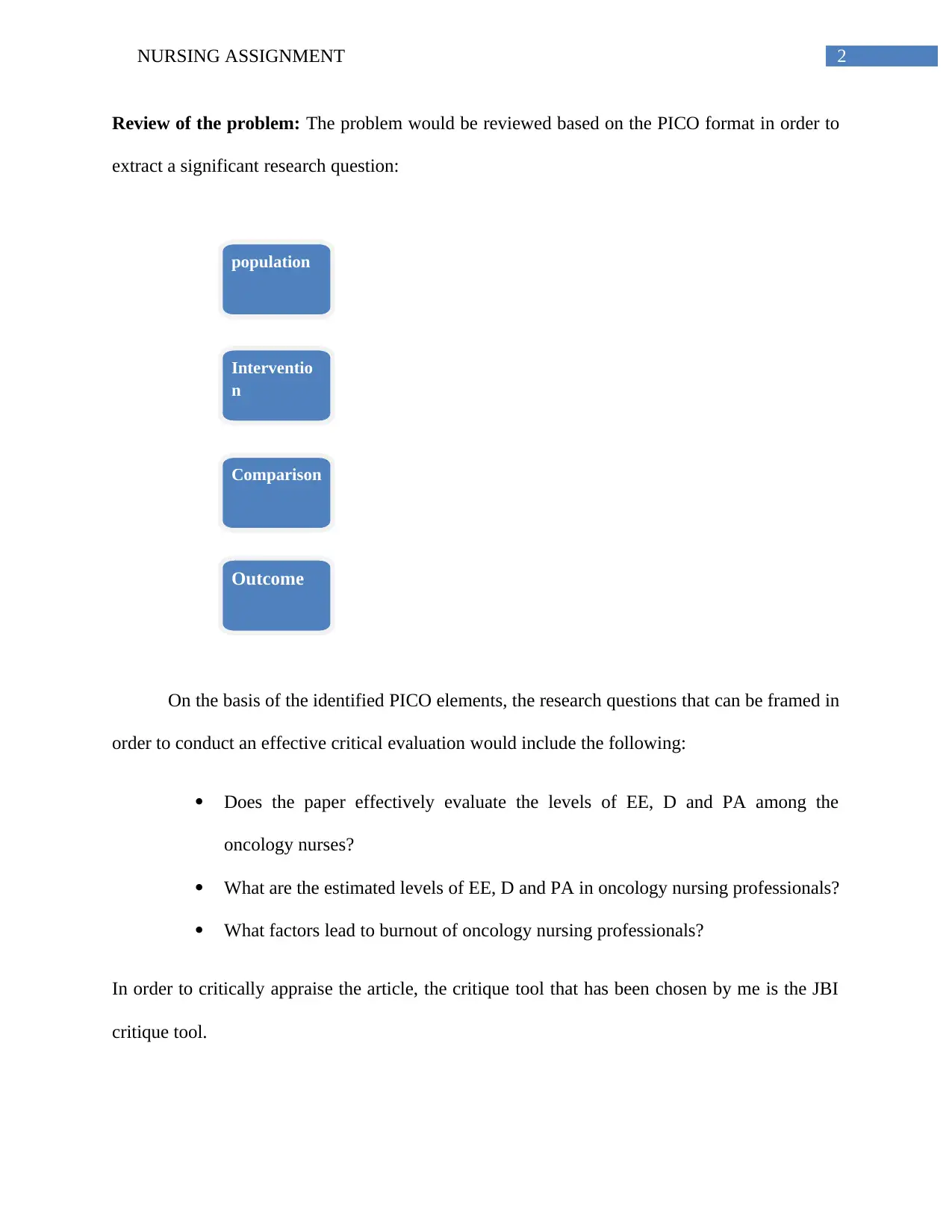
Review of the problem: The problem would be reviewed based on the PICO format in order to
extract a significant research question:
On the basis of the identified PICO elements, the research questions that can be framed in
order to conduct an effective critical evaluation would include the following:
Does the paper effectively evaluate the levels of EE, D and PA among the
oncology nurses?
What are the estimated levels of EE, D and PA in oncology nursing professionals?
What factors lead to burnout of oncology nursing professionals?
In order to critically appraise the article, the critique tool that has been chosen by me is the JBI
critique tool.
Theconcernedpopulationistheoncologynursingprofessionalspopulation.Nursesdealingwithoncologypatientsonaregularbasis.Theinterventionistojudgetheamountofpersonalfeelingsofexhaution.Evaluatethelevelsofemotionalexhaution,depersonalizationandreducedfeelingsofpersonalaccomplishmentAvailableeffectiveinterventionstocombattheissue.Interventionssuchasmindfulnessinterventiontherapy,arttherapyandpsychotherapeuticinterventionshavebeensuggestedtoreduceburnout.Outcomesrelatedtoemotionalissuescausingnursesburnoutandalsotoaccessifitmajorlyleadstoburnoutsyndrome?population
Interventio
n
Comparison
Outcome
Review of the problem: The problem would be reviewed based on the PICO format in order to
extract a significant research question:
On the basis of the identified PICO elements, the research questions that can be framed in
order to conduct an effective critical evaluation would include the following:
Does the paper effectively evaluate the levels of EE, D and PA among the
oncology nurses?
What are the estimated levels of EE, D and PA in oncology nursing professionals?
What factors lead to burnout of oncology nursing professionals?
In order to critically appraise the article, the critique tool that has been chosen by me is the JBI
critique tool.
Theconcernedpopulationistheoncologynursingprofessionalspopulation.Nursesdealingwithoncologypatientsonaregularbasis.Theinterventionistojudgetheamountofpersonalfeelingsofexhaution.Evaluatethelevelsofemotionalexhaution,depersonalizationandreducedfeelingsofpersonalaccomplishmentAvailableeffectiveinterventionstocombattheissue.Interventionssuchasmindfulnessinterventiontherapy,arttherapyandpsychotherapeuticinterventionshavebeensuggestedtoreduceburnout.Outcomesrelatedtoemotionalissuescausingnursesburnoutandalsotoaccessifitmajorlyleadstoburnoutsyndrome?population
Interventio
n
Comparison
Outcome
⊘ This is a preview!⊘
Do you want full access?
Subscribe today to unlock all pages.

Trusted by 1+ million students worldwide
3NURSING ASSIGNMENT
Is the review question clearly and explicitly stated?
Yes, the review question is clear and explicitly stated in the systematic review. The
author mentions the review questions in an extremely systematic manner and the entire review
revolves around the set of devised review questions. The authors developed the review questions
centered around the oncology professionals and aimed at accessing the factors causing burnout
and also evaluate the level of EE, D and PA among the professionals (Gomez-Urquiza et al.,
2016). The authors have been able to clearly state the review question as the systematic review
revolves around the central theme of the review questions.
Were the inclusion criteria appropriate for the review question?
Yes, the inclusion criteria were appropriate for the review question. The inclusion criteria
comprised of identifying the qualitative research studies so that primary data could be obtained.
The research papers included adhered to the MBI scale to measure the burnout (Gomez-Urquiza
et al., 2016). The justification that has been given by the author for using the MBI scale as the
inclusion criteria to measure nurses burnout is two-fold. Firstly, MBI forms the universal tool to
measure burnout and secondly, any other tool would not facilitate an easy integration of the
results (Hegney et al., 2014). However, other inclusion criteria that have been chosen by the
authors included publication at any date and in language other than English such as in Spanish
and Portugese (Gomez-Urquiza et al., 2016). It can be commented here that the language could
have been restricted to English to facilitate better search strategy and the publication date could
have been limited to the 10 years span as reviewing research articles published prior to that is
considered obsolete reference to be included in a systematic review.
Is the review question clearly and explicitly stated?
Yes, the review question is clear and explicitly stated in the systematic review. The
author mentions the review questions in an extremely systematic manner and the entire review
revolves around the set of devised review questions. The authors developed the review questions
centered around the oncology professionals and aimed at accessing the factors causing burnout
and also evaluate the level of EE, D and PA among the professionals (Gomez-Urquiza et al.,
2016). The authors have been able to clearly state the review question as the systematic review
revolves around the central theme of the review questions.
Were the inclusion criteria appropriate for the review question?
Yes, the inclusion criteria were appropriate for the review question. The inclusion criteria
comprised of identifying the qualitative research studies so that primary data could be obtained.
The research papers included adhered to the MBI scale to measure the burnout (Gomez-Urquiza
et al., 2016). The justification that has been given by the author for using the MBI scale as the
inclusion criteria to measure nurses burnout is two-fold. Firstly, MBI forms the universal tool to
measure burnout and secondly, any other tool would not facilitate an easy integration of the
results (Hegney et al., 2014). However, other inclusion criteria that have been chosen by the
authors included publication at any date and in language other than English such as in Spanish
and Portugese (Gomez-Urquiza et al., 2016). It can be commented here that the language could
have been restricted to English to facilitate better search strategy and the publication date could
have been limited to the 10 years span as reviewing research articles published prior to that is
considered obsolete reference to be included in a systematic review.
Paraphrase This Document
Need a fresh take? Get an instant paraphrase of this document with our AI Paraphraser
4NURSING ASSIGNMENT
Was the search strategy appropriate?
Yes, the search strategy was appropriate and it incorporated the best databases such as
CINAHL, Medical, ProQuest, PubMed, Scopus and so on. The databases that have been
searched for the retrieval of relevant scholarly articles are extremely authentic and no questions
can be raised about the validity of the research papers published on these databases (Gomez-
Urquiza et al., 2016). The key search terms that were used were oncology nursing and burnout
and the languages that were screened included English, Spanish and Portugese. The key search
terms used by the authors included the appropriate search terms on which the entire systematic
review is based upon. However, it can be said that the key terms were extremely generalized and
did not include any specific terms on which the research could have been formulated. Also, the
search strategy did not stringently apply filters on the research publication years or the languages
of the research articles. These characteristic criteria could have been improvised in order to
incorporate better search strategy and address the PICO questions effectively at the same time
(Jones et al., 2013).
Were the sources and resources used to search for studies adequate?
Yes, the sources and resources used to search for the studies were adequate. The authors
have use no date biasness or language biasness while searching relevant literatures on the
scholarly databases such as CINAHL, Medical, PubMed, ProQuest and Scopus (Gomez-Urquiza
et al., 2016). This can be counted as a positive strategy as it has helped the authors in assembling
all relevant literatures and at the same time formulate the key concepts of the relevant literatures
to synthesize the review. The non inclusion of stringent year or date can be termed as a helpful
tool that facilitated the authors to combine and successfully gather the theme of the systematic
review without encountering the issues related to publication biasness (Li et al., 2014).
Was the search strategy appropriate?
Yes, the search strategy was appropriate and it incorporated the best databases such as
CINAHL, Medical, ProQuest, PubMed, Scopus and so on. The databases that have been
searched for the retrieval of relevant scholarly articles are extremely authentic and no questions
can be raised about the validity of the research papers published on these databases (Gomez-
Urquiza et al., 2016). The key search terms that were used were oncology nursing and burnout
and the languages that were screened included English, Spanish and Portugese. The key search
terms used by the authors included the appropriate search terms on which the entire systematic
review is based upon. However, it can be said that the key terms were extremely generalized and
did not include any specific terms on which the research could have been formulated. Also, the
search strategy did not stringently apply filters on the research publication years or the languages
of the research articles. These characteristic criteria could have been improvised in order to
incorporate better search strategy and address the PICO questions effectively at the same time
(Jones et al., 2013).
Were the sources and resources used to search for studies adequate?
Yes, the sources and resources used to search for the studies were adequate. The authors
have use no date biasness or language biasness while searching relevant literatures on the
scholarly databases such as CINAHL, Medical, PubMed, ProQuest and Scopus (Gomez-Urquiza
et al., 2016). This can be counted as a positive strategy as it has helped the authors in assembling
all relevant literatures and at the same time formulate the key concepts of the relevant literatures
to synthesize the review. The non inclusion of stringent year or date can be termed as a helpful
tool that facilitated the authors to combine and successfully gather the theme of the systematic
review without encountering the issues related to publication biasness (Li et al., 2014).
5NURSING ASSIGNMENT
Were the criteria for appraising studies appropriate?
Yes, the criteria for appraising studies were appropriate. The authors have efficiently
considered the characteristics and thoroughly reviewed the research papers. This can be
commented on the basis of the appendix provided at the end of the paper by the authors that
critically comprises of all the articles that were reviewed, the corresponding study design and a
brief about the study type. The brief critically included the core on the universal MBI scale and
at the same time, the risk factors associated with the cause of burn out syndrome (Gomez-
Urquiza et al., 2016). Hence, it can be said that the criteria undertaken for the appraisal of the
research papers is appropriate and at the same time extremely methodical.
Was critical appraisal conducted by two or more reviewers independently?
Yes the critical appraisal was conducted by two different review teams and on
encountering an aspect that posed a dispute of opinion a third team helped in building a
constructive opinion. Hence, it can be said that the critical appraisal was conducted in an
efficient manner as for a proper review to be conducted, it is important that two individual
researchers critically access the reviews and help in comprehending the results (Gomez-Urquiza
et al., 2016). In this systematic review there were two teams appointed for conducting the review
and at the same time there was a third team that was responsible for helping in deducing an
opinion in case of a deadlock (Meyer et al., 2015). Hence, it can be said that the critical appraisal
was conducted by two review teams in an efficient manner.
Were there methods to minimize errors in data extraction?
Yes, there was a provision to minimize errors during data extraction. This could have
been achieved with the help of better filter tools or better data extraction tools. The authors could
have also made use of pilot study to minimize the possibility of errors in data extraction
Were the criteria for appraising studies appropriate?
Yes, the criteria for appraising studies were appropriate. The authors have efficiently
considered the characteristics and thoroughly reviewed the research papers. This can be
commented on the basis of the appendix provided at the end of the paper by the authors that
critically comprises of all the articles that were reviewed, the corresponding study design and a
brief about the study type. The brief critically included the core on the universal MBI scale and
at the same time, the risk factors associated with the cause of burn out syndrome (Gomez-
Urquiza et al., 2016). Hence, it can be said that the criteria undertaken for the appraisal of the
research papers is appropriate and at the same time extremely methodical.
Was critical appraisal conducted by two or more reviewers independently?
Yes the critical appraisal was conducted by two different review teams and on
encountering an aspect that posed a dispute of opinion a third team helped in building a
constructive opinion. Hence, it can be said that the critical appraisal was conducted in an
efficient manner as for a proper review to be conducted, it is important that two individual
researchers critically access the reviews and help in comprehending the results (Gomez-Urquiza
et al., 2016). In this systematic review there were two teams appointed for conducting the review
and at the same time there was a third team that was responsible for helping in deducing an
opinion in case of a deadlock (Meyer et al., 2015). Hence, it can be said that the critical appraisal
was conducted by two review teams in an efficient manner.
Were there methods to minimize errors in data extraction?
Yes, there was a provision to minimize errors during data extraction. This could have
been achieved with the help of better filter tools or better data extraction tools. The authors could
have also made use of pilot study to minimize the possibility of errors in data extraction
⊘ This is a preview!⊘
Do you want full access?
Subscribe today to unlock all pages.
Trusted by 1+ million students worldwide
6NURSING ASSIGNMENT
(Oyeleye et al., 2013). Also, use of statistical analysis tools could have helped in minimizing the
errors in data extraction. Both the review teams responsible for conducting the systematic review
could have proceeded with the sound statistical analytical tools in order to minimize errors and
chances of duplicity in terms of the idea and key findings of the research (Patricia Potter et al.,
2013).
Were the methods used to combine studies appropriate?
No, the method used to combine the studies is not appropriate. The systematic review is
broadly based upon accessing the research papers on the basis of the MBI scale to measure
burnout (Gomez-Urquiza et al., 2016). A meta-analysis could have been performed in order to
effectively stipulate the findings of the result. The findings from the systematic review are
extremely generalized and the use of the MBI scale is not appropriate with the nursing
professional’s burnout index. It could be strongly correlated to the nursing providers. Hence, it
can be said that the paper lacks a proper method to summarize the findings of the research
studies. It can also be stated that quantitative and statistical data could have effectively helped in
evaluating the concerned population of the nursing professionals especially oncology nursing
professionals falling under the category of psychological burnout. The analysis solely based on
the qualitative research finding sis extremely subjective and cannot be considered substantial
(Traeger et al., 2013).
Was the likelihood of publication bias assessed?
This question does not hold valid in this context of research study, as the systematic
review was mainly based on the research papers that dealt with qualitative analysis, and the
research results based upon qualitative analysis do not hold an association with the likelihood of
publication biasness.
(Oyeleye et al., 2013). Also, use of statistical analysis tools could have helped in minimizing the
errors in data extraction. Both the review teams responsible for conducting the systematic review
could have proceeded with the sound statistical analytical tools in order to minimize errors and
chances of duplicity in terms of the idea and key findings of the research (Patricia Potter et al.,
2013).
Were the methods used to combine studies appropriate?
No, the method used to combine the studies is not appropriate. The systematic review is
broadly based upon accessing the research papers on the basis of the MBI scale to measure
burnout (Gomez-Urquiza et al., 2016). A meta-analysis could have been performed in order to
effectively stipulate the findings of the result. The findings from the systematic review are
extremely generalized and the use of the MBI scale is not appropriate with the nursing
professional’s burnout index. It could be strongly correlated to the nursing providers. Hence, it
can be said that the paper lacks a proper method to summarize the findings of the research
studies. It can also be stated that quantitative and statistical data could have effectively helped in
evaluating the concerned population of the nursing professionals especially oncology nursing
professionals falling under the category of psychological burnout. The analysis solely based on
the qualitative research finding sis extremely subjective and cannot be considered substantial
(Traeger et al., 2013).
Was the likelihood of publication bias assessed?
This question does not hold valid in this context of research study, as the systematic
review was mainly based on the research papers that dealt with qualitative analysis, and the
research results based upon qualitative analysis do not hold an association with the likelihood of
publication biasness.
Paraphrase This Document
Need a fresh take? Get an instant paraphrase of this document with our AI Paraphraser
7NURSING ASSIGNMENT
Were recommendations for policy and/or practice supported by the reported data?
No, recommendations were not supported by the reported data. In fact, it can be said that
the paper talks more about the risk factors and the assessment of the factors that cause burnout in
oncology nursing professionals (Gomez-Urquiza et al., 2016). But, recommendations based on
reported or documented evidences are not supported in the paper.
Were the specific directives for new research appropriate?
No, the paper does not actually identify the literature gap effectively and because of not
being able to identify the literature gap, the paper is also not able to incorporate avenues or
guidelines that could be taken up by researchers in future to build up upon the findings of the
research (Gomez-Urquiza et al., 2016). Due to the lack of a proper and identified literature gap it
can be said that the no specific directives have been retrieved from the systematic review and
hence it does not serve as a promising research that could yield the possibility of processing
more ideas and building upon a new theme of research interlinked to the findings and the rational
of this systematic review.
Conclusion:
Hence, to conclude it can be said that the systematic review is broadly based upon the
key PICO elements and identifies the key reasons that are responsible for causing burnout in the
nursing professionals. The paper critically evaluates the causes that are responsible for causing
burnout in the nurses and at the same time also tries to access the level of burnout using an
obsolete scale of MBI which is not aligned with the proper study of nursing professional’s
burnout. The paper considers the risk factors but however does not include any recommendations
to combat the risk factors or even the paper does not document the availability of critical
documents or reports to support the interventions that could be devised in order to effectively
Were recommendations for policy and/or practice supported by the reported data?
No, recommendations were not supported by the reported data. In fact, it can be said that
the paper talks more about the risk factors and the assessment of the factors that cause burnout in
oncology nursing professionals (Gomez-Urquiza et al., 2016). But, recommendations based on
reported or documented evidences are not supported in the paper.
Were the specific directives for new research appropriate?
No, the paper does not actually identify the literature gap effectively and because of not
being able to identify the literature gap, the paper is also not able to incorporate avenues or
guidelines that could be taken up by researchers in future to build up upon the findings of the
research (Gomez-Urquiza et al., 2016). Due to the lack of a proper and identified literature gap it
can be said that the no specific directives have been retrieved from the systematic review and
hence it does not serve as a promising research that could yield the possibility of processing
more ideas and building upon a new theme of research interlinked to the findings and the rational
of this systematic review.
Conclusion:
Hence, to conclude it can be said that the systematic review is broadly based upon the
key PICO elements and identifies the key reasons that are responsible for causing burnout in the
nursing professionals. The paper critically evaluates the causes that are responsible for causing
burnout in the nurses and at the same time also tries to access the level of burnout using an
obsolete scale of MBI which is not aligned with the proper study of nursing professional’s
burnout. The paper considers the risk factors but however does not include any recommendations
to combat the risk factors or even the paper does not document the availability of critical
documents or reports to support the interventions that could be devised in order to effectively
8NURSING ASSIGNMENT
reduce the scenario of burnout. The systematic review paper that had been chosen by me is
critiqued and evaluated with the help of the critique tool the JBI tool. The paper has been
addressed with the proper critical assessment in accordance with the questions furnished by the
JBI critique tool in alignment with the systematic reviews. Although, the psychological burnout
phenomenon in nursing professional is an extremely significant aspect that attracts attention,
however the paper that have been evaluated by me includes an equal number of positive and
negative points that have been explained with precision while answering the critique questions.
Hence, it can be said that on being able to critically appraise a research article it becomes all the
more convenient to understand and apprehend the strengths and weaknesses associated with the
study and accordingly develop guidelines for pursing future researches based on the similar
theme.
reduce the scenario of burnout. The systematic review paper that had been chosen by me is
critiqued and evaluated with the help of the critique tool the JBI tool. The paper has been
addressed with the proper critical assessment in accordance with the questions furnished by the
JBI critique tool in alignment with the systematic reviews. Although, the psychological burnout
phenomenon in nursing professional is an extremely significant aspect that attracts attention,
however the paper that have been evaluated by me includes an equal number of positive and
negative points that have been explained with precision while answering the critique questions.
Hence, it can be said that on being able to critically appraise a research article it becomes all the
more convenient to understand and apprehend the strengths and weaknesses associated with the
study and accordingly develop guidelines for pursing future researches based on the similar
theme.
⊘ This is a preview!⊘
Do you want full access?
Subscribe today to unlock all pages.
Trusted by 1+ million students worldwide
9NURSING ASSIGNMENT
References:
Davis, S., Lind, B. K., & Sorensen, C. (2013, July). A comparison of burnout among oncology
nurses working in adult and pediatric inpatient and outpatient settings. In Oncology
Nursing Forum (Vol. 40, No. 4).
Drury, V., Craigie, M., Francis, K., Aoun, S., & Hegney, D. G. (2014). Compassion satisfaction,
compassion fatigue, anxiety, depression and stress in registered nurses in A ustralia:
Phase 2 results. Journal of Nursing Management, 22(4), 519-531.
Foureur, M., Besley, K., Burton, G., Yu, N., & Crisp, J. (2013). Enhancing the resilience of
nurses and midwives: Pilot of a mindfulnessbased program for increased health, sense of
coherence and decreased depression, anxiety and stress. Contemporary nurse, 45(1), 114-
125.
Gomez-Urquiza, J. L., Aneas-López, A. B., la Fuente-Solana, D., Emilia, I., Albendín-García, L.,
& Díaz-Rodríguez, L. (2016, May). Prevalence, Risk Factors, and Levels of Burnout
Among Oncology Nurses: A Systematic Review. In Oncology nursing forum (Vol. 43,
No. 3).
Guveli, H., Anuk, D., Oflaz, S., Guveli, M. E., Yildirim, N. K., Ozkan, M., & Ozkan, S. (2015).
Oncology staff: burnout, job satisfaction and coping with stress. Psycho
‐Oncology, 24(8),
926-931.
Hegney, D. G., Craigie, M., Hemsworth, D., Osseiran‐Moisson, R., Aoun, S., Francis, K., &
Drury, V. (2014). Compassion satisfaction, compassion fatigue, anxiety, depression and
References:
Davis, S., Lind, B. K., & Sorensen, C. (2013, July). A comparison of burnout among oncology
nurses working in adult and pediatric inpatient and outpatient settings. In Oncology
Nursing Forum (Vol. 40, No. 4).
Drury, V., Craigie, M., Francis, K., Aoun, S., & Hegney, D. G. (2014). Compassion satisfaction,
compassion fatigue, anxiety, depression and stress in registered nurses in A ustralia:
Phase 2 results. Journal of Nursing Management, 22(4), 519-531.
Foureur, M., Besley, K., Burton, G., Yu, N., & Crisp, J. (2013). Enhancing the resilience of
nurses and midwives: Pilot of a mindfulnessbased program for increased health, sense of
coherence and decreased depression, anxiety and stress. Contemporary nurse, 45(1), 114-
125.
Gomez-Urquiza, J. L., Aneas-López, A. B., la Fuente-Solana, D., Emilia, I., Albendín-García, L.,
& Díaz-Rodríguez, L. (2016, May). Prevalence, Risk Factors, and Levels of Burnout
Among Oncology Nurses: A Systematic Review. In Oncology nursing forum (Vol. 43,
No. 3).
Guveli, H., Anuk, D., Oflaz, S., Guveli, M. E., Yildirim, N. K., Ozkan, M., & Ozkan, S. (2015).
Oncology staff: burnout, job satisfaction and coping with stress. Psycho
‐Oncology, 24(8),
926-931.
Hegney, D. G., Craigie, M., Hemsworth, D., Osseiran‐Moisson, R., Aoun, S., Francis, K., &
Drury, V. (2014). Compassion satisfaction, compassion fatigue, anxiety, depression and
Paraphrase This Document
Need a fresh take? Get an instant paraphrase of this document with our AI Paraphraser
10NURSING ASSIGNMENT
stress in registered nurses in A ustralia: study 1 results. Journal of Nursing
Management, 22(4), 506-518.
Jones, M. C., Wells, M., Gao, C., Cassidy, B., & Davie, J. (2013). Work stress and well‐being in
oncology settings: a multidisciplinary study of health care professionals. Psycho
‐
oncology, 22(1), 46-53.
Li, A., Early, S. F., Mahrer, N. E., Klaristenfeld, J. L., & Gold, J. I. (2014). Group cohesion and
organizational commitment: protective factors for nurse residents' job satisfaction,
compassion fatigue, compassion satisfaction, and burnout. Journal of Professional
Nursing, 30(1), 89-99.
Meyer, R. M., Li, A., Klaristenfeld, J., & Gold, J. I. (2015). Pediatric novice nurses: examining
compassion fatigue as a mediator between stress exposure and compassion satisfaction,
burnout, and job satisfaction. Journal of pediatric nursing, 30(1), 174-183.
Oyeleye, O., Hanson, P., O’connor, N., & Dunn, D. (2013). Relationship of workplace incivility,
stress, and burnout on nurses’ turnover intentions and psychological
empowerment. Journal of Nursing Administration, 43(10), 536-542.
Patricia Potter, R. N., Julia Allen Berger DMin, B. C. C., & Sarah Olsen RN, B. S. (2013,
March). Evaluation of a compassion fatigue resiliency program for oncology nurses.
In Oncology Nursing Forum (Vol. 40, No. 2, p. 180). Oncology Nursing Society.
Traeger, L., Park, E. R., Sporn, N., Repper-DeLisi, J., Convery, M. S., Jacobo, M., & Pin, W. F.
(2013, July). Development and evaluation of targeted psychological skills training for
stress in registered nurses in A ustralia: study 1 results. Journal of Nursing
Management, 22(4), 506-518.
Jones, M. C., Wells, M., Gao, C., Cassidy, B., & Davie, J. (2013). Work stress and well‐being in
oncology settings: a multidisciplinary study of health care professionals. Psycho
‐
oncology, 22(1), 46-53.
Li, A., Early, S. F., Mahrer, N. E., Klaristenfeld, J. L., & Gold, J. I. (2014). Group cohesion and
organizational commitment: protective factors for nurse residents' job satisfaction,
compassion fatigue, compassion satisfaction, and burnout. Journal of Professional
Nursing, 30(1), 89-99.
Meyer, R. M., Li, A., Klaristenfeld, J., & Gold, J. I. (2015). Pediatric novice nurses: examining
compassion fatigue as a mediator between stress exposure and compassion satisfaction,
burnout, and job satisfaction. Journal of pediatric nursing, 30(1), 174-183.
Oyeleye, O., Hanson, P., O’connor, N., & Dunn, D. (2013). Relationship of workplace incivility,
stress, and burnout on nurses’ turnover intentions and psychological
empowerment. Journal of Nursing Administration, 43(10), 536-542.
Patricia Potter, R. N., Julia Allen Berger DMin, B. C. C., & Sarah Olsen RN, B. S. (2013,
March). Evaluation of a compassion fatigue resiliency program for oncology nurses.
In Oncology Nursing Forum (Vol. 40, No. 2, p. 180). Oncology Nursing Society.
Traeger, L., Park, E. R., Sporn, N., Repper-DeLisi, J., Convery, M. S., Jacobo, M., & Pin, W. F.
(2013, July). Development and evaluation of targeted psychological skills training for
11NURSING ASSIGNMENT
oncology nurses in managing stressful patient and family encounters. In Oncology
nursing forum (Vol. 40).
oncology nurses in managing stressful patient and family encounters. In Oncology
nursing forum (Vol. 40).
⊘ This is a preview!⊘
Do you want full access?
Subscribe today to unlock all pages.
Trusted by 1+ million students worldwide

1 out of 12


Related Documents


Your All-in-One AI-Powered Toolkit for Academic Success.
+13062052269
info@desklib.com
Available 24*7 on WhatsApp / Email
![[object Object]](/_next/static/media/star-bottom.7253800d.svg)
Unlock your academic potential
Copyright © 2020–2026 A2Z Services. All Rights Reserved. Developed and managed by ZUCOL.