ACOM103: A Comparative Essay on Buruli Ulcer and Yaws Diseases

Verified

Added on  2023/03/21

|3
|773
|74
Essay
AI Summary
This essay provides a comparative analysis of Buruli ulcer and yaws, two distinct infectious diseases. It explores their respective causes, with Buruli ulcer caused by Mycobacterium ulcerans and yaws by Treponema pallidum. The modes of transmission differ, with Buruli ulcer's transmission being indistinct and yaws spreading through direct skin contact. The essay contrasts their signs and symptoms, diagnostic methods, and treatment approaches, noting that while both diseases involve lesion development, their specific manifestations and treatments vary. Furthermore, it addresses the prognosis and complications, highlighting long-term morbidity and disfigurement associated with each disease. Finally, the essay touches on prevention strategies, emphasizing antibiotic consumption and hygiene practices. This analysis, prepared for ACOM103: Academic English for Health Sciences 1, utilizes in-text references to support its claims and adheres to APA style guidelines. Desklib offers a wealth of similar solved assignments and past papers for students.
Document Page
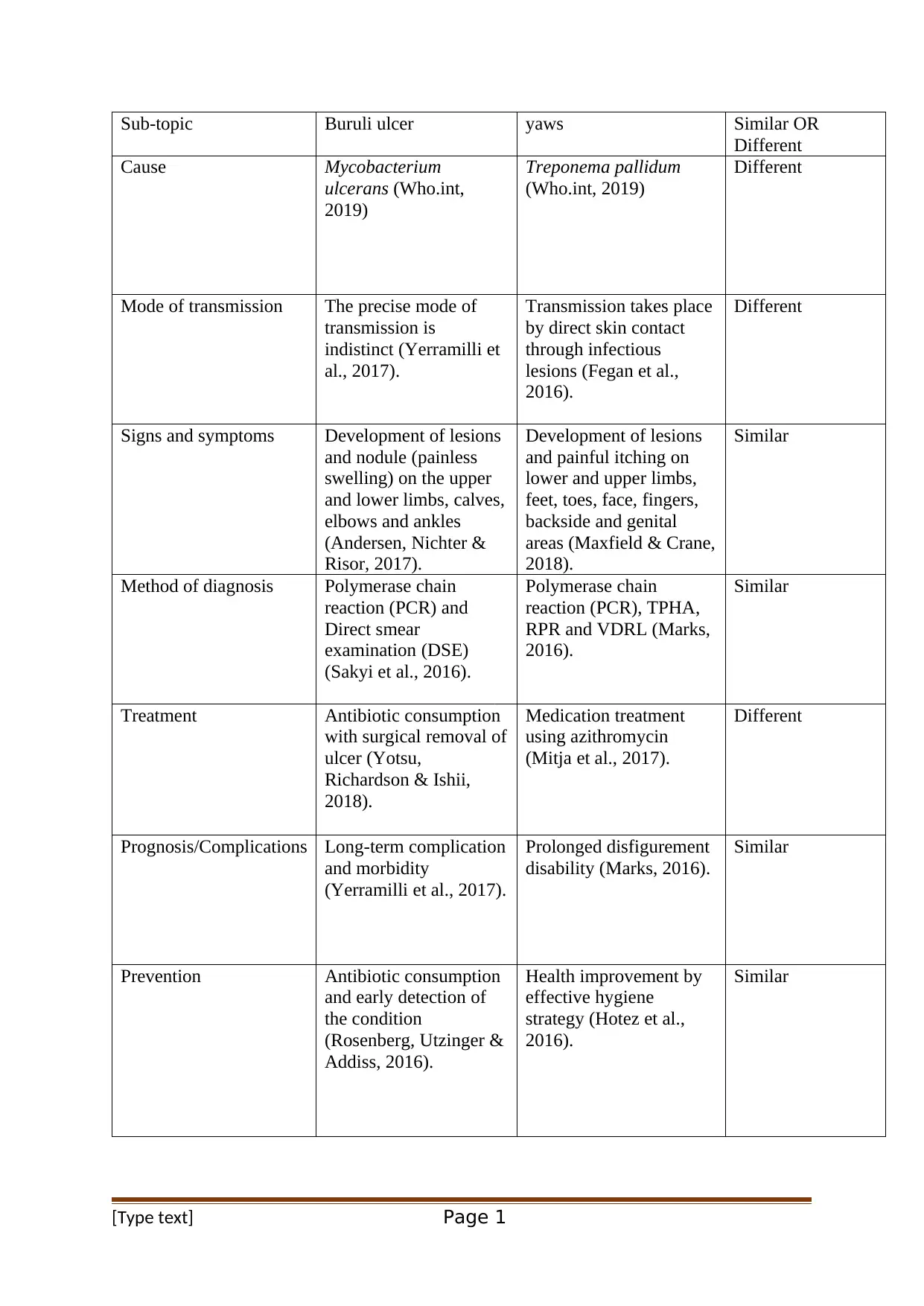
Sub-topic Buruli ulcer yaws Similar OR
Different
Cause Mycobacterium
ulcerans (Who.int,
2019)
Treponema pallidum
(Who.int, 2019)
Different
Mode of transmission The precise mode of
transmission is
indistinct (Yerramilli et
al., 2017).
Transmission takes place
by direct skin contact
through infectious
lesions (Fegan et al.,
2016).
Different
Signs and symptoms Development of lesions
and nodule (painless
swelling) on the upper
and lower limbs, calves,
elbows and ankles
(Andersen, Nichter &
Risor, 2017).
Development of lesions
and painful itching on
lower and upper limbs,
feet, toes, face, fingers,
backside and genital
areas (Maxfield & Crane,
2018).
Similar
Method of diagnosis Polymerase chain
reaction (PCR) and
Direct smear
examination (DSE)
(Sakyi et al., 2016).
Polymerase chain
reaction (PCR), TPHA,
RPR and VDRL (Marks,
2016).
Similar
Treatment Antibiotic consumption
with surgical removal of
ulcer (Yotsu,
Richardson & Ishii,
2018).
Medication treatment
using azithromycin
(Mitja et al., 2017).
Different
Prognosis/Complications Long-term complication
and morbidity
(Yerramilli et al., 2017).
Prolonged disfigurement
disability (Marks, 2016).
Similar
Prevention Antibiotic consumption
and early detection of
the condition
(Rosenberg, Utzinger &
Addiss, 2016).
Health improvement by
effective hygiene
strategy (Hotez et al.,
2016).
Similar
[Type text] Page 1
tabler-icon-diamond-filled.svg

Paraphrase This Document

Need a fresh take? Get an instant paraphrase of this document with our AI Paraphraser
Document Page
References
Andersen, R. S., Nichter, M., & Risør, M. B. (2017). Sensations, symptoms and healthcare
seeking. Anthropology in Action, 24(1), 1-5.
Fegan, D., Glennon, M. J., Kool, J., & Taleo, F. (2016). Tropical leg ulcers in children: more
than yaws. Tropical doctor, 46(2), 90-93.
Hotez, P. J., Pecoul, B., Rijal, S., Boehme, C., Aksoy, S., Malecela, M., ... & Reeder, J. C.
(2016). Eliminating the neglected tropical diseases: translational science and new
technologies. PLoS neglected tropical diseases, 10(3), e0003895.
Marks, M. (2016). Yaws: towards the WHO eradication target. Transactions of the Royal
Society of Tropical Medicine and Hygiene, 110(6), 319-320.
Maxfield, L., & Crane, J. S. (2018). Yaws (Frambesia tropica, Thymosis, Polypapilloma
tropicum, Parangi, Bouba, Frambosie, Pian). In StatPearls [Internet]. StatPearls
Publishing.
Mitjà, O., Marks, M., Bertran, L., Kollie, K., Argaw, D., Fahal, A. H., ... & Ishii, N. (2017).
Integrated control and management of neglected tropical skin diseases. PLoS
neglected tropical diseases, 11(1), e0005136.
Rosenberg, M., Utzinger, J., & Addiss, D. G. (2016). Preventive chemotherapy versus
innovative and intensified disease management in neglected tropical diseases: A
distinction whose shelf life has expired. PLoS neglected tropical diseases, 10(4),
e0004521.
Sakyi, S. A., Aboagye, S. Y., Darko Otchere, I., & Yeboah-Manu, D. (2016). Clinical and
laboratory diagnosis of Buruli ulcer disease: a systematic review. Canadian Journal
of Infectious Diseases and Medical Microbiology, 2016.
[Type text] Page 2
Document Page
Who.int. (2019). Buruli ulcer. Retrieved from
https://www.who.int/news-room/fact-sheets/detail/buruli-ulcer-(mycobacterium-
ulcerans-infection)
Who.int. (2019). Yaws. Retrieved from
https://www.who.int/news-room/fact-sheets/detail/yaws
Yerramilli, A., Tay, E. L., Stewardson, A. J., Kelley, P. G., Bishop, E., Jenkin, G. A., ... &
O’Brien, D. P. (2017). The location of Australian Buruli ulcer lesions—Implications
for unravelling disease transmission. PLoS neglected tropical diseases, 11(8),
e0005800.
Yotsu, R. R., Richardson, M., & Ishii, N. (2018). Drugs for treating Buruli ulcer
(Mycobacterium ulcerans disease). Cochrane Database of Systematic Reviews, (8).
[Type text] Page 3
chevron_up_icon
1 out of 3
circle_padding
hide_on_mobile
zoom_out_icon
[object Object]