BUS705 Innovation: Strategic Responses to Business Environment Forces

Verified

Added on  2023/04/10

|5
|879
|161
AI Summary
This blog post explores the critical role of innovation in enabling businesses to respond effectively to the dynamic forces within the business environment. It highlights the impact of technological and socio-cultural factors, emphasizing how these elements necessitate continuous improvement and adaptation. The analysis underscores the importance of understanding customer demands and values, advocating for a shift towards paradigms that prioritize customer satisfaction and value creation. By integrating concepts like the "Post-capitalist paradigm," "Service-dominant logic paradigm," and "Customer-perceived value paradigm," the post emphasizes that businesses must focus on delivering optimum value to consumers by meeting their evolving needs and expectations to maintain competitiveness in the market. This document is provided by a student on Desklib, a platform offering a variety of study resources.

Document Page
Running Head: MANAGEMENT 0
Innovation – Need of time
tabler-icon-diamond-filled.svg

Paraphrase This Document

Need a fresh take? Get an instant paraphrase of this document with our AI Paraphraser
Document Page
MANAGEMENT 1
Innovation “The Need of the Time”
Innovation is the creation of something new whether in terms of processes, products or ideas
(Birkinshaw, Hamel and Mol, 2008). In relation to business practices, ideas and products
usually signify developing new ways of getting things done for building creative ways to
attain specific objectives. Digital revolution has not just changed how businesses are
perceived but also how businesses are performed (Teece, 2010). Enterprises who proactively
see and act upon the opportunities for change through innovation in a highly dynamic and
competitive business environment will not only sustain but will also positively flourish in the
strongest of the economic situations. In this competitive business environment, innovation is
the key to achieve success, however, there are certain factors that influence it directly or
indirectly. Considering those factors, I mainly outlined two of the significant factors that are
named as socio-cultural and technological factors.
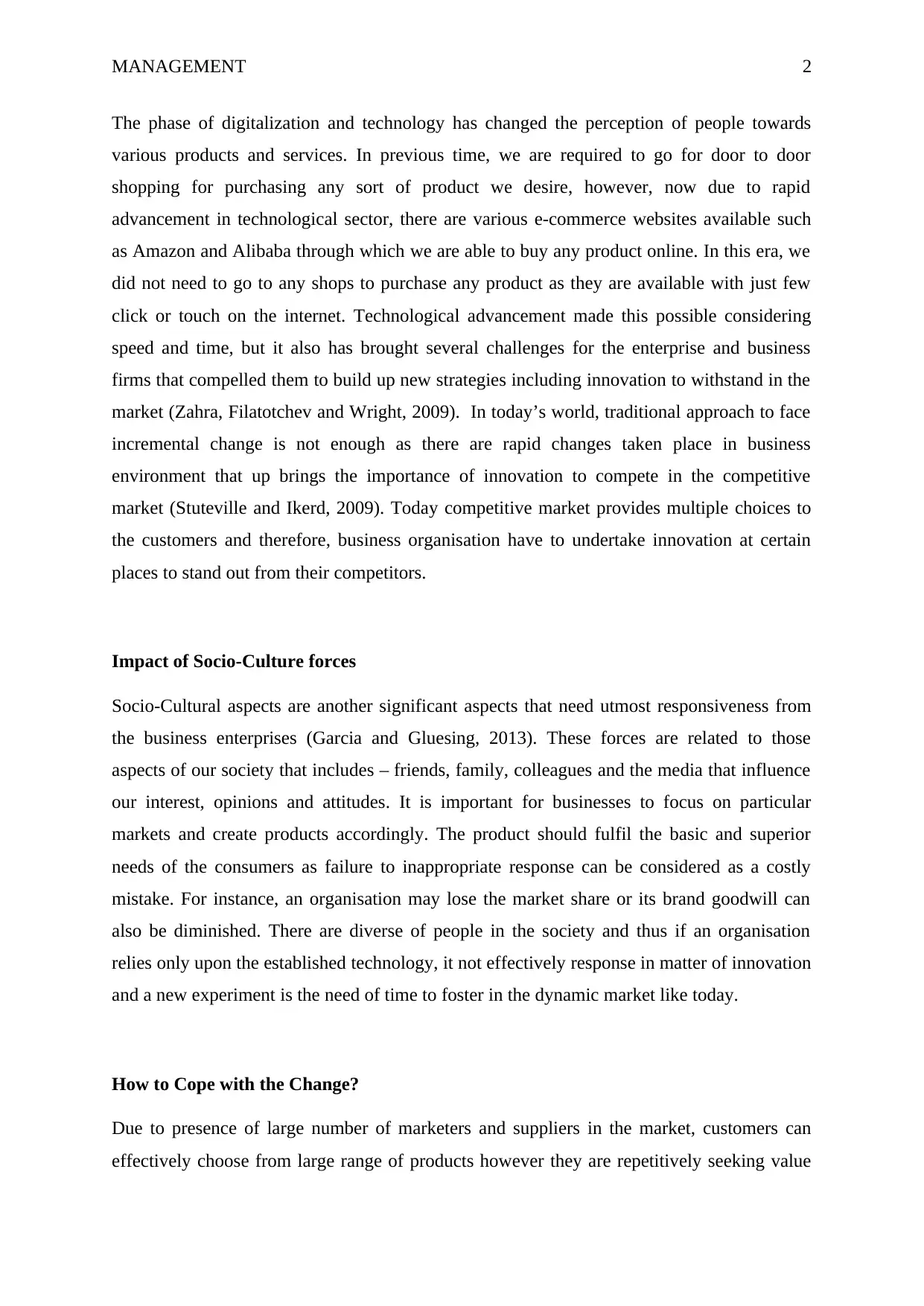
Impact of technological factors
Technological
Change
Communication
IT Networks Global Networks
Commoditization
Document Page
MANAGEMENT 2
The phase of digitalization and technology has changed the perception of people towards
various products and services. In previous time, we are required to go for door to door
shopping for purchasing any sort of product we desire, however, now due to rapid
advancement in technological sector, there are various e-commerce websites available such
as Amazon and Alibaba through which we are able to buy any product online. In this era, we
did not need to go to any shops to purchase any product as they are available with just few
click or touch on the internet. Technological advancement made this possible considering
speed and time, but it also has brought several challenges for the enterprise and business
firms that compelled them to build up new strategies including innovation to withstand in the
market (Zahra, Filatotchev and Wright, 2009). In today’s world, traditional approach to face
incremental change is not enough as there are rapid changes taken place in business
environment that up brings the importance of innovation to compete in the competitive
market (Stuteville and Ikerd, 2009). Today competitive market provides multiple choices to
the customers and therefore, business organisation have to undertake innovation at certain
places to stand out from their competitors.
Impact of Socio-Culture forces
Socio-Cultural aspects are another significant aspects that need utmost responsiveness from
the business enterprises (Garcia and Gluesing, 2013). These forces are related to those
aspects of our society that includes – friends, family, colleagues and the media that influence
our interest, opinions and attitudes. It is important for businesses to focus on particular
markets and create products accordingly. The product should fulfil the basic and superior
needs of the consumers as failure to inappropriate response can be considered as a costly
mistake. For instance, an organisation may lose the market share or its brand goodwill can
also be diminished. There are diverse of people in the society and thus if an organisation
relies only upon the established technology, it not effectively response in matter of innovation
and a new experiment is the need of time to foster in the dynamic market like today.
How to Cope with the Change?
Due to presence of large number of marketers and suppliers in the market, customers can
effectively choose from large range of products however they are repetitively seeking value
Document Page
MANAGEMENT 3
from the commodity they are paying for. Hence, every organisation required a culture of
constant improvement that drive the enterprise to immense success and where paradigms
should continuously be challenged. In existing markets, traditional paradigms will not work
and there is need to new paradigm. It relates to utmost customer demand and values and their
satisfaction. Satisfaction of customer is the most important need of time in my opinion in
align with the logic of “Post-capitalist paradigm” which values creative thinking and
innovation with “Service-dominant logic paradigm”, which focuses on approach of
effectiveness with “Customer-perceived value paradigm” which assess satisfaction of
customer as prime aim, we can attain the best product and services from the businesses.
Considering all above paradigm, it ensures that a business firm builds optimum value for
consumers by fulfilling their demands and needs.
Summary
This dynamic and competitive business environment creates various challenges for
enterprises. In order to be competitive in the market, business firms are required to develop
and foster changes with including creative changes to outstanding with the competitors. In
regards with successful operations of business, they will also have to consider the importance
of value creation to the customers and should compel traditional business paradigms to
generate an innovate response to the elements of change exists in the markets.
tabler-icon-diamond-filled.svg

Paraphrase This Document

Need a fresh take? Get an instant paraphrase of this document with our AI Paraphraser
Document Page
MANAGEMENT 4
References
Birkinshaw, J., Hamel, G. and Mol, M.J. (2008) Management innovation. Academy of
management Review, 33(4), pp.825-845.
Garcia, D. and Gluesing, J.C. (2013) Qualitative research methods in international
organizational change research. Journal of Organizational Change Management, 26(2),
pp.423-444.
Stuteville, R. and Ikerd, J. (2009) Global sustainability and service-learning: paradigms for
the future. International Journal of Organizational Analysis, 17(1), pp.10-22.
Teece, D.J. (2010) Business models, business strategy and innovation. Long range
planning, 43(2-3), pp.172-194.
Zahra, S.A., Filatotchev, I. and Wright, M. (2009) How do threshold firms sustain corporate
entrepreneurship? The role of boards and absorptive capacity. Journal of business
venturing, 24(3), pp.248-260.
chevron_up_icon
1 out of 5
circle_padding
hide_on_mobile
zoom_out_icon
[object Object]