BUSI 440: Compensation Management Thread #1 - Policy and Objectives

Verified

Added on  2022/11/27

|4
|829
|307
Discussion Board Post
AI Summary
This discussion board post explores the four policy issues within a compensation pay model: internal alignment, external competitiveness, employee contribution, and management of the pay system. It also examines the objectives of a pay model, including efficiency, fairness, and compliance with laws and regulations. The student provides an initial thread and responds to two other students' posts, incorporating scholarly sources, a scripture reference, and textbook citations as required by the assignment. The responses offer constructive feedback and additional insights, enriching the discussion on compensation strategies and their practical application in organizational settings. The student highlights the significance of internal alignment and external competitiveness and discusses the roles of ethics, efficiency, expertise, and experience in shaping compensation structures. Furthermore, the post references relevant literature and biblical scripture to support the arguments presented.

Document Page
Running head: COMPENSATION MANAGEMENT THREAD
Compensation Management Thread
Name of the University:
Name of the Student:
Author Note:
tabler-icon-diamond-filled.svg

Paraphrase This Document

Need a fresh take? Get an instant paraphrase of this document with our AI Paraphraser
Document Page
1
Compensation Management Thread
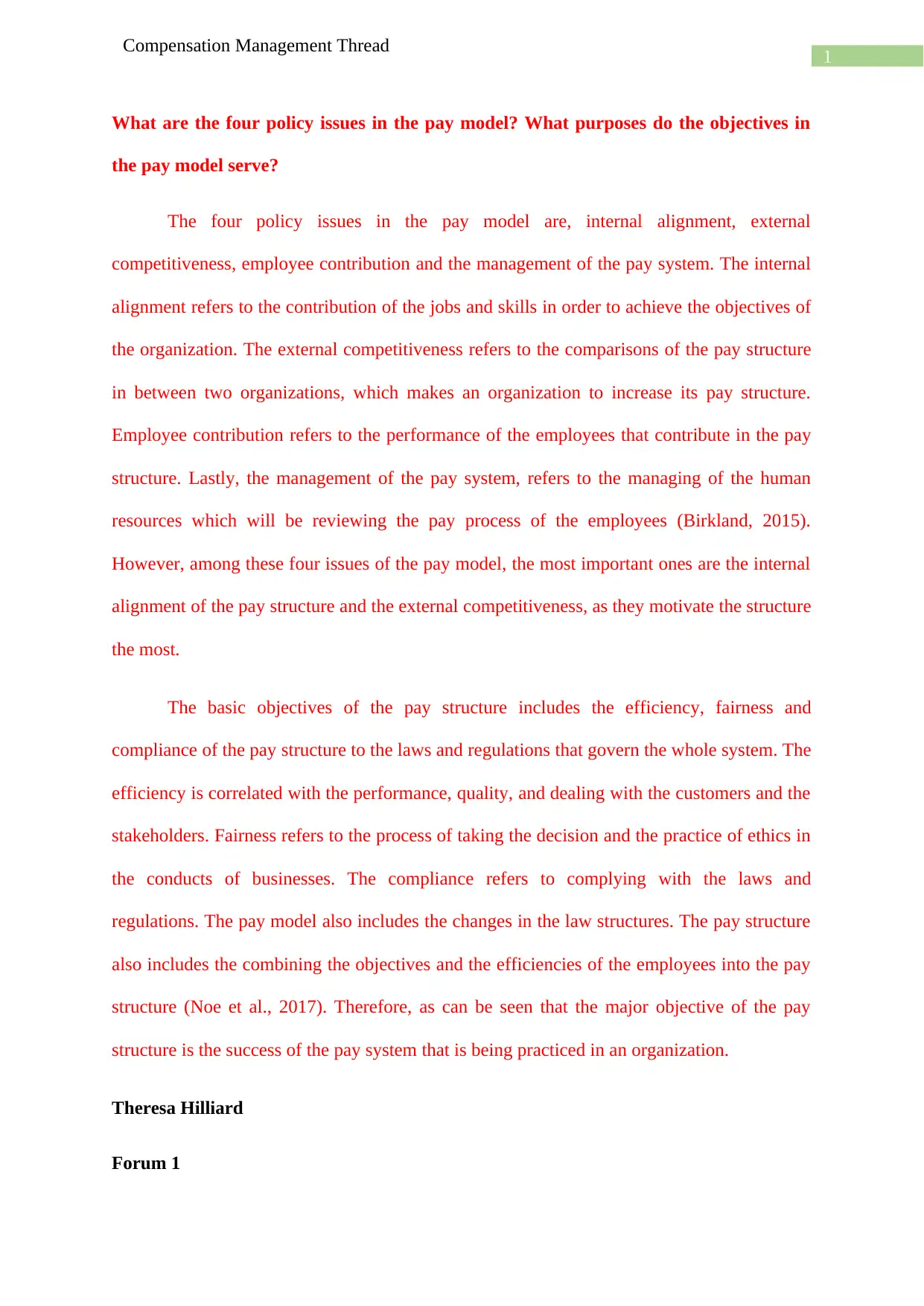
What are the four policy issues in the pay model? What purposes do the objectives in
the pay model serve?
The four policy issues in the pay model are, internal alignment, external
competitiveness, employee contribution and the management of the pay system. The internal
alignment refers to the contribution of the jobs and skills in order to achieve the objectives of
the organization. The external competitiveness refers to the comparisons of the pay structure
in between two organizations, which makes an organization to increase its pay structure.
Employee contribution refers to the performance of the employees that contribute in the pay
structure. Lastly, the management of the pay system, refers to the managing of the human
resources which will be reviewing the pay process of the employees (Birkland, 2015).
However, among these four issues of the pay model, the most important ones are the internal
alignment of the pay structure and the external competitiveness, as they motivate the structure
the most.
The basic objectives of the pay structure includes the efficiency, fairness and
compliance of the pay structure to the laws and regulations that govern the whole system. The
efficiency is correlated with the performance, quality, and dealing with the customers and the
stakeholders. Fairness refers to the process of taking the decision and the practice of ethics in
the conducts of businesses. The compliance refers to complying with the laws and
regulations. The pay model also includes the changes in the law structures. The pay structure
also includes the combining the objectives and the efficiencies of the employees into the pay
structure (Noe et al., 2017). Therefore, as can be seen that the major objective of the pay
structure is the success of the pay system that is being practiced in an organization.
Theresa Hilliard
Forum 1
Document Page
2
Compensation Management Thread
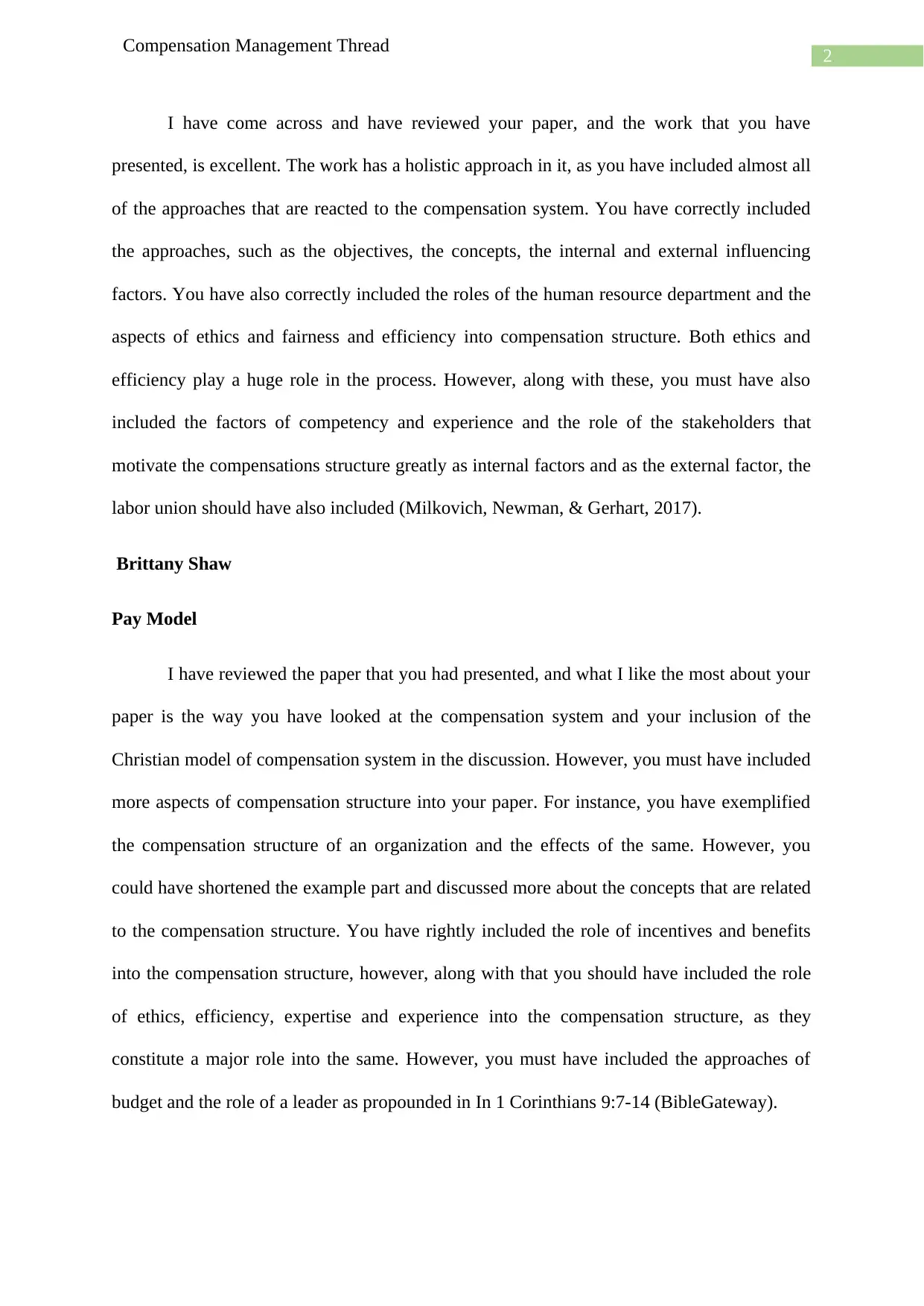
I have come across and have reviewed your paper, and the work that you have
presented, is excellent. The work has a holistic approach in it, as you have included almost all
of the approaches that are reacted to the compensation system. You have correctly included
the approaches, such as the objectives, the concepts, the internal and external influencing
factors. You have also correctly included the roles of the human resource department and the
aspects of ethics and fairness and efficiency into compensation structure. Both ethics and
efficiency play a huge role in the process. However, along with these, you must have also
included the factors of competency and experience and the role of the stakeholders that
motivate the compensations structure greatly as internal factors and as the external factor, the
labor union should have also included (Milkovich, Newman, & Gerhart, 2017).
Brittany Shaw
Pay Model
I have reviewed the paper that you had presented, and what I like the most about your
paper is the way you have looked at the compensation system and your inclusion of the
Christian model of compensation system in the discussion. However, you must have included
more aspects of compensation structure into your paper. For instance, you have exemplified
the compensation structure of an organization and the effects of the same. However, you
could have shortened the example part and discussed more about the concepts that are related
to the compensation structure. You have rightly included the role of incentives and benefits
into the compensation structure, however, along with that you should have included the role
of ethics, efficiency, expertise and experience into the compensation structure, as they
constitute a major role into the same. However, you must have included the approaches of
budget and the role of a leader as propounded in In 1 Corinthians 9:7-14 (BibleGateway).
Document Page
3
Compensation Management Thread
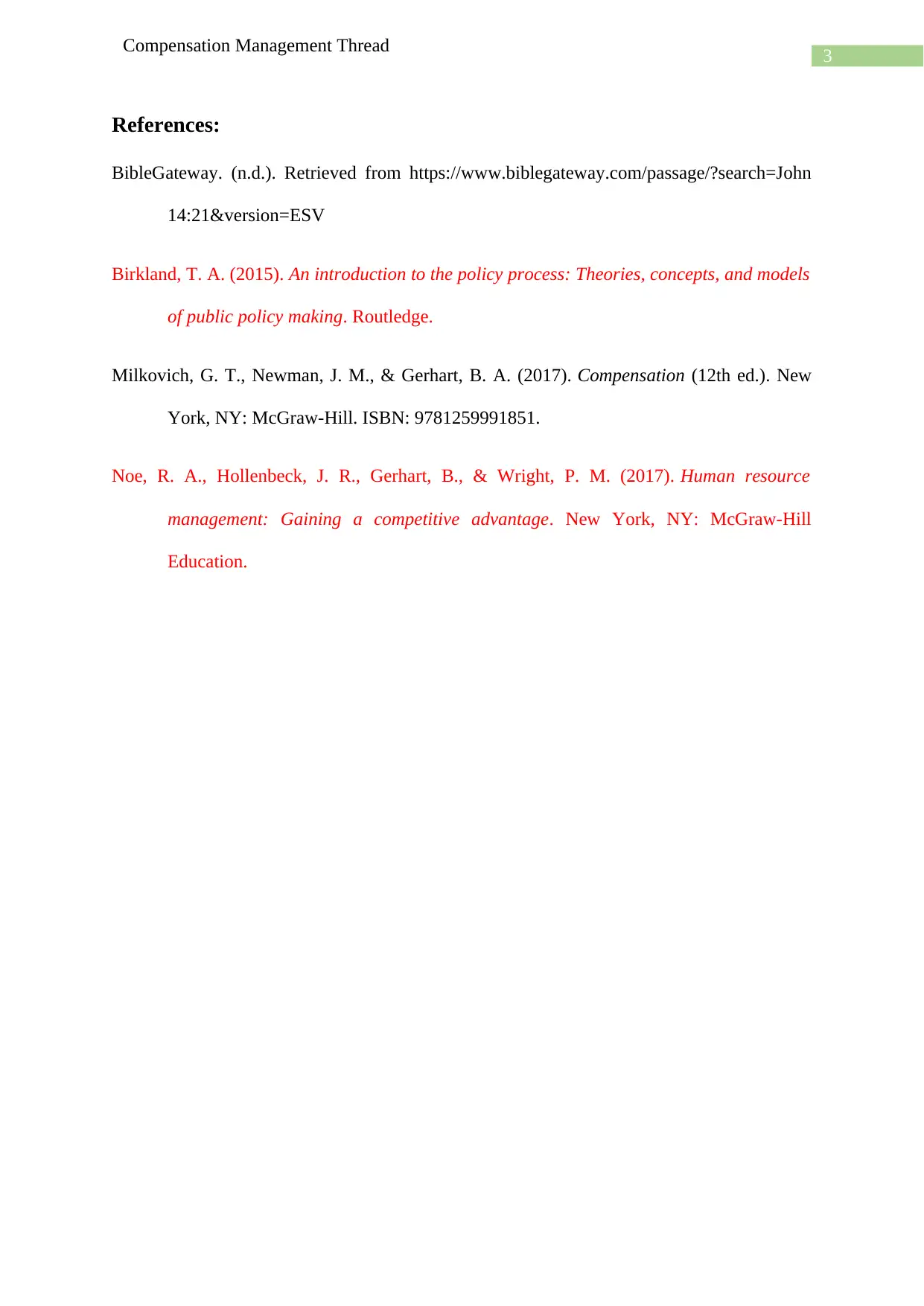
References:
BibleGateway. (n.d.). Retrieved from https://www.biblegateway.com/passage/?search=John
14:21&version=ESV
Birkland, T. A. (2015). An introduction to the policy process: Theories, concepts, and models
of public policy making. Routledge.
Milkovich, G. T., Newman, J. M., & Gerhart, B. A. (2017). Compensation (12th ed.). New
York, NY: McGraw-Hill. ISBN: 9781259991851.
Noe, R. A., Hollenbeck, J. R., Gerhart, B., & Wright, P. M. (2017). Human resource
management: Gaining a competitive advantage. New York, NY: McGraw-Hill
Education.
chevron_up_icon
1 out of 4
circle_padding
hide_on_mobile
zoom_out_icon
[object Object]