Analysis of Business Functions: Structures and Economic Impacts

Verified

Added on  2022/12/29

|9
|869
|54
Report
AI Summary
This report provides an overview of various business functions, categorizing organizations into public and private sectors, and analyzing their differences. It explores diverse organizational structures, from micro to large-sized businesses, detailing their characteristics and objectives. The report further examines the impacts of local, national, and global economic environments on these organizations, including policy and economic factors. It also includes references to academic sources to support the analysis. The report concludes by emphasizing the importance of understanding these factors for business performance and survival, and highlights the use of PESTEL analysis in determining microeconomic impacts. This report is a valuable resource for students studying business development and related fields.

Document Page
Business function
tabler-icon-diamond-filled.svg

Paraphrase This Document

Need a fresh take? Get an instant paraphrase of this document with our AI Paraphraser
Document Page
Table of Content
Introduction
Different types of organisations found in the public and private
sectors.
Different structures within the businesses.
Impacts of local, national and global economic environment.
Conclusion
References
Document Page
Introduction
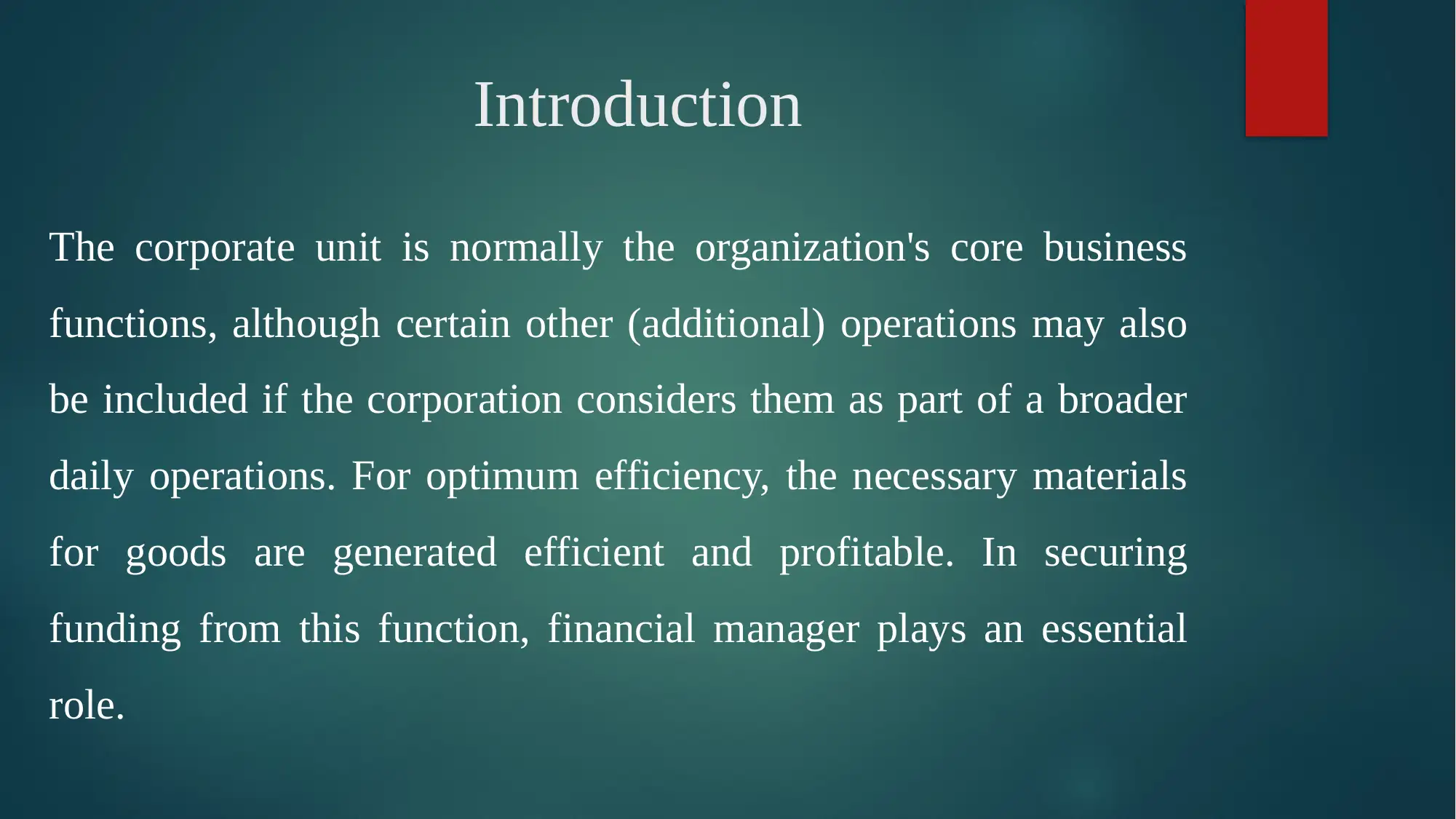
The corporate unit is normally the organization's core business
functions, although certain other (additional) operations may also
be included if the corporation considers them as part of a broader
daily operations. For optimum efficiency, the necessary materials
for goods are generated efficient and profitable. In securing
funding from this function, financial manager plays an essential
role.
Document Page
Different types of organisations found in
the public and private sectors.
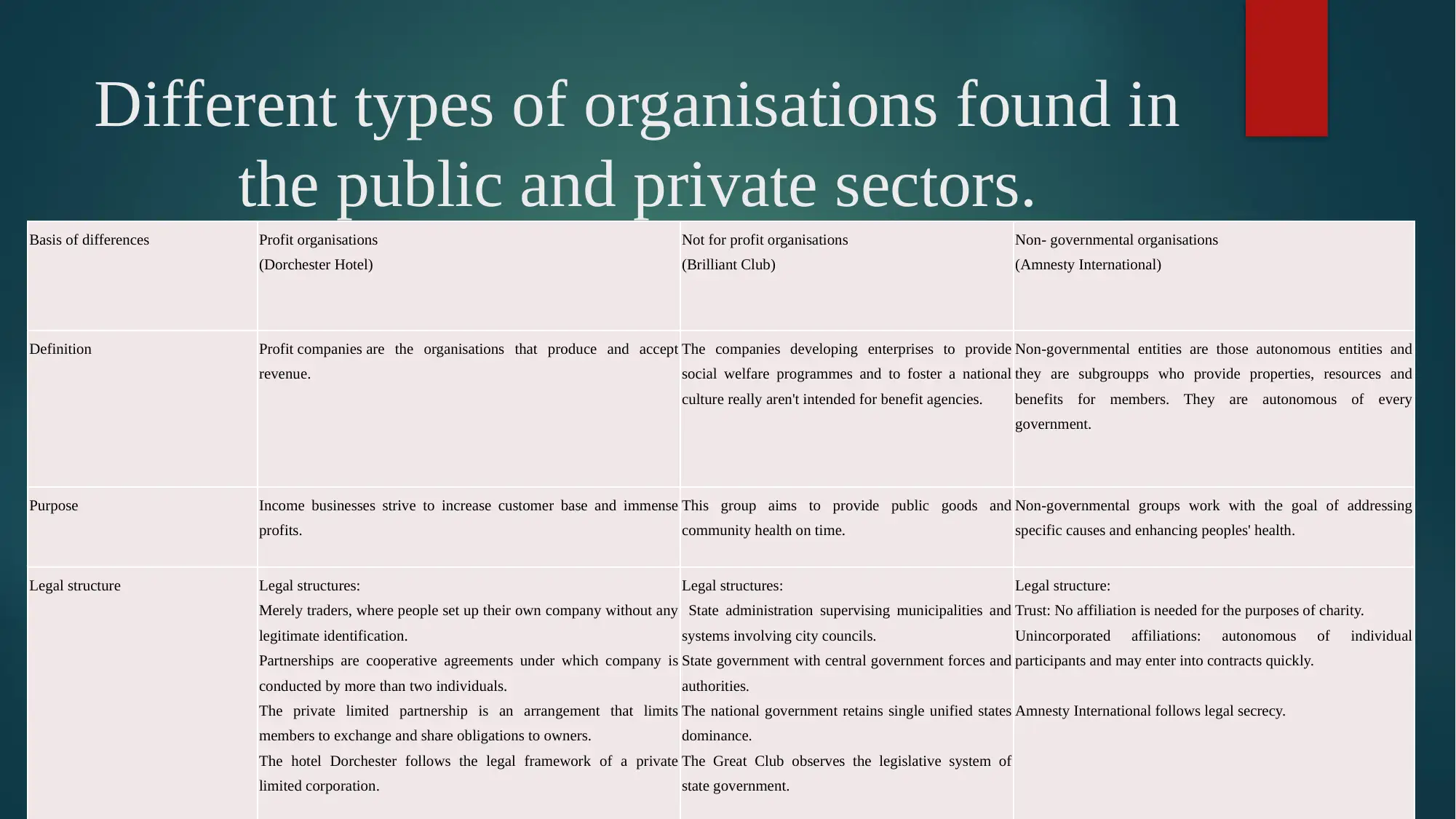
Basis of differences Profit organisations
(Dorchester Hotel)
Not for profit organisations
(Brilliant Club)
Non- governmental organisations
(Amnesty International)
Definition Profit companies are the organisations that produce and accept
revenue.
The companies developing enterprises to provide
social welfare programmes and to foster a national
culture really aren't intended for benefit agencies.
Non-governmental entities are those autonomous entities and
they are subgroupps who provide properties, resources and
benefits for members. They are autonomous of every
government.
Purpose Income businesses strive to increase customer base and immense
profits.
This group aims to provide public goods and
community health on time.
Non-governmental groups work with the goal of addressing
specific causes and enhancing peoples' health.
Legal structure Legal structures:
Merely traders, where people set up their own company without any
legitimate identification.
Partnerships are cooperative agreements under which company is
conducted by more than two individuals.
The private limited partnership is an arrangement that limits
members to exchange and share obligations to owners.
The hotel Dorchester follows the legal framework of a private
limited corporation.
Legal structures:
State administration supervising municipalities and
systems involving city councils.
State government with central government forces and
authorities.
The national government retains single unified states
dominance.
The Great Club observes the legislative system of
state government.
Legal structure:
Trust: No affiliation is needed for the purposes of charity.
Unincorporated affiliations: autonomous of individual
participants and may enter into contracts quickly.
Amnesty International follows legal secrecy.
tabler-icon-diamond-filled.svg

Paraphrase This Document

Need a fresh take? Get an instant paraphrase of this document with our AI Paraphraser
Document Page
Different structures within the
businesses
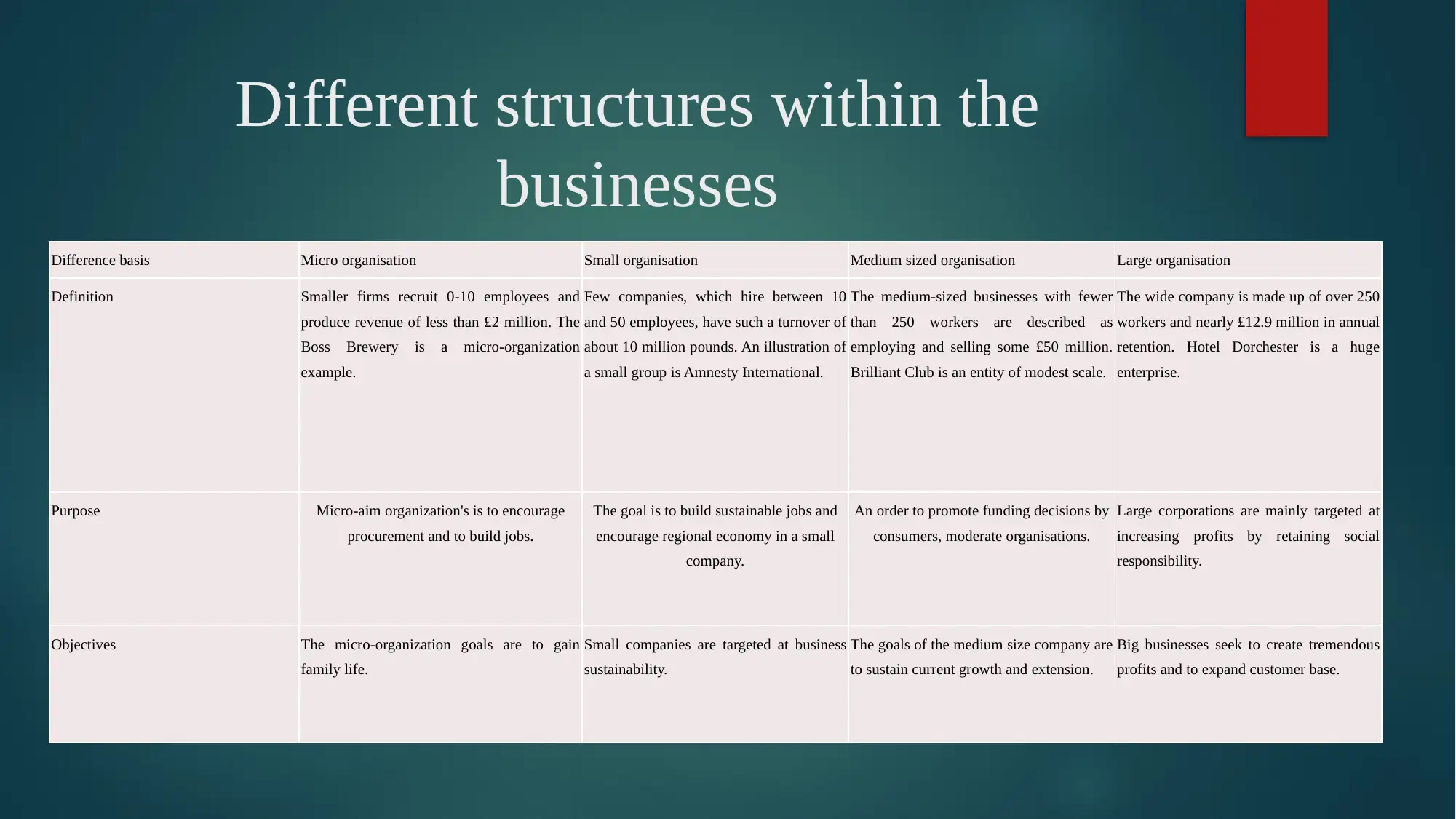
Difference basis Micro organisation Small organisation Medium sized organisation Large organisation
Definition Smaller firms recruit 0-10 employees and
produce revenue of less than £2 million. The
Boss Brewery is a micro-organization
example.
Few companies, which hire between 10
and 50 employees, have such a turnover of
about 10 million pounds. An illustration of
a small group is Amnesty International.
The medium-sized businesses with fewer
than 250 workers are described as
employing and selling some £50 million.
Brilliant Club is an entity of modest scale.
The wide company is made up of over 250
workers and nearly £12.9 million in annual
retention. Hotel Dorchester is a huge
enterprise.
Purpose Micro-aim organization's is to encourage
procurement and to build jobs.
The goal is to build sustainable jobs and
encourage regional economy in a small
company.
An order to promote funding decisions by
consumers, moderate organisations.
Large corporations are mainly targeted at
increasing profits by retaining social
responsibility.
Objectives The micro-organization goals are to gain
family life.
Small companies are targeted at business
sustainability.
The goals of the medium size company are
to sustain current growth and extension.
Big businesses seek to create tremendous
profits and to expand customer base.
Document Page
Impacts of local, national and global
economic environment.
Policy factor: This is all about government processes administration
practises for the entire hotel industry. Tariffs, duties, trade policy and
thereafter usually contain the factor. In Britain, decision-making for the
hospitality sector as a whole is in charge by the government.Factor
economic: Britain's market-oriented economy is quite well. Dorchester
Hotel is affected by the period of industry life, the production and
consumption, inflation rates of foreign policy.
Document Page
Conclusion
In last of presentation, it is concluded that different organization
operate in an country with the common motive to increase the
economic level and also maintain the decent profit for their long
term survival. It is also founded that with the help of pestel
analysis company is able to determine the micro economic factors
which can impact the overall performance.
tabler-icon-diamond-filled.svg

Paraphrase This Document

Need a fresh take? Get an instant paraphrase of this document with our AI Paraphraser
Document Page
References
Albertoni, F., Elia, S. and Piscitello, L., 2017. Complementing the
reshoring of manufacturing activities: the relocation of business
functions. In Reshoring of Manufacturing (pp. 57-75). Springer,
Cham.
Brannen, M. Y., Piekkari, R. and Tietze, S., 2017. The multifaceted
role of language in international business: Unpacking the forms,
functions and features of a critical challenge to MNC theory and
performance. In Language in international business (pp. 139-162).
Palgrave Macmillan, Cham.
Document Page
THANK YOU
chevron_up_icon
1 out of 9
circle_padding
hide_on_mobile
zoom_out_icon
[object Object]