Business Analysis and e-Portfolio Report for Great Korea Company
VerifiedAdded on 2020/02/24
|25
|5118
|100
Report
AI Summary
This report provides a comprehensive business analysis of Great Korea, a Korean grocery manufacturer and distributor. It examines the company's current operations, which heavily rely on manual processes, and identifies the need for ICT implementation to improve efficiency and competitiveness. The report includes a detailed business case, exploring the benefits of ICT integration across various departments such as sales, marketing, warehousing, purchasing, and customer service. A thorough stakeholder analysis is conducted, identifying key stakeholders, their interests, expectations, and communication needs. The report also models the current business processes to understand the functional units and job profiles within the organization. The analysis aims to provide insights into improving supply chain costs and overall management through ICT, culminating in a problem statement and proposed solutions for the company's e-portfolio.
ORGANISATION
OF E-PORTFOLIO
[Name]
Hewlett-Packard | [Company Address]
OF E-PORTFOLIO
[Name]
Hewlett-Packard | [Company Address]

Paraphrase This Document
Need a fresh take? Get an instant paraphrase of this document with our AI Paraphraser
Organisation of e-portfolio
Contents
1. An introduction..................................................................................................................................3
2. Business case.....................................................................................................................................3
3. Stakeholder analysis..........................................................................................................................4
4. Business context..............................................................................................................................16
5. Business processes...........................................................................................................................20
6. Conclusion.......................................................................................................................................23
References...........................................................................................................................................24
2
Contents
1. An introduction..................................................................................................................................3
2. Business case.....................................................................................................................................3
3. Stakeholder analysis..........................................................................................................................4
4. Business context..............................................................................................................................16
5. Business processes...........................................................................................................................20
6. Conclusion.......................................................................................................................................23
References...........................................................................................................................................24
2
Organisation of e-portfolio
1. An introduction
Great Korea is a manufacturer and distributor of Korean Groceries that specializes in canned
foods and bottled drinks that are produced in Australia. The company carries out most of its
administrative and business operations like sales, marketing, warehousing, purchasing, staff
payroll and customer service with very little use of information and communication
technology (ICT). However, the management thinks that for the company to be competitive
in the market, supply chain costs have to be reduced with improvements in management
using ICT.
This project involves a business analysis of the company including exploration of the
functional units, job profiles and roles within the organization. The current scenario of the
company operations have been analyzed to come up with a problem statement and a business
case. The report also includes stakeholder analysis done for understanding the business
requirements and business process modelling to understand the functional and business
processes used in the organization.
2. Business case
In the current situation, the grocery store has a large number of warehouses from where it is
operating that are operated manually. However, to gain competence in the growing market by
improving their services, it needed that the business starts to innovate through the use of ICT
and bring up the efficiencies of its operations and performance of its employees (Nielsen ,
2013).
The Company has multiple business operations that include sales, marketing, warehousing,
purchasing, staff payroll and customer service. These processes are managed manually by the
staff of the grocery retailer with very little use of technology. The organization operates
through its warehouses across Australia located in the capital cities of various states and
territories. Products sold by the company are located in numbered isles on large shelves
inside these warehouses. Whenever a customer needs a product, customer service staff assists
the customer with locating the products in these shelves. Sold products are recorded on
journal rolls and sales receipts are printed for customers at the sales terminal. The purchasing
staffs checks the stocks manually for the reordering. The availability of any product can be
discovered by the customer by visiting the store or calling the customer care (Bplan, 2016).
3
1. An introduction
Great Korea is a manufacturer and distributor of Korean Groceries that specializes in canned
foods and bottled drinks that are produced in Australia. The company carries out most of its
administrative and business operations like sales, marketing, warehousing, purchasing, staff
payroll and customer service with very little use of information and communication
technology (ICT). However, the management thinks that for the company to be competitive
in the market, supply chain costs have to be reduced with improvements in management
using ICT.
This project involves a business analysis of the company including exploration of the
functional units, job profiles and roles within the organization. The current scenario of the
company operations have been analyzed to come up with a problem statement and a business
case. The report also includes stakeholder analysis done for understanding the business
requirements and business process modelling to understand the functional and business
processes used in the organization.
2. Business case
In the current situation, the grocery store has a large number of warehouses from where it is
operating that are operated manually. However, to gain competence in the growing market by
improving their services, it needed that the business starts to innovate through the use of ICT
and bring up the efficiencies of its operations and performance of its employees (Nielsen ,
2013).
The Company has multiple business operations that include sales, marketing, warehousing,
purchasing, staff payroll and customer service. These processes are managed manually by the
staff of the grocery retailer with very little use of technology. The organization operates
through its warehouses across Australia located in the capital cities of various states and
territories. Products sold by the company are located in numbered isles on large shelves
inside these warehouses. Whenever a customer needs a product, customer service staff assists
the customer with locating the products in these shelves. Sold products are recorded on
journal rolls and sales receipts are printed for customers at the sales terminal. The purchasing
staffs checks the stocks manually for the reordering. The availability of any product can be
discovered by the customer by visiting the store or calling the customer care (Bplan, 2016).
3
⊘ This is a preview!⊘
Do you want full access?
Subscribe today to unlock all pages.

Trusted by 1+ million students worldwide
Organisation of e-portfolio
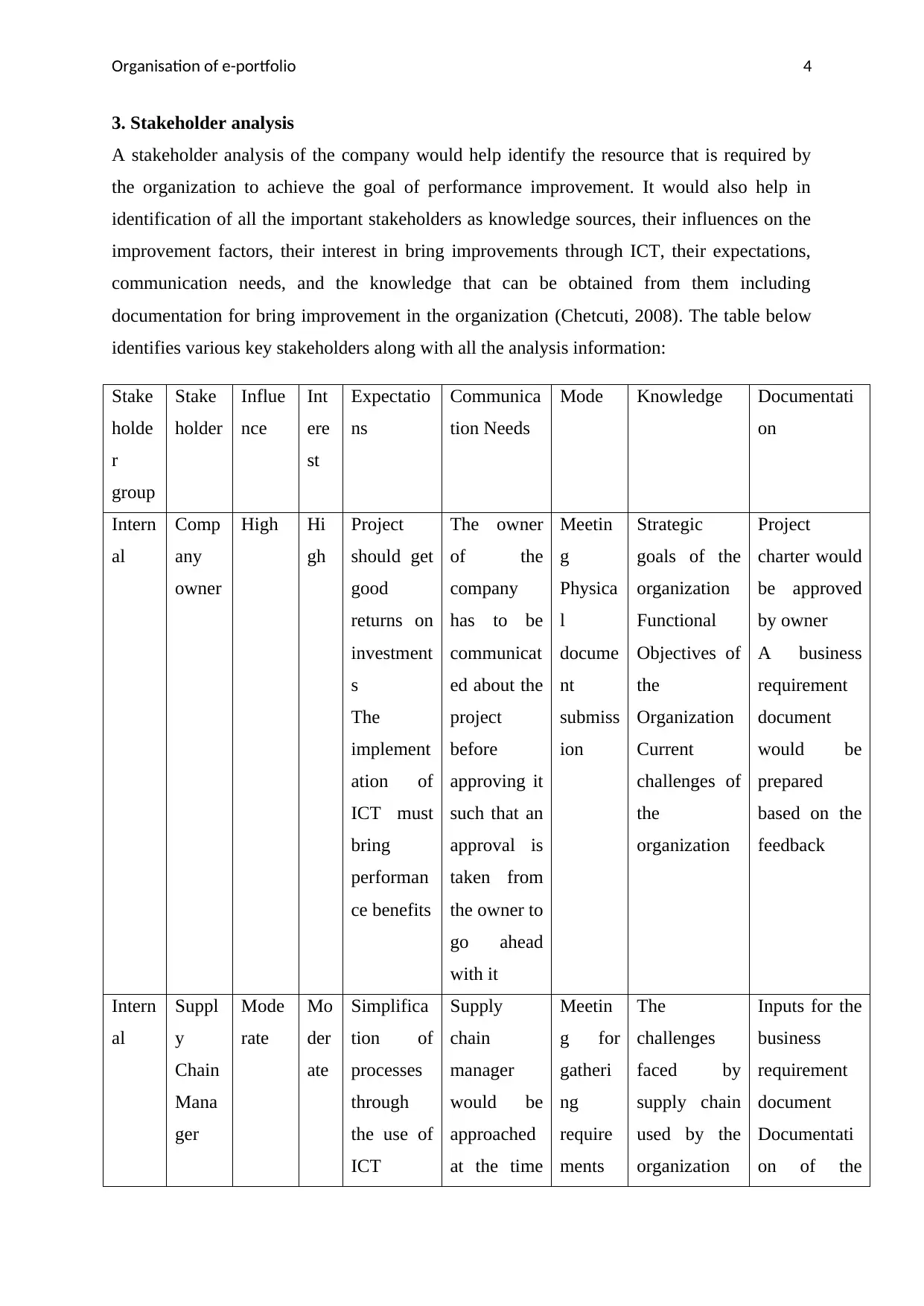
3. Stakeholder analysis
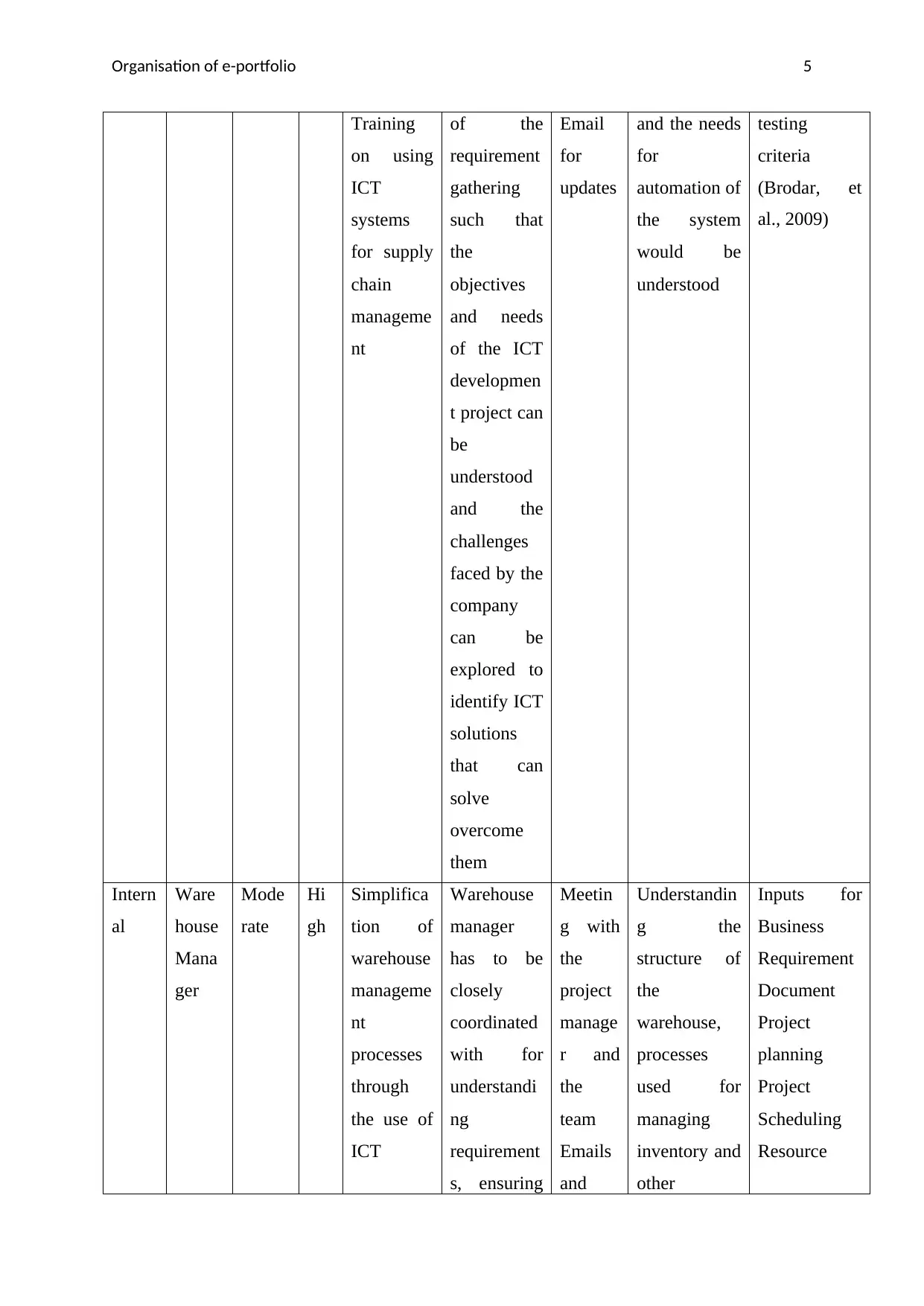
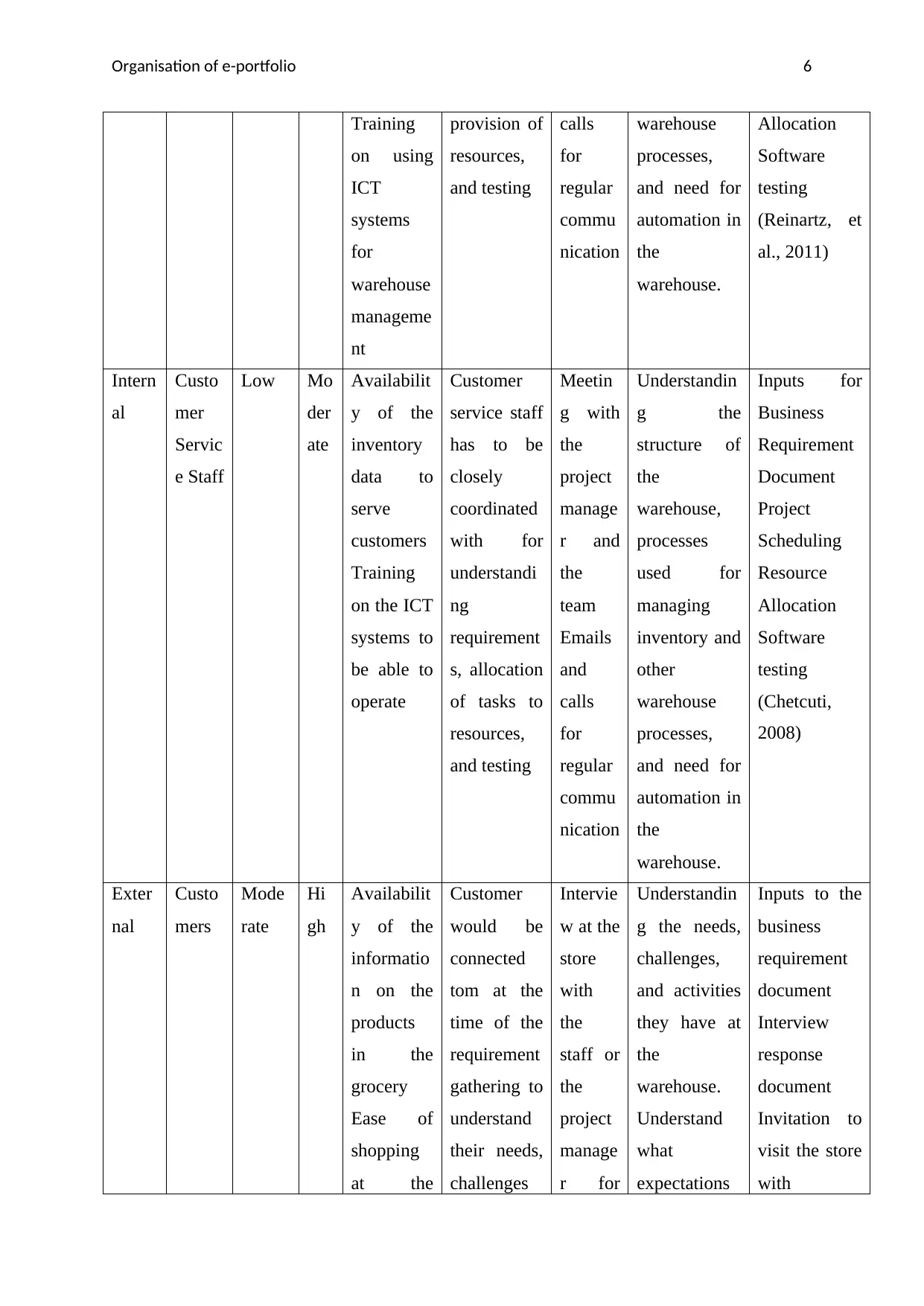
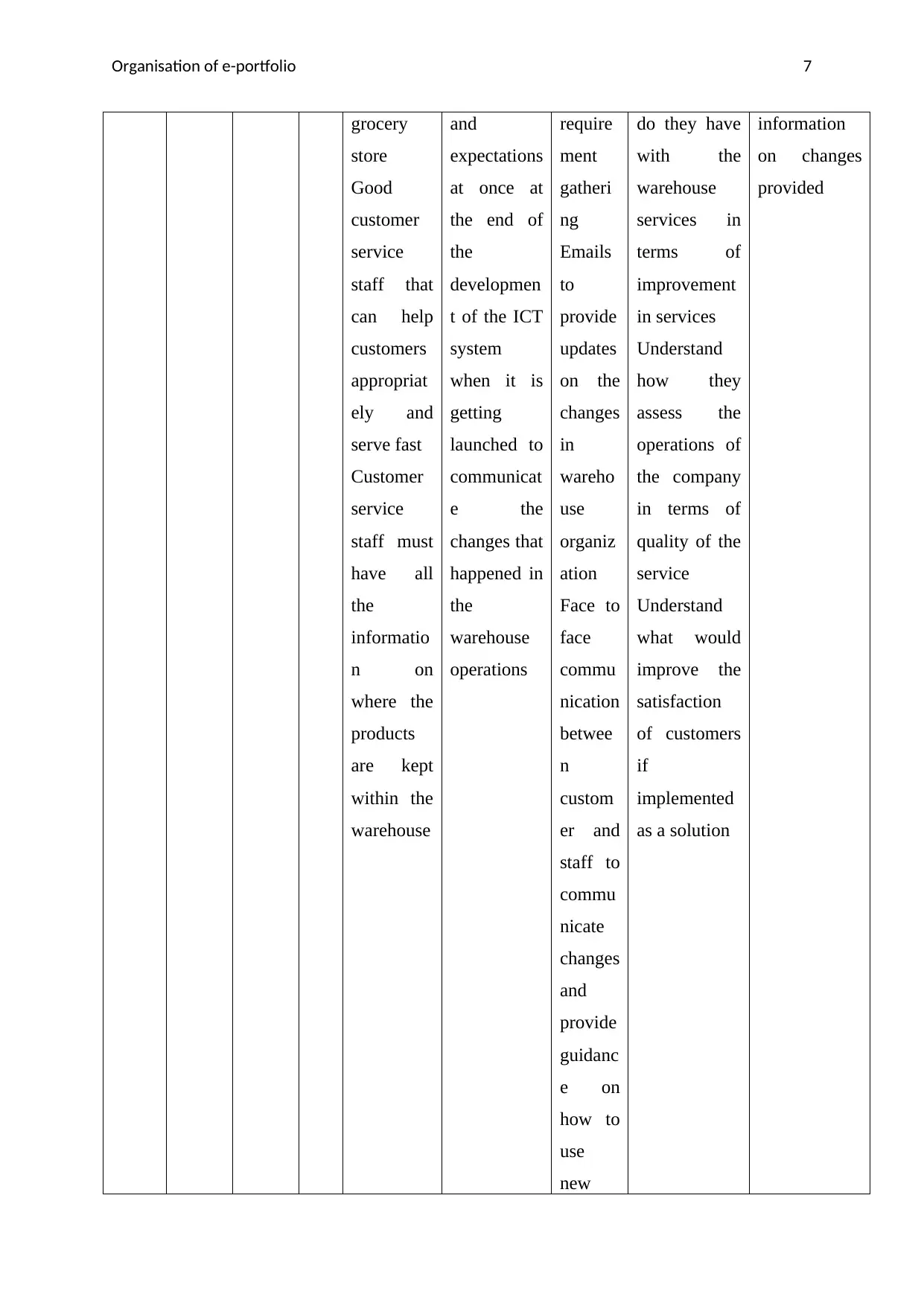
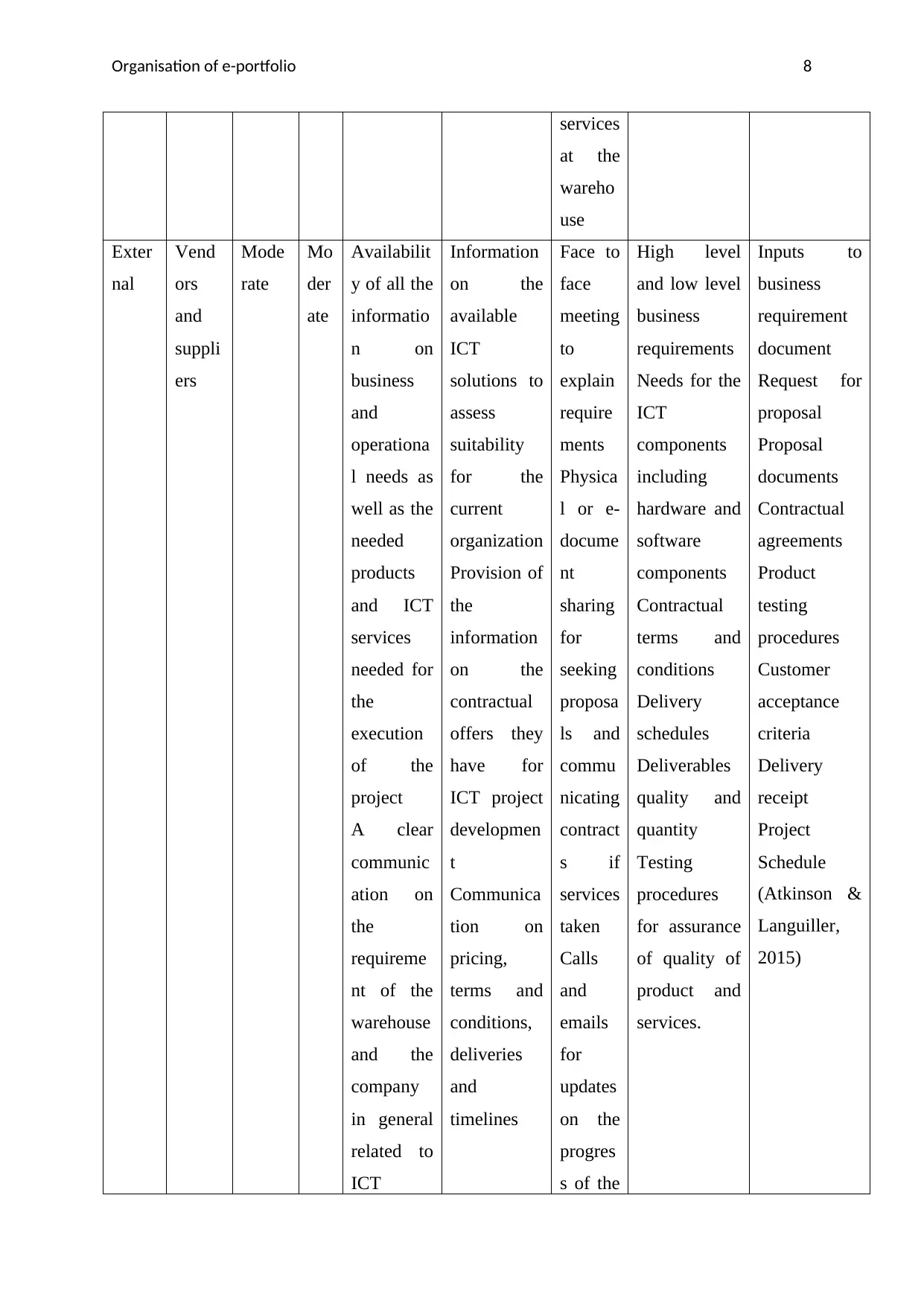
A stakeholder analysis of the company would help identify the resource that is required by
the organization to achieve the goal of performance improvement. It would also help in
identification of all the important stakeholders as knowledge sources, their influences on the
improvement factors, their interest in bring improvements through ICT, their expectations,
communication needs, and the knowledge that can be obtained from them including
documentation for bring improvement in the organization (Chetcuti, 2008). The table below
identifies various key stakeholders along with all the analysis information:
Stake
holde
r
group
Stake
holder
Influe
nce
Int
ere
st
Expectatio
ns
Communica
tion Needs
Mode Knowledge Documentati
on
Intern
al
Comp
any
owner
High Hi
gh
Project
should get
good
returns on
investment
s
The
implement
ation of
ICT must
bring
performan
ce benefits
The owner
of the
company
has to be
communicat
ed about the
project
before
approving it
such that an
approval is
taken from
the owner to
go ahead
with it
Meetin
g
Physica
l
docume
nt
submiss
ion
Strategic
goals of the
organization
Functional
Objectives of
the
Organization
Current
challenges of
the
organization
Project
charter would
be approved
by owner
A business
requirement
document
would be
prepared
based on the
feedback
Intern
al
Suppl
y
Chain
Mana
ger
Mode
rate
Mo
der
ate
Simplifica
tion of
processes
through
the use of
ICT
Supply
chain
manager
would be
approached
at the time
Meetin
g for
gatheri
ng
require
ments
The
challenges
faced by
supply chain
used by the
organization
Inputs for the
business
requirement
document
Documentati
on of the
4
3. Stakeholder analysis
A stakeholder analysis of the company would help identify the resource that is required by
the organization to achieve the goal of performance improvement. It would also help in
identification of all the important stakeholders as knowledge sources, their influences on the
improvement factors, their interest in bring improvements through ICT, their expectations,
communication needs, and the knowledge that can be obtained from them including
documentation for bring improvement in the organization (Chetcuti, 2008). The table below
identifies various key stakeholders along with all the analysis information:
Stake
holde
r
group
Stake
holder
Influe
nce
Int
ere
st
Expectatio
ns
Communica
tion Needs
Mode Knowledge Documentati
on
Intern
al
Comp
any
owner
High Hi
gh
Project
should get
good
returns on
investment
s
The
implement
ation of
ICT must
bring
performan
ce benefits
The owner
of the
company
has to be
communicat
ed about the
project
before
approving it
such that an
approval is
taken from
the owner to
go ahead
with it
Meetin
g
Physica
l
docume
nt
submiss
ion
Strategic
goals of the
organization
Functional
Objectives of
the
Organization
Current
challenges of
the
organization
Project
charter would
be approved
by owner
A business
requirement
document
would be
prepared
based on the
feedback
Intern
al
Suppl
y
Chain
Mana
ger
Mode
rate
Mo
der
ate
Simplifica
tion of
processes
through
the use of
ICT
Supply
chain
manager
would be
approached
at the time
Meetin
g for
gatheri
ng
require
ments
The
challenges
faced by
supply chain
used by the
organization
Inputs for the
business
requirement
document
Documentati
on of the
4
Paraphrase This Document
Need a fresh take? Get an instant paraphrase of this document with our AI Paraphraser
Organisation of e-portfolio
Training
on using
ICT
systems
for supply
chain
manageme
nt
of the
requirement
gathering
such that
the
objectives
and needs
of the ICT
developmen
t project can
be
understood
and the
challenges
faced by the
company
can be
explored to
identify ICT
solutions
that can
solve
overcome
them
Email
for
updates
and the needs
for
automation of
the system
would be
understood
testing
criteria
(Brodar, et
al., 2009)
Intern
al
Ware
house
Mana
ger
Mode
rate
Hi
gh
Simplifica
tion of
warehouse
manageme
nt
processes
through
the use of
ICT
Warehouse
manager
has to be
closely
coordinated
with for
understandi
ng
requirement
s, ensuring
Meetin
g with
the
project
manage
r and
the
team
Emails
and
Understandin
g the
structure of
the
warehouse,
processes
used for
managing
inventory and
other
Inputs for
Business
Requirement
Document
Project
planning
Project
Scheduling
Resource
5
Training
on using
ICT
systems
for supply
chain
manageme
nt
of the
requirement
gathering
such that
the
objectives
and needs
of the ICT
developmen
t project can
be
understood
and the
challenges
faced by the
company
can be
explored to
identify ICT
solutions
that can
solve
overcome
them
for
updates
and the needs
for
automation of
the system
would be
understood
testing
criteria
(Brodar, et
al., 2009)
Intern
al
Ware
house
Mana
ger
Mode
rate
Hi
gh
Simplifica
tion of
warehouse
manageme
nt
processes
through
the use of
ICT
Warehouse
manager
has to be
closely
coordinated
with for
understandi
ng
requirement
s, ensuring
Meetin
g with
the
project
manage
r and
the
team
Emails
and
Understandin
g the
structure of
the
warehouse,
processes
used for
managing
inventory and
other
Inputs for
Business
Requirement
Document
Project
planning
Project
Scheduling
Resource
5
Organisation of e-portfolio
Training
on using
ICT
systems
for
warehouse
manageme
nt
provision of
resources,
and testing
calls
for
regular
commu
nication
warehouse
processes,
and need for
automation in
the
warehouse.
Allocation
Software
testing
(Reinartz, et
al., 2011)
Intern
al
Custo
mer
Servic
e Staff
Low Mo
der
ate
Availabilit
y of the
inventory
data to
serve
customers
Training
on the ICT
systems to
be able to
operate
Customer
service staff
has to be
closely
coordinated
with for
understandi
ng
requirement
s, allocation
of tasks to
resources,
and testing
Meetin
g with
the
project
manage
r and
the
team
Emails
and
calls
for
regular
commu
nication
Understandin
g the
structure of
the
warehouse,
processes
used for
managing
inventory and
other
warehouse
processes,
and need for
automation in
the
warehouse.
Inputs for
Business
Requirement
Document
Project
Scheduling
Resource
Allocation
Software
testing
(Chetcuti,
2008)
Exter
nal
Custo
mers
Mode
rate
Hi
gh
Availabilit
y of the
informatio
n on the
products
in the
grocery
Ease of
shopping
at the
Customer
would be
connected
tom at the
time of the
requirement
gathering to
understand
their needs,
challenges
Intervie
w at the
store
with
the
staff or
the
project
manage
r for
Understandin
g the needs,
challenges,
and activities
they have at
the
warehouse.
Understand
what
expectations
Inputs to the
business
requirement
document
Interview
response
document
Invitation to
visit the store
with
6
Training
on using
ICT
systems
for
warehouse
manageme
nt
provision of
resources,
and testing
calls
for
regular
commu
nication
warehouse
processes,
and need for
automation in
the
warehouse.
Allocation
Software
testing
(Reinartz, et
al., 2011)
Intern
al
Custo
mer
Servic
e Staff
Low Mo
der
ate
Availabilit
y of the
inventory
data to
serve
customers
Training
on the ICT
systems to
be able to
operate
Customer
service staff
has to be
closely
coordinated
with for
understandi
ng
requirement
s, allocation
of tasks to
resources,
and testing
Meetin
g with
the
project
manage
r and
the
team
Emails
and
calls
for
regular
commu
nication
Understandin
g the
structure of
the
warehouse,
processes
used for
managing
inventory and
other
warehouse
processes,
and need for
automation in
the
warehouse.
Inputs for
Business
Requirement
Document
Project
Scheduling
Resource
Allocation
Software
testing
(Chetcuti,
2008)
Exter
nal
Custo
mers
Mode
rate
Hi
gh
Availabilit
y of the
informatio
n on the
products
in the
grocery
Ease of
shopping
at the
Customer
would be
connected
tom at the
time of the
requirement
gathering to
understand
their needs,
challenges
Intervie
w at the
store
with
the
staff or
the
project
manage
r for
Understandin
g the needs,
challenges,
and activities
they have at
the
warehouse.
Understand
what
expectations
Inputs to the
business
requirement
document
Interview
response
document
Invitation to
visit the store
with
6
⊘ This is a preview!⊘
Do you want full access?
Subscribe today to unlock all pages.
Trusted by 1+ million students worldwide
Organisation of e-portfolio
grocery
store
Good
customer
service
staff that
can help
customers
appropriat
ely and
serve fast
Customer
service
staff must
have all
the
informatio
n on
where the
products
are kept
within the
warehouse
and
expectations
at once at
the end of
the
developmen
t of the ICT
system
when it is
getting
launched to
communicat
e the
changes that
happened in
the
warehouse
operations
require
ment
gatheri
ng
Emails
to
provide
updates
on the
changes
in
wareho
use
organiz
ation
Face to
face
commu
nication
betwee
n
custom
er and
staff to
commu
nicate
changes
and
provide
guidanc
e on
how to
use
new
do they have
with the
warehouse
services in
terms of
improvement
in services
Understand
how they
assess the
operations of
the company
in terms of
quality of the
service
Understand
what would
improve the
satisfaction
of customers
if
implemented
as a solution
information
on changes
provided
7
grocery
store
Good
customer
service
staff that
can help
customers
appropriat
ely and
serve fast
Customer
service
staff must
have all
the
informatio
n on
where the
products
are kept
within the
warehouse
and
expectations
at once at
the end of
the
developmen
t of the ICT
system
when it is
getting
launched to
communicat
e the
changes that
happened in
the
warehouse
operations
require
ment
gatheri
ng
Emails
to
provide
updates
on the
changes
in
wareho
use
organiz
ation
Face to
face
commu
nication
betwee
n
custom
er and
staff to
commu
nicate
changes
and
provide
guidanc
e on
how to
use
new
do they have
with the
warehouse
services in
terms of
improvement
in services
Understand
how they
assess the
operations of
the company
in terms of
quality of the
service
Understand
what would
improve the
satisfaction
of customers
if
implemented
as a solution
information
on changes
provided
7
Paraphrase This Document
Need a fresh take? Get an instant paraphrase of this document with our AI Paraphraser
Organisation of e-portfolio
services
at the
wareho
use
Exter
nal
Vend
ors
and
suppli
ers
Mode
rate
Mo
der
ate
Availabilit
y of all the
informatio
n on
business
and
operationa
l needs as
well as the
needed
products
and ICT
services
needed for
the
execution
of the
project
A clear
communic
ation on
the
requireme
nt of the
warehouse
and the
company
in general
related to
ICT
Information
on the
available
ICT
solutions to
assess
suitability
for the
current
organization
Provision of
the
information
on the
contractual
offers they
have for
ICT project
developmen
t
Communica
tion on
pricing,
terms and
conditions,
deliveries
and
timelines
Face to
face
meeting
to
explain
require
ments
Physica
l or e-
docume
nt
sharing
for
seeking
proposa
ls and
commu
nicating
contract
s if
services
taken
Calls
and
emails
for
updates
on the
progres
s of the
High level
and low level
business
requirements
Needs for the
ICT
components
including
hardware and
software
components
Contractual
terms and
conditions
Delivery
schedules
Deliverables
quality and
quantity
Testing
procedures
for assurance
of quality of
product and
services.
Inputs to
business
requirement
document
Request for
proposal
Proposal
documents
Contractual
agreements
Product
testing
procedures
Customer
acceptance
criteria
Delivery
receipt
Project
Schedule
(Atkinson &
Languiller,
2015)
8
services
at the
wareho
use
Exter
nal
Vend
ors
and
suppli
ers
Mode
rate
Mo
der
ate
Availabilit
y of all the
informatio
n on
business
and
operationa
l needs as
well as the
needed
products
and ICT
services
needed for
the
execution
of the
project
A clear
communic
ation on
the
requireme
nt of the
warehouse
and the
company
in general
related to
ICT
Information
on the
available
ICT
solutions to
assess
suitability
for the
current
organization
Provision of
the
information
on the
contractual
offers they
have for
ICT project
developmen
t
Communica
tion on
pricing,
terms and
conditions,
deliveries
and
timelines
Face to
face
meeting
to
explain
require
ments
Physica
l or e-
docume
nt
sharing
for
seeking
proposa
ls and
commu
nicating
contract
s if
services
taken
Calls
and
emails
for
updates
on the
progres
s of the
High level
and low level
business
requirements
Needs for the
ICT
components
including
hardware and
software
components
Contractual
terms and
conditions
Delivery
schedules
Deliverables
quality and
quantity
Testing
procedures
for assurance
of quality of
product and
services.
Inputs to
business
requirement
document
Request for
proposal
Proposal
documents
Contractual
agreements
Product
testing
procedures
Customer
acceptance
criteria
Delivery
receipt
Project
Schedule
(Atkinson &
Languiller,
2015)
8
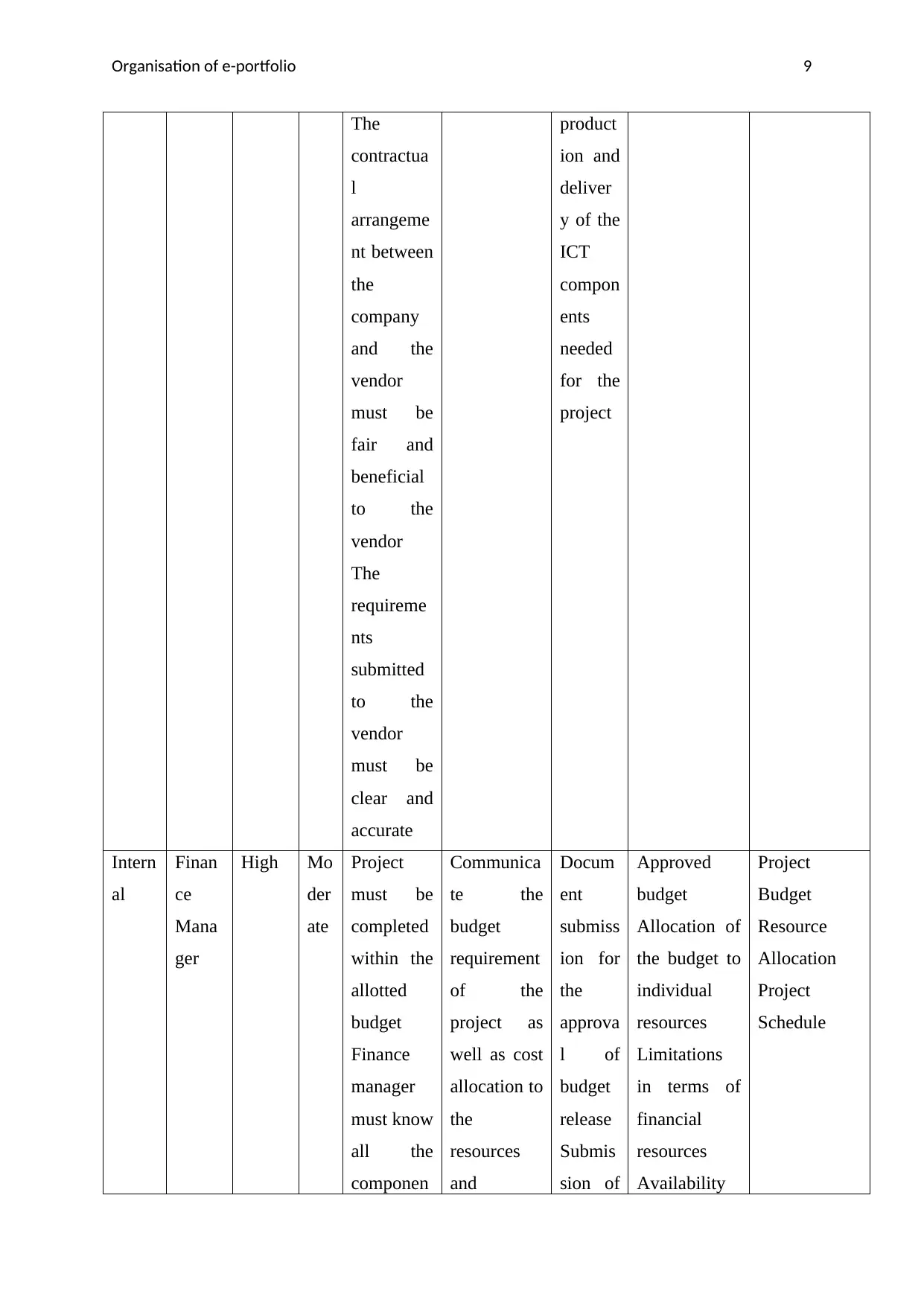
Organisation of e-portfolio
The
contractua
l
arrangeme
nt between
the
company
and the
vendor
must be
fair and
beneficial
to the
vendor
The
requireme
nts
submitted
to the
vendor
must be
clear and
accurate
product
ion and
deliver
y of the
ICT
compon
ents
needed
for the
project
Intern
al
Finan
ce
Mana
ger
High Mo
der
ate
Project
must be
completed
within the
allotted
budget
Finance
manager
must know
all the
componen
Communica
te the
budget
requirement
of the
project as
well as cost
allocation to
the
resources
and
Docum
ent
submiss
ion for
the
approva
l of
budget
release
Submis
sion of
Approved
budget
Allocation of
the budget to
individual
resources
Limitations
in terms of
financial
resources
Availability
Project
Budget
Resource
Allocation
Project
Schedule
9
The
contractua
l
arrangeme
nt between
the
company
and the
vendor
must be
fair and
beneficial
to the
vendor
The
requireme
nts
submitted
to the
vendor
must be
clear and
accurate
product
ion and
deliver
y of the
ICT
compon
ents
needed
for the
project
Intern
al
Finan
ce
Mana
ger
High Mo
der
ate
Project
must be
completed
within the
allotted
budget
Finance
manager
must know
all the
componen
Communica
te the
budget
requirement
of the
project as
well as cost
allocation to
the
resources
and
Docum
ent
submiss
ion for
the
approva
l of
budget
release
Submis
sion of
Approved
budget
Allocation of
the budget to
individual
resources
Limitations
in terms of
financial
resources
Availability
Project
Budget
Resource
Allocation
Project
Schedule
9
⊘ This is a preview!⊘
Do you want full access?
Subscribe today to unlock all pages.
Trusted by 1+ million students worldwide
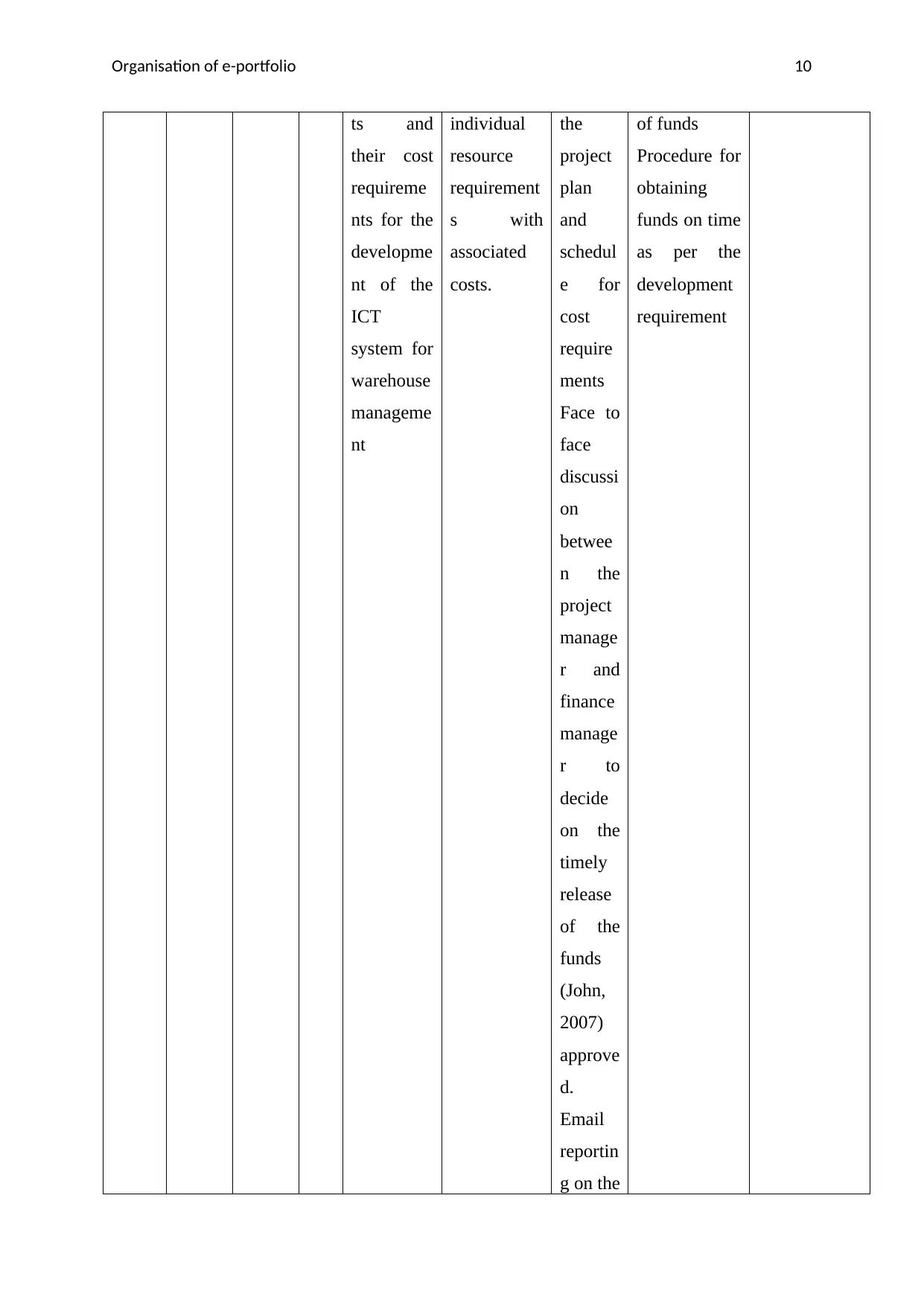
Organisation of e-portfolio
ts and
their cost
requireme
nts for the
developme
nt of the
ICT
system for
warehouse
manageme
nt
individual
resource
requirement
s with
associated
costs.
the
project
plan
and
schedul
e for
cost
require
ments
Face to
face
discussi
on
betwee
n the
project
manage
r and
finance
manage
r to
decide
on the
timely
release
of the
funds
(John,
2007)
approve
d.
Email
reportin
g on the
of funds
Procedure for
obtaining
funds on time
as per the
development
requirement
10
ts and
their cost
requireme
nts for the
developme
nt of the
ICT
system for
warehouse
manageme
nt
individual
resource
requirement
s with
associated
costs.
the
project
plan
and
schedul
e for
cost
require
ments
Face to
face
discussi
on
betwee
n the
project
manage
r and
finance
manage
r to
decide
on the
timely
release
of the
funds
(John,
2007)
approve
d.
reportin
g on the
of funds
Procedure for
obtaining
funds on time
as per the
development
requirement
10
Paraphrase This Document
Need a fresh take? Get an instant paraphrase of this document with our AI Paraphraser
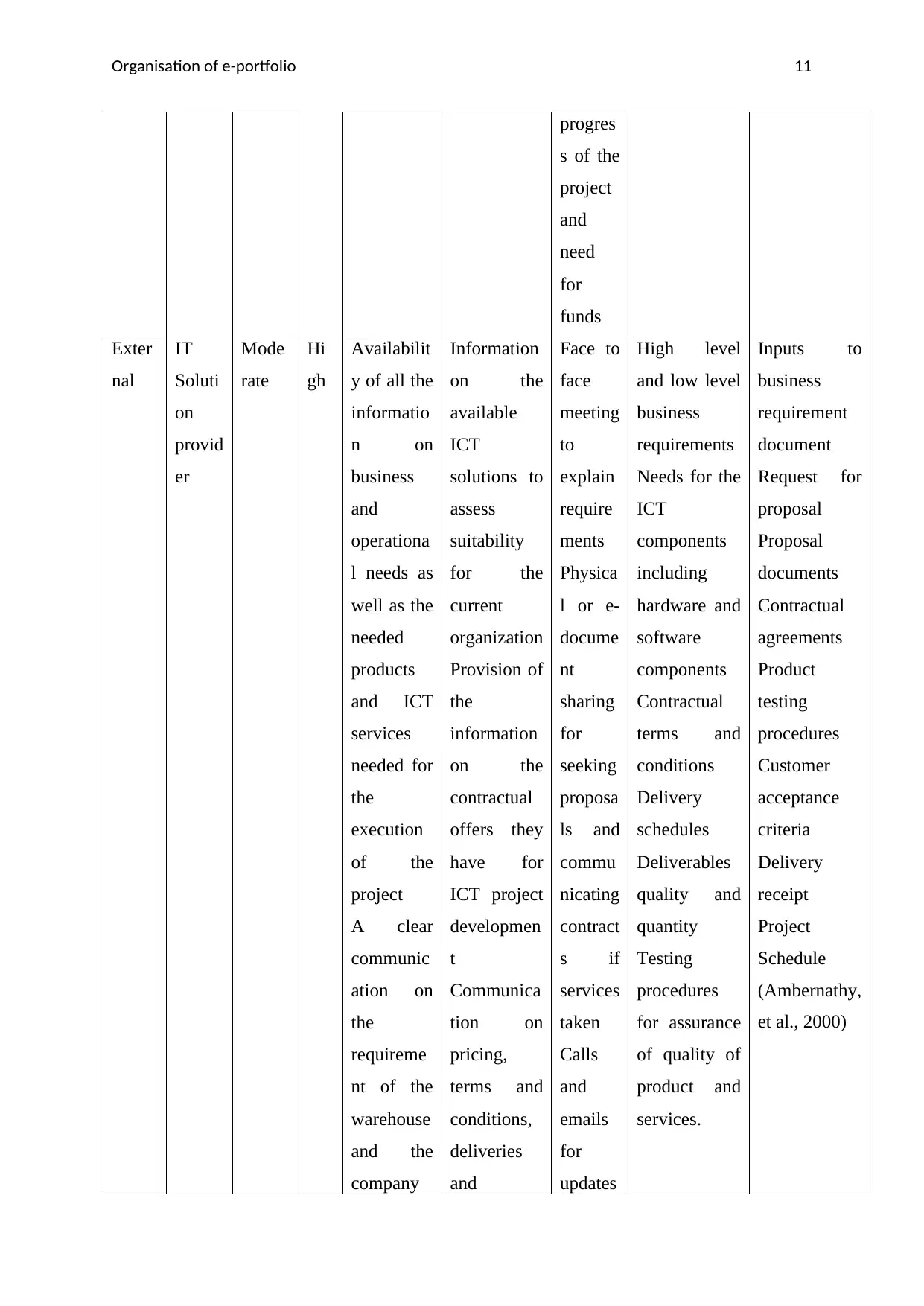
Organisation of e-portfolio
progres
s of the
project
and
need
for
funds
Exter
nal
IT
Soluti
on
provid
er
Mode
rate
Hi
gh
Availabilit
y of all the
informatio
n on
business
and
operationa
l needs as
well as the
needed
products
and ICT
services
needed for
the
execution
of the
project
A clear
communic
ation on
the
requireme
nt of the
warehouse
and the
company
Information
on the
available
ICT
solutions to
assess
suitability
for the
current
organization
Provision of
the
information
on the
contractual
offers they
have for
ICT project
developmen
t
Communica
tion on
pricing,
terms and
conditions,
deliveries
and
Face to
face
meeting
to
explain
require
ments
Physica
l or e-
docume
nt
sharing
for
seeking
proposa
ls and
commu
nicating
contract
s if
services
taken
Calls
and
emails
for
updates
High level
and low level
business
requirements
Needs for the
ICT
components
including
hardware and
software
components
Contractual
terms and
conditions
Delivery
schedules
Deliverables
quality and
quantity
Testing
procedures
for assurance
of quality of
product and
services.
Inputs to
business
requirement
document
Request for
proposal
Proposal
documents
Contractual
agreements
Product
testing
procedures
Customer
acceptance
criteria
Delivery
receipt
Project
Schedule
(Ambernathy,
et al., 2000)
11
progres
s of the
project
and
need
for
funds
Exter
nal
IT
Soluti
on
provid
er
Mode
rate
Hi
gh
Availabilit
y of all the
informatio
n on
business
and
operationa
l needs as
well as the
needed
products
and ICT
services
needed for
the
execution
of the
project
A clear
communic
ation on
the
requireme
nt of the
warehouse
and the
company
Information
on the
available
ICT
solutions to
assess
suitability
for the
current
organization
Provision of
the
information
on the
contractual
offers they
have for
ICT project
developmen
t
Communica
tion on
pricing,
terms and
conditions,
deliveries
and
Face to
face
meeting
to
explain
require
ments
Physica
l or e-
docume
nt
sharing
for
seeking
proposa
ls and
commu
nicating
contract
s if
services
taken
Calls
and
emails
for
updates
High level
and low level
business
requirements
Needs for the
ICT
components
including
hardware and
software
components
Contractual
terms and
conditions
Delivery
schedules
Deliverables
quality and
quantity
Testing
procedures
for assurance
of quality of
product and
services.
Inputs to
business
requirement
document
Request for
proposal
Proposal
documents
Contractual
agreements
Product
testing
procedures
Customer
acceptance
criteria
Delivery
receipt
Project
Schedule
(Ambernathy,
et al., 2000)
11
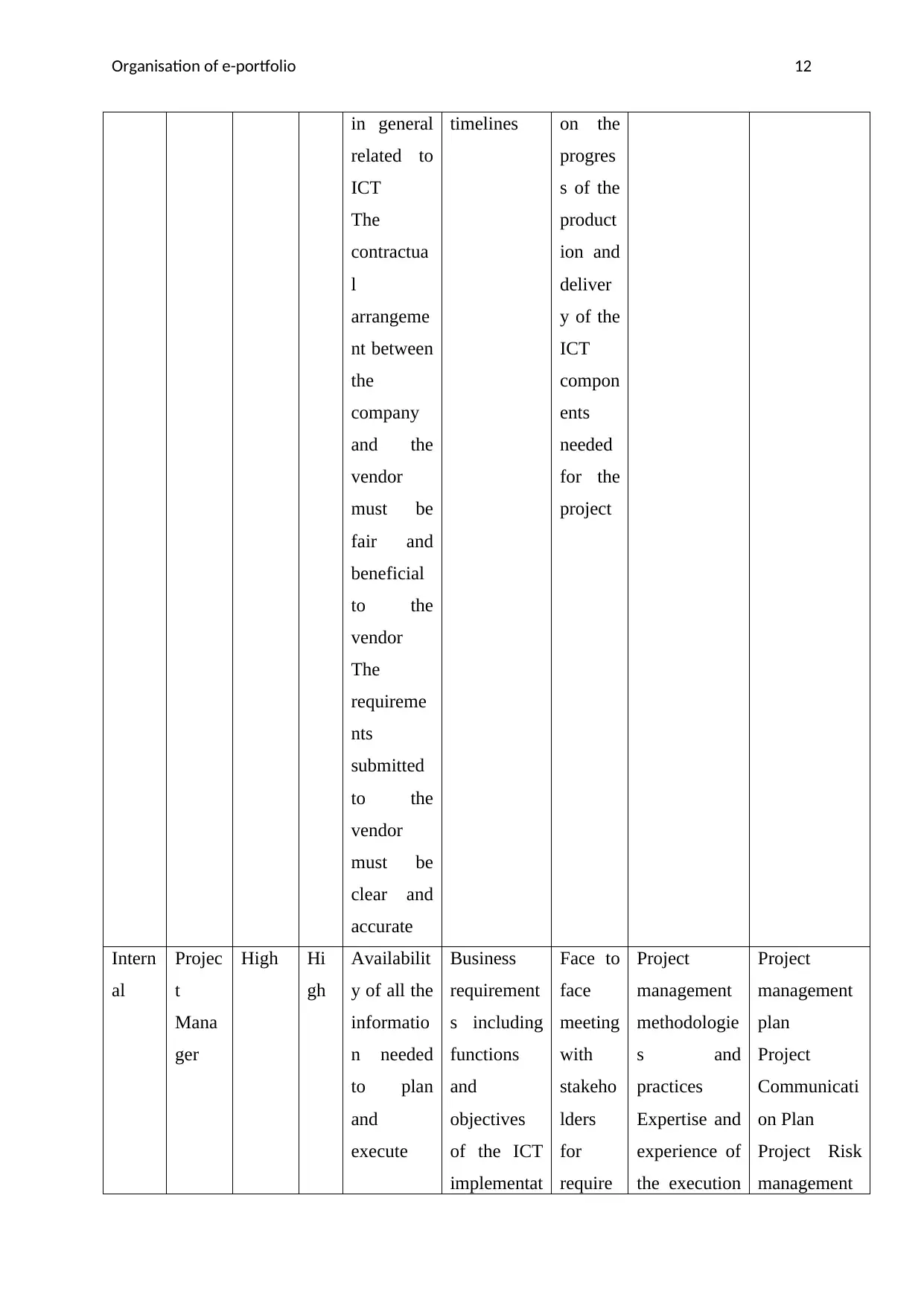
Organisation of e-portfolio
in general
related to
ICT
The
contractua
l
arrangeme
nt between
the
company
and the
vendor
must be
fair and
beneficial
to the
vendor
The
requireme
nts
submitted
to the
vendor
must be
clear and
accurate
timelines on the
progres
s of the
product
ion and
deliver
y of the
ICT
compon
ents
needed
for the
project
Intern
al
Projec
t
Mana
ger
High Hi
gh
Availabilit
y of all the
informatio
n needed
to plan
and
execute
Business
requirement
s including
functions
and
objectives
of the ICT
implementat
Face to
face
meeting
with
stakeho
lders
for
require
Project
management
methodologie
s and
practices
Expertise and
experience of
the execution
Project
management
plan
Project
Communicati
on Plan
Project Risk
management
12
in general
related to
ICT
The
contractua
l
arrangeme
nt between
the
company
and the
vendor
must be
fair and
beneficial
to the
vendor
The
requireme
nts
submitted
to the
vendor
must be
clear and
accurate
timelines on the
progres
s of the
product
ion and
deliver
y of the
ICT
compon
ents
needed
for the
project
Intern
al
Projec
t
Mana
ger
High Hi
gh
Availabilit
y of all the
informatio
n needed
to plan
and
execute
Business
requirement
s including
functions
and
objectives
of the ICT
implementat
Face to
face
meeting
with
stakeho
lders
for
require
Project
management
methodologie
s and
practices
Expertise and
experience of
the execution
Project
management
plan
Project
Communicati
on Plan
Project Risk
management
12
⊘ This is a preview!⊘
Do you want full access?
Subscribe today to unlock all pages.
Trusted by 1+ million students worldwide

1 out of 25


Related Documents


Your All-in-One AI-Powered Toolkit for Academic Success.
+13062052269
info@desklib.com
Available 24*7 on WhatsApp / Email
![[object Object]](/_next/static/media/star-bottom.7253800d.svg)
Unlock your academic potential
Copyright © 2020–2026 A2Z Services. All Rights Reserved. Developed and managed by ZUCOL.