Regent College BMP3002: Analysis of Different Types of Companies
VerifiedAdded on 2022/12/05
|8
|2292
|201
Report
AI Summary
This report, prepared for Regent College's BMP3002 Business in Practice module, provides a comprehensive analysis of various company types and their structures. It begins by defining and differentiating between micro, small, medium, and large businesses, outlining their characteristics and examples. The report then explores different legal entities, including sole traders, partnerships, limited liability businesses, public limited liability businesses, and cooperatives, detailing their characteristics and operational frameworks. Section 3 delves into organizational structures, comparing sole proprietorships, partnerships, private companies, and public companies, and explaining how these structures affect business productivity. The report also examines the impact of external factors on business performance through a PESTLE analysis, considering political, economic, social, technological, legal, and environmental factors. The report concludes with a summary of findings and a list of references.
BSc (Hons) Business
Management with Foundation
BMP3002
Business in Practice
Assessment 1
Types of Companies
INTRODUCTION......................................................................................................................2
0
Management with Foundation
BMP3002
Business in Practice
Assessment 1
Types of Companies
INTRODUCTION......................................................................................................................2
0

Paraphrase This Document
Need a fresh take? Get an instant paraphrase of this document with our AI Paraphraser
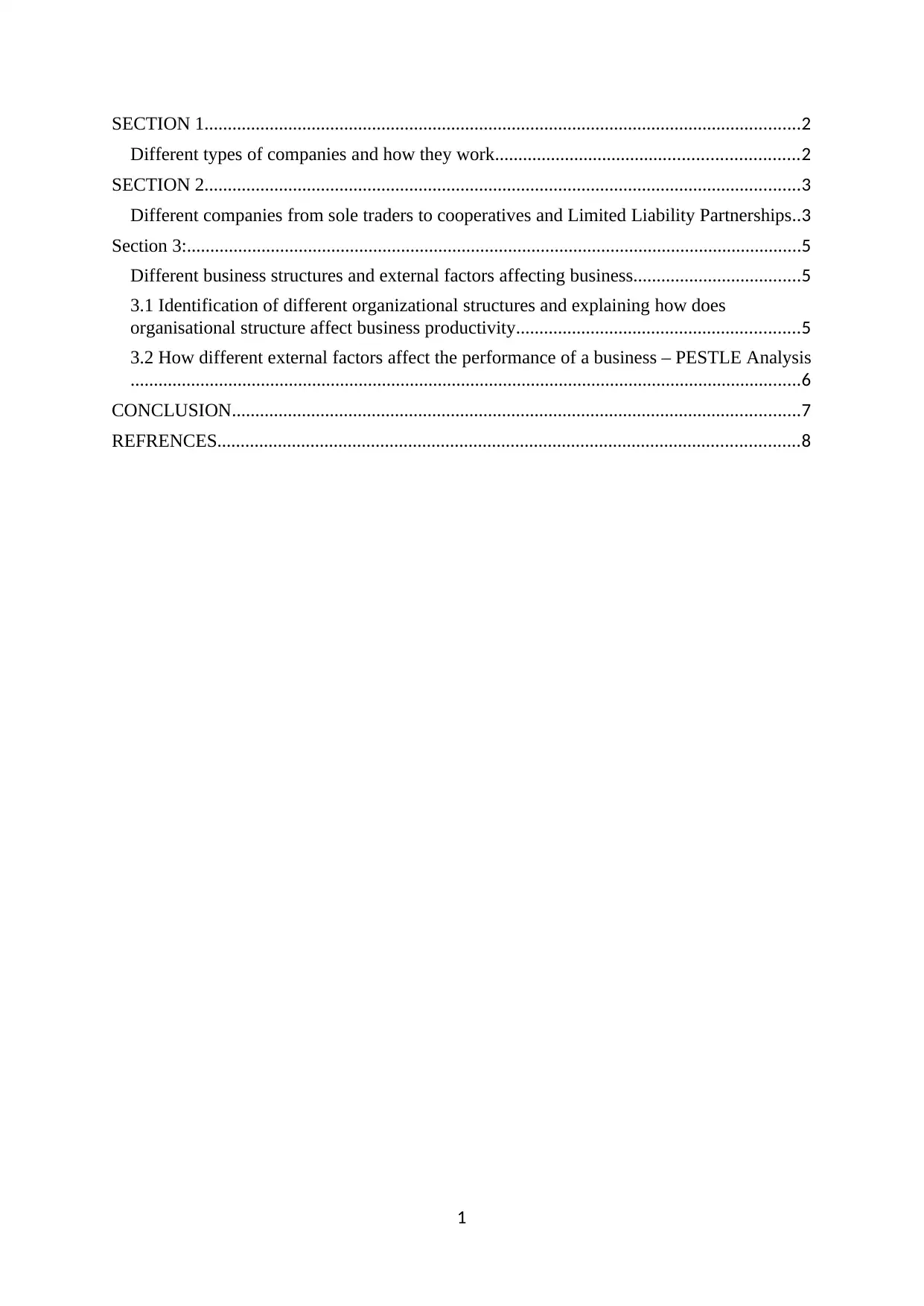
SECTION 1................................................................................................................................2
Different types of companies and how they work.................................................................2
SECTION 2................................................................................................................................3
Different companies from sole traders to cooperatives and Limited Liability Partnerships..3
Section 3:....................................................................................................................................5
Different business structures and external factors affecting business....................................5
3.1 Identification of different organizational structures and explaining how does
organisational structure affect business productivity.............................................................5
3.2 How different external factors affect the performance of a business – PESTLE Analysis
................................................................................................................................................6
CONCLUSION..........................................................................................................................7
REFRENCES.............................................................................................................................8
1
Different types of companies and how they work.................................................................2
SECTION 2................................................................................................................................3
Different companies from sole traders to cooperatives and Limited Liability Partnerships..3
Section 3:....................................................................................................................................5
Different business structures and external factors affecting business....................................5
3.1 Identification of different organizational structures and explaining how does
organisational structure affect business productivity.............................................................5
3.2 How different external factors affect the performance of a business – PESTLE Analysis
................................................................................................................................................6
CONCLUSION..........................................................................................................................7
REFRENCES.............................................................................................................................8
1
INTRODUCTION
Management is one of the most important factors which are related over performing
of various functions which is involved within business. This leads upon managing of work
within an organization. Management leads upon processing which is based over planning,
decision making, organizing, leading, motivating and makes controlling possible within an
organization. This makes human resource, finances and various other resources managed in
proper manner. It helps in making goals and objectives achieved that is been set by an
organization or educational institute. Scope of management is wider since it impacts working
of an organization. Nature is dynamic since it covers all aspects related to business in more
effective manner. The educational institute take in this file is Regent college which is been
operating in United Kingdom. Things covered within file are based upon various kinds of
business organization with types of businesses. In the end PESTLE analysis is been covered
in relation to college.
SECTION 1
Different types of companies and how they work
Micro or Small business: Micro business and small business are those business
organizations which has been operating with very limited operations at low level. In
this privately owned corporation, partnership, or sole proprietorship is been covered.
It makes annual revenue generation possible. Such organization works with less than
50 employees and does not have much strength. Also the process involved within
these organization are basic level related to content or BPO services (Kochanek and
et. al., 2019).
Medium size business: These are those kinds of organization which has been formed
in order to perform business which is of medium nature. Such organization earns
revenue and profit. They have more than 100 staff members but less than 1000. These
organization work for attaining sustainability in market.
Large size business: These are those kind of business organization which is been
formed in order to make formation of business at large scale. These organizations has
been operating with the work force of more than 1000 employees.
SECTION 2
2
Management is one of the most important factors which are related over performing
of various functions which is involved within business. This leads upon managing of work
within an organization. Management leads upon processing which is based over planning,
decision making, organizing, leading, motivating and makes controlling possible within an
organization. This makes human resource, finances and various other resources managed in
proper manner. It helps in making goals and objectives achieved that is been set by an
organization or educational institute. Scope of management is wider since it impacts working
of an organization. Nature is dynamic since it covers all aspects related to business in more
effective manner. The educational institute take in this file is Regent college which is been
operating in United Kingdom. Things covered within file are based upon various kinds of
business organization with types of businesses. In the end PESTLE analysis is been covered
in relation to college.
SECTION 1
Different types of companies and how they work
Micro or Small business: Micro business and small business are those business
organizations which has been operating with very limited operations at low level. In
this privately owned corporation, partnership, or sole proprietorship is been covered.
It makes annual revenue generation possible. Such organization works with less than
50 employees and does not have much strength. Also the process involved within
these organization are basic level related to content or BPO services (Kochanek and
et. al., 2019).
Medium size business: These are those kinds of organization which has been formed
in order to perform business which is of medium nature. Such organization earns
revenue and profit. They have more than 100 staff members but less than 1000. These
organization work for attaining sustainability in market.
Large size business: These are those kind of business organization which is been
formed in order to make formation of business at large scale. These organizations has
been operating with the work force of more than 1000 employees.
SECTION 2
2
⊘ This is a preview!⊘
Do you want full access?
Subscribe today to unlock all pages.

Trusted by 1+ million students worldwide
Different companies from sole traders to cooperatives and Limited Liability
Partnerships
Sole trader business: This that kind of business organization which is been run by an
individual person and business performed is very small in nature. Also the
organization is one of the most commonly formed organizations for doing a business.
Under its business only one owner is there and known as sole proprietorship. This
organization does have any liability in relation to tax or any other rule. Since these
organizations are very easy to be established and is been formed without any complex
process and also lengthy documents is not required. In this organization only HMRC
number is required for starting the trade and name is been decided over commencing
business (Manley and Valin, 2017).
Partnership: This is that kind of business organization within which an common
motive is been shared by an two persons that is to earn profit and generated revenue.
In these firms two or more than two persons performs business together. Also in this
business organization liability of partnership is dependent over the amount invested
by them. Such organization does not require documentation only agreement is formed
related to business they are been doing. Also these organizations makes agreement
when licensing or any kind of legal work is required by an organization to be done.
Limited liability business: This organization has been making business organizations
and is been rebated within the tax payment. Thus liability is also limited according to
investment done by partner. Also the working environment is hybrid in nature which
helps in making both corporate and partnership characteristics exists within it.
Public limited liability business: These are those business organizations that have
been made in relation over shareholders which develops business environment. In this
shares of an organization is been sold to public. Also important documents is required
which included digital signature, documents of registration and financial institution
that helps in making registration process completed in more effective manner. Such
organization is been run by various owners.
Cooperative: In this kind of organizations shares is not been sold within public and is
been kept by directors hired to do a particular work. In these directors holds all
responsibility regarding business or organization. Funding is been arranged through
loans taken form bank or through bonds and equity. Also under it Credit card, peer to
peer lending and other options are also available. Registration process of this
3
Partnerships
Sole trader business: This that kind of business organization which is been run by an
individual person and business performed is very small in nature. Also the
organization is one of the most commonly formed organizations for doing a business.
Under its business only one owner is there and known as sole proprietorship. This
organization does have any liability in relation to tax or any other rule. Since these
organizations are very easy to be established and is been formed without any complex
process and also lengthy documents is not required. In this organization only HMRC
number is required for starting the trade and name is been decided over commencing
business (Manley and Valin, 2017).
Partnership: This is that kind of business organization within which an common
motive is been shared by an two persons that is to earn profit and generated revenue.
In these firms two or more than two persons performs business together. Also in this
business organization liability of partnership is dependent over the amount invested
by them. Such organization does not require documentation only agreement is formed
related to business they are been doing. Also these organizations makes agreement
when licensing or any kind of legal work is required by an organization to be done.
Limited liability business: This organization has been making business organizations
and is been rebated within the tax payment. Thus liability is also limited according to
investment done by partner. Also the working environment is hybrid in nature which
helps in making both corporate and partnership characteristics exists within it.
Public limited liability business: These are those business organizations that have
been made in relation over shareholders which develops business environment. In this
shares of an organization is been sold to public. Also important documents is required
which included digital signature, documents of registration and financial institution
that helps in making registration process completed in more effective manner. Such
organization is been run by various owners.
Cooperative: In this kind of organizations shares is not been sold within public and is
been kept by directors hired to do a particular work. In these directors holds all
responsibility regarding business or organization. Funding is been arranged through
loans taken form bank or through bonds and equity. Also under it Credit card, peer to
peer lending and other options are also available. Registration process of this
3
Paraphrase This Document
Need a fresh take? Get an instant paraphrase of this document with our AI Paraphraser
organization is very lengthy and requires all documents to be collected in one place.
Then it is been submitted to Companies House which makes registration don in legal
manner. In these kinds of organization every work is been done by the directors
themselves in relation of functioning of company.
Section 3:
Different business structures and external factors affecting business
3.1 Identification of different organizational structures and explaining how does
organizational structure affect business productivity
Sole proprietorship: Structure of these organization is based the owner and decision
taken by owner. In this funds is been handled by an individual and is been arranged by the
owner. Funds is mainly arranged through friends, family members and taking private or
personal loan (Olivotti and et. al.2019). Management of such organization is dependent over
the owner and all responsibility is hold by sole proprietors of a business. Further advantages
and disadvantages has been explained as follows:
Advantages of sole proprietorship:
Process of setting it up is not complex in nature.
Finances required is less in order to from business.
Disadvantages of sole proprietor:
In this all liability is been hold by owner of the business and requires to handle all
things including decision making.
Tax in relation to self employment is required to be paid by owner himself.
Partnership: Such organization is been run by two or more persons with an motive
over earning profit. In this kind of organization all the work is been handled by its partners.
In this every aspect is require to be managed by the partners themselves and liability is been
hold by partners over running business (Lifshitz. and Finkelstein, 2017).
Advantages:
Process of forming an organization is very easy to be formed since it is of complex
nature.
Chances of making funds arranged in more easy manner due to more persons
involved within it.
4
Then it is been submitted to Companies House which makes registration don in legal
manner. In these kinds of organization every work is been done by the directors
themselves in relation of functioning of company.
Section 3:
Different business structures and external factors affecting business
3.1 Identification of different organizational structures and explaining how does
organizational structure affect business productivity
Sole proprietorship: Structure of these organization is based the owner and decision
taken by owner. In this funds is been handled by an individual and is been arranged by the
owner. Funds is mainly arranged through friends, family members and taking private or
personal loan (Olivotti and et. al.2019). Management of such organization is dependent over
the owner and all responsibility is hold by sole proprietors of a business. Further advantages
and disadvantages has been explained as follows:
Advantages of sole proprietorship:
Process of setting it up is not complex in nature.
Finances required is less in order to from business.
Disadvantages of sole proprietor:
In this all liability is been hold by owner of the business and requires to handle all
things including decision making.
Tax in relation to self employment is required to be paid by owner himself.
Partnership: Such organization is been run by two or more persons with an motive
over earning profit. In this kind of organization all the work is been handled by its partners.
In this every aspect is require to be managed by the partners themselves and liability is been
hold by partners over running business (Lifshitz. and Finkelstein, 2017).
Advantages:
Process of forming an organization is very easy to be formed since it is of complex
nature.
Chances of making funds arranged in more easy manner due to more persons
involved within it.
4
Disadvantages of partnership
Liability in relation over partner is limited over number of partners.
Also at times issue arises which make partnership get dissolved.
Private Company: Such organization arranges funds in the form of loans from banks
equity and through crowd funding. Such organization manages directors over selected
operations performed within business. (Packer and et. al.., 2018).
Advantages of Private Company are
It is a separate legal entity means that all it is separate from its owner.
Perpetual succession is there which means death of a member is not going to
effect Company’s existence.
Disadvantages of Private Company
Process of getting it register is very long
Also complicated procedure which becomes time consuming.
Public Company: These organizations are funded through selling of it shares to
public and taking loans from any kind of government organizations. Management of these
organizations are done through its owners.
Advantages of Public Company
Capital is raised through issuing of shares.
Sources of finance can be arranged easily (Rohlin. and Ross, 2016).
Disadvantages of Public Company
Directors appointed should have different aims as that of shareholder.
Control is lost over ownership due to various owners.
The above advantages and disadvantages of organization impacts productivity in a
way that in sole proprietorship sue to its disadvantages would not be able to generate funds
in more effective manner which makes business survival impossible. In case of partnership if
any issues occurs then whole firm is dissolved. Under private organization if at any point
directors fail to perform there functions then business collapse which makes sustainability
impacted (Sidel, 2019).
3.2 How different external factors affect the performance of a business – PESTLE
Analysis
5
Liability in relation over partner is limited over number of partners.
Also at times issue arises which make partnership get dissolved.
Private Company: Such organization arranges funds in the form of loans from banks
equity and through crowd funding. Such organization manages directors over selected
operations performed within business. (Packer and et. al.., 2018).
Advantages of Private Company are
It is a separate legal entity means that all it is separate from its owner.
Perpetual succession is there which means death of a member is not going to
effect Company’s existence.
Disadvantages of Private Company
Process of getting it register is very long
Also complicated procedure which becomes time consuming.
Public Company: These organizations are funded through selling of it shares to
public and taking loans from any kind of government organizations. Management of these
organizations are done through its owners.
Advantages of Public Company
Capital is raised through issuing of shares.
Sources of finance can be arranged easily (Rohlin. and Ross, 2016).
Disadvantages of Public Company
Directors appointed should have different aims as that of shareholder.
Control is lost over ownership due to various owners.
The above advantages and disadvantages of organization impacts productivity in a
way that in sole proprietorship sue to its disadvantages would not be able to generate funds
in more effective manner which makes business survival impossible. In case of partnership if
any issues occurs then whole firm is dissolved. Under private organization if at any point
directors fail to perform there functions then business collapse which makes sustainability
impacted (Sidel, 2019).
3.2 How different external factors affect the performance of a business – PESTLE
Analysis
5
⊘ This is a preview!⊘
Do you want full access?
Subscribe today to unlock all pages.
Trusted by 1+ million students worldwide
Political Factors: These are those factors based upon political polices formed by
government in order to make an organization operate in organized manner. Also these
policies formed by government mainly impacts externa functioning of Regent college
by impacting its quality of studies(Whitlock and et. al.2018).
Economic Factors: Such factors is based upon economic growth of a country which
deals with unemployment, import and export rate. Also it deals upon all the other
economic factors which makes revenue generation possible. It impacts Regent college
through affecting their finances which make resource available for making studies
possible.
Social Factors: Such factors is based over all kinds of trends that has been occurring
within society. Also makes sure that trends and preferences of customer understood.
Regent college gets impacted in a way that if thye are not able to follow recent trends
of studying then students would not score good marks which makes ranking reduced
Technological Factors: They are based upon technological development taking
place within society. These factors help Regent college in reaching to its students
through inline medium.
Legal Factors: These are one of the most important factors and are based over laws
that are to be followed by Regent college in order to avoid legal trouble.
Environmental Factors: These factors are based over environmental rules and
regulations formed by an government to protect environment. Regent college is
required to follow this in order to keep students healthy and make them feel positive
while studying in classes
CONCLUSION
From the above discussion it can be concluded that management is the process by
which an organization or educational institute manages its work. Management has been
helping educational institute to manage its various processes. In this file various types of
business is been covered and different kinds of business organization is covered. Then
advantages and disadvantages is covered with impact over productivity. In the end PESTLE
analysis has conducted.
6
government in order to make an organization operate in organized manner. Also these
policies formed by government mainly impacts externa functioning of Regent college
by impacting its quality of studies(Whitlock and et. al.2018).
Economic Factors: Such factors is based upon economic growth of a country which
deals with unemployment, import and export rate. Also it deals upon all the other
economic factors which makes revenue generation possible. It impacts Regent college
through affecting their finances which make resource available for making studies
possible.
Social Factors: Such factors is based over all kinds of trends that has been occurring
within society. Also makes sure that trends and preferences of customer understood.
Regent college gets impacted in a way that if thye are not able to follow recent trends
of studying then students would not score good marks which makes ranking reduced
Technological Factors: They are based upon technological development taking
place within society. These factors help Regent college in reaching to its students
through inline medium.
Legal Factors: These are one of the most important factors and are based over laws
that are to be followed by Regent college in order to avoid legal trouble.
Environmental Factors: These factors are based over environmental rules and
regulations formed by an government to protect environment. Regent college is
required to follow this in order to keep students healthy and make them feel positive
while studying in classes
CONCLUSION
From the above discussion it can be concluded that management is the process by
which an organization or educational institute manages its work. Management has been
helping educational institute to manage its various processes. In this file various types of
business is been covered and different kinds of business organization is covered. Then
advantages and disadvantages is covered with impact over productivity. In the end PESTLE
analysis has conducted.
6
Paraphrase This Document
Need a fresh take? Get an instant paraphrase of this document with our AI Paraphraser
REFRENCES
Books and Journals
AlZawati, O.K., Alsyouf, I. and Bashir, H., 2020. An exploratory study of common issues
and key differences between the European Foundation for Quality Management and
the United Arab Emirates Public Sector Excellence Model: public sector organisation
results. International Journal of System Assurance Engineering and Management,
11(6), pp.1156-1169.
Chavan, M. and Breyer, Y.A., 2020. Supply Chain Management and Social Enterprise
Towards Zero Hunger: The Akshaya Patra Foundation in India. In Industry and
Higher Education (pp. 169-187). Springer, Singapore.
Lai, W. and Spires, A.J., 2021. Marketization and Its Discontents: Unveiling the Impacts of
Foundation-led Venture Philanthropy on Grassroots NGOs in China. The China
Quarterly, 245, pp.72-93.
Lassl, W., 2019. The Product—Core and Foundation of the Organization. In The Viability of
Organizations Vol. 1 (pp. 39-58). Springer, Cham.
Mathieu, J. and Rapp, T., 2018. Laying the foundation for successful team performance
trajectories: The roles of team charters and deliberate plans. Available at SSRN
3213584.
Mathieu, J. and Rapp, T., 2018. Laying the foundation for successful team performance
trajectories: The roles of team charters and deliberate plans. Available at SSRN
3213584.
Orr, S. and Jadhav, A., 2018. Creating a sustainable supply chain: the strategic foundation.
Journal of Business Strategy.
Pitagorsky, G., 2019. Mindfulness: The Foundation for Intelligence and Optimal
Performance. In Cognitive Readiness in Project Teams (pp. 87-115). Productivity
Press.
Ritter, T. and Lettl, C., 2018. The wider implications of business-model research. Long range
planning, 51(1), pp.1-8.
Singh, R. and Ramdeo, S., 2020. Foundation Organizational Development and Change
(ODC) Models. In Leading Organizational Development and Change (pp. 99-122).
Palgrave Macmillan, Cham.
7
Books and Journals
AlZawati, O.K., Alsyouf, I. and Bashir, H., 2020. An exploratory study of common issues
and key differences between the European Foundation for Quality Management and
the United Arab Emirates Public Sector Excellence Model: public sector organisation
results. International Journal of System Assurance Engineering and Management,
11(6), pp.1156-1169.
Chavan, M. and Breyer, Y.A., 2020. Supply Chain Management and Social Enterprise
Towards Zero Hunger: The Akshaya Patra Foundation in India. In Industry and
Higher Education (pp. 169-187). Springer, Singapore.
Lai, W. and Spires, A.J., 2021. Marketization and Its Discontents: Unveiling the Impacts of
Foundation-led Venture Philanthropy on Grassroots NGOs in China. The China
Quarterly, 245, pp.72-93.
Lassl, W., 2019. The Product—Core and Foundation of the Organization. In The Viability of
Organizations Vol. 1 (pp. 39-58). Springer, Cham.
Mathieu, J. and Rapp, T., 2018. Laying the foundation for successful team performance
trajectories: The roles of team charters and deliberate plans. Available at SSRN
3213584.
Mathieu, J. and Rapp, T., 2018. Laying the foundation for successful team performance
trajectories: The roles of team charters and deliberate plans. Available at SSRN
3213584.
Orr, S. and Jadhav, A., 2018. Creating a sustainable supply chain: the strategic foundation.
Journal of Business Strategy.
Pitagorsky, G., 2019. Mindfulness: The Foundation for Intelligence and Optimal
Performance. In Cognitive Readiness in Project Teams (pp. 87-115). Productivity
Press.
Ritter, T. and Lettl, C., 2018. The wider implications of business-model research. Long range
planning, 51(1), pp.1-8.
Singh, R. and Ramdeo, S., 2020. Foundation Organizational Development and Change
(ODC) Models. In Leading Organizational Development and Change (pp. 99-122).
Palgrave Macmillan, Cham.
7

1 out of 8


Related Documents


Your All-in-One AI-Powered Toolkit for Academic Success.
+13062052269
info@desklib.com
Available 24*7 on WhatsApp / Email
![[object Object]](/_next/static/media/star-bottom.7253800d.svg)
Unlock your academic potential
Copyright © 2020–2026 A2Z Services. All Rights Reserved. Developed and managed by ZUCOL.