Business Simulation: Performance Analysis Final Report 2018

Verified

Added on  2024/05/20

|9
|1803
|372
Report
AI Summary
This report provides a comprehensive analysis of a company's performance using a balanced scorecard approach across eight rounds of simulation. The analysis covers four key perspectives: financial, internal business processes, customer, and learning and growth. The company's performance is evaluated based on various metrics such as stock prices, profits, leverage, employee turnover, productivity, total quality management costs, inventory management, and plant utilization. The report highlights the company's strengths in internal business processes and its improvement in financial performance and learning and growth. It also discusses the importance of strategic business planning and decision-making, emphasizing the need to consider both financial and non-financial factors. The simulation process is deemed beneficial for making informed decisions regarding organizational metrics and overall development.

Document Page
PERFORMANCE ANALYSIS AND SIMULATION FINAL REPORT
1
tabler-icon-diamond-filled.svg

Paraphrase This Document

Need a fresh take? Get an instant paraphrase of this document with our AI Paraphraser
Document Page
Contents
Analysis of your company’s performance.................................................................................3
Business decision making..........................................................................................................6
Appendix 1.................................................................................................................................8
References..................................................................................................................................9
2
Document Page
Analysis of your company’s performance:
Business goals:
The company has also formulated number of goals which it requires for improvising the
current situation:
The main business goals are that the company wanted to improve their financial
performance by improving financial statistics such as profits and leverage and its
stock prices.
The other goals were to improve the learning and growth perspective through its
employee turnover, employee productivity and total quality management costs.
It also requires improvising its organisation manufacturing processes such as
maintenance of inventories, cost controlling and such other factors.
The company also aims at increasing its sales to further increase its profits and satisfy
financial perspective of the organisation as well (Sainaghi, et. al., 2013).
Balanced scorecard evaluation:
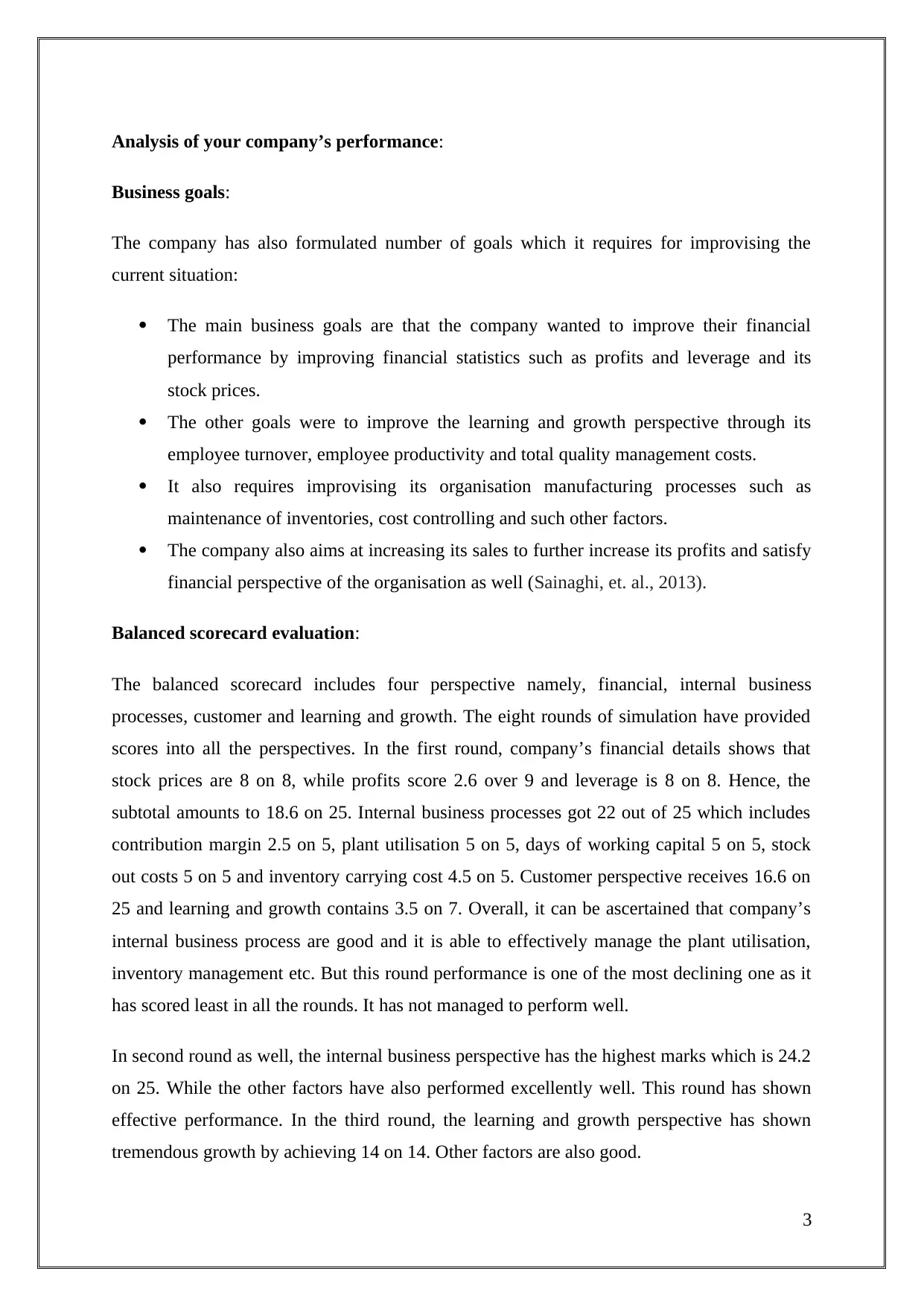
The balanced scorecard includes four perspective namely, financial, internal business
processes, customer and learning and growth. The eight rounds of simulation have provided
scores into all the perspectives. In the first round, company’s financial details shows that
stock prices are 8 on 8, while profits score 2.6 over 9 and leverage is 8 on 8. Hence, the
subtotal amounts to 18.6 on 25. Internal business processes got 22 out of 25 which includes
contribution margin 2.5 on 5, plant utilisation 5 on 5, days of working capital 5 on 5, stock
out costs 5 on 5 and inventory carrying cost 4.5 on 5. Customer perspective receives 16.6 on
25 and learning and growth contains 3.5 on 7. Overall, it can be ascertained that company’s
internal business process are good and it is able to effectively manage the plant utilisation,
inventory management etc. But this round performance is one of the most declining one as it
has scored least in all the rounds. It has not managed to perform well.
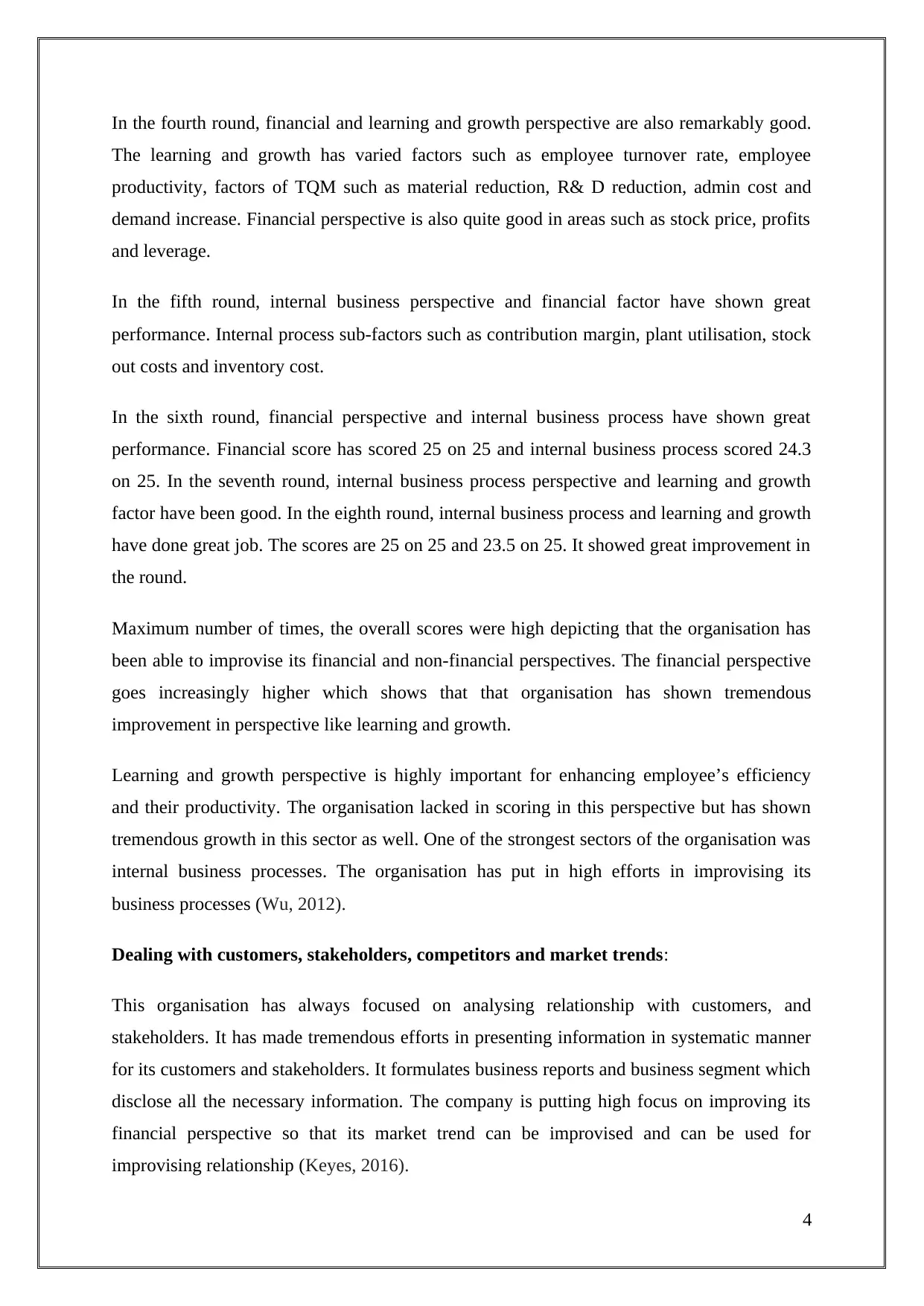
In second round as well, the internal business perspective has the highest marks which is 24.2
on 25. While the other factors have also performed excellently well. This round has shown
effective performance. In the third round, the learning and growth perspective has shown
tremendous growth by achieving 14 on 14. Other factors are also good.
3
Document Page
In the fourth round, financial and learning and growth perspective are also remarkably good.
The learning and growth has varied factors such as employee turnover rate, employee
productivity, factors of TQM such as material reduction, R& D reduction, admin cost and
demand increase. Financial perspective is also quite good in areas such as stock price, profits
and leverage.
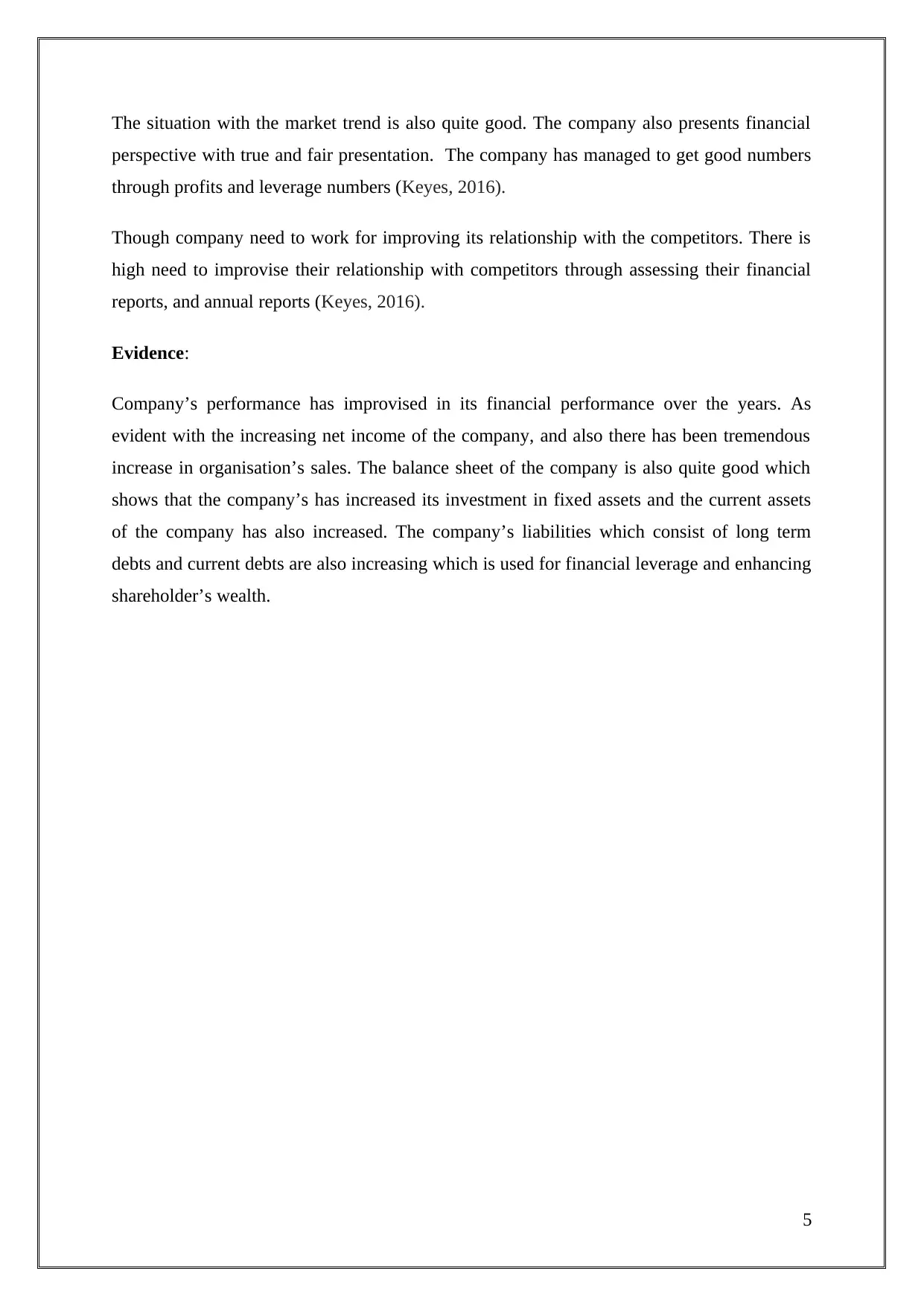
In the fifth round, internal business perspective and financial factor have shown great
performance. Internal process sub-factors such as contribution margin, plant utilisation, stock
out costs and inventory cost.
In the sixth round, financial perspective and internal business process have shown great
performance. Financial score has scored 25 on 25 and internal business process scored 24.3
on 25. In the seventh round, internal business process perspective and learning and growth
factor have been good. In the eighth round, internal business process and learning and growth
have done great job. The scores are 25 on 25 and 23.5 on 25. It showed great improvement in
the round.
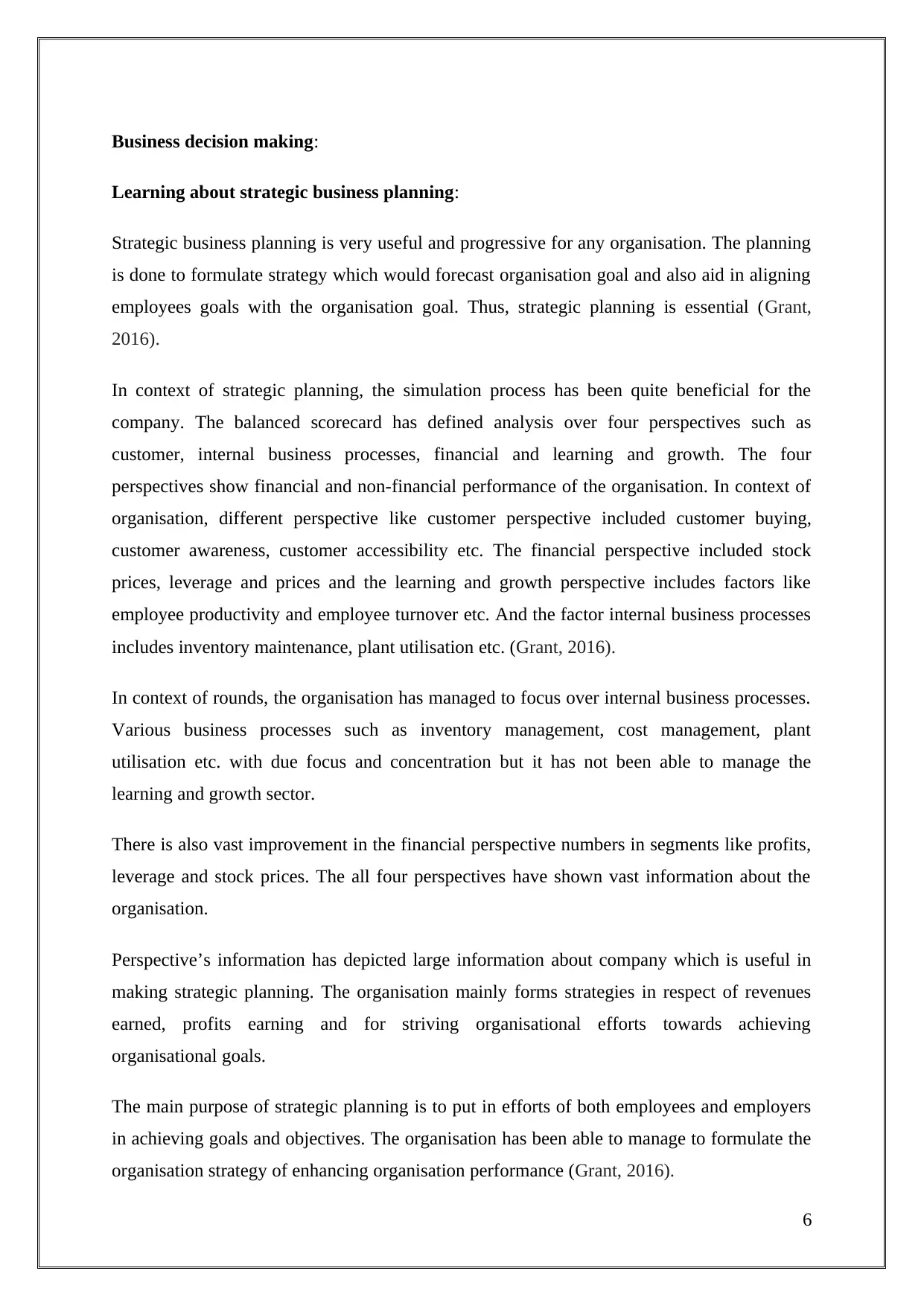
Maximum number of times, the overall scores were high depicting that the organisation has
been able to improvise its financial and non-financial perspectives. The financial perspective
goes increasingly higher which shows that that organisation has shown tremendous
improvement in perspective like learning and growth.
Learning and growth perspective is highly important for enhancing employee’s efficiency
and their productivity. The organisation lacked in scoring in this perspective but has shown
tremendous growth in this sector as well. One of the strongest sectors of the organisation was
internal business processes. The organisation has put in high efforts in improvising its
business processes (Wu, 2012).
Dealing with customers, stakeholders, competitors and market trends:
This organisation has always focused on analysing relationship with customers, and
stakeholders. It has made tremendous efforts in presenting information in systematic manner
for its customers and stakeholders. It formulates business reports and business segment which
disclose all the necessary information. The company is putting high focus on improving its
financial perspective so that its market trend can be improvised and can be used for
improvising relationship (Keyes, 2016).
4
tabler-icon-diamond-filled.svg

Paraphrase This Document

Need a fresh take? Get an instant paraphrase of this document with our AI Paraphraser
Document Page
The situation with the market trend is also quite good. The company also presents financial
perspective with true and fair presentation. The company has managed to get good numbers
through profits and leverage numbers (Keyes, 2016).
Though company need to work for improving its relationship with the competitors. There is
high need to improvise their relationship with competitors through assessing their financial
reports, and annual reports (Keyes, 2016).
Evidence:
Company’s performance has improvised in its financial performance over the years. As
evident with the increasing net income of the company, and also there has been tremendous
increase in organisation’s sales. The balance sheet of the company is also quite good which
shows that the company’s has increased its investment in fixed assets and the current assets
of the company has also increased. The company’s liabilities which consist of long term
debts and current debts are also increasing which is used for financial leverage and enhancing
shareholder’s wealth.
5
Document Page
Business decision making:
Learning about strategic business planning:
Strategic business planning is very useful and progressive for any organisation. The planning
is done to formulate strategy which would forecast organisation goal and also aid in aligning
employees goals with the organisation goal. Thus, strategic planning is essential (Grant,
2016).
In context of strategic planning, the simulation process has been quite beneficial for the
company. The balanced scorecard has defined analysis over four perspectives such as
customer, internal business processes, financial and learning and growth. The four
perspectives show financial and non-financial performance of the organisation. In context of
organisation, different perspective like customer perspective included customer buying,
customer awareness, customer accessibility etc. The financial perspective included stock
prices, leverage and prices and the learning and growth perspective includes factors like
employee productivity and employee turnover etc. And the factor internal business processes
includes inventory maintenance, plant utilisation etc. (Grant, 2016).
In context of rounds, the organisation has managed to focus over internal business processes.
Various business processes such as inventory management, cost management, plant
utilisation etc. with due focus and concentration but it has not been able to manage the
learning and growth sector.
There is also vast improvement in the financial perspective numbers in segments like profits,
leverage and stock prices. The all four perspectives have shown vast information about the
organisation.
Perspective’s information has depicted large information about company which is useful in
making strategic planning. The organisation mainly forms strategies in respect of revenues
earned, profits earning and for striving organisational efforts towards achieving
organisational goals.
The main purpose of strategic planning is to put in efforts of both employees and employers
in achieving goals and objectives. The organisation has been able to manage to formulate the
organisation strategy of enhancing organisation performance (Grant, 2016).
6
Document Page
Through these factors, the organisation can make its strategies such as it can focus more over
manufacturing processes involving products, costing of products, and implementation of
management accounting systems
Decision making:
This organisation decision making process also improvise through detailed investigation and
analysis through the simulation process. It has greatly helped management in making
financial and non-financial decisions (Grant, 2016).
An organisation needs to make decision regarding various things such as investment projects,
organisation processes, customer services and satisfaction, financial figures and revenues
number etc. These decisions are quite critical and require proper judgement before making
such decisions (Grant, 2016).
In an organisation, highest management hierarchy need to make decisions in relation to
organisations processes and management. From the simulation rounds taken regarding the
balanced scorecard, the company has hereby learned about decision making regarding
organisation metric and non-metric perspectives.
An organisation must make a balanced analysis of both numerical and non-numerical factors.
Financial figures are not only criteria for evaluating one’s performance and for taking
futuristic decisions rather non-financial figures such as customer perspective, learning
factors, internal business process must also be evaluated for making decisions.
Certain decisions like investment in employee development process may not be directly
related with earning financial figures but are eventually useful for enhancing company’s
goodwill and reputation (Grant, 2016).
Decisions based on analysis of balanced scorecard provide a much wider perspective for
looking over organisation futuristic planning and decision making and also proper
consideration is put over overall development of organisation (Grant, 2016).
Through the rounds, it can be ascertained that effective decisions must be taken regarding
financial perspective and customer perspective. Both the sectors would eventually help in
improvising company financial performance and aid in building relationship with the
customers as well.
7
tabler-icon-diamond-filled.svg

Paraphrase This Document

Need a fresh take? Get an instant paraphrase of this document with our AI Paraphraser
Document Page
Appendix 1:
8
Document Page
References:
Grant, R.M., 2016. Contemporary strategy analysis: Text and cases edition. John
Wiley & Sons.
Keyes, J., 2016. Implementing the IT balanced scorecard: Aligning IT with corporate
strategy. CRC Press.
Sainaghi, R., Phillips, P. and Corti, V., 2013. Measuring hotel performance: Using a
balanced scorecard perspectives’ approach. International Journal of Hospitality
Management, 34, pp.150-159.
Wu, H.Y., 2012. Constructing a strategy map for banking institutions with key
performance indicators of the balanced scorecard. Evaluation and Program
Planning, 35(3), pp.303-320.
9
chevron_up_icon
1 out of 9
circle_padding
hide_on_mobile
zoom_out_icon
[object Object]