Business Analytics in Practice: Applications of DSS in Marketing
VerifiedAdded on 2022/08/12
|12
|2839
|42
Report
AI Summary
This report investigates the application of Decision Support Systems (DSS) within the marketing domain of business analytics. It identifies key DSS types, including Data-based, Knowledge-based, and Model-based DSS, OLAP, and OLTP, and categorizes their applications into data resource creation and management, marketing analysis, and information resources. The study highlights the benefits of DSS for multinational companies, such as improved decision-making efficiency, early market deployment, crisis detection, and enhanced communication. The report analyzes how DSS facilitates data collection, organization, and statistical analysis, providing insights for strategic marketing decisions. Case studies, such as the adoption of Business Objects XI by Hellmann and Experian Scorex by Standard Bank, illustrate practical applications. The report concludes that DSS are essential tools for modern marketing, offering a competitive edge through data-driven insights and streamlined processes.

Business Analytics in Practice

Paraphrase This Document
Need a fresh take? Get an instant paraphrase of this document with our AI Paraphraser
Business Analytics in Practice
Executive Summary
This paper presents the findings into the investigation of the application of decision support
systems (DSS) in the marketing area of business. The Data-based Decision Support Systems,
Knowledge-based Decision Support Systems, Model-based Decision Support Systems, Online
Analytical Processing System (OLAP) and Online Transaction Processing System (OLTP) were
identified as the key DSS systems that find application in the marketing area of business. Their
applications fell under three main categories: data resource creation and management, marketing
analysis and information resource. The DSS systems were found to be beneficial to Multinational
companies by making the decision-making process efficient, allowing for early deployment of
marketing ideas ahead of the competition, early detection of potential crisis and opportunities in
the market, and ease of communication.
2
Executive Summary
This paper presents the findings into the investigation of the application of decision support
systems (DSS) in the marketing area of business. The Data-based Decision Support Systems,
Knowledge-based Decision Support Systems, Model-based Decision Support Systems, Online
Analytical Processing System (OLAP) and Online Transaction Processing System (OLTP) were
identified as the key DSS systems that find application in the marketing area of business. Their
applications fell under three main categories: data resource creation and management, marketing
analysis and information resource. The DSS systems were found to be beneficial to Multinational
companies by making the decision-making process efficient, allowing for early deployment of
marketing ideas ahead of the competition, early detection of potential crisis and opportunities in
the market, and ease of communication.
2
Business Analytics in Practice
Contents
Introduction.................................................................................................................................................4
About Business Area...................................................................................................................................5
Applications of Decision Support Systems in Marketing............................................................................5
Data Resource Creation and Management...............................................................................................5
Marketing Analysis.................................................................................................................................6
Information Resource..............................................................................................................................8
Benefits of Applications of Decision Support Systems in Marketing..........................................................9
Conclusion.................................................................................................................................................10
References.................................................................................................................................................11
3
Contents
Introduction.................................................................................................................................................4
About Business Area...................................................................................................................................5
Applications of Decision Support Systems in Marketing............................................................................5
Data Resource Creation and Management...............................................................................................5
Marketing Analysis.................................................................................................................................6
Information Resource..............................................................................................................................8
Benefits of Applications of Decision Support Systems in Marketing..........................................................9
Conclusion.................................................................................................................................................10
References.................................................................................................................................................11
3
⊘ This is a preview!⊘
Do you want full access?
Subscribe today to unlock all pages.

Trusted by 1+ million students worldwide
Business Analytics in Practice
Introduction
Increased competition in the business world has meant that the market dynamics are not enough
to rely on for guaranteed success. Market dynamics such as high demand, low supply and market
niche are currently not sufficient for improving the chances of success for a company (Kiechel,
2010; Tang, 2014). This is largely a product of availability of information to customers and
potential customers. The development of information technology and its evolution of the access
to information over the past decades has meant that the customers and the companies have access
to the same information (Halaweh & El, 2014). This reduction in the information gap between
the companies (competing companies) as well as between the companies and the customers has
given rise to stiff competition and highly sensitive customers.
Decision-making has become the new focus for improving the chances of success for companies.
A modern definition of decision-making, in the context of business, would be the ability to make
a choice that limits the losses and improves the profits (Henry & Venkatraman, 2015). Before the
onset and acceptance of data analytics, the quality of good judgement in decision-making was
based on the performance of the decision maker in previous positions (record of
accomplishment) (Trottier, 2017). Whereas data analytics has not entirely eliminated the need
and necessity of having a decision maker with an excellent record of accomplishment, it has
reduced the over-reliance on this single quality (Trottier, 2017).
In business terms, data analytics refers to the application of mathematical and statistical
approaches to available data in order to provide helpful inferences about the data (Han & Jaiwei,
2011; Fawcett & Provost, 2013). Data analytics provides additional information for decision
makers to assist them in making decisions that are backed by actual data. Data analytics is
integrated into the decision support systems (DSS) in decision-making. Decision support systems
are computerized systems involved in all aspects of the process of decision-making (Cristina,
Rudolf & Stefan, 2019; Christian & Griffiths, 2017; Bryan et al., 2012).
This paper is focused on the application and benefits of the decision support systems for a
business area. The business area will first be identified then the applications of the decision
support systems in that business area will be evaluated. In addition, this paper will check on the
benefits of the decision support systems applied in the business area. Conclusions will then be
made from the findings in this paper.
4
Introduction
Increased competition in the business world has meant that the market dynamics are not enough
to rely on for guaranteed success. Market dynamics such as high demand, low supply and market
niche are currently not sufficient for improving the chances of success for a company (Kiechel,
2010; Tang, 2014). This is largely a product of availability of information to customers and
potential customers. The development of information technology and its evolution of the access
to information over the past decades has meant that the customers and the companies have access
to the same information (Halaweh & El, 2014). This reduction in the information gap between
the companies (competing companies) as well as between the companies and the customers has
given rise to stiff competition and highly sensitive customers.
Decision-making has become the new focus for improving the chances of success for companies.
A modern definition of decision-making, in the context of business, would be the ability to make
a choice that limits the losses and improves the profits (Henry & Venkatraman, 2015). Before the
onset and acceptance of data analytics, the quality of good judgement in decision-making was
based on the performance of the decision maker in previous positions (record of
accomplishment) (Trottier, 2017). Whereas data analytics has not entirely eliminated the need
and necessity of having a decision maker with an excellent record of accomplishment, it has
reduced the over-reliance on this single quality (Trottier, 2017).
In business terms, data analytics refers to the application of mathematical and statistical
approaches to available data in order to provide helpful inferences about the data (Han & Jaiwei,
2011; Fawcett & Provost, 2013). Data analytics provides additional information for decision
makers to assist them in making decisions that are backed by actual data. Data analytics is
integrated into the decision support systems (DSS) in decision-making. Decision support systems
are computerized systems involved in all aspects of the process of decision-making (Cristina,
Rudolf & Stefan, 2019; Christian & Griffiths, 2017; Bryan et al., 2012).
This paper is focused on the application and benefits of the decision support systems for a
business area. The business area will first be identified then the applications of the decision
support systems in that business area will be evaluated. In addition, this paper will check on the
benefits of the decision support systems applied in the business area. Conclusions will then be
made from the findings in this paper.
4
Paraphrase This Document
Need a fresh take? Get an instant paraphrase of this document with our AI Paraphraser
Business Analytics in Practice
About Business Area
This paper will consider marketing as the business area case study for the application of decision
support systems. Marketing is an area of business operations that deals with the promotion of the
purchase a product or services to the clients and potential clients (Prescott, 2014; Kiechel, 2010).
The promotion also involves advertising and delivery of the product (or service). Marketing is a
critical area in any business entity because it serves as a link between the production line and the
end user (Tang, 2014). Considering a modern informed market and high competition, decisions
regarding marketing need to be as accurate as possible so as to avoid drops in market share and
subsequently losses.
Applications of Decision Support Systems in Marketing
Data Resource Creation and Management
Marketing research requires the availability of data on consumer, product and market metrics
(Henry & Venkatraman, 2015). For the consumer, this data includes information on the
consumer orders, purchases and location of purchases. The product data involves information on
prices, quantities and sales. The market metrics include competitor prices, delivery routes and
locations of outlets. This data collected on the consumer, product and market metrics need to be
organized and stored to allow for easy retrieval and use when needed (Halaweh & El, 2014).
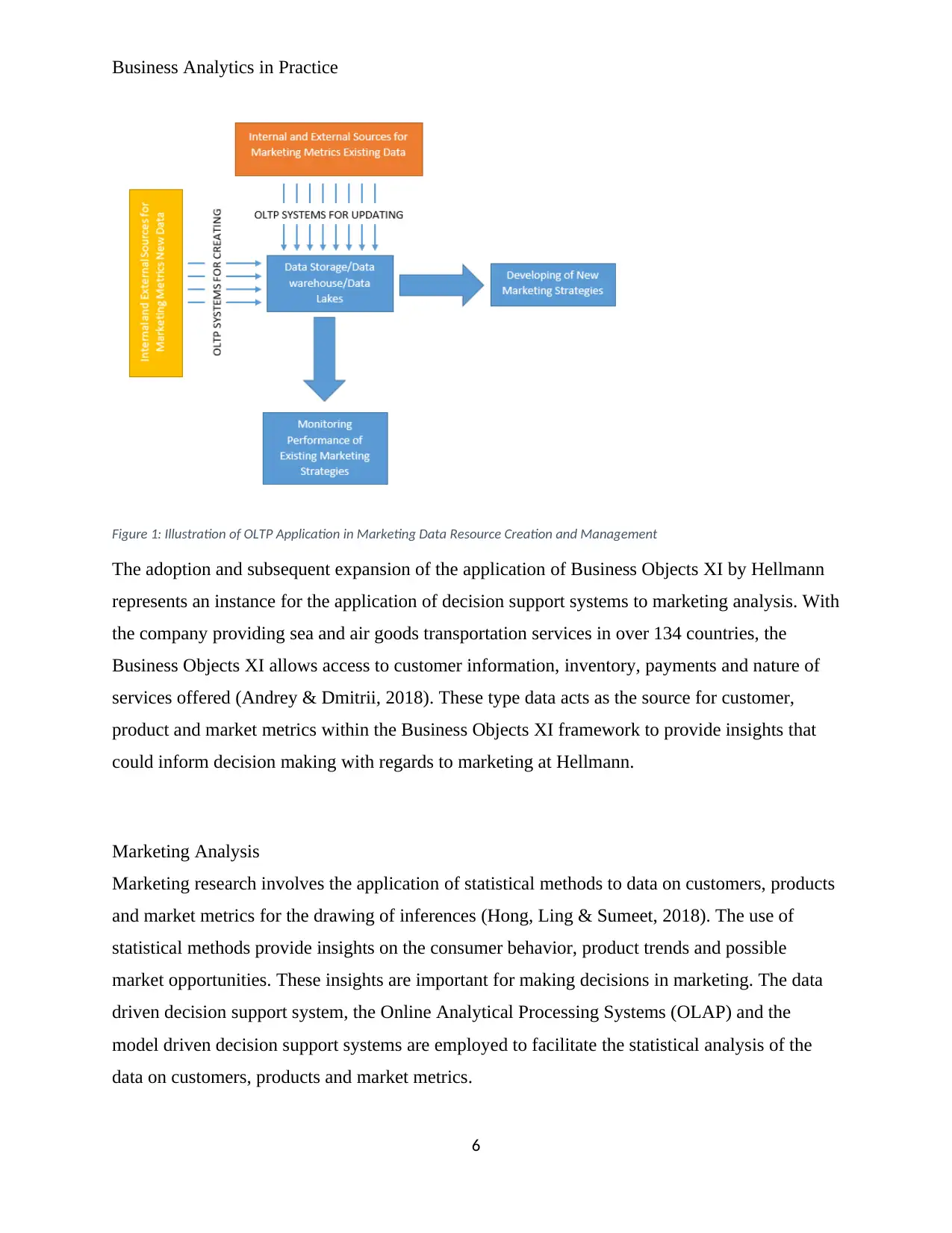
The Online Transaction Processing Systems (OLTP), for instance, can be employed to facilitate
the organization and storage of the data collected on the consumer, product and market metrics.
Online Transaction Processing Systems (OLTP) are decision support systems that are centered
on the maintenance of data and information resources (Andrey & Dmitrii, 2018). Being able to
monitor the performance of an applied marketing strategy is very important and this can be
achieved by continuous uploading of the relevant metrics into a data storage system, which can
be made possible using the OLTP. Apart from already deployed marketing strategies, data
resources are vital for the development of new marketing strategies. The data resource created
and maintained through the OLTP will therefore provide the marketing teams with a wide range
of data on market metrics that would assist in the strategy development. This can be seen in
Figure 1: Illustration of OLTP Application in Marketing Data Resource Creation and
Management below.
5
About Business Area
This paper will consider marketing as the business area case study for the application of decision
support systems. Marketing is an area of business operations that deals with the promotion of the
purchase a product or services to the clients and potential clients (Prescott, 2014; Kiechel, 2010).
The promotion also involves advertising and delivery of the product (or service). Marketing is a
critical area in any business entity because it serves as a link between the production line and the
end user (Tang, 2014). Considering a modern informed market and high competition, decisions
regarding marketing need to be as accurate as possible so as to avoid drops in market share and
subsequently losses.
Applications of Decision Support Systems in Marketing
Data Resource Creation and Management
Marketing research requires the availability of data on consumer, product and market metrics
(Henry & Venkatraman, 2015). For the consumer, this data includes information on the
consumer orders, purchases and location of purchases. The product data involves information on
prices, quantities and sales. The market metrics include competitor prices, delivery routes and
locations of outlets. This data collected on the consumer, product and market metrics need to be
organized and stored to allow for easy retrieval and use when needed (Halaweh & El, 2014).
The Online Transaction Processing Systems (OLTP), for instance, can be employed to facilitate
the organization and storage of the data collected on the consumer, product and market metrics.
Online Transaction Processing Systems (OLTP) are decision support systems that are centered
on the maintenance of data and information resources (Andrey & Dmitrii, 2018). Being able to
monitor the performance of an applied marketing strategy is very important and this can be
achieved by continuous uploading of the relevant metrics into a data storage system, which can
be made possible using the OLTP. Apart from already deployed marketing strategies, data
resources are vital for the development of new marketing strategies. The data resource created
and maintained through the OLTP will therefore provide the marketing teams with a wide range
of data on market metrics that would assist in the strategy development. This can be seen in
Figure 1: Illustration of OLTP Application in Marketing Data Resource Creation and
Management below.
5
Business Analytics in Practice
Figure 1: Illustration of OLTP Application in Marketing Data Resource Creation and Management
The adoption and subsequent expansion of the application of Business Objects XI by Hellmann
represents an instance for the application of decision support systems to marketing analysis. With
the company providing sea and air goods transportation services in over 134 countries, the
Business Objects XI allows access to customer information, inventory, payments and nature of
services offered (Andrey & Dmitrii, 2018). These type data acts as the source for customer,
product and market metrics within the Business Objects XI framework to provide insights that
could inform decision making with regards to marketing at Hellmann.
Marketing Analysis
Marketing research involves the application of statistical methods to data on customers, products
and market metrics for the drawing of inferences (Hong, Ling & Sumeet, 2018). The use of
statistical methods provide insights on the consumer behavior, product trends and possible
market opportunities. These insights are important for making decisions in marketing. The data
driven decision support system, the Online Analytical Processing Systems (OLAP) and the
model driven decision support systems are employed to facilitate the statistical analysis of the
data on customers, products and market metrics.
6
Figure 1: Illustration of OLTP Application in Marketing Data Resource Creation and Management
The adoption and subsequent expansion of the application of Business Objects XI by Hellmann
represents an instance for the application of decision support systems to marketing analysis. With
the company providing sea and air goods transportation services in over 134 countries, the
Business Objects XI allows access to customer information, inventory, payments and nature of
services offered (Andrey & Dmitrii, 2018). These type data acts as the source for customer,
product and market metrics within the Business Objects XI framework to provide insights that
could inform decision making with regards to marketing at Hellmann.
Marketing Analysis
Marketing research involves the application of statistical methods to data on customers, products
and market metrics for the drawing of inferences (Hong, Ling & Sumeet, 2018). The use of
statistical methods provide insights on the consumer behavior, product trends and possible
market opportunities. These insights are important for making decisions in marketing. The data
driven decision support system, the Online Analytical Processing Systems (OLAP) and the
model driven decision support systems are employed to facilitate the statistical analysis of the
data on customers, products and market metrics.
6
⊘ This is a preview!⊘
Do you want full access?
Subscribe today to unlock all pages.
Trusted by 1+ million students worldwide
Business Analytics in Practice
The Data-based (Data driven) DSS are decision support systems that are centered around data
and are composed of both data querying and drawing of inferences (Albright & Winston, 2014).
Online Analytical Processing Systems (OLAP) are decision support systems that enable the
application of statistical analysis techniques to data in an online environment (Hong, Ling &
Sumeet, 2018). Model-based (Model driven) DSS are decision support systems that are centered
on statistical models designed for the drawing of inferences (Gaston-Breton & Duque, 2015).
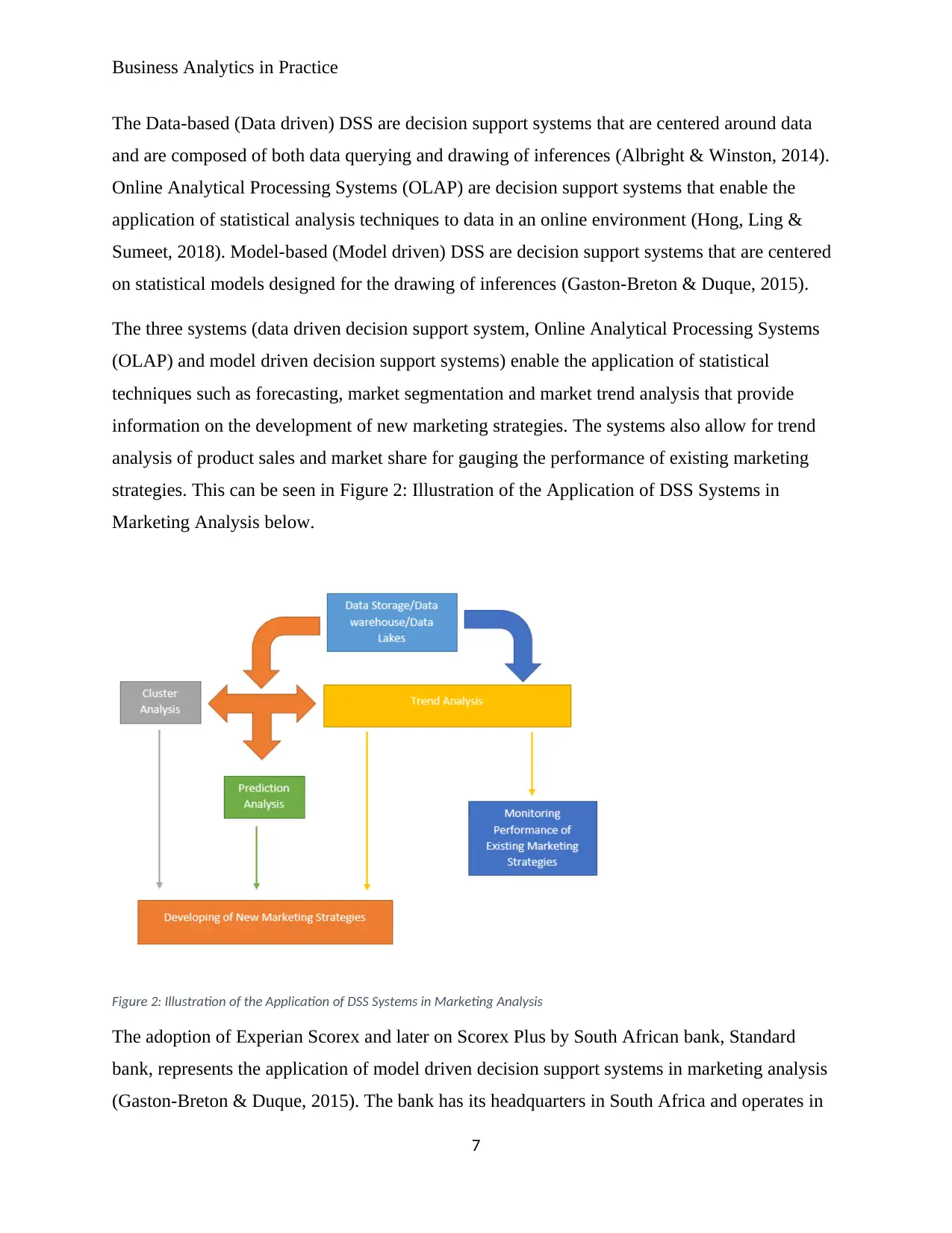
The three systems (data driven decision support system, Online Analytical Processing Systems
(OLAP) and model driven decision support systems) enable the application of statistical
techniques such as forecasting, market segmentation and market trend analysis that provide
information on the development of new marketing strategies. The systems also allow for trend
analysis of product sales and market share for gauging the performance of existing marketing
strategies. This can be seen in Figure 2: Illustration of the Application of DSS Systems in
Marketing Analysis below.
Figure 2: Illustration of the Application of DSS Systems in Marketing Analysis
The adoption of Experian Scorex and later on Scorex Plus by South African bank, Standard
bank, represents the application of model driven decision support systems in marketing analysis
(Gaston-Breton & Duque, 2015). The bank has its headquarters in South Africa and operates in
7
The Data-based (Data driven) DSS are decision support systems that are centered around data
and are composed of both data querying and drawing of inferences (Albright & Winston, 2014).
Online Analytical Processing Systems (OLAP) are decision support systems that enable the
application of statistical analysis techniques to data in an online environment (Hong, Ling &
Sumeet, 2018). Model-based (Model driven) DSS are decision support systems that are centered
on statistical models designed for the drawing of inferences (Gaston-Breton & Duque, 2015).
The three systems (data driven decision support system, Online Analytical Processing Systems
(OLAP) and model driven decision support systems) enable the application of statistical
techniques such as forecasting, market segmentation and market trend analysis that provide
information on the development of new marketing strategies. The systems also allow for trend
analysis of product sales and market share for gauging the performance of existing marketing
strategies. This can be seen in Figure 2: Illustration of the Application of DSS Systems in
Marketing Analysis below.
Figure 2: Illustration of the Application of DSS Systems in Marketing Analysis
The adoption of Experian Scorex and later on Scorex Plus by South African bank, Standard
bank, represents the application of model driven decision support systems in marketing analysis
(Gaston-Breton & Duque, 2015). The bank has its headquarters in South Africa and operates in
7
Paraphrase This Document
Need a fresh take? Get an instant paraphrase of this document with our AI Paraphraser
Business Analytics in Practice
17 other countries globally providing banking services. The Scorex Plus system allows the bank
to develop targeted marketing for different market segments for its customers through enabling
the understanding the decision making process of the customers and developing credit scores for
the customers.
Information Resource
The above two applications of decision support systems in the marketing area of business (Data
Resource Creation and Management and Marketing Analysis) apply for individuals that are
specialized in data analytics. However, not every individual in the marketing area of business is
knowledgeable of the data analytics methodologies and uses (Igor, Igor & Sergey, 2019).
Therefore, this makes it necessary for the information resulting from the Data Resource Creation
and Management and Marketing Analysis to be available in a form that can be comprehended by
every end user regardless of knowledge of data analytics.
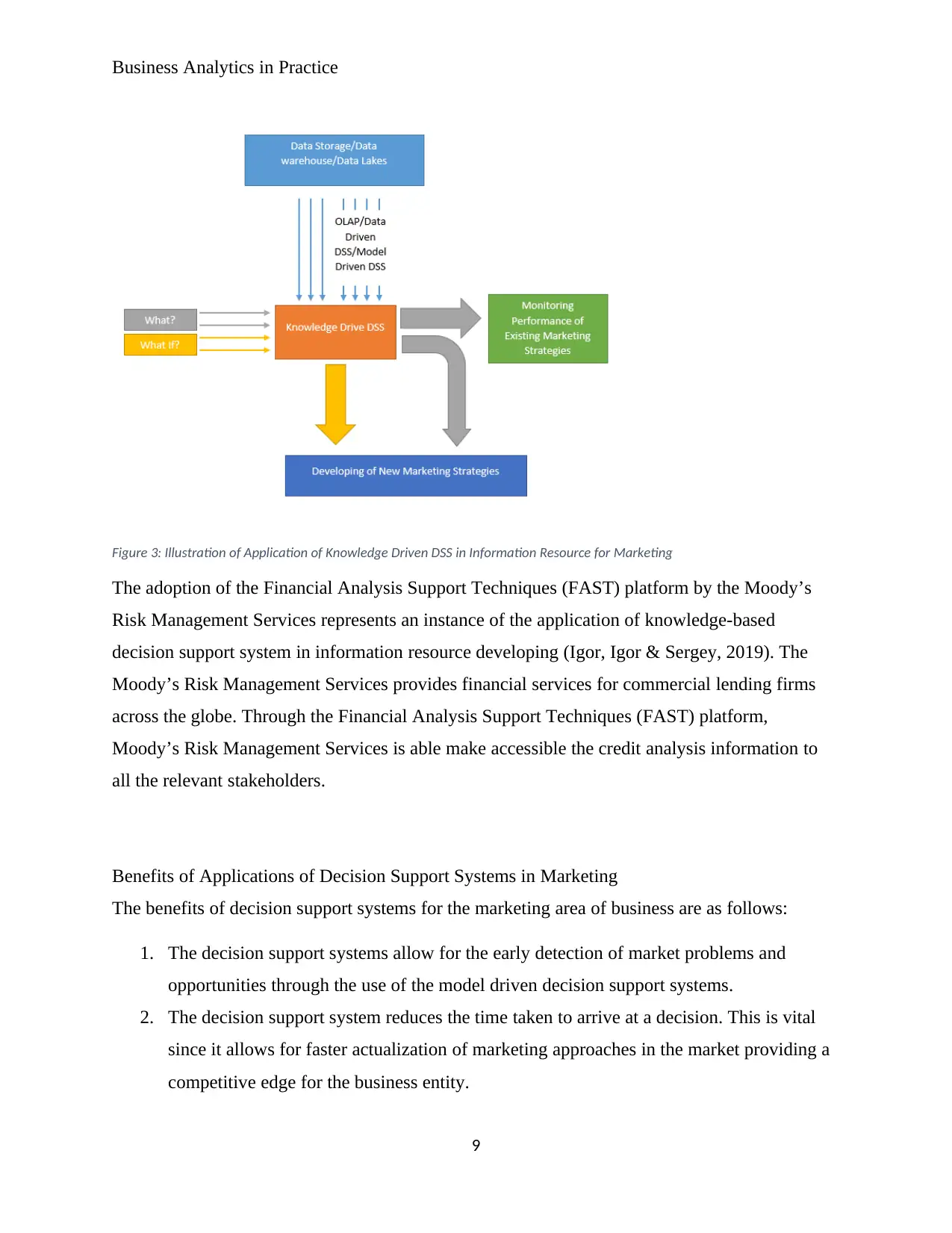
In order to achieve this, the knowledge driven decision support system is employed and provides
for an information resource platform with the audience-sensitive data and inferences about
customers, products and market metrics accessible (Igor, Igor & Sergey, 2019). Knowledge-
based (Knowledge driven) DSS are decision support systems centered on already existing
information without the need for analysis and inferencing (Igor, Igor & Sergey, 2019). The
system acts as an advisory platform where marketing teams can ask questions and be provided
with answers based on all the available information. Asking “what” questions can provide
information on existing marketing strategies as well as on new marketing strategies while asking
“what if” questions can provide information on new marketing strategies. This can be seen in
Figure 3: Illustration of Application of Knowledge Driven DSS in Information Resource for
Marketing below.
8
17 other countries globally providing banking services. The Scorex Plus system allows the bank
to develop targeted marketing for different market segments for its customers through enabling
the understanding the decision making process of the customers and developing credit scores for
the customers.
Information Resource
The above two applications of decision support systems in the marketing area of business (Data
Resource Creation and Management and Marketing Analysis) apply for individuals that are
specialized in data analytics. However, not every individual in the marketing area of business is
knowledgeable of the data analytics methodologies and uses (Igor, Igor & Sergey, 2019).
Therefore, this makes it necessary for the information resulting from the Data Resource Creation
and Management and Marketing Analysis to be available in a form that can be comprehended by
every end user regardless of knowledge of data analytics.
In order to achieve this, the knowledge driven decision support system is employed and provides
for an information resource platform with the audience-sensitive data and inferences about
customers, products and market metrics accessible (Igor, Igor & Sergey, 2019). Knowledge-
based (Knowledge driven) DSS are decision support systems centered on already existing
information without the need for analysis and inferencing (Igor, Igor & Sergey, 2019). The
system acts as an advisory platform where marketing teams can ask questions and be provided
with answers based on all the available information. Asking “what” questions can provide
information on existing marketing strategies as well as on new marketing strategies while asking
“what if” questions can provide information on new marketing strategies. This can be seen in
Figure 3: Illustration of Application of Knowledge Driven DSS in Information Resource for
Marketing below.
8
Business Analytics in Practice
Figure 3: Illustration of Application of Knowledge Driven DSS in Information Resource for Marketing
The adoption of the Financial Analysis Support Techniques (FAST) platform by the Moody’s
Risk Management Services represents an instance of the application of knowledge-based
decision support system in information resource developing (Igor, Igor & Sergey, 2019). The
Moody’s Risk Management Services provides financial services for commercial lending firms
across the globe. Through the Financial Analysis Support Techniques (FAST) platform,
Moody’s Risk Management Services is able make accessible the credit analysis information to
all the relevant stakeholders.
Benefits of Applications of Decision Support Systems in Marketing
The benefits of decision support systems for the marketing area of business are as follows:
1. The decision support systems allow for the early detection of market problems and
opportunities through the use of the model driven decision support systems.
2. The decision support system reduces the time taken to arrive at a decision. This is vital
since it allows for faster actualization of marketing approaches in the market providing a
competitive edge for the business entity.
9
Figure 3: Illustration of Application of Knowledge Driven DSS in Information Resource for Marketing
The adoption of the Financial Analysis Support Techniques (FAST) platform by the Moody’s
Risk Management Services represents an instance of the application of knowledge-based
decision support system in information resource developing (Igor, Igor & Sergey, 2019). The
Moody’s Risk Management Services provides financial services for commercial lending firms
across the globe. Through the Financial Analysis Support Techniques (FAST) platform,
Moody’s Risk Management Services is able make accessible the credit analysis information to
all the relevant stakeholders.
Benefits of Applications of Decision Support Systems in Marketing
The benefits of decision support systems for the marketing area of business are as follows:
1. The decision support systems allow for the early detection of market problems and
opportunities through the use of the model driven decision support systems.
2. The decision support system reduces the time taken to arrive at a decision. This is vital
since it allows for faster actualization of marketing approaches in the market providing a
competitive edge for the business entity.
9
⊘ This is a preview!⊘
Do you want full access?
Subscribe today to unlock all pages.
Trusted by 1+ million students worldwide
Business Analytics in Practice
3. The availability of marketing information at a central source for all the stakeholders
improves on the communication in the business entity and thereby enhances the creation
of marketing ideas and solutions by the stakeholders.
Conclusion
This paper concludes that the decision support systems are necessary tools in modern day
marketing. The critical role that is played by marketing in businesses further amplifies the
necessity of the decision support systems. Despite the existence of a wide variety of decision
support systems, apart from those discussed above (such as communication driven decision
support systems and document driven decision support systems), the nature of market research
and the marketing area of business limits the decision support systems that can be employed to
the ones above.
The decision support systems find application in the creation and management of data resources,
marketing analysis and as sources of audience-sensitive marketing resources. For business
entities that have completely integrated cloud technology into their operations, the Online
Transaction Processing Systems (OLTP) and Online Analytical Processing Systems (OLAP) are
the most efficient decision support systems for data resource creation and managing, and
marketing analysis respectively.
The paper also concludes that the decision support systems are beneficial to marketing through
making the decision-making process efficient, allowing for early deployment of marketing ideas
ahead of the competition, early detection of potential crisis and opportunities in the market, and
ease of communication.
10
3. The availability of marketing information at a central source for all the stakeholders
improves on the communication in the business entity and thereby enhances the creation
of marketing ideas and solutions by the stakeholders.
Conclusion
This paper concludes that the decision support systems are necessary tools in modern day
marketing. The critical role that is played by marketing in businesses further amplifies the
necessity of the decision support systems. Despite the existence of a wide variety of decision
support systems, apart from those discussed above (such as communication driven decision
support systems and document driven decision support systems), the nature of market research
and the marketing area of business limits the decision support systems that can be employed to
the ones above.
The decision support systems find application in the creation and management of data resources,
marketing analysis and as sources of audience-sensitive marketing resources. For business
entities that have completely integrated cloud technology into their operations, the Online
Transaction Processing Systems (OLTP) and Online Analytical Processing Systems (OLAP) are
the most efficient decision support systems for data resource creation and managing, and
marketing analysis respectively.
The paper also concludes that the decision support systems are beneficial to marketing through
making the decision-making process efficient, allowing for early deployment of marketing ideas
ahead of the competition, early detection of potential crisis and opportunities in the market, and
ease of communication.
10
Paraphrase This Document
Need a fresh take? Get an instant paraphrase of this document with our AI Paraphraser
Business Analytics in Practice
References
Albright, CS & Winston, WL 2014, Business Analytics: Data Analysis & Decision Making, 1st
edn, Cengage Learning, New York.
Andrey, T & Dmitrii, Z 2018, 'Verification and online updating of decision making control logic
for onboard real-time control systems', Procedia Computer Science, vol.126, no.4, pp. 1457-
1466.
Bryan, H, Dianne, H, David, P & James, CF 2012, 'Journal of the Association for Information
Systems', A Look Toward the Future: Decision Support Systems Research is Alive and Well,
vol.13, no.3, pp. 315-340.
Christian, B & Griffiths, T 2017, Algorithms To Live By:The Computer Science of Human
Decisions, 2nd edn, William Collins, London.
Cristina, K, Rudolf, M & Stefan, F 2019, 'Public decision support for low population density
areas: An imbalance-aware hyper-ensemble for spatio-temporal crime prediction. Decision
Support Systems, vol.119, no.5, pp. 107-117.
Fawcett, T & Provost, F 2013, Data Science for Business, 1st edn, O'Reilly Media Inc, London.
Gaston-Breton, C & Duque, LC 2015, 'Utilitarian and Hedonic Promotional Appeals of 99-
Ending Prices: The Influence of Decision-Making Style', European Journal of Marketing ,
vol.43, no.1, p. 212-237.
Halaweh, M & El, MA 2014, 'Conceptual Model for Successful Implementation of Big Data in
Organizations', Journal of International Technology and Information Management, vol.24, no.2,
pp. 21-35.
Han, K & Jaiwei, P 2011, Data Mining: Concepts and Techniques, 3rd edn, Morgan Kaufman,
London.
Henry, R & Venkatraman, S 2015, 'Big data analytics: the next big learning opportunity',
Journal of Management Information and Decision Sciences, vol.18, no.2, pp. 17-29.
11
References
Albright, CS & Winston, WL 2014, Business Analytics: Data Analysis & Decision Making, 1st
edn, Cengage Learning, New York.
Andrey, T & Dmitrii, Z 2018, 'Verification and online updating of decision making control logic
for onboard real-time control systems', Procedia Computer Science, vol.126, no.4, pp. 1457-
1466.
Bryan, H, Dianne, H, David, P & James, CF 2012, 'Journal of the Association for Information
Systems', A Look Toward the Future: Decision Support Systems Research is Alive and Well,
vol.13, no.3, pp. 315-340.
Christian, B & Griffiths, T 2017, Algorithms To Live By:The Computer Science of Human
Decisions, 2nd edn, William Collins, London.
Cristina, K, Rudolf, M & Stefan, F 2019, 'Public decision support for low population density
areas: An imbalance-aware hyper-ensemble for spatio-temporal crime prediction. Decision
Support Systems, vol.119, no.5, pp. 107-117.
Fawcett, T & Provost, F 2013, Data Science for Business, 1st edn, O'Reilly Media Inc, London.
Gaston-Breton, C & Duque, LC 2015, 'Utilitarian and Hedonic Promotional Appeals of 99-
Ending Prices: The Influence of Decision-Making Style', European Journal of Marketing ,
vol.43, no.1, p. 212-237.
Halaweh, M & El, MA 2014, 'Conceptual Model for Successful Implementation of Big Data in
Organizations', Journal of International Technology and Information Management, vol.24, no.2,
pp. 21-35.
Han, K & Jaiwei, P 2011, Data Mining: Concepts and Techniques, 3rd edn, Morgan Kaufman,
London.
Henry, R & Venkatraman, S 2015, 'Big data analytics: the next big learning opportunity',
Journal of Management Information and Decision Sciences, vol.18, no.2, pp. 17-29.
11
Business Analytics in Practice
Hong, Z, Ling, Z & Sumeet, G 2018, 'The role of online product recommendations on customer
decision making and loyalty in social shopping communities', International Journal of
Information Management, vol.38, no.1, pp. 150-166.
Igor, K, Igor, S & Sergey, A 2019, 'Hierarchical fuzzy situational networks for online decision-
making: Application to telecommunication systems', Knowledge-Based Systems, vol.185, no.1,
pp. 43-57.
Kiechel, W 2010, The Lords of Strategy, 2nd edn, Havard Business Press, New York.
Prescott, ME 2014, 'Big data and competitive advantage at Nielsen', Management Decision,
vol.52, no.3, pp. 573-601.
Tang, D 2014, 'Introduction to Strategy Development and Strategy Execution', Flevy, vol.3, no.1,
pp. 1-5.
Trottier, K 2017, 'Leading Under Pressure: Evaluating The Decision-Making Style of NHL
Coaches', Sports, Business and Management: An International Journal, vol.7, no,3, pp. 97-112.
12
Hong, Z, Ling, Z & Sumeet, G 2018, 'The role of online product recommendations on customer
decision making and loyalty in social shopping communities', International Journal of
Information Management, vol.38, no.1, pp. 150-166.
Igor, K, Igor, S & Sergey, A 2019, 'Hierarchical fuzzy situational networks for online decision-
making: Application to telecommunication systems', Knowledge-Based Systems, vol.185, no.1,
pp. 43-57.
Kiechel, W 2010, The Lords of Strategy, 2nd edn, Havard Business Press, New York.
Prescott, ME 2014, 'Big data and competitive advantage at Nielsen', Management Decision,
vol.52, no.3, pp. 573-601.
Tang, D 2014, 'Introduction to Strategy Development and Strategy Execution', Flevy, vol.3, no.1,
pp. 1-5.
Trottier, K 2017, 'Leading Under Pressure: Evaluating The Decision-Making Style of NHL
Coaches', Sports, Business and Management: An International Journal, vol.7, no,3, pp. 97-112.
12
⊘ This is a preview!⊘
Do you want full access?
Subscribe today to unlock all pages.
Trusted by 1+ million students worldwide

1 out of 12


Related Documents


Your All-in-One AI-Powered Toolkit for Academic Success.
+13062052269
info@desklib.com
Available 24*7 on WhatsApp / Email
![[object Object]](/_next/static/media/star-bottom.7253800d.svg)
Unlock your academic potential
Copyright © 2020–2026 A2Z Services. All Rights Reserved. Developed and managed by ZUCOL.