Business Capstone Project: Maritime Company Transformation Analysis
VerifiedAdded on 2021/06/17
|12
|3046
|130
Project
AI Summary
This business capstone project examines the challenges faced by Maritime Company, a small to medium-sized organization in the maritime safety industry, as it struggles to adapt to market changes and maintain its competitive edge. The project identifies the core problem as the company's difficulty in embracing new ideas and technologies, leading to stagnation and missed opportunities. The report provides a comprehensive analysis of the issues, causes, and potential solutions, including employee motivation, employee involvement in decision making, fostering innovation, conducting market research, and adopting advanced technologies. The project utilizes SWOT analysis and decision criteria to evaluate the effectiveness of different alternatives and recommends a strategic implementation plan. The study emphasizes the importance of organizational change and the need for Maritime Company to modernize its operations to remain competitive and sustainable in the dynamic market environment. The project offers insights into the company's strengths, weaknesses, opportunities, and threats, ultimately guiding the company towards a successful business transformation.
BUSINESS CAPSTONE PROJECT
Name
Course
Date
Name
Course
Date

Paraphrase This Document
Need a fresh take? Get an instant paraphrase of this document with our AI Paraphraser
Summary
The size of Maritime Company is what we refer to as a small to medium sized
organization that has about 40-50 employees. Since then until today, their board is made up of
big enterprises type organizations and the reason why they requested for our service was to come
in and give a review of why transformation was evident in the organization. Apparently, a lot of
factors seemed to contribute to the changes within the organization. As established these were
organizational based, cultural and technological. Which means the company was delivering
technological service at the same time in Marine Safety.
The main objective of this report is to find out the problem in Maritime Company.
Consequently, the management is finding it hard to alter operations in the company and allow it
fit better in the market. As stated earlier, the cause of the problem is difficulty to explore new
ideas and try them in the company. This has been caused by the relaxation to formulate new
ideas since the old ones have continued to serve in the past until now when they are becoming
useless. As such Maritime Company is giving her competitors the chance to take advantage and
thrive ahead.
The report highlighted five solutions that the company can incorporate to gain its stability
once more. One is to motivate employees and involve them in decision making. Also, it can
come up with new ideas and skills. Finally, conduct a good market research and involve the use
of more advanced technology. The proposed results have been compared and evaluated
depending on the decision criteria and SWOT analysis. In addition, the implementation and
implication involved in the process include illustrating the manner in which solution is offered
and the effect on the company.
The size of Maritime Company is what we refer to as a small to medium sized
organization that has about 40-50 employees. Since then until today, their board is made up of
big enterprises type organizations and the reason why they requested for our service was to come
in and give a review of why transformation was evident in the organization. Apparently, a lot of
factors seemed to contribute to the changes within the organization. As established these were
organizational based, cultural and technological. Which means the company was delivering
technological service at the same time in Marine Safety.
The main objective of this report is to find out the problem in Maritime Company.
Consequently, the management is finding it hard to alter operations in the company and allow it
fit better in the market. As stated earlier, the cause of the problem is difficulty to explore new
ideas and try them in the company. This has been caused by the relaxation to formulate new
ideas since the old ones have continued to serve in the past until now when they are becoming
useless. As such Maritime Company is giving her competitors the chance to take advantage and
thrive ahead.
The report highlighted five solutions that the company can incorporate to gain its stability
once more. One is to motivate employees and involve them in decision making. Also, it can
come up with new ideas and skills. Finally, conduct a good market research and involve the use
of more advanced technology. The proposed results have been compared and evaluated
depending on the decision criteria and SWOT analysis. In addition, the implementation and
implication involved in the process include illustrating the manner in which solution is offered
and the effect on the company.
Issue.
The issue we had to provide a solution concerned a private sectors organization that
operated on the maritime safety industry. The company according to our analysis was fully
established and its services were provided across to many organizations. The particular problem
began due to a point of inflection that the organization arrived. Initially, the company had
established a variety of services which of course were popular and known by other organizations
that they carried with business. Moreover, their performance financially was satisfying to them
and they had a good bond with customers in the markets. Whatever the company had
acknowledged earlier around is that they could not remain static as a company thus they thought
it better to alter the way they provided services to their clients. A lot of changes were evident in
the external environment and so themselves they need to change. Regardless of their hard stand
on their activities, the company had begun making changes about three years ago before
involving us.
The problem became complicated when Maritime Company had inflection at three
different stages where they got impelled to prevent the changes that were occurring then until
they begun again, this time raising a big concern to the management and the company as a
whole. The concern entailed, funds, regulations by the company, reputational risk and also
sustainability of the services since their directly had an effect on Maritime safety. Good enough,
the company was able to realize unless they changed their structures them it was going to be hard
to deliver its services successfully, making them invite us over for a solution.
Cause
The problem at Maritime Company had been attributed by a number of factors; key
among them by the organization itself. The organization lacks an independent perspective on the
The issue we had to provide a solution concerned a private sectors organization that
operated on the maritime safety industry. The company according to our analysis was fully
established and its services were provided across to many organizations. The particular problem
began due to a point of inflection that the organization arrived. Initially, the company had
established a variety of services which of course were popular and known by other organizations
that they carried with business. Moreover, their performance financially was satisfying to them
and they had a good bond with customers in the markets. Whatever the company had
acknowledged earlier around is that they could not remain static as a company thus they thought
it better to alter the way they provided services to their clients. A lot of changes were evident in
the external environment and so themselves they need to change. Regardless of their hard stand
on their activities, the company had begun making changes about three years ago before
involving us.
The problem became complicated when Maritime Company had inflection at three
different stages where they got impelled to prevent the changes that were occurring then until
they begun again, this time raising a big concern to the management and the company as a
whole. The concern entailed, funds, regulations by the company, reputational risk and also
sustainability of the services since their directly had an effect on Maritime safety. Good enough,
the company was able to realize unless they changed their structures them it was going to be hard
to deliver its services successfully, making them invite us over for a solution.
Cause
The problem at Maritime Company had been attributed by a number of factors; key
among them by the organization itself. The organization lacks an independent perspective on the
⊘ This is a preview!⊘
Do you want full access?
Subscribe today to unlock all pages.

Trusted by 1+ million students worldwide
appropriate success to lead to transformation. Besides, it had minimum independent oversight in
the manner it can create change or rather adjust to the inflections that it encountered. To a given
extent, there was also a degree of organizational capability which was missing. Even though this
had been identified by the organization in the past years, it made minimum efforts to rectify the
problem. Instead, the company kept providing parallel services without internal changes and
transformation. In other words, the company did not show the desire to change and adjust
towards reaping positive outcomes. The same management that is blamed for the outdated styles
opposed the idea of new changes in the company. Any suggestion to bring change was stopped
by their decision which ensured such projects remained pending. According to them, all they had
was enough since the company was still doing well with its operations even with the traditional
services. Bold enough, they saw no point of change as long as the company was in a position to
deliver services to its clients. More causes of the problem as identified were, the approach
towards problems was one continuous method, with similar capability and similar service. Of
course, this was to maintain the traditional style in services delivery without ever initiating a new
idea. So the problems remained constant, without a solution. The company continued to deliver
even in such a status but realized slowly their competitors had become fast in overtaking them
and taking over the market. Also, they admitted very little had been done in terms of innovation
hence part of the problem. Each time, their risk associated with the company`s reputation and its
commercial status was so high that they had to find a solution. One key reason as to why we had
to come in and carry out the reviews. At least, it can identify different options to select the best
one moving forward.
Alternatives
After reviewing the company, we established five key alternatives to serve as solutions
for Maritime Company. As we suggest the implementation of these alternatives can bring foresee
the manner it can create change or rather adjust to the inflections that it encountered. To a given
extent, there was also a degree of organizational capability which was missing. Even though this
had been identified by the organization in the past years, it made minimum efforts to rectify the
problem. Instead, the company kept providing parallel services without internal changes and
transformation. In other words, the company did not show the desire to change and adjust
towards reaping positive outcomes. The same management that is blamed for the outdated styles
opposed the idea of new changes in the company. Any suggestion to bring change was stopped
by their decision which ensured such projects remained pending. According to them, all they had
was enough since the company was still doing well with its operations even with the traditional
services. Bold enough, they saw no point of change as long as the company was in a position to
deliver services to its clients. More causes of the problem as identified were, the approach
towards problems was one continuous method, with similar capability and similar service. Of
course, this was to maintain the traditional style in services delivery without ever initiating a new
idea. So the problems remained constant, without a solution. The company continued to deliver
even in such a status but realized slowly their competitors had become fast in overtaking them
and taking over the market. Also, they admitted very little had been done in terms of innovation
hence part of the problem. Each time, their risk associated with the company`s reputation and its
commercial status was so high that they had to find a solution. One key reason as to why we had
to come in and carry out the reviews. At least, it can identify different options to select the best
one moving forward.
Alternatives
After reviewing the company, we established five key alternatives to serve as solutions
for Maritime Company. As we suggest the implementation of these alternatives can bring foresee
Paraphrase This Document
Need a fresh take? Get an instant paraphrase of this document with our AI Paraphraser
the company in making a positive turn. The most appropriate alternative will be selected
considering the research and measure as per the decision criteria.
The first alternative for Maritime Company is to motivate employees to adjust to new
changes in the organizations. This means the company must understand and be in a position to
tell values inhibited by employees, their culture, skills, and interests and then attract them
towards initiating the changes. Maritimes company must bear in mind is beyond hardworking
only and doing tasks as recommended. The workers in the organization can be considering their
sources of motivation from different grounds which must be prioritized.1It may come even from
doing the work alone from a perspective to obtain specific objectives at the end. In a sum, the
behavior of employees in the organization depends on what motivates them. Considering the
case of the Maritime company, the employees ought to find motivation in the company`s urge to
create change.2 A well-talented worker who is not motivated may not perform to similar
standards with the one who is motivated.
The second alternative suggests, Maritime Company should involve its employees in
decision making and policy making, specifically for change. Such a step implies, the company is
able to get additional reviews and also assign the workers roles for a steady flow of the process
of change. notably, the workers are in a position to settle for the best decisions concerning
change because they possess adequate information regarding the company`s direction.3 They are
1 MacLeod, David, and Nita Clarke. Engaging for success: enhancing performance through employee engagement:
a report to the government. London: Department for Business, Innovation, and Skills, 2009.
2 Cadwallader, Susan, Cheryl Burke Jarvis, Mary Jo Bitner, and Amy L. Ostrom. "Frontline employee motivation to
participate in service innovation implementation." Journal of the Academy of Marketing Science 38, no. 2 (2010):
219-239.
3 Kompaso, Solomon Markos, and M. Sandhya Sridevi. "Employee engagement: The key to improving
performance." International journal of business and management 5, no. 12 (2010): 89.
considering the research and measure as per the decision criteria.
The first alternative for Maritime Company is to motivate employees to adjust to new
changes in the organizations. This means the company must understand and be in a position to
tell values inhibited by employees, their culture, skills, and interests and then attract them
towards initiating the changes. Maritimes company must bear in mind is beyond hardworking
only and doing tasks as recommended. The workers in the organization can be considering their
sources of motivation from different grounds which must be prioritized.1It may come even from
doing the work alone from a perspective to obtain specific objectives at the end. In a sum, the
behavior of employees in the organization depends on what motivates them. Considering the
case of the Maritime company, the employees ought to find motivation in the company`s urge to
create change.2 A well-talented worker who is not motivated may not perform to similar
standards with the one who is motivated.
The second alternative suggests, Maritime Company should involve its employees in
decision making and policy making, specifically for change. Such a step implies, the company is
able to get additional reviews and also assign the workers roles for a steady flow of the process
of change. notably, the workers are in a position to settle for the best decisions concerning
change because they possess adequate information regarding the company`s direction.3 They are
1 MacLeod, David, and Nita Clarke. Engaging for success: enhancing performance through employee engagement:
a report to the government. London: Department for Business, Innovation, and Skills, 2009.
2 Cadwallader, Susan, Cheryl Burke Jarvis, Mary Jo Bitner, and Amy L. Ostrom. "Frontline employee motivation to
participate in service innovation implementation." Journal of the Academy of Marketing Science 38, no. 2 (2010):
219-239.
3 Kompaso, Solomon Markos, and M. Sandhya Sridevi. "Employee engagement: The key to improving
performance." International journal of business and management 5, no. 12 (2010): 89.
the same managers who do not involve employees in decision making and then complain about
employees' inability to make the right decision.
The third alternative states the company is supposed to create new ideas. Apparently, this
is towards advancement and pertains both skills and experiences in the team and is able to create
a sense of recognizing the work from employees. In addition, bring a solution to the very old
traditional tasks but in a new style. The process of developing new skills by the company
contributes to the way employees carry out their activity and also increase the speed and quality
of the work, in turn saving on time spent and efforts.4 Therefore, for employees to stay informed
about the current trends and create change, learning new skills and ideas is quite significant.
Otherwise, if learning stops, then it means little or no development takes place in us.
The fourth alternative that the company can rely upon is conducting market research to
stay updated with the ever-changing trends and practice relevant activities to fit into the market.
In order to achieve such a step, the company can have many sources of data and then make
comparisons. Otherwise, the whole process may end up useless without a thorough scrutiny.5
The company is assured of staying ahead of its competitors by adequately researching its market.
Market research comprises of a systematic, collection of data with a determined objective and
then analyzing, with more focus on the target market and activities by competitors. 6 The
ultimate goal of the organization is supposed to been adding up to the amount of knowledge that
is already in place and so should be done more frequently.
4 Boons, Frank, Carlos Montalvo, Jaco Quist, and Marcus Wagner. "Sustainable innovation, business models and
economic performance: an overview." Journal of Cleaner Production 45 (2013): 1-8.
5 Pulver, Simone. "Business and the Environment." (2012).
6 Chi, Ting, Peter PD Kilduff, and Vidyaranya B. Gargeya. "Alignment between business environment
characteristics, competitive priorities, supply chain structures, and firm business performance." International
Journal of productivity and performance management 58, no. 7 (2009): 645-669.
employees' inability to make the right decision.
The third alternative states the company is supposed to create new ideas. Apparently, this
is towards advancement and pertains both skills and experiences in the team and is able to create
a sense of recognizing the work from employees. In addition, bring a solution to the very old
traditional tasks but in a new style. The process of developing new skills by the company
contributes to the way employees carry out their activity and also increase the speed and quality
of the work, in turn saving on time spent and efforts.4 Therefore, for employees to stay informed
about the current trends and create change, learning new skills and ideas is quite significant.
Otherwise, if learning stops, then it means little or no development takes place in us.
The fourth alternative that the company can rely upon is conducting market research to
stay updated with the ever-changing trends and practice relevant activities to fit into the market.
In order to achieve such a step, the company can have many sources of data and then make
comparisons. Otherwise, the whole process may end up useless without a thorough scrutiny.5
The company is assured of staying ahead of its competitors by adequately researching its market.
Market research comprises of a systematic, collection of data with a determined objective and
then analyzing, with more focus on the target market and activities by competitors. 6 The
ultimate goal of the organization is supposed to been adding up to the amount of knowledge that
is already in place and so should be done more frequently.
4 Boons, Frank, Carlos Montalvo, Jaco Quist, and Marcus Wagner. "Sustainable innovation, business models and
economic performance: an overview." Journal of Cleaner Production 45 (2013): 1-8.
5 Pulver, Simone. "Business and the Environment." (2012).
6 Chi, Ting, Peter PD Kilduff, and Vidyaranya B. Gargeya. "Alignment between business environment
characteristics, competitive priorities, supply chain structures, and firm business performance." International
Journal of productivity and performance management 58, no. 7 (2009): 645-669.
⊘ This is a preview!⊘
Do you want full access?
Subscribe today to unlock all pages.
Trusted by 1+ million students worldwide
Lastly, the fifth alternative is to improve the technology and uses and incorporate some of
the latest and most advanced. Technological improvements mean well for the business is that it
improves quality of output and make workers use minimum efforts.7 They can always give more
attention to the activities that test on intellectual capacity since much of the physical work is left
for the new technological changes. It becomes very simple for Maritime Company access
information concerning changes in the organization at any place and time. Of course, such
operation has been facilitated through the use of current technologies. Most of the companies are
transforming towards incorporating modern technologies which Maritimes must also do to
competent.8 The recent improvements in technologies will also create a boost in the company`s
production. Arguably, human beings cannot keep up with the speed in the machines in producing
results hence new technology is just in order for the company.
Decision Criteria
In any decision-making process, there are elements to weigh upon to settle on the right
decision. Decision criteria, therefore, highlights the aspects taken into consideration before
choosing the best alternative for Maritime Company. Their target is, in particular, is to identify
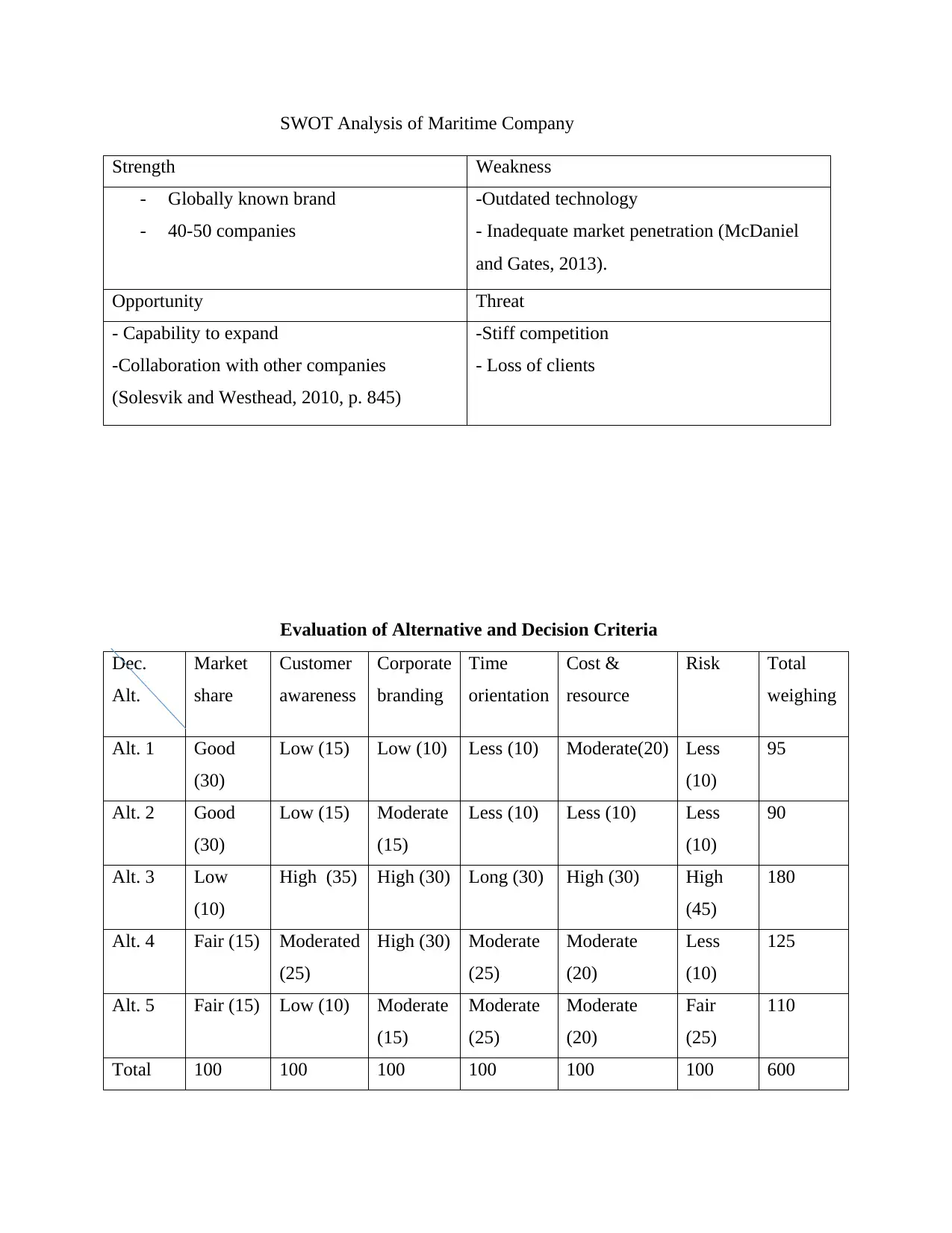
and evaluate how much then alternatives are effective. For this scenarios, SWOT analysis
identifies the strength, weakness in every alternative and picks the best one among five.
7 Rothaermel, Frank T., and Warren Boeker. "Old technology meets new technology: Complementarities,
similarities, and alliance formation." Strategic Management Journal 29, no. 1 (2008): 47-77.
8 Dunning, John H. Multinationals, Technology & Competitiveness (RLE International Business). Vol. 13.
Routledge, 2013.
the latest and most advanced. Technological improvements mean well for the business is that it
improves quality of output and make workers use minimum efforts.7 They can always give more
attention to the activities that test on intellectual capacity since much of the physical work is left
for the new technological changes. It becomes very simple for Maritime Company access
information concerning changes in the organization at any place and time. Of course, such
operation has been facilitated through the use of current technologies. Most of the companies are
transforming towards incorporating modern technologies which Maritimes must also do to
competent.8 The recent improvements in technologies will also create a boost in the company`s
production. Arguably, human beings cannot keep up with the speed in the machines in producing
results hence new technology is just in order for the company.
Decision Criteria
In any decision-making process, there are elements to weigh upon to settle on the right
decision. Decision criteria, therefore, highlights the aspects taken into consideration before
choosing the best alternative for Maritime Company. Their target is, in particular, is to identify
and evaluate how much then alternatives are effective. For this scenarios, SWOT analysis
identifies the strength, weakness in every alternative and picks the best one among five.
7 Rothaermel, Frank T., and Warren Boeker. "Old technology meets new technology: Complementarities,
similarities, and alliance formation." Strategic Management Journal 29, no. 1 (2008): 47-77.
8 Dunning, John H. Multinationals, Technology & Competitiveness (RLE International Business). Vol. 13.
Routledge, 2013.
Paraphrase This Document
Need a fresh take? Get an instant paraphrase of this document with our AI Paraphraser
SWOT Analysis of Maritime Company
Strength Weakness
- Globally known brand
- 40-50 companies
-Outdated technology
- Inadequate market penetration (McDaniel
and Gates, 2013).
Opportunity Threat
- Capability to expand
-Collaboration with other companies
(Solesvik and Westhead, 2010, p. 845)
-Stiff competition
- Loss of clients
Evaluation of Alternative and Decision Criteria
Dec.
Alt.
Market
share
Customer
awareness
Corporate
branding
Time
orientation
Cost &
resource
Risk Total
weighing
Alt. 1 Good
(30)
Low (15) Low (10) Less (10) Moderate(20) Less
(10)
95
Alt. 2 Good
(30)
Low (15) Moderate
(15)
Less (10) Less (10) Less
(10)
90
Alt. 3 Low
(10)
High (35) High (30) Long (30) High (30) High
(45)
180
Alt. 4 Fair (15) Moderated
(25)
High (30) Moderate
(25)
Moderate
(20)
Less
(10)
125
Alt. 5 Fair (15) Low (10) Moderate
(15)
Moderate
(25)
Moderate
(20)
Fair
(25)
110
Total 100 100 100 100 100 100 600
Strength Weakness
- Globally known brand
- 40-50 companies
-Outdated technology
- Inadequate market penetration (McDaniel
and Gates, 2013).
Opportunity Threat
- Capability to expand
-Collaboration with other companies
(Solesvik and Westhead, 2010, p. 845)
-Stiff competition
- Loss of clients
Evaluation of Alternative and Decision Criteria
Dec.
Alt.
Market
share
Customer
awareness
Corporate
branding
Time
orientation
Cost &
resource
Risk Total
weighing
Alt. 1 Good
(30)
Low (15) Low (10) Less (10) Moderate(20) Less
(10)
95
Alt. 2 Good
(30)
Low (15) Moderate
(15)
Less (10) Less (10) Less
(10)
90
Alt. 3 Low
(10)
High (35) High (30) Long (30) High (30) High
(45)
180
Alt. 4 Fair (15) Moderated
(25)
High (30) Moderate
(25)
Moderate
(20)
Less
(10)
125
Alt. 5 Fair (15) Low (10) Moderate
(15)
Moderate
(25)
Moderate
(20)
Fair
(25)
110
Total 100 100 100 100 100 100 600
Recommendation
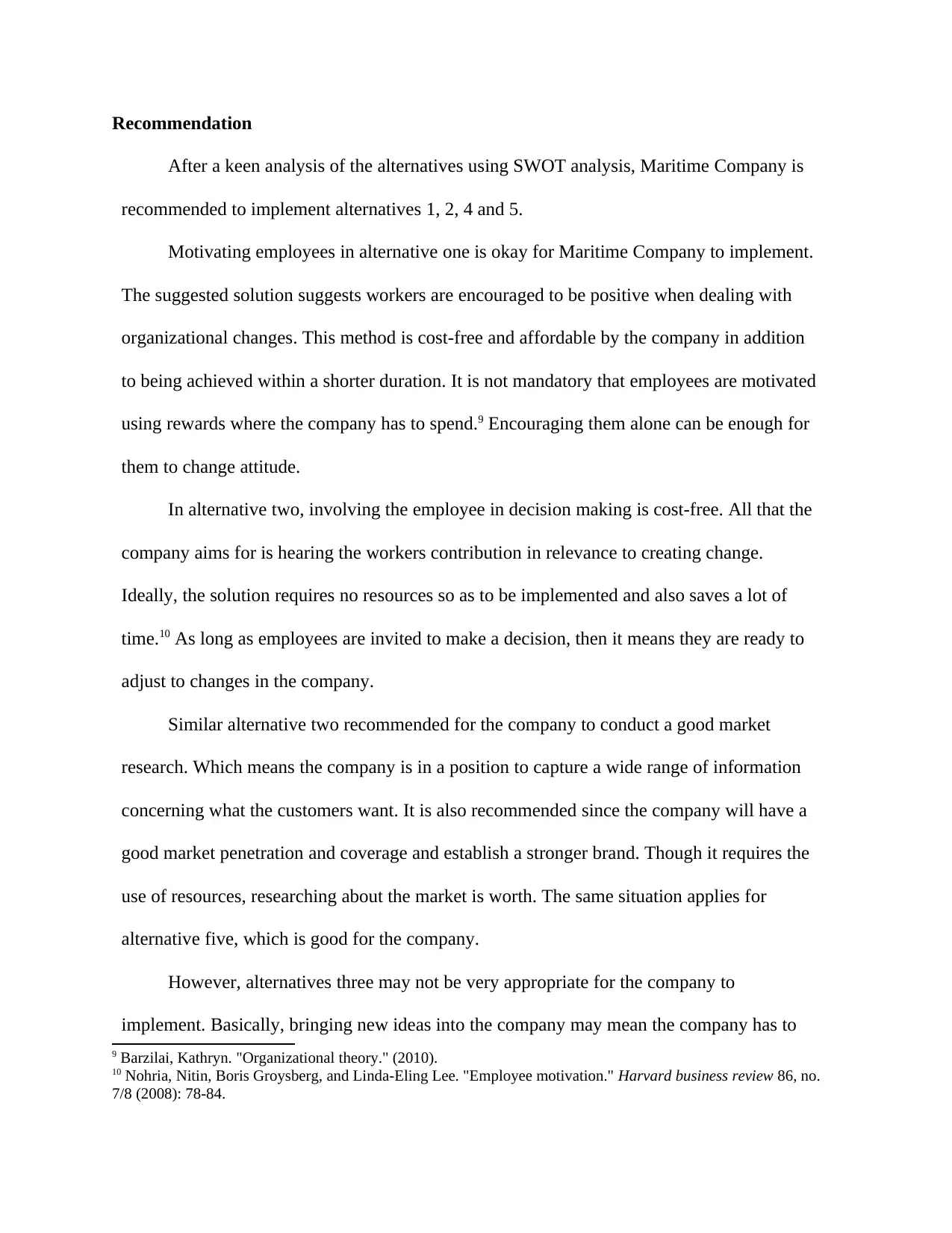
After a keen analysis of the alternatives using SWOT analysis, Maritime Company is
recommended to implement alternatives 1, 2, 4 and 5.
Motivating employees in alternative one is okay for Maritime Company to implement.
The suggested solution suggests workers are encouraged to be positive when dealing with
organizational changes. This method is cost-free and affordable by the company in addition
to being achieved within a shorter duration. It is not mandatory that employees are motivated
using rewards where the company has to spend.9 Encouraging them alone can be enough for
them to change attitude.
In alternative two, involving the employee in decision making is cost-free. All that the
company aims for is hearing the workers contribution in relevance to creating change.
Ideally, the solution requires no resources so as to be implemented and also saves a lot of
time.10 As long as employees are invited to make a decision, then it means they are ready to
adjust to changes in the company.
Similar alternative two recommended for the company to conduct a good market
research. Which means the company is in a position to capture a wide range of information
concerning what the customers want. It is also recommended since the company will have a
good market penetration and coverage and establish a stronger brand. Though it requires the
use of resources, researching about the market is worth. The same situation applies for
alternative five, which is good for the company.
However, alternatives three may not be very appropriate for the company to
implement. Basically, bringing new ideas into the company may mean the company has to
9 Barzilai, Kathryn. "Organizational theory." (2010).
10 Nohria, Nitin, Boris Groysberg, and Linda-Eling Lee. "Employee motivation." Harvard business review 86, no.
7/8 (2008): 78-84.
After a keen analysis of the alternatives using SWOT analysis, Maritime Company is
recommended to implement alternatives 1, 2, 4 and 5.
Motivating employees in alternative one is okay for Maritime Company to implement.
The suggested solution suggests workers are encouraged to be positive when dealing with
organizational changes. This method is cost-free and affordable by the company in addition
to being achieved within a shorter duration. It is not mandatory that employees are motivated
using rewards where the company has to spend.9 Encouraging them alone can be enough for
them to change attitude.
In alternative two, involving the employee in decision making is cost-free. All that the
company aims for is hearing the workers contribution in relevance to creating change.
Ideally, the solution requires no resources so as to be implemented and also saves a lot of
time.10 As long as employees are invited to make a decision, then it means they are ready to
adjust to changes in the company.
Similar alternative two recommended for the company to conduct a good market
research. Which means the company is in a position to capture a wide range of information
concerning what the customers want. It is also recommended since the company will have a
good market penetration and coverage and establish a stronger brand. Though it requires the
use of resources, researching about the market is worth. The same situation applies for
alternative five, which is good for the company.
However, alternatives three may not be very appropriate for the company to
implement. Basically, bringing new ideas into the company may mean the company has to
9 Barzilai, Kathryn. "Organizational theory." (2010).
10 Nohria, Nitin, Boris Groysberg, and Linda-Eling Lee. "Employee motivation." Harvard business review 86, no.
7/8 (2008): 78-84.
⊘ This is a preview!⊘
Do you want full access?
Subscribe today to unlock all pages.
Trusted by 1+ million students worldwide
recruit new employees which may be relatively expensive since it has to set its status right
still. Besides, the duration to train on new skill and knowledge may be long.11
Implementation and implication
The best way to implement alternative one on motivation is use of incentive plans.
Such a plan encourages employees achieve at higher levels.12 While involving employees in
decision making, the company can implement alternative two by allowing employees a free
forum to air their opinions. Finally, alternative four can be implemented by carrying out an
investigation on the customers’ desire and five replacing the old facilities with modern
facilities in the company.13
Bibliography
Ayyagari, Meghana, Asli Demirgüç-Kunt, and Vojislav Maksimovic. "How important are
financing constraints? The role of finance in the business environment." The world bank
economic review 22, no. 3 (2008): 483-516.
Barzilai, Kathryn. "Organizational theory." (2010).
11 Ayyagari, Meghana, Asli Demirgüç-Kunt, and Vojislav Maksimovic. "How important are financing constraints?
The role of finance in the business environment." The World Bank economic review 22, no. 3 (2008): 483-516.
12 Nielsen, Morten Birkeland, Kjersti Bergheim, and Jarle Eid. "Relationships between work environment factors
and workers’ well-being in the maritime industry." International maritime health 64, no. 2 (2013): 80-88.
13 Roos, Wanda, and René Van Eeden. "The relationship between employee motivation, job satisfaction and
corporate culture: empirical research." SA Journal of industrial psychology 34, no. 1 (2008): 54-63.
still. Besides, the duration to train on new skill and knowledge may be long.11
Implementation and implication
The best way to implement alternative one on motivation is use of incentive plans.
Such a plan encourages employees achieve at higher levels.12 While involving employees in
decision making, the company can implement alternative two by allowing employees a free
forum to air their opinions. Finally, alternative four can be implemented by carrying out an
investigation on the customers’ desire and five replacing the old facilities with modern
facilities in the company.13
Bibliography
Ayyagari, Meghana, Asli Demirgüç-Kunt, and Vojislav Maksimovic. "How important are
financing constraints? The role of finance in the business environment." The world bank
economic review 22, no. 3 (2008): 483-516.
Barzilai, Kathryn. "Organizational theory." (2010).
11 Ayyagari, Meghana, Asli Demirgüç-Kunt, and Vojislav Maksimovic. "How important are financing constraints?
The role of finance in the business environment." The World Bank economic review 22, no. 3 (2008): 483-516.
12 Nielsen, Morten Birkeland, Kjersti Bergheim, and Jarle Eid. "Relationships between work environment factors
and workers’ well-being in the maritime industry." International maritime health 64, no. 2 (2013): 80-88.
13 Roos, Wanda, and René Van Eeden. "The relationship between employee motivation, job satisfaction and
corporate culture: empirical research." SA Journal of industrial psychology 34, no. 1 (2008): 54-63.
Paraphrase This Document
Need a fresh take? Get an instant paraphrase of this document with our AI Paraphraser
Boons, Frank, Carlos Montalvo, Jaco Quist, and Marcus Wagner. "Sustainable innovation,
business models and economic performance: an overview." Journal of Cleaner Production 45
(2013): 1-8.
Cadwallader, Susan, Cheryl Burke Jarvis, Mary Jo Bitner, and Amy L. Ostrom. "Frontline
employee motivation to participate in service innovation implementation." Journal of the
Academy of Marketing Science 38, no. 2 (2010): 219-239.
Chi, Ting, Peter PD Kilduff, and Vidyaranya B. Gargeya. "Alignment between business
environment characteristics, competitive priorities, supply chain structures, and firm business
performance." International Journal of productivity and performance management 58, no. 7
(2009): 645-669.
Dunning, John H. Multinationals, Technology & Competitiveness (RLE International
Business). Vol. 13. Routledge, 2013.
Kompaso, Solomon Markos, and M. Sandhya Sridevi. "Employee engagement: The key to
improving performance." International journal of business and management 5, no. 12 (2010):
89.
MacLeod, David, and Nita Clarke. Engaging for success: enhancing performance through
employee engagement: a report to the government. London: Department for Business,
Innovation, and Skills, 2009.
McDaniel, Carl, and Roger Gates. Marketing research. Singapore, 2013.
Nielsen, Morten Birkeland, Kjersti Bergheim, and Jarle Eid. "Relationships between work
environment factors and workers’ well-being in the maritime industry." International maritime
health 64, no. 2 (2013): 80-88.
business models and economic performance: an overview." Journal of Cleaner Production 45
(2013): 1-8.
Cadwallader, Susan, Cheryl Burke Jarvis, Mary Jo Bitner, and Amy L. Ostrom. "Frontline
employee motivation to participate in service innovation implementation." Journal of the
Academy of Marketing Science 38, no. 2 (2010): 219-239.
Chi, Ting, Peter PD Kilduff, and Vidyaranya B. Gargeya. "Alignment between business
environment characteristics, competitive priorities, supply chain structures, and firm business
performance." International Journal of productivity and performance management 58, no. 7
(2009): 645-669.
Dunning, John H. Multinationals, Technology & Competitiveness (RLE International
Business). Vol. 13. Routledge, 2013.
Kompaso, Solomon Markos, and M. Sandhya Sridevi. "Employee engagement: The key to
improving performance." International journal of business and management 5, no. 12 (2010):
89.
MacLeod, David, and Nita Clarke. Engaging for success: enhancing performance through
employee engagement: a report to the government. London: Department for Business,
Innovation, and Skills, 2009.
McDaniel, Carl, and Roger Gates. Marketing research. Singapore, 2013.
Nielsen, Morten Birkeland, Kjersti Bergheim, and Jarle Eid. "Relationships between work
environment factors and workers’ well-being in the maritime industry." International maritime
health 64, no. 2 (2013): 80-88.
Nohria, Nitin, Boris Groysberg, and Linda-Eling Lee. "Employee motivation." Harvard business
review 86, no. 7/8 (2008): 78-84.
Pulver, Simone. "Business and the Environment." (2012).
Roos, Wanda, and René Van Eeden. "The relationship between employee motivation, job
satisfaction and corporate culture: empirical research." SA Journal of industrial psychology 34,
no. 1 (2008): 54-63.
Rothaermel, Frank T., and Warren Boeker. "Old technology meets new technology:
Complementarities, similarities, and alliance formation." Strategic Management Journal 29, no.
1 (2008): 47-77.
Solesvik, Marina Z., and Paul Westhead. "Partner selection for strategic alliances: case study
insights from the maritime industry." Industrial Management & Data Systems 110, no. 6 (2010):
841-860.
Warschauer, M. and Matuchniak, T., 2010. New technology and digital worlds: Analyzing
evidence of equity in access, use, and outcomes. Review of research in education, 34(1),
pp.179-225.
review 86, no. 7/8 (2008): 78-84.
Pulver, Simone. "Business and the Environment." (2012).
Roos, Wanda, and René Van Eeden. "The relationship between employee motivation, job
satisfaction and corporate culture: empirical research." SA Journal of industrial psychology 34,
no. 1 (2008): 54-63.
Rothaermel, Frank T., and Warren Boeker. "Old technology meets new technology:
Complementarities, similarities, and alliance formation." Strategic Management Journal 29, no.
1 (2008): 47-77.
Solesvik, Marina Z., and Paul Westhead. "Partner selection for strategic alliances: case study
insights from the maritime industry." Industrial Management & Data Systems 110, no. 6 (2010):
841-860.
Warschauer, M. and Matuchniak, T., 2010. New technology and digital worlds: Analyzing
evidence of equity in access, use, and outcomes. Review of research in education, 34(1),
pp.179-225.
⊘ This is a preview!⊘
Do you want full access?
Subscribe today to unlock all pages.
Trusted by 1+ million students worldwide

1 out of 12


Related Documents


Your All-in-One AI-Powered Toolkit for Academic Success.
+13062052269
info@desklib.com
Available 24*7 on WhatsApp / Email
![[object Object]](/_next/static/media/star-bottom.7253800d.svg)
Unlock your academic potential
Copyright © 2020–2026 A2Z Services. All Rights Reserved. Developed and managed by ZUCOL.