Business Report: Analyzing The Dingleys' Children's Care Home Finances
VerifiedAdded on 2023/01/11
|13
|2677
|50
Report
AI Summary
This report provides a detailed financial analysis of a children's care home, examining key aspects such as profit and break-even points, fixed and variable costs, and sensitivity analysis to determine its impact on the business. It includes a comparative analysis of laundry options, offering insights into cost-effective choices. Furthermore, the report evaluates different accommodation options, comparing their potential profitability. The sensitivity analysis explores how changes in key variables, such as the number of children enrolled, affect the care home's break-even point and overall profitability. The report aims to guide financial decision-making for the care home's owners, the Dingleys, by providing data-driven recommendations based on the case study.
The Dingleys’
children’s care home
children’s care home

Paraphrase This Document
Need a fresh take? Get an instant paraphrase of this document with our AI Paraphraser
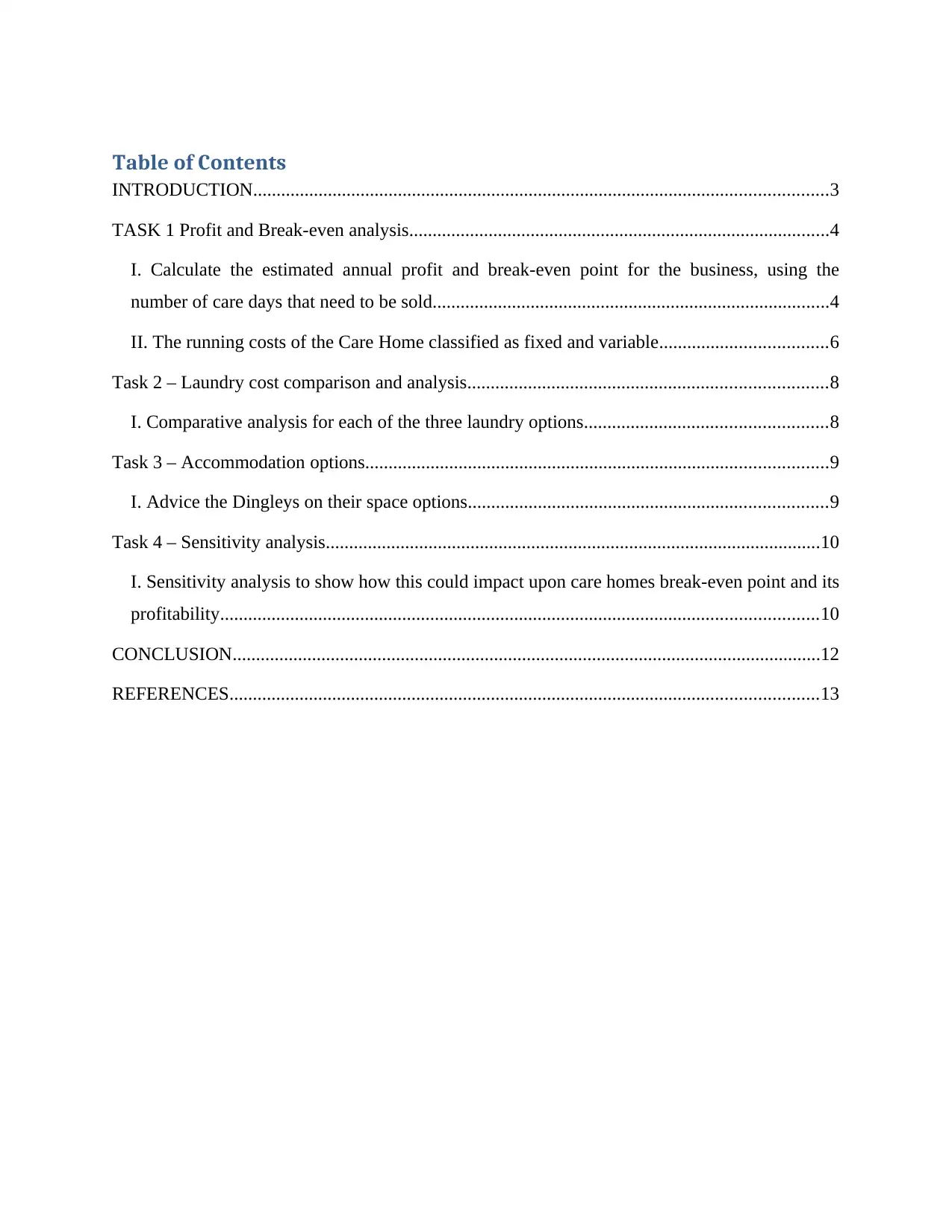
Table of Contents
INTRODUCTION...........................................................................................................................3
TASK 1 Profit and Break-even analysis..........................................................................................4
I. Calculate the estimated annual profit and break-even point for the business, using the
number of care days that need to be sold.....................................................................................4
II. The running costs of the Care Home classified as fixed and variable....................................6
Task 2 – Laundry cost comparison and analysis.............................................................................8
I. Comparative analysis for each of the three laundry options....................................................8
Task 3 – Accommodation options...................................................................................................9
I. Advice the Dingleys on their space options.............................................................................9
Task 4 – Sensitivity analysis..........................................................................................................10
I. Sensitivity analysis to show how this could impact upon care homes break-even point and its
profitability................................................................................................................................10
CONCLUSION..............................................................................................................................12
REFERENCES..............................................................................................................................13
INTRODUCTION...........................................................................................................................3
TASK 1 Profit and Break-even analysis..........................................................................................4
I. Calculate the estimated annual profit and break-even point for the business, using the
number of care days that need to be sold.....................................................................................4
II. The running costs of the Care Home classified as fixed and variable....................................6
Task 2 – Laundry cost comparison and analysis.............................................................................8
I. Comparative analysis for each of the three laundry options....................................................8
Task 3 – Accommodation options...................................................................................................9
I. Advice the Dingleys on their space options.............................................................................9
Task 4 – Sensitivity analysis..........................................................................................................10
I. Sensitivity analysis to show how this could impact upon care homes break-even point and its
profitability................................................................................................................................10
CONCLUSION..............................................................................................................................12
REFERENCES..............................................................................................................................13
INTRODUCTION
Business accounting is systematic evidence gathering, review, evaluation and delivery.
Accounting may be carried out by one person in a small company or by multiple teams of big
businesses. Accounting is the way a corporation tracks its operations. Accounting is the
recording method for company-related financial transactions. In the accounting process, the
expenditure is called, evaluated and disclosed to supervisory authorities, regulators and tax
collectors. Basically, accounting is necessary for business entities in order to take corrective
actions such as making financial decisions and many more. The reports used are a short summary
of financial activities over an accounting cycle, which describes the functions, financial
condition, and cash flows of a business. The project report is based on a case study which is
related to running a children care home. The report covers detailed information about calculation
of profit, break even analysis, sensitivity analysis and many more.
Business accounting is systematic evidence gathering, review, evaluation and delivery.
Accounting may be carried out by one person in a small company or by multiple teams of big
businesses. Accounting is the way a corporation tracks its operations. Accounting is the
recording method for company-related financial transactions. In the accounting process, the
expenditure is called, evaluated and disclosed to supervisory authorities, regulators and tax
collectors. Basically, accounting is necessary for business entities in order to take corrective
actions such as making financial decisions and many more. The reports used are a short summary
of financial activities over an accounting cycle, which describes the functions, financial
condition, and cash flows of a business. The project report is based on a case study which is
related to running a children care home. The report covers detailed information about calculation
of profit, break even analysis, sensitivity analysis and many more.
⊘ This is a preview!⊘
Do you want full access?
Subscribe today to unlock all pages.

Trusted by 1+ million students worldwide
TASK 1 Profit and Break-even analysis
I. Calculate the estimated annual profit and break-even point for the business,
using the number of care days that need to be sold.
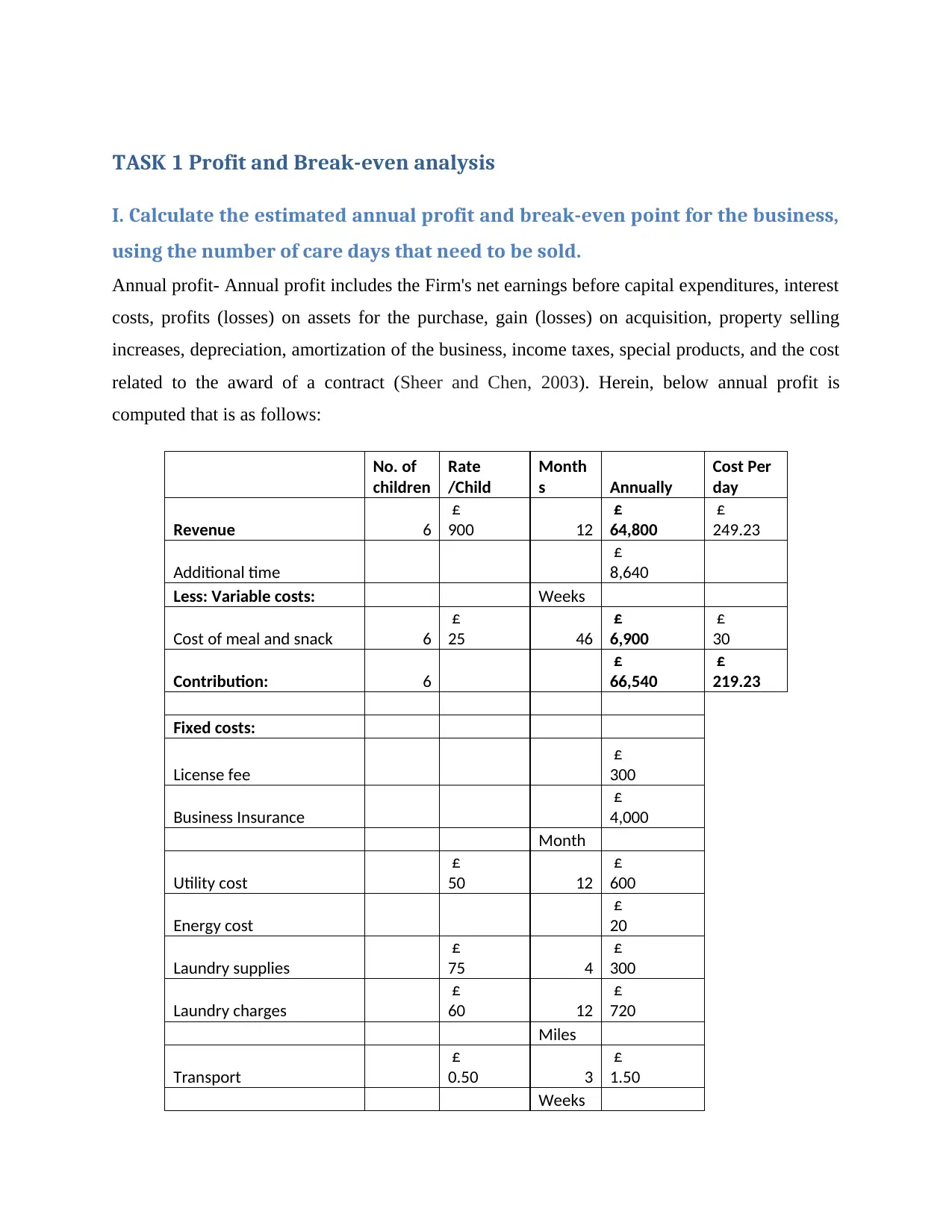
Annual profit- Annual profit includes the Firm's net earnings before capital expenditures, interest
costs, profits (losses) on assets for the purchase, gain (losses) on acquisition, property selling
increases, depreciation, amortization of the business, income taxes, special products, and the cost
related to the award of a contract (Sheer and Chen, 2003). Herein, below annual profit is
computed that is as follows:
No. of
children
Rate
/Child
Month
s Annually
Cost Per
day
Revenue 6
£
900 12
£
64,800
£
249.23
Additional time
£
8,640
Less: Variable costs: Weeks
Cost of meal and snack 6
£
25 46
£
6,900
£
30
Contribution: 6
£
66,540
£
219.23
Fixed costs:
License fee
£
300
Business Insurance
£
4,000
Month
Utility cost
£
50 12
£
600
Energy cost
£
20
Laundry supplies
£
75 4
£
300
Laundry charges
£
60 12
£
720
Miles
Transport
£
0.50 3
£
1.50
Weeks
I. Calculate the estimated annual profit and break-even point for the business,
using the number of care days that need to be sold.
Annual profit- Annual profit includes the Firm's net earnings before capital expenditures, interest
costs, profits (losses) on assets for the purchase, gain (losses) on acquisition, property selling
increases, depreciation, amortization of the business, income taxes, special products, and the cost
related to the award of a contract (Sheer and Chen, 2003). Herein, below annual profit is
computed that is as follows:
No. of
children
Rate
/Child
Month
s Annually
Cost Per
day
Revenue 6
£
900 12
£
64,800
£
249.23
Additional time
£
8,640
Less: Variable costs: Weeks
Cost of meal and snack 6
£
25 46
£
6,900
£
30
Contribution: 6
£
66,540
£
219.23
Fixed costs:
License fee
£
300
Business Insurance
£
4,000
Month
Utility cost
£
50 12
£
600
Energy cost
£
20
Laundry supplies
£
75 4
£
300
Laundry charges
£
60 12
£
720
Miles
Transport
£
0.50 3
£
1.50
Weeks
Paraphrase This Document
Need a fresh take? Get an instant paraphrase of this document with our AI Paraphraser
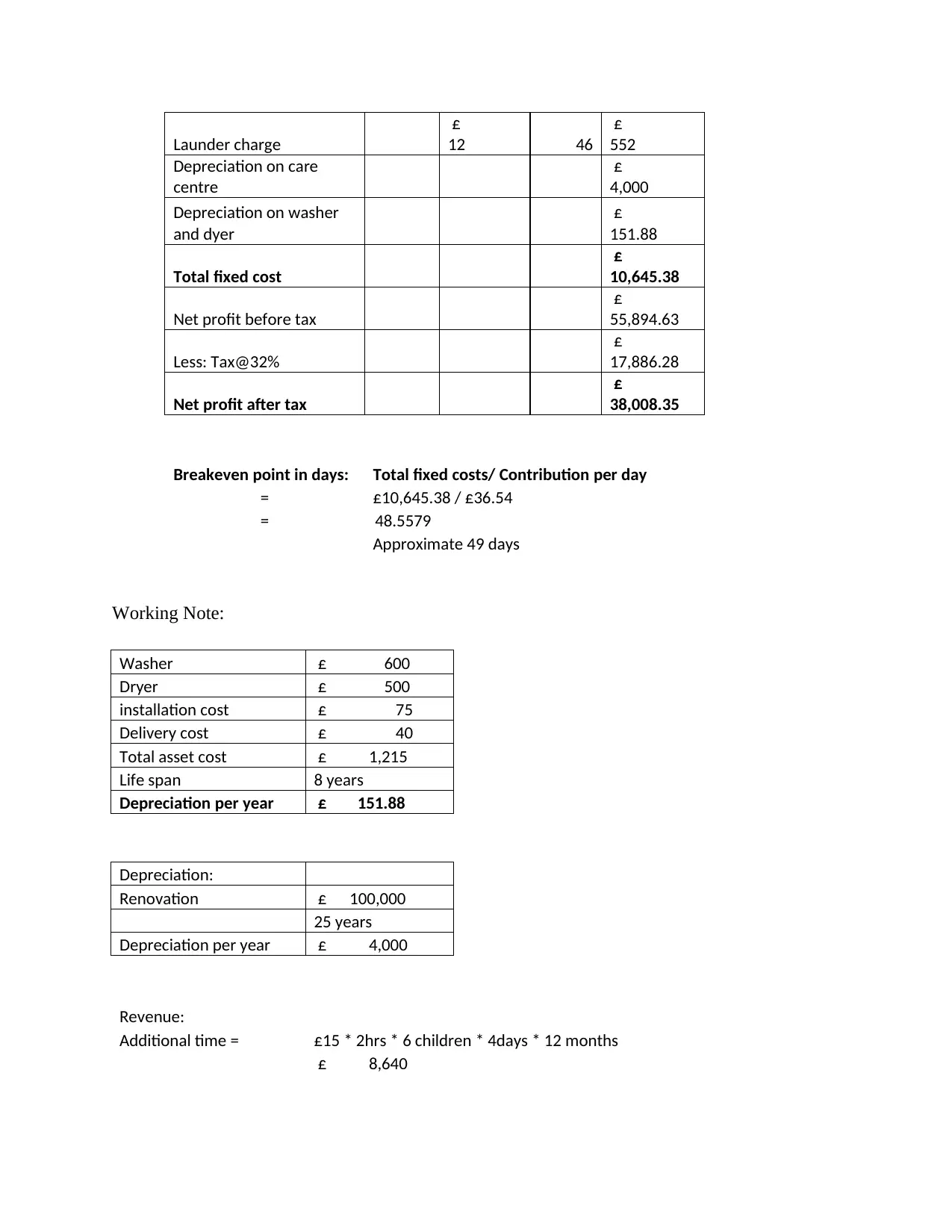
Launder charge
£
12 46
£
552
Depreciation on care
centre
£
4,000
Depreciation on washer
and dyer
£
151.88
Total fixed cost
£
10,645.38
Net profit before tax
£
55,894.63
Less: Tax@32%
£
17,886.28
Net profit after tax
£
38,008.35
Breakeven point in days: Total fixed costs/ Contribution per day
= £10,645.38 / £36.54
= 48.5579
Approximate 49 days
Working Note:
Washer £ 600
Dryer £ 500
installation cost £ 75
Delivery cost £ 40
Total asset cost £ 1,215
Life span 8 years
Depreciation per year £ 151.88
Depreciation:
Renovation £ 100,000
25 years
Depreciation per year £ 4,000
Revenue:
Additional time = £15 * 2hrs * 6 children * 4days * 12 months
£ 8,640
£
12 46
£
552
Depreciation on care
centre
£
4,000
Depreciation on washer
and dyer
£
151.88
Total fixed cost
£
10,645.38
Net profit before tax
£
55,894.63
Less: Tax@32%
£
17,886.28
Net profit after tax
£
38,008.35
Breakeven point in days: Total fixed costs/ Contribution per day
= £10,645.38 / £36.54
= 48.5579
Approximate 49 days
Working Note:
Washer £ 600
Dryer £ 500
installation cost £ 75
Delivery cost £ 40
Total asset cost £ 1,215
Life span 8 years
Depreciation per year £ 151.88
Depreciation:
Renovation £ 100,000
25 years
Depreciation per year £ 4,000
Revenue:
Additional time = £15 * 2hrs * 6 children * 4days * 12 months
£ 8,640
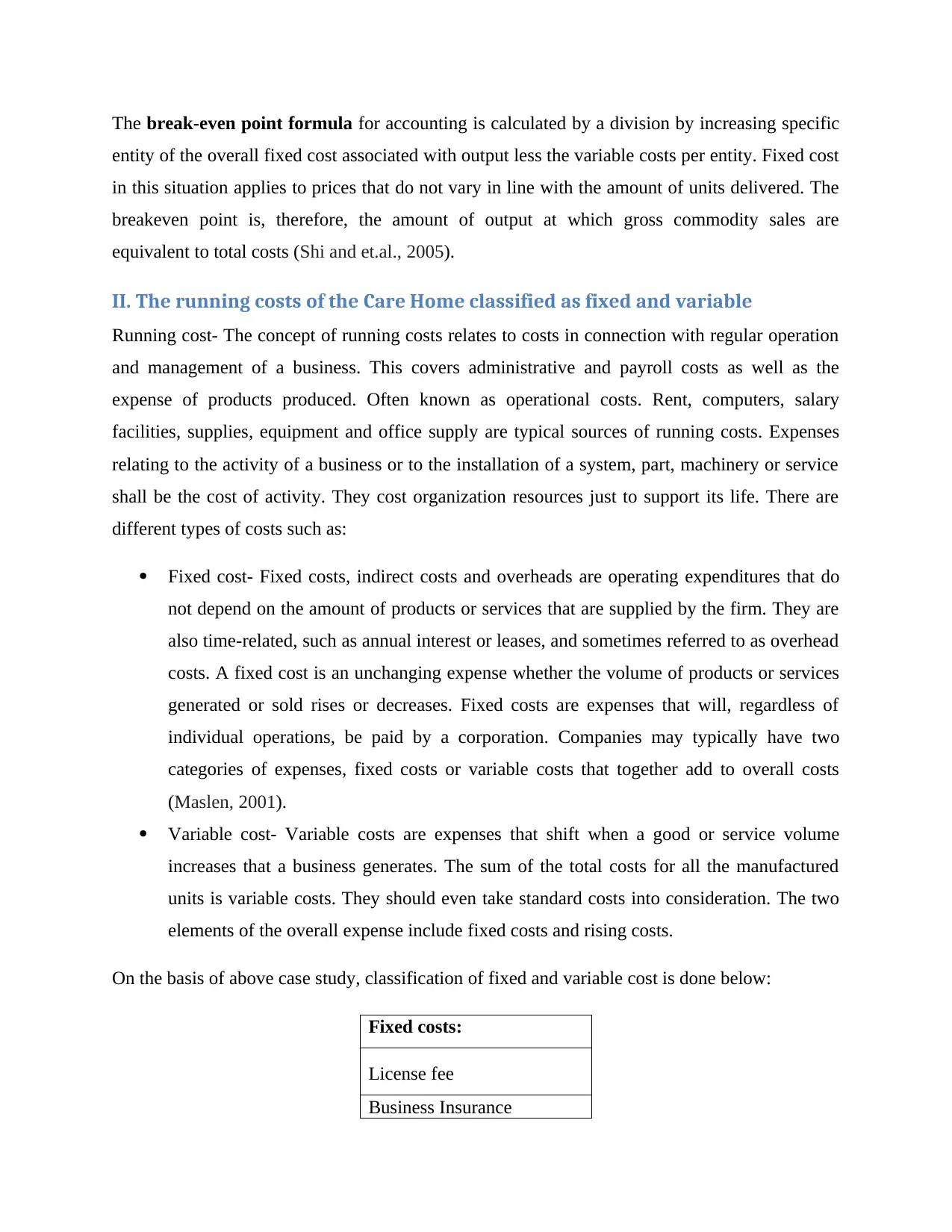
The break-even point formula for accounting is calculated by a division by increasing specific
entity of the overall fixed cost associated with output less the variable costs per entity. Fixed cost
in this situation applies to prices that do not vary in line with the amount of units delivered. The
breakeven point is, therefore, the amount of output at which gross commodity sales are
equivalent to total costs (Shi and et.al., 2005).
II. The running costs of the Care Home classified as fixed and variable
Running cost- The concept of running costs relates to costs in connection with regular operation
and management of a business. This covers administrative and payroll costs as well as the
expense of products produced. Often known as operational costs. Rent, computers, salary
facilities, supplies, equipment and office supply are typical sources of running costs. Expenses
relating to the activity of a business or to the installation of a system, part, machinery or service
shall be the cost of activity. They cost organization resources just to support its life. There are
different types of costs such as:
Fixed cost- Fixed costs, indirect costs and overheads are operating expenditures that do
not depend on the amount of products or services that are supplied by the firm. They are
also time-related, such as annual interest or leases, and sometimes referred to as overhead
costs. A fixed cost is an unchanging expense whether the volume of products or services
generated or sold rises or decreases. Fixed costs are expenses that will, regardless of
individual operations, be paid by a corporation. Companies may typically have two
categories of expenses, fixed costs or variable costs that together add to overall costs
(Maslen, 2001).
Variable cost- Variable costs are expenses that shift when a good or service volume
increases that a business generates. The sum of the total costs for all the manufactured
units is variable costs. They should even take standard costs into consideration. The two
elements of the overall expense include fixed costs and rising costs.
On the basis of above case study, classification of fixed and variable cost is done below:
Fixed costs:
License fee
Business Insurance
entity of the overall fixed cost associated with output less the variable costs per entity. Fixed cost
in this situation applies to prices that do not vary in line with the amount of units delivered. The
breakeven point is, therefore, the amount of output at which gross commodity sales are
equivalent to total costs (Shi and et.al., 2005).
II. The running costs of the Care Home classified as fixed and variable
Running cost- The concept of running costs relates to costs in connection with regular operation
and management of a business. This covers administrative and payroll costs as well as the
expense of products produced. Often known as operational costs. Rent, computers, salary
facilities, supplies, equipment and office supply are typical sources of running costs. Expenses
relating to the activity of a business or to the installation of a system, part, machinery or service
shall be the cost of activity. They cost organization resources just to support its life. There are
different types of costs such as:
Fixed cost- Fixed costs, indirect costs and overheads are operating expenditures that do
not depend on the amount of products or services that are supplied by the firm. They are
also time-related, such as annual interest or leases, and sometimes referred to as overhead
costs. A fixed cost is an unchanging expense whether the volume of products or services
generated or sold rises or decreases. Fixed costs are expenses that will, regardless of
individual operations, be paid by a corporation. Companies may typically have two
categories of expenses, fixed costs or variable costs that together add to overall costs
(Maslen, 2001).
Variable cost- Variable costs are expenses that shift when a good or service volume
increases that a business generates. The sum of the total costs for all the manufactured
units is variable costs. They should even take standard costs into consideration. The two
elements of the overall expense include fixed costs and rising costs.
On the basis of above case study, classification of fixed and variable cost is done below:
Fixed costs:
License fee
Business Insurance
⊘ This is a preview!⊘
Do you want full access?
Subscribe today to unlock all pages.
Trusted by 1+ million students worldwide
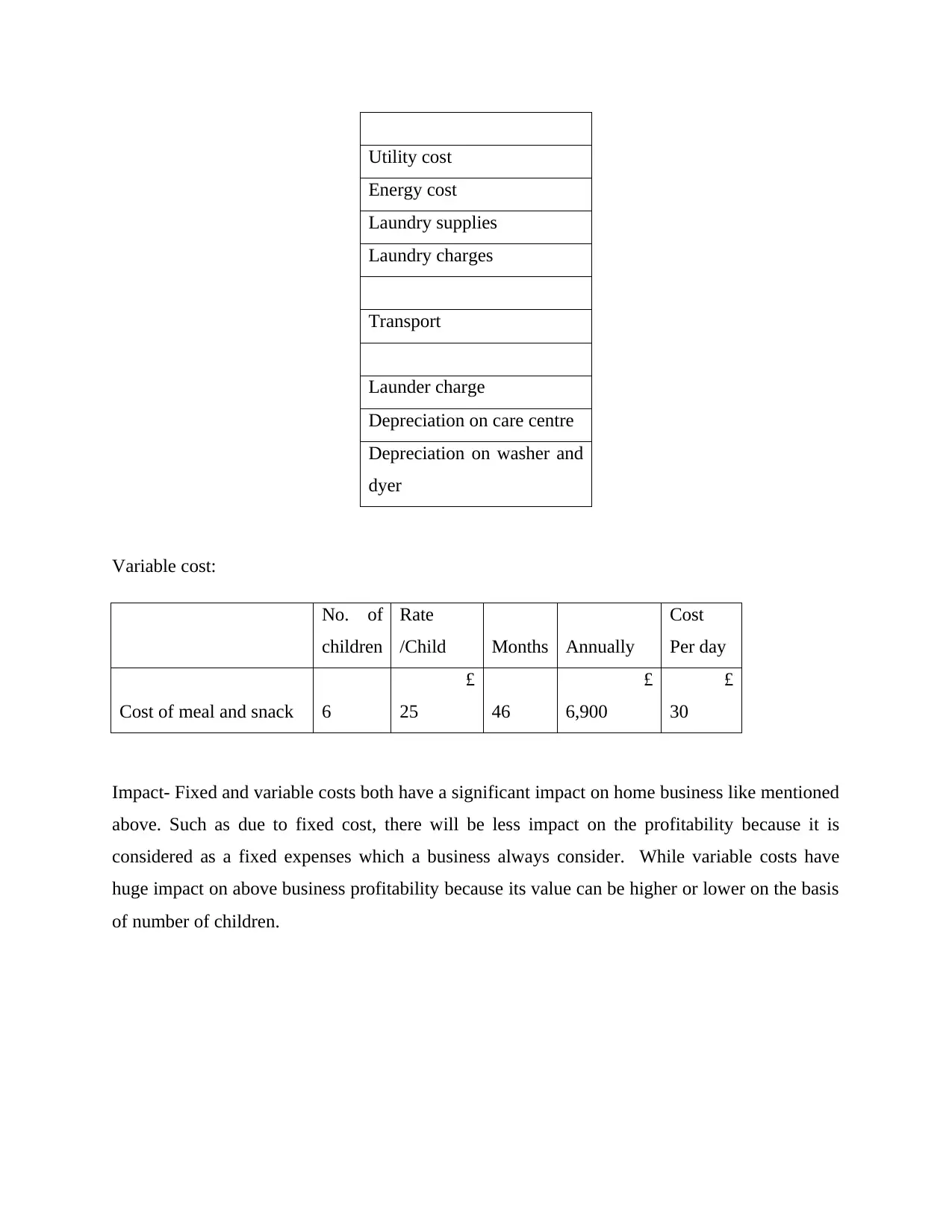
Utility cost
Energy cost
Laundry supplies
Laundry charges
Transport
Launder charge
Depreciation on care centre
Depreciation on washer and
dyer
Variable cost:
No. of
children
Rate
/Child Months Annually
Cost
Per day
Cost of meal and snack 6
£
25 46
£
6,900
£
30
Impact- Fixed and variable costs both have a significant impact on home business like mentioned
above. Such as due to fixed cost, there will be less impact on the profitability because it is
considered as a fixed expenses which a business always consider. While variable costs have
huge impact on above business profitability because its value can be higher or lower on the basis
of number of children.
Energy cost
Laundry supplies
Laundry charges
Transport
Launder charge
Depreciation on care centre
Depreciation on washer and
dyer
Variable cost:
No. of
children
Rate
/Child Months Annually
Cost
Per day
Cost of meal and snack 6
£
25 46
£
6,900
£
30
Impact- Fixed and variable costs both have a significant impact on home business like mentioned
above. Such as due to fixed cost, there will be less impact on the profitability because it is
considered as a fixed expenses which a business always consider. While variable costs have
huge impact on above business profitability because its value can be higher or lower on the basis
of number of children.
Paraphrase This Document
Need a fresh take? Get an instant paraphrase of this document with our AI Paraphraser
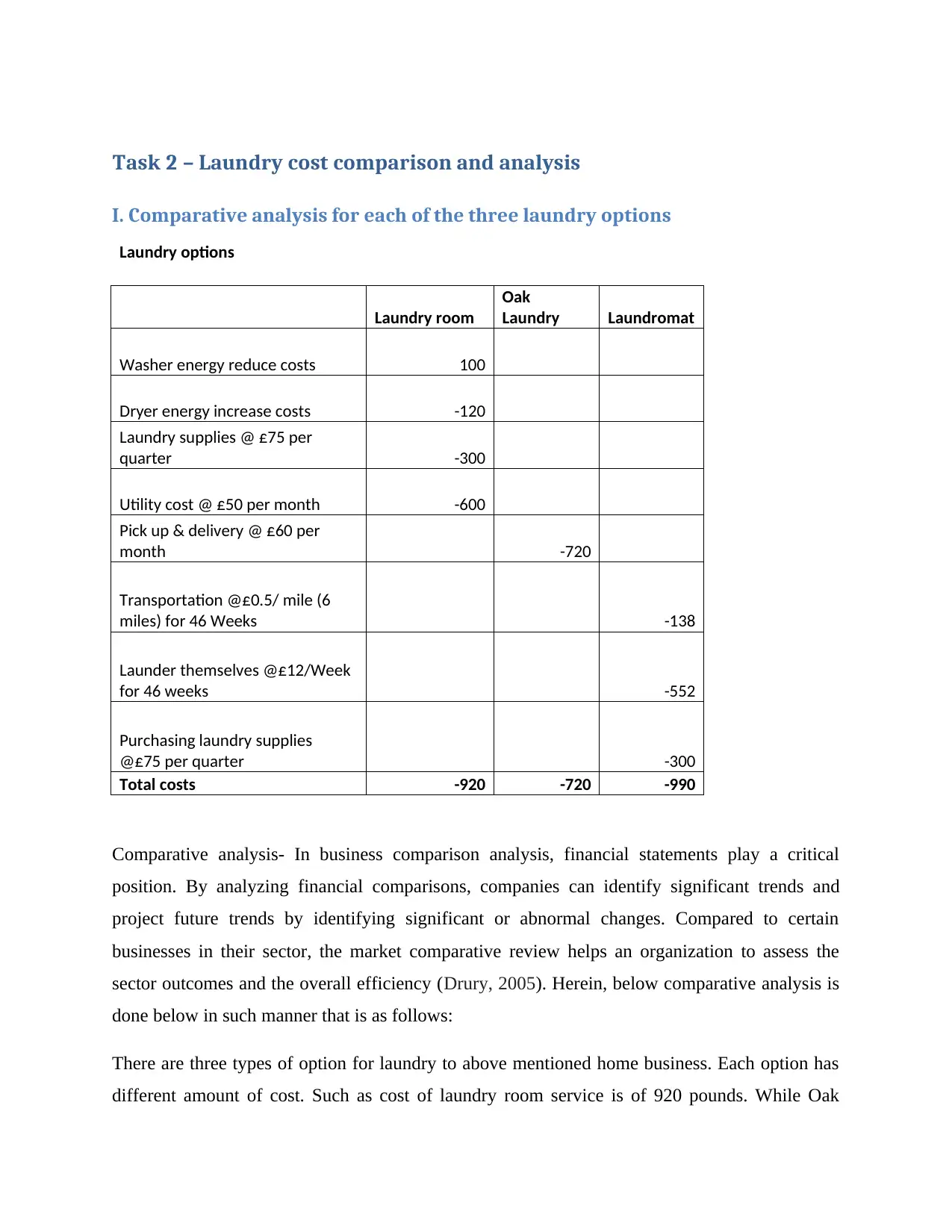
Task 2 – Laundry cost comparison and analysis
I. Comparative analysis for each of the three laundry options
Laundry options
Laundry room
Oak
Laundry Laundromat
Washer energy reduce costs 100
Dryer energy increase costs -120
Laundry supplies @ £75 per
quarter -300
Utility cost @ £50 per month -600
Pick up & delivery @ £60 per
month -720
Transportation @£0.5/ mile (6
miles) for 46 Weeks -138
Launder themselves @£12/Week
for 46 weeks -552
Purchasing laundry supplies
@£75 per quarter -300
Total costs -920 -720 -990
Comparative analysis- In business comparison analysis, financial statements play a critical
position. By analyzing financial comparisons, companies can identify significant trends and
project future trends by identifying significant or abnormal changes. Compared to certain
businesses in their sector, the market comparative review helps an organization to assess the
sector outcomes and the overall efficiency (Drury, 2005). Herein, below comparative analysis is
done below in such manner that is as follows:
There are three types of option for laundry to above mentioned home business. Each option has
different amount of cost. Such as cost of laundry room service is of 920 pounds. While Oak
I. Comparative analysis for each of the three laundry options
Laundry options
Laundry room
Oak
Laundry Laundromat
Washer energy reduce costs 100
Dryer energy increase costs -120
Laundry supplies @ £75 per
quarter -300
Utility cost @ £50 per month -600
Pick up & delivery @ £60 per
month -720
Transportation @£0.5/ mile (6
miles) for 46 Weeks -138
Launder themselves @£12/Week
for 46 weeks -552
Purchasing laundry supplies
@£75 per quarter -300
Total costs -920 -720 -990
Comparative analysis- In business comparison analysis, financial statements play a critical
position. By analyzing financial comparisons, companies can identify significant trends and
project future trends by identifying significant or abnormal changes. Compared to certain
businesses in their sector, the market comparative review helps an organization to assess the
sector outcomes and the overall efficiency (Drury, 2005). Herein, below comparative analysis is
done below in such manner that is as follows:
There are three types of option for laundry to above mentioned home business. Each option has
different amount of cost. Such as cost of laundry room service is of 920 pounds. While Oak
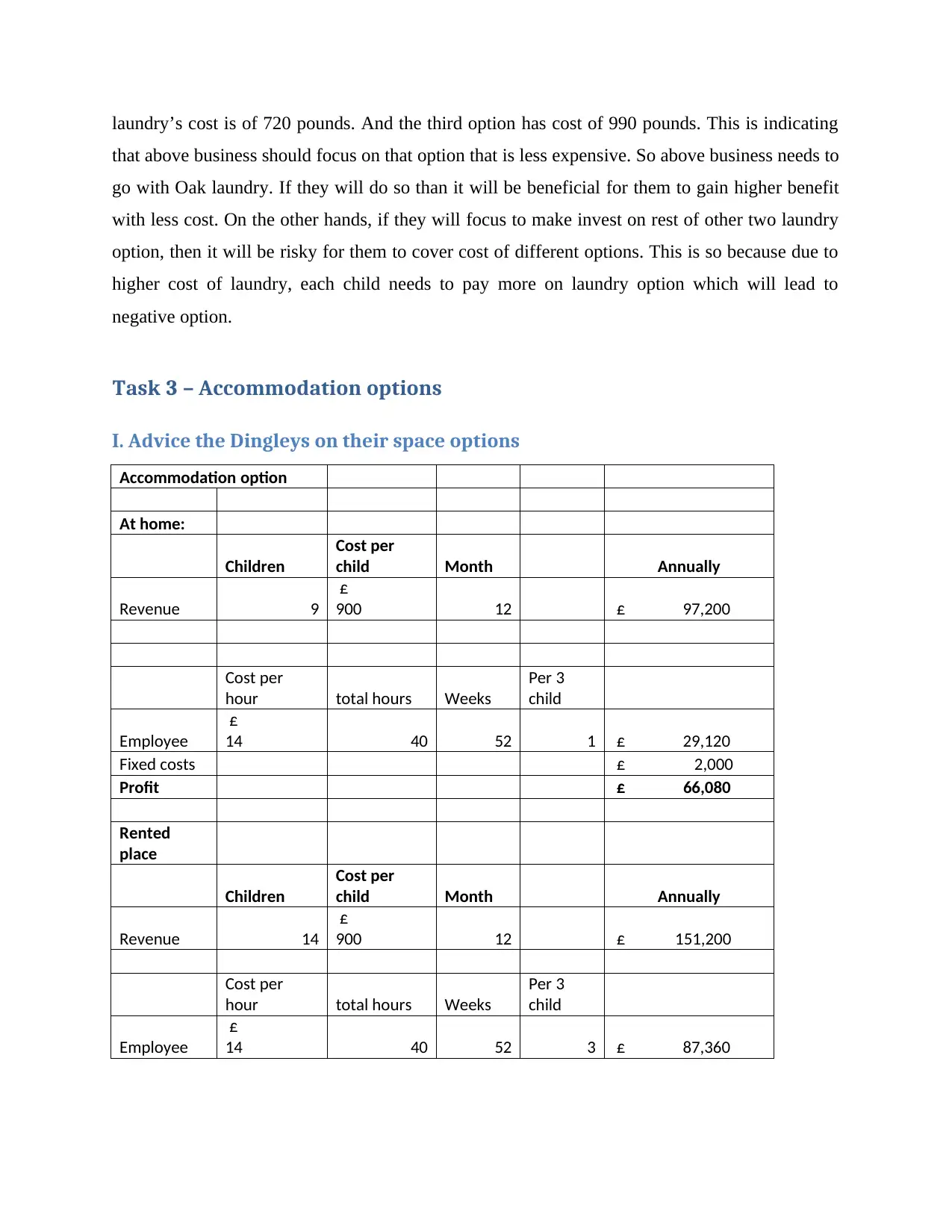
laundry’s cost is of 720 pounds. And the third option has cost of 990 pounds. This is indicating
that above business should focus on that option that is less expensive. So above business needs to
go with Oak laundry. If they will do so than it will be beneficial for them to gain higher benefit
with less cost. On the other hands, if they will focus to make invest on rest of other two laundry
option, then it will be risky for them to cover cost of different options. This is so because due to
higher cost of laundry, each child needs to pay more on laundry option which will lead to
negative option.
Task 3 – Accommodation options
I. Advice the Dingleys on their space options
Accommodation option
At home:
Children
Cost per
child Month Annually
Revenue 9
£
900 12 £ 97,200
Cost per
hour total hours Weeks
Per 3
child
Employee
£
14 40 52 1 £ 29,120
Fixed costs £ 2,000
Profit £ 66,080
Rented
place
Children
Cost per
child Month Annually
Revenue 14
£
900 12 £ 151,200
Cost per
hour total hours Weeks
Per 3
child
Employee
£
14 40 52 3 £ 87,360
that above business should focus on that option that is less expensive. So above business needs to
go with Oak laundry. If they will do so than it will be beneficial for them to gain higher benefit
with less cost. On the other hands, if they will focus to make invest on rest of other two laundry
option, then it will be risky for them to cover cost of different options. This is so because due to
higher cost of laundry, each child needs to pay more on laundry option which will lead to
negative option.
Task 3 – Accommodation options
I. Advice the Dingleys on their space options
Accommodation option
At home:
Children
Cost per
child Month Annually
Revenue 9
£
900 12 £ 97,200
Cost per
hour total hours Weeks
Per 3
child
Employee
£
14 40 52 1 £ 29,120
Fixed costs £ 2,000
Profit £ 66,080
Rented
place
Children
Cost per
child Month Annually
Revenue 14
£
900 12 £ 151,200
Cost per
hour total hours Weeks
Per 3
child
Employee
£
14 40 52 3 £ 87,360
⊘ This is a preview!⊘
Do you want full access?
Subscribe today to unlock all pages.
Trusted by 1+ million students worldwide
Cost @ £750
per month £ 9,000
Utility cost
@ £150 per
month £ 1,800
Insurance £ 7,500
Profit £ 45,540
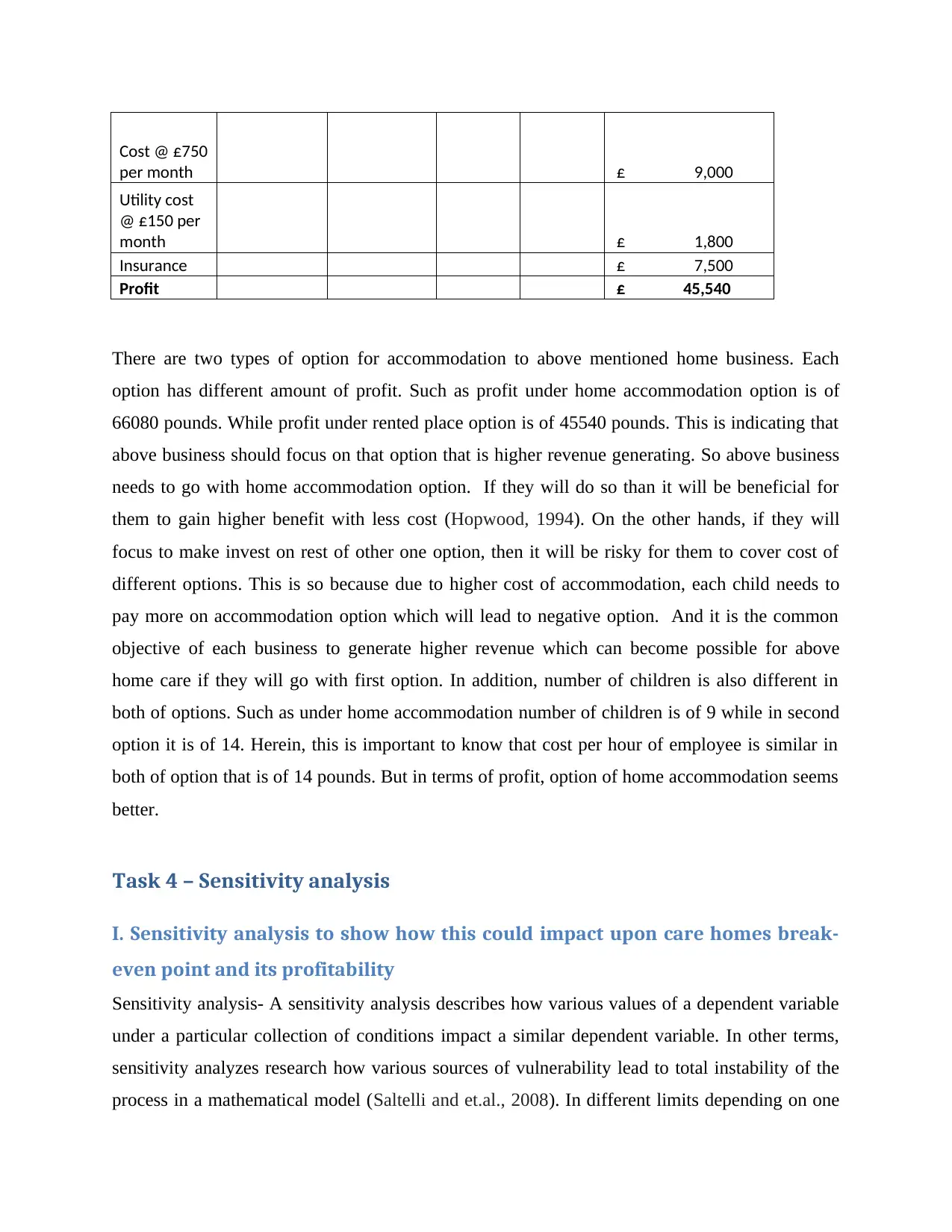
There are two types of option for accommodation to above mentioned home business. Each
option has different amount of profit. Such as profit under home accommodation option is of
66080 pounds. While profit under rented place option is of 45540 pounds. This is indicating that
above business should focus on that option that is higher revenue generating. So above business
needs to go with home accommodation option. If they will do so than it will be beneficial for
them to gain higher benefit with less cost (Hopwood, 1994). On the other hands, if they will
focus to make invest on rest of other one option, then it will be risky for them to cover cost of
different options. This is so because due to higher cost of accommodation, each child needs to
pay more on accommodation option which will lead to negative option. And it is the common
objective of each business to generate higher revenue which can become possible for above
home care if they will go with first option. In addition, number of children is also different in
both of options. Such as under home accommodation number of children is of 9 while in second
option it is of 14. Herein, this is important to know that cost per hour of employee is similar in
both of option that is of 14 pounds. But in terms of profit, option of home accommodation seems
better.
Task 4 – Sensitivity analysis
I. Sensitivity analysis to show how this could impact upon care homes break-
even point and its profitability
Sensitivity analysis- A sensitivity analysis describes how various values of a dependent variable
under a particular collection of conditions impact a similar dependent variable. In other terms,
sensitivity analyzes research how various sources of vulnerability lead to total instability of the
process in a mathematical model (Saltelli and et.al., 2008). In different limits depending on one
per month £ 9,000
Utility cost
@ £150 per
month £ 1,800
Insurance £ 7,500
Profit £ 45,540
There are two types of option for accommodation to above mentioned home business. Each
option has different amount of profit. Such as profit under home accommodation option is of
66080 pounds. While profit under rented place option is of 45540 pounds. This is indicating that
above business should focus on that option that is higher revenue generating. So above business
needs to go with home accommodation option. If they will do so than it will be beneficial for
them to gain higher benefit with less cost (Hopwood, 1994). On the other hands, if they will
focus to make invest on rest of other one option, then it will be risky for them to cover cost of
different options. This is so because due to higher cost of accommodation, each child needs to
pay more on accommodation option which will lead to negative option. And it is the common
objective of each business to generate higher revenue which can become possible for above
home care if they will go with first option. In addition, number of children is also different in
both of options. Such as under home accommodation number of children is of 9 while in second
option it is of 14. Herein, this is important to know that cost per hour of employee is similar in
both of option that is of 14 pounds. But in terms of profit, option of home accommodation seems
better.
Task 4 – Sensitivity analysis
I. Sensitivity analysis to show how this could impact upon care homes break-
even point and its profitability
Sensitivity analysis- A sensitivity analysis describes how various values of a dependent variable
under a particular collection of conditions impact a similar dependent variable. In other terms,
sensitivity analyzes research how various sources of vulnerability lead to total instability of the
process in a mathematical model (Saltelli and et.al., 2008). In different limits depending on one
Paraphrase This Document
Need a fresh take? Get an instant paraphrase of this document with our AI Paraphraser
or more input variables, this approach is used. Sensitivity analysis is a technique which is used to
determine how different values of an independent variable will influence a particular dependent
variable under a given set of assumptions. This technique is used within specific limits that will
depend on one or more input variables, such as the effect that changes in interest rates will have
on the price of such a bond (Saltelli, and et.al., 2004).
Sensitivity analysis is related to the uncertainty inherent in mathematical models, where the
values of inputs used in the model may vary. It is the companion analytical tool for uncertainty
analysis, and the two are often used together. All models are formulated based on assumptions
regarding the validity of inputs used in calculations or studies conducted to draw conclusions for
policy decisions.
Sensitivity analysis No. of child enrolled during a year
Worst (1) Most likely (6) Best (14)
Sales £ 10,800 £ 64,800 £ 151,200
Less: Variable cost £ 1,150 £ 6,900 £ 16,100
Contribution £ 9,650 £ 57,900 £ 135,100
Fixed cost £ 10,645.38 £ 10,645.38 £ 10,645.38
Net profit -£ 995.38 £ 47,254.63 £ 124,454.63
Sensitivity analysis Breakeven point
Worst (1) Most likely (6) Best (14)
Sales £ 41.54
£
249.23 £ 581.54 Cost per day
Less: Variable cost £ 5
£
30 £ 70 Cost per day
Contribution £ 36.54
£
219.23 £ 511.54
Fixed cost £ 10,645.38
£
10,645.38 £ 10,645.38
Break even in days 291.35 48.56 20.81
291 days 49 days 21 days
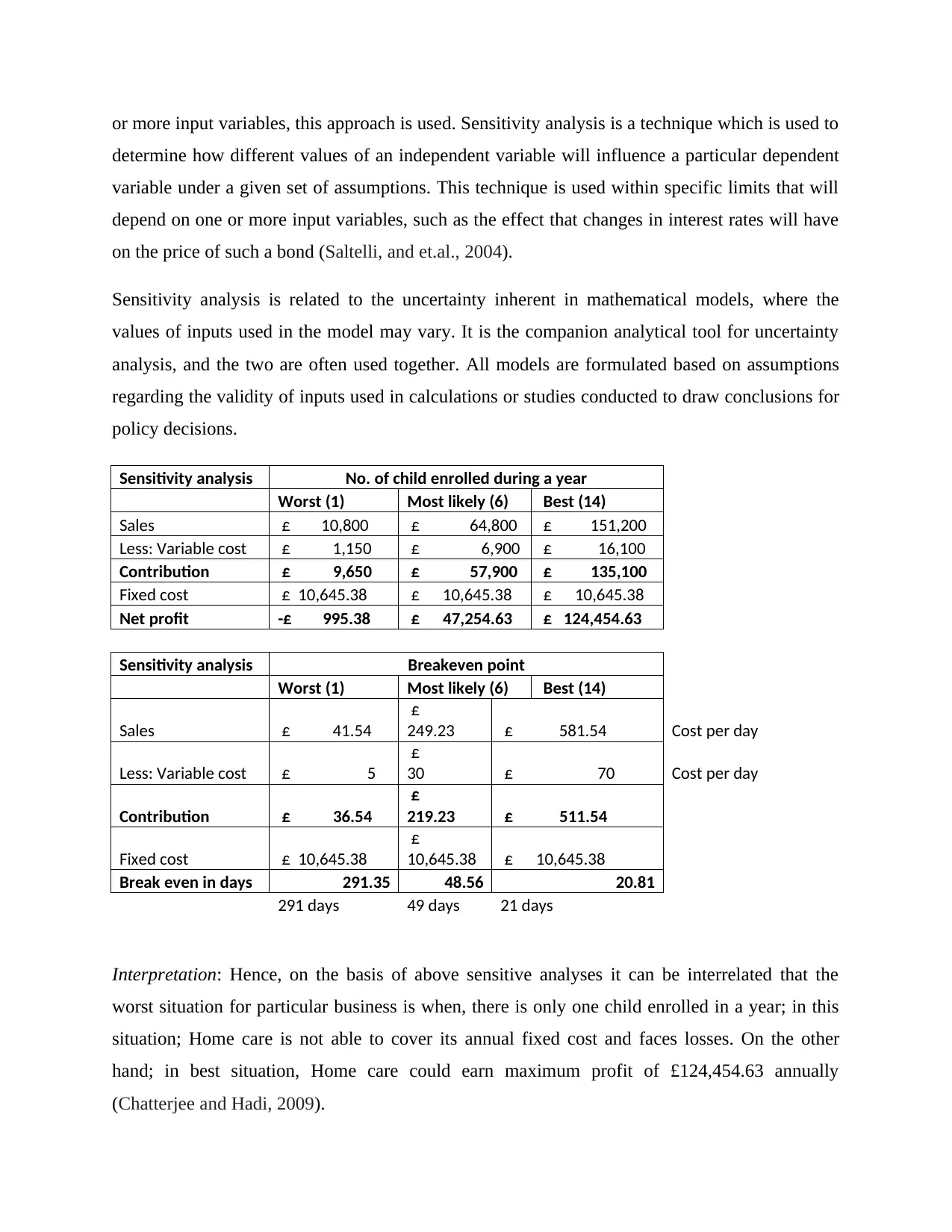
Interpretation: Hence, on the basis of above sensitive analyses it can be interrelated that the
worst situation for particular business is when, there is only one child enrolled in a year; in this
situation; Home care is not able to cover its annual fixed cost and faces losses. On the other
hand; in best situation, Home care could earn maximum profit of £124,454.63 annually
(Chatterjee and Hadi, 2009).
determine how different values of an independent variable will influence a particular dependent
variable under a given set of assumptions. This technique is used within specific limits that will
depend on one or more input variables, such as the effect that changes in interest rates will have
on the price of such a bond (Saltelli, and et.al., 2004).
Sensitivity analysis is related to the uncertainty inherent in mathematical models, where the
values of inputs used in the model may vary. It is the companion analytical tool for uncertainty
analysis, and the two are often used together. All models are formulated based on assumptions
regarding the validity of inputs used in calculations or studies conducted to draw conclusions for
policy decisions.
Sensitivity analysis No. of child enrolled during a year
Worst (1) Most likely (6) Best (14)
Sales £ 10,800 £ 64,800 £ 151,200
Less: Variable cost £ 1,150 £ 6,900 £ 16,100
Contribution £ 9,650 £ 57,900 £ 135,100
Fixed cost £ 10,645.38 £ 10,645.38 £ 10,645.38
Net profit -£ 995.38 £ 47,254.63 £ 124,454.63
Sensitivity analysis Breakeven point
Worst (1) Most likely (6) Best (14)
Sales £ 41.54
£
249.23 £ 581.54 Cost per day
Less: Variable cost £ 5
£
30 £ 70 Cost per day
Contribution £ 36.54
£
219.23 £ 511.54
Fixed cost £ 10,645.38
£
10,645.38 £ 10,645.38
Break even in days 291.35 48.56 20.81
291 days 49 days 21 days
Interpretation: Hence, on the basis of above sensitive analyses it can be interrelated that the
worst situation for particular business is when, there is only one child enrolled in a year; in this
situation; Home care is not able to cover its annual fixed cost and faces losses. On the other
hand; in best situation, Home care could earn maximum profit of £124,454.63 annually
(Chatterjee and Hadi, 2009).
While talking about break-even point; in case of worst scenario, Home care is not able to cover
its fixed cost. This indicated by 291 days which exceeds 52 weeks in a year and in best scenario,
the minimum time taken by business to cover its fixed cost is 21 days.
CONCLUSION
Hence, after analyzing whole business report, it can be concluded that; Home care business has
more opportunity to grow its business through adopting best way fit to its business requirement
and legal actions. As, the whole report is just an assumption and estimation, other non-financial
factors like cultural gaps, moral issues and mental development should also considered and
prioritize for profit and generating sales revenues.
its fixed cost. This indicated by 291 days which exceeds 52 weeks in a year and in best scenario,
the minimum time taken by business to cover its fixed cost is 21 days.
CONCLUSION
Hence, after analyzing whole business report, it can be concluded that; Home care business has
more opportunity to grow its business through adopting best way fit to its business requirement
and legal actions. As, the whole report is just an assumption and estimation, other non-financial
factors like cultural gaps, moral issues and mental development should also considered and
prioritize for profit and generating sales revenues.
⊘ This is a preview!⊘
Do you want full access?
Subscribe today to unlock all pages.
Trusted by 1+ million students worldwide

1 out of 13


Related Documents


Your All-in-One AI-Powered Toolkit for Academic Success.
+13062052269
info@desklib.com
Available 24*7 on WhatsApp / Email
![[object Object]](/_next/static/media/star-bottom.7253800d.svg)
Unlock your academic potential
Copyright © 2020–2026 A2Z Services. All Rights Reserved. Developed and managed by ZUCOL.