Business Case on Gap Inc.: Digital Strategy and Big Data Analysis
VerifiedAdded on 2021/06/14
|18
|5097
|160
Report
AI Summary
This business case analyzes Gap Inc.'s digital strategy, focusing on the use of big data to predict consumer tastes and improve retail performance. The report examines the company's approach to digital marketing, including social media engagement, online sales, and brand awareness. It details the business opportunity, potential impact, and alternatives considered, such as becoming a third-party seller on Amazon versus a wholesale model. The analysis includes assumptions, a comparison of the pros and cons of each alternative, and recommendations for maximizing business value through customer-centric outcomes, a big data blueprint, and new product development. The report also addresses risks, such as competition, and provides mitigation plans. The study highlights how Gap Inc. leverages data analytics to understand customer preferences, optimize marketing efforts, and adapt to the evolving retail landscape. The company's investment in big data and analytics is geared towards driving website traffic, increasing social media followers, fostering customer interaction, and boosting sales and brand awareness.
Running head: BUSINESS CASE ON GAP INC.
Assessment 2: Business Case on Gap Inc.
Name of the Student:
Name of the University:
Assessment 2: Business Case on Gap Inc.
Name of the Student:
Name of the University:

Paraphrase This Document
Need a fresh take? Get an instant paraphrase of this document with our AI Paraphraser
1BUSINESS CASE ON GAP INC.
Executive Summary
The business case is based on Gap Inc. which defines the opportunity, identifies the alternatives,
gathers the data and estimates the timeframe, analyzes the alternatives, and assesses the risks and
communication plan. The business case is aimed to predict the consumer tastes with the big data
at GAP. The company is used of digital strategy for managing their underperforming retail
stores. The impact of big data into the digital marketing of Gap is to know about the customer's
preferences. The service provider can use the data in innovative ways at the instance of designing
of product for the objective customers.
Executive Summary
The business case is based on Gap Inc. which defines the opportunity, identifies the alternatives,
gathers the data and estimates the timeframe, analyzes the alternatives, and assesses the risks and
communication plan. The business case is aimed to predict the consumer tastes with the big data
at GAP. The company is used of digital strategy for managing their underperforming retail
stores. The impact of big data into the digital marketing of Gap is to know about the customer's
preferences. The service provider can use the data in innovative ways at the instance of designing
of product for the objective customers.
2BUSINESS CASE ON GAP INC.
Table of Contents
1.0 Introduction to proposed project................................................................................................3
2.0 Description of proposed project.................................................................................................3
3.0 Business opportunity.................................................................................................................4
4.0 Potential impact of business results...........................................................................................5
5.0 Alternatives chosen for analysis................................................................................................5
6.0 Assumptions..............................................................................................................................6
7.0 Analysis of alternatives..............................................................................................................6
8.0 Recommendation and rationale.................................................................................................8
8.1 Recommendation...................................................................................................................8
8.2 Rationale................................................................................................................................9
9.0 Risk and mitigation plans..........................................................................................................9
10.0 Implementation plan..............................................................................................................12
References......................................................................................................................................18
Table of Contents
1.0 Introduction to proposed project................................................................................................3
2.0 Description of proposed project.................................................................................................3
3.0 Business opportunity.................................................................................................................4
4.0 Potential impact of business results...........................................................................................5
5.0 Alternatives chosen for analysis................................................................................................5
6.0 Assumptions..............................................................................................................................6
7.0 Analysis of alternatives..............................................................................................................6
8.0 Recommendation and rationale.................................................................................................8
8.1 Recommendation...................................................................................................................8
8.2 Rationale................................................................................................................................9
9.0 Risk and mitigation plans..........................................................................................................9
10.0 Implementation plan..............................................................................................................12
References......................................................................................................................................18
⊘ This is a preview!⊘
Do you want full access?
Subscribe today to unlock all pages.

Trusted by 1+ million students worldwide
3BUSINESS CASE ON GAP INC.
1.0 Introduction to proposed project
The project is based on “Predicting the consumer tastes with the big data at GAP”. GAP
is a clothing as well as accessories retailer which is used of digital strategy for managing their
underperforming retail stores. The company is used to collect insights from the online browsing
activity of the customers along with engagement into the social media platforms. It helps to
understand the customer's buying decisions from the physical stores (Ekbia et al. 2015). The
company is used of big data and predictive analytics into their marketing operations to sell of
existing products and new development of the product. Gap Inc. can able to discover new
products on the platforms (Millington and Millington 2015). It can be created of real human
connections which is one of the most important benefits of the social media for the business.
The business case describes the six steps such as define the opportunity, identify the
alternatives, gather the data and estimate the timeframe, analyze the alternatives, and assess the
risks and communication plan. The company assesses the business opportunities into the retail
industry along with diverse the possible strategic responses based on the market intelligence and
innovates of trends as well as change into the customer preferences.
2.0 Description of proposed project
The digital marketing strategy aims to develop a performance of GAP Inc. which includes of
engagement into the social media, sales the products on online shops, brand awareness as well as
attitude. Based on the social media platforms, GAP can interact with the customers as well as an
increase in engagement (Akter and Wamba 2016). Better is the website traffic. With the help of
the search engine marketing, GAP can able to know about the customers and build a long-term
1.0 Introduction to proposed project
The project is based on “Predicting the consumer tastes with the big data at GAP”. GAP
is a clothing as well as accessories retailer which is used of digital strategy for managing their
underperforming retail stores. The company is used to collect insights from the online browsing
activity of the customers along with engagement into the social media platforms. It helps to
understand the customer's buying decisions from the physical stores (Ekbia et al. 2015). The
company is used of big data and predictive analytics into their marketing operations to sell of
existing products and new development of the product. Gap Inc. can able to discover new
products on the platforms (Millington and Millington 2015). It can be created of real human
connections which is one of the most important benefits of the social media for the business.
The business case describes the six steps such as define the opportunity, identify the
alternatives, gather the data and estimate the timeframe, analyze the alternatives, and assess the
risks and communication plan. The company assesses the business opportunities into the retail
industry along with diverse the possible strategic responses based on the market intelligence and
innovates of trends as well as change into the customer preferences.
2.0 Description of proposed project
The digital marketing strategy aims to develop a performance of GAP Inc. which includes of
engagement into the social media, sales the products on online shops, brand awareness as well as
attitude. Based on the social media platforms, GAP can interact with the customers as well as an
increase in engagement (Akter and Wamba 2016). Better is the website traffic. With the help of
the search engine marketing, GAP can able to know about the customers and build a long-term
Paraphrase This Document
Need a fresh take? Get an instant paraphrase of this document with our AI Paraphraser
4BUSINESS CASE ON GAP INC.
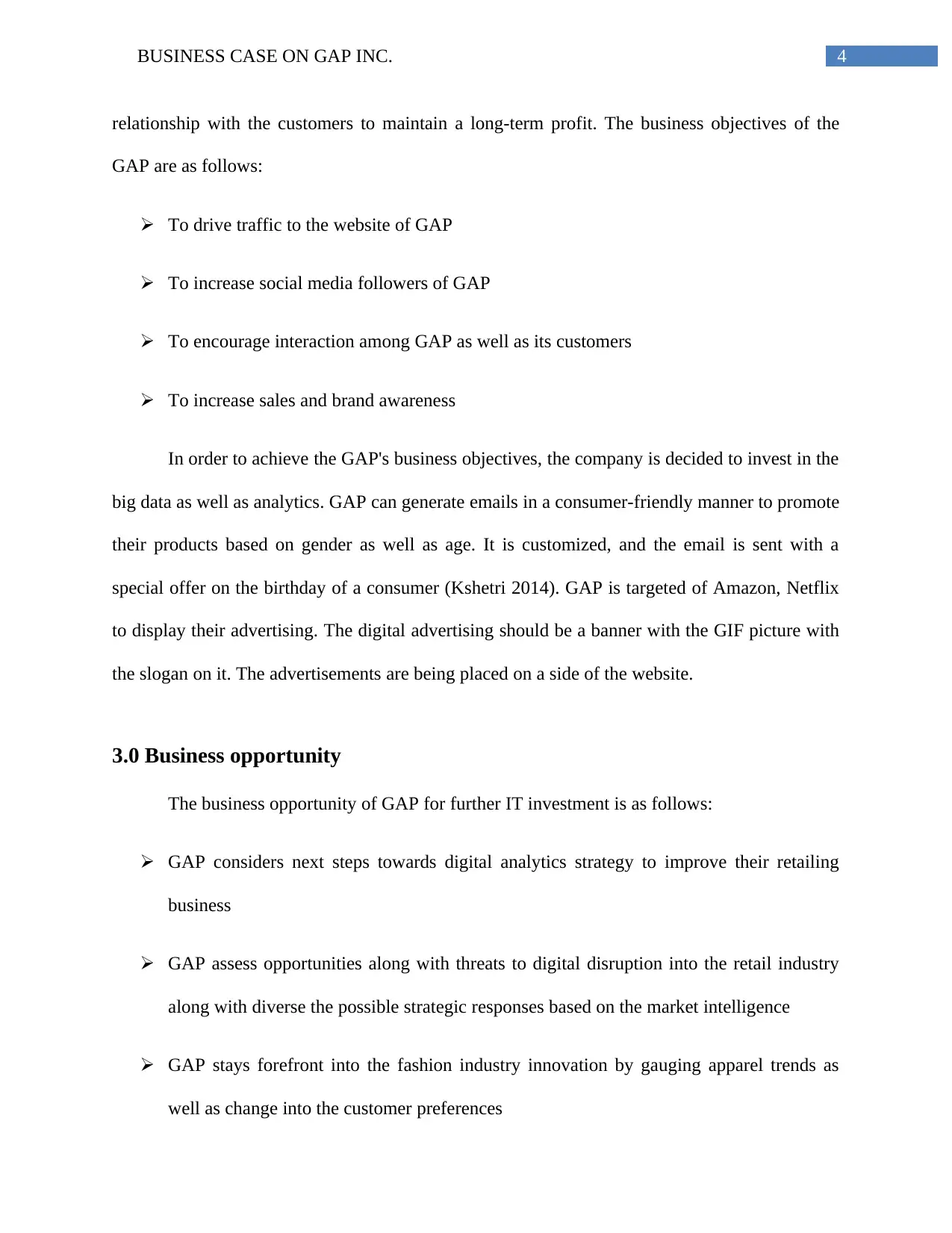
relationship with the customers to maintain a long-term profit. The business objectives of the
GAP are as follows:
To drive traffic to the website of GAP
To increase social media followers of GAP
To encourage interaction among GAP as well as its customers
To increase sales and brand awareness
In order to achieve the GAP's business objectives, the company is decided to invest in the
big data as well as analytics. GAP can generate emails in a consumer-friendly manner to promote
their products based on gender as well as age. It is customized, and the email is sent with a
special offer on the birthday of a consumer (Kshetri 2014). GAP is targeted of Amazon, Netflix
to display their advertising. The digital advertising should be a banner with the GIF picture with
the slogan on it. The advertisements are being placed on a side of the website.
3.0 Business opportunity
The business opportunity of GAP for further IT investment is as follows:
GAP considers next steps towards digital analytics strategy to improve their retailing
business
GAP assess opportunities along with threats to digital disruption into the retail industry
along with diverse the possible strategic responses based on the market intelligence
GAP stays forefront into the fashion industry innovation by gauging apparel trends as
well as change into the customer preferences
relationship with the customers to maintain a long-term profit. The business objectives of the
GAP are as follows:
To drive traffic to the website of GAP
To increase social media followers of GAP
To encourage interaction among GAP as well as its customers
To increase sales and brand awareness
In order to achieve the GAP's business objectives, the company is decided to invest in the
big data as well as analytics. GAP can generate emails in a consumer-friendly manner to promote
their products based on gender as well as age. It is customized, and the email is sent with a
special offer on the birthday of a consumer (Kshetri 2014). GAP is targeted of Amazon, Netflix
to display their advertising. The digital advertising should be a banner with the GIF picture with
the slogan on it. The advertisements are being placed on a side of the website.
3.0 Business opportunity
The business opportunity of GAP for further IT investment is as follows:
GAP considers next steps towards digital analytics strategy to improve their retailing
business
GAP assess opportunities along with threats to digital disruption into the retail industry
along with diverse the possible strategic responses based on the market intelligence
GAP stays forefront into the fashion industry innovation by gauging apparel trends as
well as change into the customer preferences
5BUSINESS CASE ON GAP INC.
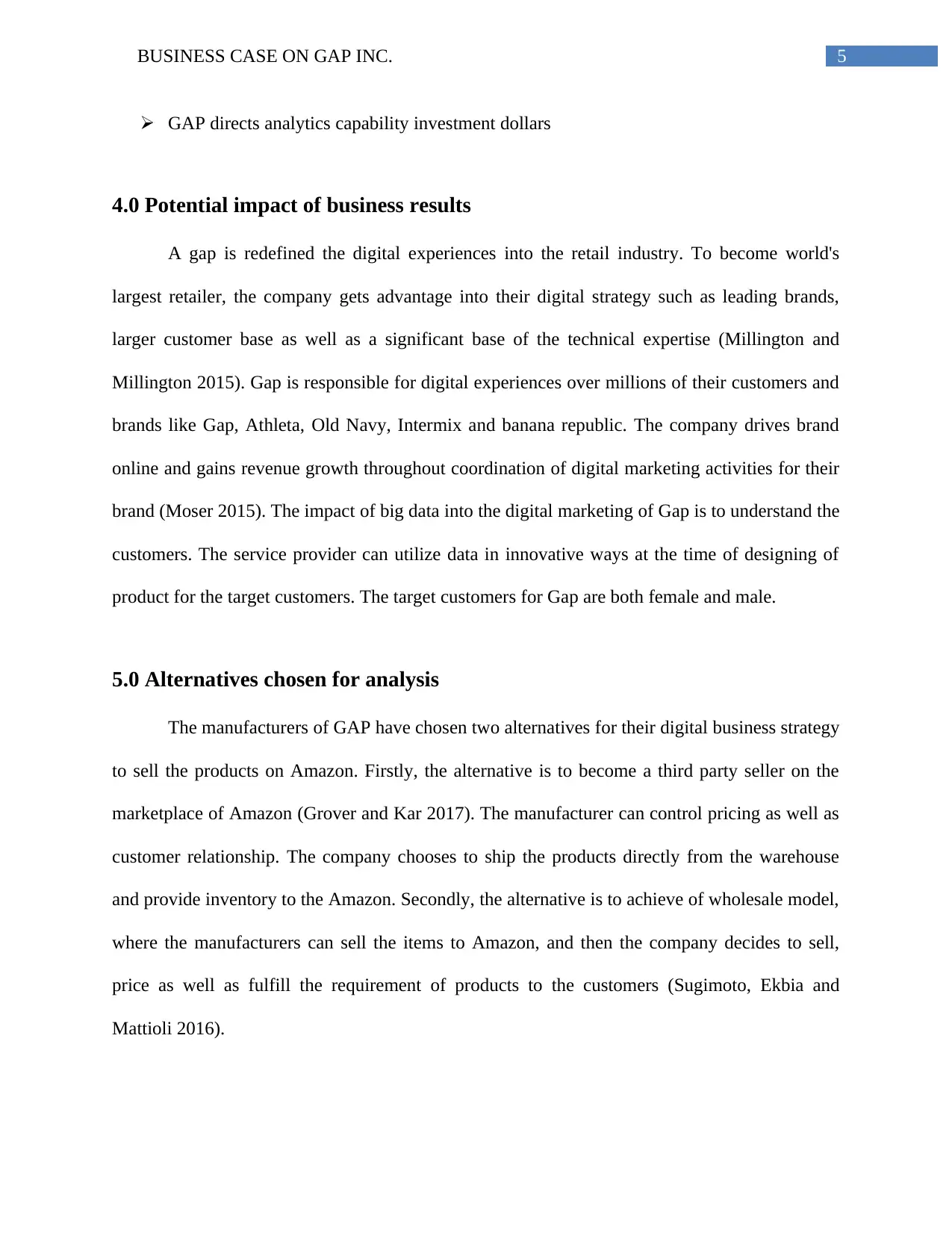
GAP directs analytics capability investment dollars
4.0 Potential impact of business results
A gap is redefined the digital experiences into the retail industry. To become world's
largest retailer, the company gets advantage into their digital strategy such as leading brands,
larger customer base as well as a significant base of the technical expertise (Millington and
Millington 2015). Gap is responsible for digital experiences over millions of their customers and
brands like Gap, Athleta, Old Navy, Intermix and banana republic. The company drives brand
online and gains revenue growth throughout coordination of digital marketing activities for their
brand (Moser 2015). The impact of big data into the digital marketing of Gap is to understand the
customers. The service provider can utilize data in innovative ways at the time of designing of
product for the target customers. The target customers for Gap are both female and male.
5.0 Alternatives chosen for analysis
The manufacturers of GAP have chosen two alternatives for their digital business strategy
to sell the products on Amazon. Firstly, the alternative is to become a third party seller on the
marketplace of Amazon (Grover and Kar 2017). The manufacturer can control pricing as well as
customer relationship. The company chooses to ship the products directly from the warehouse
and provide inventory to the Amazon. Secondly, the alternative is to achieve of wholesale model,
where the manufacturers can sell the items to Amazon, and then the company decides to sell,
price as well as fulfill the requirement of products to the customers (Sugimoto, Ekbia and
Mattioli 2016).
GAP directs analytics capability investment dollars
4.0 Potential impact of business results
A gap is redefined the digital experiences into the retail industry. To become world's
largest retailer, the company gets advantage into their digital strategy such as leading brands,
larger customer base as well as a significant base of the technical expertise (Millington and
Millington 2015). Gap is responsible for digital experiences over millions of their customers and
brands like Gap, Athleta, Old Navy, Intermix and banana republic. The company drives brand
online and gains revenue growth throughout coordination of digital marketing activities for their
brand (Moser 2015). The impact of big data into the digital marketing of Gap is to understand the
customers. The service provider can utilize data in innovative ways at the time of designing of
product for the target customers. The target customers for Gap are both female and male.
5.0 Alternatives chosen for analysis
The manufacturers of GAP have chosen two alternatives for their digital business strategy
to sell the products on Amazon. Firstly, the alternative is to become a third party seller on the
marketplace of Amazon (Grover and Kar 2017). The manufacturer can control pricing as well as
customer relationship. The company chooses to ship the products directly from the warehouse
and provide inventory to the Amazon. Secondly, the alternative is to achieve of wholesale model,
where the manufacturers can sell the items to Amazon, and then the company decides to sell,
price as well as fulfill the requirement of products to the customers (Sugimoto, Ekbia and
Mattioli 2016).
⊘ This is a preview!⊘
Do you want full access?
Subscribe today to unlock all pages.
Trusted by 1+ million students worldwide
6BUSINESS CASE ON GAP INC.
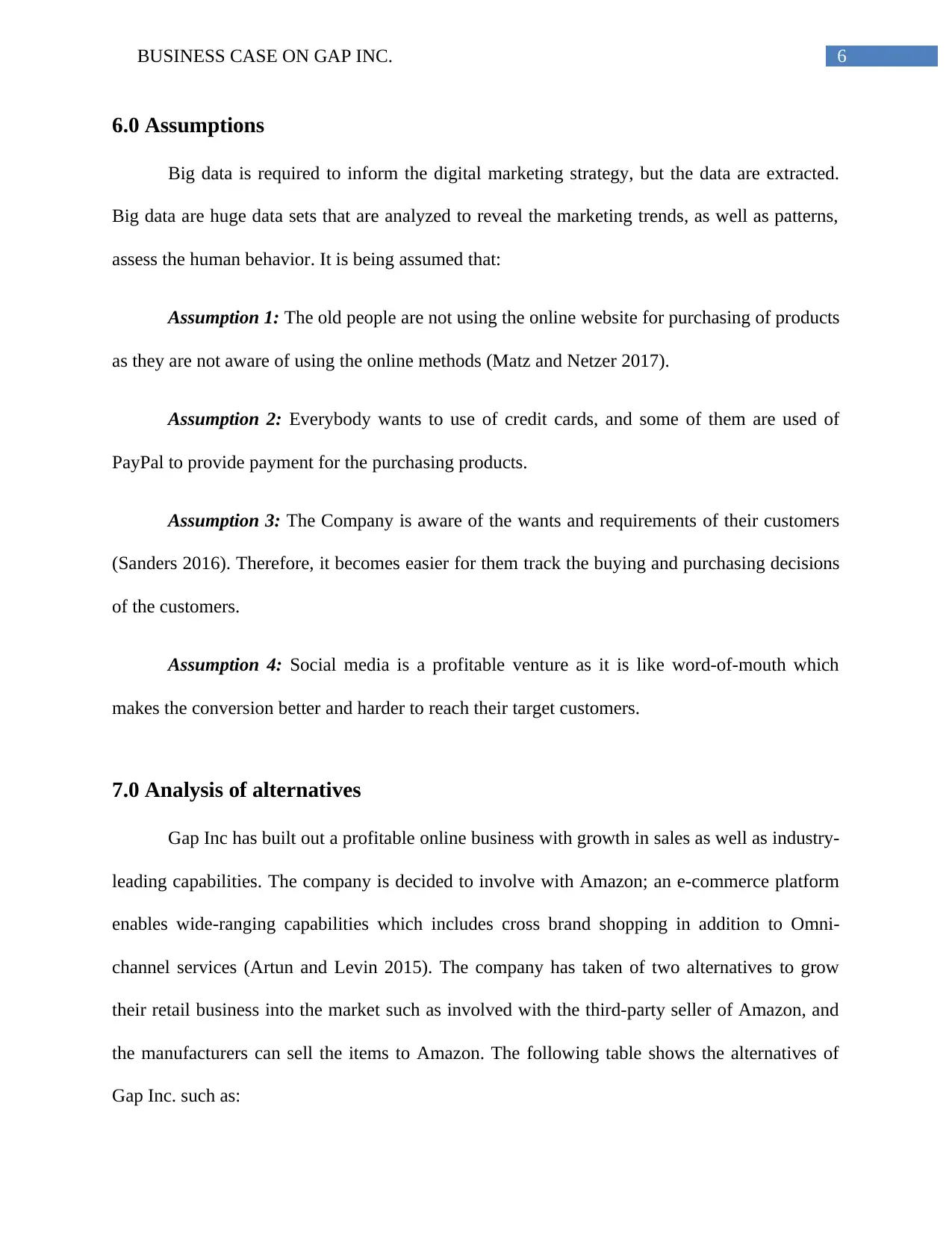
6.0 Assumptions
Big data is required to inform the digital marketing strategy, but the data are extracted.
Big data are huge data sets that are analyzed to reveal the marketing trends, as well as patterns,
assess the human behavior. It is being assumed that:
Assumption 1: The old people are not using the online website for purchasing of products
as they are not aware of using the online methods (Matz and Netzer 2017).
Assumption 2: Everybody wants to use of credit cards, and some of them are used of
PayPal to provide payment for the purchasing products.
Assumption 3: The Company is aware of the wants and requirements of their customers
(Sanders 2016). Therefore, it becomes easier for them track the buying and purchasing decisions
of the customers.
Assumption 4: Social media is a profitable venture as it is like word-of-mouth which
makes the conversion better and harder to reach their target customers.
7.0 Analysis of alternatives
Gap Inc has built out a profitable online business with growth in sales as well as industry-
leading capabilities. The company is decided to involve with Amazon; an e-commerce platform
enables wide-ranging capabilities which includes cross brand shopping in addition to Omni-
channel services (Artun and Levin 2015). The company has taken of two alternatives to grow
their retail business into the market such as involved with the third-party seller of Amazon, and
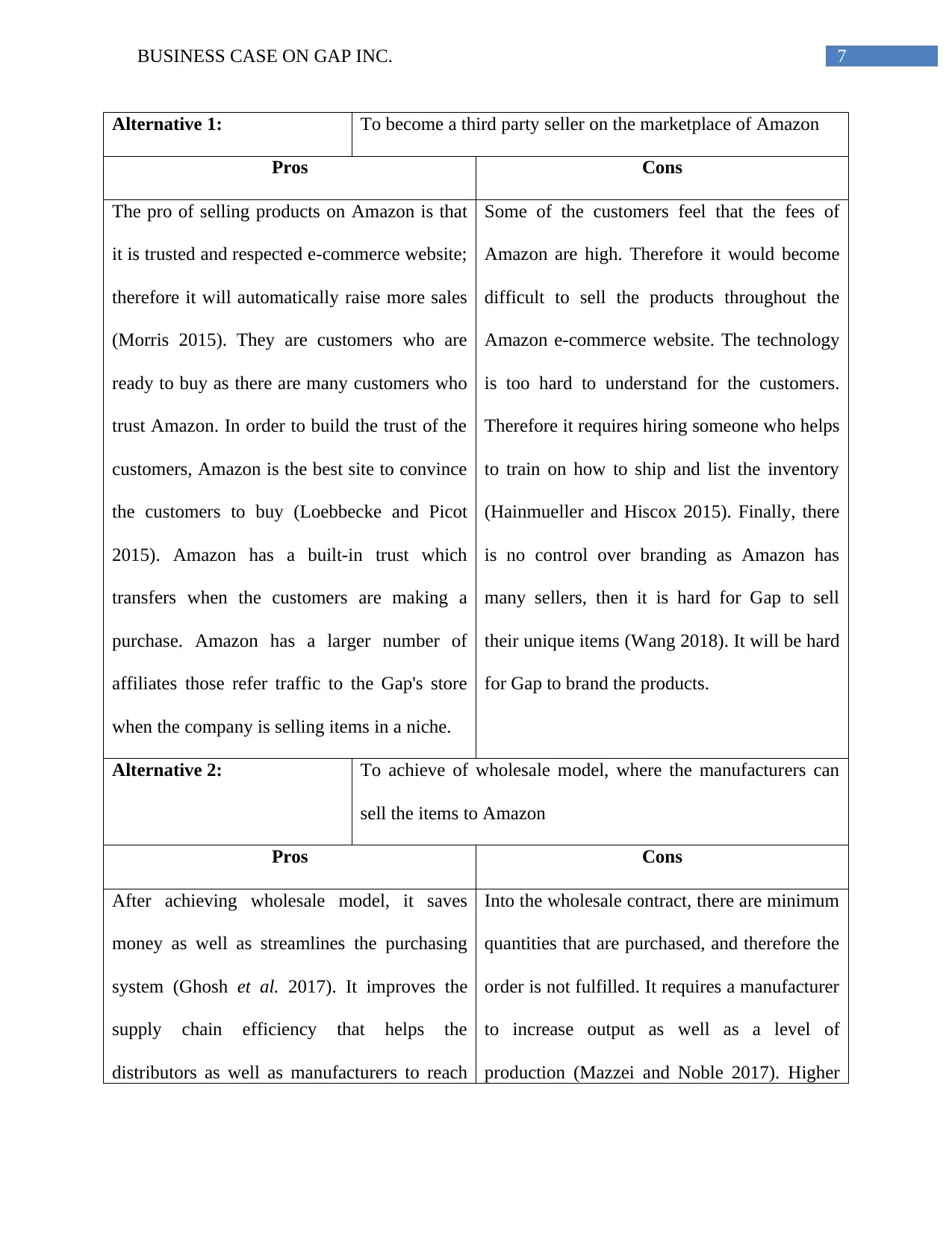
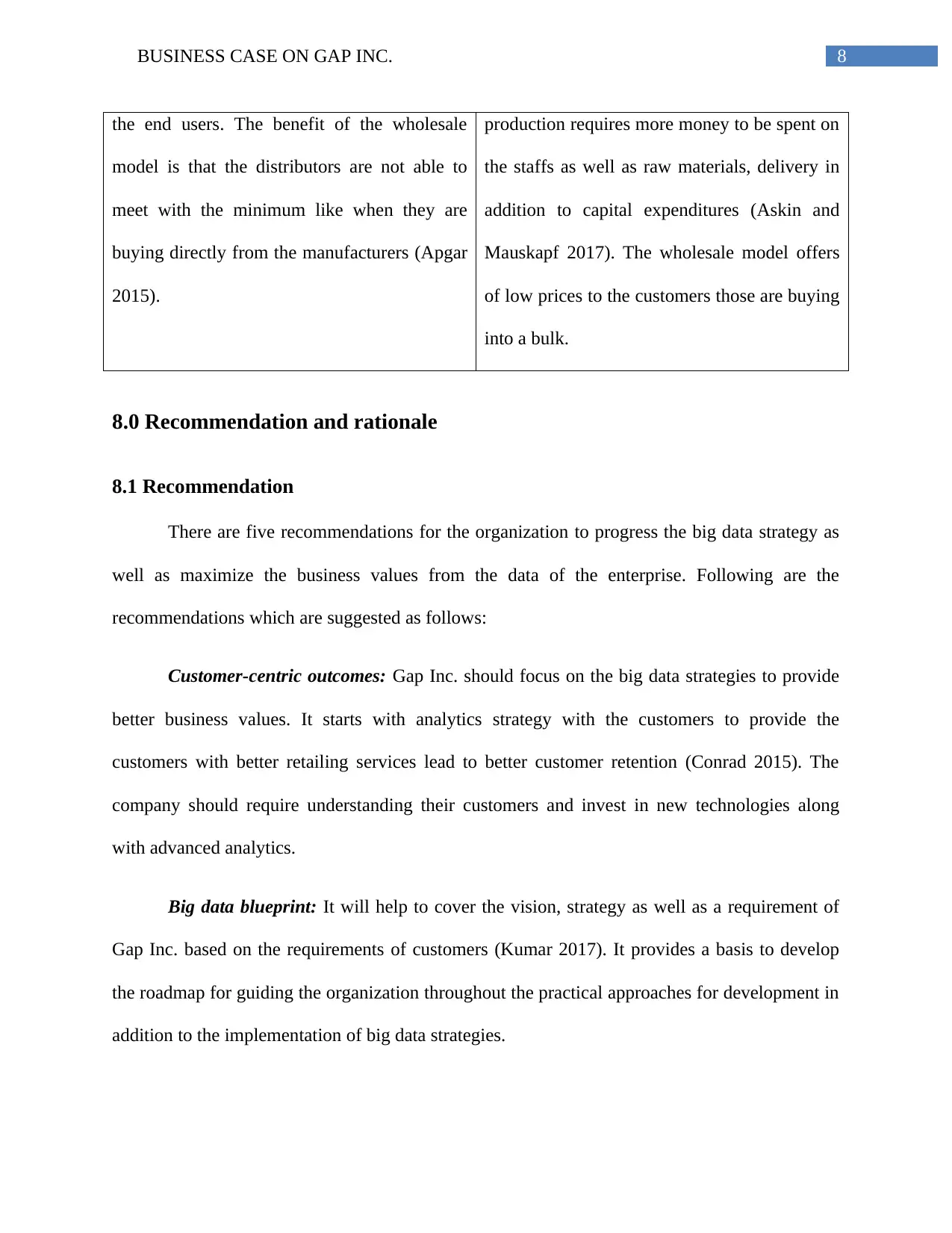
the manufacturers can sell the items to Amazon. The following table shows the alternatives of
Gap Inc. such as:
6.0 Assumptions
Big data is required to inform the digital marketing strategy, but the data are extracted.
Big data are huge data sets that are analyzed to reveal the marketing trends, as well as patterns,
assess the human behavior. It is being assumed that:
Assumption 1: The old people are not using the online website for purchasing of products
as they are not aware of using the online methods (Matz and Netzer 2017).
Assumption 2: Everybody wants to use of credit cards, and some of them are used of
PayPal to provide payment for the purchasing products.
Assumption 3: The Company is aware of the wants and requirements of their customers
(Sanders 2016). Therefore, it becomes easier for them track the buying and purchasing decisions
of the customers.
Assumption 4: Social media is a profitable venture as it is like word-of-mouth which
makes the conversion better and harder to reach their target customers.
7.0 Analysis of alternatives
Gap Inc has built out a profitable online business with growth in sales as well as industry-
leading capabilities. The company is decided to involve with Amazon; an e-commerce platform
enables wide-ranging capabilities which includes cross brand shopping in addition to Omni-
channel services (Artun and Levin 2015). The company has taken of two alternatives to grow
their retail business into the market such as involved with the third-party seller of Amazon, and
the manufacturers can sell the items to Amazon. The following table shows the alternatives of
Gap Inc. such as:
Paraphrase This Document
Need a fresh take? Get an instant paraphrase of this document with our AI Paraphraser
7BUSINESS CASE ON GAP INC.
Alternative 1: To become a third party seller on the marketplace of Amazon
Pros Cons
The pro of selling products on Amazon is that
it is trusted and respected e-commerce website;
therefore it will automatically raise more sales
(Morris 2015). They are customers who are
ready to buy as there are many customers who
trust Amazon. In order to build the trust of the
customers, Amazon is the best site to convince
the customers to buy (Loebbecke and Picot
2015). Amazon has a built-in trust which
transfers when the customers are making a
purchase. Amazon has a larger number of
affiliates those refer traffic to the Gap's store
when the company is selling items in a niche.
Some of the customers feel that the fees of
Amazon are high. Therefore it would become
difficult to sell the products throughout the
Amazon e-commerce website. The technology
is too hard to understand for the customers.
Therefore it requires hiring someone who helps
to train on how to ship and list the inventory
(Hainmueller and Hiscox 2015). Finally, there
is no control over branding as Amazon has
many sellers, then it is hard for Gap to sell
their unique items (Wang 2018). It will be hard
for Gap to brand the products.
Alternative 2: To achieve of wholesale model, where the manufacturers can
sell the items to Amazon
Pros Cons
After achieving wholesale model, it saves
money as well as streamlines the purchasing
system (Ghosh et al. 2017). It improves the
supply chain efficiency that helps the
distributors as well as manufacturers to reach
Into the wholesale contract, there are minimum
quantities that are purchased, and therefore the
order is not fulfilled. It requires a manufacturer
to increase output as well as a level of
production (Mazzei and Noble 2017). Higher
Alternative 1: To become a third party seller on the marketplace of Amazon
Pros Cons
The pro of selling products on Amazon is that
it is trusted and respected e-commerce website;
therefore it will automatically raise more sales
(Morris 2015). They are customers who are
ready to buy as there are many customers who
trust Amazon. In order to build the trust of the
customers, Amazon is the best site to convince
the customers to buy (Loebbecke and Picot
2015). Amazon has a built-in trust which
transfers when the customers are making a
purchase. Amazon has a larger number of
affiliates those refer traffic to the Gap's store
when the company is selling items in a niche.
Some of the customers feel that the fees of
Amazon are high. Therefore it would become
difficult to sell the products throughout the
Amazon e-commerce website. The technology
is too hard to understand for the customers.
Therefore it requires hiring someone who helps
to train on how to ship and list the inventory
(Hainmueller and Hiscox 2015). Finally, there
is no control over branding as Amazon has
many sellers, then it is hard for Gap to sell
their unique items (Wang 2018). It will be hard
for Gap to brand the products.
Alternative 2: To achieve of wholesale model, where the manufacturers can
sell the items to Amazon
Pros Cons
After achieving wholesale model, it saves
money as well as streamlines the purchasing
system (Ghosh et al. 2017). It improves the
supply chain efficiency that helps the
distributors as well as manufacturers to reach
Into the wholesale contract, there are minimum
quantities that are purchased, and therefore the
order is not fulfilled. It requires a manufacturer
to increase output as well as a level of
production (Mazzei and Noble 2017). Higher
8BUSINESS CASE ON GAP INC.
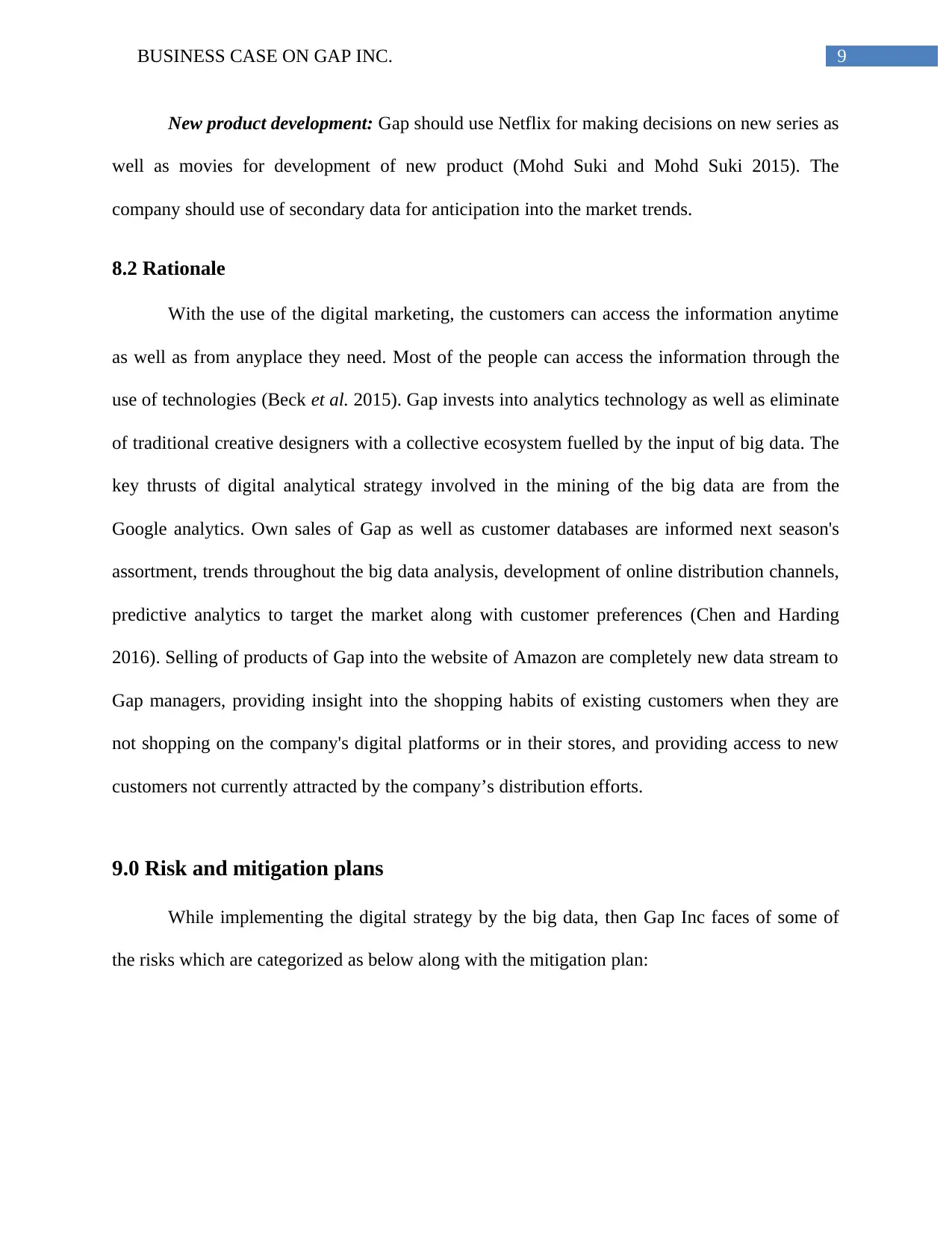
the end users. The benefit of the wholesale
model is that the distributors are not able to
meet with the minimum like when they are
buying directly from the manufacturers (Apgar
2015).
production requires more money to be spent on
the staffs as well as raw materials, delivery in
addition to capital expenditures (Askin and
Mauskapf 2017). The wholesale model offers
of low prices to the customers those are buying
into a bulk.
8.0 Recommendation and rationale
8.1 Recommendation
There are five recommendations for the organization to progress the big data strategy as
well as maximize the business values from the data of the enterprise. Following are the
recommendations which are suggested as follows:
Customer-centric outcomes: Gap Inc. should focus on the big data strategies to provide
better business values. It starts with analytics strategy with the customers to provide the
customers with better retailing services lead to better customer retention (Conrad 2015). The
company should require understanding their customers and invest in new technologies along
with advanced analytics.
Big data blueprint: It will help to cover the vision, strategy as well as a requirement of
Gap Inc. based on the requirements of customers (Kumar 2017). It provides a basis to develop
the roadmap for guiding the organization throughout the practical approaches for development in
addition to the implementation of big data strategies.
the end users. The benefit of the wholesale
model is that the distributors are not able to
meet with the minimum like when they are
buying directly from the manufacturers (Apgar
2015).
production requires more money to be spent on
the staffs as well as raw materials, delivery in
addition to capital expenditures (Askin and
Mauskapf 2017). The wholesale model offers
of low prices to the customers those are buying
into a bulk.
8.0 Recommendation and rationale
8.1 Recommendation
There are five recommendations for the organization to progress the big data strategy as
well as maximize the business values from the data of the enterprise. Following are the
recommendations which are suggested as follows:
Customer-centric outcomes: Gap Inc. should focus on the big data strategies to provide
better business values. It starts with analytics strategy with the customers to provide the
customers with better retailing services lead to better customer retention (Conrad 2015). The
company should require understanding their customers and invest in new technologies along
with advanced analytics.
Big data blueprint: It will help to cover the vision, strategy as well as a requirement of
Gap Inc. based on the requirements of customers (Kumar 2017). It provides a basis to develop
the roadmap for guiding the organization throughout the practical approaches for development in
addition to the implementation of big data strategies.
⊘ This is a preview!⊘
Do you want full access?
Subscribe today to unlock all pages.
Trusted by 1+ million students worldwide
9BUSINESS CASE ON GAP INC.
New product development: Gap should use Netflix for making decisions on new series as
well as movies for development of new product (Mohd Suki and Mohd Suki 2015). The
company should use of secondary data for anticipation into the market trends.
8.2 Rationale
With the use of the digital marketing, the customers can access the information anytime
as well as from anyplace they need. Most of the people can access the information through the
use of technologies (Beck et al. 2015). Gap invests into analytics technology as well as eliminate
of traditional creative designers with a collective ecosystem fuelled by the input of big data. The
key thrusts of digital analytical strategy involved in the mining of the big data are from the
Google analytics. Own sales of Gap as well as customer databases are informed next season's
assortment, trends throughout the big data analysis, development of online distribution channels,
predictive analytics to target the market along with customer preferences (Chen and Harding
2016). Selling of products of Gap into the website of Amazon are completely new data stream to
Gap managers, providing insight into the shopping habits of existing customers when they are
not shopping on the company's digital platforms or in their stores, and providing access to new
customers not currently attracted by the company’s distribution efforts.
9.0 Risk and mitigation plans
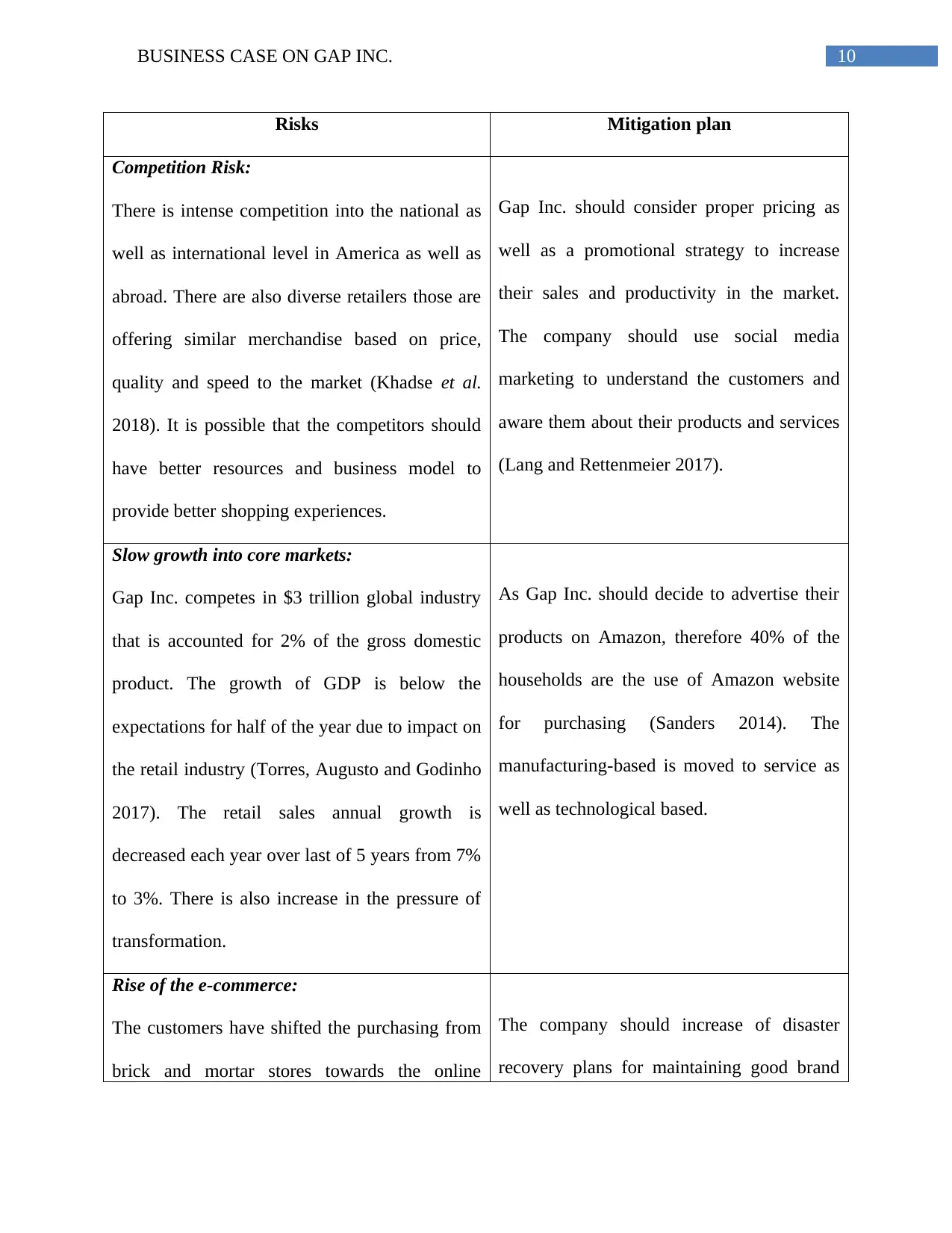
While implementing the digital strategy by the big data, then Gap Inc faces of some of
the risks which are categorized as below along with the mitigation plan:
New product development: Gap should use Netflix for making decisions on new series as
well as movies for development of new product (Mohd Suki and Mohd Suki 2015). The
company should use of secondary data for anticipation into the market trends.
8.2 Rationale
With the use of the digital marketing, the customers can access the information anytime
as well as from anyplace they need. Most of the people can access the information through the
use of technologies (Beck et al. 2015). Gap invests into analytics technology as well as eliminate
of traditional creative designers with a collective ecosystem fuelled by the input of big data. The
key thrusts of digital analytical strategy involved in the mining of the big data are from the
Google analytics. Own sales of Gap as well as customer databases are informed next season's
assortment, trends throughout the big data analysis, development of online distribution channels,
predictive analytics to target the market along with customer preferences (Chen and Harding
2016). Selling of products of Gap into the website of Amazon are completely new data stream to
Gap managers, providing insight into the shopping habits of existing customers when they are
not shopping on the company's digital platforms or in their stores, and providing access to new
customers not currently attracted by the company’s distribution efforts.
9.0 Risk and mitigation plans
While implementing the digital strategy by the big data, then Gap Inc faces of some of
the risks which are categorized as below along with the mitigation plan:
Paraphrase This Document
Need a fresh take? Get an instant paraphrase of this document with our AI Paraphraser
10BUSINESS CASE ON GAP INC.
Risks Mitigation plan
Competition Risk:
There is intense competition into the national as
well as international level in America as well as
abroad. There are also diverse retailers those are
offering similar merchandise based on price,
quality and speed to the market (Khadse et al.
2018). It is possible that the competitors should
have better resources and business model to
provide better shopping experiences.
Gap Inc. should consider proper pricing as
well as a promotional strategy to increase
their sales and productivity in the market.
The company should use social media
marketing to understand the customers and
aware them about their products and services
(Lang and Rettenmeier 2017).
Slow growth into core markets:
Gap Inc. competes in $3 trillion global industry
that is accounted for 2% of the gross domestic
product. The growth of GDP is below the
expectations for half of the year due to impact on
the retail industry (Torres, Augusto and Godinho
2017). The retail sales annual growth is
decreased each year over last of 5 years from 7%
to 3%. There is also increase in the pressure of
transformation.
As Gap Inc. should decide to advertise their
products on Amazon, therefore 40% of the
households are the use of Amazon website
for purchasing (Sanders 2014). The
manufacturing-based is moved to service as
well as technological based.
Rise of the e-commerce:
The customers have shifted the purchasing from
brick and mortar stores towards the online
The company should increase of disaster
recovery plans for maintaining good brand
Risks Mitigation plan
Competition Risk:
There is intense competition into the national as
well as international level in America as well as
abroad. There are also diverse retailers those are
offering similar merchandise based on price,
quality and speed to the market (Khadse et al.
2018). It is possible that the competitors should
have better resources and business model to
provide better shopping experiences.
Gap Inc. should consider proper pricing as
well as a promotional strategy to increase
their sales and productivity in the market.
The company should use social media
marketing to understand the customers and
aware them about their products and services
(Lang and Rettenmeier 2017).
Slow growth into core markets:
Gap Inc. competes in $3 trillion global industry
that is accounted for 2% of the gross domestic
product. The growth of GDP is below the
expectations for half of the year due to impact on
the retail industry (Torres, Augusto and Godinho
2017). The retail sales annual growth is
decreased each year over last of 5 years from 7%
to 3%. There is also increase in the pressure of
transformation.
As Gap Inc. should decide to advertise their
products on Amazon, therefore 40% of the
households are the use of Amazon website
for purchasing (Sanders 2014). The
manufacturing-based is moved to service as
well as technological based.
Rise of the e-commerce:
The customers have shifted the purchasing from
brick and mortar stores towards the online
The company should increase of disaster
recovery plans for maintaining good brand
11BUSINESS CASE ON GAP INC.
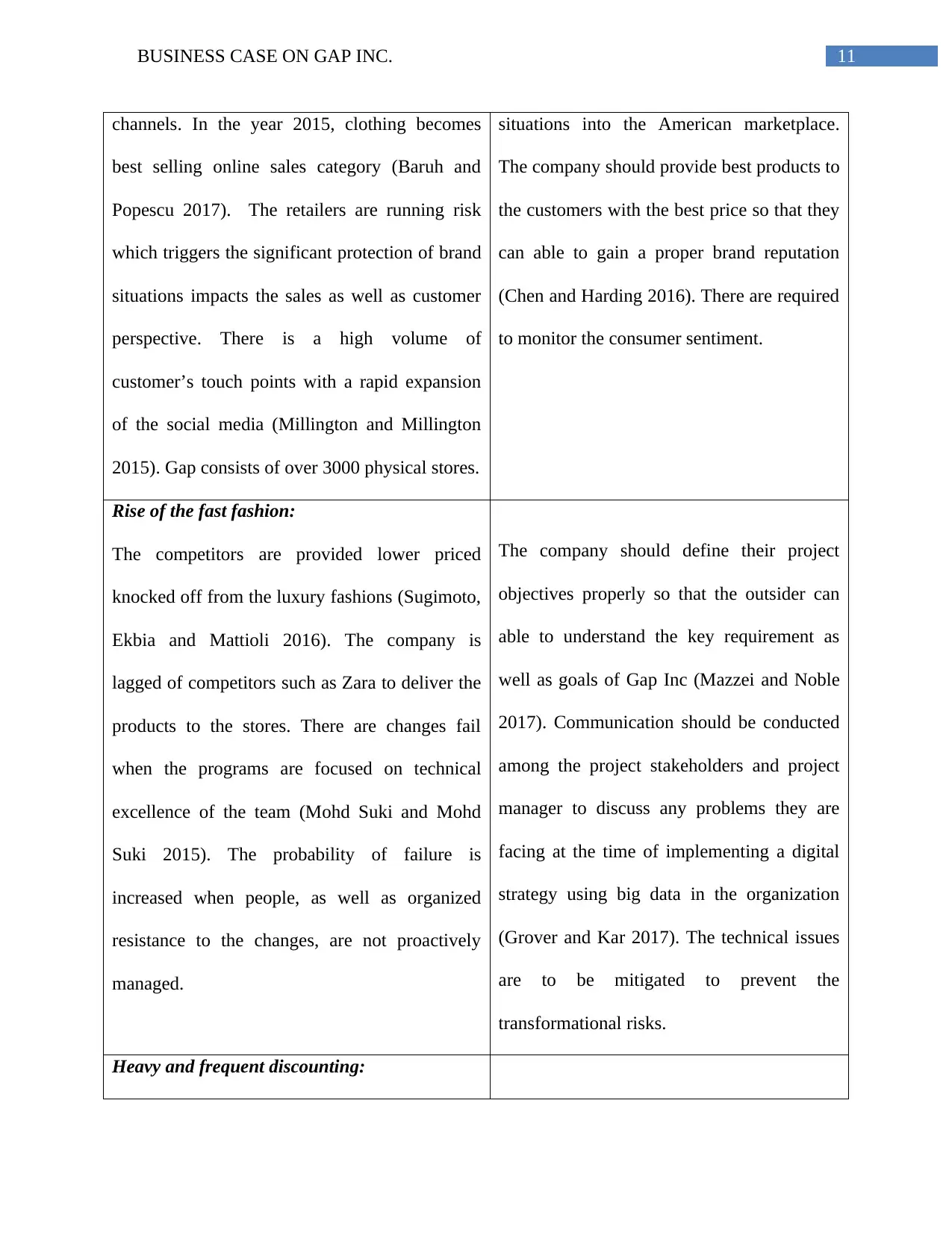
channels. In the year 2015, clothing becomes
best selling online sales category (Baruh and
Popescu 2017). The retailers are running risk
which triggers the significant protection of brand
situations impacts the sales as well as customer
perspective. There is a high volume of
customer’s touch points with a rapid expansion
of the social media (Millington and Millington
2015). Gap consists of over 3000 physical stores.
situations into the American marketplace.
The company should provide best products to
the customers with the best price so that they
can able to gain a proper brand reputation
(Chen and Harding 2016). There are required
to monitor the consumer sentiment.
Rise of the fast fashion:
The competitors are provided lower priced
knocked off from the luxury fashions (Sugimoto,
Ekbia and Mattioli 2016). The company is
lagged of competitors such as Zara to deliver the
products to the stores. There are changes fail
when the programs are focused on technical
excellence of the team (Mohd Suki and Mohd
Suki 2015). The probability of failure is
increased when people, as well as organized
resistance to the changes, are not proactively
managed.
The company should define their project
objectives properly so that the outsider can
able to understand the key requirement as
well as goals of Gap Inc (Mazzei and Noble
2017). Communication should be conducted
among the project stakeholders and project
manager to discuss any problems they are
facing at the time of implementing a digital
strategy using big data in the organization
(Grover and Kar 2017). The technical issues
are to be mitigated to prevent the
transformational risks.
Heavy and frequent discounting:
channels. In the year 2015, clothing becomes
best selling online sales category (Baruh and
Popescu 2017). The retailers are running risk
which triggers the significant protection of brand
situations impacts the sales as well as customer
perspective. There is a high volume of
customer’s touch points with a rapid expansion
of the social media (Millington and Millington
2015). Gap consists of over 3000 physical stores.
situations into the American marketplace.
The company should provide best products to
the customers with the best price so that they
can able to gain a proper brand reputation
(Chen and Harding 2016). There are required
to monitor the consumer sentiment.
Rise of the fast fashion:
The competitors are provided lower priced
knocked off from the luxury fashions (Sugimoto,
Ekbia and Mattioli 2016). The company is
lagged of competitors such as Zara to deliver the
products to the stores. There are changes fail
when the programs are focused on technical
excellence of the team (Mohd Suki and Mohd
Suki 2015). The probability of failure is
increased when people, as well as organized
resistance to the changes, are not proactively
managed.
The company should define their project
objectives properly so that the outsider can
able to understand the key requirement as
well as goals of Gap Inc (Mazzei and Noble
2017). Communication should be conducted
among the project stakeholders and project
manager to discuss any problems they are
facing at the time of implementing a digital
strategy using big data in the organization
(Grover and Kar 2017). The technical issues
are to be mitigated to prevent the
transformational risks.
Heavy and frequent discounting:
⊘ This is a preview!⊘
Do you want full access?
Subscribe today to unlock all pages.
Trusted by 1+ million students worldwide

1 out of 18


Related Documents


Your All-in-One AI-Powered Toolkit for Academic Success.
+13062052269
info@desklib.com
Available 24*7 on WhatsApp / Email
![[object Object]](/_next/static/media/star-bottom.7253800d.svg)
Unlock your academic potential
Copyright © 2020–2026 A2Z Services. All Rights Reserved. Developed and managed by ZUCOL.