Business Communication Analysis

Verified

Added on  2020/02/24

|6
|1486
|210
Essay
AI Summary
The essay discusses the significance of feedback in business communication, differentiating between negative feedback and destructive criticism. It emphasizes the importance of delivering feedback constructively to enhance employee performance and motivation. The author argues that both positive and negative feedback serve the same purpose: to inform individuals about their performance and encourage improvement. The essay also highlights the need for effective communication skills when providing feedback to ensure it is received positively.
Document Page
Running head: BUSINESS COMMUNICATION
Business Communication
Name of the Student:
Name of the University:
Author note:
tabler-icon-diamond-filled.svg

Paraphrase This Document

Need a fresh take? Get an instant paraphrase of this document with our AI Paraphraser
Document Page
1BUSINESS COMMUNICATION
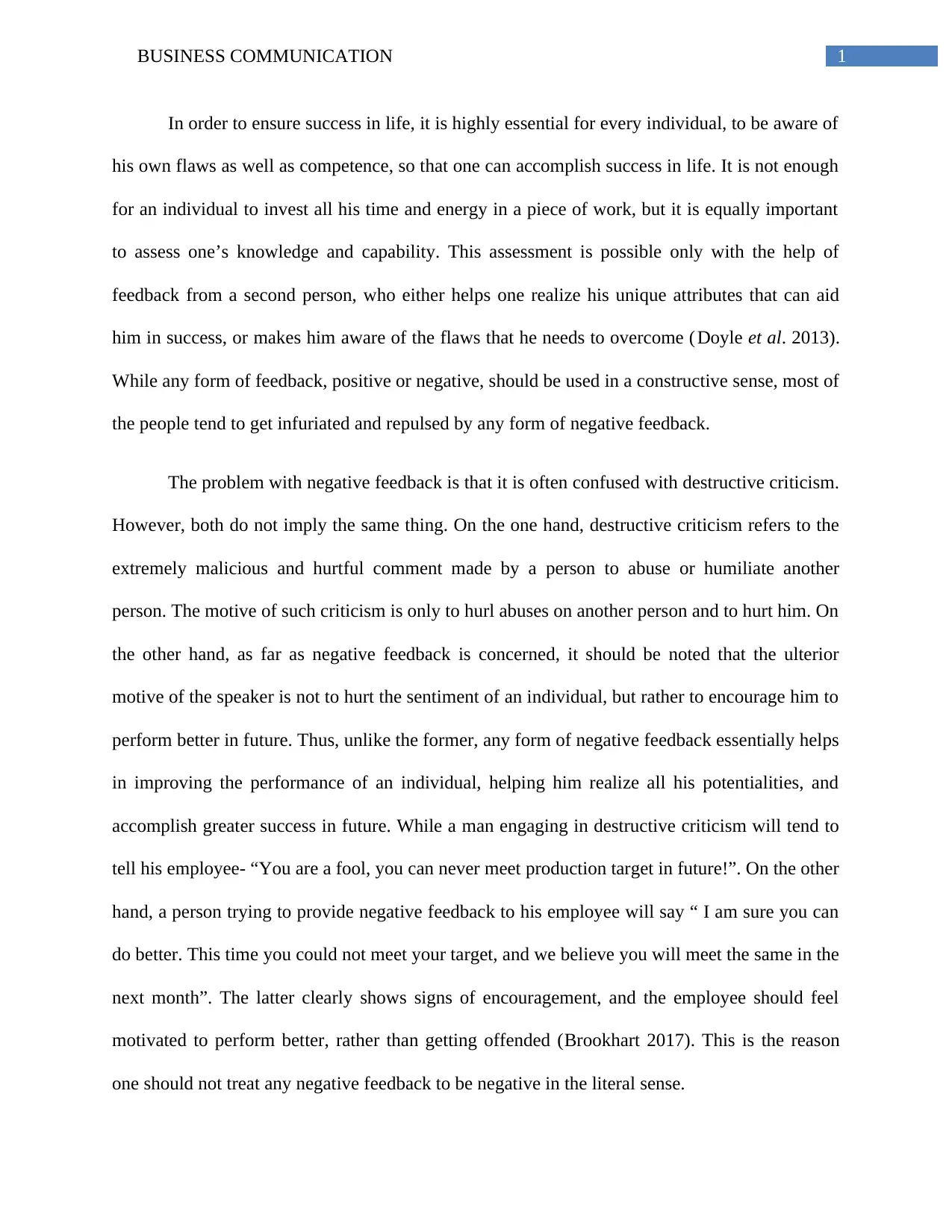
In order to ensure success in life, it is highly essential for every individual, to be aware of
his own flaws as well as competence, so that one can accomplish success in life. It is not enough
for an individual to invest all his time and energy in a piece of work, but it is equally important
to assess one’s knowledge and capability. This assessment is possible only with the help of
feedback from a second person, who either helps one realize his unique attributes that can aid
him in success, or makes him aware of the flaws that he needs to overcome (Doyle et al. 2013).
While any form of feedback, positive or negative, should be used in a constructive sense, most of
the people tend to get infuriated and repulsed by any form of negative feedback.
The problem with negative feedback is that it is often confused with destructive criticism.
However, both do not imply the same thing. On the one hand, destructive criticism refers to the
extremely malicious and hurtful comment made by a person to abuse or humiliate another
person. The motive of such criticism is only to hurl abuses on another person and to hurt him. On
the other hand, as far as negative feedback is concerned, it should be noted that the ulterior
motive of the speaker is not to hurt the sentiment of an individual, but rather to encourage him to
perform better in future. Thus, unlike the former, any form of negative feedback essentially helps
in improving the performance of an individual, helping him realize all his potentialities, and
accomplish greater success in future. While a man engaging in destructive criticism will tend to
tell his employee- “You are a fool, you can never meet production target in future!”. On the other
hand, a person trying to provide negative feedback to his employee will say “ I am sure you can
do better. This time you could not meet your target, and we believe you will meet the same in the
next month”. The latter clearly shows signs of encouragement, and the employee should feel
motivated to perform better, rather than getting offended (Brookhart 2017). This is the reason
one should not treat any negative feedback to be negative in the literal sense.
Document Page
2BUSINESS COMMUNICATION
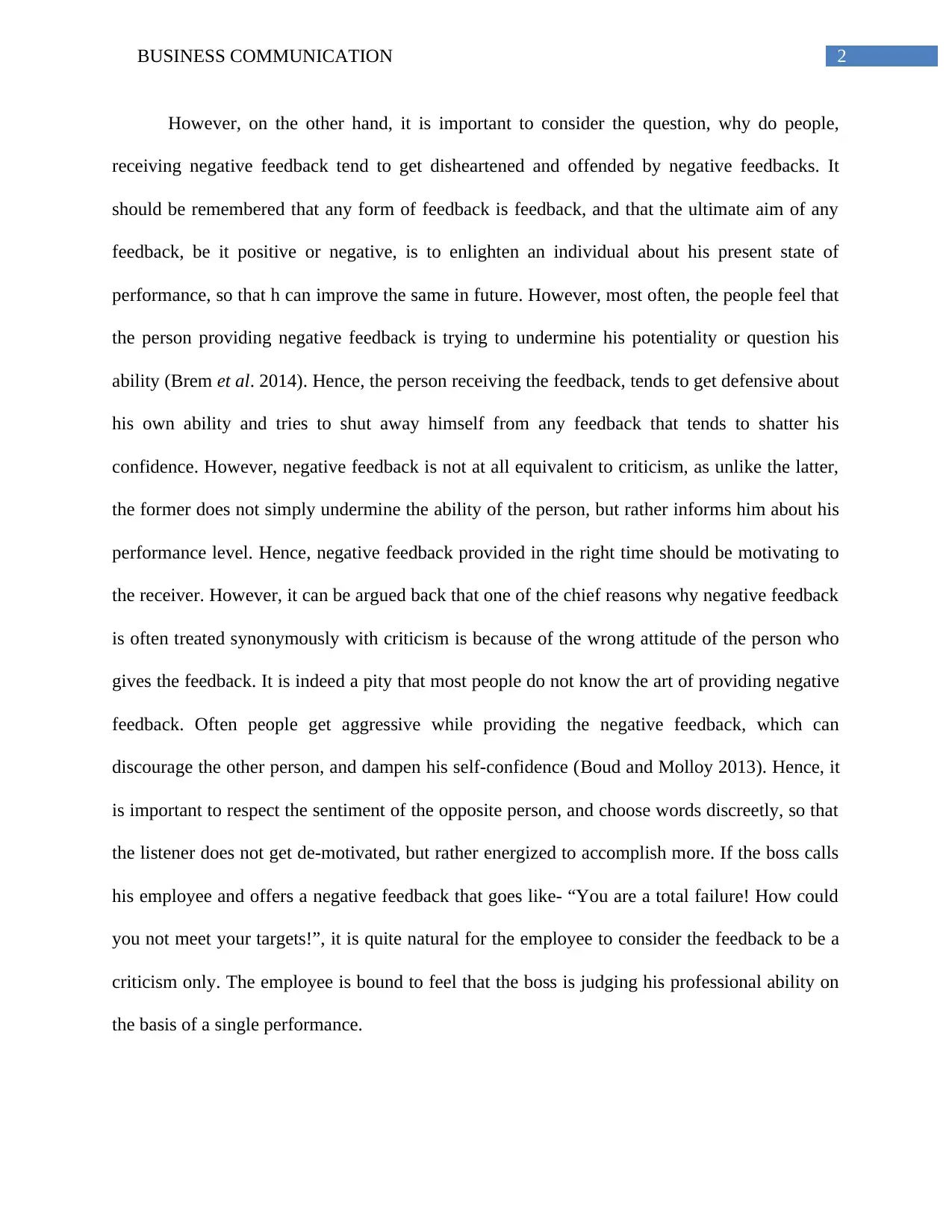
However, on the other hand, it is important to consider the question, why do people,
receiving negative feedback tend to get disheartened and offended by negative feedbacks. It
should be remembered that any form of feedback is feedback, and that the ultimate aim of any
feedback, be it positive or negative, is to enlighten an individual about his present state of
performance, so that h can improve the same in future. However, most often, the people feel that
the person providing negative feedback is trying to undermine his potentiality or question his
ability (Brem et al. 2014). Hence, the person receiving the feedback, tends to get defensive about
his own ability and tries to shut away himself from any feedback that tends to shatter his
confidence. However, negative feedback is not at all equivalent to criticism, as unlike the latter,
the former does not simply undermine the ability of the person, but rather informs him about his
performance level. Hence, negative feedback provided in the right time should be motivating to
the receiver. However, it can be argued back that one of the chief reasons why negative feedback
is often treated synonymously with criticism is because of the wrong attitude of the person who
gives the feedback. It is indeed a pity that most people do not know the art of providing negative
feedback. Often people get aggressive while providing the negative feedback, which can
discourage the other person, and dampen his self-confidence (Boud and Molloy 2013). Hence, it
is important to respect the sentiment of the opposite person, and choose words discreetly, so that
the listener does not get de-motivated, but rather energized to accomplish more. If the boss calls
his employee and offers a negative feedback that goes like- “You are a total failure! How could
you not meet your targets!”, it is quite natural for the employee to consider the feedback to be a
criticism only. The employee is bound to feel that the boss is judging his professional ability on
the basis of a single performance.
Document Page
3BUSINESS COMMUNICATION
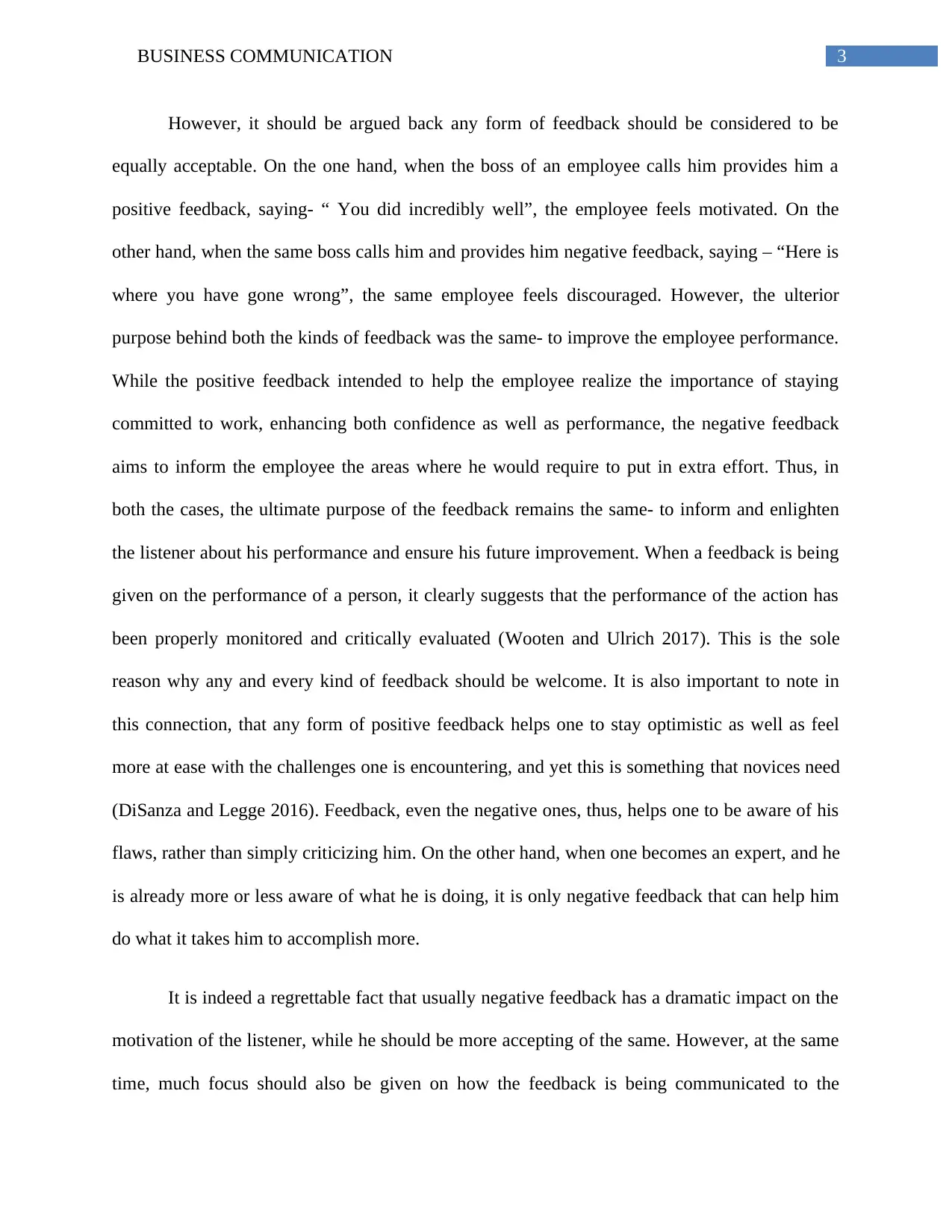
However, it should be argued back any form of feedback should be considered to be
equally acceptable. On the one hand, when the boss of an employee calls him provides him a
positive feedback, saying- “ You did incredibly well”, the employee feels motivated. On the
other hand, when the same boss calls him and provides him negative feedback, saying – “Here is
where you have gone wrong”, the same employee feels discouraged. However, the ulterior
purpose behind both the kinds of feedback was the same- to improve the employee performance.
While the positive feedback intended to help the employee realize the importance of staying
committed to work, enhancing both confidence as well as performance, the negative feedback
aims to inform the employee the areas where he would require to put in extra effort. Thus, in
both the cases, the ultimate purpose of the feedback remains the same- to inform and enlighten
the listener about his performance and ensure his future improvement. When a feedback is being
given on the performance of a person, it clearly suggests that the performance of the action has
been properly monitored and critically evaluated (Wooten and Ulrich 2017). This is the sole
reason why any and every kind of feedback should be welcome. It is also important to note in
this connection, that any form of positive feedback helps one to stay optimistic as well as feel
more at ease with the challenges one is encountering, and yet this is something that novices need
(DiSanza and Legge 2016). Feedback, even the negative ones, thus, helps one to be aware of his
flaws, rather than simply criticizing him. On the other hand, when one becomes an expert, and he
is already more or less aware of what he is doing, it is only negative feedback that can help him
do what it takes him to accomplish more.
It is indeed a regrettable fact that usually negative feedback has a dramatic impact on the
motivation of the listener, while he should be more accepting of the same. However, at the same
time, much focus should also be given on how the feedback is being communicated to the
tabler-icon-diamond-filled.svg

Paraphrase This Document

Need a fresh take? Get an instant paraphrase of this document with our AI Paraphraser
Document Page
4BUSINESS COMMUNICATION
listener. The feedback provider should not employ the use of abusive words, nor should he forget
to leave behind a piece of good advice at the end of the feedback is being given. This will help
the listeners, especially the novices, remain optimistic about their capabilities. Any kind of
feedback helps a person improve his performance and evolve himself for a better future.
Document Page
5BUSINESS COMMUNICATION
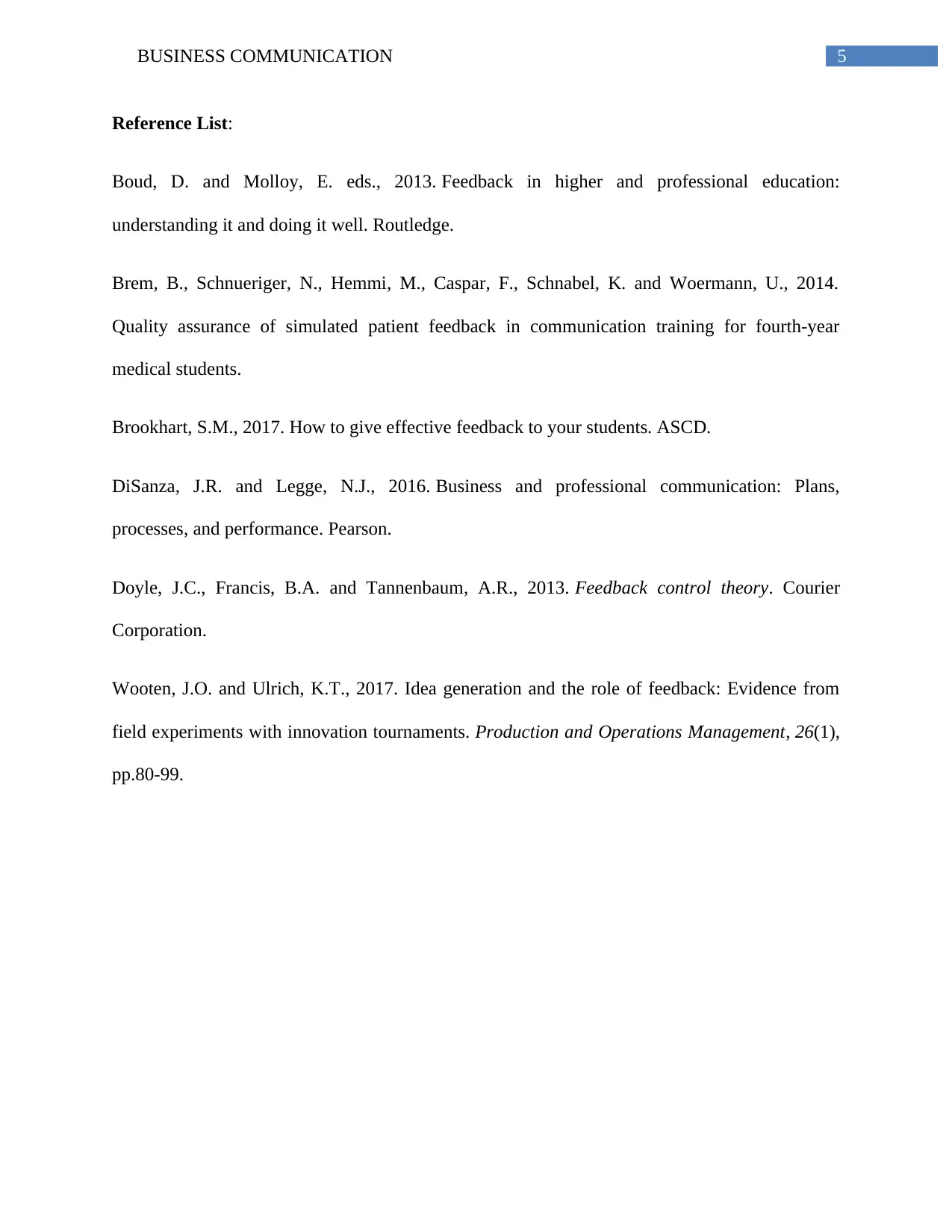
Reference List:
Boud, D. and Molloy, E. eds., 2013. Feedback in higher and professional education:
understanding it and doing it well. Routledge.
Brem, B., Schnueriger, N., Hemmi, M., Caspar, F., Schnabel, K. and Woermann, U., 2014.
Quality assurance of simulated patient feedback in communication training for fourth-year
medical students.
Brookhart, S.M., 2017. How to give effective feedback to your students. ASCD.
DiSanza, J.R. and Legge, N.J., 2016. Business and professional communication: Plans,
processes, and performance. Pearson.
Doyle, J.C., Francis, B.A. and Tannenbaum, A.R., 2013. Feedback control theory. Courier
Corporation.
Wooten, J.O. and Ulrich, K.T., 2017. Idea generation and the role of feedback: Evidence from
field experiments with innovation tournaments. Production and Operations Management, 26(1),
pp.80-99.
chevron_up_icon
1 out of 6
circle_padding
hide_on_mobile
zoom_out_icon
[object Object]