BUS101 Business Communication: Analyzing Barriers in Communication

Verified

Added on  2023/06/15

|10
|1459
|260
Report
AI Summary
This report delves into the intricacies of communication by dissecting a personal incident where miscommunication led to undesired outcomes. Utilizing Berlo's communication model, the analysis identifies key issues such as noise, unclear communication channels, semantic barriers, and encoding/decoding failures. Furthermore, the report explores various barriers to effective communication, including emotional obstacles, lack of interest, differing viewpoints, physical disabilities, non-verbal misinterpretations, and cultural differences. To mitigate these barriers, the report suggests strategies such as clarifying thoughts, understanding audience needs, seeking expert advice, and actively listening. The conclusion emphasizes the importance of clear and concise communication to ensure messages are well-received by all parties involved. This analysis highlights the critical role communication plays in all interactions and the necessity of proactively addressing potential barriers to foster understanding and prevent misinterpretations.
Document Page
Running head: BUSINESS COMMUNICATION
BUSINESS COMMUNICATION
Name of the Student
Name of the University
Author Note
tabler-icon-diamond-filled.svg

Paraphrase This Document

Need a fresh take? Get an instant paraphrase of this document with our AI Paraphraser
Document Page
1BUSINESS COMMUNICATION
Executive Summary
This report highlights the meaning of communication and narrates an incident relating to a
failed communication process. The barriers to communication and relevant strategies to
overcome these barriers have been discussed. The report is designed to highlight the
importance of communication.
Document Page
2BUSINESS COMMUNICATION
Table of Contents
Introduction................................................................................................................................3
Discussion..................................................................................................................................3
Situation.................................................................................................................................3
Issues in the Incident:.............................................................................................................4
Major issues:..........................................................................................................................4
Barriers to Communication....................................................................................................5
Methods to Remove Barriers of Communication..................................................................6
Conclusion..................................................................................................................................6
References..................................................................................................................................8
Appendix....................................................................................................................................9
Document Page
3BUSINESS COMMUNICATION
Introduction
Communication forms an essential part of any process. Without communication a
human is unable to express one`s feelings that tends o spoil relationships. Therefore, it is
necessary to communicate in order to express one`s feeling (DeVito 2015). This report
throws light on a personal incident and describes the issues in the model using a
communication model. The barriers with reference to the incident of communication have
been analyzed and a strategy to overcome such barriers has been examined.
Discussion
Situation
This incident relates back to the time I was in the last year of my school. I had fallen
sick during the year and had to attend back up classes for the same and borrow notes for the
same. I had asked a classmate of mine to provide me with her notebooks and other notes so
that I could get them photocopied and prepare for the final examination. She provided me
with all the notes and I gave those notes to a photocopy centre nearby which was run by an
old couple. I made them mark the pages, which I wanted a copy of and informed them I
would be collecting it later. When I collected the notes the next day, I observed that they had
xeroxed all the wrong pages. I had to pay extra and apply more time to get the right pages
Xeroxed.
Hence, the photocopy shop owners failed to take the action as per my instructions and
my communication failed.
tabler-icon-diamond-filled.svg

Paraphrase This Document

Need a fresh take? Get an instant paraphrase of this document with our AI Paraphraser
Document Page
4BUSINESS COMMUNICATION
Issues in the Incident:
Issues in a communication process arise from a variety of reasons. In the given
incident, there lie certain issues with respect to the communication process. I will be
identifying these issues using the Model of Berlo .When I had visited the photocopy shop, it
was late in the evening and due to the examination season there was a lot of rush in the shop.
I made half of the payment in advance and left this store (McQuail and Windahl 2015). The
environment of the shop was very busy as there were many students getting their notes
photocopied.
If Berlo`s model is applied in this case, the sender of the message has certain levels to
complete before the message is sent in the medium. The sender has to edit his message,
encode it and then transmit it into the medium so that it is received by the opposite party.
Similarly, from my end I had roughly folded the pages I wanted to get photocopied
(Broadbent 2013). The pages were folded unevenly and there was no clear distinction
between the marked pages and those that were not marked. Then when this was transmitted to
the shopkeeper, he did not consider it relevant to ask for clarifications and thus failed to
decode the message. There was a lot of rush in the shop at that time and thus this caused
miscommunication between the shop owner and me resulting in the wrong pages being
Xeroxed. Hence, the channel of communication was wrong as well as I did not make it clear
for the owner as to which pages needed to be photocopied.
Major issues:
Noise- As there were other students present in the shop and it was almost closing
time, my instruction was not delivered clearly to the owner of the shop (Tubbs 2012).
Document Page
5BUSINESS COMMUNICATION
Channel- The channel through which I conveyed my message was not clear. I should
have written the page numbers that needed to be photocopied
Semantic barriers- There existed certain semantic barriers between the shopkeeper
and me, as he was unable to pick up the meaning of my message.
Decoding- The shop owner was unable to decode my message clearly. H e was unable
to pick up my message
Encoding- I was unable to provide him the message properly; had I done it well a
clear message would have been transmitted. (Refer to Figure 2 in the appendix).
Barriers to Communication
Emotional barriers- Very often many people find it difficult to express their feelings
to others and they tend to believe that certain topics are off the limits and they are
unable to express themselves clearly (Grunig 2013).
Lack of interest in a certain topic or the presence or the presence of distraction may
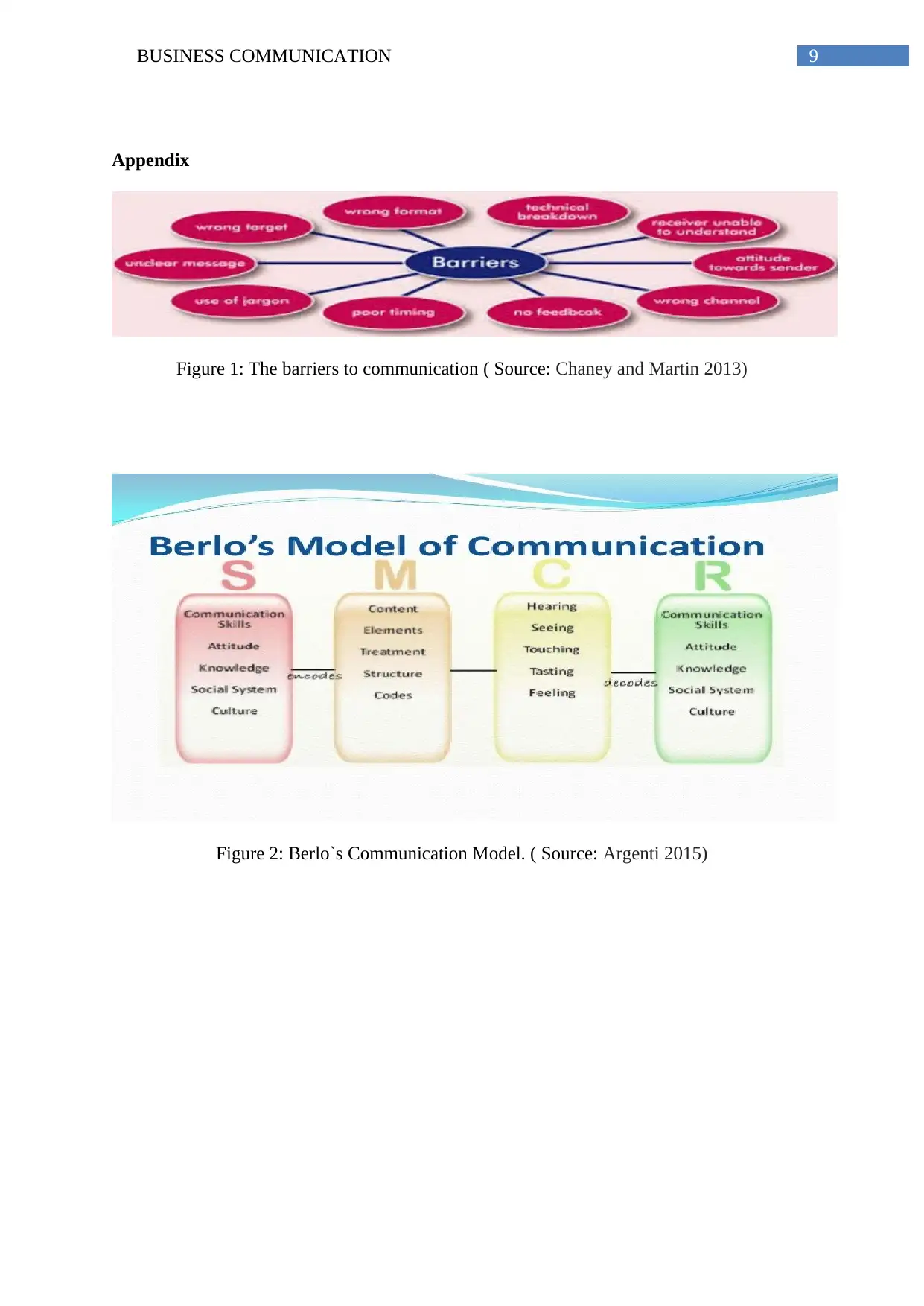
also become a barrier to communication. (Refer to Figure 1 in the Appendix)
Thoughts and viewpoints of two individuals often tend to differ from one another, not
everyone can agree to a single statement.
Physical disabilities such as a hearing problem or difficulties in speaking may serve as
a barrier.
Barriers to non-verbal communication consists of inability to understand gestures,
postures and body language which results in making the communication process less
effective (Chaney and Martin 2013).
Language and accents which are unfamiliar also play the barrier to effective
communication
Document Page
6BUSINESS COMMUNICATION
Sometimes cultural differences tend to play a crucial role in becoming a barrier to
communication.
Methods to Remove Barriers of Communication
Have Clarity In Your Thoughts: The thoughts or the viewpoints that need to be
conveyed should be clear in nature. The objective of the communication needs to be
transparent.
Understand the needs of your audience: The audience`s need and requirement needs
to be understood before conveying the message. Only when the needs of the
audiences are understood properly then the message can be delivered successfully.
Seek the Advice of experts before Communicating:
Not everyone has knowledge about all the subjects that are present. Therefore, the
communicator should make sure that expert advice has been taken before
communicating relevant matters to avoid any risks (Hawthorn 2015).
Adequate care must be taken of one`s tone and language while conversing as
misunderstandings in this filed can lead to a failed communication.
It should always be made a point to receive feedback from the receiver of the
message, which helps in improvement. The communication process must be kept
short and crisp (Argenti 2015).
Listen- The communicator or the sender must be a good listener.
Conclusion
Therefore, it can be concluded from the discussion that the communication process
must be clear and crisp. It should avoid barriers so that the messages to be transmitted are
tabler-icon-diamond-filled.svg

Paraphrase This Document

Need a fresh take? Get an instant paraphrase of this document with our AI Paraphraser
Document Page
7BUSINESS COMMUNICATION
well received by both the parties. The roles of both the parties are crucial in a communication
process.
Document Page
8BUSINESS COMMUNICATION
References
Argenti, P.A., 2015. Corporate communication. McGraw-Hill Higher Education.
Broadbent, D.E., 2013. Perception and communication. Elsevier.
Chaney, L. and Martin, J., 2013. Intercultural business communication. Pearson Higher Ed.
DeVito, J.A., 2015. The interpersonal communication book. Pearson.
Grunig, J.E. ed., 2013. Excellence in public relations and communication management.
Routledge.
Hawthorn, M., 2015. The importance of communication in sustaining hope at the end of
life. British Journal of Nursing, 24(13).
McQuail, D. and Windahl, S., 2015. Communication models for the study of mass
communications. Routledge.
Tubbs, S.L., 2012. Human communication: Principles and contexts.
Document Page
9BUSINESS COMMUNICATION
Appendix
Figure 1: The barriers to communication ( Source: Chaney and Martin 2013)
Figure 2: Berlo`s Communication Model. ( Source: Argenti 2015)
chevron_up_icon
1 out of 10
circle_padding
hide_on_mobile
zoom_out_icon
[object Object]