Crisis Communication in Business: A Managerial Perspective Report
VerifiedAdded on 2023/05/30
|8
|1937
|61
Report
AI Summary
This report delves into the critical role of communication during business crises, drawing insights from two key articles. The first article, by Kim (2018), emphasizes the importance of two-way transparent communication between employees and the organization, advocating for strategic management within internal communication to facilitate information exchange and feedback, fostering trust and support during crises. The second article, by Jamal and Bakar (2017), highlights the significance of charismatic leadership communication, particularly in integrating crisis responsibility. The authors propose a model for leaders to effectively influence followers and mediate organizational reputation during crises. While both articles underscore the need for effective communication, they differ in their approaches: Kim (2018) promotes a strategic, two-way communication model, while Jamal and Bakar (2017) advocate for integrating crisis responsibility within charismatic leadership communication. Both articles, however, stress the importance of considering employee perspectives and aligning communication strategies with organizational goals for successful crisis resolution.
Running head: BUSINESS COMMUNICATION FOR MANAGERS
Business Communication for Managers
Name of the Student:
Name of the University:
Author’s Note:
Business Communication for Managers
Name of the Student:
Name of the University:
Author’s Note:
Paraphrase This Document
Need a fresh take? Get an instant paraphrase of this document with our AI Paraphraser

1BUSINESS COMMUNICATION FOR MANAGERS
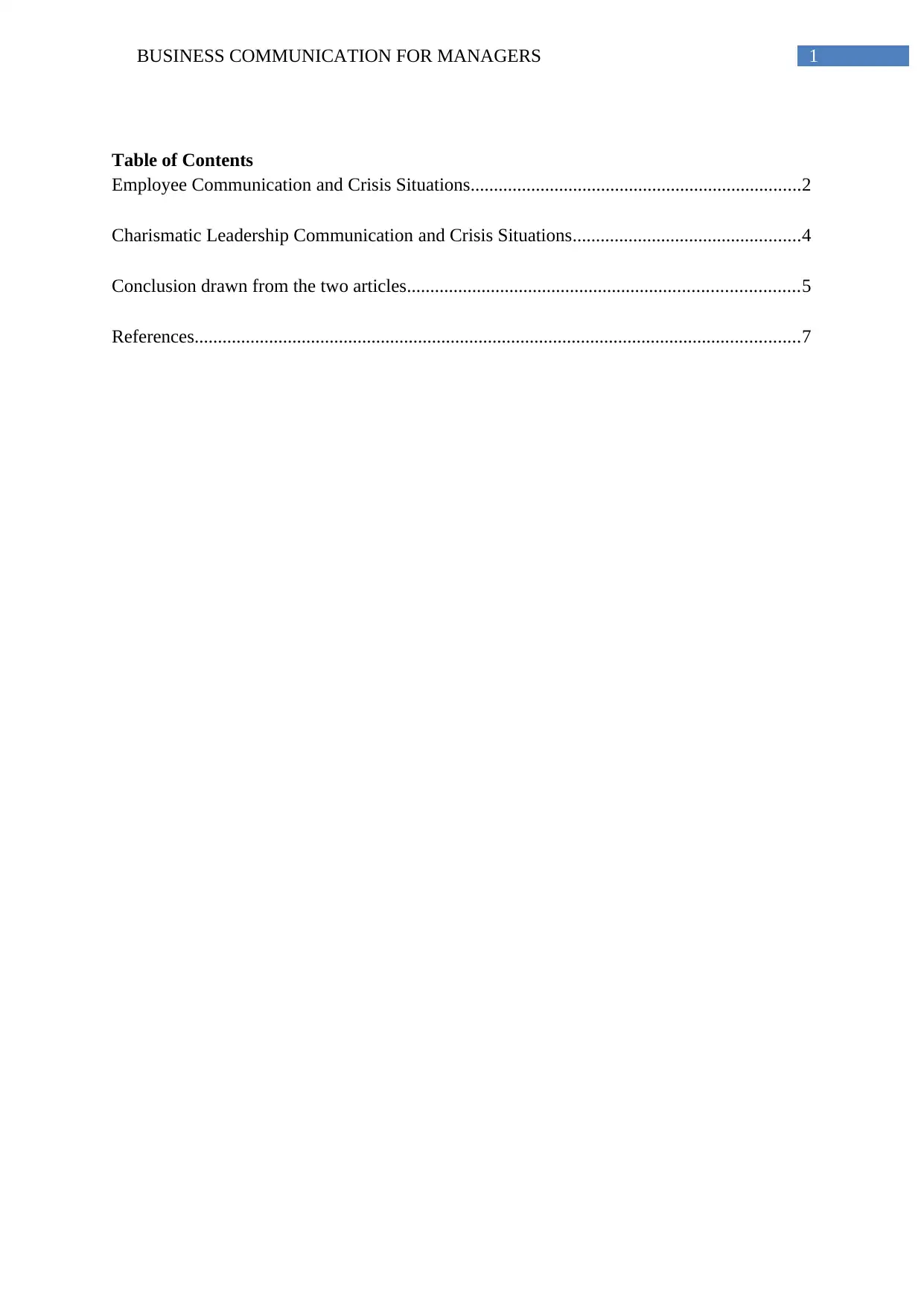
Table of Contents
Employee Communication and Crisis Situations.......................................................................2
Charismatic Leadership Communication and Crisis Situations.................................................4
Conclusion drawn from the two articles....................................................................................5
References..................................................................................................................................7
Table of Contents
Employee Communication and Crisis Situations.......................................................................2
Charismatic Leadership Communication and Crisis Situations.................................................4
Conclusion drawn from the two articles....................................................................................5
References..................................................................................................................................7

2BUSINESS COMMUNICATION FOR MANAGERS
Employee Communication and Crisis Situations
Business organizations during the course of their business operations face various
kinds of crisis situations and the overall prospects of an organization depends to a great
extent on the effectiveness with which it is being able to deal with these crisis situations
(Pangarkar 2016). More importantly, it is seen that the process of effective employee
communication plays a pivotal role during these crisis situations and helps in its resolution or
mitigation in an adequate manner (Stam et al. 2018). In this regard, Kim Young’s article
“Enhancing employee communication behaviors for sensemaking and sensegiving in
crisis situations: Strategic management approach for effective internal crisis
communication” (2018) is an important one. The article sheds valuable light on the kind of
employee communication that the organizations need to use during the time crisis for its
mitigation.
The primary aim of the author in this article is to find out the manner in which the
process of strategic management can be utilized within the framework of internal
communication followed by the different organizations (Kim 2018). More important, the
author at the end of the article derives the conclusion that a two-way transparent
communication between the employees and the organization enhance the effectiveness of the
concerned organization. In addition to this, a two-way transparent communication also helps
in the better management of various kinds of crisis situations by facilitating a thorough
exchange of information as well as feedback between the employees and the organization
(Kim 2018). Furthermore, the author is of the viewpoint that this kind of communication is
the current need of the hour since it is becoming increasingly important for the organizations
to take into effective consideration the perspective of the employees. Moreover, an effective
use of this kind of communication enables the organizations to not only earn the trust of
Employee Communication and Crisis Situations
Business organizations during the course of their business operations face various
kinds of crisis situations and the overall prospects of an organization depends to a great
extent on the effectiveness with which it is being able to deal with these crisis situations
(Pangarkar 2016). More importantly, it is seen that the process of effective employee
communication plays a pivotal role during these crisis situations and helps in its resolution or
mitigation in an adequate manner (Stam et al. 2018). In this regard, Kim Young’s article
“Enhancing employee communication behaviors for sensemaking and sensegiving in
crisis situations: Strategic management approach for effective internal crisis
communication” (2018) is an important one. The article sheds valuable light on the kind of
employee communication that the organizations need to use during the time crisis for its
mitigation.
The primary aim of the author in this article is to find out the manner in which the
process of strategic management can be utilized within the framework of internal
communication followed by the different organizations (Kim 2018). More important, the
author at the end of the article derives the conclusion that a two-way transparent
communication between the employees and the organization enhance the effectiveness of the
concerned organization. In addition to this, a two-way transparent communication also helps
in the better management of various kinds of crisis situations by facilitating a thorough
exchange of information as well as feedback between the employees and the organization
(Kim 2018). Furthermore, the author is of the viewpoint that this kind of communication is
the current need of the hour since it is becoming increasingly important for the organizations
to take into effective consideration the perspective of the employees. Moreover, an effective
use of this kind of communication enables the organizations to not only earn the trust of
⊘ This is a preview!⊘
Do you want full access?
Subscribe today to unlock all pages.

Trusted by 1+ million students worldwide

3BUSINESS COMMUNICATION FOR MANAGERS
employees but also to make them support the concerned organization in times of crisis (Kim
2018).
The author for the collection of necessary as well as relevant data that were needed
for the completion of the article under discussion here conducted a nationwide survey in USA
in which around 544 employees from different organizations participated (Kim 2018).
Interestingly, majority of these participants concurred on the viewpoint that the organizations
need to adopt a transparent approach which will offer a clear and concrete picture to the
employees regarding the crisis that the organization is facing. In addition to this, it is seen
that in the majority of organizations a one-way communication process is being followed
which offers very limited opportunity to the individuals to articulate their viewpoints (Kim
2018). Thus, they are of the viewpoint that the use of a two-way communication process is
likely to help the organization and also the employees to resolve the crisis situation in an
effective manner.
Two of the most important notions that Kim articulates in the article under discussion
here are sensemaking and sensegiving. According to Kim (2018), sensemaking can be
defined as the process through which the individuals can give meaning to their collective
beliefs or thoughts. On the other hand, sensegiving is described as the process which is used
to influence sensemaking and making it more beneficial from the perspective of the
organization (Kim 2018). The author, at the same time, articulates the viewpoint that for the
effective utilization of both of these processes the organizations need to ensure the fact that
communication process which it is using is synchronicity with its strategic objectives. Thus,
it can be said that the use of strategic management within the framework of the
communication process that is being followed by an organization can help it in a substantial
manner to overcome the different crisis situations.
employees but also to make them support the concerned organization in times of crisis (Kim
2018).
The author for the collection of necessary as well as relevant data that were needed
for the completion of the article under discussion here conducted a nationwide survey in USA
in which around 544 employees from different organizations participated (Kim 2018).
Interestingly, majority of these participants concurred on the viewpoint that the organizations
need to adopt a transparent approach which will offer a clear and concrete picture to the
employees regarding the crisis that the organization is facing. In addition to this, it is seen
that in the majority of organizations a one-way communication process is being followed
which offers very limited opportunity to the individuals to articulate their viewpoints (Kim
2018). Thus, they are of the viewpoint that the use of a two-way communication process is
likely to help the organization and also the employees to resolve the crisis situation in an
effective manner.
Two of the most important notions that Kim articulates in the article under discussion
here are sensemaking and sensegiving. According to Kim (2018), sensemaking can be
defined as the process through which the individuals can give meaning to their collective
beliefs or thoughts. On the other hand, sensegiving is described as the process which is used
to influence sensemaking and making it more beneficial from the perspective of the
organization (Kim 2018). The author, at the same time, articulates the viewpoint that for the
effective utilization of both of these processes the organizations need to ensure the fact that
communication process which it is using is synchronicity with its strategic objectives. Thus,
it can be said that the use of strategic management within the framework of the
communication process that is being followed by an organization can help it in a substantial
manner to overcome the different crisis situations.
Paraphrase This Document
Need a fresh take? Get an instant paraphrase of this document with our AI Paraphraser

4BUSINESS COMMUNICATION FOR MANAGERS
Charismatic Leadership Communication and Crisis Situations
As opined by Stam et al. (2018), the machinery of charismatic leadership has gained a
significant amount of prominence within the cannon of contemporary world and is being used
in an extensive manner by the different individuals. More importantly, it is seen that effective
communication skill is considered to be one of the primary skills of the charismatic leaders
since it is through the active use of this skill that they are required to influence the behavior
of followers. In this context, Jamal and Bakar’s article entitled “The Mediating Role of
Charismatic Leadership Communication in a Crisis: A Malaysian Example” (2015) is an
important one. The authors in this article highlight the manner in which the charismatic
leaders can use the framework of effective communication for the resolution of crisis
situations.
The focus of the author in the article under discussion here is to analyze the manner in
which crisis responsibility can be integrated within the framework of charismatic leadership
communication process that is being used by the different organizations currently.
Furthermore, for the collection of data that was required for the completion of the concerned
article the authors conducted surveys with around 383 employees related to different public
organizations in the nation of Malaysia (Jamal and Bakar 2017). It is pertinent to note that the
majority of these participants concur on the point that integrating crisis intervention
responsibility within the framework of charismatic leadership communication is likely to help
the organizations during crisis situations in a substantial manner. More importantly, the
organizations which use this model of communication have been to mediate “the relationship
between crisis responsibility and perceived organizational reputation during a crisis” (Jamal
and Bakar 2017).
The authors commenting on the effectiveness of the model that they are proposing
state that the use of this model by the leaders is likely to equip them with a tool which would
Charismatic Leadership Communication and Crisis Situations
As opined by Stam et al. (2018), the machinery of charismatic leadership has gained a
significant amount of prominence within the cannon of contemporary world and is being used
in an extensive manner by the different individuals. More importantly, it is seen that effective
communication skill is considered to be one of the primary skills of the charismatic leaders
since it is through the active use of this skill that they are required to influence the behavior
of followers. In this context, Jamal and Bakar’s article entitled “The Mediating Role of
Charismatic Leadership Communication in a Crisis: A Malaysian Example” (2015) is an
important one. The authors in this article highlight the manner in which the charismatic
leaders can use the framework of effective communication for the resolution of crisis
situations.
The focus of the author in the article under discussion here is to analyze the manner in
which crisis responsibility can be integrated within the framework of charismatic leadership
communication process that is being used by the different organizations currently.
Furthermore, for the collection of data that was required for the completion of the concerned
article the authors conducted surveys with around 383 employees related to different public
organizations in the nation of Malaysia (Jamal and Bakar 2017). It is pertinent to note that the
majority of these participants concur on the point that integrating crisis intervention
responsibility within the framework of charismatic leadership communication is likely to help
the organizations during crisis situations in a substantial manner. More importantly, the
organizations which use this model of communication have been to mediate “the relationship
between crisis responsibility and perceived organizational reputation during a crisis” (Jamal
and Bakar 2017).
The authors commenting on the effectiveness of the model that they are proposing
state that the use of this model by the leaders is likely to equip them with a tool which would

5BUSINESS COMMUNICATION FOR MANAGERS
enable them to resolve the crisis situations in a better manner (Jamal and Bakar 2017).
Furthermore, the authors are also of the viewpoint that this model can be used as an
instructional guide that the various leaders as well as the organizations can utilize for the
mitigation or resolution of different kinds of crisis situations that they normally face. In
addition to these, the authors state that the various charismatic leaders through the use of this
model can not only influence the behavior of the followers in a much effective manner but at
the same time work in an effective manner during crisis situations (Jamal and Bakar 2017).
These benefits of the proposed model become evident from the success that the different
leaders and organizations have been able to gain through the use of this model in Malaysia.
Conclusion drawn from the two articles
The authors in the two articles under discussion here concur on the point that the
process of communication indeed plays a significant role during the time of crisis situations.
Furthermore, it is commonly seen that the different organizations during the course of their
business operations at one point or the other face various kinds of crisis situations and the
business fortunes of an organizations depends greatly on the manner in which they are being
able to resolve these situations. However, the two articles under discussion here suggest two
different methods of communication styles for the resolution of the crisis situations that the
organizations commonly face. For example, Kim (2018), in his article proposes that a two-
way transparent communication process is likely to help the organizations and the leaders
who are related to them to resolve the crisis situations in an effective manner. On the other
hand, Jamal and Bakar (2017), argue that the use of a charismatic leadership communication
approach is likely to help the organizations to resolve or mitigate the adverse effects of the
various crisis situations in a much effective manner.
enable them to resolve the crisis situations in a better manner (Jamal and Bakar 2017).
Furthermore, the authors are also of the viewpoint that this model can be used as an
instructional guide that the various leaders as well as the organizations can utilize for the
mitigation or resolution of different kinds of crisis situations that they normally face. In
addition to these, the authors state that the various charismatic leaders through the use of this
model can not only influence the behavior of the followers in a much effective manner but at
the same time work in an effective manner during crisis situations (Jamal and Bakar 2017).
These benefits of the proposed model become evident from the success that the different
leaders and organizations have been able to gain through the use of this model in Malaysia.
Conclusion drawn from the two articles
The authors in the two articles under discussion here concur on the point that the
process of communication indeed plays a significant role during the time of crisis situations.
Furthermore, it is commonly seen that the different organizations during the course of their
business operations at one point or the other face various kinds of crisis situations and the
business fortunes of an organizations depends greatly on the manner in which they are being
able to resolve these situations. However, the two articles under discussion here suggest two
different methods of communication styles for the resolution of the crisis situations that the
organizations commonly face. For example, Kim (2018), in his article proposes that a two-
way transparent communication process is likely to help the organizations and the leaders
who are related to them to resolve the crisis situations in an effective manner. On the other
hand, Jamal and Bakar (2017), argue that the use of a charismatic leadership communication
approach is likely to help the organizations to resolve or mitigate the adverse effects of the
various crisis situations in a much effective manner.
⊘ This is a preview!⊘
Do you want full access?
Subscribe today to unlock all pages.

Trusted by 1+ million students worldwide

6BUSINESS COMMUNICATION FOR MANAGERS
The two articles under discussion here also stress on the importance of integrating as
well as taking into effective consideration the perspectives of the employees into the
decisions that are being made by the organizations. This is perhaps one of the major reasons
why Kim (2018) proposes for a two- way communication approach since by taking into
effective consideration an organization would be able to motivate the employees to work in
an effective manner during the crisis situation. Jamal and Bakar (2017) also concur with Kim
by saying that the charismatic leaders need to take into effective consideration the
perspectives of the employees so as to influence their behavior in a positive manner.
However, at the same time, it needs to be said that there are some inherent differences
between the conclusions that are being derived by the authors in the two articles under
discussion here.
Kim (2018) by collecting the data from the employees in the nation of the United
States of America comes to the conclusion that the effective utilization of the process of
strategic management within the framework of communication process is likely to help the
organizations during crisis situations. In addition to this, the author also states that the
objectives of the communication process which is being used by an organization during crisis
situations needs to be in alignment with the strategic goals of the concerned organization.
Jamal and Bakar (2017), on the other hand, derive the conclusion that the organizations as
well as the leaders need to integrate the communication process which is being followed by
them within the framework of charismatic leadership. Thus, it can be said that although the
two articles differ in the communication models that they propose yet they concur on the
viewpoint that effective communication process is indeed an integral remedy for crisis
resolution or mitigation.
The two articles under discussion here also stress on the importance of integrating as
well as taking into effective consideration the perspectives of the employees into the
decisions that are being made by the organizations. This is perhaps one of the major reasons
why Kim (2018) proposes for a two- way communication approach since by taking into
effective consideration an organization would be able to motivate the employees to work in
an effective manner during the crisis situation. Jamal and Bakar (2017) also concur with Kim
by saying that the charismatic leaders need to take into effective consideration the
perspectives of the employees so as to influence their behavior in a positive manner.
However, at the same time, it needs to be said that there are some inherent differences
between the conclusions that are being derived by the authors in the two articles under
discussion here.
Kim (2018) by collecting the data from the employees in the nation of the United
States of America comes to the conclusion that the effective utilization of the process of
strategic management within the framework of communication process is likely to help the
organizations during crisis situations. In addition to this, the author also states that the
objectives of the communication process which is being used by an organization during crisis
situations needs to be in alignment with the strategic goals of the concerned organization.
Jamal and Bakar (2017), on the other hand, derive the conclusion that the organizations as
well as the leaders need to integrate the communication process which is being followed by
them within the framework of charismatic leadership. Thus, it can be said that although the
two articles differ in the communication models that they propose yet they concur on the
viewpoint that effective communication process is indeed an integral remedy for crisis
resolution or mitigation.
Paraphrase This Document
Need a fresh take? Get an instant paraphrase of this document with our AI Paraphraser

7BUSINESS COMMUNICATION FOR MANAGERS
References
Jamal, J. and Abu Bakar, H., 2017. The mediating role of charismatic leadership
communication in a crisis: A Malaysian example. International Journal of Business
Communication, 54(4), pp.369-393.
Kim, Y., 2018. Enhancing employee communication behaviors for sensemaking and
sensegiving in crisis situations: Strategic management approach for effective internal crisis
communication. Journal of Communication Management, 22(4), pp.451-475.
Pangarkar, N., 2016. A framework for effective crisis response. Journal of Organizational
Change Management, 29(4), pp.464-483.
Stam, D., van Knippenberg, D., Wisse, B. and Nederveen Pieterse, A., 2018. Motivation in
words: Promotion-and prevention-oriented leader communication in times of crisis. Journal
of Management, 44(7), pp.2859-2887.
References
Jamal, J. and Abu Bakar, H., 2017. The mediating role of charismatic leadership
communication in a crisis: A Malaysian example. International Journal of Business
Communication, 54(4), pp.369-393.
Kim, Y., 2018. Enhancing employee communication behaviors for sensemaking and
sensegiving in crisis situations: Strategic management approach for effective internal crisis
communication. Journal of Communication Management, 22(4), pp.451-475.
Pangarkar, N., 2016. A framework for effective crisis response. Journal of Organizational
Change Management, 29(4), pp.464-483.
Stam, D., van Knippenberg, D., Wisse, B. and Nederveen Pieterse, A., 2018. Motivation in
words: Promotion-and prevention-oriented leader communication in times of crisis. Journal
of Management, 44(7), pp.2859-2887.
1 out of 8
Related Documents
Your All-in-One AI-Powered Toolkit for Academic Success.
+13062052269
info@desklib.com
Available 24*7 on WhatsApp / Email
Unlock your academic potential
Copyright © 2020–2026 A2Z Services. All Rights Reserved. Developed and managed by ZUCOL.