Business Communication Report on Emergency Care Service Policies
VerifiedAdded on 2023/06/13
|10
|2121
|61
Report
AI Summary
This report provides a critical analysis of emergency care services, focusing on the role of business communication in improving service delivery. It examines proposals such as a unilateral fee structure, standard scheduling of paramedics, two-tiered service, and reduced admissions into training programs, highlighting both the advantages and challenges associated with each. The report identifies potential loopholes and offers recommendations for the provincial government, including the formulation of a superior fee structure, efficient paramedic training strategies, addressing inequality in two-tiered service access, and implementing effective practical training sessions. Ultimately, the report underscores the crucial role of emergency care services in contemporary society and advocates for sustainable development of medical and healthcare facilities.
Running Head: BUSINESS COMMUNICATION
Business Communication of Emergency Care Service
Business Communication of Emergency Care Service

Paraphrase This Document
Need a fresh take? Get an instant paraphrase of this document with our AI Paraphraser
Table of Contents
Introduction......................................................................................................................................3
Unilateral Fee Structure...................................................................................................................3
Standard Scheduling of all Paramedics...........................................................................................4
Two-Tiered Service.........................................................................................................................5
Reduction of Admissions into Recognized Training Programs......................................................5
Recommendations............................................................................................................................6
Conclusion.......................................................................................................................................7
References........................................................................................................................................8
Introduction......................................................................................................................................3
Unilateral Fee Structure...................................................................................................................3
Standard Scheduling of all Paramedics...........................................................................................4
Two-Tiered Service.........................................................................................................................5
Reduction of Admissions into Recognized Training Programs......................................................5
Recommendations............................................................................................................................6
Conclusion.......................................................................................................................................7
References........................................................................................................................................8
Introduction
Emergency care service can be defined as instantaneous medical health care provided to a
patient in order to treat or evaluate a specific medical condition which requires unscheduled
medical care. Such services potentially fortify the medical healthcare facilities of a province by
dealing with various medical circumstances. The provincial government also considers these
services as a crucial factor of divisions due to its significant contribution in providing the
improved standard of living (Bernaldo-De-Quirós, Piccini, Gómez & Cerdeira, 2015). In this
context, this research report is undertaken to critically analyze the attributes of emergency care
services. Furthermore, proposals such as unilateral fee structure, standard scheduling of all
paramedics, two-tiered service and reduction of admissions into recognized training programs
are also critically examined and on the basis of findings, some recommendations are proposed
for the provincial government to improvise the overall emergency care service.
Unilateral Fee Structure
The term unilateral fee structure is used to illustrate an independent format of fee
regulations for all the sectors of the society. This helps in bringing transparency and impartiality
to the society by discouraging the practices of bigotry among the society on the basis of caste,
color, creed, and sex. It justifies the considerations associated with the lifestyle stability and
balance among the masses of society. Moreover, it also rationalizes the prospect of equal
opportunity and contribution for the population to voluntarily participate in the practices of
emergency care services (Grašič, Mason & Street, 2015). Furthermore, the effectiveness of the
healthcare services also augments on incorporating the unilateral fee structure.
Emergency care service can be defined as instantaneous medical health care provided to a
patient in order to treat or evaluate a specific medical condition which requires unscheduled
medical care. Such services potentially fortify the medical healthcare facilities of a province by
dealing with various medical circumstances. The provincial government also considers these
services as a crucial factor of divisions due to its significant contribution in providing the
improved standard of living (Bernaldo-De-Quirós, Piccini, Gómez & Cerdeira, 2015). In this
context, this research report is undertaken to critically analyze the attributes of emergency care
services. Furthermore, proposals such as unilateral fee structure, standard scheduling of all
paramedics, two-tiered service and reduction of admissions into recognized training programs
are also critically examined and on the basis of findings, some recommendations are proposed
for the provincial government to improvise the overall emergency care service.
Unilateral Fee Structure
The term unilateral fee structure is used to illustrate an independent format of fee
regulations for all the sectors of the society. This helps in bringing transparency and impartiality
to the society by discouraging the practices of bigotry among the society on the basis of caste,
color, creed, and sex. It justifies the considerations associated with the lifestyle stability and
balance among the masses of society. Moreover, it also rationalizes the prospect of equal
opportunity and contribution for the population to voluntarily participate in the practices of
emergency care services (Grašič, Mason & Street, 2015). Furthermore, the effectiveness of the
healthcare services also augments on incorporating the unilateral fee structure.
⊘ This is a preview!⊘
Do you want full access?
Subscribe today to unlock all pages.

Trusted by 1+ million students worldwide
However, on another part, there are some loopholes associated with the assimilation of
the proposed practice. The foremost challenge for the provincial government is to compensate
the services for the underprivileged population. Harmonizing the deprived people with the
prosperous populace in unilateral fee structure can lead to severe monetary predicament (Grašič,
et al., 2015). Every province comprises a diverse range of people, which cannot be synchronized
on a common ground due to multiplicity in their culture, lifestyle, occupation and financial
standards.
Standard Scheduling of all Paramedics
The term ‘Paramedics’ is used for the person, who is medically trained in giving
emergency health care help to the patient before they are taken to the hospital. They are trained
practitioners in emergency medical services to cure accidental cases, severe injuries, and other
epidemics. The scheduling of paramedics is centrally surrounded to instruct them about the
conduct for various emergency care services (Myers, Wages, Rowe, Nollette, Touchstone,
Sinclair & Barger, 2018). Therefore, standard scheduling of all paramedics will facilitate the
provincial government in providing high-quality healthcare training. Furthermore, it will also
concentrate the decision-making power to the central body resulting in the overall development
of the emergency care services.
In contrast to this, learning compliance is explored as a potential challenge for this
proposal. Every individual is different from nature and mental state, thus, it is not necessary that
a standard format of practices can impart quality acquaintance to all the members. Every
individual is compatible in his own form; hence, handling assorted mental state in a standard
the proposed practice. The foremost challenge for the provincial government is to compensate
the services for the underprivileged population. Harmonizing the deprived people with the
prosperous populace in unilateral fee structure can lead to severe monetary predicament (Grašič,
et al., 2015). Every province comprises a diverse range of people, which cannot be synchronized
on a common ground due to multiplicity in their culture, lifestyle, occupation and financial
standards.
Standard Scheduling of all Paramedics
The term ‘Paramedics’ is used for the person, who is medically trained in giving
emergency health care help to the patient before they are taken to the hospital. They are trained
practitioners in emergency medical services to cure accidental cases, severe injuries, and other
epidemics. The scheduling of paramedics is centrally surrounded to instruct them about the
conduct for various emergency care services (Myers, Wages, Rowe, Nollette, Touchstone,
Sinclair & Barger, 2018). Therefore, standard scheduling of all paramedics will facilitate the
provincial government in providing high-quality healthcare training. Furthermore, it will also
concentrate the decision-making power to the central body resulting in the overall development
of the emergency care services.
In contrast to this, learning compliance is explored as a potential challenge for this
proposal. Every individual is different from nature and mental state, thus, it is not necessary that
a standard format of practices can impart quality acquaintance to all the members. Every
individual is compatible in his own form; hence, handling assorted mental state in a standard
Paraphrase This Document
Need a fresh take? Get an instant paraphrase of this document with our AI Paraphraser
manner could lead to severe complexities for the provincial government in administrating the
emergency care services (Isong, Dladlu & Magogodi, 2016).
Two-Tiered Service
A two-tier healthcare service is considered as a promising proposal from the regional
government for the betterment of existing emergency healthcare services. In this system, the
primary healthcare practices for the patient are provided by the government whereas access to
the second tier of care is for the people who can pay for better care, additional features, and
faster access. Under this policy, the non-emergency cases of medical care are being outsourced
by the government bodies to the independent providers (Bingham, Fossum, Barratt & Bucknall,
2015). This assists the government is plummeting responsibilities of management and also
facilitates the work opportunity for independent providers.
In contradiction to the aforementioned advantages, dislocation of central power is a
challenge aligned with this proposed policy. The centralized power of provincial government in
the sector of medical healthcare facilities will be alienated among the different private bodies.
Besides, the risk of corruption and unwarranted means will also augment due to privatization and
dislocation of centralized power. Diversity and inequality among the society will also be
encouraged due to this proposal as it promotes the acquisition of facilitates on the basis of
payments (Bingham, et al., 2015).
Reduction of Admissions into Recognized Training Programs
Reducing the number of admissions into recognized training programs is a prospective
measure proposed by the provincial government to sustainably develop the existing emergency
emergency care services (Isong, Dladlu & Magogodi, 2016).
Two-Tiered Service
A two-tier healthcare service is considered as a promising proposal from the regional
government for the betterment of existing emergency healthcare services. In this system, the
primary healthcare practices for the patient are provided by the government whereas access to
the second tier of care is for the people who can pay for better care, additional features, and
faster access. Under this policy, the non-emergency cases of medical care are being outsourced
by the government bodies to the independent providers (Bingham, Fossum, Barratt & Bucknall,
2015). This assists the government is plummeting responsibilities of management and also
facilitates the work opportunity for independent providers.
In contradiction to the aforementioned advantages, dislocation of central power is a
challenge aligned with this proposed policy. The centralized power of provincial government in
the sector of medical healthcare facilities will be alienated among the different private bodies.
Besides, the risk of corruption and unwarranted means will also augment due to privatization and
dislocation of centralized power. Diversity and inequality among the society will also be
encouraged due to this proposal as it promotes the acquisition of facilitates on the basis of
payments (Bingham, et al., 2015).
Reduction of Admissions into Recognized Training Programs
Reducing the number of admissions into recognized training programs is a prospective
measure proposed by the provincial government to sustainably develop the existing emergency
care services. The proposed policy will compel the aspiring paramedics to become a part of the
authentic longer and practical training programs (Baron, Beard, Davis, Delp, Forst, Kidd‐Taylor
& Welch, 2014). Admittance to more efficient training programs will impart high-quality tactics
to deal with emergency healthcare conditions. In addition to this, longer practical training
sessions will afford a broader subject exposure for the aspiring paramedics.
In negation to this, reduction of admissions in recognized training programs will lead to a
critical issue of time relations. As compared to earlier times, the practice and learning sessions
will get longer for the paramedics. The shorter duration of former practical and theoretical
training was time efficient for the candidates in all aspects. Moreover, it was also beneficial for
the government as shorter training forum means less cost of management (Baron, et al., 2014).
Now, the proposed policy of longer practical and theoretical training will lead to high monetary
regulations for the Health Ministry of the state.
Recommendations
On the basis of challenges and loopholes explored above, some promising
recommendations for the Premier and the Minister of Health are proposed below:
In order to deal with the challenge of unilateral fee structure, the provincial government
is recommended to formulate a superior fee structure considering all the sectors of the
society. In addition to this, they should also introduce some policies to smooth the
progress of underprivileged population of the society (Carpenter, et al., 2014).
authentic longer and practical training programs (Baron, Beard, Davis, Delp, Forst, Kidd‐Taylor
& Welch, 2014). Admittance to more efficient training programs will impart high-quality tactics
to deal with emergency healthcare conditions. In addition to this, longer practical training
sessions will afford a broader subject exposure for the aspiring paramedics.
In negation to this, reduction of admissions in recognized training programs will lead to a
critical issue of time relations. As compared to earlier times, the practice and learning sessions
will get longer for the paramedics. The shorter duration of former practical and theoretical
training was time efficient for the candidates in all aspects. Moreover, it was also beneficial for
the government as shorter training forum means less cost of management (Baron, et al., 2014).
Now, the proposed policy of longer practical and theoretical training will lead to high monetary
regulations for the Health Ministry of the state.
Recommendations
On the basis of challenges and loopholes explored above, some promising
recommendations for the Premier and the Minister of Health are proposed below:
In order to deal with the challenge of unilateral fee structure, the provincial government
is recommended to formulate a superior fee structure considering all the sectors of the
society. In addition to this, they should also introduce some policies to smooth the
progress of underprivileged population of the society (Carpenter, et al., 2014).
⊘ This is a preview!⊘
Do you want full access?
Subscribe today to unlock all pages.
Trusted by 1+ million students worldwide
The regional government is also proposed to take firm actions over the issue of standard
scheduling of all paramedics. It should be understood that different characters are
adaptable to a different situation, so it is not always possible to administer things with a
single command. Hence, some efficient training strategies should be introduced to
efficiently justify the scheduling of paramedics (Nicholson, McCollough, Wachira &
Mould-Millman, 2017).
In order to deal with the concern of two-tiered service, the government is anticipated to
remove inequality on the basis of financial regulations. The deprived sector of the society
should be provided with some additional benefits in order to compensate their
accessibility to the two-tiered system (James, Waggoner, Weiss, Patterson, Higgins, Lang
& Van Dongen, 2018).
To overcome another loophole of time constraint due to longer practical and theoretical
training, the provincial government is suggested to implement some effective practices in
the practical training sessions of the paramedics. This will enhance the overall
effectiveness of the training programs (Perkins, Travers, Berg, Castren, Considine,
Escalante & Olasveengen, 2015).
scheduling of all paramedics. It should be understood that different characters are
adaptable to a different situation, so it is not always possible to administer things with a
single command. Hence, some efficient training strategies should be introduced to
efficiently justify the scheduling of paramedics (Nicholson, McCollough, Wachira &
Mould-Millman, 2017).
In order to deal with the concern of two-tiered service, the government is anticipated to
remove inequality on the basis of financial regulations. The deprived sector of the society
should be provided with some additional benefits in order to compensate their
accessibility to the two-tiered system (James, Waggoner, Weiss, Patterson, Higgins, Lang
& Van Dongen, 2018).
To overcome another loophole of time constraint due to longer practical and theoretical
training, the provincial government is suggested to implement some effective practices in
the practical training sessions of the paramedics. This will enhance the overall
effectiveness of the training programs (Perkins, Travers, Berg, Castren, Considine,
Escalante & Olasveengen, 2015).
Paraphrase This Document
Need a fresh take? Get an instant paraphrase of this document with our AI Paraphraser
Conclusion
On the basis of all the arguments and facts presented above, it can be concluded that
emergency care services play a crucial role in the contemporary living world. It facilitates the
people with advanced healthcare facilities and emergency medical conveniences. Evermore, it is
a vital contributor to the overall and sustainable development of the medical and healthcare
facilities of the present time. Therefore, this report has discussed the attributes of emergency care
services and policies associated with it. The critical analysis of the proposed strategies explored
some advantages and challenges out of it. On the basis of investigated loopholes, some
recommendations are proposed for the Premier and the Minister of Health. Overall, this report
study has validated the purpose by presenting quality research content over the proposed topic.
On the basis of all the arguments and facts presented above, it can be concluded that
emergency care services play a crucial role in the contemporary living world. It facilitates the
people with advanced healthcare facilities and emergency medical conveniences. Evermore, it is
a vital contributor to the overall and sustainable development of the medical and healthcare
facilities of the present time. Therefore, this report has discussed the attributes of emergency care
services and policies associated with it. The critical analysis of the proposed strategies explored
some advantages and challenges out of it. On the basis of investigated loopholes, some
recommendations are proposed for the Premier and the Minister of Health. Overall, this report
study has validated the purpose by presenting quality research content over the proposed topic.
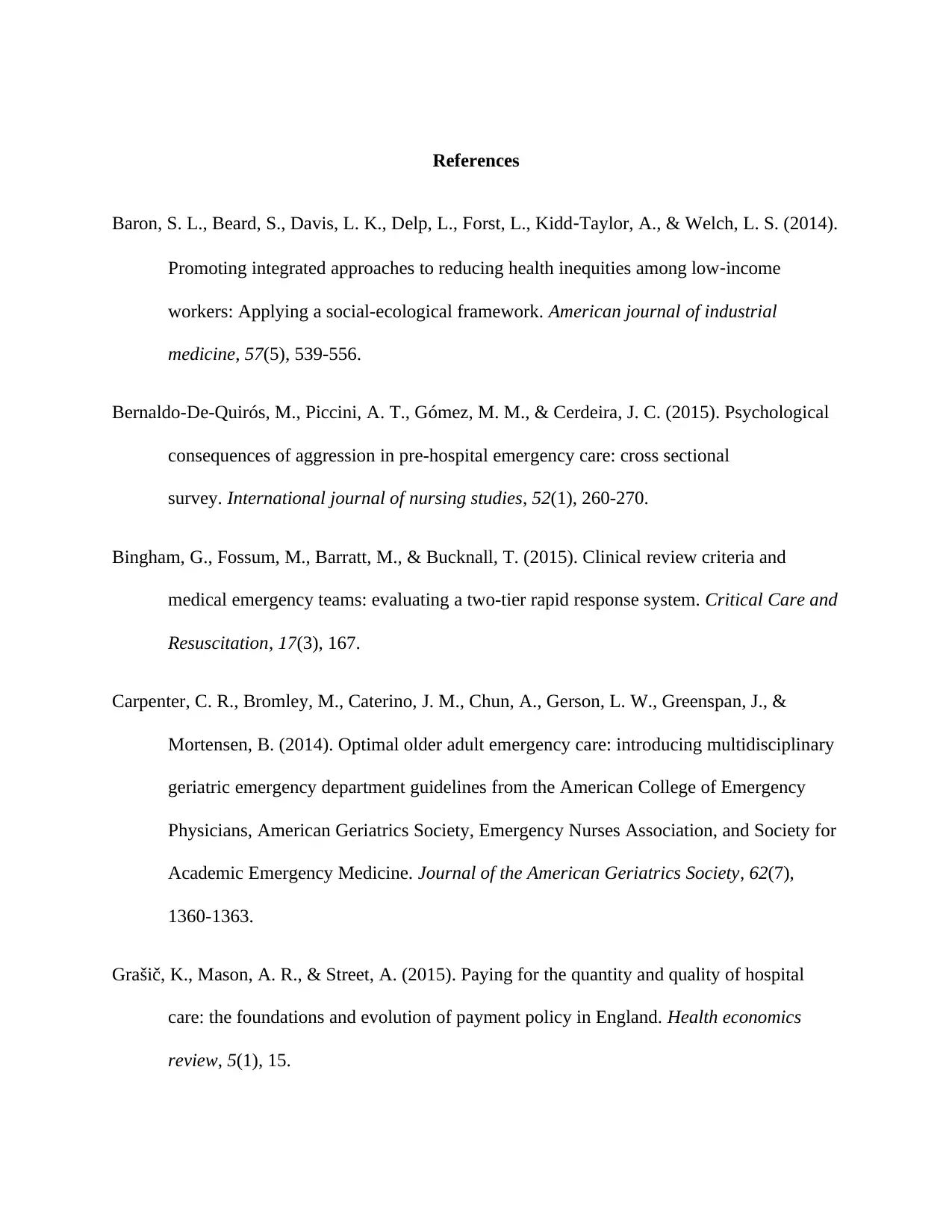
References
Baron, S. L., Beard, S., Davis, L. K., Delp, L., Forst, L., Kidd‐Taylor, A., & Welch, L. S. (2014).
Promoting integrated approaches to reducing health inequities among low‐income
workers: Applying a social-ecological framework. American journal of industrial
medicine, 57(5), 539-556.
Bernaldo-De-Quirós, M., Piccini, A. T., Gómez, M. M., & Cerdeira, J. C. (2015). Psychological
consequences of aggression in pre-hospital emergency care: cross sectional
survey. International journal of nursing studies, 52(1), 260-270.
Bingham, G., Fossum, M., Barratt, M., & Bucknall, T. (2015). Clinical review criteria and
medical emergency teams: evaluating a two-tier rapid response system. Critical Care and
Resuscitation, 17(3), 167.
Carpenter, C. R., Bromley, M., Caterino, J. M., Chun, A., Gerson, L. W., Greenspan, J., &
Mortensen, B. (2014). Optimal older adult emergency care: introducing multidisciplinary
geriatric emergency department guidelines from the American College of Emergency
Physicians, American Geriatrics Society, Emergency Nurses Association, and Society for
Academic Emergency Medicine. Journal of the American Geriatrics Society, 62(7),
1360-1363.
Grašič, K., Mason, A. R., & Street, A. (2015). Paying for the quantity and quality of hospital
care: the foundations and evolution of payment policy in England. Health economics
review, 5(1), 15.
Baron, S. L., Beard, S., Davis, L. K., Delp, L., Forst, L., Kidd‐Taylor, A., & Welch, L. S. (2014).
Promoting integrated approaches to reducing health inequities among low‐income
workers: Applying a social-ecological framework. American journal of industrial
medicine, 57(5), 539-556.
Bernaldo-De-Quirós, M., Piccini, A. T., Gómez, M. M., & Cerdeira, J. C. (2015). Psychological
consequences of aggression in pre-hospital emergency care: cross sectional
survey. International journal of nursing studies, 52(1), 260-270.
Bingham, G., Fossum, M., Barratt, M., & Bucknall, T. (2015). Clinical review criteria and
medical emergency teams: evaluating a two-tier rapid response system. Critical Care and
Resuscitation, 17(3), 167.
Carpenter, C. R., Bromley, M., Caterino, J. M., Chun, A., Gerson, L. W., Greenspan, J., &
Mortensen, B. (2014). Optimal older adult emergency care: introducing multidisciplinary
geriatric emergency department guidelines from the American College of Emergency
Physicians, American Geriatrics Society, Emergency Nurses Association, and Society for
Academic Emergency Medicine. Journal of the American Geriatrics Society, 62(7),
1360-1363.
Grašič, K., Mason, A. R., & Street, A. (2015). Paying for the quantity and quality of hospital
care: the foundations and evolution of payment policy in England. Health economics
review, 5(1), 15.
⊘ This is a preview!⊘
Do you want full access?
Subscribe today to unlock all pages.
Trusted by 1+ million students worldwide
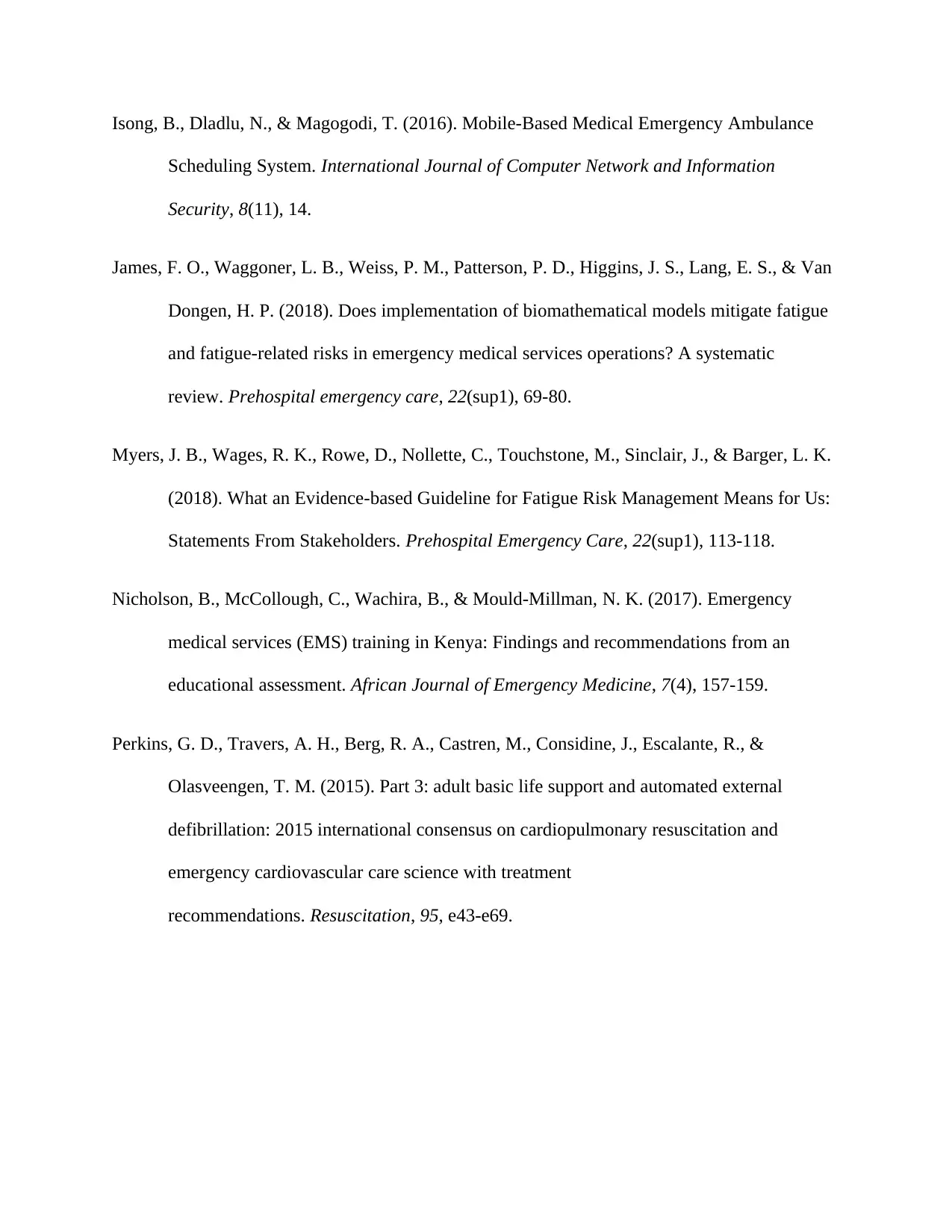
Isong, B., Dladlu, N., & Magogodi, T. (2016). Mobile-Based Medical Emergency Ambulance
Scheduling System. International Journal of Computer Network and Information
Security, 8(11), 14.
James, F. O., Waggoner, L. B., Weiss, P. M., Patterson, P. D., Higgins, J. S., Lang, E. S., & Van
Dongen, H. P. (2018). Does implementation of biomathematical models mitigate fatigue
and fatigue-related risks in emergency medical services operations? A systematic
review. Prehospital emergency care, 22(sup1), 69-80.
Myers, J. B., Wages, R. K., Rowe, D., Nollette, C., Touchstone, M., Sinclair, J., & Barger, L. K.
(2018). What an Evidence-based Guideline for Fatigue Risk Management Means for Us:
Statements From Stakeholders. Prehospital Emergency Care, 22(sup1), 113-118.
Nicholson, B., McCollough, C., Wachira, B., & Mould-Millman, N. K. (2017). Emergency
medical services (EMS) training in Kenya: Findings and recommendations from an
educational assessment. African Journal of Emergency Medicine, 7(4), 157-159.
Perkins, G. D., Travers, A. H., Berg, R. A., Castren, M., Considine, J., Escalante, R., &
Olasveengen, T. M. (2015). Part 3: adult basic life support and automated external
defibrillation: 2015 international consensus on cardiopulmonary resuscitation and
emergency cardiovascular care science with treatment
recommendations. Resuscitation, 95, e43-e69.
Scheduling System. International Journal of Computer Network and Information
Security, 8(11), 14.
James, F. O., Waggoner, L. B., Weiss, P. M., Patterson, P. D., Higgins, J. S., Lang, E. S., & Van
Dongen, H. P. (2018). Does implementation of biomathematical models mitigate fatigue
and fatigue-related risks in emergency medical services operations? A systematic
review. Prehospital emergency care, 22(sup1), 69-80.
Myers, J. B., Wages, R. K., Rowe, D., Nollette, C., Touchstone, M., Sinclair, J., & Barger, L. K.
(2018). What an Evidence-based Guideline for Fatigue Risk Management Means for Us:
Statements From Stakeholders. Prehospital Emergency Care, 22(sup1), 113-118.
Nicholson, B., McCollough, C., Wachira, B., & Mould-Millman, N. K. (2017). Emergency
medical services (EMS) training in Kenya: Findings and recommendations from an
educational assessment. African Journal of Emergency Medicine, 7(4), 157-159.
Perkins, G. D., Travers, A. H., Berg, R. A., Castren, M., Considine, J., Escalante, R., &
Olasveengen, T. M. (2015). Part 3: adult basic life support and automated external
defibrillation: 2015 international consensus on cardiopulmonary resuscitation and
emergency cardiovascular care science with treatment
recommendations. Resuscitation, 95, e43-e69.

1 out of 10


Your All-in-One AI-Powered Toolkit for Academic Success.
+13062052269
info@desklib.com
Available 24*7 on WhatsApp / Email
![[object Object]](/_next/static/media/star-bottom.7253800d.svg)
Unlock your academic potential
Copyright © 2020–2026 A2Z Services. All Rights Reserved. Developed and managed by ZUCOL.