Business Communication Issues Report
VerifiedAdded on 2020/03/15
|13
|2575
|50
Report
AI Summary
This report analyzes the communication issues faced in diverse business environments, particularly in the United States. It identifies key problems such as language barriers, misunderstandings, and ineffective feedback mechanisms that hinder effective communication. The report proposes actionable strategies to improve communication, including training, feedback mechanisms, and the establishment of clear communication channels. It emphasizes the importance of understanding cultural differences and fostering an inclusive workplace to enhance overall productivity and employee morale.

Running head: BUSINESS
Business
Name of student
Name of University
Author note
Table of Contents
Business
Name of student
Name of University
Author note
Table of Contents

Paraphrase This Document
Need a fresh take? Get an instant paraphrase of this document with our AI Paraphraser
1
BUSINESS
Introduction......................................................................................................................................3
Statement of issues..........................................................................................................................3
Analysis of the issues.......................................................................................................................5
The root causes................................................................................................................................5
Proposed actions to the issues..........................................................................................................6
Major goals with SMART objectives..............................................................................................7
Implementation of strategies for achieving the goals and objectives..............................................8
Recommendations............................................................................................................................9
Conclusion.......................................................................................................................................9
References......................................................................................................................................11
BUSINESS
Introduction......................................................................................................................................3
Statement of issues..........................................................................................................................3
Analysis of the issues.......................................................................................................................5
The root causes................................................................................................................................5
Proposed actions to the issues..........................................................................................................6
Major goals with SMART objectives..............................................................................................7
Implementation of strategies for achieving the goals and objectives..............................................8
Recommendations............................................................................................................................9
Conclusion.......................................................................................................................................9
References......................................................................................................................................11
2
BUSINESS
Introduction
Management of effective communication within the business organizations in United
States is essential for handling the major management functions and procedures properly such as
planning, organizing, motivating and controlling. Proper communication can create workplace
diversity as well as reduce the barriers like cultural and language differences. This will also
smoothen up the flow of work and allow the workers of the organization to interact with each
other, discuss certain matters for increasing production level and decrease the chances of errors.
For managing effective communication, good communicators shall play important roles of
preparing a message with a clear focus on the organizational goals and create something
appropriate that can be appealing to the audiences (Anderson, 2013). The effective
communicators make the employees understand their roles and responsibilities properly and call
people to action, furthermore create ease and convenience to respond as well. It is quite evident
that while managing communication in business, there can be certain issues and the primary
focus of the report will be to identify the issues, analyse those and develop resolution techniques
for overcoming the issues.
Statement of issues
The issues related to business communication within the workplace could cost both
money and productivity of the organizations. Any issue relating due to the active business
communicators could create complexities while exchanging or transferring data and information
needed for the management of business operations and for developing an effective
communication network. The communication issues in business are identified properly to create
various policies and procedures so that the problems do not arise again and a useful network for
BUSINESS
Introduction
Management of effective communication within the business organizations in United
States is essential for handling the major management functions and procedures properly such as
planning, organizing, motivating and controlling. Proper communication can create workplace
diversity as well as reduce the barriers like cultural and language differences. This will also
smoothen up the flow of work and allow the workers of the organization to interact with each
other, discuss certain matters for increasing production level and decrease the chances of errors.
For managing effective communication, good communicators shall play important roles of
preparing a message with a clear focus on the organizational goals and create something
appropriate that can be appealing to the audiences (Anderson, 2013). The effective
communicators make the employees understand their roles and responsibilities properly and call
people to action, furthermore create ease and convenience to respond as well. It is quite evident
that while managing communication in business, there can be certain issues and the primary
focus of the report will be to identify the issues, analyse those and develop resolution techniques
for overcoming the issues.
Statement of issues
The issues related to business communication within the workplace could cost both
money and productivity of the organizations. Any issue relating due to the active business
communicators could create complexities while exchanging or transferring data and information
needed for the management of business operations and for developing an effective
communication network. The communication issues in business are identified properly to create
various policies and procedures so that the problems do not arise again and a useful network for
⊘ This is a preview!⊘
Do you want full access?
Subscribe today to unlock all pages.

Trusted by 1+ million students worldwide
3
BUSINESS
communication is established within the business organisations in the United States. Business
organisations like Walmart and Amazon in the US have a diverse workforce consisting of
employees and staffs who belong from different backgrounds, culture, ethnicity, religion, etc
(Aral, Dellarocas & Godes, 2013). In such situations, language barriers could be a major issue
for managing communication between employees, as the people would be unable to interact with
others who interact in other languages. The language barriers is a major issue that also slows
down the communication process and creates misunderstandings during communication
(Waldeck et al., 2012).
Effective communicators manage communication according to the professional skills that
are present for ensuring that the business operations function properly. There are personal issues
too that affect the communication processes in business, and it may even take a long time to
identify and resolve. Personal issues could result because of the differences in opinions and
views of employees within the workplace, and this would create misunderstanding and confusion
that might degrade the business performance and productivity (Conrad & Newberry, 2012). Poor
responses and feedbacks can be another major issue faced during effective communication in
business. Within the organisations, there are various departments and if a particular department
sends the information in a format that is not understandable by the employees working there,
then also there will be a communication problem. After the processes of recruitment and
selection are completed, the new employees might be unable to adopt the right approach to
communication, which could further pose to be a major threat for the communication process
within the organisation in the US. If there is no communication training provided to the workers,
then they will be facing issues to interact with each other properly and maintain smooth transfer
and flow of information within the organizations (DeKay, 2012).
BUSINESS
communication is established within the business organisations in the United States. Business
organisations like Walmart and Amazon in the US have a diverse workforce consisting of
employees and staffs who belong from different backgrounds, culture, ethnicity, religion, etc
(Aral, Dellarocas & Godes, 2013). In such situations, language barriers could be a major issue
for managing communication between employees, as the people would be unable to interact with
others who interact in other languages. The language barriers is a major issue that also slows
down the communication process and creates misunderstandings during communication
(Waldeck et al., 2012).
Effective communicators manage communication according to the professional skills that
are present for ensuring that the business operations function properly. There are personal issues
too that affect the communication processes in business, and it may even take a long time to
identify and resolve. Personal issues could result because of the differences in opinions and
views of employees within the workplace, and this would create misunderstanding and confusion
that might degrade the business performance and productivity (Conrad & Newberry, 2012). Poor
responses and feedbacks can be another major issue faced during effective communication in
business. Within the organisations, there are various departments and if a particular department
sends the information in a format that is not understandable by the employees working there,
then also there will be a communication problem. After the processes of recruitment and
selection are completed, the new employees might be unable to adopt the right approach to
communication, which could further pose to be a major threat for the communication process
within the organisation in the US. If there is no communication training provided to the workers,
then they will be facing issues to interact with each other properly and maintain smooth transfer
and flow of information within the organizations (DeKay, 2012).
Paraphrase This Document
Need a fresh take? Get an instant paraphrase of this document with our AI Paraphraser
4
BUSINESS
Analysis of the issues
Within the business organisations, teamwork is essential for enhancing profit level as
well as productivity. However, within the diverse workforce, many people do not belong from
the US and are from different cultures. The language acts as a major barrier for them to
communicate with others properly and discuss tasks even. This not only creates difficulty in
managing proper coordination among team members but also reduces the ability to work as a
team and bring out desired positive outcomes in business. Different employees belong from
different cultures and so their ways of reaching an agreement and making a decision also differ.
Their views and opinions also differ, which further hinders successful accomplishment of
communication criteria and deteriorates the level of production (Guffey & Loewy, 2012).
It is seen that not providing feedbacks creates communication issues when the receiver
does not send any message to the sender regarding the delivery of the message that has been sent.
Messages are sent in some formats that may not be understood properly by the employees, which
can also create issues and thus the messages will repeatedly be sent, thereby creating message
redundancy. Multiple departments do not share information to achieve the common goals
because those are competitive rather than collaborative and this hinders the ability of the
organization (Hynes, 2012). Employees, due to their varied opinions and views often do not trust
each other and this prevents sharing and exchange of information in close proximity.
The root causes
The problems related to effective communication within the business organisations are
originated from misunderstandings and lack of ability to gain knowledge and proper information.
There are various causes of communication issues from the business perspective including the
BUSINESS
Analysis of the issues
Within the business organisations, teamwork is essential for enhancing profit level as
well as productivity. However, within the diverse workforce, many people do not belong from
the US and are from different cultures. The language acts as a major barrier for them to
communicate with others properly and discuss tasks even. This not only creates difficulty in
managing proper coordination among team members but also reduces the ability to work as a
team and bring out desired positive outcomes in business. Different employees belong from
different cultures and so their ways of reaching an agreement and making a decision also differ.
Their views and opinions also differ, which further hinders successful accomplishment of
communication criteria and deteriorates the level of production (Guffey & Loewy, 2012).
It is seen that not providing feedbacks creates communication issues when the receiver
does not send any message to the sender regarding the delivery of the message that has been sent.
Messages are sent in some formats that may not be understood properly by the employees, which
can also create issues and thus the messages will repeatedly be sent, thereby creating message
redundancy. Multiple departments do not share information to achieve the common goals
because those are competitive rather than collaborative and this hinders the ability of the
organization (Hynes, 2012). Employees, due to their varied opinions and views often do not trust
each other and this prevents sharing and exchange of information in close proximity.
The root causes
The problems related to effective communication within the business organisations are
originated from misunderstandings and lack of ability to gain knowledge and proper information.
There are various causes of communication issues from the business perspective including the
5
BUSINESS
poor listening skills which can not only create conflicts and misunderstandings but may also
waste a lot of time, money and hamper the production level of the organisation too. There could
also be business communication-related issues when the individual who send the message and
information to others adopt the inappropriate style of communication, and this might even make
the receiver unable to interpret the messages that had been sent by the individual (Keyton et al.,
2013). In case the sender could not understand the actual causes of confusion or
misunderstanding, there might be poor communication as well, furthermore losing focus on the
achievement of business goals and objectives with ease and efficiency. Selecting the
inappropriate way of communicating such as email, letters could create complexities along with
wrong organising of documents and typing mistakes as well. Using an inappropriate format
while exchanging messages or information within the organisation’s workplace could be a major
cause for ineffective communication in business too (Mai & Hoffmann, 2014).
Proposed actions to the issues
Both the employees and managers of the organisations must provide feedbacks and
opinions regarding the improvement of the quality of information that had been distributed along
with the information delivered. Communication issues could often result in lowering the morale
of workers, and this could even develop culture clash where people within the organisation
would fail to acknowledge and value the differences in the workplace. Thus, the recipient must
take time to listen and reflect on what had been said and resolve the conflicts and
misunderstandings with ease and effectiveness. Participation of all the workers is essential for
managing good communication and resolve issues like cultural and language barriers. To handle
this kind of issue, it is important for the employees to address a proper style of communication
for determining how assertively and expressively they interact with each other within the
BUSINESS
poor listening skills which can not only create conflicts and misunderstandings but may also
waste a lot of time, money and hamper the production level of the organisation too. There could
also be business communication-related issues when the individual who send the message and
information to others adopt the inappropriate style of communication, and this might even make
the receiver unable to interpret the messages that had been sent by the individual (Keyton et al.,
2013). In case the sender could not understand the actual causes of confusion or
misunderstanding, there might be poor communication as well, furthermore losing focus on the
achievement of business goals and objectives with ease and efficiency. Selecting the
inappropriate way of communicating such as email, letters could create complexities along with
wrong organising of documents and typing mistakes as well. Using an inappropriate format
while exchanging messages or information within the organisation’s workplace could be a major
cause for ineffective communication in business too (Mai & Hoffmann, 2014).
Proposed actions to the issues
Both the employees and managers of the organisations must provide feedbacks and
opinions regarding the improvement of the quality of information that had been distributed along
with the information delivered. Communication issues could often result in lowering the morale
of workers, and this could even develop culture clash where people within the organisation
would fail to acknowledge and value the differences in the workplace. Thus, the recipient must
take time to listen and reflect on what had been said and resolve the conflicts and
misunderstandings with ease and effectiveness. Participation of all the workers is essential for
managing good communication and resolve issues like cultural and language barriers. To handle
this kind of issue, it is important for the employees to address a proper style of communication
for determining how assertively and expressively they interact with each other within the
⊘ This is a preview!⊘
Do you want full access?
Subscribe today to unlock all pages.
Trusted by 1+ million students worldwide
6
BUSINESS
workplace (Robles, 2012). To resolve the issue and determine a probable action that will be
undertaken, it is necessary for determining the style of communication of the audience whom the
person wants to reach. Asking open-ended questions that are specific and to the point can also
develop a better flow of information while communicating within the organisation.
Reflecting statements could also help in developing trust among the employees of the
organisation and promote good and effective communication with ease and effectiveness.
Listening attentively and speaking politely require a set of skills including practice and diligence,
though it can facilitate communication procedure and avoid any misconceptions. The managers
also play vital roles and responsibilities to educate the employees about the advantages of
communication, which can reduce the stress and tension at the workplace and promote a good
relationship between the workers of the business organisations in the United States (Ruppert &
Green, 2012). Not just using emails can ease down the business communication issues, because
it saves a lot of cost and time, but it is needed for the sender to deliver a clear and consistent
message through various communication channels that are appropriate for the targeted audiences
and situations involved. An interpreter could be used who know both the languages and could
convey the messages very easily to the employees. The training sessions should be arranged for
the individuals for making them know how to communicate and ensure that messages would be
exchanged properly (Schullery, 2013).
Major goals with SMART objectives
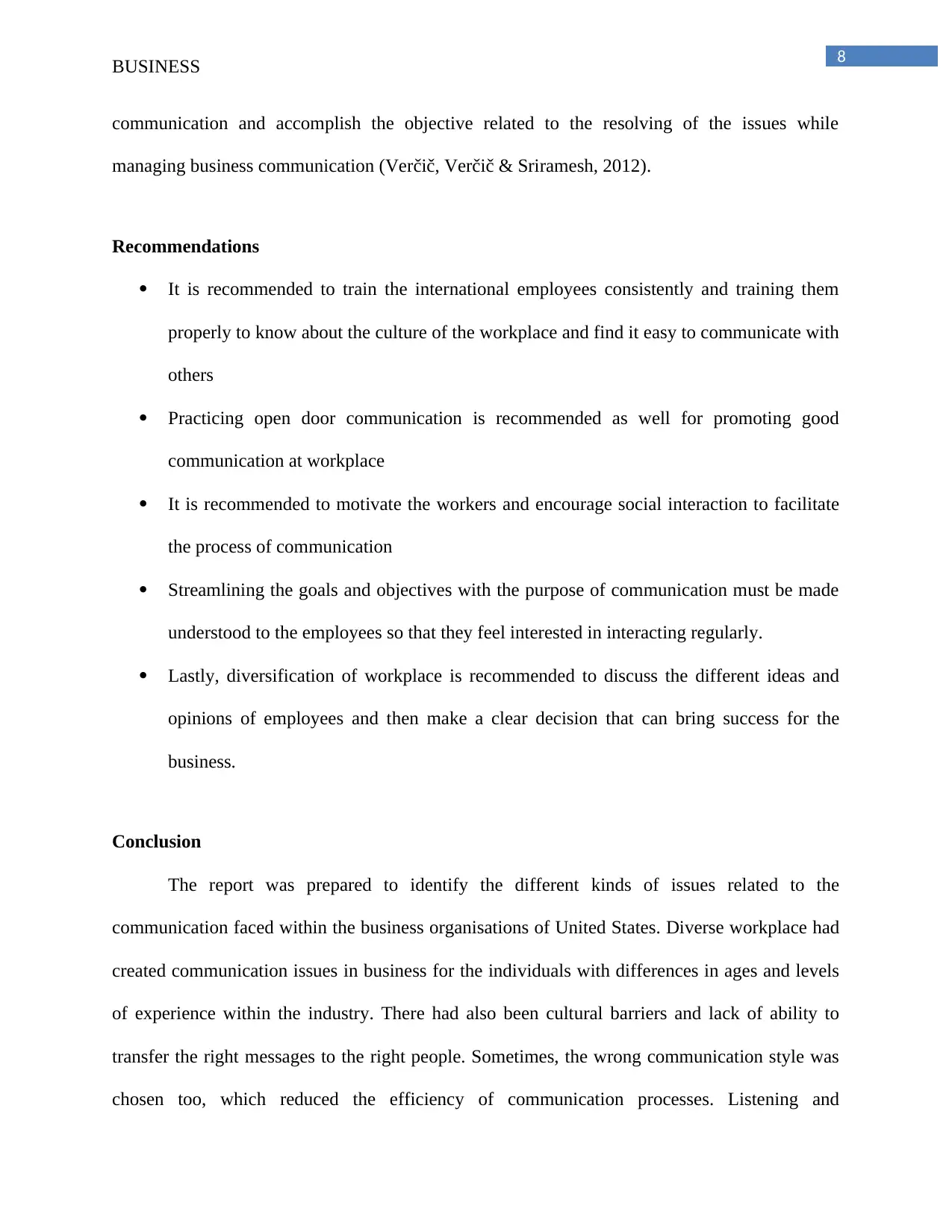
The two major goals of communication are to resolve the language and cultural barriers
within a diversity workplace, manage understanding of the receiver and develop good
relationship between the employees.
BUSINESS
workplace (Robles, 2012). To resolve the issue and determine a probable action that will be
undertaken, it is necessary for determining the style of communication of the audience whom the
person wants to reach. Asking open-ended questions that are specific and to the point can also
develop a better flow of information while communicating within the organisation.
Reflecting statements could also help in developing trust among the employees of the
organisation and promote good and effective communication with ease and effectiveness.
Listening attentively and speaking politely require a set of skills including practice and diligence,
though it can facilitate communication procedure and avoid any misconceptions. The managers
also play vital roles and responsibilities to educate the employees about the advantages of
communication, which can reduce the stress and tension at the workplace and promote a good
relationship between the workers of the business organisations in the United States (Ruppert &
Green, 2012). Not just using emails can ease down the business communication issues, because
it saves a lot of cost and time, but it is needed for the sender to deliver a clear and consistent
message through various communication channels that are appropriate for the targeted audiences
and situations involved. An interpreter could be used who know both the languages and could
convey the messages very easily to the employees. The training sessions should be arranged for
the individuals for making them know how to communicate and ensure that messages would be
exchanged properly (Schullery, 2013).
Major goals with SMART objectives
The two major goals of communication are to resolve the language and cultural barriers
within a diversity workplace, manage understanding of the receiver and develop good
relationship between the employees.
Paraphrase This Document
Need a fresh take? Get an instant paraphrase of this document with our AI Paraphraser
7
BUSINESS
Implementation of strategies for achieving the goals and objectives
The objectives are already stated above and to achieve those, it is important to establish a
baseline for communication to identify the success and progress according to the areas of
business issues. It is also important for the managers and leaders to motivate and encourage the
workers to communicate with each other and make ultimate decisions after discussions for
achieving the business goals and objectives and derive good communication outcomes too.
Proper communication resources must be present to ensure that sender could deliver messages
and information that would be understandable by the receiver and even adopt a good
communication style (Toth, 2013). Anti Discrimination policies and Fair Work Act are
established so that discrimination can be prevented to establish good relationships between
workers and eliminate any sort of gender biasness within the workplace. Obtaining feedbacks
could allow for understanding whether the messages and information had been delivered
properly or not. All these strategies could be applied for improving the process of
SSpecific-ResolvingthelanguageandculturalbarrierscanhelptofacilitatethecommunicationprocessMMeasurable-QualityofmessagesandquantitiyofdatathathavebeensendfromthesendertotherecieverAAchievable-GoodrelationshipsbetweenemployeescouldbedevelopedandwouldbeachievedthroughpropertrainingsessionsprovidedtotheemployeesRRelevant-ConsistencyofmessagesandhavingaclearandspecificfocusareessentialtoowithaccessibilityofpropercommunciationcchannelsormediaTTimeBound-Communciationshouldbeestablishedwithinquicktimesothattheproductivitydoesnotgethamperedandtimelydleiveryofproductsandservicesshouldbepossibleaswell.
BUSINESS
Implementation of strategies for achieving the goals and objectives
The objectives are already stated above and to achieve those, it is important to establish a
baseline for communication to identify the success and progress according to the areas of
business issues. It is also important for the managers and leaders to motivate and encourage the
workers to communicate with each other and make ultimate decisions after discussions for
achieving the business goals and objectives and derive good communication outcomes too.
Proper communication resources must be present to ensure that sender could deliver messages
and information that would be understandable by the receiver and even adopt a good
communication style (Toth, 2013). Anti Discrimination policies and Fair Work Act are
established so that discrimination can be prevented to establish good relationships between
workers and eliminate any sort of gender biasness within the workplace. Obtaining feedbacks
could allow for understanding whether the messages and information had been delivered
properly or not. All these strategies could be applied for improving the process of
SSpecific-ResolvingthelanguageandculturalbarrierscanhelptofacilitatethecommunicationprocessMMeasurable-QualityofmessagesandquantitiyofdatathathavebeensendfromthesendertotherecieverAAchievable-GoodrelationshipsbetweenemployeescouldbedevelopedandwouldbeachievedthroughpropertrainingsessionsprovidedtotheemployeesRRelevant-ConsistencyofmessagesandhavingaclearandspecificfocusareessentialtoowithaccessibilityofpropercommunciationcchannelsormediaTTimeBound-Communciationshouldbeestablishedwithinquicktimesothattheproductivitydoesnotgethamperedandtimelydleiveryofproductsandservicesshouldbepossibleaswell.
8
BUSINESS
communication and accomplish the objective related to the resolving of the issues while
managing business communication (Verčič, Verčič & Sriramesh, 2012).
Recommendations
It is recommended to train the international employees consistently and training them
properly to know about the culture of the workplace and find it easy to communicate with
others
Practicing open door communication is recommended as well for promoting good
communication at workplace
It is recommended to motivate the workers and encourage social interaction to facilitate
the process of communication
Streamlining the goals and objectives with the purpose of communication must be made
understood to the employees so that they feel interested in interacting regularly.
Lastly, diversification of workplace is recommended to discuss the different ideas and
opinions of employees and then make a clear decision that can bring success for the
business.
Conclusion
The report was prepared to identify the different kinds of issues related to the
communication faced within the business organisations of United States. Diverse workplace had
created communication issues in business for the individuals with differences in ages and levels
of experience within the industry. There had also been cultural barriers and lack of ability to
transfer the right messages to the right people. Sometimes, the wrong communication style was
chosen too, which reduced the efficiency of communication processes. Listening and
BUSINESS
communication and accomplish the objective related to the resolving of the issues while
managing business communication (Verčič, Verčič & Sriramesh, 2012).
Recommendations
It is recommended to train the international employees consistently and training them
properly to know about the culture of the workplace and find it easy to communicate with
others
Practicing open door communication is recommended as well for promoting good
communication at workplace
It is recommended to motivate the workers and encourage social interaction to facilitate
the process of communication
Streamlining the goals and objectives with the purpose of communication must be made
understood to the employees so that they feel interested in interacting regularly.
Lastly, diversification of workplace is recommended to discuss the different ideas and
opinions of employees and then make a clear decision that can bring success for the
business.
Conclusion
The report was prepared to identify the different kinds of issues related to the
communication faced within the business organisations of United States. Diverse workplace had
created communication issues in business for the individuals with differences in ages and levels
of experience within the industry. There had also been cultural barriers and lack of ability to
transfer the right messages to the right people. Sometimes, the wrong communication style was
chosen too, which reduced the efficiency of communication processes. Listening and
⊘ This is a preview!⊘
Do you want full access?
Subscribe today to unlock all pages.
Trusted by 1+ million students worldwide
9
BUSINESS
understanding attentively to what the organisation wanted to could resolve the issues of
communication in business. The goals were represented based on SMART objectives, and lastly
few strategies were implemented to achieve the outcomes with convenience.
BUSINESS
understanding attentively to what the organisation wanted to could resolve the issues of
communication in business. The goals were represented based on SMART objectives, and lastly
few strategies were implemented to achieve the outcomes with convenience.
Paraphrase This Document
Need a fresh take? Get an instant paraphrase of this document with our AI Paraphraser
10
BUSINESS
References
Anderson, V. (2013). Research methods in human resource management: investigating a
business issue. Kogan Page Publishers.
Aral, S., Dellarocas, C., & Godes, D. (2013). Introduction to the special issue—social media and
business transformation: a framework for research. Information Systems Research, 24(1),
3-13.
Conrad, D., & Newberry, R. (2012). Identification and instruction of important business
communication skills for graduate business education. Journal of Education for
Business, 87(2), 112-120.
DeKay, S. H. (2012). Interpersonal communication in the workplace: A largely unexplored
region. Business Communication Quarterly, 75(4), 449-452.
Guffey, M. E., & Loewy, D. (2012). Essentials of business communication. Cengage Learning.
Hynes, G. E. (2012). Improving employees’ interpersonal communication competencies: A
qualitative study. Business communication quarterly, 75(4), 466-475.
Keyton, J., Caputo, J. M., Ford, E. A., Fu, R., Leibowitz, S. A., Liu, T., ... & Wu, C. (2013).
Investigating verbal workplace communication behaviors. The Journal of Business
Communication (1973), 50(2), 152-169.
Mai, R., & Hoffmann, S. (2014). Accents in business communication: An integrative model and
propositions for future research. Journal of Consumer Psychology, 24(1), 137-158.
Robles, M. M. (2012). Executive perceptions of the top 10 soft skills needed in today’s
workplace. Business Communication Quarterly, 75(4), 453-465.
BUSINESS
References
Anderson, V. (2013). Research methods in human resource management: investigating a
business issue. Kogan Page Publishers.
Aral, S., Dellarocas, C., & Godes, D. (2013). Introduction to the special issue—social media and
business transformation: a framework for research. Information Systems Research, 24(1),
3-13.
Conrad, D., & Newberry, R. (2012). Identification and instruction of important business
communication skills for graduate business education. Journal of Education for
Business, 87(2), 112-120.
DeKay, S. H. (2012). Interpersonal communication in the workplace: A largely unexplored
region. Business Communication Quarterly, 75(4), 449-452.
Guffey, M. E., & Loewy, D. (2012). Essentials of business communication. Cengage Learning.
Hynes, G. E. (2012). Improving employees’ interpersonal communication competencies: A
qualitative study. Business communication quarterly, 75(4), 466-475.
Keyton, J., Caputo, J. M., Ford, E. A., Fu, R., Leibowitz, S. A., Liu, T., ... & Wu, C. (2013).
Investigating verbal workplace communication behaviors. The Journal of Business
Communication (1973), 50(2), 152-169.
Mai, R., & Hoffmann, S. (2014). Accents in business communication: An integrative model and
propositions for future research. Journal of Consumer Psychology, 24(1), 137-158.
Robles, M. M. (2012). Executive perceptions of the top 10 soft skills needed in today’s
workplace. Business Communication Quarterly, 75(4), 453-465.
11
BUSINESS
Ruppert, B., & Green, D. A. (2012). Practicing what we teach: Credibility and alignment in the
business communication classroom. Business Communication Quarterly, 75(1), 29-44.
Schullery, N. M. (2013). Workplace engagement and generational differences in values. Business
Communication Quarterly, 76(2), 252-265.
Toth, C. (2013). Revisiting a genre: Teaching infographics in business and professional
communication courses. Business Communication Quarterly, 76(4), 446-457.
Verčič, A. T., Verčič, D., & Sriramesh, K. (2012). Internal communication: Definition,
parameters, and the future. Public relations review, 38(2), 223-230.
Waldeck, J., Durante, C., Helmuth, B., & Marcia, B. (2012). Communication in a changing
world: Contemporary perspectives on business communication competence. Journal of
Education for Business, 87(4), 230-240.
BUSINESS
Ruppert, B., & Green, D. A. (2012). Practicing what we teach: Credibility and alignment in the
business communication classroom. Business Communication Quarterly, 75(1), 29-44.
Schullery, N. M. (2013). Workplace engagement and generational differences in values. Business
Communication Quarterly, 76(2), 252-265.
Toth, C. (2013). Revisiting a genre: Teaching infographics in business and professional
communication courses. Business Communication Quarterly, 76(4), 446-457.
Verčič, A. T., Verčič, D., & Sriramesh, K. (2012). Internal communication: Definition,
parameters, and the future. Public relations review, 38(2), 223-230.
Waldeck, J., Durante, C., Helmuth, B., & Marcia, B. (2012). Communication in a changing
world: Contemporary perspectives on business communication competence. Journal of
Education for Business, 87(4), 230-240.
⊘ This is a preview!⊘
Do you want full access?
Subscribe today to unlock all pages.
Trusted by 1+ million students worldwide

1 out of 13


Related Documents


Your All-in-One AI-Powered Toolkit for Academic Success.
+13062052269
info@desklib.com
Available 24*7 on WhatsApp / Email
![[object Object]](/_next/static/media/star-bottom.7253800d.svg)
Unlock your academic potential
Copyright © 2020–2026 A2Z Services. All Rights Reserved. Developed and managed by ZUCOL.