Business Communication Principles: Negotiation and Systems
VerifiedAdded on 2020/06/04
|11
|2834
|89
Report
AI Summary
This report provides a comprehensive overview of business communication principles, exploring key aspects such as negotiation tactics, different types of presentations, resources for presentation development, and best practices for effective delivery. It delves into the characteristics of bespoke documents and examines the typical stages of information system development, including feasibility studies, analysis, design, development, testing, implementation, evaluation, and maintenance. The report also discusses the benefits and limitations of information systems, as well as legal, security, and confidentiality requirements. Furthermore, it addresses methods for monitoring the use and effectiveness of information systems. Overall, the report offers valuable insights into various facets of business communication and information system management.
PRINCIPLES OF BUSINESS
COMMUNICATION
COMMUNICATION

Paraphrase This Document
Need a fresh take? Get an instant paraphrase of this document with our AI Paraphraser
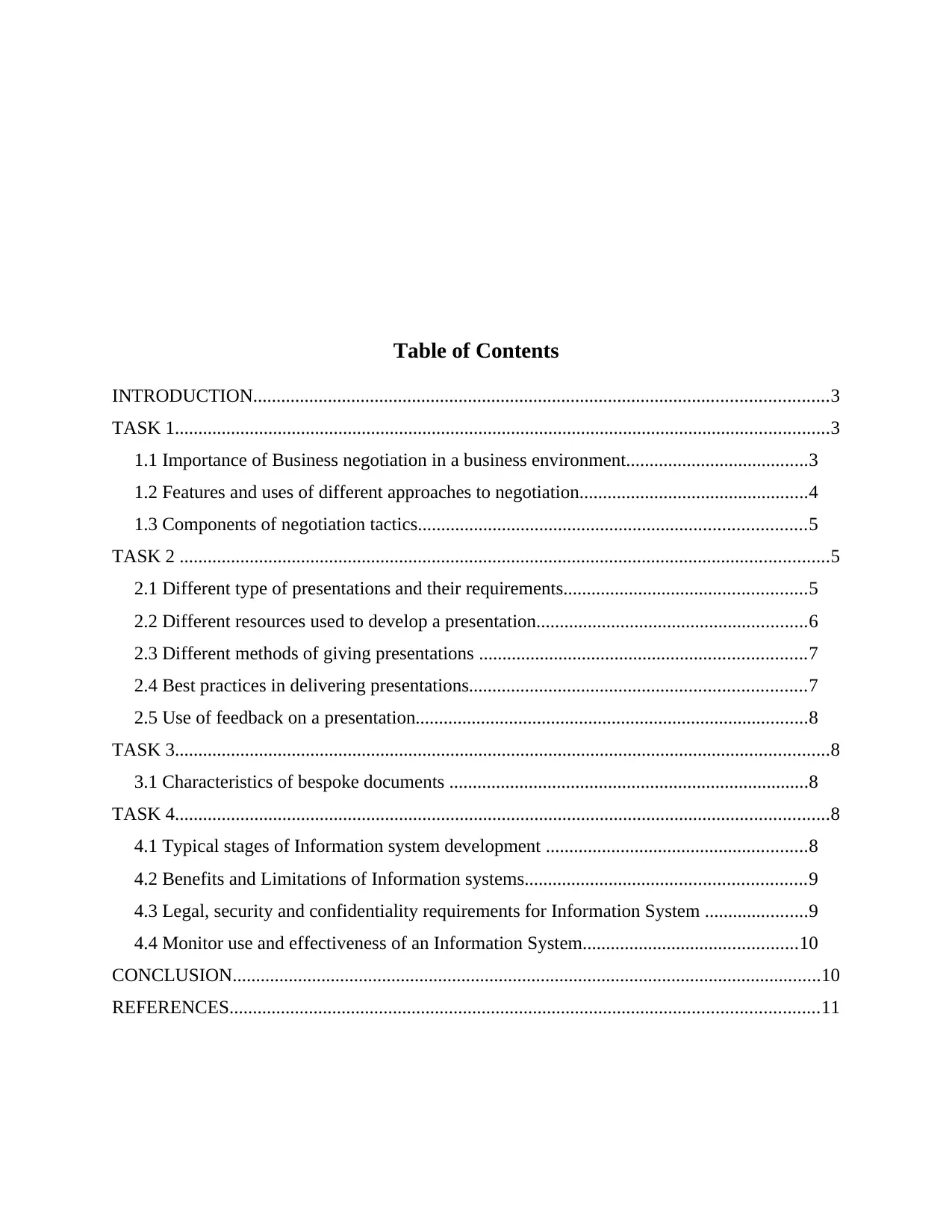
Table of Contents
INTRODUCTION...........................................................................................................................3
TASK 1............................................................................................................................................3
1.1 Importance of Business negotiation in a business environment.......................................3
1.2 Features and uses of different approaches to negotiation.................................................4
1.3 Components of negotiation tactics...................................................................................5
TASK 2 ...........................................................................................................................................5
2.1 Different type of presentations and their requirements....................................................5
2.2 Different resources used to develop a presentation..........................................................6
2.3 Different methods of giving presentations ......................................................................7
2.4 Best practices in delivering presentations........................................................................7
2.5 Use of feedback on a presentation....................................................................................8
TASK 3............................................................................................................................................8
3.1 Characteristics of bespoke documents .............................................................................8
TASK 4............................................................................................................................................8
4.1 Typical stages of Information system development ........................................................8
4.2 Benefits and Limitations of Information systems............................................................9
4.3 Legal, security and confidentiality requirements for Information System ......................9
4.4 Monitor use and effectiveness of an Information System..............................................10
CONCLUSION..............................................................................................................................10
REFERENCES..............................................................................................................................11
INTRODUCTION...........................................................................................................................3
TASK 1............................................................................................................................................3
1.1 Importance of Business negotiation in a business environment.......................................3
1.2 Features and uses of different approaches to negotiation.................................................4
1.3 Components of negotiation tactics...................................................................................5
TASK 2 ...........................................................................................................................................5
2.1 Different type of presentations and their requirements....................................................5
2.2 Different resources used to develop a presentation..........................................................6
2.3 Different methods of giving presentations ......................................................................7
2.4 Best practices in delivering presentations........................................................................7
2.5 Use of feedback on a presentation....................................................................................8
TASK 3............................................................................................................................................8
3.1 Characteristics of bespoke documents .............................................................................8
TASK 4............................................................................................................................................8
4.1 Typical stages of Information system development ........................................................8
4.2 Benefits and Limitations of Information systems............................................................9
4.3 Legal, security and confidentiality requirements for Information System ......................9
4.4 Monitor use and effectiveness of an Information System..............................................10
CONCLUSION..............................................................................................................................10
REFERENCES..............................................................................................................................11
INTRODUCTION
Business communication is information sharing between people within and outside an
organization that is performed for the commercial benefit of the organization. It can also be
defined as relaying of information within a business by its people. It can also be said to be the
way employees, management and administration communicate in order to reach to their
organizational goals. Effective communicating by business managers facilitates information
sharing between company employees and can substantially contribute to its commercial success.
Principles of Business Communication are some guidelines or principles that are to be
considered and followed to make process effective and efficient.
TASK 1
1.1 Importance of Business negotiation in a business environment
Negotiating can be a lot about play acting and may even require you to get aggressive.
Negotiating can also put you on the very edge of having to turn down a deal that you sorely
Business communication is information sharing between people within and outside an
organization that is performed for the commercial benefit of the organization. It can also be
defined as relaying of information within a business by its people. It can also be said to be the
way employees, management and administration communicate in order to reach to their
organizational goals. Effective communicating by business managers facilitates information
sharing between company employees and can substantially contribute to its commercial success.
Principles of Business Communication are some guidelines or principles that are to be
considered and followed to make process effective and efficient.
TASK 1
1.1 Importance of Business negotiation in a business environment
Negotiating can be a lot about play acting and may even require you to get aggressive.
Negotiating can also put you on the very edge of having to turn down a deal that you sorely
⊘ This is a preview!⊘
Do you want full access?
Subscribe today to unlock all pages.

Trusted by 1+ million students worldwide
want. Essentially, negotiation is a conversation between two people, or groups of people,
looking for a solution that suits both parties. kingfisher Plc also perform negotiation sometimes.
There are several importance of business negotiation that are discussed below:
Negotiation is also important when you are dealing with vendors: An organization needs
money to survive and take care of the employees as well. It can’t afford to spend money
as it is. A single penny saved will help you and the organization later.
Negotiate with one’s superiors: Remember negotiation does not mean you have to shout
on others, you need to be polite. Don’t accept responsibilities just because your boss
wants it. If you are not comfortable with any role, its better to decline it, rather than
accepting something you are not familiar with and losing interest later. After all there are
other employees as well, they can accept the same and you can do something else which
suits your profile.
1.2 Features and uses of different approaches to negotiation
The various approaches to negotiation are as follows:
◦ Distributive Negotiation or Win-Lose Approach: This is also called competitive, zero
sum, or claiming value approach. This approach is based on the premise that one
person can win only at the expense of the other.
◦ Lose-Lose Approach: This negotiation approach is adopted when one negotiating
partner feels that his own interests are threatened and he does all he can to ensure that
the outcome of the negotiation is not suitable to the interests of the other party as well
◦ Compromise Approach: This approach provides an outcome which is some
improvement over the lose-lose strategy outcome. To avoid a lose-lose situation, both
parties give up a part of what they had originally sought and settle for something less
than that
◦ Integrative Negotiation or Win-Win Approach: This negotiation approach is also
called as collaborative or creating value approach. It is superior to all negotiation
approaches. It results in both the parties feeling that they are achieving what they
wanted.
looking for a solution that suits both parties. kingfisher Plc also perform negotiation sometimes.
There are several importance of business negotiation that are discussed below:
Negotiation is also important when you are dealing with vendors: An organization needs
money to survive and take care of the employees as well. It can’t afford to spend money
as it is. A single penny saved will help you and the organization later.
Negotiate with one’s superiors: Remember negotiation does not mean you have to shout
on others, you need to be polite. Don’t accept responsibilities just because your boss
wants it. If you are not comfortable with any role, its better to decline it, rather than
accepting something you are not familiar with and losing interest later. After all there are
other employees as well, they can accept the same and you can do something else which
suits your profile.
1.2 Features and uses of different approaches to negotiation
The various approaches to negotiation are as follows:
◦ Distributive Negotiation or Win-Lose Approach: This is also called competitive, zero
sum, or claiming value approach. This approach is based on the premise that one
person can win only at the expense of the other.
◦ Lose-Lose Approach: This negotiation approach is adopted when one negotiating
partner feels that his own interests are threatened and he does all he can to ensure that
the outcome of the negotiation is not suitable to the interests of the other party as well
◦ Compromise Approach: This approach provides an outcome which is some
improvement over the lose-lose strategy outcome. To avoid a lose-lose situation, both
parties give up a part of what they had originally sought and settle for something less
than that
◦ Integrative Negotiation or Win-Win Approach: This negotiation approach is also
called as collaborative or creating value approach. It is superior to all negotiation
approaches. It results in both the parties feeling that they are achieving what they
wanted.
Paraphrase This Document
Need a fresh take? Get an instant paraphrase of this document with our AI Paraphraser
1.3 Components of negotiation tactics
Good negotiation skills can help you reach these or other goals when in talks with a
prospective or current employer, third-party payer, or hospital administrator. Negotiating is
something that can be learned—something for which there are resources. There are some tactics
that can be followed by negotiation process which are illustrated below:
Research the Other Party: If you will be negotiating with a group practice, read
everything on its Web site and ask to have any marketing literature or patient handouts
about the practice sent to you in advance. Check to see if any of the physicians have
published articles or reports.
Unbundle the Items to Be Negotiated: Break the agreement to be negotiated into small
parts. In dealing with an employment contract, for instance, break “compensation” down
into its smallest components, such as salary, health benefits, moving costs, bonuses,
reimbursed expenses such as a car allowance or cell phone, and so on
Anticipate the Other Party's Wants and Needs: It is important to study other party's top
issues that are present. This will help company to develop strategies to negotiate your
position.
TASK 2
2.1 Different type of presentations and their requirements
A presentation is a means of communication that can be adapted to various speaking
situations, such as talking to a group, addressing a meeting or briefing a team.
The following is an overview of several common types of presentations and their purpose.
Informative: Informative presentation is brief and to the point. It depicts facts and avoid
complicated information.
Instructional: Purpose of an instructional presentation is to give specific directions or
orders. It will probably be a bit longer, because it has to cover the topic thoroughly. In an
instructional presentation, listeners should come away with new knowledge or a new
skill.
Good negotiation skills can help you reach these or other goals when in talks with a
prospective or current employer, third-party payer, or hospital administrator. Negotiating is
something that can be learned—something for which there are resources. There are some tactics
that can be followed by negotiation process which are illustrated below:
Research the Other Party: If you will be negotiating with a group practice, read
everything on its Web site and ask to have any marketing literature or patient handouts
about the practice sent to you in advance. Check to see if any of the physicians have
published articles or reports.
Unbundle the Items to Be Negotiated: Break the agreement to be negotiated into small
parts. In dealing with an employment contract, for instance, break “compensation” down
into its smallest components, such as salary, health benefits, moving costs, bonuses,
reimbursed expenses such as a car allowance or cell phone, and so on
Anticipate the Other Party's Wants and Needs: It is important to study other party's top
issues that are present. This will help company to develop strategies to negotiate your
position.
TASK 2
2.1 Different type of presentations and their requirements
A presentation is a means of communication that can be adapted to various speaking
situations, such as talking to a group, addressing a meeting or briefing a team.
The following is an overview of several common types of presentations and their purpose.
Informative: Informative presentation is brief and to the point. It depicts facts and avoid
complicated information.
Instructional: Purpose of an instructional presentation is to give specific directions or
orders. It will probably be a bit longer, because it has to cover the topic thoroughly. In an
instructional presentation, listeners should come away with new knowledge or a new
skill.
Arousing: Main aim of an arousing presentation is to make people think about a certain
problem or situation. It focus on raising the audience’s emotions and intellect so that they
will be receptive to presenter's point of view
Persuasive: Purpose of a persuasive presentation is to convince listeners to accept the
proposal. A convincing persuasive presentation offers a solution to a controversy,
dispute, or problem.
Decision-making: Your purpose in a decision-making presentation is to move your
audience to take your suggested action. A decision-making presentation presents ideas,
suggestions, and arguments strongly enough to persuade an audience to carry out your
requests. In a decision-making presentation, you must tell the audience what to do and
how to do it.
2.2 Different resources used to develop a presentation
A web presentation designed using modern techniques offers a high level of interaction,
fast loading times and responsiveness that a desktop presentation cannot provide. However, the
format you choose for your presentation matters little if the presentation itself is not effective.
Here are some guidelines to follow to ensure your presentation is memorable and conveys the
message you want it to:
Keep it short and sweet: Strip the fluff out of your presentation, and get down to the stuff
that matters. If there is need of speaking or narrating, the majority of stuff that has to be
communicate should come from personally from speaker.
Use bold typography and proper hierarchy: Presentation must be readable on a variety of
devices. Use a small number of complimentary fonts for their weight and style, and use
effects such as gradients or shadows to help set them apart from the background.
Illustrate your point: Charts, infographics, photography and art can demonstrate what you
don’t have room to say with text, or add emphasis to the topic.
Style tastefully: A pleasing design and focused layout can help define the overall purpose
of your presentation. There should be power to direct the visitor’s eyes where it is needed
to go as you design each slide.
problem or situation. It focus on raising the audience’s emotions and intellect so that they
will be receptive to presenter's point of view
Persuasive: Purpose of a persuasive presentation is to convince listeners to accept the
proposal. A convincing persuasive presentation offers a solution to a controversy,
dispute, or problem.
Decision-making: Your purpose in a decision-making presentation is to move your
audience to take your suggested action. A decision-making presentation presents ideas,
suggestions, and arguments strongly enough to persuade an audience to carry out your
requests. In a decision-making presentation, you must tell the audience what to do and
how to do it.
2.2 Different resources used to develop a presentation
A web presentation designed using modern techniques offers a high level of interaction,
fast loading times and responsiveness that a desktop presentation cannot provide. However, the
format you choose for your presentation matters little if the presentation itself is not effective.
Here are some guidelines to follow to ensure your presentation is memorable and conveys the
message you want it to:
Keep it short and sweet: Strip the fluff out of your presentation, and get down to the stuff
that matters. If there is need of speaking or narrating, the majority of stuff that has to be
communicate should come from personally from speaker.
Use bold typography and proper hierarchy: Presentation must be readable on a variety of
devices. Use a small number of complimentary fonts for their weight and style, and use
effects such as gradients or shadows to help set them apart from the background.
Illustrate your point: Charts, infographics, photography and art can demonstrate what you
don’t have room to say with text, or add emphasis to the topic.
Style tastefully: A pleasing design and focused layout can help define the overall purpose
of your presentation. There should be power to direct the visitor’s eyes where it is needed
to go as you design each slide.
⊘ This is a preview!⊘
Do you want full access?
Subscribe today to unlock all pages.
Trusted by 1+ million students worldwide
2.3 Different methods of giving presentations
There are several ways that are adopted to deliver presentations to larger number of
people that are discussed below:
◦ Electronic: Because of its convenience and the fact that it seems to be everywhere,
with people having 24/7 access, email has become a default delivery system for
information.
◦ Print: Print media have an advantage over electronic communication in that client
won’t have to worry about how the message looks on devices and computers with
different display settings.
◦ Face-to-Face: Face-to-face meetings let presenter get more personal, evaluate the
body language of peers, demonstrate products and use visual aids.
◦ Teleconference: Telemeetings give many of the same benefits of face-to-face
communications without the travel costs and scheduling headaches.
◦ Visual Aids: Using visual aids will better engage attendees and make relevant points.
Charts and graphs give a visual pop to numbers that are presenting, having an instant
impact on audience.
2.4 Best practices in delivering presentations
In order to deliver presentations there are some practices that are available and has to be
adopted to make in successful. Some steps are discussed below:
Design: There is specific Company slide template, that has to be applied in a clean and
simple design based on the colour palette and font for visual consistency.
Content: Two words: reuse & shorten. If website is current, effectively designed and
includes targeted content throughout, use this as source material, and then convert it into
slides for optimal reuse.
Script: This also allows to insert pre-planned pauses to engage the customer, ask about
their challenges, and bridge back to how company has the perfect solution.
Customization: After all the work to polish and standardize message, make sure the
presentation is customizable for each audience.
There are several ways that are adopted to deliver presentations to larger number of
people that are discussed below:
◦ Electronic: Because of its convenience and the fact that it seems to be everywhere,
with people having 24/7 access, email has become a default delivery system for
information.
◦ Print: Print media have an advantage over electronic communication in that client
won’t have to worry about how the message looks on devices and computers with
different display settings.
◦ Face-to-Face: Face-to-face meetings let presenter get more personal, evaluate the
body language of peers, demonstrate products and use visual aids.
◦ Teleconference: Telemeetings give many of the same benefits of face-to-face
communications without the travel costs and scheduling headaches.
◦ Visual Aids: Using visual aids will better engage attendees and make relevant points.
Charts and graphs give a visual pop to numbers that are presenting, having an instant
impact on audience.
2.4 Best practices in delivering presentations
In order to deliver presentations there are some practices that are available and has to be
adopted to make in successful. Some steps are discussed below:
Design: There is specific Company slide template, that has to be applied in a clean and
simple design based on the colour palette and font for visual consistency.
Content: Two words: reuse & shorten. If website is current, effectively designed and
includes targeted content throughout, use this as source material, and then convert it into
slides for optimal reuse.
Script: This also allows to insert pre-planned pauses to engage the customer, ask about
their challenges, and bridge back to how company has the perfect solution.
Customization: After all the work to polish and standardize message, make sure the
presentation is customizable for each audience.
Paraphrase This Document
Need a fresh take? Get an instant paraphrase of this document with our AI Paraphraser
2.5 Use of feedback on a presentation
Feedback can either be external – from the present audience, friends and colleagues; or
internal –members can give yourself feedback. Until people have tamed your public speaking
monkeys, you often take feedback from others in a negative way and the feedback you give
yourself is likely to be unbalanced and too harsh. As you will recall from your presentation
training courses, once the monkeys are on your side, you’ll be able to hear feedback in a
balanced way, and realise how helpful it is. Hence, these aid in improving certain areas that is
required.
TASK 3
3.1 Characteristics of bespoke documents
TASK 4
4.1 Typical stages of Information system development
The development of information systems can either be acquired through In-sourcing,
Out-sourcing, Self-sourcing, or Prototyping.
1. Feasibility Study – the stage where information analyst makes a study of whether the
managements’ concept of having the desired new system is achievable. It may be that
development of a new system is not needed instead an update of the existing is enough.
2. Analysis – the stage where users and IT specialists work together to collect and comprehend
the business requirements. Based on requirements, both will work on the design.
3. Design – the stage where the system’s blueprint is created. The technical architecture is
designed which includes telecommunications, hardware and software suited for the system..
4. Development and Testing – the stage where building of the technical architecture, database
and programs are executed. It is also the stage where the system is tested using the established
test scripts and compare the expected outcomes to actual outcomes.
5. Implementation- the stage where system is in place and is used by the actual workforce.
6. Evaluation – the stage where system need to be evaluated for any bug from time to time.
7. Maintenance- the stage where system needs to be enhanced or strengthened in order to meet
the goals of the organization.
Feedback can either be external – from the present audience, friends and colleagues; or
internal –members can give yourself feedback. Until people have tamed your public speaking
monkeys, you often take feedback from others in a negative way and the feedback you give
yourself is likely to be unbalanced and too harsh. As you will recall from your presentation
training courses, once the monkeys are on your side, you’ll be able to hear feedback in a
balanced way, and realise how helpful it is. Hence, these aid in improving certain areas that is
required.
TASK 3
3.1 Characteristics of bespoke documents
TASK 4
4.1 Typical stages of Information system development
The development of information systems can either be acquired through In-sourcing,
Out-sourcing, Self-sourcing, or Prototyping.
1. Feasibility Study – the stage where information analyst makes a study of whether the
managements’ concept of having the desired new system is achievable. It may be that
development of a new system is not needed instead an update of the existing is enough.
2. Analysis – the stage where users and IT specialists work together to collect and comprehend
the business requirements. Based on requirements, both will work on the design.
3. Design – the stage where the system’s blueprint is created. The technical architecture is
designed which includes telecommunications, hardware and software suited for the system..
4. Development and Testing – the stage where building of the technical architecture, database
and programs are executed. It is also the stage where the system is tested using the established
test scripts and compare the expected outcomes to actual outcomes.
5. Implementation- the stage where system is in place and is used by the actual workforce.
6. Evaluation – the stage where system need to be evaluated for any bug from time to time.
7. Maintenance- the stage where system needs to be enhanced or strengthened in order to meet
the goals of the organization.
4.2 Benefits and Limitations of Information systems
Advantages
Communication– With help of information technologies the instant messaging, emails, voice
and video calls becomes quicker, cheaper and much efficient.
Globalization and cultural gap– By implementing information systems we can bring down the
linguistic, geographical and some cultural boundaries. Sharing the information, knowledge,
communication and relationships between different countries, languages and cultures becomes
much easier.
Availability– Information systems has made it possible for businesses to be open 24×7 all over
the globe. This means that a business can be open anytime anywhere, making purchases from
different countries easier and more convenient. It also means that you can have your goods
delivered right to your doorstep with having to move a single muscle.
Disadvantages
Unemployment and lack of job security– Implementing the information systems can save a
great deal of time during the completion of tasks and some labour mechanic works.
Dominant culture –While information technology may have made the world a global village, it
has also contributed to one culture dominating another weaker one.
4.3 Legal, security and confidentiality requirements for Information System
There are eight principles of data (information) processing with which the data controller
must ensure compliance. In this instance the Law Centre is the ‘data controller’.
The law: The Data Protection Act is mandatory and Law Centre (NI) is therefore required
under law to comply with the Act.
Policy Statement: Law Centre (NI) is committed to fulfilling its legal obligations within
the provisions of the Data Protection Act.
Employment: Code of Practice: there are certain codes that has to be followed in
conducive manner.
Advantages
Communication– With help of information technologies the instant messaging, emails, voice
and video calls becomes quicker, cheaper and much efficient.
Globalization and cultural gap– By implementing information systems we can bring down the
linguistic, geographical and some cultural boundaries. Sharing the information, knowledge,
communication and relationships between different countries, languages and cultures becomes
much easier.
Availability– Information systems has made it possible for businesses to be open 24×7 all over
the globe. This means that a business can be open anytime anywhere, making purchases from
different countries easier and more convenient. It also means that you can have your goods
delivered right to your doorstep with having to move a single muscle.
Disadvantages
Unemployment and lack of job security– Implementing the information systems can save a
great deal of time during the completion of tasks and some labour mechanic works.
Dominant culture –While information technology may have made the world a global village, it
has also contributed to one culture dominating another weaker one.
4.3 Legal, security and confidentiality requirements for Information System
There are eight principles of data (information) processing with which the data controller
must ensure compliance. In this instance the Law Centre is the ‘data controller’.
The law: The Data Protection Act is mandatory and Law Centre (NI) is therefore required
under law to comply with the Act.
Policy Statement: Law Centre (NI) is committed to fulfilling its legal obligations within
the provisions of the Data Protection Act.
Employment: Code of Practice: there are certain codes that has to be followed in
conducive manner.
⊘ This is a preview!⊘
Do you want full access?
Subscribe today to unlock all pages.
Trusted by 1+ million students worldwide
4.4 Monitor use and effectiveness of an Information System
Systems and Customer Delight: Organizations are fully aware that proliferation of
information systems has reduced product life cycle, reduced margin and brought in new
products
Systems and Organizational Productivity: Organizations require different types of
information systems to mitigate distinctive process and requirements. Efficient business
transaction systems make organization productive.
System and Workers Productivity: Information systems have facilitated the increase in
workers’ productivity.
CONCLUSION
This report highlight various aspects that include importance of business communication
that take place between different level of management. It also put light on process of
presentations of distinctive nature and types. Company also uses information system that have
numerous benefits and advantages.
Systems and Customer Delight: Organizations are fully aware that proliferation of
information systems has reduced product life cycle, reduced margin and brought in new
products
Systems and Organizational Productivity: Organizations require different types of
information systems to mitigate distinctive process and requirements. Efficient business
transaction systems make organization productive.
System and Workers Productivity: Information systems have facilitated the increase in
workers’ productivity.
CONCLUSION
This report highlight various aspects that include importance of business communication
that take place between different level of management. It also put light on process of
presentations of distinctive nature and types. Company also uses information system that have
numerous benefits and advantages.
Paraphrase This Document
Need a fresh take? Get an instant paraphrase of this document with our AI Paraphraser
REFERENCES
Books and Journals
Chow, A. T. and et. al., AT&T Intellectual Property II LP, 2012.Computer readable medium
with embedded instructions for providing communication services between a broadband
network and an enterprise wireless communication platform within a residential or
business environment. U.S. Patent 8,155,155.
Björklund, M., 2011. Influence from the business environment on environmental purchasing—
Drivers and hinders of purchasing green transportation services.Journal of Purchasing
and Supply Management. 17(1). pp.11-22.
Louhiala-Salminen, L. and Kankaanranta, A., 2011. Professional communication in a global
business context: The notion of global communicative competence.IEEE Transactions
on professional communication. 54(3). pp.244-262.
Popescu, G. H., 2013. Macroeconomics, effective leadership, and the global business
environment.Contemporary Readings in Law and Social Justice. 5(2). p.170.
Fassin, Y. and Buelens, M., 2011. The hypocrisy-sincerity continuum in corporate
communication and decision making: A model of corporate social responsibility and
business ethics practices. Management Decision. 49(4). pp.586-600.
Savrul, M., Incekara, A. and Sener, S., 2014. The potential of e-commerce for SMEs in a
globalizing business environment. Procedia-Social and Behavioral Sciences. 150.
pp.35-45.
Charter, M. ed., 2017.Greener marketing: A responsible approach to business. Routledge.
Pulver, S., 2012. Business and the Environment.
Siewiorek, A. and et. al., 2012. Learning leadership skills in a simulated business
environment.Computers & Education. 58(1). pp.121-135.
Roth, S., 2014. The things that go without saying: on performative differences between business
value communication and communication on business values. International Journal of
Business Performance Management. 15(3). pp.175-191.
Books and Journals
Chow, A. T. and et. al., AT&T Intellectual Property II LP, 2012.Computer readable medium
with embedded instructions for providing communication services between a broadband
network and an enterprise wireless communication platform within a residential or
business environment. U.S. Patent 8,155,155.
Björklund, M., 2011. Influence from the business environment on environmental purchasing—
Drivers and hinders of purchasing green transportation services.Journal of Purchasing
and Supply Management. 17(1). pp.11-22.
Louhiala-Salminen, L. and Kankaanranta, A., 2011. Professional communication in a global
business context: The notion of global communicative competence.IEEE Transactions
on professional communication. 54(3). pp.244-262.
Popescu, G. H., 2013. Macroeconomics, effective leadership, and the global business
environment.Contemporary Readings in Law and Social Justice. 5(2). p.170.
Fassin, Y. and Buelens, M., 2011. The hypocrisy-sincerity continuum in corporate
communication and decision making: A model of corporate social responsibility and
business ethics practices. Management Decision. 49(4). pp.586-600.
Savrul, M., Incekara, A. and Sener, S., 2014. The potential of e-commerce for SMEs in a
globalizing business environment. Procedia-Social and Behavioral Sciences. 150.
pp.35-45.
Charter, M. ed., 2017.Greener marketing: A responsible approach to business. Routledge.
Pulver, S., 2012. Business and the Environment.
Siewiorek, A. and et. al., 2012. Learning leadership skills in a simulated business
environment.Computers & Education. 58(1). pp.121-135.
Roth, S., 2014. The things that go without saying: on performative differences between business
value communication and communication on business values. International Journal of
Business Performance Management. 15(3). pp.175-191.

1 out of 11


Related Documents


Your All-in-One AI-Powered Toolkit for Academic Success.
+13062052269
info@desklib.com
Available 24*7 on WhatsApp / Email
![[object Object]](/_next/static/media/star-bottom.7253800d.svg)
Unlock your academic potential
Copyright © 2020–2026 A2Z Services. All Rights Reserved. Developed and managed by ZUCOL.